

8+ years growing brands on KPIs, now with AI
More Revenue from Your Magento Store
We run demand-gen for Adobe Commerce merchants who already have the build and need the growth.
Google Ads · Meta · TikTok · 8+ years of performance marketing · now with AI


Get your free Growth Gap Analysis
Senior strategist review · response within one business day
Prefer to reach out directly?
The Challenge
Adobe Commerce is powerful, and among the hardest platforms to grow on
You run attribute sets with dozens of fields, configurable products with hundreds of child SKUs, B2B shared catalogs layered on B2C pricing, and a deployment pipeline where a feed fix needs a build cycle. That complexity is your moat, and it's why most agencies underserve you.
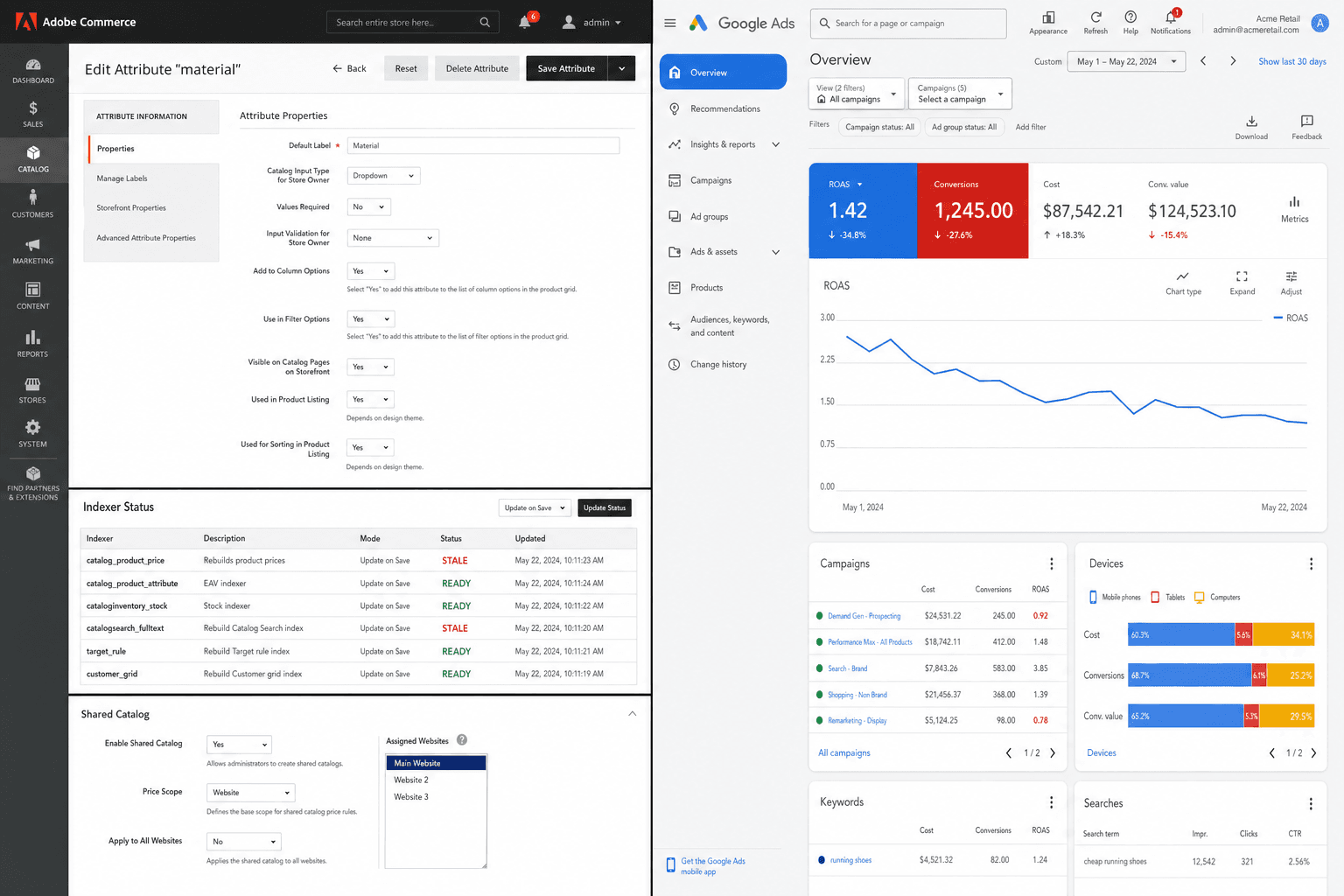
They treat your Shopping feed like a Shopify Simple Product export, ignoring how EAV stores attributes in separate rows across joined value tables. Your feed ships incomplete GTINs and MPNs, and paid traffic bounces off stale landing-page prices.
A shared catalog reindex can take hours and silently desync B2B pricing from your ads. Blended ROAS looks acceptable until you run contribution margin by category and find your highest-volume SKUs perform worst.
On Luma, your storefront almost certainly fails Google's LCP threshold, and the lost Quality Score adds a CPC premium to search clicks. Hyvä gives you a foundation for paid and organic performance that pays off only when your demand-gen matches it. You need a partner who knows what runs underneath, not a rebuild.
The Opportunity
Done right, Adobe Commerce demand-gen compounds advantages simpler platforms can't match
Merchants taking a disproportionate share of Adobe Commerce's estimated $173 billion in annual GMV don't have the most sophisticated builds; they've closed the gap between platform capability and marketing execution.
Your B2B AOV runs roughly 2.5x your B2C AOV, and B2B repeat purchase rates run about 50% higher, so a one-point gain in quote-to-order conversion on negotiable quotes can outweigh most B2C optimizations. That gain depends on demand-gen reaching the right company accounts with the right catalog visibility, and most operators leave that to organic traffic and a sales team.
Your attribute-rich catalog is a Google Shopping asset: GTINs, MPNs, color, size, and material mapped from EAV give Performance Max the signal quality to find buyers competitors' thin feeds miss.
Hyvä-migrated storefronts often score 90+ on mobile PageSpeed, helping paid Quality Score and organic crawl budget.
What Most Get Wrong
What Adobe Commerce merchants and their agencies get wrong
Pushing budget into a raw, unengineered feed
50K-SKU catalogs need out-of-stock suppression for child SKUs, variant deduplication, and GTIN/MPN mapping from EAV. Raw feeds mean low match rates, suppressed impressions, and Performance Max funding the wrong SKUs.
Running indexers on Update on Save with a large catalog
Every price rule, promotion, or category change triggers a reindex, slowing the database and risking deadlocks among concurrent users. PPC landing pages show stale `catalog_product_price` data that contradicts your ads.
Ignoring Core Web Vitals on Luma storefronts
A default Luma page can load around 230 requests and roughly 3MB of uncompressed assets. Google has long penalized that in rankings, and lost Quality Score raises paid search CPCs.
Trusting last-click when Adobe Commerce lacks native multi-touch attribution
A B2B buyer clicks a Google Search ad, downloads a spec sheet, requests a negotiable quote, and orders 18 days later. Last-click credits direct or organic, so you underfund paid.
Hiring agencies that have never touched an EAV schema
They can't tie `is_filterable` and `use_in_layered_navigation` to faceted-navigation SEO or diagnose a shared catalog reindex bloating the Product Price indexer's runtime. They report impressions and clicks while blended ROAS slips.
Why Now
Your Adobe Commerce edge is built before peak season, not during it
Most of your Adobe Commerce competitors run demand-gen that lags the platform, and the gap between the platform's capability and what merchants get from it in paid and organic has never been wider.
AI feed management, creative testing, and bidding now let a disciplined operator run catalog-level campaign architecture that once took a six-person in-house team. Performance Max has also shifted Google's Shopping allocation toward merchants with clean, attribute-complete feeds and fast, relevant landing pages.
Merchants who fix feed mapping, stabilize indexers, rebuild attribution around B2B purchase cycles, and test creative at volume before their seasonal ramp will enter peak season with a compounding advantage, and those who wait will bid against them at higher CPCs. These fixes take weeks to compound, so start before demand climbs.
The Mechanism
Where AI gives Adobe Commerce merchants a measurable edge
Real productivity, not AI theater. Here's where it actually moves a number for adobe commerce magento brands.
Feed Management and Performance Max
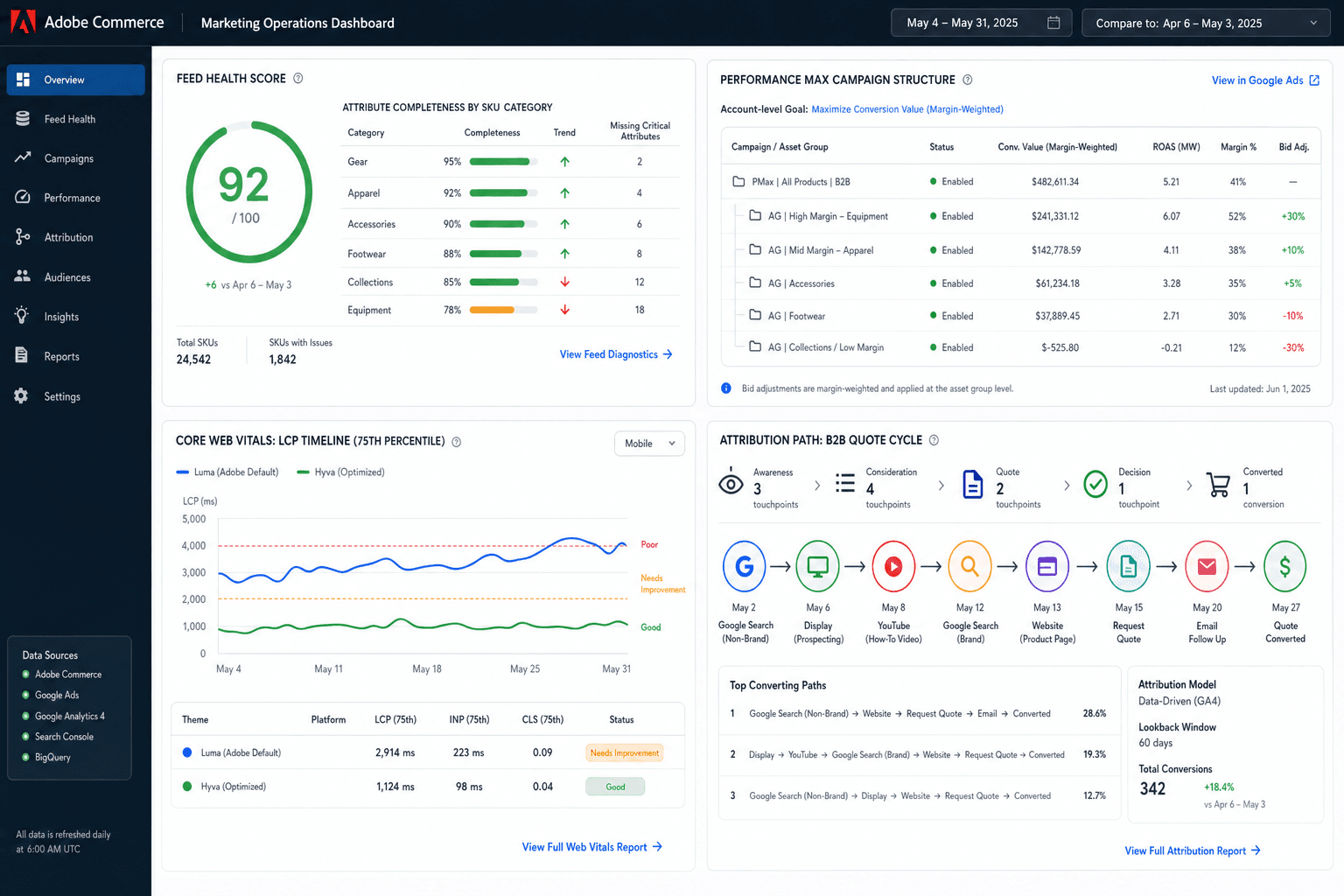
What AI does: Maps EAV attributes to Google's required and recommended fields, including product type taxonomy, across 10K to 500K+ SKUs, flags suppressed items and gaps, and checks feed freshness against your indexer schedule.
The result: Shopping impression share rises, suppression falls, and Performance Max gets the signal to find high-intent buyers instead of broad, low-converting traffic.
Why it matters here: EAV, ecommerce's most flexible catalog model, is the hardest to translate into a Google feed. Most merchants unknowingly run at 60–70% attribute completeness.
Paid Search and Shopping
What AI does: Shifts budget by SKU and category toward the attribute combinations and product types with the highest contribution margin, away from SKUs whose acceptable ROAS hides negative margin after returns and fulfillment.
The result: Blended ROAS improves as spend follows margin, and B2B search built on RFQ and quote-initiation intent fills pipeline earlier.
Why it matters here: If you sell B2B and B2C from one instance, campaigns that treat a procurement manager's 500-unit order like a single-unit purchase risk your highest-AOV conversions.
Creative Testing
What AI does: Generates and tests attribute-led (material, construction, certifications), use-case-led, and social-proof-led angles at a volume humans can't sustain, plus B2B LinkedIn and Google Display messaging on shared catalog access, net-30 terms, and quick-order-by-SKU.
The result: You find the converting message in weeks rather than months and feed winning angles into landing page copy and product descriptions.
Why it matters here: Your attribute-rich catalog gives you more creative surface area than almost any other ecommerce operator, yet most merchants run two or three static ad variants.
Analytics and Attribution
What AI does: Stitches GA4, server-side GTM, and the order grid to rebuild the actual path from first paid touch to order, including multi-user B2B quote cycles spanning days or weeks.
The result: Paid budgets follow pipeline contribution, and B2B campaigns that start RFQ workflows get credit when orders close weeks later.
Why it matters here: Negotiable quote cycles break last-click models, which undercredit paid and overcredit direct, and the resulting budget errors compound monthly.
Conversion Optimization
What AI does: Audits Core Web Vitals (LCP, INP, CLS), finds Luma render-blocking assets or Hyvä configuration gaps costing Quality Score and conversions, and tests page variants against control, including B2B pages with quote-request CTAs.
The result: Higher Quality Scores cut paid CPCs, faster LCP lifts organic rankings, and procurement-focused B2B pages convert company account registrations at higher rates than generic pages.
Why it matters here: Luma routinely fails LCP, and early-2000s Amazon tests tied each 100ms of added latency to about 1% of sales, so slow pages waste spend.
Ready to see what this looks like for your adobe commerce magento brands business?
No obligation. A senior strategist will show you exactly where the wins are.
The Strategy
The marketing strategy that works for Adobe Commerce merchants
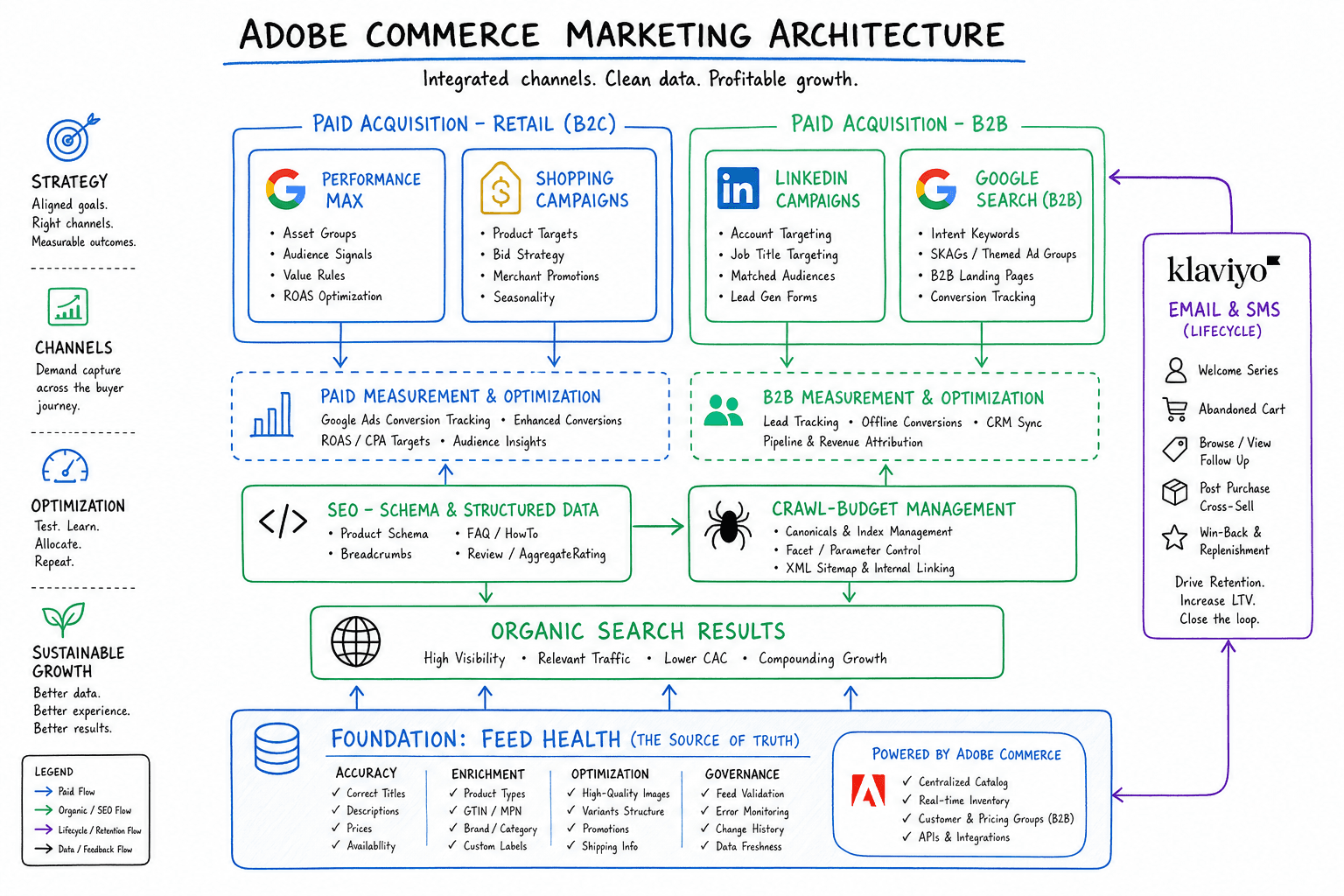
Before you optimize paid spend, get the platform right: indexers on Update by Schedule, an attribute-complete feed mapped from EAV, and attribution separating B2C transactions from B2B quote-to-order conversions.
For B2C, Performance Max and Shopping lead, but only on an engineered feed with continuous attribute monitoring. Structure Performance Max around margin by category, since margins vary by product type.
Paid search targets high-intent transactional and comparison queries with attribute-tuned landing pages. On Hyvä, Quality Scores reflect the speed; on Luma, page-speed fixes are part of the paid strategy.
B2B buyers read spec sheets, request samples, start RFQ workflows, and return repeatedly before a negotiable quote opens. Reach procurement managers and category buyers at the research stage through Google Search for high-intent B2B queries and LinkedIn account-based targeting by company size and industry, then retarget by quote stage.
SEO is where most merchants underinvest. Luma almost certainly isn't outputting Product, Offer, and AggregateRating schema, and Hyvä ships only some. Canonical tags and `is_filterable` discipline keep faceted navigation from wasting crawl budget.
Email covers B2C post-purchase, browse abandonment, and category-level replenishment flows plus B2B quote follow-up, requisition list reorder reminders, and company account onboarding. Adobe Commerce's native email is limited, so pair Klaviyo or a comparable platform with order and quote data.
The one number that governs this
Measure every channel on blended ROAS and contribution margin by category, not platform ROAS. Judge B2B campaigns on quote-initiation and quote-to-order rates.
How We Help
What we would do for your Adobe Commerce business
We start where most Adobe Commerce merchants leak revenue: we fix the feed, rebuild attribution, and stabilize indexers before touching a bid. Then we build demand-gen on top.
Feed Engineering and Performance Max
We audit EAV attributes against Google's fields, engineer the feed for your configurable products, and monitor it against your indexer schedule.
Paid Search: B2C and B2B
We build separate B2C and B2B campaign architectures with distinct intent signals, landing pages, and conversion events, structuring B2B around RFQ initiation and quote-to-order conversion.
Attribution Modeling and Analytics
We rebuild attribution across your stack, including multi-user B2B quote cycles, so budgets follow pipeline contribution.
SEO: Schema, Crawl Budget, and Faceted Navigation
We add missing schema, canonicalize faceted navigation to protect crawl budget, and target high-intent B2B and B2C queries.
Conversion Optimization and Page Speed
We audit Core Web Vitals for render-blocking assets and configuration gaps, then test variants, including B2B pages built for procurement.
Email and Owned Channel Automation
We build your B2C and B2B Klaviyo flows on Adobe Commerce order data, adding owned-channel revenue that lifts blended ROAS without more ad spend.
AI-Assisted Creative Testing
We test creative at volume to find the attribute combinations, use cases, and B2B value propositions that convert, then feed winners into page copy.
Who's Behind This
Who we are, and what makes us different
Sagum is a performance marketing agency founded in January 2017 in St. George, Utah. We've spent 8+ years growing real brands and being judged on KPIs, not vanity metrics.
We deliberately limit how many clients we take so each one gets senior attention. We treat your numbers like our own, we never run generic playbooks, and your strategy is built for your business, because shouldn't your brand's marketing be custom to your brand?
Sagum.ai is our AI arm: the same proven operators now build AI into the work wherever it creates real edge, not as theater, but as leverage applied with discipline.
- 8+ years growing brands on performance KPIs, not vanity metrics
- Limited client roster, with senior attention on every account
- An extension of your team; your success is tied to ours
- Custom strategy per brand, never a generic playbook
- AI built in where it moves a number; judgment over hype
“Sagum is a performance marketing agency that's spent 8+ years growing brands by treating their numbers like our own. We take on few clients, never run generic playbooks, and now build AI into the work wherever it creates real edge, not hype. Your strategy is built for your business, and our success is tied to yours.”

“After six years, Sagum is our most important partner: trusted, communicative, and caring about our business as if it's their own.”
Long-term partner
6-year client
Proof
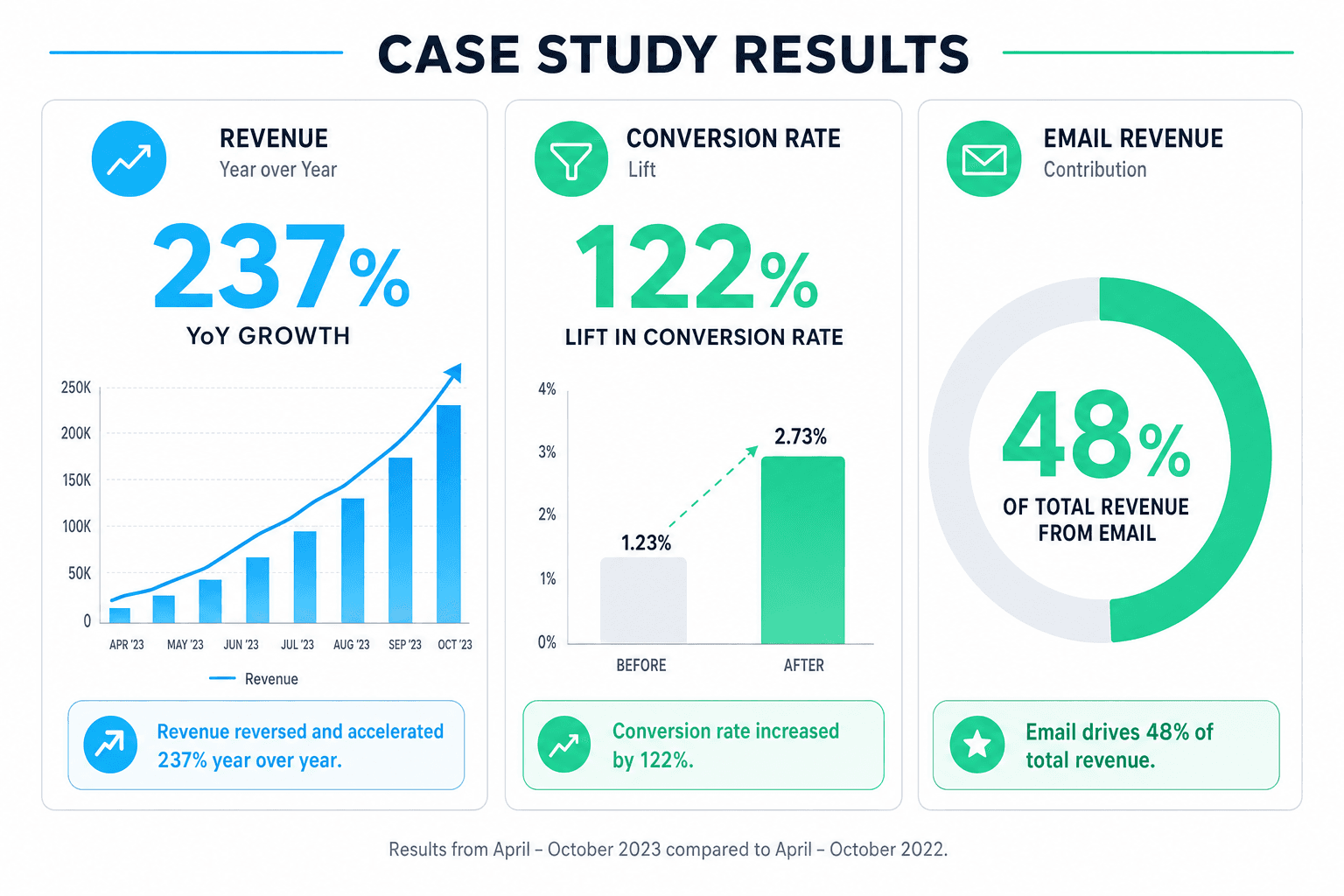
Reversed 3 years of decline to 237% YoY
Bisaddle
Challenge
Bisaddle needed to reverse three years of decline.
What we did
We redesigned the site, doubling its speed, and grew the email program: the same foundation work that pays off on an Adobe Commerce store.
Result
Bisaddle reversed the decline, reaching 237% YoY growth, a 122% lift in site conversion, and email at 48% of revenue.
Your Adobe Commerce build is done. Let us make it grow.
No obligation. We'll audit your feed health, attribution model, and paid channel structure for your catalog and B2B configuration, measure them against your blended ROAS targets, and tell you exactly where revenue is leaking.
Sagum · January 2017 · St. George, Utah · 8+ years