
8+ years growing brands on KPIs, now with AI
More Booked Jobs for Auto Repair Shops
We build search and local campaigns that fill your bays with high-ticket repair work, not just oil change clicks.
8+ years growing service businesses | Google Ads, Meta, TikTok | Now with AI-powered optimization


Get your free marketing audit
Senior strategist review · response within one business day
Prefer to reach out directly?
The Challenge
Marketing an Auto Repair Shop Is Nothing Like Marketing a Product
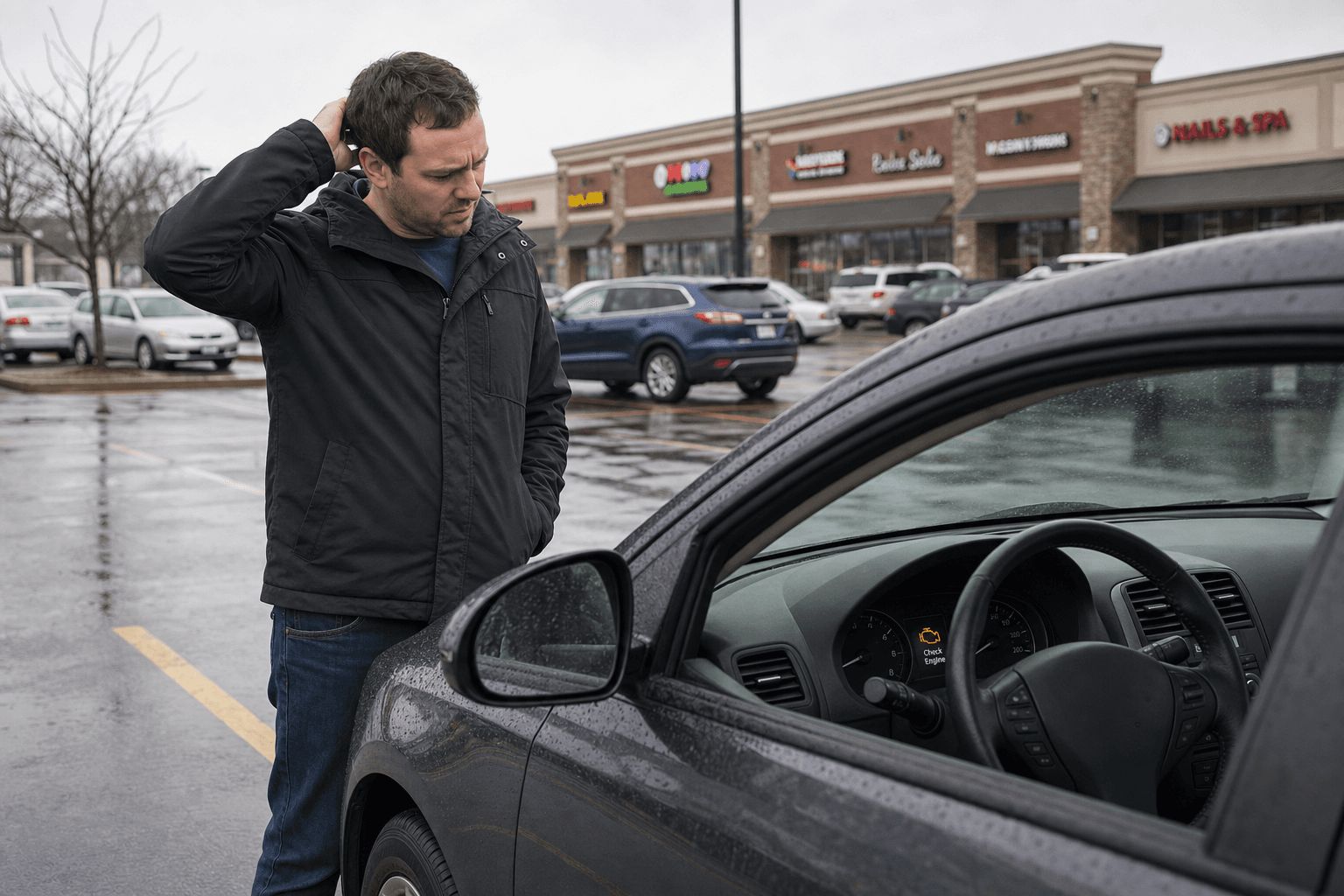
Your best customers do not browse for you on a Tuesday afternoon. They find you in a parking lot staring at a check engine light, on the side of a highway with a grinding brake, or in a driveway with a car that will not start. The search happens in minutes. The decision happens in seconds. And whoever appears first with a name they can trust gets the call.
That urgency-driven buyer is your highest-value customer. A brake job, a transmission service, or a full diagnostic can carry an average repair order of $500 to $700 or more. But the same Google search that surfaces your shop also surfaces the Firestone down the street, the dealer service department with its OEM warranty pitch, and the independent competitor who has 200 more Google reviews than you do. The buyer is anxious and trust-deficient. They are not price-shopping. They are trust-shopping.
Planned maintenance is a different animal entirely. The driver who is 3,000 miles past their oil change interval deliberates for a few days, compares prices, and responds to convenience. That customer is worth less per visit but is the foundation of your retention flywheel. Confuse the two segments in your marketing and you end up buying cheap oil-change traffic that inflates car count while hiding the fact that your cost per booked appointment on high-ARO work is bleeding you dry.
Then there is the seasonality that every shop owner knows but most marketing agencies ignore. Batteries and winter tires spike hard in October through December. AC repairs and cooling system work surge from May through August. January and February go quiet. If your ad budget runs flat all year, you are overspending during the trough and underspending during the peaks when the highest-value jobs are on the table.
The Opportunity
The Demand Is Already There. Most Shops Are Just Capturing It Poorly.
Most car owners search online before choosing a repair shop. That search is happening right now, in your zip code, for the exact services your technicians do best. The opportunity is not awareness. It is capture and conversion.
Google Local Services Ads often generate auto repair leads for less than standard Google Ads. That is a real cost advantage on the highest-intent traffic that exists in your market. Most independent shops either are not running LSAs at all or are running them without the verified credentials and review volume needed to win the top placement.
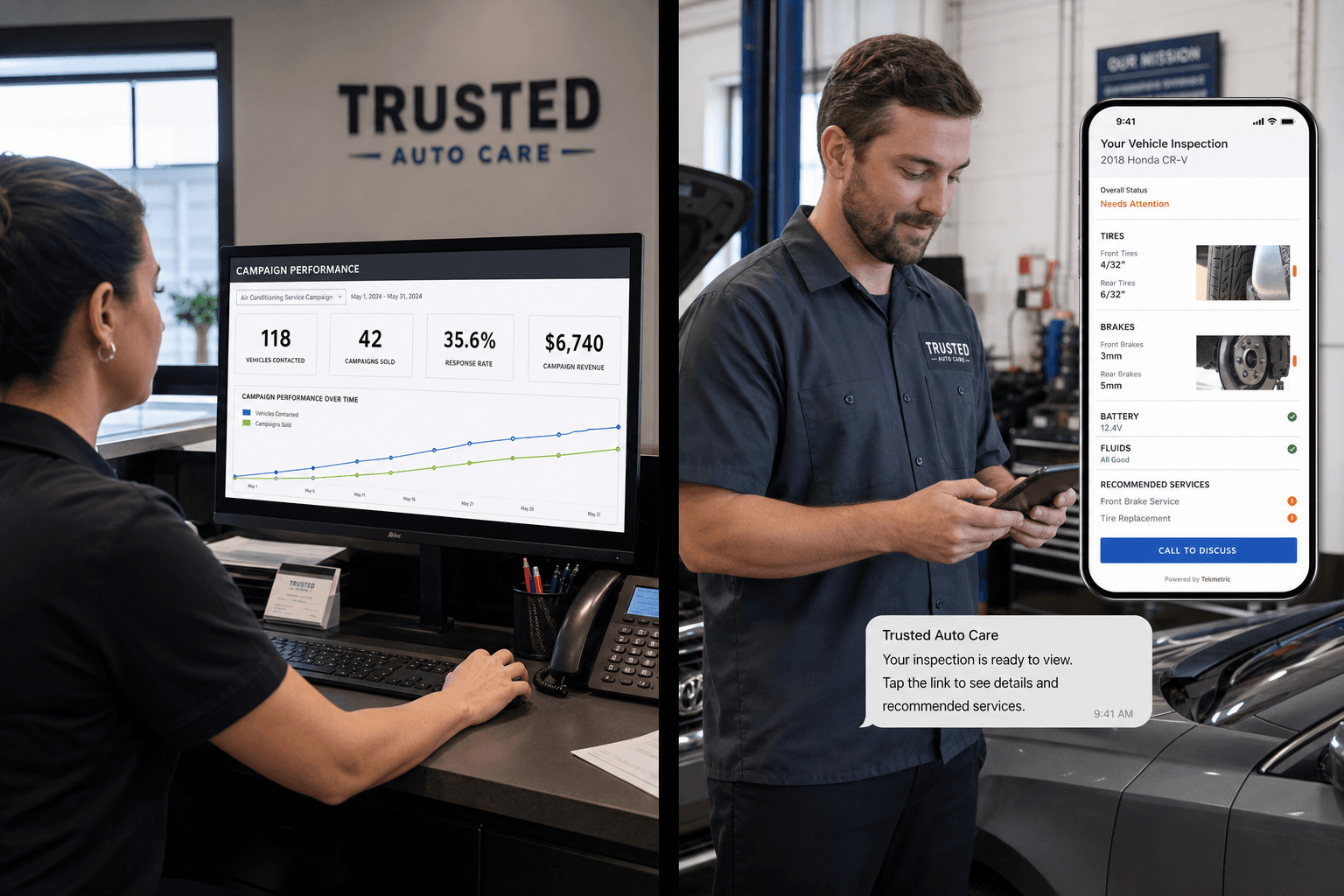
The retention opportunity is just as large. A loyal customer who services two household vehicles at your shop for ten years can generate tens of thousands of dollars in lifetime revenue. A single fleet account with five vans can be worth more than $40,000 over the relationship. The shops winning those relationships are not doing anything exotic. They are sending automated maintenance reminders, requesting reviews within an hour of every pickup, and following up on every declined service before the customer ends up at the dealer.
The shops that get this right do not just grow car count. They grow the right car count: high-ARO work booked at a sustainable cost per appointment, with a retention system that turns first-time visitors into customers who refer their neighbors.
What Most Get Wrong
What Most Auto Repair Shops and Their Marketing Agencies Get Wrong
Measuring calls instead of booked appointments
A $60 cost per lead sounds reasonable until you realize your front desk is converting 40 percent of those calls to scheduled drop-offs. Your real cost per booked appointment is $150. Without call tracking connected to your shop management system, you are optimizing a number that does not reflect the economics of your business.
Letting oil change traffic bury the high-ARO numbers
Running one campaign that mixes brake and diagnostic keywords with oil change promotions makes the blended CPL look fine while the profitable work goes unmeasured. A $39.95 oil change special fills a bay for an hour. A brake job or transmission service fills it for a day and funds your payroll. They need to be tracked and budgeted separately.
Flat ad budgets that ignore your actual demand calendar
Shops that spend the same amount in January as they do in October are wasting money during the trough and leaving the highest-value seasonal peaks underserved. Battery campaigns should be running in September, not December. AC campaigns should launch in April, not June. Shops that wait until demand peaks pay more per click and convert less.
Ignoring Google Local Services Ads and a thin Google Business Profile
LSAs often cost less per lead than standard Google Ads for auto repair. A shop without LSA verification or with a thin, low-rated Google Business Profile is effectively invisible to the highest-intent local searchers. Competitors with 200 reviews and a complete profile win those calls by default.
No follow-up system for declined services
When a technician flags deferred work and nobody follows up, that customer eventually returns to a competitor or the dealership when the symptom worsens. A declined brake inspection today is a $600 job that belongs to whoever reaches out first in 60 days. Most independent shops have no automated system to reclaim it.
Why Now
Why the Next 90 Days Matter More Than Most Shop Owners Realize
Most of your direct competitors are running the same set-and-forget Google Ads campaigns they set up two years ago. Same keywords, same ad copy, same flat monthly budget. They are not adjusting for the spring surge coming in March and April. They are not testing new creative. They are not shifting spend toward the services that actually book.
AI now makes it practical for a disciplined operator to do things that were previously only available to national chains with dedicated media teams: shift budget toward high-converting service categories in real time, test five times more ad creative angles per week than a manual process allows, and catch attribution errors that are making bad campaigns look like good ones.
The shops that build this infrastructure before the spring season do not just have a better April. They have better data, better conversion rates, and lower cost per booked appointment going into the summer AC surge and the fall battery season. The compounding advantage is real.
The window is open right now because most independent shops have not made this move yet. The national chains have scale but no local agility. The dealer service departments have brand but no urgency in their marketing. An independent shop with the right performance infrastructure in place can own its local market before competitors realize what changed.
The Mechanism
Where AI Creates a Real Edge for Auto Repair Shop Marketing
Real productivity, not AI theater. Here's where it actually moves a number for auto repair shops.
Digital Ads
What AI does: AI-driven bid management monitors campaign performance around the clock and shifts budget toward the service categories and time windows that are actually booking appointments, not just generating clicks.
The result: Budget follows real demand instead of a static monthly plan. During a cold snap, battery and heating system campaigns get more spend automatically. During a heat wave, AC and cooling system campaigns accelerate.
Why it matters here: Auto repair demand is weather-driven and time-sensitive. A campaign that cannot react to a three-day cold front in real time is leaving the highest-urgency, highest-ARO calls to competitors who move faster.
Analytics and Attribution
What AI does: AI audits your tracking stack to verify that calls, form fills, and online bookings are attributed to the campaigns that actually drove them, and flags discrepancies before they corrupt your decisions.
The result: You know which keywords are booking brake jobs and which are booking oil changes. You stop optimizing for a blended CPL that hides the real economics.
Why it matters here: Without accurate attribution tied to your shop management system, you cannot separate a $45 oil change lead from a $650 transmission diagnostic lead. The difference determines whether your ad spend is profitable or not.
Creative
What AI does: AI generates and tests multiple ad copy variations simultaneously, including service-specific angles (ASE-certified technicians, 24-month warranty, same-day availability) so you find the message that books calls faster.
The result: Instead of running one ad for 90 days and guessing whether it works, you are running five variations and knowing which one drives booked appointments within two weeks.
Why it matters here: The anxious driver searching at 7 PM with a grinding brake responds to completely different messaging than the driver scheduling a spring coolant flush on a Sunday afternoon. Testing at speed is the only way to find those distinctions.
Conversion Optimization
What AI does: AI-assisted landing page analysis identifies where prospective customers drop off before calling or booking, and surfaces specific fixes: load speed, click-to-call button placement, trust signals like ASE badges and warranty language.
The result: Service-specific pages for brakes, diagnostics, and AC convert at higher rates because the page matches the search intent and removes every friction point between the search and the scheduled appointment.
Why it matters here: A driver who searched 'brake repair near me' and lands on your homepage has to do extra work to find the right service. A driver who lands on a dedicated brake page with a click-to-call button and a 24-month warranty callout is far more likely to book on the spot.
Ready to see what this looks like for your auto repair shops business?
No obligation. A senior strategist will show you exactly where the wins are.
The Strategy
The Right Marketing Strategy for an Auto Repair Shop Looks Nothing Like a Generic Agency Plan
The foundation is Google Local Services Ads and Google Search, in that order. LSAs run on a pay-per-lead model and often deliver auto repair leads for less than standard search campaigns. They also put your star rating and review count right in the ad, which matters to a buyer who is already skeptical about being taken advantage of. LSAs go live first because they are the fastest path to booked appointments at the lowest cost per lead.
Google Search campaigns run in parallel, structured by service category, not by a single broad 'auto repair' campaign. Brake keywords go to a brake landing page with a click-to-call button and ASE certification prominently displayed. AC keywords go to an AC service page with seasonal messaging and same-day availability. Diagnostic keywords go to a page built around transparency: here is what a diagnostic costs, here is what happens next, here is our warranty. Each page has one job: get the call or the online booking.
Geo-targeting is tighter for routine maintenance (three to five miles) and wider for specialty work like transmission service or diesel repair (ten to twenty miles), where fewer qualified competitors exist and drivers will travel further for a shop they trust.
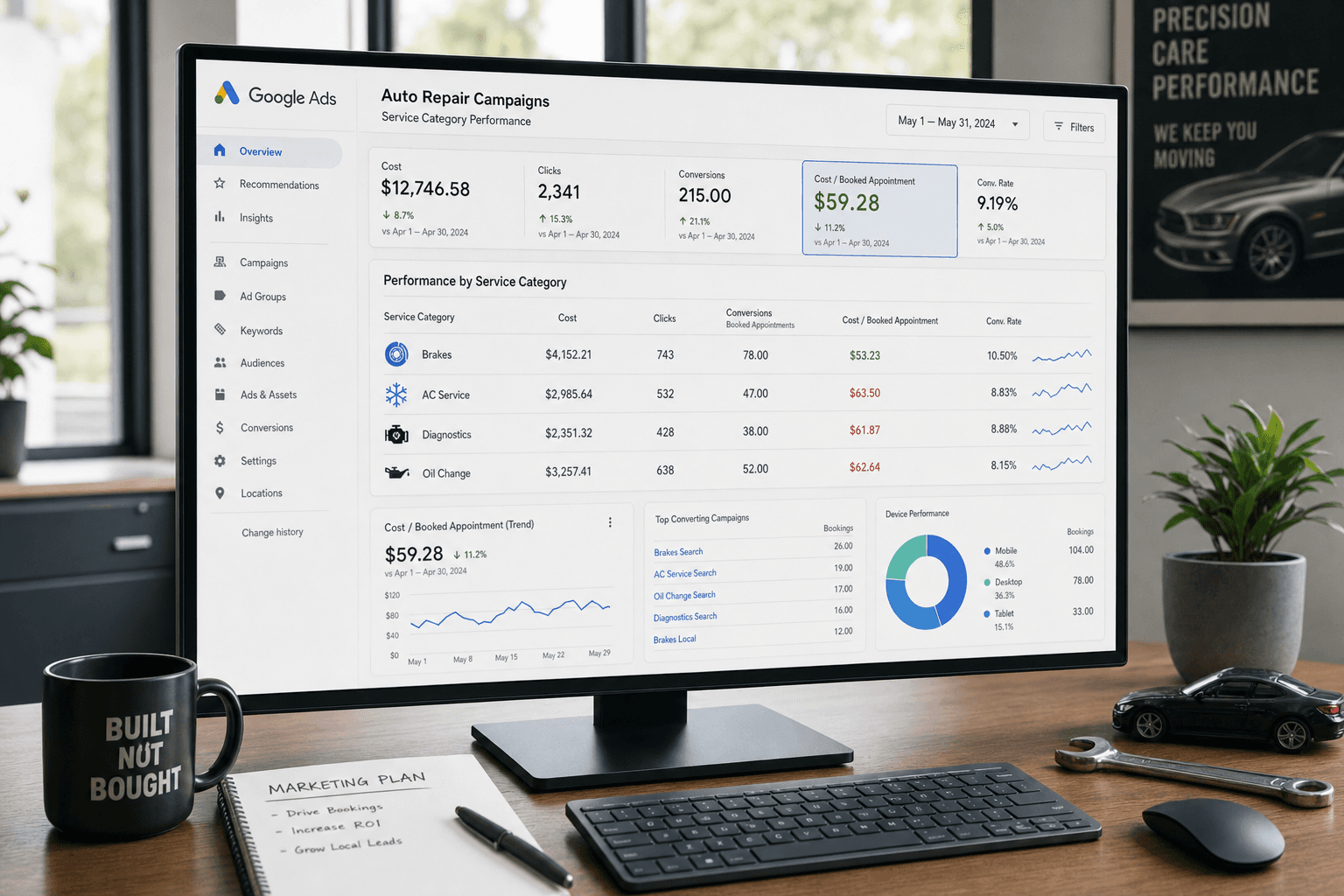
Call tracking is non-negotiable and must connect to your shop management system, not just a call count. Every campaign is evaluated on cost per booked appointment by service category. A $70 CPL on brake work with a 65 percent book rate is a $108 cost per booked appointment. A $40 CPL on oil changes with a 30 percent book rate is a $133 cost per booked appointment. The brake campaign wins. You cannot see that without the right tracking.
Budget pacing follows the demand calendar. Spend increases four weeks before the spring surge and the fall battery and tire season. January and February budgets shift toward retention: automated maintenance reminders, lapsed customer reactivation for anyone who has not been in for 180-plus days, and review request texts sent within one hour of every vehicle pickup.
Online scheduling and review generation are not optional add-ons. They are the conversion infrastructure that determines whether the traffic you buy turns into booked appointments and repeat customers.
The one number that governs this
Every dollar is measured against cost per booked appointment by service category, with average repair order tracked alongside car count so cheap traffic cannot hide the real economics.
How We Help
Here Is Exactly How We Would Run This for Your Shop
We start with the tracking infrastructure, because every other decision depends on knowing which campaigns are actually booking appointments and which are generating noise. From there we build the channel stack in the order that moves your numbers fastest.
Attribution and Call Tracking Setup
Connect call tracking to your shop management system so every campaign is evaluated on cost per booked appointment by service category, not just call volume or blended CPL.
Google Local Services Ads Management
Establish and optimize LSA verification, credential display, and review strategy to win top placement at the lowest cost per lead, before expanding into standard search.
Google Search Campaign Build and Management
Structure campaigns by service category with dedicated ad groups for brakes, diagnostics, AC, transmission, and tires, each matched to a service-specific landing page with a single conversion action.
Service-Specific Landing Pages
Build and continuously optimize dedicated pages for high-ARO services with click-to-call buttons, ASE certification signals, warranty language, and DVI proof points to convert high-intent searchers into booked appointments.
Seasonal Budget Pacing and Campaign Scheduling
Shift spend toward battery and tire campaigns in September, AC campaigns in April, and pull back on paid acquisition during the January and February trough in favor of retention campaigns.
Retention Automation
Build the minimum retention system every shop needs: automated maintenance reminders by mileage and time interval, review request texts within one hour of pickup, and lapsed customer reactivation for anyone past 180 days.
Google Business Profile Optimization
Treat each physical location as its own local SEO entity with location-specific photos, services, and a steady review cadence to maintain the strong star rating that supports local pack visibility.
AI-Powered Creative Testing
Generate and test multiple ad copy angles per week, including trust signals, warranty messaging, and urgency-driven copy, so you find the message that books the most appointments at the lowest cost.
Who's Behind This
Who we are, and what makes us different
Sagum is a performance marketing agency founded in January 2017 in St. George, Utah. We've spent 8+ years growing real brands and being judged on KPIs, not vanity metrics.
We deliberately limit how many clients we take so each one gets senior attention. We treat your numbers like our own, we never run generic playbooks, and your strategy is built for your business, because shouldn't your brand's marketing be custom to your brand?
Sagum.ai is our AI arm: the same proven operators now build AI into the work wherever it creates real edge, not as theater, but as leverage applied with discipline.
- 8+ years growing brands on performance KPIs, not vanity metrics
- Limited client roster, with senior attention on every account
- An extension of your team; your success is tied to ours
- Custom strategy per brand, never a generic playbook
- AI built in where it moves a number; judgment over hype
“Sagum is a performance marketing agency that's spent 8+ years growing brands by treating their numbers like our own. We take on few clients, never run generic playbooks, and now build AI into the work wherever it creates real edge, not hype. Your strategy is built for your business, and our success is tied to yours.”

“After six years, Sagum is our most important partner: trusted, communicative, and caring about our business as if it's their own.”
Proof
From a $20 CPL goal to $13 CPL and 300+ leads/mo
Rizzoli's Automotive
Challenge
Rizzoli's Automotive needed to hit 100 qualified leads per month at a target cost per lead around $20.
What we did
We built a custom call-driving landing page and restructured the campaign around high-intent service keywords.
Result
Cost per lead dropped to $13, monthly lead volume exceeded 300, and the landing page converted at 60 percent or better. That growth supported the client opening multiple new locations.

- Cost per lead
- $13
- Leads / month
- 300+
- Landing-page conversion
- 60%+
Find Out Exactly Where Your Shop Is Leaving Booked Appointments on the Table
No obligation. We will review your current campaigns, tracking setup, and local presence and show you specifically where the gaps are. Built around your shop, your service mix, and your market.
Sagum · January 2017 · St. George, Utah · 8+ years