
8+ years growing brands on KPIs, now with AI
Beauty-brand marketing past the generic playbook
We build the paid social, creative, and retention engine that makes your unit economics actually work.
8+ years growing DTC brands · Google, Meta & TikTok partner · Performance-judged, not retainer-comfortable


Get your free Growth Gap Analysis
Senior strategist review · response within one business day
Prefer to reach out directly?
The Challenge
The Economics of Beauty Ecommerce Are Punishing Unless You Get the Full Stack Right
Here is the math that keeps beauty founders up at night: your average new customer spends $50–$55 on their first order. Your median gross margin is 69%. Meta's median CPA across the industry in 2025 is $38.19. After ad spend, you have roughly $0–$15 of gross profit on a new customer, before fulfillment, packaging, and overhead touch it. The only way this business works is if that customer comes back. And in beauty, they are not loyal by default.
Beauty is a category notorious for trial-and-switch behavior. Consumers genuinely believe products stop working after a while. They discover a new brand on TikTok every week. Your LTV window, roughly 107 days between orders on average, is short enough that a single missed re-engagement sequence can cost you the relationship entirely.
Meanwhile, the creative treadmill never stops. Meta CPMs hit $10.88 in Q1 2025, up 19% year-over-year. The ad sets that drove your best ROAS six months ago are fatiguing. The platform's own data suggests you need to rotate creative every 3–5 days to maintain performance. If you are a team of two or three managing this manually, you are already behind.
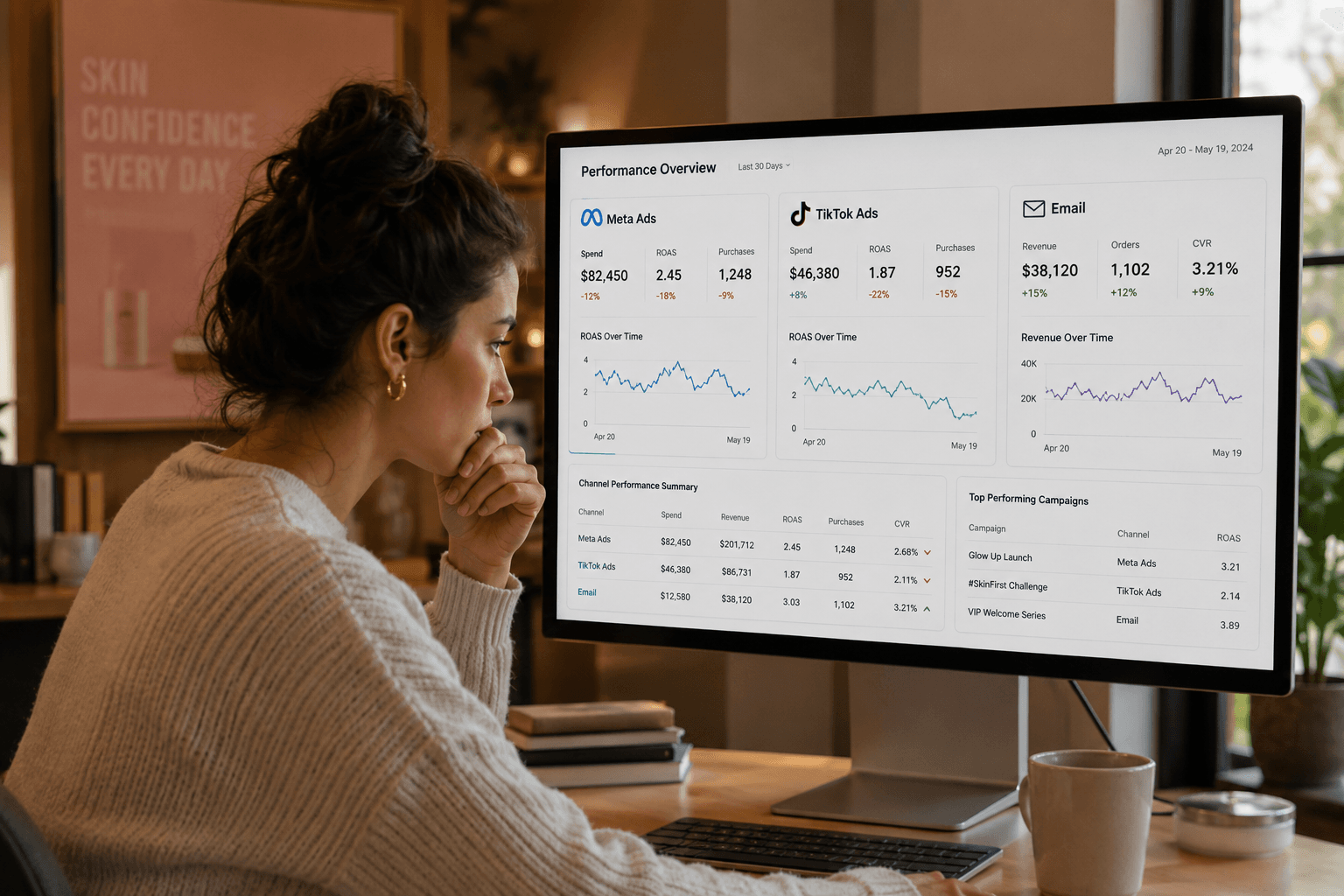
And then there is attribution. Post-iOS 14, your platform-reported ROAS numbers are lying to you in ways that are hard to quantify. Founders who are making budget decisions based on Meta's self-reported numbers are optimizing against a fiction. The brands pulling away right now are the ones who have replaced platform attribution with blended Marketing Efficiency Ratio (total revenue divided by total ad spend) and are making decisions from that number instead.
This is the real challenge in beauty ecommerce: not finding customers, but building the full stack (creative velocity, personalized retention, accurate attribution, and AOV mechanics) that makes the acquisition cost worth paying in the first place.
The Opportunity
The Brands Winning in Beauty Right Now Are Doing Three Things Differently
The U.S. beauty and personal care market is expected to generate approximately $61 billion this year. Online and Amazon now account for more than 41% of all beauty purchases. The demand is enormous and growing. The question is not whether customers are buying. It is whether they are buying from you.
The first thing winning brands are doing: treating creative as a production system, not a creative project. TikTok Shop beauty brands are running 3.5x ROAS on short-form video content because they have built a machine for generating, testing, and scaling UGC and micro-influencer content continuously. Research consistently shows UGC outperforms branded content by 6–8x in beauty. The brands with a repeatable creative testing process find the winning angle in two weeks; everyone else runs the same ad until it dies.
The second thing: building AOV before worrying about acquisition. The average beauty transaction is $71, a single-item purchase pattern that leaves margin on the table. Brands implementing discovery sets, subscription programs, and personalized bundling at checkout are seeing 2–3x AOV improvements. When your AOV moves from $55 to $110, the same Meta CPA that was underwater becomes profitable on the first order.
The third thing: personalizing the post-purchase journey with the same rigor they apply to prospecting. Email converts at 4–5% in beauty, the highest of any channel, but most brands are running broadcast campaigns to their full list. The brands compounding LTV are segmenting by skin concern, purchase history, and repurchase timing, then sending the right product recommendation to the right customer at day 90, not a generic newsletter. That is the difference between a $138 LTV and a $300+ LTV.
None of this requires an enterprise budget. It requires a disciplined operator who knows where to apply the effort and how to measure whether it worked.
What Most Get Wrong
What Most Beauty Brands (and the Agencies That Work With Them) Get Wrong
Optimizing prospecting ROAS in isolation
Beauty's Meta prospecting ROAS sits around 1.57 industry-wide, which looks catastrophic until you understand it is a top-of-funnel awareness investment, and the retargeting ROAS that follows sits closer to 3.5x. Brands that cut prospecting spend because the reported ROAS looks weak are starving the top of a funnel that feeds their most profitable campaigns. The number to watch is blended MER, not campaign-level ROAS in isolation.
Running creative until it dies instead of testing continuously
Meta and TikTok both reward fresh creative. Ad fatigue in beauty is measurable within days: CPMs rise, CTR falls, and ROAS collapses, often while the campaign is still technically 'active.' Brands rotating creative every 3–5 days with a structured testing framework consistently outperform brands running the same hero asset for weeks. The cost of not testing is not just lower ROAS. It is the missed discovery of the angle that could have scaled.
Ignoring AOV mechanics and hoping repeat purchases fix the math
At a $50–$55 AOV and a $38 CPA, first-purchase economics are nearly breakeven before fulfillment. Brands that do not actively engineer AOV upward (through bundles, discovery sets, subscription prompts at checkout, or upsell sequences) are permanently dependent on LTV to justify acquisition. When retention underperforms (which in beauty it often does), the whole model breaks. AOV is the lever most brands leave untouched the longest.
Trusting platform-reported attribution post-iOS 14
Meta's self-reported ROAS numbers are overstated for most beauty brands because of modeled conversions filling in the gaps left by signal loss. Brands making budget allocation decisions from the Meta Ads Manager dashboard are optimizing against inflated numbers. The consequence is misallocated spend, often underinvesting in Google Shopping and email, which show lower reported numbers but are frequently driving more incremental revenue than the platform admits.
Treating email as a broadcast channel instead of a retention engine
Beauty's average time between orders is 107 days. A brand that sends a generic promotional email to its full list every two weeks is leaving the most important retention lever on the table. Segmenting by product category (skincare vs. fragrance vs. haircare), skin concern, and purchase recency, then triggering replenishment sequences at day 80–90, is the difference between a one-time buyer and a customer who contributes $300+ in LTV. Most beauty brands have Klaviyo and are using 20% of what it can do.
Why Now
Why the Next 6 Months Are the Window to Pull Ahead in Beauty Ecommerce
TikTok Shop beauty sales jumped 165% during BFCM 2024 compared to the prior year. Short-form video is no longer an experimental channel. It is a primary acquisition surface, and the brands that have built a repeatable content-to-conversion system on TikTok are compounding that advantage every week. The window to be an early mover is closing, not opening.
At the same time, AI creative tools have reached a point where a disciplined operator can test five times more creative angles per week than was possible eighteen months ago, without five times the production budget. The brands using these tools with a structured testing process are finding winning hooks faster, scaling them harder, and rotating out fatigued creative before it costs them ROAS points. Their competitors are still running the same three ad sets they launched in Q3.
Q4 is the most important revenue window in beauty. Meta's ROAS during Black Friday/Cyber Monday 2024 increased 17%, with conversion rates surging 32%. But the brands that won Q4 2024 most efficiently were the ones that launched their strongest creative and built their retargeting audiences in September and early October, before CPMs spiked and before the competition compressed margins. The brands that wait until November to get serious about Q4 pay a significant CPM premium for the privilege.
If your creative testing infrastructure, AOV mechanics, and retention sequences are not in place before Q4 ramps, you will spend more to acquire customers and keep fewer of them. The operators building those systems now are the ones who will own the season.
The Mechanism
Where AI Actually Moves the Numbers for Beauty Brands
Real productivity, not AI theater. Here's where it actually moves a number for beauty brands.
Paid Social (Meta & TikTok)
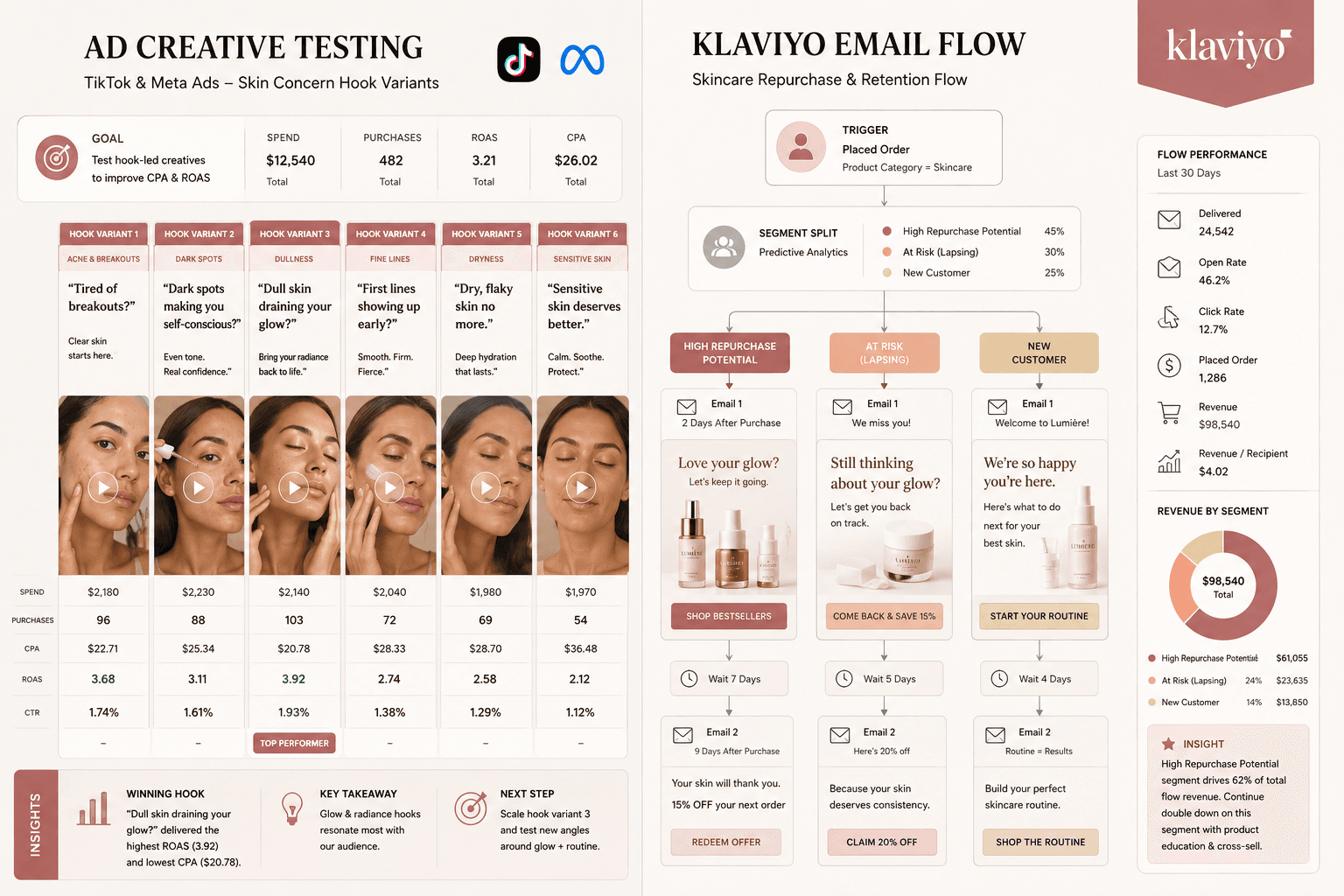
What AI does: A high-velocity creative engine paired with disciplined audience and budget management. AI-assisted production and structured A/B testing of 15–20 creative variants per week (across hooks, formats, and skin-concern angles) feed campaigns that separate cold prospecting (skin-concern interest targeting, lookalikes from high-LTV purchasers) from warm retargeting (product-view, add-to-cart, past purchaser by category), with budget shifting dynamically on real-time ROAS signals rather than a static monthly plan.
The result: The winning hook (ingredient-led, transformation, routine-fit, skin-type match) gets found and scaled fast, then rotated before fatigue sets in, while prospecting builds the retargeting pool at controlled CPMs and retargeting converts at 4.0–6.0x ROAS by showing the right product to the right warm audience inside the 107-day repurchase window.
Why it matters here: In beauty, creative IS the performance lever: a winning hook on a serum ad can cut CPM by 30–40% and double CTR overnight, and the brands testing the most creative, systematically, find those hooks fastest. But creative only pays off when the campaign structure behind it is right: beauty's Meta prospecting ROAS of 1.57 is not a failure, it is the cost of filling a funnel that pays out in retargeting. Brands that manage the two campaign types with separate objectives and benchmarks (and let AI make high-volume creative testing feasible for a lean team) consistently outperform those that collapse them into one blended number and cut spend when it looks weak.
Email & Automation
What AI does: AI-powered segmentation in Klaviyo that builds flows triggered by product category purchased (skincare vs. haircare vs. fragrance), skin concern captured at quiz or checkout, and repurchase timing: sending a replenishment prompt for a 30ml serum at day 25, a complementary product recommendation at day 60, and a subscription conversion offer at day 90.
The result: Email revenue that compounds month-over-month as the segmented list grows, with per-email revenue 2–3x higher than broadcast campaigns and a measurable reduction in the 107-day average time between orders for customers who receive triggered sequences.
Why it matters here: Email converts at 4–5% in beauty, higher than any paid channel, and it costs a fraction of a Meta impression to send. For a brand with a $138 average LTV and a $38 CPA, the difference between a one-time buyer and a three-purchase customer is almost entirely determined by what happens in the inbox in the 90 days after the first order. Most beauty brands have the platform and are not using it.
Analytics & Attribution
What AI does: Replacing platform-reported ROAS with a blended Marketing Efficiency Ratio (total revenue ÷ total ad spend) as the governing decision metric, supplemented by incrementality testing on major channel budget decisions and pixel/conversion API audits to catch signal loss inflating or deflating reported numbers.
The result: Budget allocation decisions made from accurate data, knowing which channels are driving incremental revenue versus which are claiming credit for organic purchases that would have happened anyway.
Why it matters here: Post-iOS 14, Meta's self-reported numbers are modeled, not measured. Beauty brands making channel mix decisions from the Ads Manager dashboard are frequently underinvesting in Google Shopping and email (which show lower reported numbers but high incrementality) and overinvesting in Meta prospecting campaigns that are claiming credit they did not earn. Fixing attribution is not a technical exercise. It is a revenue decision.
Conversion Optimization
What AI does: AI-assisted landing page and PDP testing focused on AOV mechanics (bundle presentation, subscription offer placement, skin-concern quiz routing, and social proof sequencing) with continuous analysis of where in the purchase flow customers are dropping off and why.
The result: AOV movement from the $50–$55 single-item baseline toward $90–$120+ through structured bundle and subscription conversion, and a higher percentage of paid traffic converting to purchase rather than bouncing from a generic product page.
Why it matters here: At a $38 median CPA and a $55 AOV, a 10% AOV lift is worth more to your unit economics than a 10% CPM reduction. For most beauty brands, the PDP and cart experience are the most underleveraged part of the funnel, optimized once at launch and never touched again, while the paid media budget absorbs all the attention.
Ready to see what this looks like for your beauty brands business?
No obligation. A senior strategist will show you exactly where the wins are.
The Strategy
The Marketing Architecture That Makes Beauty Ecommerce Unit Economics Work
The strategy for a DTC beauty brand is not complicated to describe. It is hard to execute well. You need a creative engine feeding paid social at the top, accurate attribution telling you what is actually working, AOV mechanics converting single-item buyers into multi-product customers, and a retention system compounding LTV in the 90–107 days after each purchase. Every piece has to work, because the math only closes when all four are running.
Channel priority for a beauty brand doing $1M–$20M in DTC revenue: Meta (Instagram and Facebook) takes 50–60% of paid spend as the primary prospecting and retargeting surface. TikTok takes 15–20% and grows as your UGC and short-form creative library matures. It is the highest-ROAS social channel in beauty at 3.5x, and TikTok Shop is a separate acquisition surface worth building now. Google Shopping and PMax capture high-intent repurchase searches and branded queries, typically 25–30% of spend, with the highest reported ROAS but lower incremental volume than the platform claims.
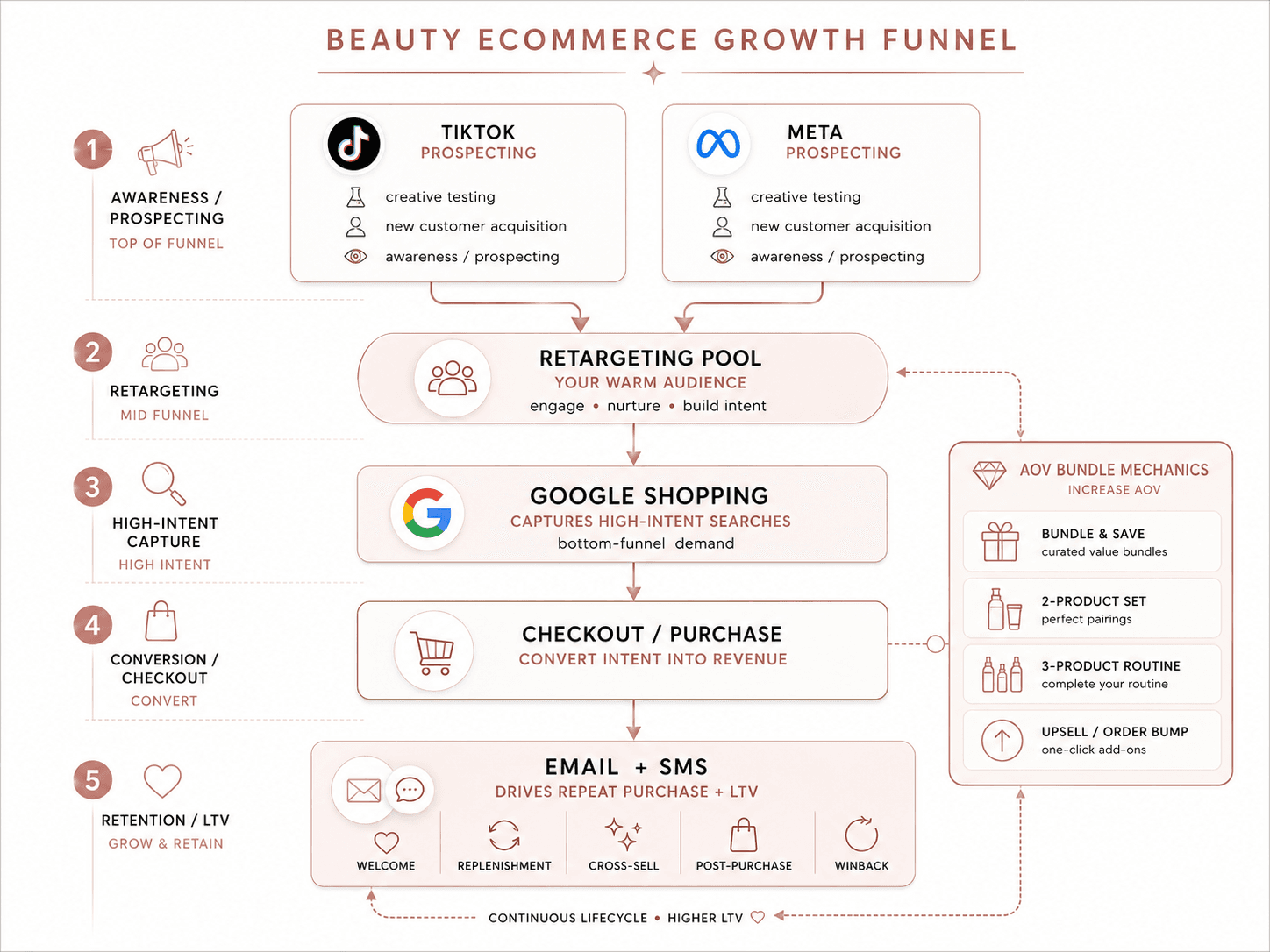
The funnel logic: cold prospecting on Meta and TikTok, segmented by skin concern and demographic, builds the retargeting pool. Retargeting campaigns (product-view, add-to-cart, past purchaser by category) run at separate objectives and separate ROAS benchmarks (4.0–6.0x is achievable; do not evaluate them against prospecting standards). Google captures the demand that prospecting created. Email and SMS own the post-purchase window.
Seasonality shapes budget pacing more than most beauty brands acknowledge. Q4 (October–December) is the dominant revenue window, with ROAS lifting 17–32% during BFCM for brands that are ready. But the brands that win Q4 most efficiently are the ones that build their creative library and retargeting audiences in September, before CPMs spike. Valentine's Day and Mother's Day are the second and third most important gift-purchase windows, especially for fragrance and skincare sets. January post-holiday and late August are the cheapest testing windows: lower CPMs, less competition, the right time to find the next winning creative angle.
The governing number is blended MER (total revenue divided by total ad spend across all channels). Per-campaign ROAS is useful for optimization decisions within a channel; MER is the number that tells you whether the whole system is working. Set a target MER floor (typically 3.0–3.5x for a beauty brand with 69% gross margins), hold every budget decision against it, and do not let a single channel's self-reported numbers override what the blended number is telling you.
The one number that governs this
Governing KPI: Blended ROAS / MER ≥ 3.0x (prospecting), 4.0–6.0x (retargeting), with AOV and 90-day repeat purchase rate as the supporting metrics that determine whether the acquisition math closes.
How We Help
What We'd Actually Build for Your Beauty Brand
We take on a limited number of clients so that every engagement gets senior attention, not a junior account manager running a template. For a DTC beauty brand, here is the sequence we would follow: fix what is broken first (attribution and tracking), build the creative engine, then scale what the data proves is working. Every service maps directly to a strategy point above.
Attribution & Analytics Audit
Before we touch your ad spend, we audit your pixel, conversion API setup, and attribution model to establish a trustworthy MER baseline. If your reported ROAS numbers are inflated by signal loss or misconfigured events, which is common post-iOS 14, we find it and fix it. You cannot optimize a number you cannot trust.
Paid Social Management (Meta & TikTok)
We structure your campaigns to separate prospecting (skin-concern targeting, high-LTV lookalikes) from retargeting (product-view, add-to-cart, past purchaser by category) with distinct objectives and ROAS benchmarks for each. Budget pacing follows your seasonal calendar, heavier in September building toward Q4, lighter in January when CPMs drop and testing is cheap.
Creative Strategy & Testing
We build a structured creative testing system (15–20 variants per week across hooks, formats, and skin-concern angles) so you are finding the next winning creative before the current one fatigues. We work with your existing UGC and micro-influencer content or help you build the pipeline if it does not exist yet.
Google Shopping & PMax
We manage Google campaigns to capture the high-intent repurchase and branded search demand that your Meta and TikTok prospecting created, with feed optimization, negative keyword discipline, and PMax asset group segmentation by product category (skincare vs. haircare vs. fragrance perform differently and should be managed separately).
Email & SMS Automation (Klaviyo)
We build or rebuild your post-purchase flows segmented by product category purchased, skin concern, and repurchase timing: replenishment prompts at day 25, complementary product recommendations at day 60, subscription conversion offers at day 90. We treat email as your highest-ROAS retention channel, because at 4–5% conversion it is.
Conversion Optimization & AOV Mechanics
We test bundle presentation, subscription offer placement, and quiz routing on your PDPs and cart to move AOV from the $50–$55 single-item baseline toward $90–$120+. A 20% AOV lift at your margin profile is worth more to unit economics than most CPM optimizations.
AI Systems & Reporting
We build the blended MER dashboard that becomes your governing decision metric, with weekly reporting structured around the numbers that actually matter, not platform-reported ROAS that flatters whoever is presenting it.
Who's Behind This
Who we are, and what makes us different
Sagum is a performance marketing agency founded in January 2017 in St. George, Utah. We've spent 8+ years growing real brands and being judged on KPIs, not vanity metrics.
We deliberately limit how many clients we take so each one gets senior attention. We treat your numbers like our own, we never run generic playbooks, and your strategy is built for your business, because shouldn't your brand's marketing be custom to your brand?
Sagum.ai is our AI arm: the same proven operators now build AI into the work wherever it creates real edge, not as theater, but as leverage applied with discipline.
- 8+ years growing brands on performance KPIs, not vanity metrics
- Limited client roster, with senior attention on every account
- An extension of your team; your success is tied to ours
- Custom strategy per brand, never a generic playbook
- AI built in where it moves a number; judgment over hype
“Sagum is a performance marketing agency that's spent 8+ years growing brands by treating their numbers like our own. We take on few clients, never run generic playbooks, and now build AI into the work wherever it creates real edge, not hype. Your strategy is built for your business, and our success is tied to yours.”

“Sagum roughly doubled our bottom line. They treat the work like it's their own business.”
Proof
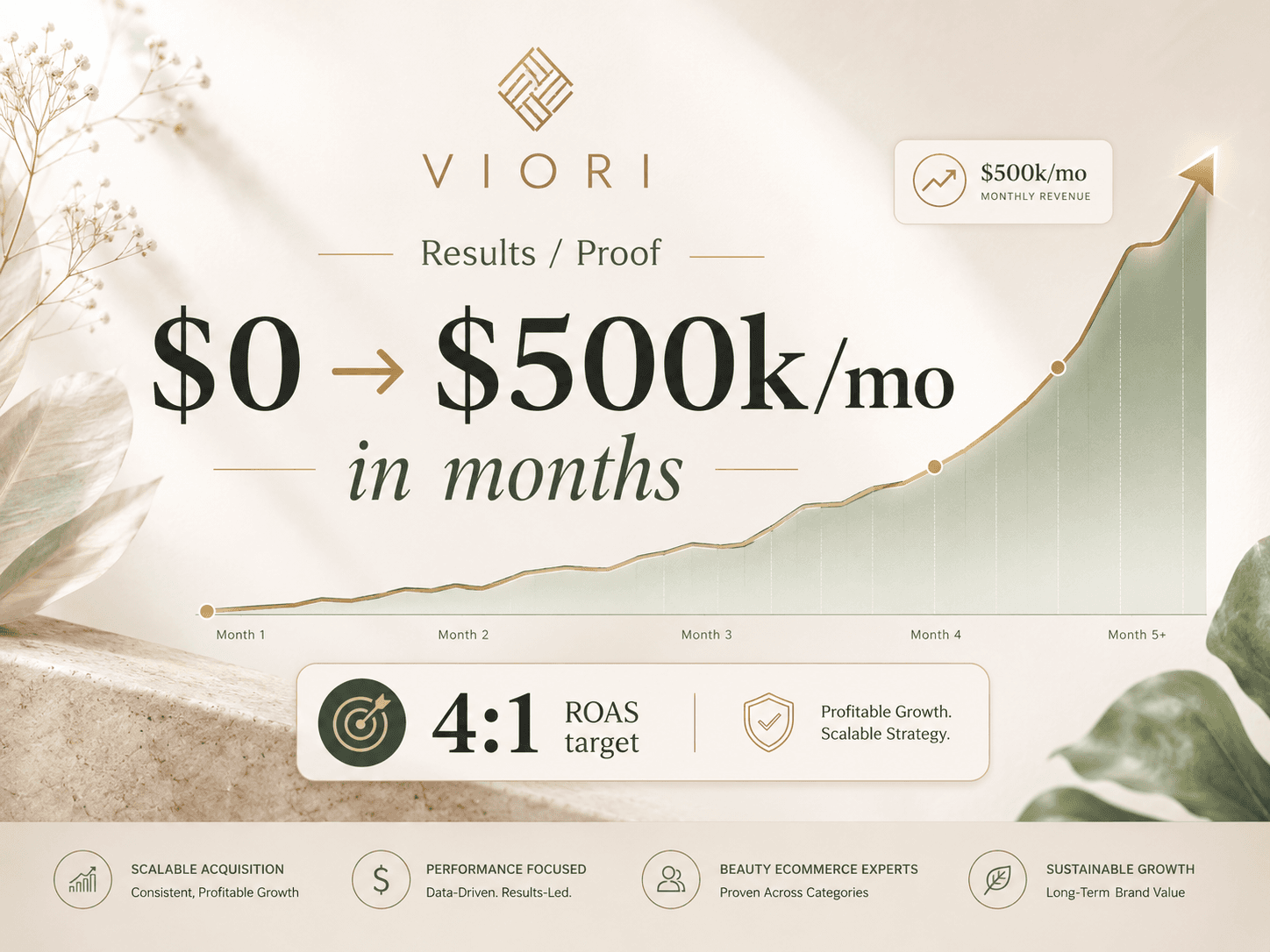
$0 → $500k/mo in months at a 4:1 ROAS target
Viori
Challenge
Viori came to us needing to scale a DTC brand from zero, the cold-start problem every emerging beauty brand knows: real demand to capture, but no proven acquisition engine yet and no margin to waste while building one.
What we did
We built and scaled paid acquisition against a strict 4:1 ROAS target, finding the channels and creative angles that actually returned and concentrating budget where the math held as spend grew.
Result
Viori went from $0 to $500k per month in a matter of months while holding the 4:1 ROAS target: profitable scale, not growth bought at any cost. Full details at sagum.com/case-studies/.
If Your Paid Social ROAS Has Plateaued or Your Creative Is Fatiguing, Let's Talk
No obligation. We'll come to the conversation having already thought about your specific brand, your category's unit economics, and where the highest-leverage opportunities are likely to be. If we're not the right fit, we'll tell you.
Sagum · January 2017 · St. George, Utah · 8+ years