
8+ years growing brands on KPIs, now with AI
Car Dealer Marketing Measured in Sold Units
Inventory-driven ads, smarter attribution, and BDC-ready lead flows built for the way automotive shoppers actually decide.
8+ years of performance marketing results | Google Ads, Meta & TikTok Partner


Get your free marketing audit
Senior strategist review · response within one business day
Prefer to reach out directly?
The Challenge
Selling Cars Online Is a Different Problem Than It Used to Be
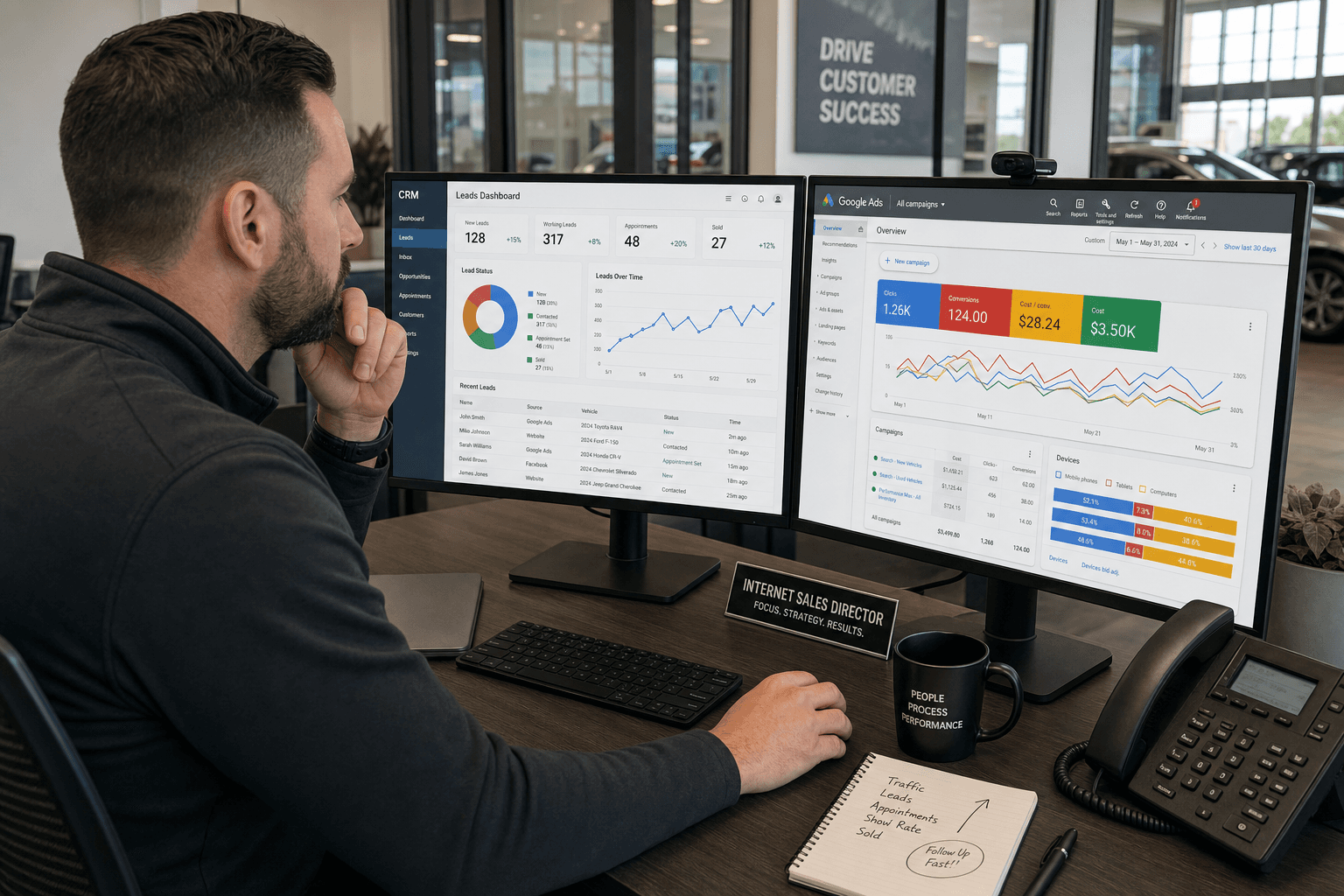
Your shoppers spend hours researching across OEM configurators, CarGurus listings, Edmunds reviews, and your own VDPs before they ever fill out a form. By the time a lead hits your CRM, that person has already compared your price against three competitors, checked your Google rating, and estimated their trade-in value on a third-party tool. They are not browsing. They are deciding.
The problem is that most of your marketing infrastructure was built for a world where volume was the goal. Third-party marketplaces sell you leads they also sell to other stores in your DMA. Generic Search campaigns drive clicks to your homepage instead of directly to the VDP for the unit the shopper actually searched. And your cost-per-lead number looks fine right up until you match it against your DMS and realize how few of those leads ever turned into a sold unit.
Front-end gross on new vehicles has compressed hard since its 2022 peak and is thin at many stores. F&I income is carrying more of the P&L than it should. Your service drive is the most durable profit center you have, and it is almost certainly underfunded in your ad budget. Meanwhile, a shopper who submits a lead to your store and two competitors will often buy from whoever responds first with a real answer. That is the actual race you are running.
The dealers who are growing right now are not spending more. They are spending on the right inventory, with the right message, in the right geo radius, measured against cost per sold unit instead of cost per click. That is a different discipline entirely.
The Opportunity
The Demand Is There. Most Dealers Are Just Capturing It Sloppily.
Automotive search ads reach in-market shoppers at the moment they are comparing units. That is a highly efficient channel when the feed is accurate, the landing page is a live VDP, and the lead routing fires within 60 seconds. Most stores do not have all three working at the same time.
Vehicle Listing Ads fed by a clean, real-time inventory feed send high-intent shoppers directly to the specific unit they searched for. When that VDP loads fast, shows transparent pricing including dealer fees, and has a frictionless lead form above the fold, conversion rates climb. When it does not, the shopper clicks back to CarGurus and you paid for the visit anyway.
Your service drive is the highest-LTV asset in your business. A sold vehicle that returns to your service lanes two or three times a year for five to seven years is worth multiples of the front-end gross. Dedicated fixed-ops campaigns on branded and non-branded service terms, run separately from your vehicle campaigns with their own budget and their own cost-per-booked-appointment target, consistently outperform general awareness spend on ROI. Most stores either do not run them or fold them into a single campaign where their performance is invisible.
The equity mining opportunity inside your own DMS is the most underused channel in automotive. Customers who are 90 days from lease maturity or sitting on meaningful positive equity are far more likely to transact than a cold conquest lead. Surfacing them with personalized outreach, before a competitor does, is a retention play that costs a fraction of conquest advertising and closes at a fraction of the effort.
What Most Get Wrong
What Most Dealerships and Their Agencies Get Wrong
Measuring leads instead of sold units
Third-party marketplaces and broad Search campaigns can generate hundreds of leads a month that never match to a sold unit in the DMS. If your agency reports on lead volume and you are not reconciling it against your sales log, you are optimizing for a number that does not pay the floor plan.
Running a single campaign for new, used, CPO, and service
New vehicle margins, used vehicle margins, CPO certification premiums, and service labor rates have completely different economics, different buyer intent, and different competitive landscapes. Pooling them into one campaign means your budget flows to whichever segment has the cheapest clicks, not the highest return. You lose visibility into what is actually working by department.
Inventory feeds that are stale or inaccurate
A Vehicle Listing Ad or Performance Max campaign is only as good as the feed powering it. A unit that sold yesterday but still appears in ads wastes budget and sends a shopper to a dead VDP. Price mismatches between the feed and the VDP create FTC exposure. Feed hygiene is unglamorous and most agencies do not own it.
Ignoring geo radius discipline
Most buyers purchase close to home. Running campaigns that serve ads 40 miles out for new vehicles inflates impressions, dilutes relevance scores, and drives up CPCs for shoppers who will never make the drive. Used shoppers will travel farther for the right unit. Service shoppers rarely travel far. Each department needs its own radius.
No attribution path from ad click to sold unit
Most dealership attribution stops at the lead form. Without call tracking tied to campaigns, VDP session data matched to CRM records, and a process for tagging sold units back to their originating source, you cannot tell whether your $15,000 monthly ad budget is selling cars or just generating activity. Agencies that cannot show you cost per sold unit by channel are guessing.
Why Now
Why the Next 90 Days Are the Window to Pull Ahead
Spring tax season is one of the biggest selling windows in automotive. When refunds land, with the average federal refund topping $3,000 in 2026, that money moves into down payments on used and CPO inventory, and February refund recipients are in-market by March. Dealers whose campaigns are dialed in before that traffic peaks capture the volume. Dealers who are still troubleshooting their feeds and fixing attribution in April are buying their way into a crowded auction.
The competitive gap between dealers using AI-assisted campaign management and those still running static, set-and-forget campaigns is widening faster than most GMs realize. An AI system that watches your VDP traffic, adjusts bids toward the units with the highest days-on-lot pressure, and reallocates budget toward the geo clusters actually converting does something a monthly agency check-in cannot. It responds to what is happening in your market this week, not last month.
OEM incentive programs and stair-step structures make month-end the most high-stakes 72 hours in your business. A campaign architecture that can surge budget and swap to urgency-driven creative in the last five days of the month, then pull back without waste, is a structural advantage. Most dealers either miss the surge or leave the budget running flat into the next month. Getting this right before your peak spring months compounds across every month-end for the rest of the year.
The dealers who are hardest to compete against in 12 months are the ones who fixed their attribution, cleaned their feeds, and built a lead-response workflow that fires in under 60 seconds starting now. That infrastructure takes time to build and calibrate. The window to build it before your competitors do is open, but it is not permanent.
The Mechanism
Where AI Creates a Real Edge in Automotive Marketing
Real productivity, not AI theater. Here's where it actually moves a number for car dealers.
Digital Ads and Inventory Feed Management
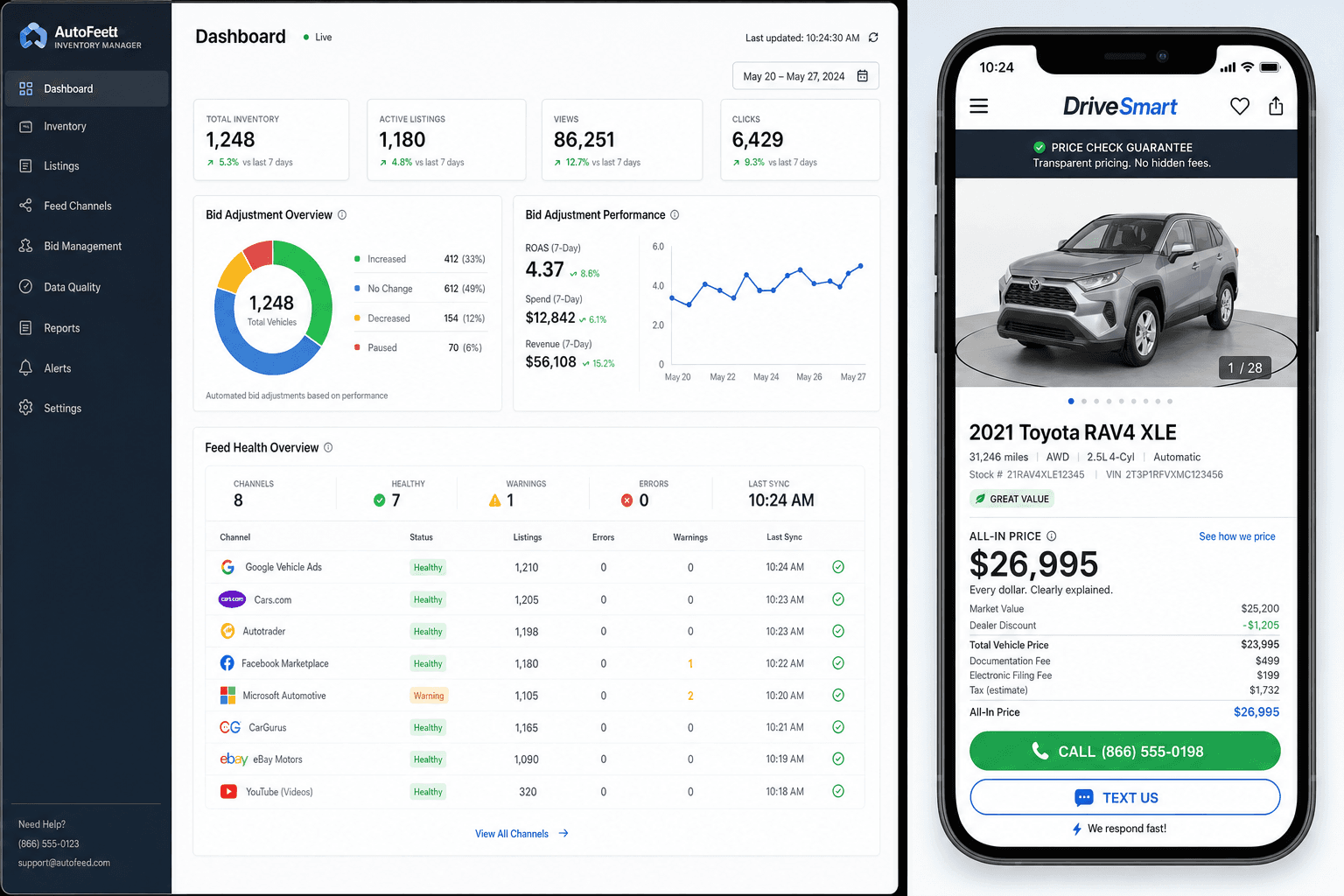
What AI does: AI monitors your live inventory feed and adjusts Vehicle Listing Ad and Performance Max bids in real time, pushing harder on units with high days-on-lot and pulling back on sold or low-margin stock. It also flags feed errors, price mismatches, and missing photos before they serve a bad ad.
The result: Budget follows your actual inventory pressure instead of a static monthly plan. High-age units get the exposure they need to move. Sold units stop burning budget the day they leave the lot.
Why it matters here: In automotive, a stale feed is not just a wasted impression. It is a compliance risk, a shopper experience failure, and a signal to Google that your account is poorly managed. Feed accuracy is the single biggest lever on VLA performance, and it requires daily attention that AI can provide at a cost no human team can match.
Analytics and Attribution
What AI does: AI connects ad click data, call tracking records, VDP session behavior, and CRM lead records to produce a cost-per-sold-unit view by channel, not just a cost-per-lead view. It surfaces attribution gaps, identifies lead sources that generate volume but never close, and flags when third-party marketplace spend is cannibalizing your own Search traffic.
The result: You stop optimizing for the number your agency reports and start optimizing for the number on your sales log. Budget shifts away from lead-volume sources that do not sell cars and toward the channels that actually do.
Why it matters here: Most dealership leads never become a sold vehicle. That means a significant portion of your ad spend is generating activity, not sales. Without attribution that closes the loop at the DMS, you cannot tell which of those leads are the ones that matter.
Conversion Optimization for VDPs and Lead Forms
What AI does: AI audits your Vehicle Detail Pages for load speed, pricing transparency, form friction, and mobile experience, then tests changes systematically. It identifies the specific friction points causing shoppers to bounce rather than submit a lead or click to call.
The result: Higher lead submission rates from the same VDP traffic, and higher-quality leads because the form design and pricing presentation filter for serious buyers rather than price shoppers.
Why it matters here: Only a small fraction of dealership website visitors ever buy. A VDP that loads in under two seconds, shows an all-in price, and puts a click-to-call button above the fold on mobile converts at a meaningfully higher rate than the industry average. That improvement multiplies across every paid click you send to the page.
Creative Testing for Paid Social Inventory Ads
What AI does: AI generates and tests multiple ad creative variations for used and CPO inventory on Meta, rotating vehicle photos, price callouts, payment messaging (with the Reg Z or Reg M disclosures and Meta financial-services ad category it triggers), and audience segments simultaneously rather than running one ad set until it fatigues.
The result: Faster identification of the creative angle that drives VDP clicks from in-market audiences, with less budget wasted on underperforming variations.
Why it matters here: Dynamic inventory ads on Meta work for used and CPO retargeting and conquest, but creative fatigue hits fast in automotive because the same shopper sees your inventory repeatedly across a long research cycle. Testing more variations more quickly keeps CPCs from climbing as frequency rises.
Ready to see what this looks like for your car dealers business?
No obligation. A senior strategist will show you exactly where the wins are.
The Strategy
How Automotive Digital Marketing Should Actually Be Structured
The foundation is a clean, real-time inventory feed connected to Google Vehicle Listing Ads and Performance Max. Every paid click should land on the specific VDP for the unit the shopper searched, not a generic inventory page. Feed accuracy, photo quality, and pricing transparency on the VDP determine whether that click becomes a lead.
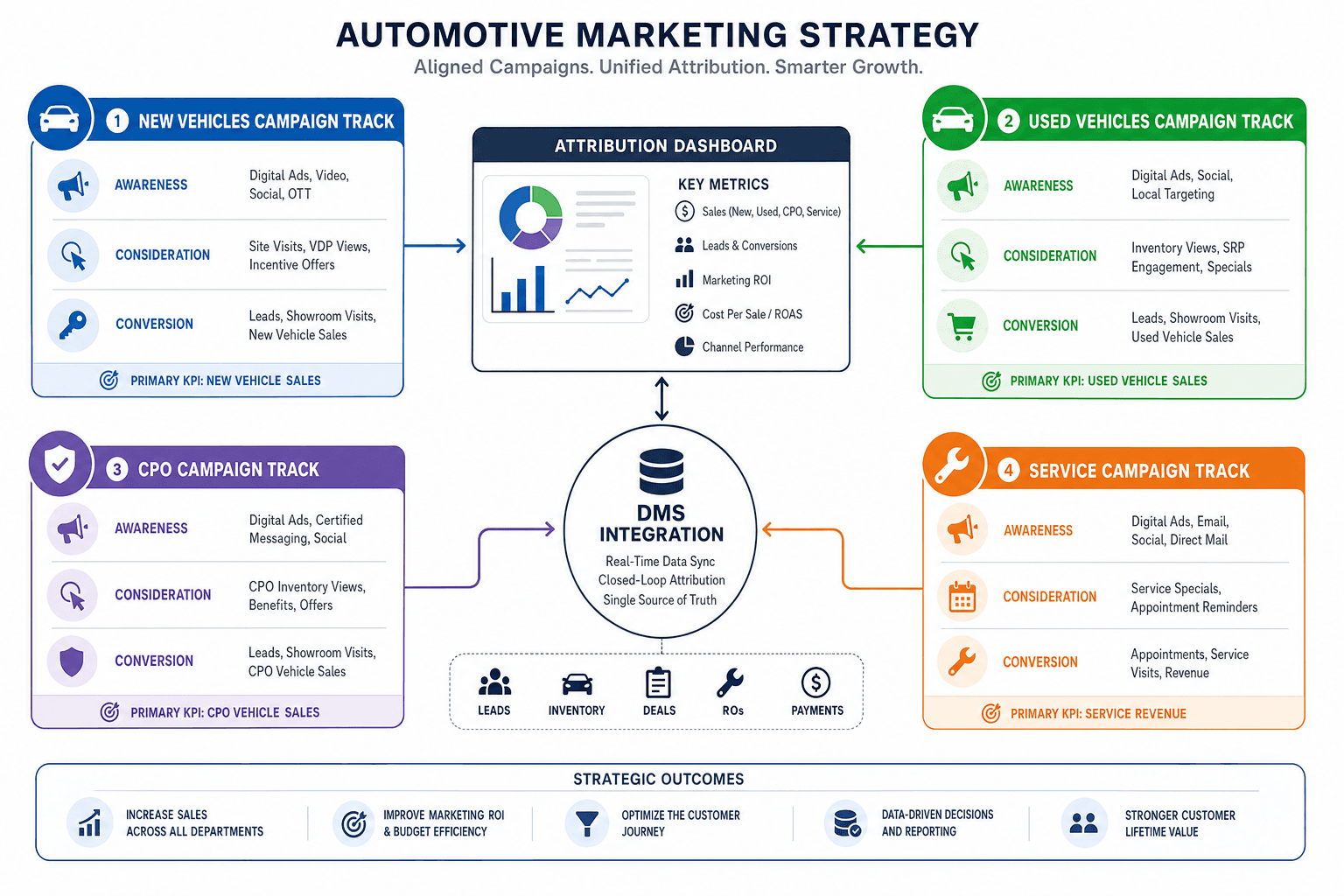
Campaigns must be separated by department and by inventory type: new vehicles, used vehicles, CPO, and fixed ops each have different margins, different buyer intent, different competitive sets, and different geo radii. New runs tight, 10 to 15 miles. Used runs wider, 20 to 25 miles, because shoppers will travel for the right unit. Service runs tightest, 8 to 10 miles, and bids on both branded service terms and high-intent non-branded queries like oil change near me and brake inspection.
Call tracking is non-negotiable across every campaign. Phone calls are among the highest-converting leads a dealership gets. If you cannot tell which campaign drove a call, you cannot manage the channel. Every ad extension, every landing page, and every VDP needs a tracked number that routes correctly and records, with a recording notice, for BDC quality review.
Budget pacing should follow the automotive calendar, not a flat monthly line. The last five days of the month are a volume sprint driven by OEM stair-step incentives and salesperson quotas. Budget should surge and creative should shift to urgency and incentive messaging in that window. Spring tax season and Labor Day model-year closeout periods need elevated budgets planned in advance, not reactive spending after the peak has already started.
The CRM and DMS are your highest-ROI channels and most dealers treat them as afterthoughts. Equity mining, identifying customers with positive equity or lease maturities within 90 days, and triggering personalized outreach before a competitor does, converts at a far higher rate than conquest advertising. This is not a marketing tactic. It is a retention system that compounds over time.
Attribution closes the loop. Every lead source, including third-party marketplaces, paid Search, paid social, organic, and phone, must be traceable to a sold unit in the DMS. Cost per sold unit by channel is the governing number. Everything else is an input.
The one number that governs this
The governing KPI is cost per sold unit and cost per booked service appointment, traced from ad click to DMS record. Lead volume is an input, not the outcome.
How We Help
What We Would Actually Do for Your Dealership
We start by fixing the foundation: feed accuracy, call tracking, and attribution that closes at the DMS. Then we build the campaign structure your inventory and your margins actually require. Here is what that looks like in practice.
Inventory Feed Management and Vehicle Listing Ads
We connect your DMS to a real-time inventory feed, audit it for price accuracy, photo completeness, and sold-unit removal, then power your Google VLA and Performance Max campaigns from that feed so every click lands on a live, accurate VDP.
Paid Search by Department (New, Used, CPO, Service)
We build separate campaign structures for each inventory type and for fixed ops, each with its own budget, its own geo radius, its own keyword strategy, and its own cost-per-outcome target. No more pooled campaigns where you cannot see what is working.
Paid Social Inventory Ads (Meta)
We run dynamic inventory ads for used and CPO retargeting and conquest on Meta, with creative testing across vehicle photos, pricing callouts, and compliant payment messaging (Reg Z or Reg M disclosures, run in Meta's financial-services ad category) to find the angle that drives VDP traffic at the lowest cost.
Call Tracking and Attribution Setup
We install tracked numbers across every campaign, ad extension, and landing page, route calls correctly, and build the reporting layer that connects ad clicks to CRM leads to DMS sold units so you have a real cost per sold unit by channel.
VDP and Landing Page Conversion Optimization
We audit your Vehicle Detail Pages for load speed, pricing transparency, form friction, and mobile call-to-action placement, then test improvements systematically to raise your lead submission rate from existing traffic.
Fixed Ops Campaign Management
We build and manage dedicated service department campaigns on branded and non-branded terms, measured against cost per booked service appointment, with separate budgets that reflect the margin contribution of your service drive.
CRM Equity Mining and Retention Outreach
We work with your DMS data to surface in-equity customers and lease maturities, then build triggered outreach sequences that put the right offer in front of the right customer before a competitor does.
AI-Assisted Budget Pacing and Month-End Surge
We use AI to watch performance daily, shift budget toward high-converting units and campaigns in real time, and execute the month-end budget surge and creative swap automatically so you capture the volume without manual intervention.
Who's Behind This
Who we are, and what makes us different
Sagum is a performance marketing agency founded in January 2017 in St. George, Utah. We've spent 8+ years growing real brands and being judged on KPIs, not vanity metrics.
We deliberately limit how many clients we take so each one gets senior attention. We treat your numbers like our own, we never run generic playbooks, and your strategy is built for your business, because shouldn't your brand's marketing be custom to your brand?
Sagum.ai is our AI arm: the same proven operators now build AI into the work wherever it creates real edge, not as theater, but as leverage applied with discipline.
- 8+ years growing brands on performance KPIs, not vanity metrics
- Limited client roster, with senior attention on every account
- An extension of your team; your success is tied to ours
- Custom strategy per brand, never a generic playbook
- AI built in where it moves a number; judgment over hype
“Sagum is a performance marketing agency that's spent 8+ years growing brands by treating their numbers like our own. We take on few clients, never run generic playbooks, and now build AI into the work wherever it creates real edge, not hype. Your strategy is built for your business, and our success is tied to yours.”

“After six years, Sagum is our most important partner: trusted, communicative, and caring about our business as if it's their own.”
Proof
From a $20 CPL goal to $13 CPL and 300+ leads/mo
Rizzoli's Automotive
Challenge
Rizzoli's Automotive needed a predictable, scalable lead flow at a cost that made sense against their service margins. Their goal was 100 qualified leads per month at roughly $20 per lead.
What we did
We rebuilt the campaign structure around high-intent search terms and launched a purpose-built call-driving landing page.
Result
Cost per lead dropped from a $20 target to $13. Monthly lead volume grew to more than 300 qualified leads. Landing page conversion exceeded 60%. The client opened multiple new locations on the back of the lead volume the system was generating.

- Cost per lead
- $13
- Leads / month
- 300+
- Landing-page conversion
- 60%+
Find Out Where Your Ad Budget Is Selling Cars and Where It Is Not
No obligation. We will show you exactly where your current campaigns are leaking cost per sold unit and what a properly structured automotive marketing program would look like for your store.
Sagum · January 2017 · St. George, Utah · 8+ years