
8+ years growing brands on KPIs, now with AI
More New Patients for Your Chiropractic Clinic
We build and run marketing systems that fill your schedule with booked, kept appointments at a cost your practice can sustain.
Google Ads Partner · Meta Partner · 8+ Years Growing Local Service Businesses


Get your free marketing audit
Senior strategist review · response within one business day
Prefer to reach out directly?
The Challenge
Marketing a Chiropractic Practice Is Nothing Like Marketing a Product
Your patients are not browsing. They are in pain. When someone searches 'chiropractor near me' or 'sciatica relief [city],' they have already made the decision to get help. The only question is which clinic answers fast enough, looks trustworthy enough, and makes booking easy enough to win the call.
That urgency cuts both ways. The window to capture a new patient is measured in hours, not days. A lead that sits unanswered for two hours is a patient sitting in a competitor's adjusting room. And because you are limited by chair time and your own clinical hours, a flood of unqualified inquiries is almost as painful as a slow month.
Meanwhile, the economics of your practice are genuinely complex. A cash-pay wellness visit, an insurance-reimbursed acute case, a prenatal patient, and a personal injury lien case all have different acquisition costs, different treatment durations, different billing cycles, and different lifetime values. A marketing agency that treats them all the same is burning your budget.
Add to that the competitive pressure from The Joint Chiropractic, which wins on walk-in convenience and $29 first visits and $79-a-month wellness plans, and you have a market that punishes generic marketing and rewards specificity. The practices that grow in this environment are not the ones spending the most on ads. They are the ones with the tightest targeting, the fastest lead response, and the clearest message for each patient type.

The Opportunity
The Demand Is There. Most Clinics Are Just Capturing It Sloppily.
In most US metro areas, 'chiropractor near me' and condition-specific searches like 'back pain relief [city]' or 'auto accident chiropractor [city]' generate consistent, high-intent local traffic every single day. These are not people casually exploring options. They are ready to book.
The practices winning this demand are not necessarily the best clinicians in town. They are the ones showing up in the Google Map 3-Pack within a 5-8 mile radius of the clinic, running condition-segmented Google Search campaigns that match the searcher's specific complaint, and converting that traffic with a landing page that makes booking take 60 seconds instead of three clicks and a phone call.
Google Local Services Ads, when set up correctly for a chiropractic practice, often deliver leads well below what most clinics pay on traditional Search campaigns. Condition-specific ad groups targeting 'sciatica chiropractor' or 'auto injury chiropractor' typically cut cost per lead compared with generic chiropractic campaigns.
Lapsed patient reactivation is the highest-margin opportunity most practices are completely ignoring. A simple SMS or email sequence to patients inactive for 90 or more days costs almost nothing to run and converts at a fraction of the cost of acquiring a new patient from paid search.
The practices that capture this opportunity are not spending more than their competitors. They are spending smarter, measuring the right number (cost per new patient visit, not cost per click), and building the infrastructure to convert high-intent traffic into booked, kept appointments.
What Most Get Wrong
What Most Chiropractic Clinics and Their Marketing Agencies Get Wrong
Measuring cost per lead instead of cost per new patient visit
A form fill or a phone call is not a patient. Because only a fraction of leads become booked, kept appointments, your true cost per acquired patient typically runs several times your cost per lead. Clinics that optimize for cheap leads often end up paying the same or more per actual patient visit, with a worse-quality patient mix and a front desk drowning in no-shows.
Running one campaign for all patient types
A cash-pay wellness patient, an insurance acute case, and a personal injury lien patient require completely different messaging, different landing pages, and different economics. Pooling them into one campaign means your ad copy speaks to no one specifically, your landing page converts poorly across the board, and you have no idea which patient type is actually profitable to acquire.
Targeting the entire city instead of the actual patient travel radius
Chiropractic patients do not drive 25 miles for a first visit. In most markets, the realistic radius is 5-10 miles from the clinic address. Campaigns targeting a full city or metro are paying for clicks from people who will see your location and leave immediately, inflating cost per lead and depressing conversion rate with no benefit.
Ignoring the Google Business Profile while spending on ads
For 'chiropractor near me' intent, the Map 3-Pack outperforms organic rankings and often paid ads for click-through rate. A practice with a poorly optimized GBP, thin reviews, or inconsistent NAP data is spending on ads to compensate for a conversion problem, not a visibility problem. Many patients call or book directly from the search results page without ever visiting the website.
Slow lead response destroying ad spend
Google's Local Services Ads algorithm rewards practices that respond quickly. A clinic that responds to every LSA lead within five minutes gets significantly more lead volume at the same budget than one that lets inquiries sit for hours. If your front desk is not set up to respond immediately or your online booking is not live, you are paying for traffic that your operations cannot convert.
Why Now
Why the Clinics That Move Now Will Own Their Local Market
Most chiropractic clinics in any given market are running the same playbook they ran three years ago: a basic Google Ads account with broad keywords, a generic website homepage as the landing page, and a Google Business Profile that gets updated twice a year. That playbook is getting more expensive and less effective every quarter.
Since early 2025, Meta has limited which conversion events healthcare advertisers can track and optimize toward. Google CPCs for competitive chiropractic terms are climbing in most metros. The clinics running undifferentiated campaigns are paying more for the same results, or worse.
The practices pulling away right now are doing two things differently. First, they are building condition-specific infrastructure: separate landing pages for back pain, auto injury, prenatal, and sports chiropractic, each with its own tracking, its own offer, and its own conversion path. Second, they are using AI to do what a solo DC or a small front desk team cannot: monitor campaign performance around the clock, test multiple ad angles simultaneously, and catch the attribution errors that make bad campaigns look profitable.
January and February bring a wave of new patients for many practices, driven by post-holiday health resolutions. September and October bring a second surge from deductible burn-down behavior, when patients rush to use remaining insurance benefits before year-end. The clinics with their infrastructure built and tested before those windows open capture the volume. The ones scrambling to fix their campaigns in January watch the leads go to the practice down the street.
This is not a window that stays open. As more practices adopt better targeting and faster lead response, the gap between the top practice in a zip code and everyone else widens. The time to build the infrastructure is before the next peak, not during it.
The Mechanism
Where AI Actually Moves the Number for a Chiropractic Practice
Real productivity, not AI theater. Here's where it actually moves a number for chiropractors.
Digital Ads
What AI does: AI monitors your Google Search and Local Services Ads campaigns continuously, shifting budget toward the ad groups and keywords generating booked appointments rather than just clicks or calls. It adjusts bids in real time based on time of day, day of week, and seasonal demand patterns specific to your practice.
The result: Budget follows actual patient acquisition instead of a static monthly plan. During a January resolution surge or a September insurance burn-down window, spend automatically concentrates where it is converting, without requiring manual intervention.
Why it matters here: A solo DC cannot watch campaign performance at 7am on a Tuesday and 9pm on a Friday simultaneously. AI does. For a practice with a hard capacity ceiling of 150 visits per week, every dollar that goes to a click that does not book is a dollar that could have funded a patient who completes a 12-visit care plan.
Analytics and Attribution
What AI does: AI audits your tracking setup to confirm that phone calls, online bookings, and form fills are being attributed to the correct campaign, ad group, and keyword. It surfaces attribution errors, such as a misfiring call tracking tag or a booking confirmation page that is not firing the conversion event, before they distort your cost per new patient data.
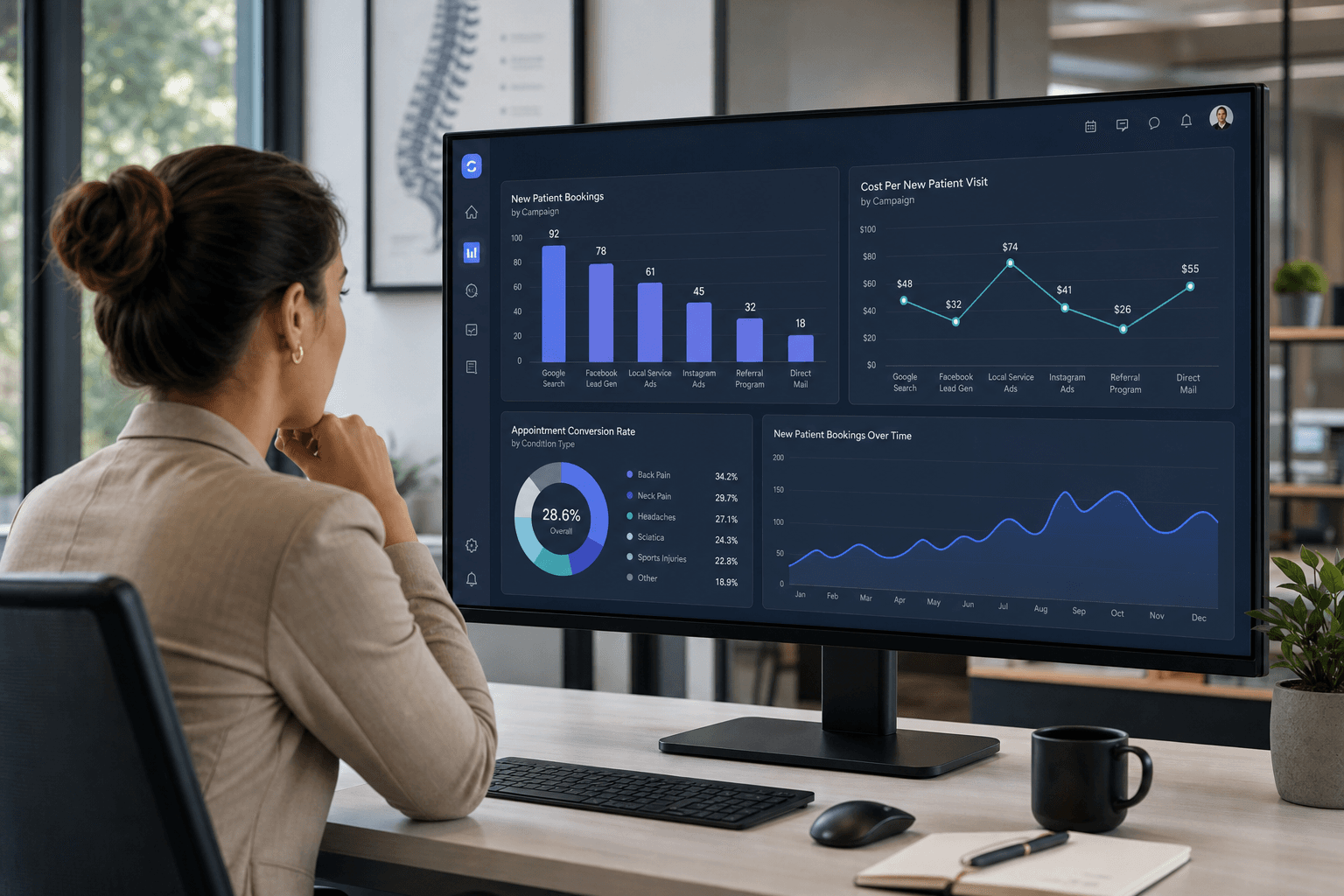
The result: You know which campaigns are actually generating kept appointments, not just which ones look good in the dashboard. The difference between a $45 cost per new patient and a $180 cost per new patient is often a tracking error, not a campaign problem.
Why it matters here: Chiropractic practices run multiple conversion paths simultaneously: phone calls from ads, online bookings from landing pages, walk-ins from GBP, and referrals from PI attorneys. Without clean attribution across all of them, you are making budget decisions on bad data.
Creative
What AI does: AI generates and tests multiple ad copy angles per week across your condition-specific campaigns, rotating headlines and descriptions for back pain, auto injury, prenatal, and sports chiropractic audiences. It identifies which message resonates with each patient type and concentrates spend on the winning angle.
The result: Instead of running one ad per campaign for months, you are continuously finding the message that books appointments for each patient type. A headline that converts for a sciatica searcher is different from one that converts for a car accident victim or a pregnant patient in her second trimester.
Why it matters here: Most chiropractic ads say the same thing: 'Accepting new patients. Call today.' The practices winning on Search are the ones whose ad copy matches the specific complaint the searcher typed. AI makes it possible to test five angles per week instead of one per month.
Conversion Optimization
What AI does: AI analyzes your condition-specific landing pages for conversion leaks: form fields that cause abandonment, page load times that push mobile users to a competitor, or booking flows that require too many steps. It surfaces the highest-impact fixes and, where possible, tests variations automatically.
The result: A landing page built for a back pain searcher that loads in under two seconds, leads with a clear first-visit offer, and puts the online booking widget above the fold consistently outperforms a generic homepage on conversion rate. AI keeps that page optimized as patient behavior and device patterns shift.
Why it matters here: Many patients will go to a competitor rather than call. If your landing page requires a phone call to book, you are losing a real share of your paid traffic before they ever reach your front desk. AI-assisted CRO closes that gap systematically.
Ready to see what this looks like for your chiropractors business?
No obligation. A senior strategist will show you exactly where the wins are.
The Strategy
How Chiropractic Marketing Should Actually Be Built
The strategy for a chiropractic clinic starts with one governing number: cost per new patient visit. Not cost per click, not cost per lead, not impressions. Every channel decision, every budget allocation, and every optimization call gets made against that number.
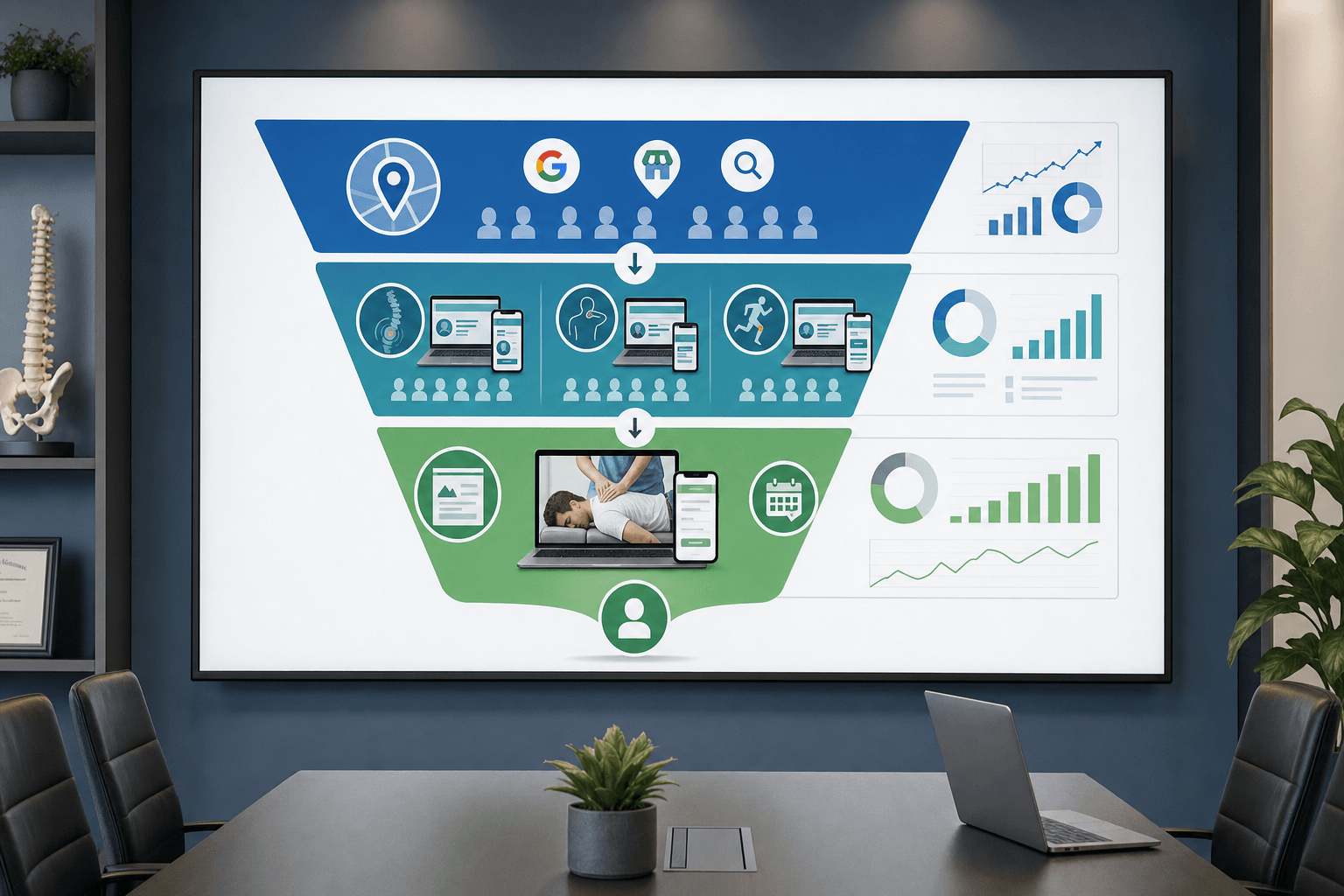
The foundation is local search infrastructure. Your Google Business Profile needs to be fully built out and actively managed within your true patient travel radius, typically 5-8 miles from the clinic address. Reviews need to be requested systematically after every visit, not reactionally. The Map 3-Pack within your zip code is more valuable than a page-one organic ranking for a broad city keyword.
On top of that foundation, Google Local Services Ads run for the highest-intent queries, often at the lowest cost per lead in the account. Google Search campaigns are segmented by condition: one campaign for back and neck pain, one for auto injury and personal injury, one for sports chiropractic, one for prenatal if you offer it. Each has its own ad copy, its own landing page, and its own conversion tracking. Mixing them destroys your ability to know what is working.
Every landing page is built to do one thing: get the visitor to book an appointment or call the clinic. The page matches the condition the searcher typed. It loads in under two seconds on mobile. The first-visit offer, if compliant with your state board rules, insurance contracts, and federal anti-inducement rules for Medicare and Medicaid patients, is visible above the fold. The booking widget is not buried.
Call tracking is non-negotiable. Every campaign gets a unique tracking number. Every call gets recorded and reviewed. You cannot improve what you cannot measure, and for a chiropractic practice, the phone call is still the primary conversion event for high-intent patients.
Meta and paid social run a supporting role: retargeting website visitors who did not book and building awareness for wellness and specialty services like decompression or prenatal care in a defined local radius. Cold prospecting on Meta is not the primary acquisition channel for most practices; it is a supplement.
Lapsed patient reactivation runs on a separate track: a short SMS and email sequence to patients inactive for 90 or more days, timed to seasonal triggers like January benefit resets or September insurance benefit reminders. This is consistently the lowest cost per reactivated visit in the practice.
The one number that governs this
Governing KPI: Cost Per New Patient Visit. Every budget decision, every channel test, and every optimization is measured against what it costs to put a new patient in the chair for a kept first appointment.
How We Help
What We Would Actually Do for Your Practice
Here is how we would execute this strategy for a chiropractic clinic. We start with tracking and infrastructure because every optimization decision that follows depends on clean data. Then we build the acquisition layer, condition by condition, and layer in retention and reactivation once the new patient engine is running. We take on a limited number of clients so your account gets senior attention, and we measure our own success by your cost per new patient visit, not by activity metrics.
Tracking and Attribution Setup
Install call tracking on every campaign and location, verify that online booking confirmations fire conversion events correctly, and audit your existing Google Ads and GBP data for attribution errors before spending a dollar on new campaigns.
Google Business Profile Management
Fully optimize your GBP for each clinic location, build a review generation system that asks every patient after their visit, and manage the profile actively to compete for the Map 3-Pack within your true patient travel radius.
Google Local Services Ads
Launch and manage LSA campaigns targeting your highest-intent local queries at the lowest available cost per lead, with rapid lead response protocols built in to maximize lead volume at a given budget.
Condition-Segmented Google Search Campaigns
Build separate campaigns for each patient type: back and neck pain, auto injury and personal injury, sports chiropractic, and prenatal where applicable. Each campaign has its own keywords, ad copy, landing page, and conversion tracking.
Condition-Specific Landing Pages
Design and build fast-loading, mobile-optimized landing pages for each condition segment, with first-visit offers compliant with your state board rules and federal anti-inducement rules, prominent online booking, and click-to-call above the fold.
AI-Assisted Creative Testing
Generate and test multiple ad copy angles per week across each condition campaign, identifying the messages that book appointments for each patient type and concentrating spend on the winners.
Meta Ads for Retargeting
Run Meta campaigns targeting website visitors who did not book, timed to seasonal triggers like January benefit resets and September insurance benefit windows.
Analytics and Performance Reporting
Report on cost per new patient visit by campaign and patient type, not vanity metrics. Surface attribution errors and optimization opportunities weekly, and adjust budget allocation based on what is actually generating kept appointments.
Who's Behind This
Who we are, and what makes us different
Sagum is a performance marketing agency founded in January 2017 in St. George, Utah. We've spent 8+ years growing real brands and being judged on KPIs, not vanity metrics.
We deliberately limit how many clients we take so each one gets senior attention. We treat your numbers like our own, we never run generic playbooks, and your strategy is built for your business, because shouldn't your brand's marketing be custom to your brand?
Sagum.ai is our AI arm: the same proven operators now build AI into the work wherever it creates real edge, not as theater, but as leverage applied with discipline.
- 8+ years growing brands on performance KPIs, not vanity metrics
- Limited client roster, with senior attention on every account
- An extension of your team; your success is tied to ours
- Custom strategy per brand, never a generic playbook
- AI built in where it moves a number; judgment over hype
“Sagum is a performance marketing agency that's spent 8+ years growing brands by treating their numbers like our own. We take on few clients, never run generic playbooks, and now build AI into the work wherever it creates real edge, not hype. Your strategy is built for your business, and our success is tied to yours.”

“After six years, Sagum is our most important partner: trusted, communicative, and caring about our business as if it's their own.”
Proof
From a $20 CPL goal to $13 CPL and 300+ leads/mo
Rizzoli's Automotive
Challenge
A local auto service business came to us with a goal of 100 qualified leads per month at roughly a $20 cost per lead, and needed a paid search program that could hit both numbers.
What we did
We restructured paid search around high-intent, service-specific keywords and built a custom landing page designed to drive phone calls rather than generic traffic.
Result
Cost per lead dropped from a $20 target to $13 actual, volume grew to 300 or more leads per month, and the landing page converted at over 60 percent. The client expanded to multiple new locations on the strength of that lead flow.
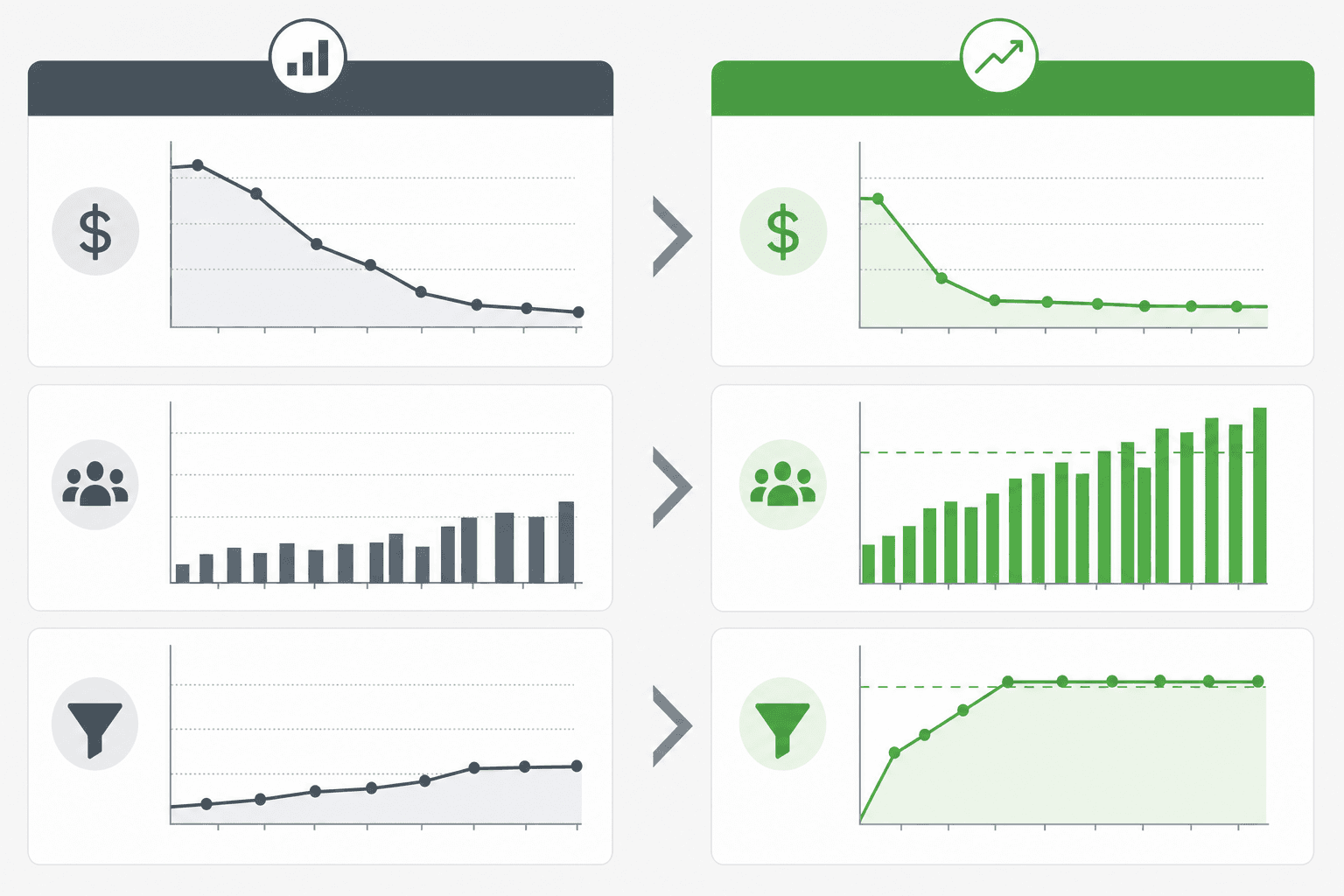
- Cost per lead
- $13
- Leads / month
- 300+
- Landing-page conversion
- 60%+
Find Out What Your Practice Is Leaving on the Table
No obligation. We will review your current campaigns, tracking setup, and local search presence and tell you exactly where the gaps are, whether you work with us or not.
Sagum · January 2017 · St. George, Utah · 8+ years