

8+ years growing brands on KPIs, now with AI
Coffee & tea growth built on subscriber LTV
We acquire profitable subscribers, not just first-time buyers, with disciplined paid media, email, and creative.
8+ years of performance marketing · Google, Meta & TikTok partner · judged on your ROAS, not ours


Get your free Growth Gap Analysis
Senior strategist review · response within one business day
Prefer to reach out directly?
The Challenge
Coffee and Tea Economics Only Work if Subscribers Stay Past Month Three
Your first-order ROAS might look fine, but a $30 bag sale barely covers CAC. You're selling a recurring relationship that must survive the day a subscriber has four bags stacked up and hasn't finished the open one.
Over-stocking is the number-one churn trigger in DTC coffee and tea, so build retention into acquisition before the first bag ships: cadence flexibility, a skip-a-shipment flow, roast-date transparency. Most paid media agencies set up your Meta prospecting without planning for month-3 retention.
Q4 and September are your acquisition windows: October's hot beverage spike, BFCM gift-set volume, and the pumpkin-spice moment, a subscriber acquisition event if you're ready. June and July consumption drops roughly 12%, and cold brew partly offsets the bag-sale dip. With a flat year-round budget, you overspend in that trough and underfund your acquisition windows.
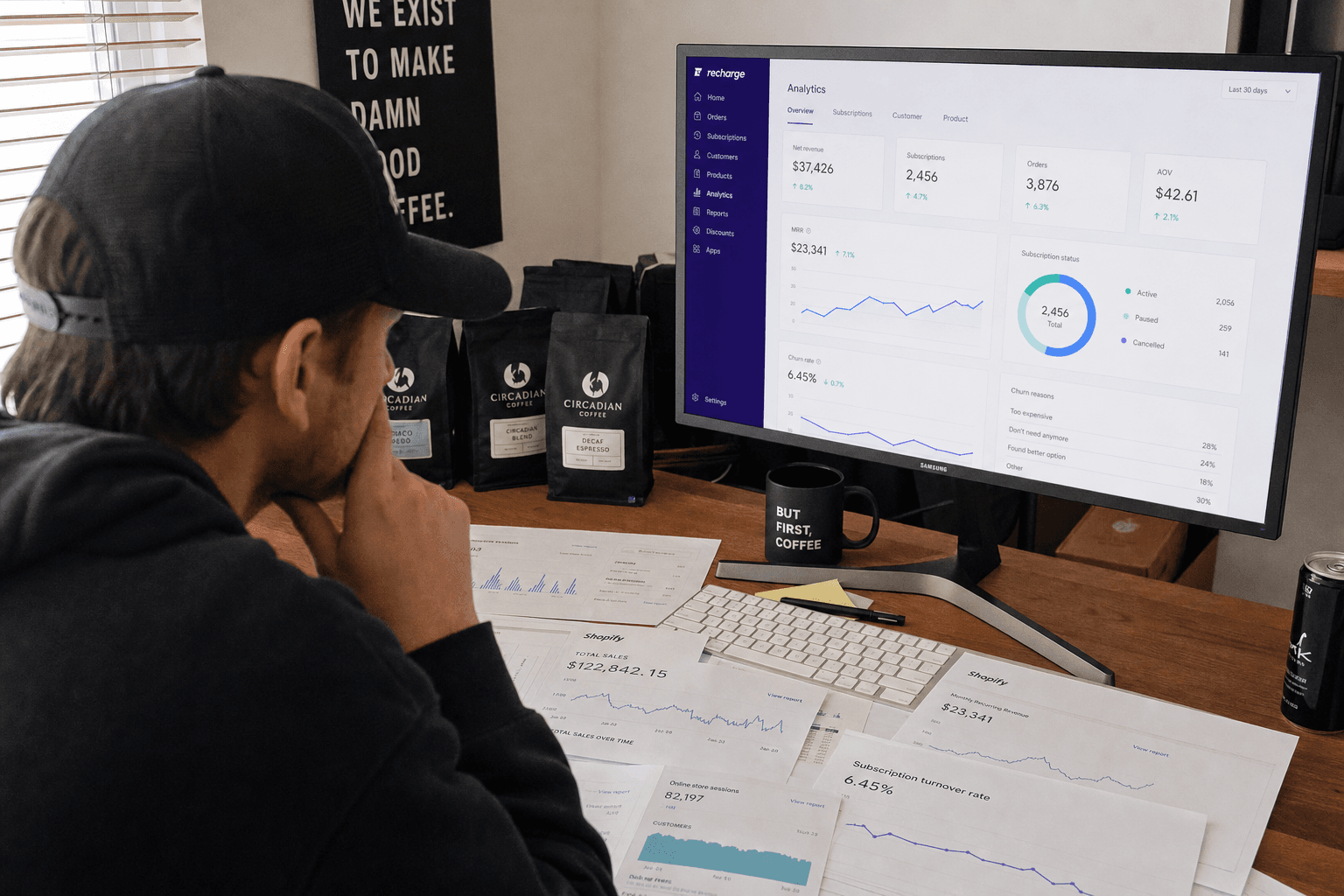
Since iOS 14 you can't trust platform-reported ROAS: Meta's dashboard and Shopify revenue disagree. You need server-side tracking, a real blended ROAS, and someone who knows why nCAC tells a different story.
The Opportunity
Winning Coffee and Tea Brands Compete on Subscriber Economics
A $30/month subscriber at 50% gross margin and 8% monthly churn yields $187 LTV; best-in-class personalization (roast, brewing method, flavor profile) can mean $300–$500 in revenue over 12–18 months. At 3:1 LTV:CAC or better you can profitably outbid competitors on Meta.
Meta suits coffee and tea: food and beverage converts around 2% there, the highest of any vertical, and $0.42–$0.52 CPCs are among DTC's lowest, so struggling brands have creative, email, or attribution problems.
TikTok is still underpriced: social conversations about matcha rose 107% year-over-year, and brands posting real, unpolished content win subscribers there for well under Meta's cold-audience CAC.
Full-list emails for limited single-origin drops, like a first-flush Darjeeling, beat Klaviyo win-back flows on open rate. Your freshness story (roast date on the bag, shipped within 48 hours) keeps subscribers, and Amazon's private-label Subscribe & Save can't match it.
What Most Get Wrong
Where Coffee & Tea Brands and Their Agencies Go Wrong
Optimizing for first-order ROAS over subscriber LTV
Agencies optimizing Meta for first-bag ROAS train it to find one-time buyers. Brands that target subscription conversion and LTV:CAC acquire fewer customers per dollar and build a more profitable business.
Running flat ad budgets year-round
Spending the same in July as in October wastes budget when conversion rates are structurally lower and underfunds the September and Q4 windows that build retention-worthy cohorts.
Ignoring the skip/pause flow until churn spikes
If your Recharge or Skio setup doesn't make skipping, pausing, or changing frequency easy, you turn over-stocking into cancellations and lost LTV. Most brands find out after month-3 retention breaks.
Trusting platform-reported ROAS after iOS 14
Meta Ads Manager overcounts conversions; Shopify revenue is ground truth. Run the business on platform ROAS and you scale unprofitable campaigns and cut ones that work but get poor attribution.
Treating email, your highest-ROAS channel, as an afterthought
Without Klaviyo welcome, post-purchase, and win-back flows, you barely tap email's 10–20:1 ROAS. A win-back for subscribers who skipped twice in a row can recover 15–25% of at-risk churners.
Why Now
Why Coffee and Tea Brands Should Build Acquisition and Retention Systems Now
Eighty-eight percent of subscription brands reported higher acquisition costs in 2025, with Meta CPMs up and cold audiences harder to convert. The brands that will own DTC coffee and tea over the next three years are building systems now, not just running campaigns.
AI lets you test 15–20 concepts a month to find a hook, like 'your barista doesn't know your name but we do,' that converts cold audiences at a profitable nCAC. Competitors testing 2–3 a month can't keep up.
Matcha is at an inflection point: global matcha revenue is projected to grow from $4.17B in 2025 to $7.15B by 2030, per The Business Research Company. Brands building paid and organic TikTok and Meta presence now, before it's as crowded as specialty coffee, will beat later entrants on CAC.
The Mechanism
Where AI Gives Coffee and Tea Brands an Edge
Real productivity, not AI theater. Here's where it actually moves a number for coffee & tea brands.
Creative
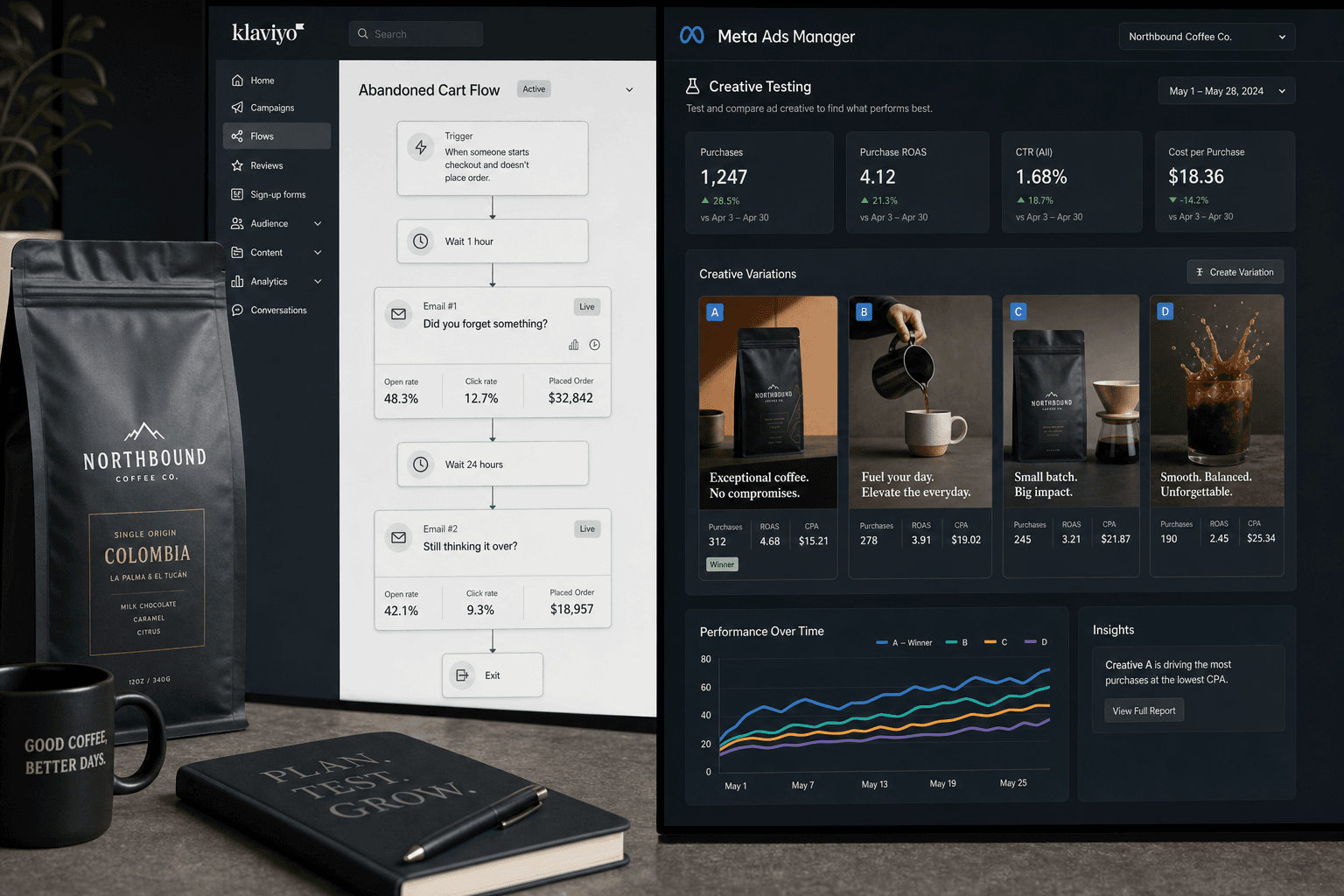
What AI does: AI-assisted production generates multiple Meta and TikTok concepts weekly around the hooks that work in beverage DTC: freshness (roast date, farm story), ritual (morning routine UGC), and community (direct-trade sourcing, sustainability certifications).
The result: You test 5–10x more creative angles per month than manual production allows, find winners faster, and retire losers before they drain budget.
Why it matters here: Lo-fi usually converts: a founder's phone video on roast date, a 15-second TikTok of the pour. Faster discovery lowers Q4 nCAC, when LTV potential peaks.
Email & Automation
What AI does: AI optimizes your Klaviyo flows, from welcome series and post-purchase education (brewing method, storage, roast profile) to skip/pause triggers, win-back sequences, and single-origin drops, with send-time optimization and subject-line testing.
The result: Month-1 and month-3 retention rise because messages land at peak churn risk, typically after the second bag arrives and before a skip decision.
Why it matters here: Email is your highest-ROAS channel and the only one where you can step in on over-stocking before it becomes a cancellation.
Analytics & Attribution
What AI does: Server-side tracking, blended ROAS dashboards reconciled to Shopify ground truth, and cohort LTV reporting show how each channel's subscribers perform at month 1, month 3, and month 6.
The result: Budget follows the channels producing retained subscribers, not the ones claiming the most last-click conversions post-iOS 14.
Why it matters here: Meta's reported ROAS almost certainly overcounts conversions and undercounts what month-two churn costs. We've caught misfiring pixels inflating a brand's reported numbers by 30–40%.
Digital Ads
What AI does: AI assists campaign structure and bid optimization across Meta (prospecting, retention), Google (branded and high-intent search), and TikTok (emerging prospecting, especially matcha and functional tea), with budgets paced to the seasonal calendar.
The result: You acquire more subscribers in Q4 and September, when new cohorts retain best, and cut spend with discipline in June–July.
Why it matters here: July-acquired subscribers are less habitual hot-beverage drinkers and likelier to churn by month two, so September and Q4 budget buys more LTV per dollar.
Conversion Optimization
What AI does: AI-assisted landing page and PDP tests target roast-date transparency, skip/pause/frequency options before add-to-cart, social proof from coffee-literate reviewers, and first-order offers that don't train customers to seek discounts.
The result: More of the paid clicks you already buy become subscribers instead of one-time buyers.
Why it matters here: At 500 paid orders a month, a 1-percentage-point lift in subscription conversion adds 60 subscribers a year and $11,000-plus in LTV without new ad spend.
Ready to see what this looks like for your coffee & tea brands business?
No obligation. A senior strategist will show you exactly where the wins are.
The Strategy
How a Coffee or Tea Brand Should Run Its Marketing
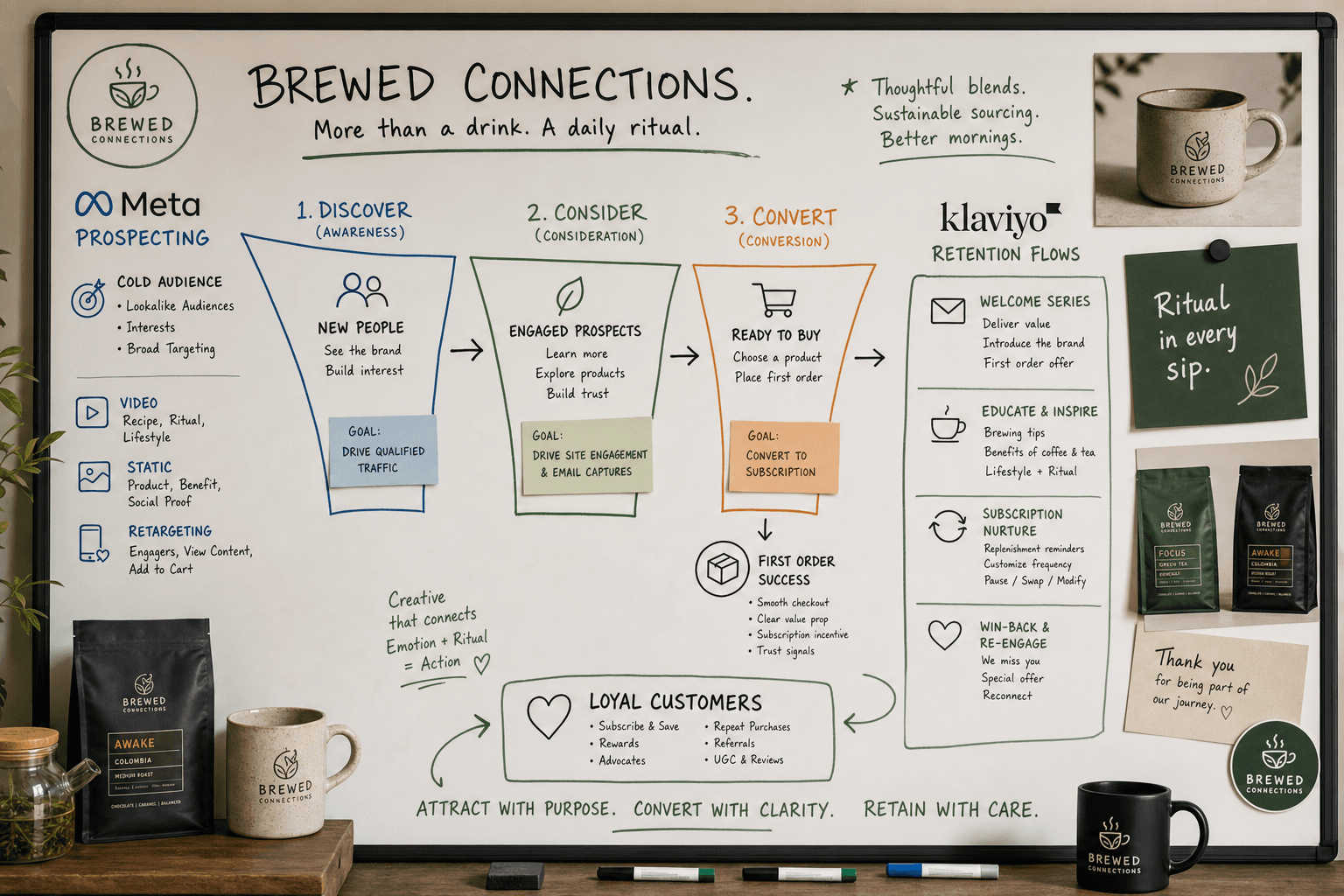
Fix measurement before you scale paid media: server-side tracking reconciled against Shopify, a true blended ROAS, and retention by acquisition channel.
Use Meta to prospect cold audiences matching your best subscriber profile, with fast creative tests on freshness, ritual, and sourcing; Google to capture high-intent queries like 'best light roast coffee subscription' and 'matcha shipped same day'; and TikTok as the emerging channel for matcha, functional tea, and founder-led brands.
Email is your primary retention lever: finish the Klaviyo architecture before scaling paid, including a post-purchase flow that eases over-stocking anxiety before it becomes a skip.
Time single-origin drops to harvest seasons (Ethiopian naturals in Q1, Kenyan AAs in Q3, a limited Geisha at BFCM) and give each a full-list email, a short paid burst, and organic social. Few brands do this yet; early movers own the category narrative.
Keep testing subscription conversion on the landing page and PDP, with skip/pause messaging above the fold.
Campaign ROAS is only a diagnostic. A 1.5:1 first-order ROAS on a subscriber acquisition campaign can be the right trade if month-3 retention is strong and LTV is climbing past the $187 base case.
The one number that governs this
Track LTV:CAC ≥3:1 as your north star, business-wide blended ROAS as the governing metric, and month-1 and month-3 retention by acquisition channel.
How We Help
How Sagum Executes This for Your Coffee or Tea Brand
We treat your LTV:CAC ratio like our own P&L. This is the sequence we'd run for a coffee or tea brand.
Attribution & Tracking Audit
We fix measurement before touching ad spend, starting with server-side tracking and blended ROAS reconciled to Shopify.
Paid Media Management (Meta, Google, TikTok)
We pace Meta prospecting to the season, run Google Search on high-intent queries, and use TikTok for matcha and functional tea while it's still underpriced.
Creative Production & Testing
We test AI-assisted creative on Meta and TikTok, retiring losers fast and finding winners before competitors testing 2–3 concepts a month notice them.
Email & SMS (Klaviyo Architecture)
We build or audit every Klaviyo flow, from welcome series through single-origin drops, and aim each at month-3 retention, the checkpoint that predicts long-term LTV:CAC.
Conversion Rate Optimization
We test landing pages and PDPs for subscription conversion and run continuous AI-assisted reviews for conversion leaks.
Subscription Retention Strategy
We surface cadence flexibility in Recharge, Skio, or Stay AI so over-stocked subscribers can pause instead of cancelling.
Who's Behind This
Who we are, and what makes us different
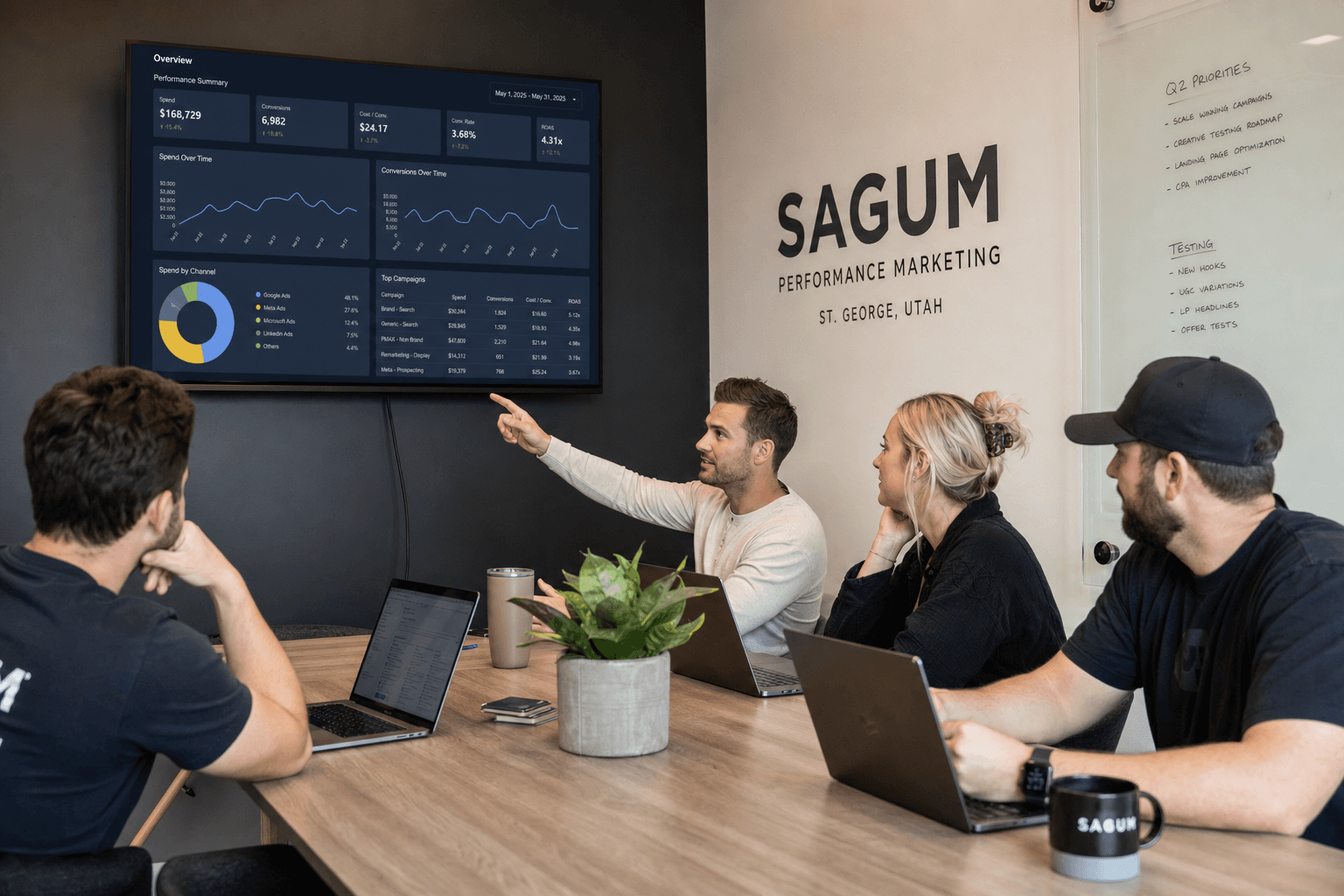
Sagum is a performance marketing agency founded in January 2017 in St. George, Utah. We've spent 8+ years growing real brands and being judged on KPIs, not vanity metrics.
We deliberately limit how many clients we take so each one gets senior attention. We treat your numbers like our own, we never run generic playbooks, and your strategy is built for your business, because shouldn't your brand's marketing be custom to your brand?
Sagum.ai is our AI arm: the same proven operators now build AI into the work wherever it creates real edge, not as theater, but as leverage applied with discipline.
- 8+ years growing brands on performance KPIs, not vanity metrics
- Limited client roster, with senior attention on every account
- An extension of your team; your success is tied to ours
- Custom strategy per brand, never a generic playbook
- AI built in where it moves a number; judgment over hype
“Sagum is a performance marketing agency that's spent 8+ years growing brands by treating their numbers like our own. We take on few clients, never run generic playbooks, and now build AI into the work wherever it creates real edge, not hype. Your strategy is built for your business, and our success is tied to yours.”
“Sagum roughly doubled our bottom line. They treat the work like it's their own business.”
Rachel Nilsson
CEO, RAGS
Proof
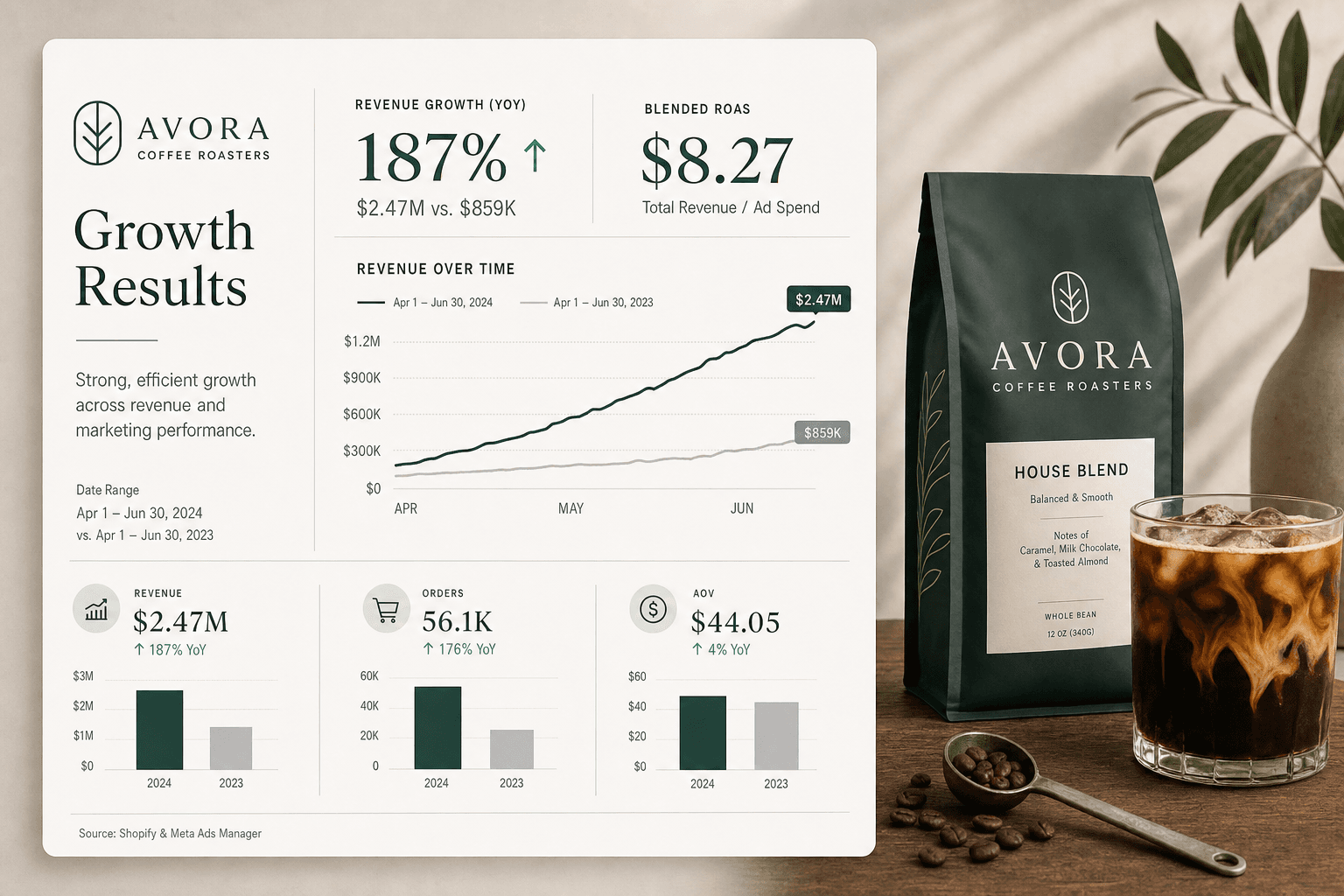
187% YoY, $8+ ROAS on Meta, +79% web conversion
Clean Monday Meals
Challenge
A food DTC brand needed to grow across channels, a goal most coffee and tea brands share.
What we did
We scaled Meta and took over email and Amazon, the same channel mix a coffee or tea brand can run.
Result
They grew 187% year-over-year, hit $8+ ROAS on Meta, and lifted web conversion rate by 79%.
Let's Acquire and Keep Subscribers Worth $187 or More Each
No obligation. We'll bring a read on your attribution, your seasonal opportunity, and where your LTV:CAC ratio has room to move, built around your brand, not a template.
Sagum · January 2017 · St. George, Utah · 8+ years