
8+ years growing brands on KPIs, now with AI
New Dental Patients Who Book, Show, and Stay
We build dental marketing that books implant, aligner, and hygiene patients at a profitable cost per visit.
Google Ads Partner · Meta Partner · 8+ years growing local service businesses


Get your free marketing audit
Senior strategist review · response within one business day
Prefer to reach out directly?
The Challenge
Dental Marketing Is Harder Than It Looks From the Outside
Your schedule lives and dies by a dozen variables no generic marketing agency accounts for. A patient moves into the zip code and searches 'dentist near me' on a Tuesday. Another is in acute pain at 7 p.m. on a Friday and calls whoever picks up. A third has been sitting on an implant consultation for six weeks, comparing your financing page to three competitors, and will book the practice that follows up first. These are three completely different funnels with three completely different urgencies, and most dental marketing treats them all the same.
Layer on the economics. Your overhead is running somewhere around 62 percent of collections. A PPO write-down on a crown case leaves you with a fraction of the production value. An implant or full-arch case, placed and restored in-house, can carry margins above 60 percent. That spread means your marketing dollars have to chase the right cases, not just any new patient.
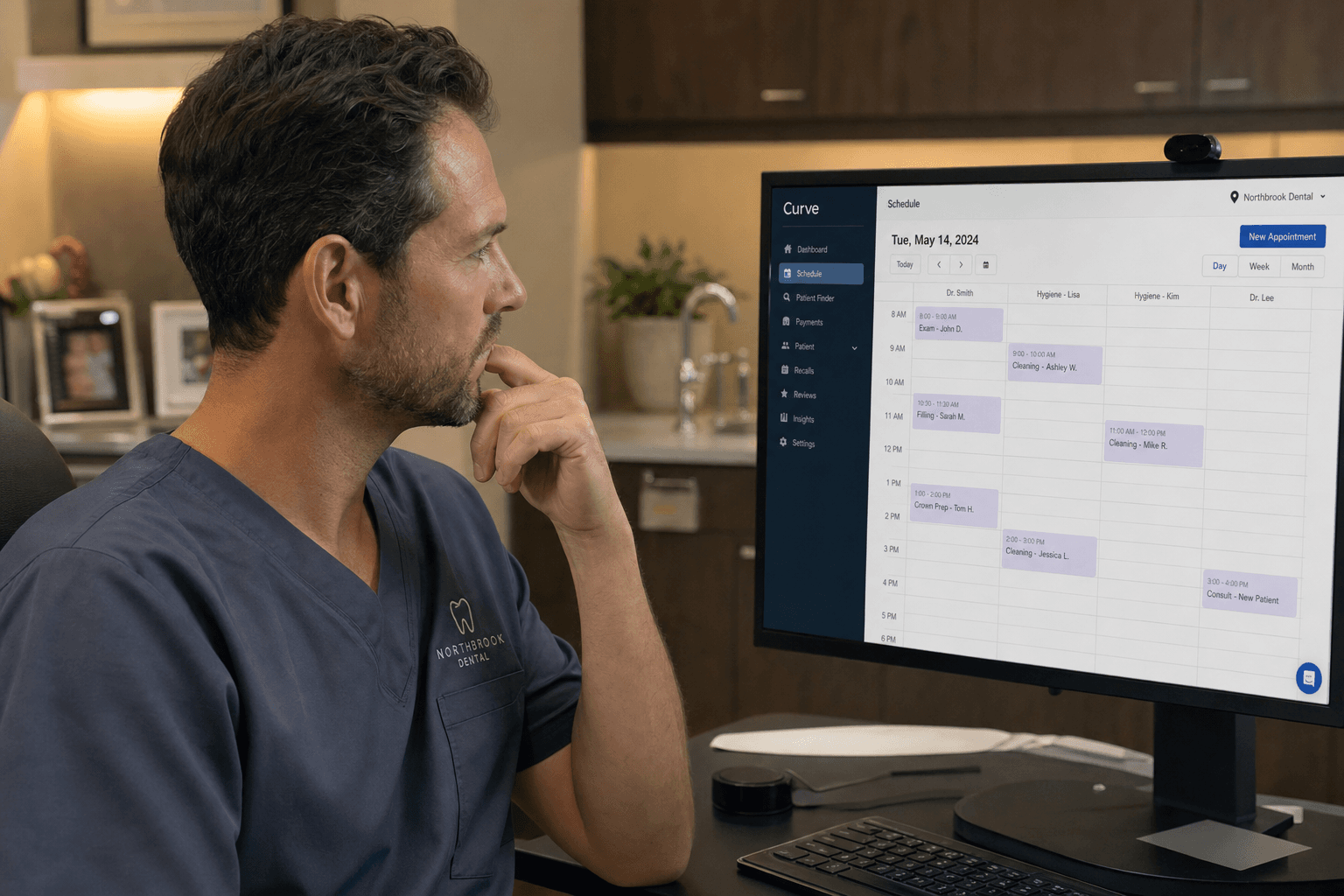
Then there is the front desk. A missed call with no text-back follow-up is a lost patient. An online form submission that sits unanswered for two hours goes to the practice that responded in five minutes. The best-performing ad campaign in your market cannot overcome a phone that rings out or a front desk that is too busy to call back a web inquiry before the patient books somewhere else.
Add HIPAA-safe tracking requirements, state dental board rules on specialty claims, DSO competition with larger ad budgets, and the year-end insurance rush that compresses your highest-revenue window into ten weeks, and you have a marketing environment that punishes guesswork and rewards precision.
The Opportunity
The Demand Is There. The Question Is Whether You Capture It.
In your local market, patients are searching for implants, emergency care, Invisalign, and a new family dentist every single day. The average dental implant case generates $3,000 to $5,000 in revenue. A full-arch reconstruction runs $22,000 to $60,000. A general new patient, properly retained, is worth many times their first visit over their lifetime with your practice. This is not a market with thin margins chasing low-value clicks. It is a market where winning one more implant case per month from your ad spend can change the shape of your year.
The practices capturing that demand are not necessarily the best clinicians in the market. They are the ones showing up in the Google Local Pack with a 4.8-star rating and 200-plus reviews, running service-specific landing pages for implants and emergency care that load fast and have a click-to-call button above the fold, and following up every missed call with an automated text within three minutes.
The year-end insurance window alone, October through December, is a concentrated revenue opportunity that most practices underinvest in. Patients who have been putting off a crown or a consultation all year are suddenly motivated by a hard deadline. The practices that run explicit 'use your benefits before they expire' messaging in Q4 and have the scheduling capacity to absorb the surge capture cases that competitors leave on the table.
There is also a reactivation opportunity sitting inside your own patient database. Patients lapsed 12 to 18 months who have not responded to a postcard often respond to a well-timed SMS with an insurance-benefit urgency message. This is the highest-ROI tactic in dental marketing because the acquisition cost is effectively zero.
What Most Get Wrong
What Most Dental Practices and Their Agencies Get Wrong
Running one campaign for every patient type
Emergency, implant, hygiene, and cosmetic patients have nothing in common except that they have teeth. Mixing them into a single campaign means your expensive implant keywords are competing with your cheap general dentistry clicks in the same budget pool, your ad copy is too vague to speak to any one intent, and your landing page is a homepage that converts at a fraction of the rate of a service-specific page.
Tracking form fills and calls as 'leads' without scoring them
A call from someone asking about teeth whitening pricing and a call from someone who needs a same-day extraction are not the same lead. Practices that report aggregate call volume have no idea which campaigns are generating booked, seated patients versus tire-kickers. Without call scoring and front-desk attribution, you cannot optimize toward cost per new patient visit, which is the only number that matters.
Ignoring Google Business Profile while spending on ads
The Local Pack appears above paid search results. A patient searching 'dentist near me' sees your GBP listing before they see your ad. Practices that neglect weekly posts, photo uploads, and review responses are paying for clicks that land below a competitor with a stronger organic presence. GBP is the highest-impact asset per location and the most commonly neglected.
No missed-call text-back or after-hours response
New patients consistently cite responsiveness as a key factor in choosing a provider. An emergency patient who calls at 6:45 p.m. and reaches voicemail will book the next practice on the list within minutes. A missed call with no automated text-back follow-up is not a lead that bounced. It is a patient who chose your competitor.
Using HIPAA-non-compliant tracking or making specialty claims that violate state board rules
Standard Google Analytics and Meta Pixel implementations can capture protected health information if they fire on appointment confirmation pages or intake forms. A board complaint over an unsubstantiated specialty claim in ad copy can cost more than a year of marketing spend. These are not edge cases. They are the compliance gaps that sink practices that move fast without a partner who knows dental advertising rules.
Why Now
Why the Next 90 Days Are the Right Window to Move
The year-end insurance rush is the single most predictable revenue window in dentistry. Patients who have been sitting on a crown recommendation, an implant consultation, or a clear aligner case all year become motivated buyers the moment they realize their benefits expire December 31. The practices that have their campaigns, landing pages, and front-desk workflows ready before October 1 capture the surge. The ones that scramble in November compete for the scraps.
At the same time, the competitive landscape in local dental search is shifting faster than most practice owners realize. AI-driven bid management now lets a disciplined operator adjust spend by service type, time of day, and local demand signal in ways that a manually managed campaign simply cannot match. A competitor running static monthly budgets on a broad keyword list is not the same threat they were two years ago. The gap between a well-run AI-assisted campaign and a set-and-forget campaign is widening every quarter.
Local Service Ads for dentists are still underutilized in most mid-size markets. LSAs appear above traditional paid search results, carry a Google Verified badge that builds immediate trust, and operate on a pay-per-lead model rather than pay-per-click. Practices that establish strong LSA profiles now, before more competitors enter the format, are buying lead volume at costs that will be harder to achieve once competitors catch up.
The practices that build the right infrastructure now, proper tracking, service-specific campaigns, automated follow-up, and a review generation system, enter peak season with a compounding advantage. The ones that wait are building it while the window is closing.
The Mechanism
Where AI Creates a Real Edge in Dental Marketing
Real productivity, not AI theater. Here's where it actually moves a number for dentists.
Digital Ads
What AI does: AI-driven bid management adjusts spend by service type, time of day, day of week, and local search volume in real time, without manual intervention between campaign reviews.
The result: Implant and emergency campaigns get more budget during the hours and days when high-intent patients are actually searching, rather than running a flat daily budget that burns through spend during low-conversion windows.
Why it matters here: In dental, the difference between a $150 cost per new patient and a $400 cost per new patient is often not the keyword list. It is whether your budget is concentrated in the hours your front desk can actually answer and convert the call. AI bid management closes that gap.
Conversion Optimization
What AI does: AI tools analyze landing page behavior, call recording transcripts, and form completion patterns to identify where prospective patients drop off before booking, then surface specific fixes.
The result: Service-specific landing pages for implants, emergency care, and Invisalign are continuously tested and refined, driving higher call and form conversion rates without requiring manual A/B test cycles that take months.
Why it matters here: A dedicated implant landing page that converts at 12 percent versus one that converts at 5 percent means you are booking more than twice as many consultations from the same ad spend. For a case worth thousands of dollars, that difference can pay for the entire marketing program.
Analytics and Attribution
What AI does: AI-assisted call scoring and attribution connect every booked patient back to the specific campaign, keyword, and ad that generated the call, while flagging HIPAA compliance risks in the tracking setup.
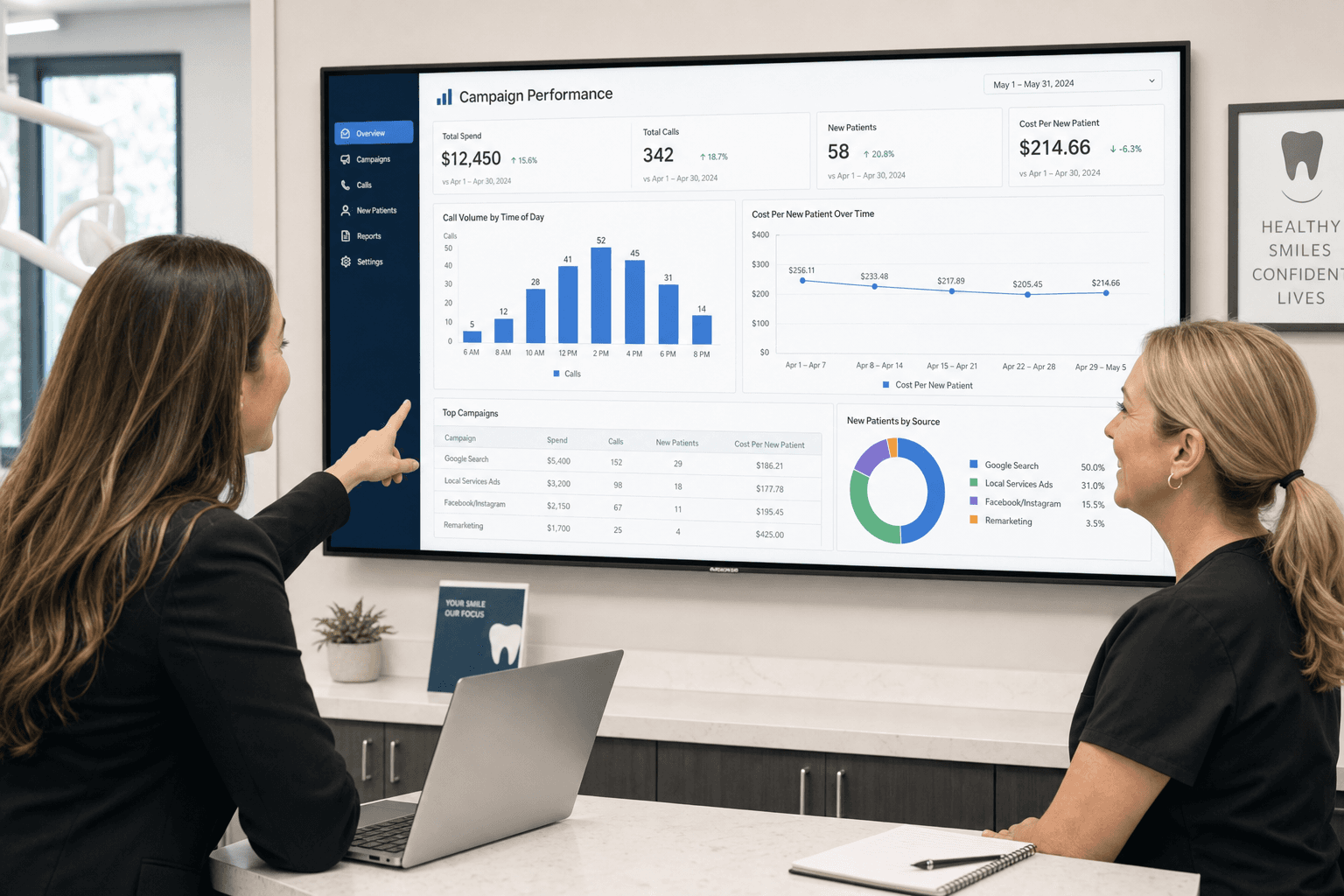
The result: You know which campaigns are producing seated patients at a profitable cost per new patient visit, not just which ones are generating call volume. Attribution errors that inflate reported performance are caught before they cause you to scale the wrong campaign.
Why it matters here: Dental practices routinely over-invest in campaigns that generate high call volume from low-quality inquiries, and under-invest in the campaigns that are quietly booking implant consultations. Clean attribution fixes that. It also helps keep your tracking setup on the right side of HIPAA.
Creative
What AI does: AI tools generate and test multiple ad copy variations per service line simultaneously, identifying which headlines, offers, and urgency triggers produce the highest click-to-call rates for each patient segment.
The result: Instead of running one or two ad variants for three months before reviewing performance, you are testing five to ten angles per service line per month and rotating to winners faster.
Why it matters here: For implant campaigns, the difference between 'dental implants starting at $X' and 'same-day implant consultations, financing available' can be a real difference in click-through rate. For year-end insurance campaigns, the right urgency message in October versus November can mean the difference between capturing the surge and reacting to it.
Ready to see what this looks like for your dentists business?
No obligation. A senior strategist will show you exactly where the wins are.
The Strategy
How Dental Marketing Should Actually Be Built
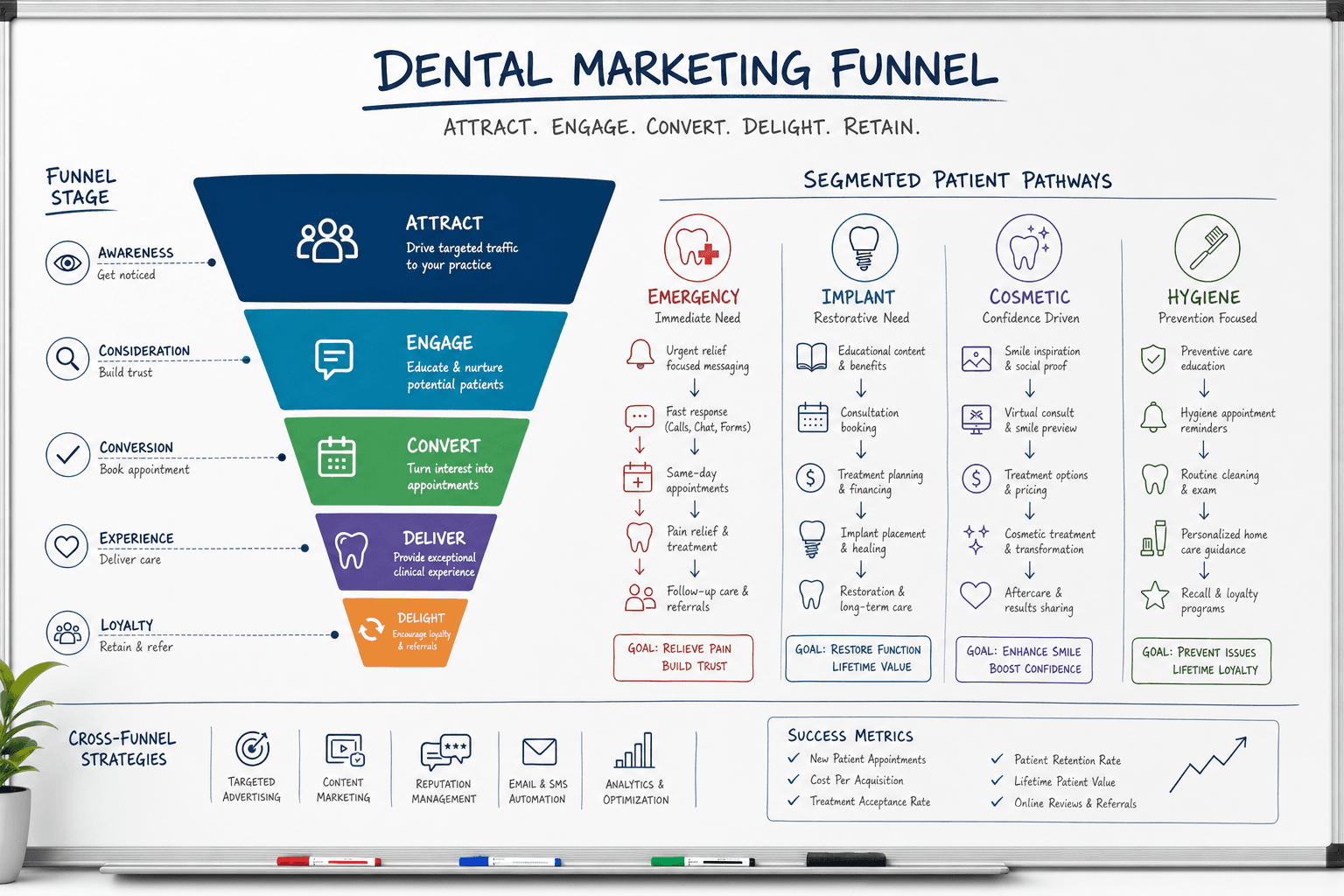
The foundation is segmentation. Emergency, implant, cosmetic, aligner, and general hygiene patients are different buyers with different urgencies, different keyword sets, and different landing page requirements. Every campaign structure starts by separating these into distinct ad groups with dedicated landing pages and dedicated phone tracking numbers. Mixing them is how practices end up with a blended cost-per-lead number that tells them nothing about which cases they are actually winning.
Google Business Profile optimization comes before any paid spend. The Local Pack is the first thing a patient searching 'dentist near me' sees. Weekly posts, consistent photo uploads, active review responses, and accurate service listings are non-negotiable. For multi-location practices, each location needs its own GBP, its own local phone number for call tracking, and its own review generation workflow.
Google Local Service Ads run alongside Search campaigns, not instead of them. LSAs carry a Google Verified badge and appear above traditional paid results. For general dentistry and emergency in most markets, they produce steady lead flow with built-in trust signals. Search campaigns cover the high-value, high-intent terms where LSAs do not give you enough creative control, particularly for implants and Invisalign.
Every phone number on every ad, landing page, and GBP listing is a tracked number that routes through call scoring. Front-desk calls are reviewed for booking conversion rate, not just call volume. Missed calls trigger an automated text-back within three minutes. This is not optional infrastructure. It is the difference between a campaign that looks like it is working and one that is actually filling chairs.
Reactivation campaigns run continuously in the background, targeting patients lapsed 12 to 18 months with insurance-benefit urgency messaging. In Q4, those campaigns shift to explicit year-end benefit expiration copy. In May and June, cosmetic and aligner campaigns target life-event audiences on Meta and Instagram. The calendar drives the message, not a generic evergreen offer.
SEO and service-page content build long-term cost efficiency. A well-ranked implant page or emergency dentist page generates patients at a lower acquisition cost than paid search alone. Paid and organic work together, not in competition.
The one number that governs this
The governing KPI is cost per new patient visit for general and hygiene cases, and cost per completed implant or aligner consultation for high-value segments. Call volume and form fills are inputs, not outcomes.
How We Help
What We Would Actually Build for Your Practice
Here is how we map Sagum's capabilities onto the strategy above for a dental practice. We start with the infrastructure that makes everything else measurable, then build the campaigns that fill the specific segments your practice needs most.
HIPAA-Safe Tracking and Call Attribution Setup
Before any campaign goes live, we audit your existing tracking for HIPAA compliance risks and rebuild attribution so every booked patient traces back to the campaign and keyword that generated the call. This is the foundation. Without it, every optimization decision is a guess.
Google Business Profile Management (Per Location)
We manage weekly posts, photo uploads, review response cadence, and service listing accuracy for each location. GBP is the highest-impact asset in local dental search and the one most practices let drift.
Google Local Service Ads
We set up and manage LSA profiles for each location, complete the screening for the Google Verified badge, and dispute invalid leads so you are not paying for spam.
Segmented Google Search Campaigns
Separate campaigns and ad groups for implants, Invisalign, emergency, cosmetic, and general hygiene, each with dedicated budgets, keyword lists, and landing pages. AI bid management adjusts spend by time of day and demand signal in real time.
Service-Specific Landing Pages with Click-to-Call
We build and continuously optimize dedicated pages for each service line, each with a tracked phone number, online scheduling integration, insurance and financing messaging, and conversion testing running in the background.
Missed-Call Text-Back and Front-Desk Conversion Support
Automated missed-call text-back within three minutes, plus call scoring to measure front-desk booking conversion rate. We identify where calls are being lost between the ad click and the booked appointment.
Reactivation and Recall Email and SMS Campaigns
Ongoing reactivation campaigns targeting lapsed patients, with messaging that shifts to year-end insurance benefit urgency in Q4 and cosmetic or aligner offers in the spring and summer trough.
Meta and Instagram Ads for Cosmetic and Aligner Cases
Policy-compliant before-and-after creative campaigns targeting adult life-event audiences for veneers, whitening, and Invisalign. Meta is the right channel for cosmetic intent where search volume is lower but visual creative drives consultation requests.
Review Generation System
Automated post-visit review request sequences for Google and Healthgrades, designed to build the rating and review volume that makes your GBP listing the obvious choice over DSO competition in the Local Pack.
Who's Behind This
Who we are, and what makes us different
Sagum is a performance marketing agency founded in January 2017 in St. George, Utah. We've spent 8+ years growing real brands and being judged on KPIs, not vanity metrics.
We deliberately limit how many clients we take so each one gets senior attention. We treat your numbers like our own, we never run generic playbooks, and your strategy is built for your business, because shouldn't your brand's marketing be custom to your brand?
Sagum.ai is our AI arm: the same proven operators now build AI into the work wherever it creates real edge, not as theater, but as leverage applied with discipline.
- 8+ years growing brands on performance KPIs, not vanity metrics
- Limited client roster, with senior attention on every account
- An extension of your team; your success is tied to ours
- Custom strategy per brand, never a generic playbook
- AI built in where it moves a number; judgment over hype
“Sagum is a performance marketing agency that's spent 8+ years growing brands by treating their numbers like our own. We take on few clients, never run generic playbooks, and now build AI into the work wherever it creates real edge, not hype. Your strategy is built for your business, and our success is tied to yours.”

“After six years, Sagum is our most important partner: trusted, communicative, and caring about our business as if it's their own.”
Proof
From a $20 CPL goal to $13 CPL and 300+ leads/mo
Rizzoli's Automotive
Challenge
A local auto service business came to us with a goal of 100 qualified leads per month at roughly a $20 cost per lead, and needed a paid search program that could hit both numbers.
What we did
We built a dedicated conversion-focused landing page designed to drive phone calls and rebuilt their paid search around high-intent service queries.
Result
Cost per lead dropped to $13, monthly lead volume grew past 300, and landing page conversion exceeded 60 percent. The client opened multiple new locations on the back of the growth. The same model, high-intent campaigns and call-driving conversion design, is what we would build for your practice.

- Cost per lead
- $13
- Leads / month
- 300+
- Landing-page conversion
- 60%+
Find Out What Your Practice Is Leaving on the Table
No obligation. We review your current campaigns, tracking setup, and local search presence, then show you specifically where new patient volume and case value are leaking. Built around your practice, your market, and your service mix.
Sagum · January 2017 · St. George, Utah · 8+ years