
8+ years growing brands on KPIs, now with AI
Fill Your Dermatology Schedule Profitably
Separate medical and cosmetic funnels, built around how patients actually find and choose a dermatologist.
8+ years growing local-service businesses | Google, Meta, TikTok


Get your free marketing audit
Senior strategist review · response within one business day
Prefer to reach out directly?
The Challenge
Two Completely Different Patients. One Schedule to Fill.
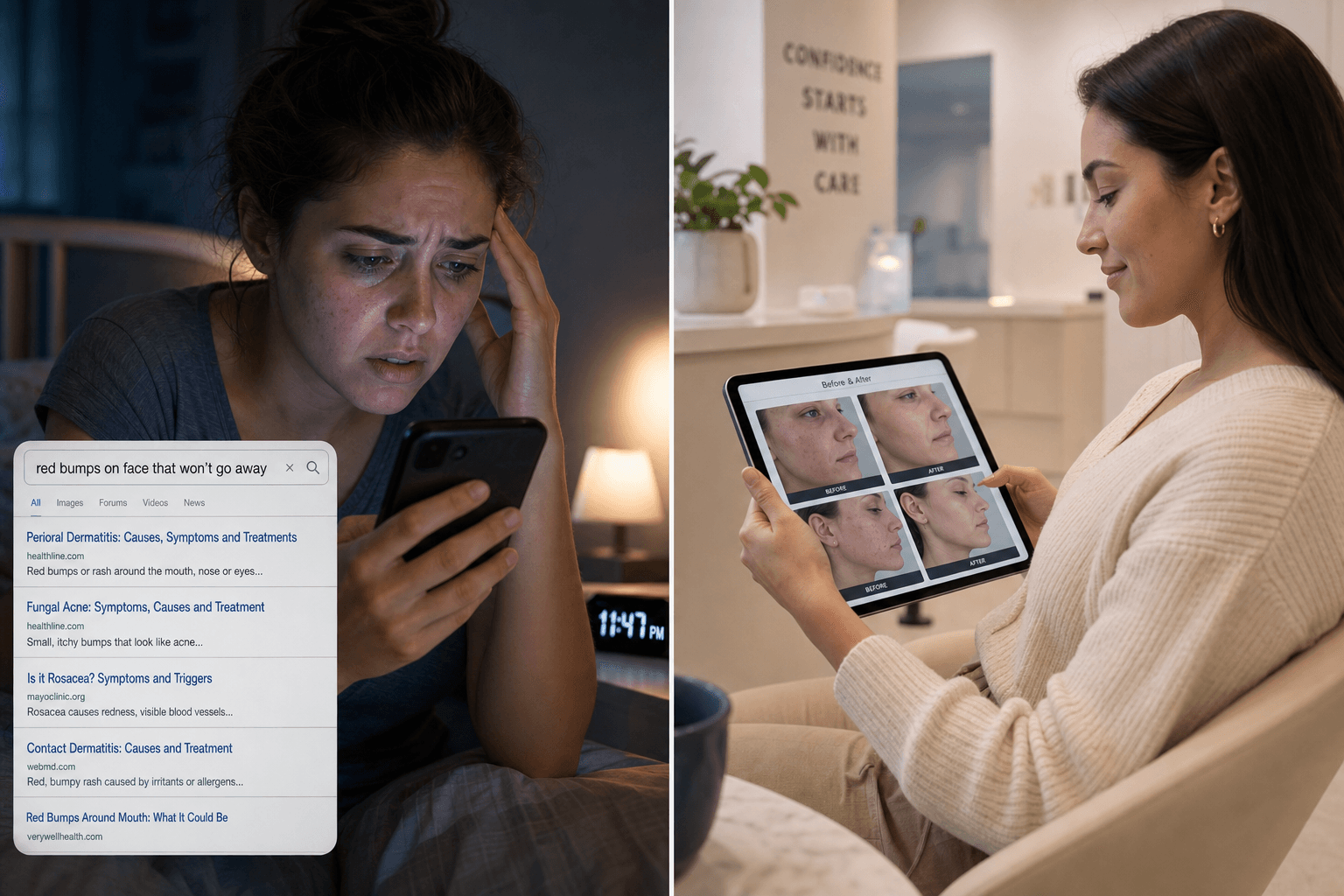
The insured medical patient does not browse. She found a new mole last Tuesday, called her PCP, got a referral, and is now searching 'dermatologist accepting new patients near me' at 8 p.m. from her phone. She will book with whoever picks up, responds fastest, or has online scheduling that works tonight. If your front desk is closed and your booking link is buried, she books with the practice down the street.
The cosmetic patient is a completely different person making a completely different decision. She has been watching your competitor's injector on Instagram for six weeks. She has read 40 Google reviews across three practices. She is comparing before-and-afters, scrutinizing provider credentials, and calculating whether the drive is worth it. Price matters, but so does trust in the specific provider who will put a needle in her face.
Running one marketing strategy for both of these buyers is one of the most expensive mistakes a dermatology practice can make. The keywords, the creative, the landing pages, the KPIs, and the conversion path are fundamentally different. Yet most practices run a single Google Ads campaign, a generic website, and a Facebook page with clinic announcements, and wonder why the cosmetic column stays half-empty while the medical schedule fills with low-reimbursement visits.
Add to this the pressure of PE-backed groups entering your market with budgets and operational infrastructure you cannot match head-to-head. The share of physicians in private practice dropped from 60% in 2012 to 42% in 2024. Independent practices that do not build a marketing engine built for their specific payer mix and service mix are not just leaving money on the table. They are losing ground they will not recover.
The Opportunity
The Schedule You Want Is Already Searching for You
On Zocdoc, three out of five dermatology bookings are for appointments within eight days. Patients who can find availability book fast. A private practice that surfaces the right information at the right moment, accepts online booking, and responds within the hour wins those appointments before the PE-backed group across town even returns the call.
The cosmetic opportunity is even more concrete. A patient who books Botox every three to four months is recurring injectable revenue on her own, and her value compounds over years of maintenance visits. They are loyal to a specific provider, not a clinic, which means an independent practice with a credible, visible injector has a real advantage over a corporate group where staff turns over.
Most dermatology practices are also sitting on an underactivated cosmetic lead source: their own medical patients. A systematic cross-sell program converts a meaningful share of medical patients to cosmetic procedures within a year. The patient already trusts your practice. She just has not been told, in the right moment and the right way, that you also do the treatment she has been researching online.
The practices capturing this opportunity are not spending more. They are spending smarter: separating medical and cosmetic funnels, measuring every dollar against cost per booked appointment rather than clicks or impressions, and building recall and retention programs that recover the active patients most practices lose to attrition every year without noticing.
What Most Get Wrong
What Most Dermatology Practices Get Wrong with Marketing
Running one campaign for two completely different buyers
A single Google Ads campaign mixing 'skin check near me' and 'Botox near me' keywords wastes budget on the wrong intent signals, sends both patient types to a generic homepage, and converts neither well. Medical and cosmetic funnels need separate keywords, separate landing pages, separate KPIs, and separate creative. Blending them inflates your cost per booked appointment across the board.
Measuring clicks and form fills instead of kept appointments
A $50 lead that books and shows at a 20% rate is a $250 patient acquisition cost. Practices that optimize for form fills or calls without tracking whether those calls converted to confirmed, kept appointments are optimizing for the wrong number. You can have a 'great' CPL and a terrible cost per booked new patient if your front desk conversion rate is poor or your no-show rate is high.
Ignoring HIPAA-safe tracking and violating healthcare ad policies
Sending health-condition data to ad platforms through standard pixel events can be a HIPAA violation and is a Meta policy violation. Practices that install a standard Google or Meta pixel without a healthcare-compliant configuration are exposing themselves to regulatory risk and likely getting their ad accounts flagged or suspended. Privacy-safe conversion tracking is not optional in this vertical.
Neglecting Google Business Profile and local SEO for each location
Multi-location groups that run a single GBP or a single practice page lose local relevance for every location beyond the primary one. A patient searching 'dermatologist accepting new patients in [neighborhood]' will not find your satellite office if it does not have its own optimized profile, its own insurance-accepted page, and its own location-specific content. Each location is its own local SEO problem.
Using the same budget and creative year-round regardless of seasonality
Skin checks and mole mapping spike May through August. Laser and resurfacing procedures (Fraxel, CO2, IPL) are cooler-month services because patients need sun avoidance during healing. Injectables spike pre-holiday and pre-summer. A flat monthly ad budget running the same creative in every season misses the peaks where ROI is highest and wastes spend in troughs where intent is low.
Why Now
Why Independent Practices That Move Now Will Own Their Market
PE-backed dermatology groups have scale, but they have a blind spot: their marketing is built for volume, not differentiation. They run broad campaigns with generic creative because customizing by location, by provider, and by service line is operationally difficult at their size. An independent practice that builds a precise, segmented marketing engine right now can out-compete them on the searches that matter most.
The AI inflection point makes this more achievable than it has ever been. Testing five creative angles for a cosmetic campaign used to take months and a large budget. Today it takes days. Shifting budget toward the campaigns that are actually booking appointments, rather than the ones that look good in a report, used to require a full-time analyst. Today it is a system running continuously in the background.
The timing within dermatology is specific: summer skin-check season is the highest-intent medical window of the year, and the pre-holiday injectable spike is the highest-revenue cosmetic window. Practices that build and tune their funnels before those windows open capture the demand. Practices that start after the peak scramble to catch up.
The competitive vacuum for independent practices is real. Med spas are not set up for Mohs, biopsies, or medical dermatology. PE groups cannot offer the provider continuity and personal relationship that keeps a cosmetic patient loyal for a decade. Those are structural advantages. The question is whether your marketing makes them visible to the patients who are searching right now.
The Mechanism
Where AI Creates a Real Advantage for Dermatology Practices
Real productivity, not AI theater. Here's where it actually moves a number for dermatologists.
Digital Ads
What AI does: AI bidding systems adjust bids in real time based on search intent signals, time of day, device, and historical conversion data, separately for medical and cosmetic campaigns.
The result: Budget flows toward the searches that are actually booking appointments rather than the searches that generate calls that never convert.
Why it matters here: In dermatology, a 'skin check' search at 8 p.m. on a mobile device from a patient 10 miles away has a completely different conversion probability than the same search at 2 p.m. on a desktop. Static bidding treats them identically. AI bidding does not.
Creative
What AI does: Generate and systematically test multiple ad creative angles per week for cosmetic campaigns, including different injector-led video formats, before-and-after framing (within platform policy), and offer structures, rather than running one ad for months.
The result: Identify the creative that drives cosmetic consultation requests in weeks rather than quarters, and retire underperforming angles before they drain budget.
Why it matters here: Cosmetic patients are comparison-shopping across Instagram and TikTok for weeks before calling. The practice whose creative stops the scroll and builds provider trust during that research phase wins the consultation request. One static ad running for three months will not do that.
Analytics
What AI does: Build privacy-safe, HIPAA-compliant conversion tracking that routes appointment and call data back to the ad platforms that allow it, without exposing protected health information, and audit the full funnel from click to kept appointment.
The result: Know your actual cost per booked new patient, not your cost per form fill, and identify exactly where the funnel is leaking, whether that is ad click-through, landing page conversion, front-desk call conversion, or no-show rate.
Why it matters here: Many dermatology practices leave a large share of calls unanswered, then lose more callers between the front desk and a booked visit. You cannot fix what you cannot see. Compliant attribution that traces a patient from search query to kept appointment is the foundation of every other optimization.
Conversion Optimization
What AI does: Build and continuously test separate landing pages for medical intent (insurance accepted, conditions treated, online booking, wait time) and cosmetic intent (provider credentials, before-and-after gallery, consultation offer, reviews), with AI reviewing each page for conversion leaks.
The result: Higher landing-page-to-booking rates for both funnels, measured separately, so you know which service lines are converting and which are losing patients at the page level.
Why it matters here: A medical patient landing on a page that leads with Botox pricing will leave. A cosmetic patient landing on a page about eczema treatment will leave. Sending both to your homepage is the single most common and most expensive conversion mistake in dermatology marketing.
What AI does: Build automated recall sequences for medical patients due for annual skin checks, post-visit cosmetic follow-up sequences that introduce injectable and laser services, and seasonal campaign triggers tied to your procedure calendar (laser push in September, injectable push in October).
The result: Recover a meaningful share of the active patients most practices lose to attrition annually, and activate the medical patients who are open to cosmetic procedures.
Why it matters here: Your existing patient list is the highest-converting cosmetic lead source in your practice. They already trust you. Automated, well-timed email sequences turn that trust into booked cosmetic consultations at a fraction of the cost of paid acquisition.
Ready to see what this looks like for your dermatologists business?
No obligation. A senior strategist will show you exactly where the wins are.
The Strategy
What a Dermatology Marketing Strategy Actually Looks Like
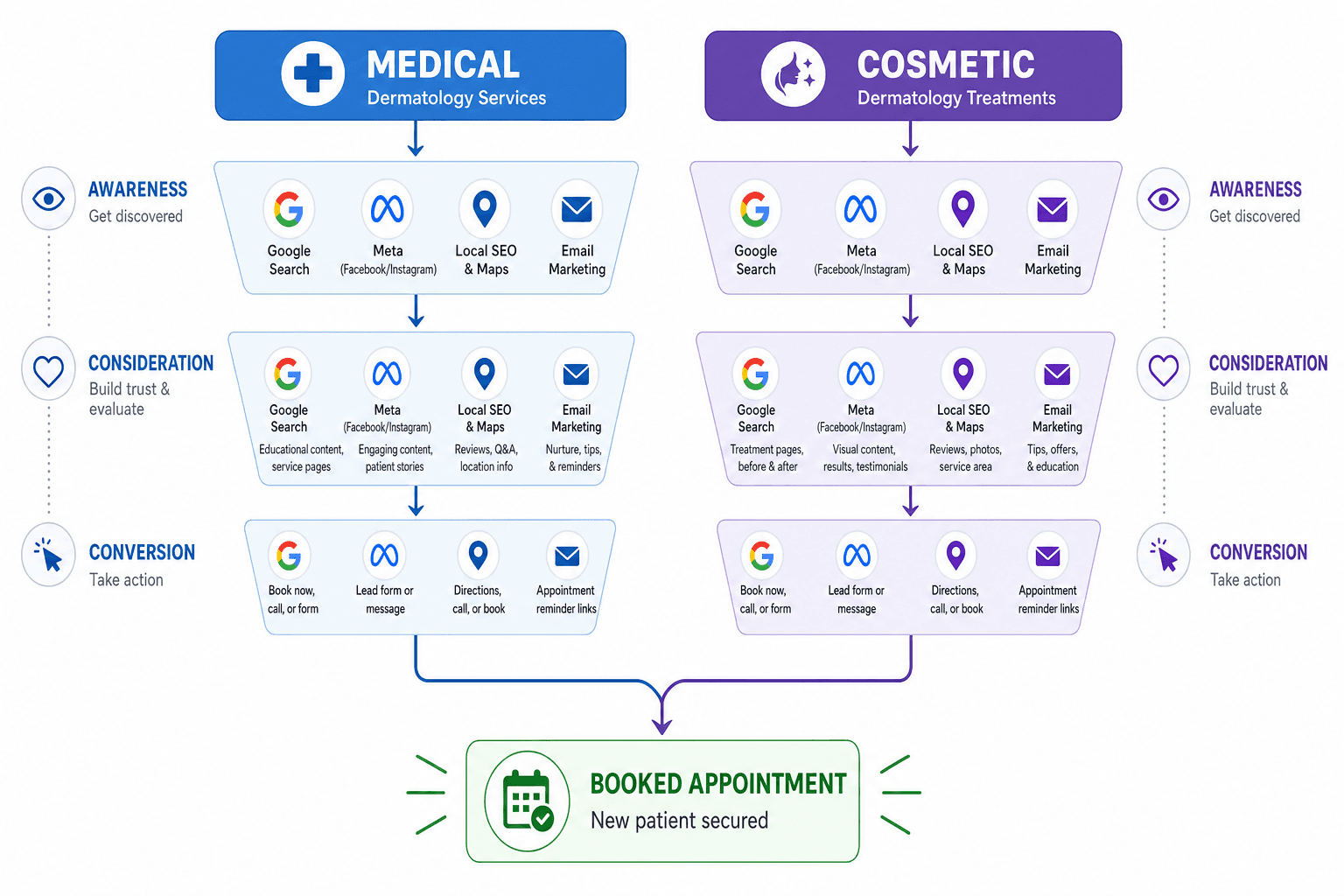
The foundation is separation. Medical and cosmetic funnels are run as distinct campaigns with distinct keywords, distinct landing pages, distinct creative, and distinct KPIs. Blending them is the fastest way to get mediocre results in both.
For the medical funnel: Google Search Ads targeting high-intent condition and availability queries ('dermatologist accepting new patients [city],' 'skin cancer screening near me,' 'Mohs surgery [city]') paired with a landing page that leads with insurance accepted, conditions treated, and an online booking CTA. Google Business Profile optimized per location with current hours, insurance lists, and review response cadence. Local SEO with condition-specific pages for eczema, acne, psoriasis, and Mohs, each targeting the city or neighborhood the location serves. Budget paced to seasonal demand: heavier spend April through August for skin checks, pulled back in the January trough.
For the cosmetic funnel: Meta (Instagram and Facebook) paid social with video creative featuring the injector, before-and-after content with signed consent, and targeting women 28 to 55 within 15 miles of each location in higher-income ZIP codes. Google Search Ads for procedure-specific queries ('wrinkle relaxer near me,' 'laser skin resurfacing [city],' 'lip filler [city]'). Meta retargeting audiences built from website visitors and video viewers who have not yet requested a consultation. Budget spiked pre-holiday (October through December) and pre-summer (April through May) when cosmetic intent peaks.
Across both funnels: HIPAA-compliant conversion tracking that routes appointment data back to the ad platforms that allow it, without exposing protected health information. Call tracking on every campaign so you know which ads are ringing the phone. Front-desk conversion monitoring so you can see whether calls are becoming booked appointments. Automated recall and cross-sell email sequences running continuously in the background.
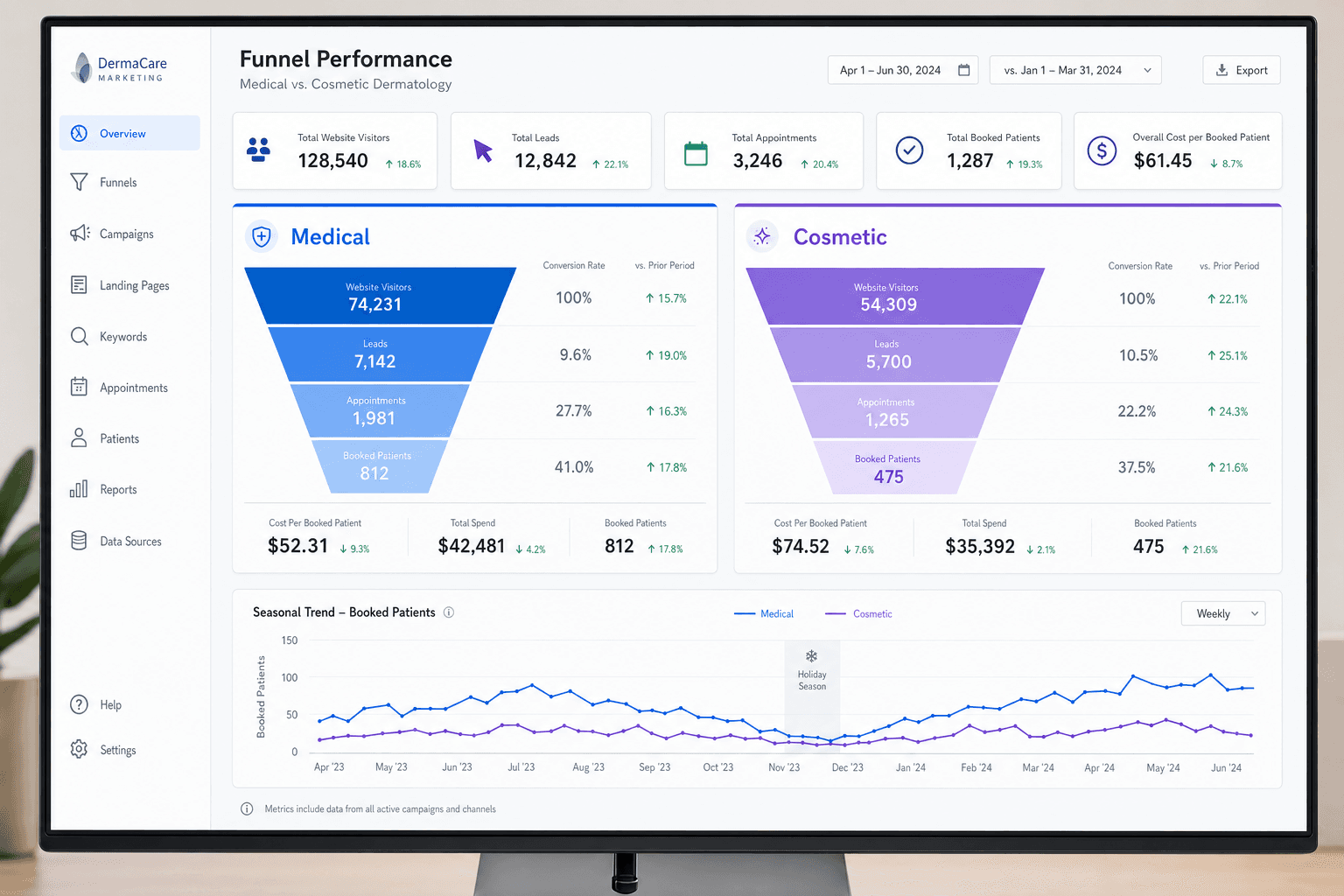
Everything is measured against one number per funnel: cost per booked new medical patient and cost per completed cosmetic consultation. Not clicks. Not impressions. Not form fills. Appointments.
The one number that governs this
Governing KPIs: cost per booked new patient (medical funnel) and cost per completed cosmetic consultation (cosmetic funnel), tracked from ad click to kept appointment.
How We Help
How We Execute This for Your Practice
We start by understanding your current patient mix, your target payer mix, your provider capacity, and where your schedule has the most room to grow. Then we build the funnels in the right sequence, so every dollar is working before we add the next layer.
HIPAA-Compliant Conversion Tracking Setup
Before any campaign runs, we configure privacy-safe tracking that routes appointment and call data to the ad platforms that allow it, without exposing protected health information. This is the foundation. You cannot optimize what you cannot measure, and you cannot measure in dermatology without getting the compliance layer right first.
Google Search Ads (Medical and Cosmetic, Separated)
We build and manage distinct Google Search campaigns for medical intent (condition queries, availability queries, insurance queries) and cosmetic intent (procedure queries, provider queries). Separate ad groups, separate landing pages, separate bid strategies, separate budgets paced to your seasonal demand calendar.
Meta Paid Social (Cosmetic Funnel)
We build and test Instagram and Facebook campaigns targeting the cosmetic patient profile, using provider-led video creative, before-and-after content within platform policy, and retargeting sequences for patients who have engaged but not yet booked a consultation.
Local SEO and Google Business Profile Management
Condition-specific landing pages, insurance-accepted pages, and location-specific content for each office, paired with GBP optimization per location. This is the highest-ROI channel for insured medical patients and the one most independent practices underinvest in relative to paid search.
Landing Page Build and Conversion Optimization
Separate landing pages for medical and cosmetic campaigns, each built around the specific decision factors of that patient type. Continuous testing of page elements, booking CTAs, and trust signals, with AI reviewing each page for conversion leaks on an ongoing basis.
Email Automation (Recall, Cross-Sell, and Seasonal Campaigns)
Automated recall sequences for annual skin checks, post-visit cosmetic introduction sequences for medical patients, and seasonal triggers tied to your procedure calendar. Built to run continuously without requiring staff time to manage.
Analytics and Attribution Reporting
A single reporting view showing cost per booked new patient and cost per cosmetic consultation across every channel, with funnel-stage breakdowns so you can see where patients are dropping off, whether that is the ad, the landing page, the call, or the front desk.
Who's Behind This
Who we are, and what makes us different
Sagum is a performance marketing agency founded in January 2017 in St. George, Utah. We've spent 8+ years growing real brands and being judged on KPIs, not vanity metrics.
We deliberately limit how many clients we take so each one gets senior attention. We treat your numbers like our own, we never run generic playbooks, and your strategy is built for your business, because shouldn't your brand's marketing be custom to your brand?
Sagum.ai is our AI arm: the same proven operators now build AI into the work wherever it creates real edge, not as theater, but as leverage applied with discipline.
- 8+ years growing brands on performance KPIs, not vanity metrics
- Limited client roster, with senior attention on every account
- An extension of your team; your success is tied to ours
- Custom strategy per brand, never a generic playbook
- AI built in where it moves a number; judgment over hype
“Sagum is a performance marketing agency that's spent 8+ years growing brands by treating their numbers like our own. We take on few clients, never run generic playbooks, and now build AI into the work wherever it creates real edge, not hype. Your strategy is built for your business, and our success is tied to yours.”

“After six years, Sagum is our most important partner: trusted, communicative, and caring about our business as if it's their own.”
Proof
From a $20 CPL goal to $13 CPL and 300+ leads/mo
Rizzoli's Automotive
Challenge
The client, a local auto service business, came to us with a goal of 100 qualified leads per month at roughly a $20 cost per lead, and needed a paid search program that could hit both numbers.
What we did
We restructured paid search around the highest-intent service queries and launched a purpose-built landing page designed to drive phone calls rather than general traffic.
Result
Cost per lead dropped to $13, monthly lead volume exceeded 300, and landing-page conversion broke 60%. The client went on to open multiple new locations.

- Cost per lead
- $13
- Leads / month
- 300+
- Landing-page conversion
- 60%+
Let's Build the Funnels Your Practice Actually Needs
No obligation. We will review your current patient acquisition setup across medical and cosmetic funnels, identify the highest-impact gaps, and show you exactly what a strategy built for your practice would look like.
Sagum · January 2017 · St. George, Utah · 8+ years