

8+ years growing brands on KPIs, now with AI
Paid Ads for Dropshipping That Stay Profitable
We run Meta, TikTok, and Google campaigns anchored to your break-even ROAS so every order earns its keep.
8+ years performance marketing · Google, Meta & TikTok partner · BEROAS-first campaign management


Get your free Growth Gap Analysis
Senior strategist review · response within one business day
Prefer to reach out directly?
The Challenge
Thin Dropshipping Margins Mean One Bad Ad Week Can Erase the Month
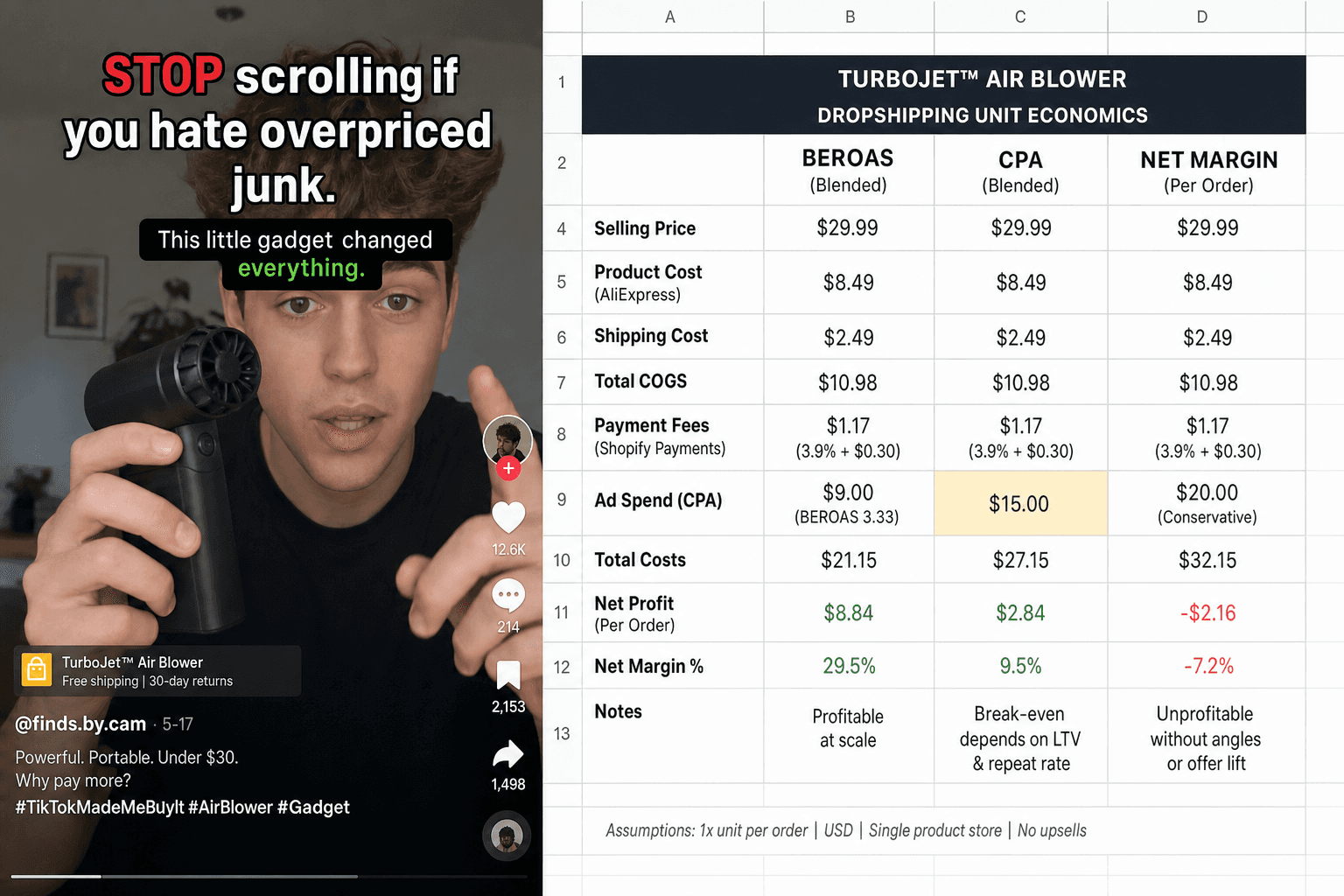
At a 30% gross margin, your break-even ROAS (BEROAS) is 3.33, before chargebacks, PayPal disputes, or a DSers product that stocked out while your ads kept spending. Most agencies ignore it, billing on ad spend regardless of profit.
Dropshipping is first-order economics: no repeat customers, no email list worth monetizing, no subscription MRR, no LTV to justify loss-leader acquisition. Every order must clear BEROAS or you're funding your supplier's growth.
Product windows last weeks. The week a product pops on TikTok's FYP, three hundred stores source it from CJ Dropshipping; by the time creative is dialed in, margins have compressed and CPMs spiked. Profitable stores find the hook, test fast, scale winners before the window closes, and kill losers before they drain the account.
Shipping from Chinese suppliers takes 7–20 days; customers now expect under four. Chargebacks climb, Shopify Payments flags the account, and the operational fire outgrows the marketing problem. You need an ads partner who understands both, not one showing a glossy ROAS while net profit is negative.
The Opportunity
Top Dropshipping Stores Win on Testing Speed Most Competitors Can't Match
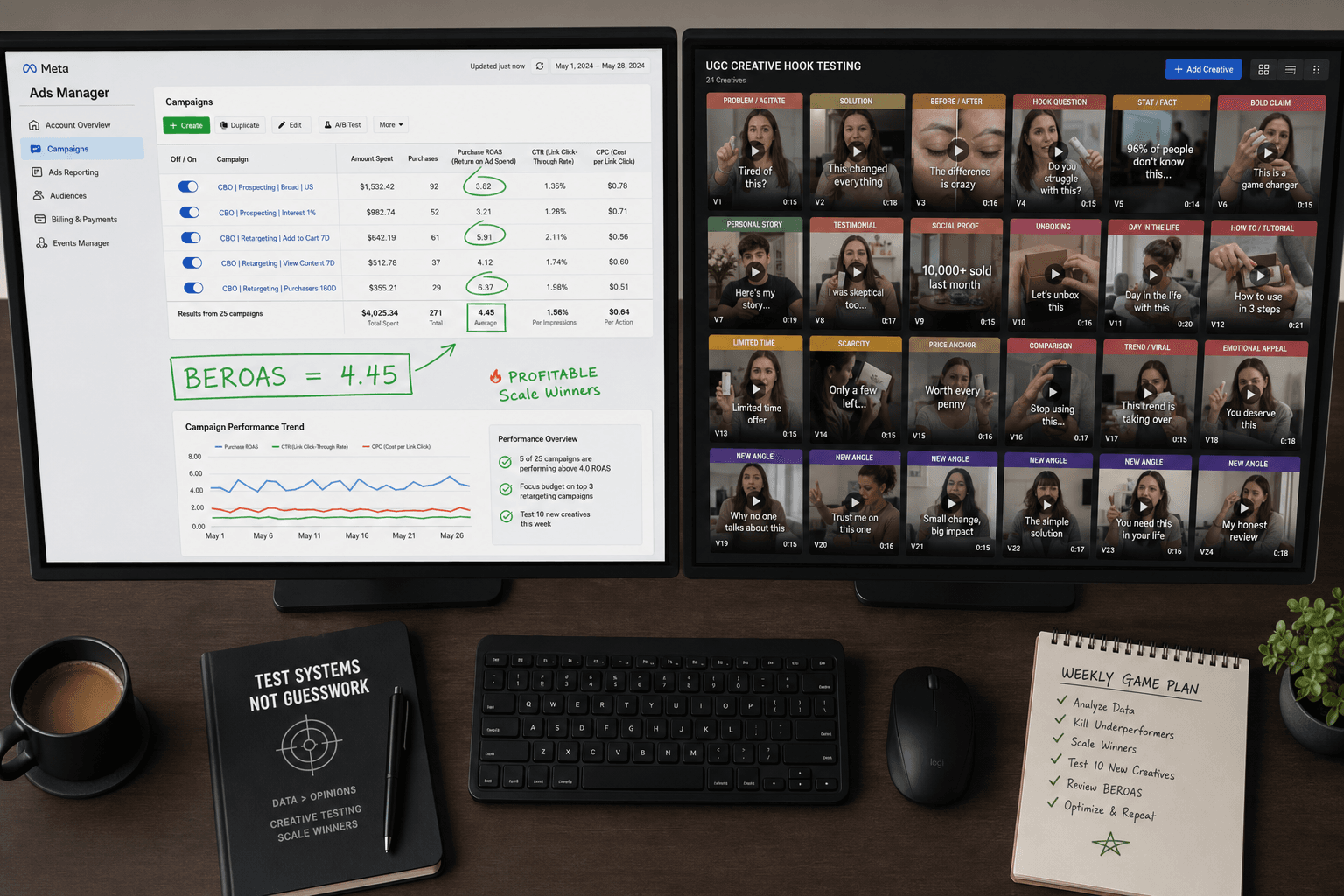
The top 10% of dropshipping stores win on creative velocity more than product choice: a dozen mediocre-to-good video variants beat three polished ones, because the algorithm needs data and the audience needs pattern interrupts. They test variants in batches, read the results without emotion, and back winners before competitors notice.
Most competitors still run one or two static creatives, check their Meta dashboard manually every few days, and guess which ad sets to kill. That gap comes down to testing systems and speed, and it's where your margin hides.
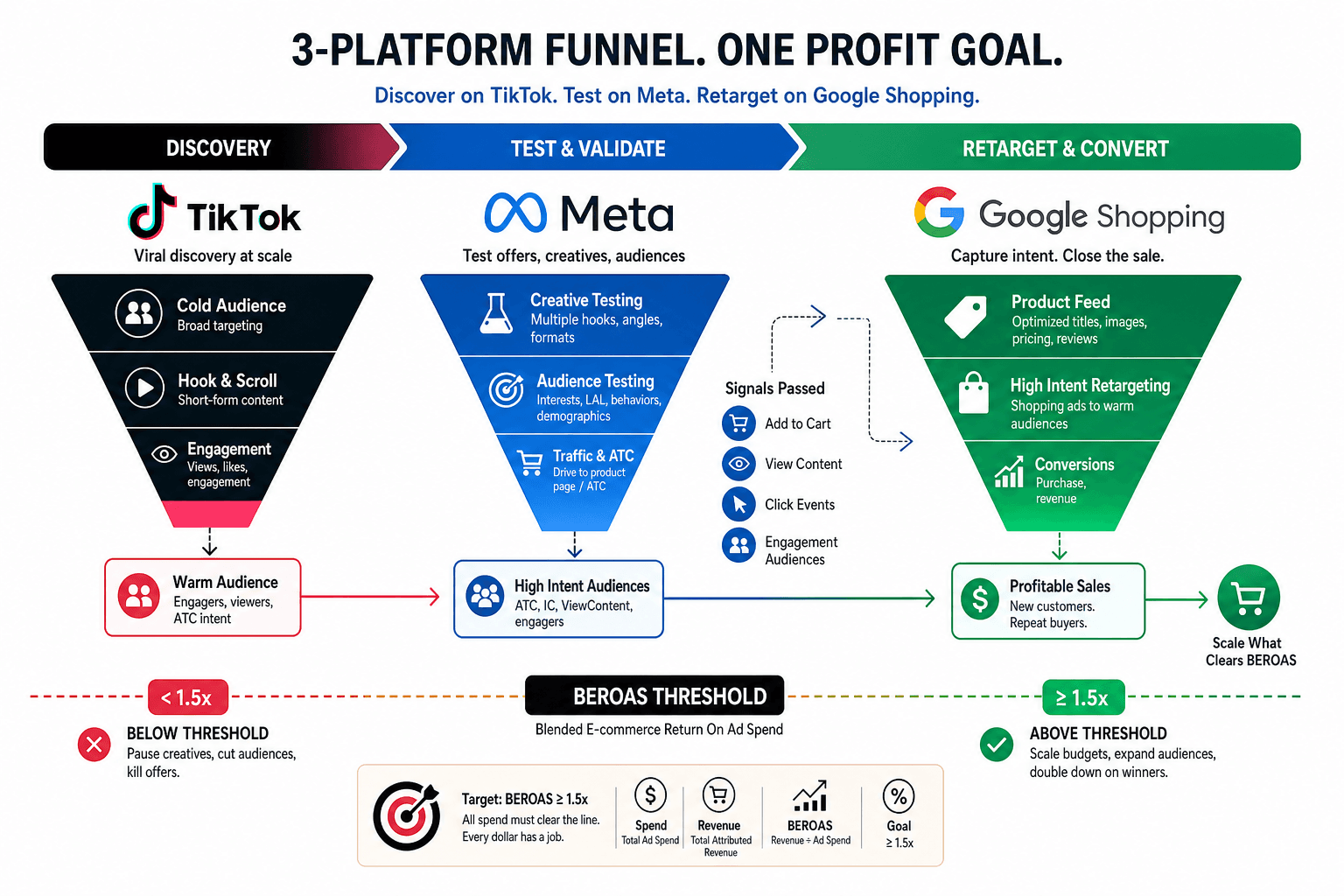
Google Shopping and Performance Max are almost untapped for proven winners. Once a product validates on TikTok or Meta, Shopping campaigns catch buyers who saw it on social and now search for it. That revenue comes in at a lower CPA than cold acquisition, so Shopping's ROAS more often clears BEROAS.
What Most Get Wrong
What Kills Dropshipping Ad Accounts, and Why Most Agencies Make It Worse
Optimizing for ROAS instead of BEROAS
At a 25% gross margin, a 3.0x ROAS loses money daily. Agencies that ignore selling price, COGS, shipping, and transaction fees report a top-line ROAS unconnected to profit.
Testing too few creatives per product
Stores testing two creatives on $500 miss winners. Below 10–15 variations per product, you kill products that would have worked with a different first three seconds and back small-sample flukes.
Splitting budget across channels without checking each against BEROAS
2025 benchmarks put median ecommerce ROAS near 1.9x on Meta, 1.4x on TikTok and 3.5x on Google. A product clearing BEROAS on Shopping can bleed on TikTok; blending hides that.
Ignoring the de minimis change and adding tariff costs late
The 2025 US tariff changes ended de minimis for Chinese-origin goods. Stores slow to reprice saw COGS and BEROAS floors jump overnight; agencies unaware of it run broken cost models.
Pitching brand-building and LTV to a first-order-economics business
Agencies pushing retention or long-term LTV spend your budget on strategies that pay off only with repeat buyers you'll never have. Every acquisition must profit on order #1.
Why Now
The Creative Velocity Gap in Dropshipping Is Closing Fast
Most stores still brief a UGC creator on Billo or Fiverr, wait a week for three variations, run them until they die, and start over. One product test takes three to four weeks, the entire profitable window for most products.
The operators pulling ahead pair AI-assisted production (Creatify, AdStellar) with real UGC sourcing to cut that cycle to days, so they test 15 angles instead of three and find the one converting at a BEROAS-positive CPA before the market floods.
Since Meta consolidated and removed many detailed interest options in early 2026, Advantage+ Audience and broad targeting are the default, and creative is the targeting lever. Most competitors haven't rebuilt testing for it, so stores that build systematic creative testing before the next product cycle peaks pull ahead.
The Mechanism
Where AI Gives Dropshipping Stores an Edge
Real productivity, not AI theater. Here's where it actually moves a number for dropshipping brands.
Creative
What AI does: AI-assisted production generates hook variations, script structures, and visual concepts per product for a structured testing rotation on Meta ABO and TikTok In-Feed.
The result: Instead of 2–3 creatives per product, you test a batch of 10–15 every cycle, with performance data in 48–72 hours.
Why it matters here: With creative as the targeting lever, the store that finds the winning hook first owns the window before competitors flood in.
Digital Ads
What AI does: AI-assisted management tracks BEROAS and CPA per ad set across Meta (ABO tests; scaling in Advantage+ sales campaigns, formerly Advantage+ Shopping), TikTok (In-Feed, Spark Ads), and Google (Shopping, Performance Max), flagging underperformers.
The result: Ad sets below BEROAS get caught in hours, not days; budget shifts to profitable ones automatically, and weekly kill/scale decisions run on data.
Why it matters here: At 22–30% gross margins, one ad set two days below BEROAS can erase a week of profit, and a manual daily check reacts too slowly.
Analytics
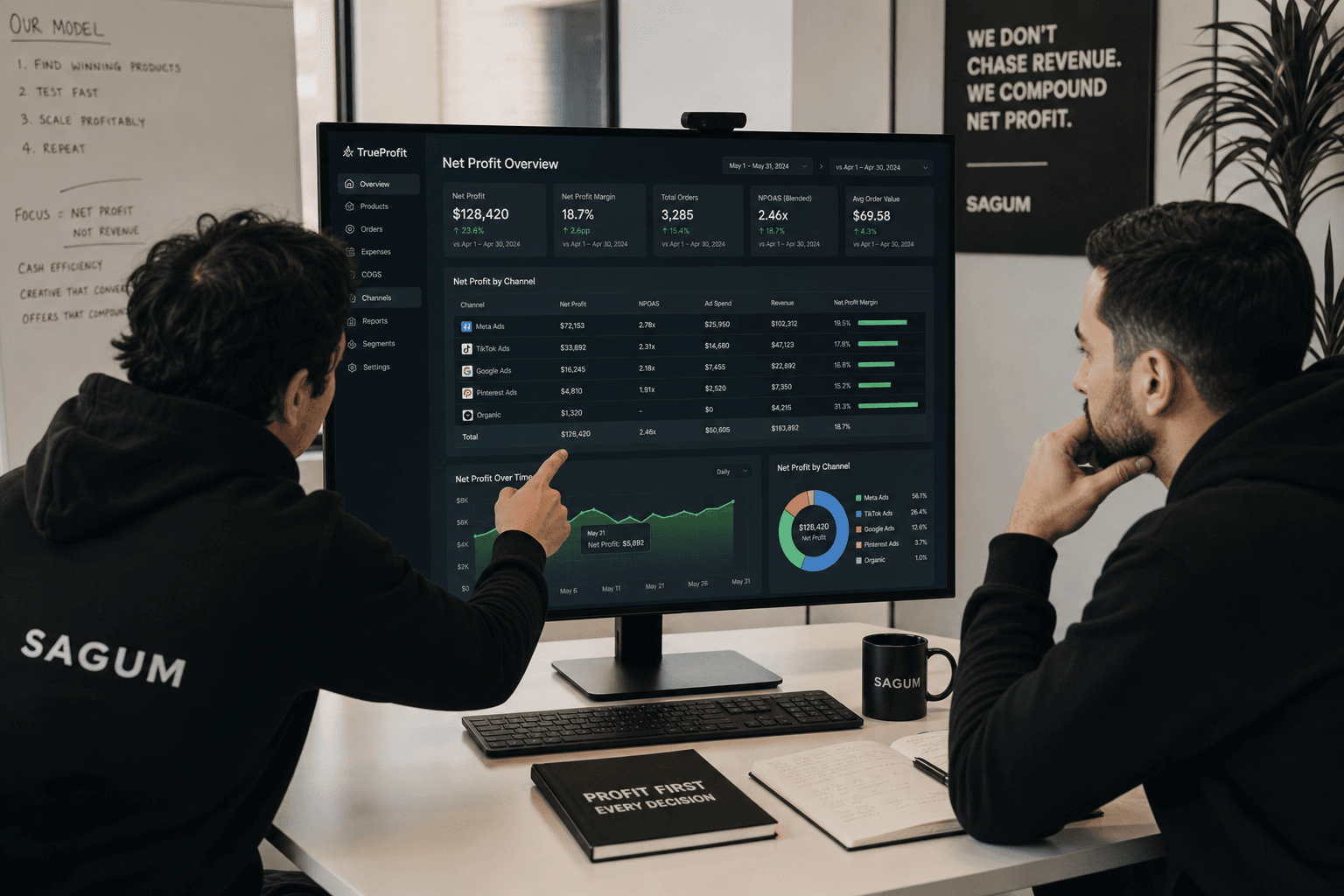
What AI does: We instrument TrueProfit or a comparable dashboard so every campaign reports NPOAS (Net Profit on Ad Spend) after COGS, shipping, transaction fees, and ad spend.
The result: You see which channels and products make money, instead of watching Shopify's misleading revenue counter go up.
Why it matters here: At 4.0x ROAS, a 22% gross margin plus $6 per order in transaction and fulfillment fees might mean negative NPOAS, which most stores can't see.
Conversion Optimization
What AI does: AI-assisted review covers product page structure, the above-the-fold hook, trust signals, and checkout flow, and flags drop-offs that inflate CPA without showing in the ad account.
The result: A product page converting at 2.5% instead of 1.8% on the same traffic lowers effective CPA by 28%, raising ROAS against BEROAS without more spend.
Why it matters here: Stores often install Debutify or Booster but skip page tests; a one-product store usually converts better on a page tuned to its exact buying trigger.
Ready to see what this looks like for your dropshipping brands business?
No obligation. A senior strategist will show you exactly where the wins are.
The Strategy
How to Run Paid Media for a Dropshipping Store
Before testing, we calculate each product's BEROAS floor from selling price minus COGS, shipping, transaction fees, and tariffs on Chinese-origin goods. Every campaign target sits above that hard floor, and any ad set below it for more than 48 hours gets killed or restructured.
Product testing starts on Meta ABO at $20–$50/day per ad set, with variations covering hooks, problem framings, and CTAs. TikTok In-Feed runs in parallel for products with strong visual or demo angles, and Spark Ads amplify UGC that has organic traction.
Google Shopping and Performance Max come in only after social validation, catching post-viral search demand without cold spend on unproven items. Winners scale through Advantage+ sales campaigns, which shift budget between prospecting and retargeting on real-time conversion signals.
We benchmark Meta, TikTok, and Google ROAS separately against each product's BEROAS floor, and net-profit reporting catches a negative-margin day.
We monitor DSers and supplier feeds for stock-outs and price changes: a $3 supplier increase on a $25 product can push you below BEROAS without the ad account flagging it. We track chargeback rates as a cost and a leading indicator of payment processor risk.
The one number that governs this
BEROAS, the minimum ROAS to profit on order #1, governs every ad set, channel, and product test. Store-level NPOAS shows whether the business makes money.
How We Help
What We'd Do for Your Dropshipping Store
We start with each product's BEROAS floor and net-profit reporting, then build Meta, TikTok, and Google Shopping on top, in the order we'd run them.
BEROAS Audit and Cost-Structure Setup
Before touching the ad account, we set each active product's BEROAS floor, tariffs included.
Net Profit Attribution (TrueProfit / NPOAS Layer)
We instrument net-profit reporting so every channel reports NPOAS.
Meta Paid Media (ABO Testing → Advantage+ Sales Scaling)
We run ABO creative tests, pick winners within 48–72 hours, and scale them through Advantage+ sales campaigns.
TikTok Paid Media (In-Feed and Spark Ads)
We test TikTok In-Feed alongside Meta and use Spark Ads to amplify UGC with organic traction, capturing the discovery layer before competitors do.
Google Shopping and Performance Max
After social validation, we add Google Shopping and PMax to capture high-intent search at a lower CPA.
Creative Production and Velocity System
We pair AI-assisted production with UGC sourcing so every product enters testing with a full batch of hook variations, not 2–3.
Product Page and Checkout Conversion Optimization
We audit Shopify product pages for the above-the-fold hook, trust signals, and checkout drop-off to lower effective CPA without more ad spend.
Who's Behind This
Who we are, and what makes us different
Sagum is a performance marketing agency founded in January 2017 in St. George, Utah. We've spent 8+ years growing real brands and being judged on KPIs, not vanity metrics.
We deliberately limit how many clients we take so each one gets senior attention. We treat your numbers like our own, we never run generic playbooks, and your strategy is built for your business, because shouldn't your brand's marketing be custom to your brand?
Sagum.ai is our AI arm: the same proven operators now build AI into the work wherever it creates real edge, not as theater, but as leverage applied with discipline.
- 8+ years growing brands on performance KPIs, not vanity metrics
- Limited client roster, with senior attention on every account
- An extension of your team; your success is tied to ours
- Custom strategy per brand, never a generic playbook
- AI built in where it moves a number; judgment over hype
“Sagum is a performance marketing agency that's spent 8+ years growing brands by treating their numbers like our own. We take on few clients, never run generic playbooks, and now build AI into the work wherever it creates real edge, not hype. Your strategy is built for your business, and our success is tied to yours.”
“After six years, Sagum is our most important partner: trusted, communicative, and caring about our business as if it's their own.”
Long-term partner
6-year client
Proof
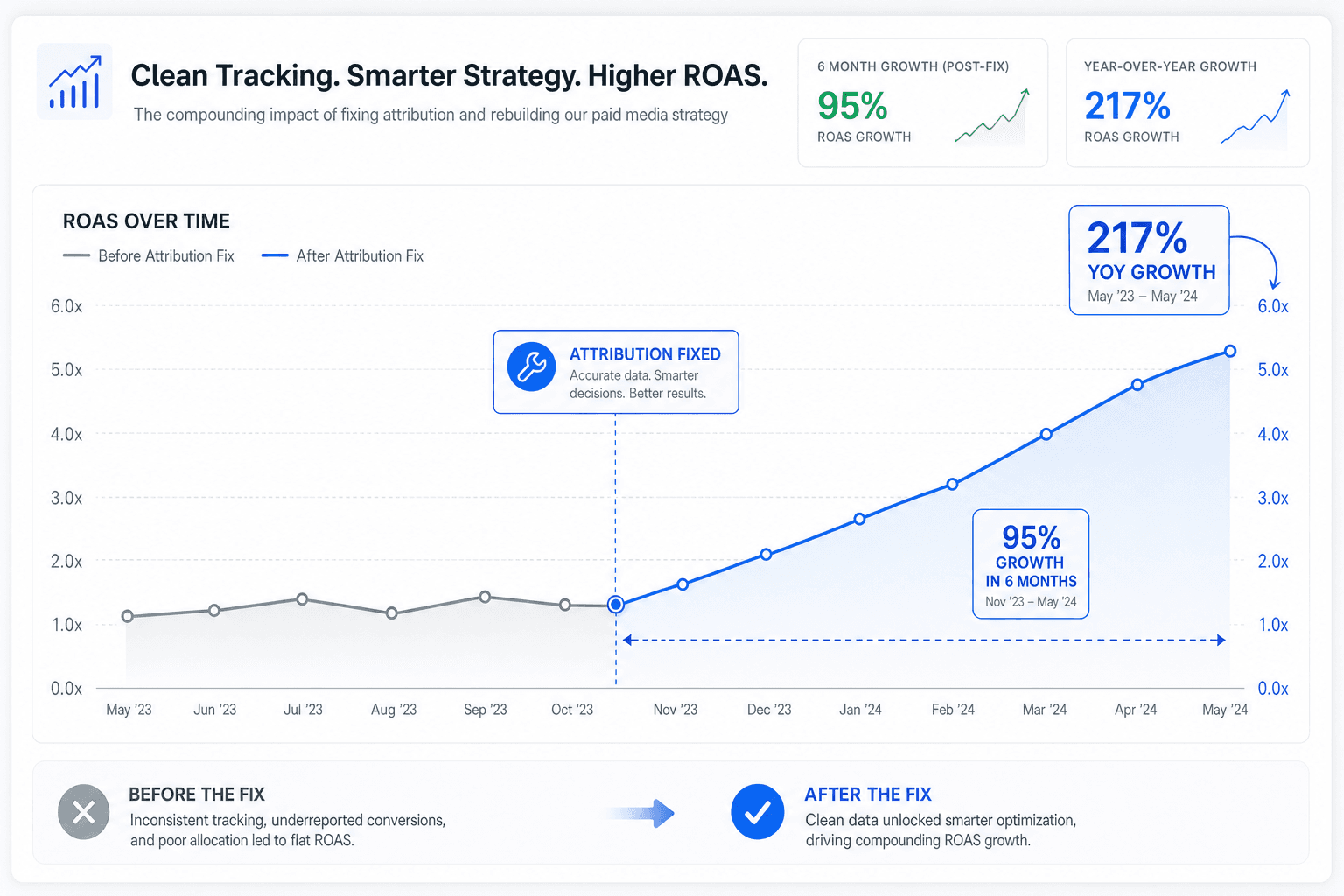
95% growth in 6 months, 217% YoY after fixing a misfiring pixel
Ballerina Farm
Challenge
Ballerina Farm, a DTC food brand, had a misfiring pixel inflating its reported numbers and hiding true performance.
What we did
We fixed tracking, then scaled TikTok, Google, and Pinterest.
Result
After the tracking fix, Ballerina Farm grew 95% in six months and 217% year over year, with ROAS 64% better than planned. The takeaway for dropshipping: you can't manage to BEROAS with broken tracking.
Find Out Exactly Where Your Ad Account Is Leaking Margin
No obligation, no generic agency pitch. We'll review your BEROAS floor, channel mix, and creative testing cadence, then tell you where the margin is going and what we'd do about it.
Sagum · January 2017 · St. George, Utah · 8+ years