

8+ years growing brands on KPIs, now with AI
Grow Your DTC Brand on Real Numbers
We run Meta, TikTok, and Klaviyo around your blended ROAS and contribution margin, not what the dashboards claim.
8+ years growing DTC brands · Google, Meta & TikTok partners · AI-assisted, operator-run


Get your free Growth Gap Analysis
Senior strategist review · response within one business day
Prefer to reach out directly?
The Challenge
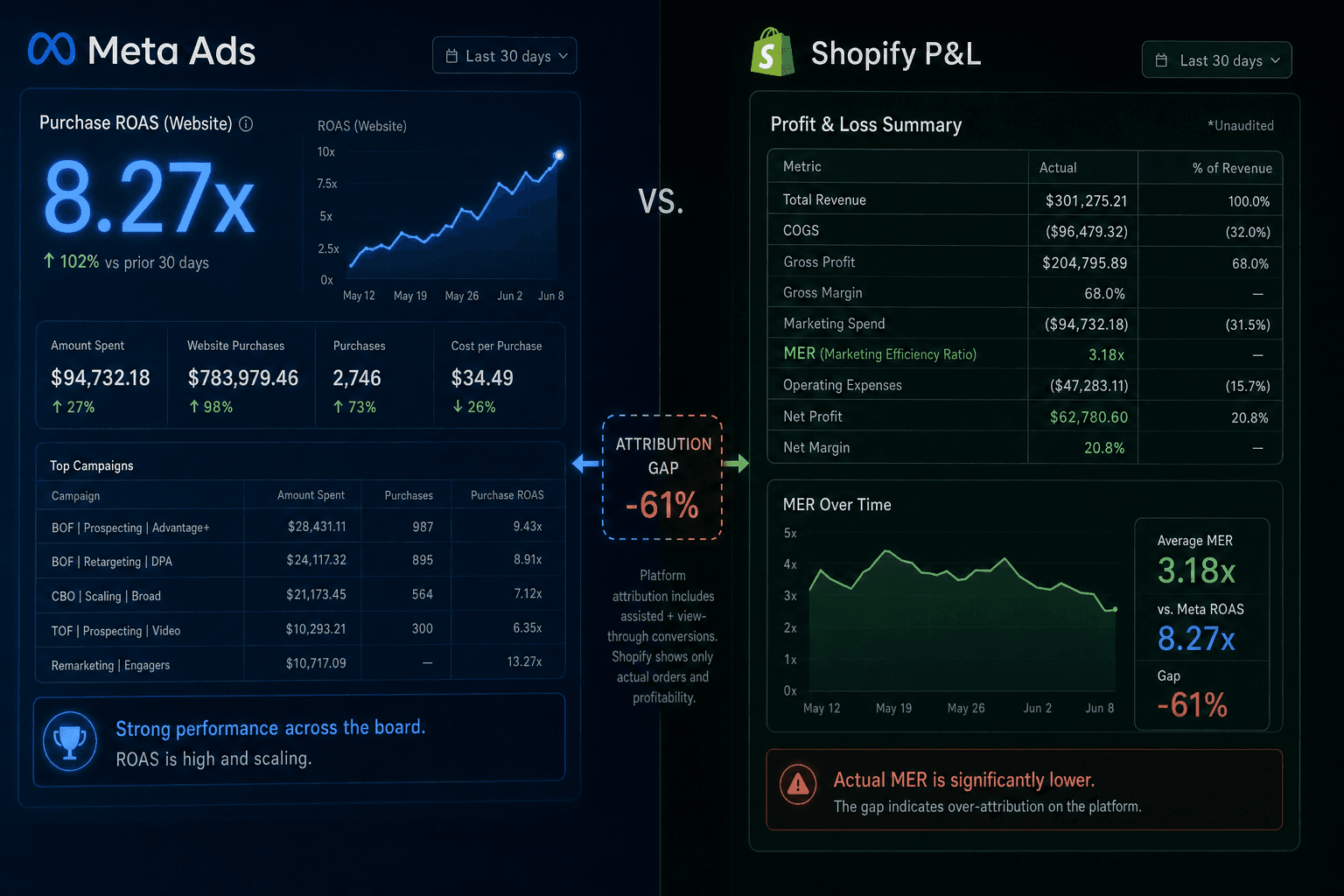
Your Ad Platform Says 3x ROAS. Your Bank Account Disagrees.
You spend on Meta and TikTok, Klaviyo flows are live and dashboards look fine, yet blended ROAS (Shopify revenue ÷ total ad spend) drifts and new-customer CAC climbs. Combined, Meta, Google and Klaviyo claim 40% more revenue than Shopify recorded, and margin disappears in that gap.
After iOS 14 and ATT, Meta and Google over-credit themselves and double-count conversions, so summed platform ROAS can't show profitability. Operators who fixed this early scaled confidently; the rest hit a profitability cliff north of $500K/month.
Median DTC contribution margin fell from 35% in 2021 to roughly 22% as CPMs nearly doubled from 2020 levels. Scale against CM2 (revenue minus COGS, shipping, 3PL pick/pack, Shopify Payments fees of 2.4–2.9% + $0.30/transaction, and return reserves), not gross margin.
Retention bleeds most brands: only 18.8% of DTC customers buy again within a year. If your Klaviyo account runs three or four basic flows, weekly full-list blasts and no RFM segmentation, you forfeit compounding retention and pay Meta to re-acquire customers you already own.
The Opportunity
DTC Winners Measure Blended ROAS and Compound Retention
Your opportunity is measurement and retention, not a bigger Meta budget. Brands scaling profitably have fixed attribution first, know CM2 to the dollar before scaling, govern spend by blended ROAS and run a Klaviyo program that works. That system is buildable, and most competitors haven't built it.
Well-built Klaviyo flows generate close to 41% of email revenue from 5.3% of sends; top-quartile brands drive 30–40% of store revenue through email. If email drives 10–15% of your revenue, fix the architecture. Build welcome-through-winback flows on RFM segments, A/B test them continuously, and they compound alongside paid acquisition.
TikTok Shop and TikTok Ads are separate decisions most operators conflate. Creator affiliates get your product and earn commission, TikTok surfaces what converts, and you can build GMV with no media budget. That's acquisition economics nothing like Meta's, where Q4 CPMs can top $25.
What Most Get Wrong
What Most DTC Brands (and Most Agencies) Get Wrong
Optimizing to platform ROAS instead of blended ROAS
Meta reports 4x and Google 6x, but blended ROAS is 2.1x and CAC payback runs 9 months. That's how brands spend $100K/month and quietly lose money on every new customer.
Scaling paid spend without knowing CM2
3PL, fees, returns and shipping cut 55% gross margin to 18% contribution margin; after acquisition cost, orders can lose $4 each. Audits have found brands at $50K/month on Meta here.
Running Klaviyo like a campaign channel, not a retention engine
Basic flows, full-list blasts and unmonitored deliverability burn the list, sink opens and leave email at 8% of revenue, not 30%. Poorly integrated flows silently leak 10–30% of automation revenue.
Agencies that report great channel metrics while blended ROAS deteriorates
Agency-controlled dashboards look healthy while blended ROAS slides, the most common DTC agency failure. If yours can't show its blended ROAS impact, it's optimizing for its reporting, not your P&L.
Treating TikTok Ads and TikTok Shop as the same decision
Most brands ignore TikTok or dump media budget into TikTok Ads without first testing TikTok Shop creator affiliates, whose organic GMV runs on fundamentally different unit economics.
Why Now
DTC Brands Using AI Now Get Harder to Catch Within 12 Months
DTC new-customer ROAS has deteriorated faster than blended ROAS: new-customer CAC rose roughly 9% in 2025, and Q4 CPMs can top $25. Win the next cycle by getting more per dollar: fix measurement, compound retention and reach TikTok Shop creator affiliates before that channel gets crowded.
AI lets teams that ran two or three concepts a month test many more angles weekly and rotate winners before fatigue. At today's Meta CPMs, creative velocity is a direct cost lever.
AI-assisted Klaviyo segmentation can catch triggers manual management misses (browse depth, purchase frequency, predicted CLV). Brands building it now compound a retention advantage measurable in blended ROAS within two quarters. Most competitors still run three flows, two creatives and a flat monthly budget; build your lead before these tools become table stakes.
The Mechanism
Where AI Moves the Number for a DTC Brand
Real productivity, not AI theater. Here's where it actually moves a number for dtc brands.
Creative & Paid Social
What AI does: AI-assisted generation and structured testing vary hook, offer, format and visual angle across Meta and TikTok at a volume a human team can't match by hand.
The result: You find winners faster, catch fatigue earlier and pay a lower effective CPM, since relevant ads cost less to deliver.
Why it matters here: With median blended CAC near $87, creative is the most accessible cost lever. Brands testing 15 angles weekly outlearn those testing two or three monthly.
Analytics & Attribution
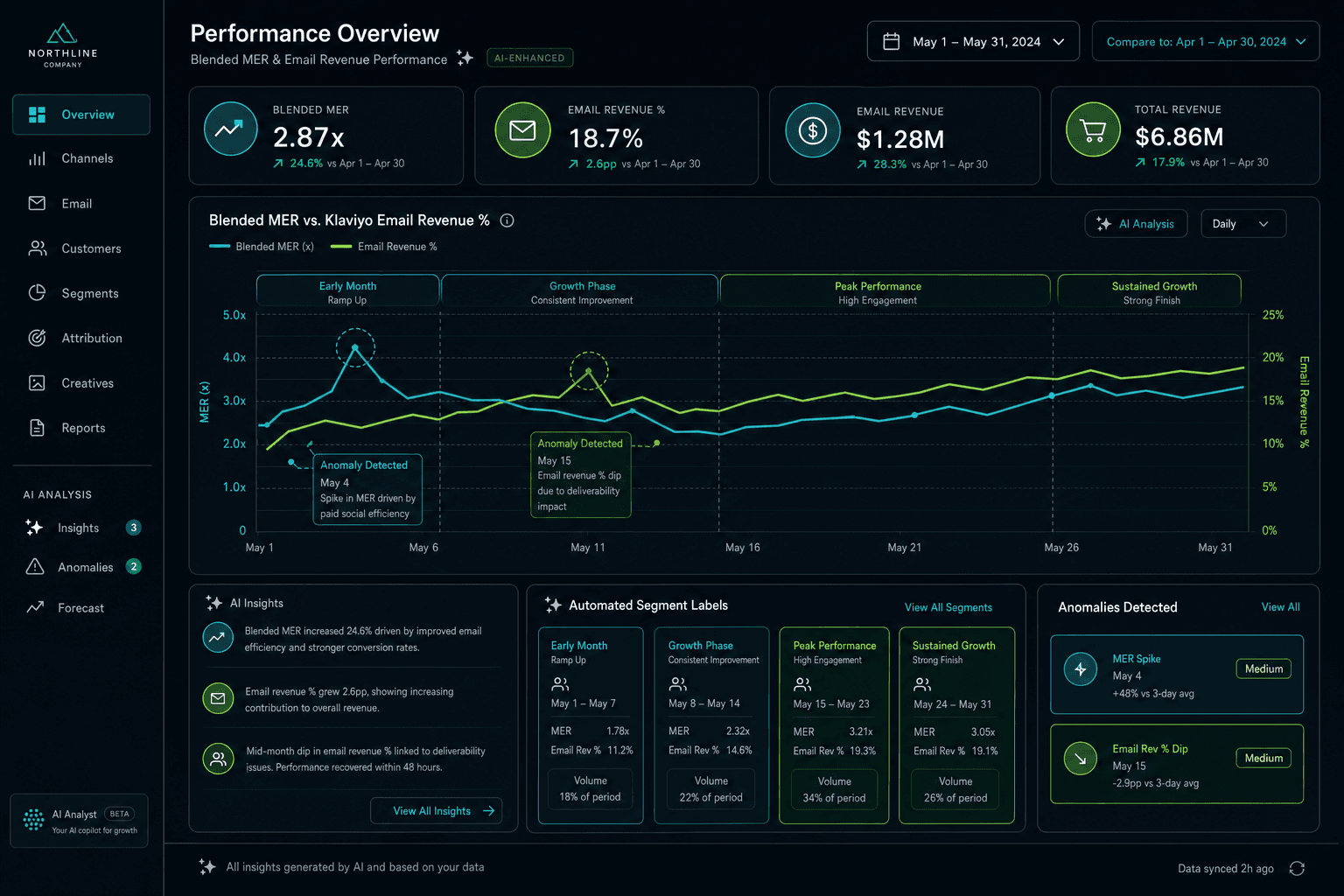
What AI does: AI-assisted reconciliation matches platform ROAS to Shopify revenue, measures the gap, flags pixel misfires and adds first-party and post-purchase survey signals to a blended view.
The result: You allocate budget on numbers that reconcile with your bank account.
Why it matters here: Scaling on platform ROAS as blended ROAS slides is DTC's most common mistake; catching attribution overlap early separates profitable growth from a $500K/month cash wall.
Email & Retention (Klaviyo)
What AI does: AI-assisted flow architecture and RFM segmentation find triggers, like purchase recency, that move each customer through your flows more precisely than manual management.
The result: Automated flows drive 30%+ of total store revenue while deliverability holds and the list gets healthier.
Why it matters here: Fixing flows is the highest-ROI move because they reach customers already on your list, the same ones you'd otherwise pay Meta to re-acquire.
Conversion Optimization
What AI does: AI reviews landing pages and product detail pages (PDPs) against CM2-aware targets, finds friction, tests headline and offer framing, and optimizes AOV alongside conversion rate.
The result: You earn more per session from traffic you already pay for, and AOV gains widen contribution margin.
Why it matters here: At 22% contribution margin and CAC near $87, a 20% conversion lift or $15 AOV increase changes the unit economics of your entire acquisition program.
Ready to see what this looks like for your dtc brands business?
No obligation. A senior strategist will show you exactly where the wins are.
The Strategy
The DTC Marketing Strategy That Scales
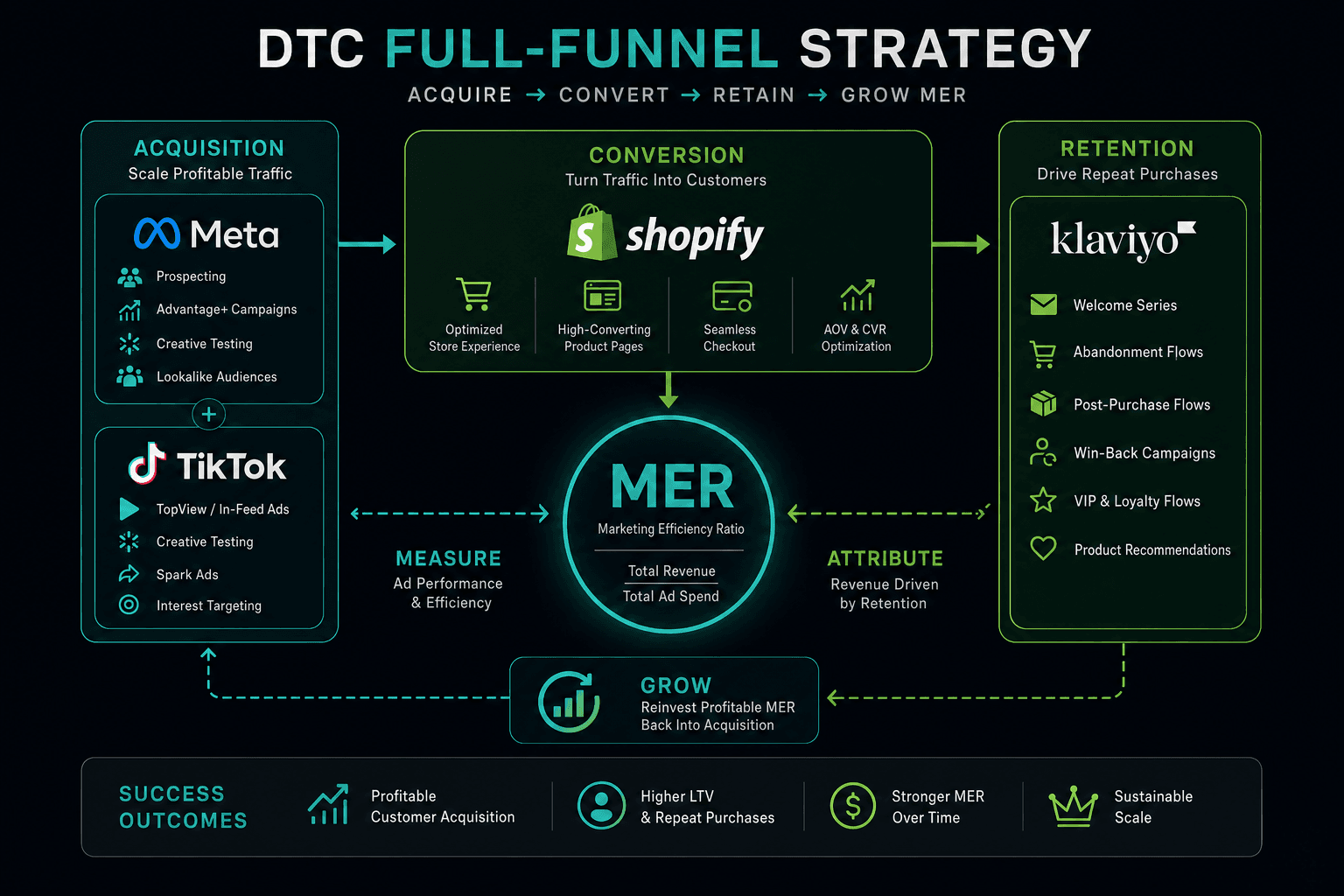
Blended ROAS is the governing metric because it's attribution-independent and reconciles with your results. Platform ROAS is a diagnostic input only.
Run Meta as the primary acquisition channel (it takes 61–68% of DTC ad dollars) and test TikTok Ads as a supplement once Meta is dialed in. Evaluate TikTok Shop creator affiliates separately from the media budget.
Creative is a performance variable: you test multiple angles and audiences per week, then scale winners and cut losers on a defined schedule.
Retention runs on a five-flow Klaviyo architecture segmented by RFM behavior: welcome series, browse abandonment, abandoned cart and checkout, post-purchase (cross-sell, review request, replenishment) and winback, plus SMS as a higher-urgency layer. Flows should drive 30%+ of total store revenue.
Fix attribution before scaling spend: reconcile against Shopify actuals, deploy first-party pixel signals, and use post-purchase surveys as a zero-party check. Measure the blended vs. platform ROAS gap weekly; if it widens, hold spend until you find the source.
Track CAC payback by cohort: 3-month and 9-month paybacks look alike in aggregate and diverge on a cash flow statement. Target under 6 months, and under 3 months before scaling aggressively.
The one number that governs this
Blended ROAS governs every budget call; new-customer ROAS signals acquisition health; CM2 is the profitability floor before any spend increase.
How We Help
What Sagum Would Do for Your DTC Brand
We execute the strategy above for a limited number of clients, so each gets senior attention, not a junior account manager. We treat your numbers like ours.
Attribution & Measurement Audit
Before any scaling, we spend the first 30 days reconciling platform ROAS with Shopify, finding pixel errors and overlap, and building your blended ROAS view.
Meta Ads Management
We run Meta to a blended ROAS target and CM2 floor, tie budget to Shopify revenue, and build audiences around new-customer CAC payback by cohort.
TikTok Ads & TikTok Shop Strategy
We evaluate TikTok Ads and TikTok Shop creator affiliates as separate budget decisions, each against your CAC payback target.
Creative Strategy & Production
We run a continuous testing cadence of multiple angles per week, with AI-assisted generation and structured performance review.
Klaviyo Email & SMS
We build or rebuild the five flows with RFM segmentation, monthly deliverability audits, SMS for urgency and continuous A/B tests toward email's revenue target.
Conversion Rate Optimization
We optimize landing pages and PDPs to CM2-aware targets. Conversion and AOV lifts widen CM2, and each lift counts more on today's thinner margins.
AI Systems & Ongoing Analytics
We build AI into creative testing, Klaviyo triggers and weekly ROAS reconciliation. You own your accounts and see what we see; we report blended ROAS.
Who's Behind This
Who we are, and what makes us different
Sagum is a performance marketing agency founded in January 2017 in St. George, Utah. We've spent 8+ years growing real brands and being judged on KPIs, not vanity metrics.
We deliberately limit how many clients we take so each one gets senior attention. We treat your numbers like our own, we never run generic playbooks, and your strategy is built for your business, because shouldn't your brand's marketing be custom to your brand?
Sagum.ai is our AI arm: the same proven operators now build AI into the work wherever it creates real edge, not as theater, but as leverage applied with discipline.
- 8+ years growing brands on performance KPIs, not vanity metrics
- Limited client roster, with senior attention on every account
- An extension of your team; your success is tied to ours
- Custom strategy per brand, never a generic playbook
- AI built in where it moves a number; judgment over hype
“Sagum is a performance marketing agency that's spent 8+ years growing brands by treating their numbers like our own. We take on few clients, never run generic playbooks, and now build AI into the work wherever it creates real edge, not hype. Your strategy is built for your business, and our success is tied to yours.”

“Sagum roughly doubled our bottom line. They treat the work like it's their own business.”
Rachel Nilsson
CEO, RAGS
Proof
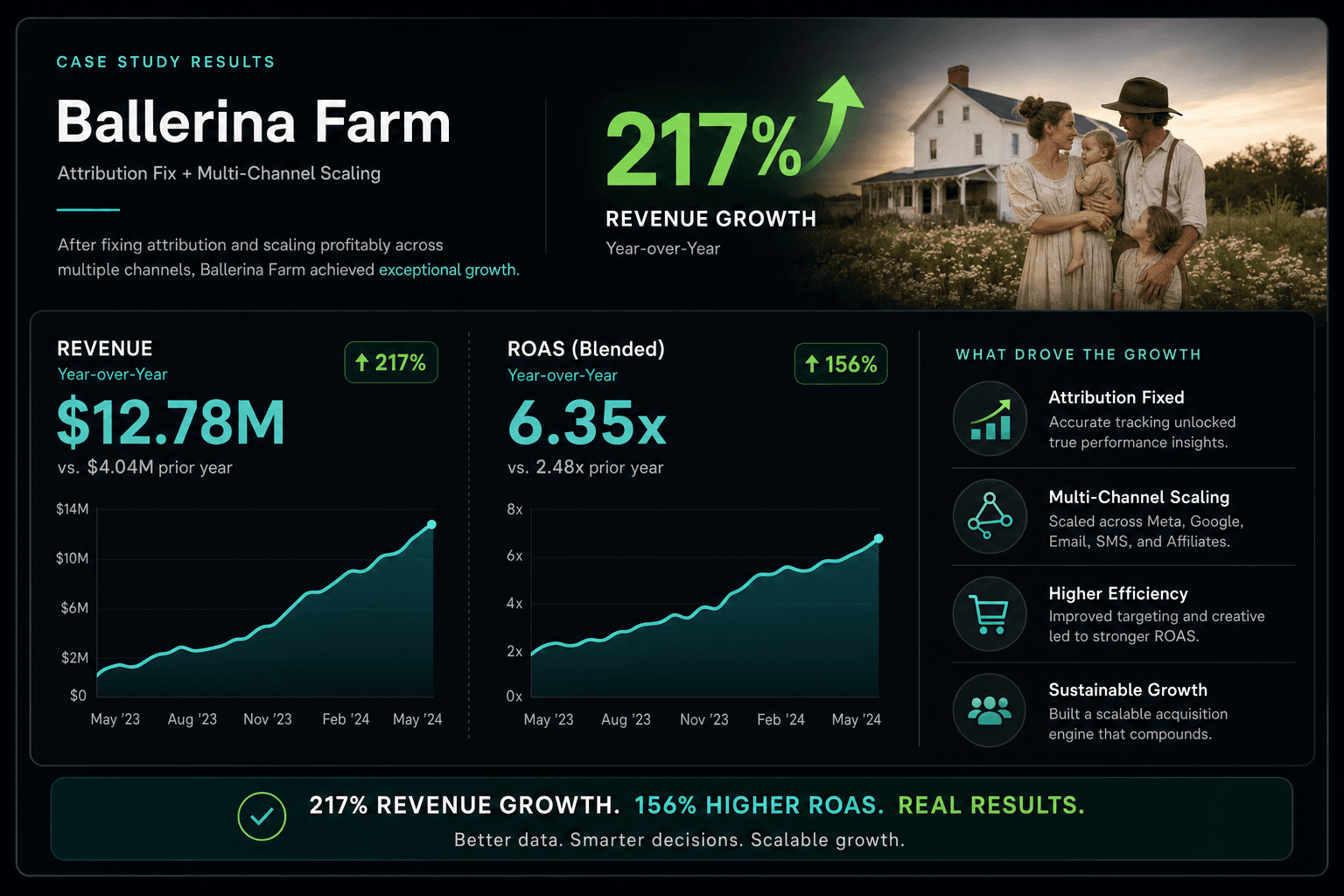
95% growth in 6 months, 217% YoY after fixing a misfiring pixel
Ballerina Farm
Challenge
A misfiring pixel was inflating Ballerina Farm's numbers and hiding true performance.
What we did
We fixed the tracking, then scaled TikTok, Google and Pinterest: the same fix-then-scale order we'd bring to your brand.
Result
Ballerina Farm grew 95% in 6 months and 217% year over year, with ROAS 64% better than planned. Full details are at sagum.com/case-studies/.
Find Where Your Blended ROAS Leaks and What to Do About It
No obligation. We'll review your blended ROAS, attribution setup and Klaviyo architecture and name the specific gaps, whether or not we work together.
Sagum · January 2017 · St. George, Utah · 8+ years