

8+ years growing brands on KPIs, now with AI
Grow Your eBay Store Profitably
We manage Promoted Listings, Best Match ranking, and catalog health so your ACoS drops and sell-through climbs.
8+ years performance marketing · Google, Meta & TikTok partner · AI-assisted execution


Get your free Growth Gap Analysis
Senior strategist review · response within one business day
Prefer to reach out directly?
The Challenge
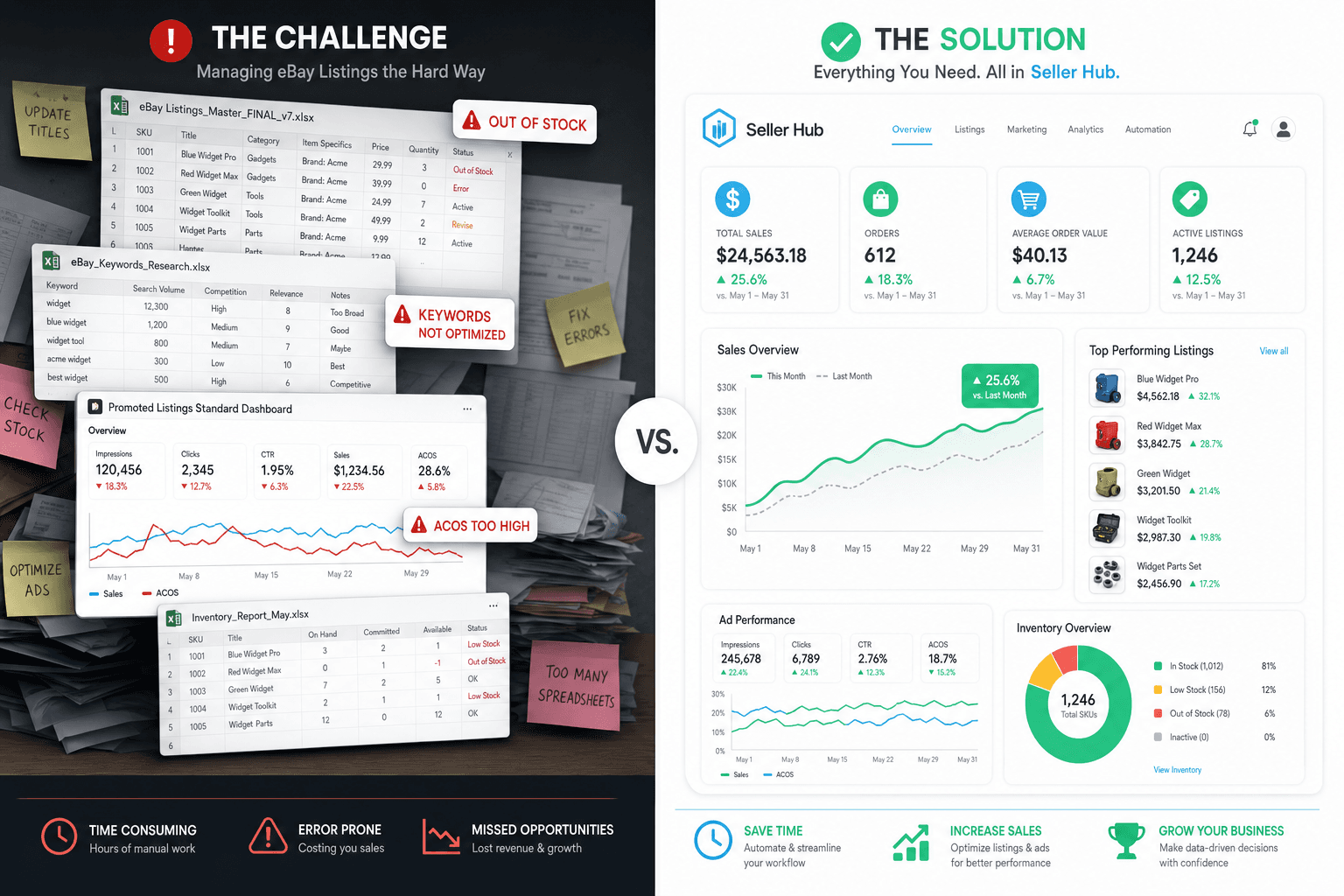
Scaling an eBay store is a full-time optimization job
Defect rate, late shipments, and unresolved cases decide your Top Rated Seller (TRS) status, the prerequisite for Top Rated Plus listings: a 10% final value fee (FVF) discount and 44% more Best Match visibility. Lose it to one late carrier, and margin and rank drop within days.
Cassini, eBay's search engine, predicts buyer intent rather than matching keywords, weighing sales velocity, engagement, feedback score, shipping speed, and total cost including shipping. Purchases and watchers can lift a listing in 24–48 hours; lost velocity sinks it as fast.
Ad rate floors keep rising: the Promoted Listings general strategy (formerly PLS) minimum went from 1% to 2%, the Dynamic Ad Rate Cap floor to 5%, and suggested rates top 20%+ in competitive categories. Set-and-forget sellers bleed margin monthly while PLS's 30-day attribution window hides what works.
At 1,000+ SKUs, missing item specifics drop catalog segments from filtered search, variation listings need consolidating, and the priority strategy (formerly PLA) Search Query Report needs weekly pulls. Most small teams stall under that workload.
The Opportunity
Most eBay sellers leave margin unclaimed, and you can take it
They set Promoted Listings once, never pull a Search Query Report, and leave item specifics gaps across 20–40% of their catalog. That hands you an edge.
Top Rated Plus listings require same-day or one-business-day handling and a 30-day free return window, and earn the TRS+ seal in search plus the 10% FVF discount. In most categories, buyers who see that badge convert at a meaningfully higher rate, and sellers who keep it hold a cost and visibility advantage that compounds.
PLS is pay-per-sale, a different risk profile from CPC advertising. Set rates by margin tier, adjust them weekly on ACoS (ad cost of sale), layer PLA onto high-priority SKUs, and you can scale spend confidently because cost tracks outcome.
The sellers Cassini surfaces first pair complete item specifics, consolidated variation listings, and strong sales velocity with disciplined ad management.
What Most Get Wrong
What most eBay sellers and their agencies get wrong
Setting ad rates once and walking away
Suggested rates keep drifting up, so a January rate left until June either forfeits impressions (too low) or erodes margin (too high for your ACoS), with no alert.
Ignoring item specifics across your legacy catalog
Listings missing color, material, or compatibility fields vanish for buyers who filter, a large share of serious buyers in competitive categories. Account-level data looks fine until you audit each SKU.
Never pulling the Search Query Report for PLA
It shows exactly what buyers typed before clicking. Without it you pay for irrelevant traffic, miss high-converting exact-match terms, and build no negatives, so the waste repeats weekly.
Treating TRS status as a given
If a carrier delay or bad-faith dispute pushes your defect rate past 0.5%, eBay downgrades you at its 20th-of-month evaluation, before appeals resolve, costing you the FVF discount and visibility.
Agencies running generic Shopify or Amazon playbooks on eBay
They run eBay like a Google Shopping feed or chase platform ROAS without knowing Cassini, ACoS, Best Match, or TRS thresholds, improving familiar metrics while eBay's growth drivers go untouched.
Why Now
eBay ad rates keep rising, and AI-assisted sellers are pulling ahead now
eBay keeps raising ad rate floors, with separate increases to the PLS minimum and the Dynamic Ad Rate Cap floor. Its Marketing Terms also expand Promoted Listings attribution and let it raise ad fee rates with no advance notice. Sellers who build margin-aware ad management now, knowing ACoS by SKU tier and adjusting within a week, will absorb the increases.
AI-assisted sellers now handle the weekly grind, from Search Query Report pulls to item specifics audits across thousands of SKUs, at a pace manual competitors can't match.
The gap between well-run and average eBay stores keeps widening as the platform grows more complex and ads cost more. Most of your competitors still run set-and-forget campaigns, carry item specifics gaps, and react to TRS downgrades after they land.
The Mechanism
Where AI gives eBay sellers a real edge
Real productivity, not AI theater. Here's where it actually moves a number for ebay sellers.
Analytics and attribution
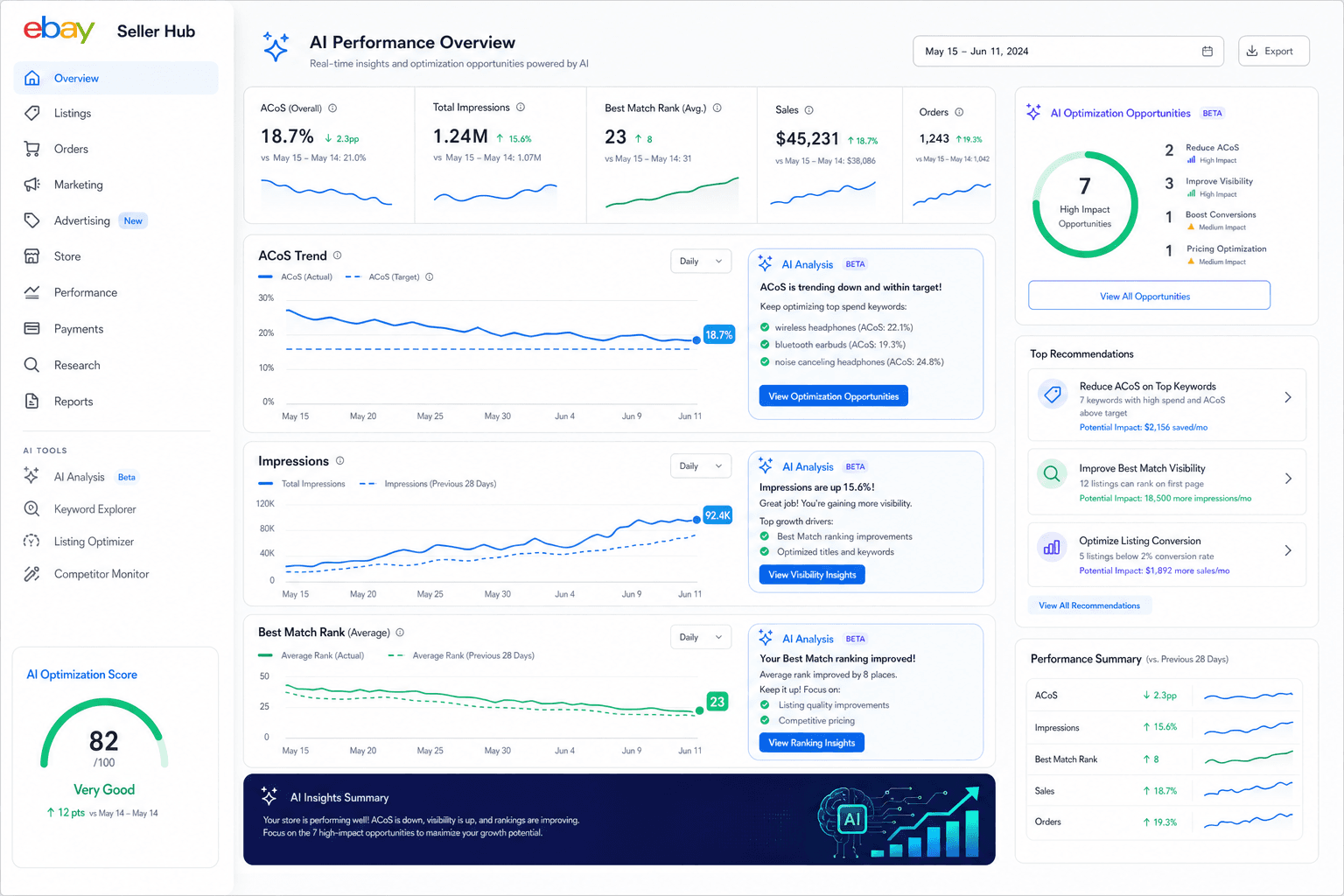
What AI does: AI tracks ACoS by campaign and SKU tier, flags suggested rates drifting above your margin threshold, and surfaces listings losing impressions (a Cassini velocity signal) before weekly sales show it.
The result: You catch rate creep and velocity drops in days rather than weeks, before margin erodes or rank slides.
Why it matters here: The PLS attribution window and monthly TRS evaluation let problems compound quietly for days between checks. Continuous AI monitoring closes that lag.
Digital ads
What AI does: AI pulls the PLA Search Query Report weekly instead of monthly, flags exact-match terms and negatives, and recommends rate changes by margin tier across general strategy campaigns.
The result: PLA campaigns reflect what buyers type, the negative keyword list grows every week, and rates follow each product line's margin.
Why it matters here: eBay sets suggested rates to maximize its own revenue, not your profit. Rates based on real ACoS keep more margin as the floor rises.
Conversion optimization
What AI does: AI audits your full catalog for missing optional item specifics (compatibility, material, color, size type), prioritized by category competitiveness and impression share.
The result: Catalog segments hidden from filtered-search buyers become visible, recovering impressions you were silently losing at the SKU level.
Why it matters here: At 1,000+ SKUs a manual audit takes months. AI can surface the highest-impact gaps in hours, making it weekly maintenance.
Creative
What AI does: AI studies top listings in your category for title structure, keyword placement, and gallery photo choice, then generates and tests variants to lift click-through from Best Match results.
The result: Higher click-through on impressions you already earn feeds Cassini's engagement signal and improves organic rank over time.
Why it matters here: Cassini counts views, clicks, and watchers as engagement, so a title that wins more clicks from the same impressions keeps earning more impressions and sales.
SEO
What AI does: AI reads Cassini ranking patterns alongside Terapeak data to find high-intent, low-competition terms in your category, then builds them into titles, item specifics, and descriptions.
The result: You gain organic Best Match visibility on queries your listings miss today and lean less on paid ad rates.
Why it matters here: Organic rank lowers the ad rate you need. As eBay's minimums rise, you keep more margin headroom than sellers relying entirely on Promoted Listings.
Ready to see what this looks like for your ebay sellers business?
No obligation. A senior strategist will show you exactly where the wins are.
The Strategy
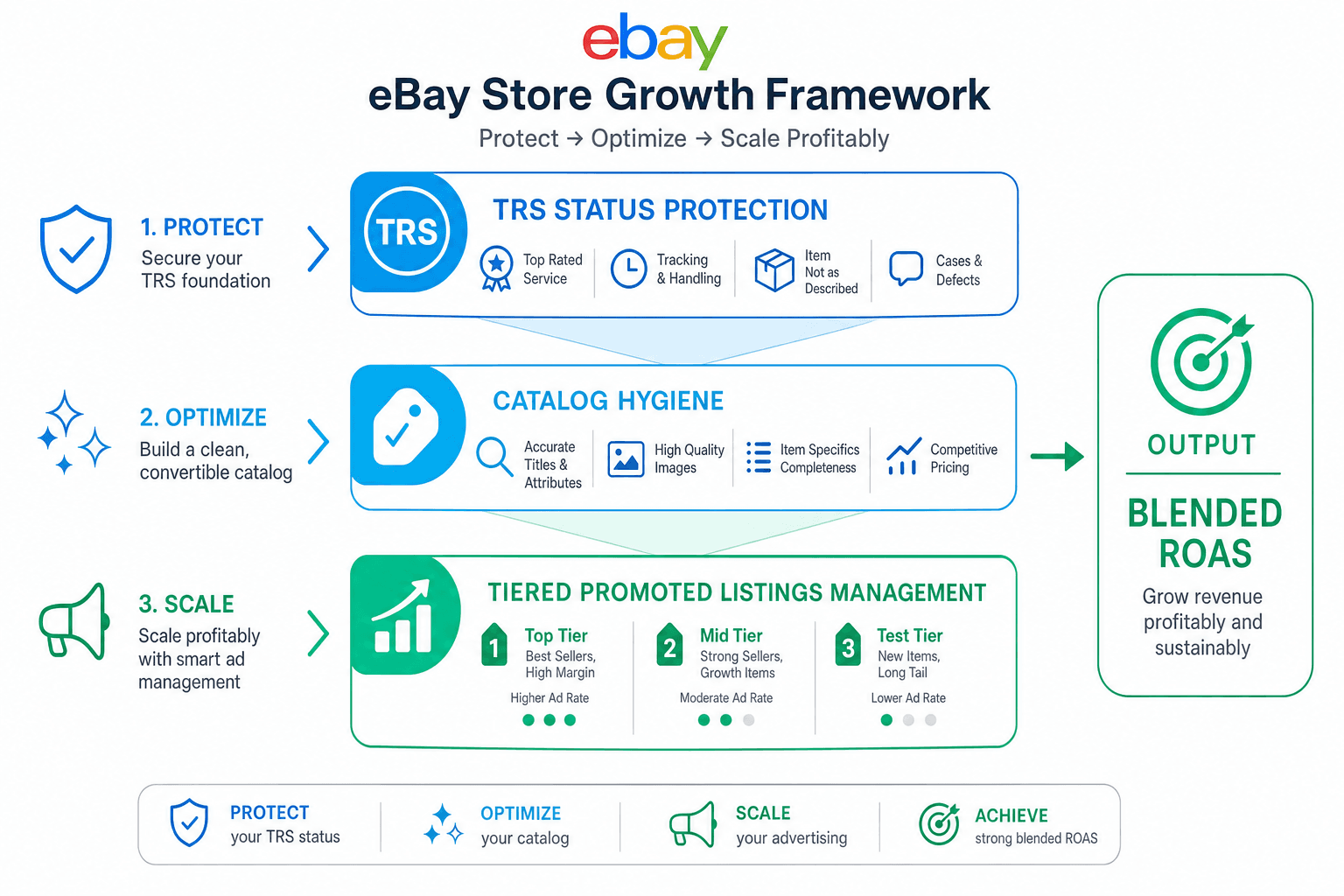
How eBay store growth should be run
Unlike a Shopify store, an eBay store runs inside a marketplace: Cassini decides who gets seen, seller metrics set your fees, and Promoted Listings efficiency is measured in ACoS. Blended ROAS still judges the whole store.
Treat TRS as non-negotiable: check the Seller Dashboard every week against the thresholds (0.5% defect rate, 0.3% unresolved cases, 3% late shipments) before the 20th-of-month evaluation.
In parallel, complete optional item specifics as well as required ones, since optional fields decide filtered-result placement in competitive categories, and consolidate variation listings where possible so sales history, a Cassini ranking signal, builds on one listing.
Set PLS rates by margin tier rather than one catalog-wide rate, and review them weekly against ACoS instead of eBay's suggestions. Pull the PLA Search Query Report weekly for exact-match adds, negatives, and bid changes based on performance.
eBay's target daily budget model lets spend run up to 50% above daily budget on high-traffic days, so know your weekly spend ceiling.
Judge offsite ads and external traffic (Google Shopping, Meta) in a blended view. The PLS attribution window means platform-reported numbers need interpretation.
The one number that governs this
The governing KPI is blended ROAS (store revenue ÷ total ad spend); ACoS (ad fees ÷ ad sales × 100) guides every Promoted Listings decision.
How We Help
What we would do for your eBay store
We fix the foundation before scaling spend: your seller metrics, catalog, and attribution come first.
Seller performance monitoring and TRS protection
We check your TRS metrics against eBay's thresholds weekly and flag downgrade risk before the monthly evaluation.
Catalog hygiene and item specifics audit
AI ranks your item specifics gaps by category and impression impact; we work through the backlog and build a process so new listings launch complete.
Promoted Listings general strategy (PLS) management
We set rates by margin tier, adjust weekly on ACoS, and manage the target daily budget model so high-traffic days don't overrun weekly spend.
Promoted Listings priority strategy (PLA) keyword management
We run the weekly Search Query Report cycle (exact-match adds, negatives, bid changes) for your PLA campaigns.
Cassini SEO and listing optimization
We find high-intent, lower-competition queries with Terapeak and test titles and copy with AI to lift Best Match click-through and Cassini engagement.
Analytics and blended attribution
We blend eBay organic, Promoted Listings, and offsite channels into one view, so budgets rest on numbers corrected for the attribution window.
Who's Behind This
Who we are, and what makes us different
Sagum is a performance marketing agency founded in January 2017 in St. George, Utah. We've spent 8+ years growing real brands and being judged on KPIs, not vanity metrics.
We deliberately limit how many clients we take so each one gets senior attention. We treat your numbers like our own, we never run generic playbooks, and your strategy is built for your business, because shouldn't your brand's marketing be custom to your brand?
Sagum.ai is our AI arm: the same proven operators now build AI into the work wherever it creates real edge, not as theater, but as leverage applied with discipline.
- 8+ years growing brands on performance KPIs, not vanity metrics
- Limited client roster, with senior attention on every account
- An extension of your team; your success is tied to ours
- Custom strategy per brand, never a generic playbook
- AI built in where it moves a number; judgment over hype
“Sagum is a performance marketing agency that's spent 8+ years growing brands by treating their numbers like our own. We take on few clients, never run generic playbooks, and now build AI into the work wherever it creates real edge, not hype. Your strategy is built for your business, and our success is tied to yours.”

“After six years, Sagum is our most important partner: trusted, communicative, and caring about our business as if it's their own.”
Long-term partner
6-year client
Proof
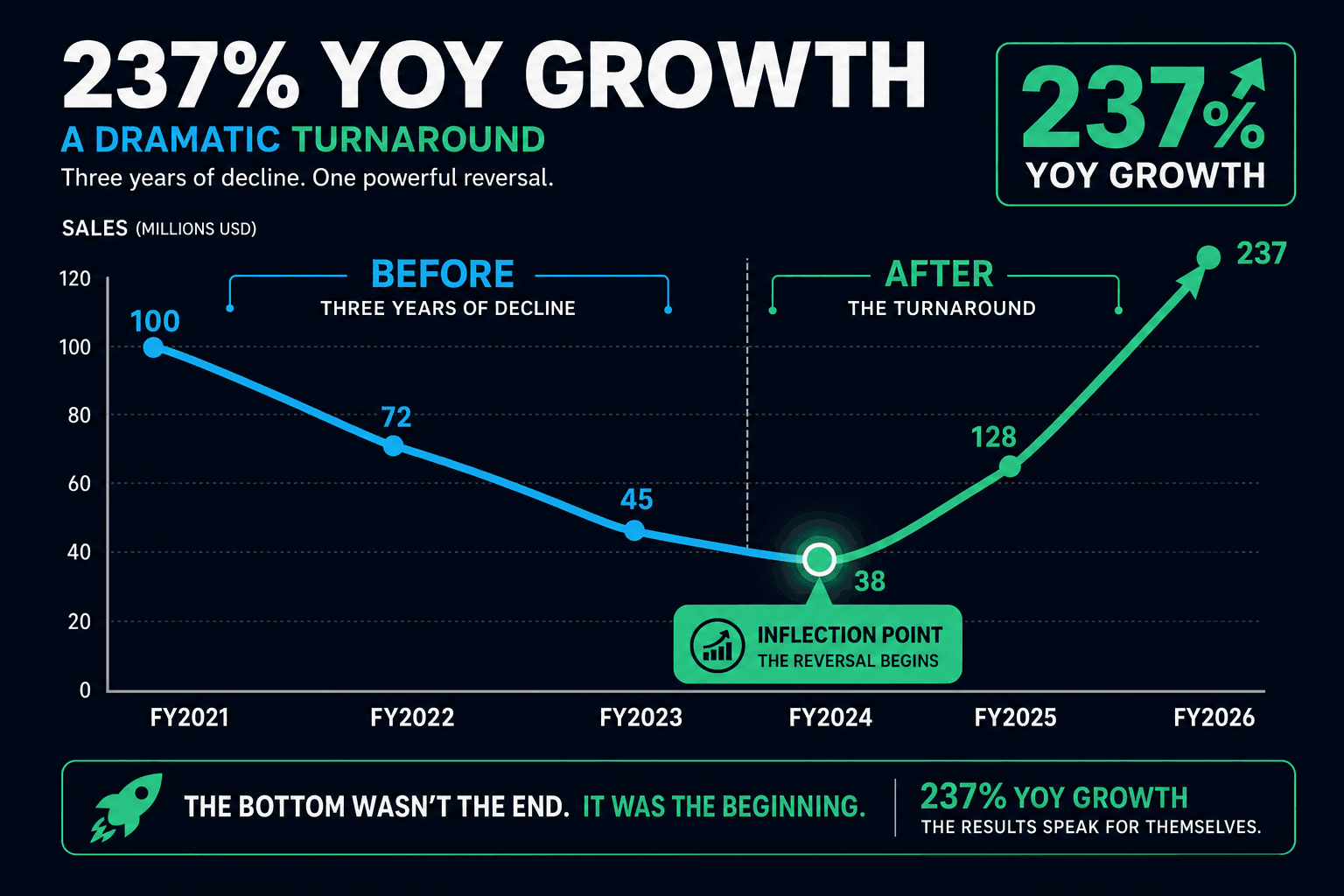
Reversed 3 years of decline to 237% YoY
Bisaddle
Challenge
Bisaddle was coming off three years of decline.
What we did
We redesigned Bisaddle's site, doubling its speed, and grew email. For an eBay store, the same conversion-first discipline applies to listings before you scale ad spend.
Result
Bisaddle grew 237% year over year. The redesign lifted site conversion 122%, email grew to 48% of revenue, and three years of decline reversed.
Run your eBay store like a precision instrument
No obligation. We review your Seller Hub numbers (ACoS, TRS status, item specifics coverage, ad rate structure) and show you the growth gap and our plan for your store, not a generic playbook.
Sagum · January 2017 · St. George, Utah · 8+ years