

8+ years growing brands on KPIs, now with AI
More Etsy Sales, Less Wasted Ad Spend
We build listing quality, Etsy Ads ROAS, and off-platform demand for handmade and vintage shops that are ready to scale.
Google Ads · Meta · TikTok Partner | 8+ Years Growing Ecommerce Brands | Now with AI


Get your free Growth Gap Analysis
Senior strategist review · response within one business day
Prefer to reach out directly?
The Challenge
Running an Etsy Shop Is a Full-Time Optimization Problem
You've become an algorithm specialist, timing renewals to Etsy's 9 AM Eastern traffic peak and puzzling over why identically tagged listings rank differently. Search runs in two phases: query matching on your title and all 13 tags, then ranking by a hidden listing quality score built from CTR, add-to-cart, and conversion rates.
Before profit, you price against a 6.5% transaction fee, payment processing, materials, and labor. Above $10,000 in annual sales, Offsite Ads are mandatory at 12% of every order attributed within 30 days (15% for smaller opted-in shops), even if the buyer clicked Etsy's Google ad in week one and bought in week three. Sellers at scale build 27–30% margin into price to stay solvent.
Star Seller can vanish for 90 days because one message, split into two threads, sat unanswered for 25 hours. Losing the badge hides you from high-intent buyers who filter search by it.
Most sellers try to grow on Etsy without a system, and most agencies don't know the platform well enough to build one.

The Opportunity
Etsy Sellers Win on Better Systems, Not Bigger Catalogs
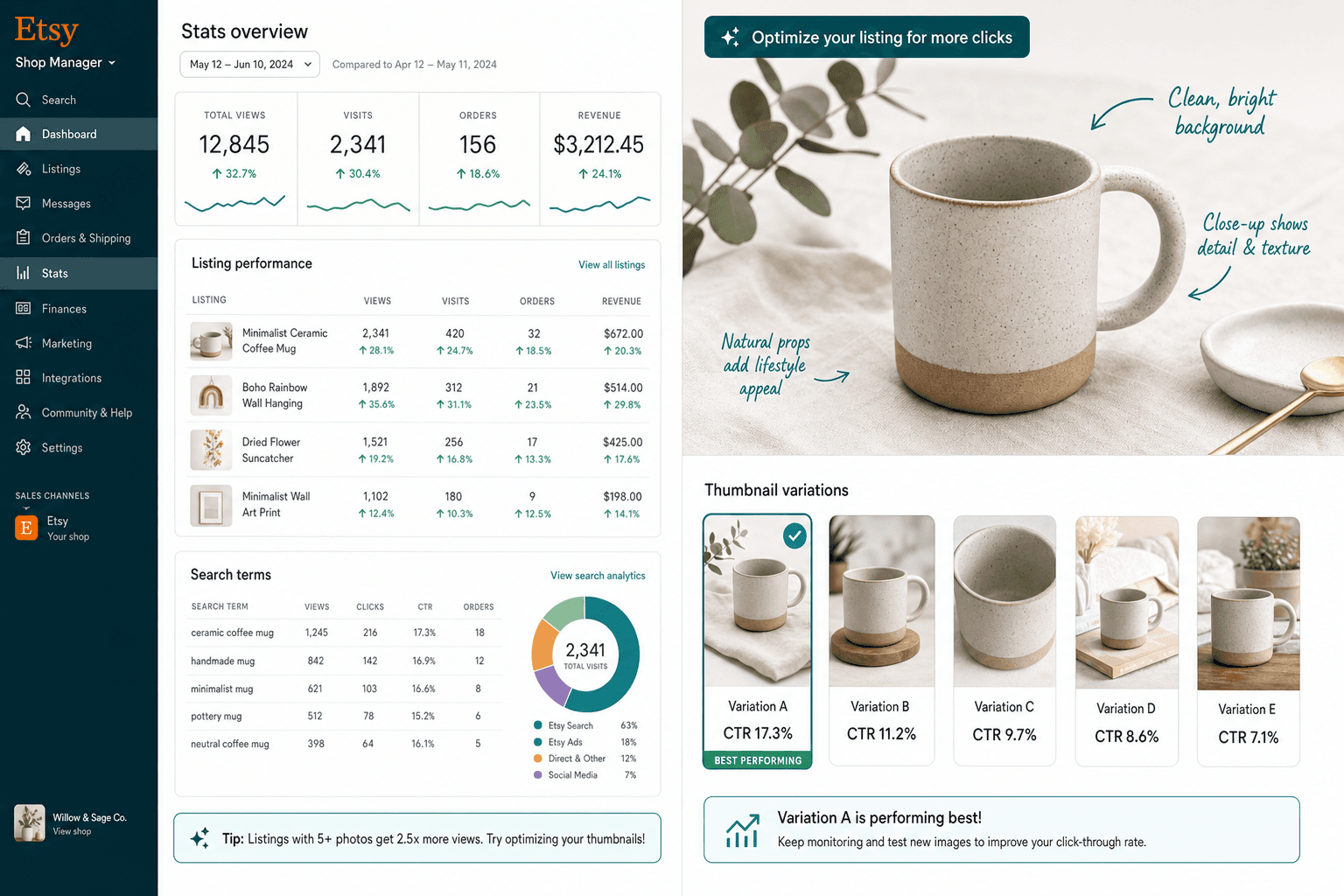
The thumbnail is now your biggest conversion lever: nearly half of Etsy's gross merchandise sales (about 47% in Q2 2026) come through the mobile app. Most sellers treat it as an afterthought; those who test it for CTR, as they would paid-media creative, pull outsized organic rank and Etsy Ads placement.
The top four Etsy Ads slots in search go to the highest-quality-score listings: $10/day on a listing converting at 4% outplaces $50/day on one at 1.2%. Improving quality is free and compounds: better CTR lifts quality score, rank, and traffic, and the new conversion data raises quality score again.
Off-platform demand is even less contested. Most sellers have never run a structured Meta or TikTok campaign, though a well-run one signals demand, can speed quality score gains, and builds an audience you own outside Etsy's fees.
What Most Get Wrong
What Most Etsy Sellers and Agencies Get Wrong
Keyword-stuffing titles instead of leading with product identity
Etsy's 2025 search guidance found stuffing hurts buyer confidence and conversion. 'Mug Ceramic Handmade Coffee Cup Gift Mom Personalized Custom' reads as spam, sinking quality score, rank, and Ads placement.
Renewing before fixing the thumbnail, title, or conversion rate
A $0.20 renewal's boost typically lasts a few hours to a couple of days and needs engagement. Otherwise Etsy learns the listing underperforms, and quality score loss outlasts the boost.
Deactivating well-performing listings to 'start fresh'
Deactivating wipes accumulated quality score, favorites count, and review associations. Edit in place instead: update the title, swap the main image, adjust tags, and let Etsy re-learn from positive history.
Treating Offsite Ads ROAS as a dial you can turn
Etsy picks the listings, platforms, and targeting, so tuning Offsite Ads ROAS wastes effort. Your levers are Etsy Ads budget allocation and quality score, which decides whether Etsy promotes you.
Running Google Shopping or Meta ads against your Offsite Ads
On listings Etsy promotes offsite, you can bid up your CPCs and still pay its 12% or 15% fee. Target listings with few Offsite Ads orders, or your own site.
Why Now
Etsy Search Rewards Engagement While Most Sellers Still Run on Instinct
Etsy search is personalized: under Context Specific Ranking, two people searching the same term see different listings, based on browsing and purchase history. Shops win on fast engagement (clicks, favorites, purchases) from buyers matching a listing's conversion profile, not tag count or ad budget.
AI scales once-impractical work: testing five thumbnails a week instead of one, auditing all 13 tags across 200 listings for semantic relevance, and using Shop Manager → Stats → Traffic to rewrite listings whose search terms draw views but not conversions.
Most sellers decide on gut feel and occasional eRank checks. Quality score compounds; shops systematizing before the next algorithm update and peak season build a hard-to-close lead. TikTok's product discovery suits handmade and vintage, and most sellers haven't tapped it.
The Mechanism
Where AI Gives Etsy Sellers an Edge
Real productivity, not AI theater. Here's where it actually moves a number for etsy sellers.
Analytics
What AI does: AI scans Shop Manager search terms, listing CTR, and conversion across hundreds of listings to find where title or tag changes would lift quality score and where the thumbnail is the problem.
The result: You stop guessing and work a fix list ranked by impact, not alphabetical order.
Why it matters here: You can only infer the hidden quality score from CTR, conversion, and search position trends, which takes weeks by hand and still misses cross-listing patterns.
Creative
What AI does: AI generates thumbnail variants (background color, prop arrangement, lifestyle vs. flat-lay, text overlay vs. clean product) and structures A/B tests for CTR in Etsy Ads before organic rollout.
The result: Even a 0.5–1 percentage point CTR gain lifts quality score, raises organic rank, and lowers effective Etsy Ads CPC, from an asset you already own.
Why it matters here: On mobile, the thumbnail is the first and often only impression. Etsy's data shows listings with high-quality photos rank higher; most sellers never test theirs.
Digital Ads
What AI does: AI checks Etsy Ads daily, flagging high-spend listings converting below your shop's benchmark, shifting budget to listings converting above it, and naming quality fixes to make before adding spend.
The result: Your budget stops funding weak listings and concentrates on those earning placement through quality score.
Why it matters here: More spend on a low-quality-score listing burns budget at worse ROAS, so you fix quality first, then scale; AI runs that triage catalog-wide.
Social Media
What AI does: AI picks products with strong process-reveal or story potential, scripts short-form video concepts, and structures TikTok and Meta campaigns that send traffic to strong listings with few Offsite Ads orders.
The result: External traffic sends Etsy a demand signal and builds an audience you own outside the platform's fees.
Why it matters here: Buyers searching your shop name after a making-of TikTok are direct-navigation traffic, Etsy's highest-quality signal, and demand you generated yourself carries no Offsite Ads fee.
Conversion Optimization
What AI does: AI audits listing copy, pricing against search-result competitors, shipping setup (free shipping threshold vs. itemized), and review responses, with fixes for each tier: high-traffic/low-conversion, low-traffic/high-conversion, and dormant.
The result: A shop moving from 1.8% to 2.6% conversion lifts quality score, rank, and traffic without added ad spend; conversion work is SEO by another name.
Why it matters here: Etsy's benchmark is 1–3% conversion; above 3% is high performance. Beyond doubled revenue, 3% versus 1.5% means a different quality score, position, and Ads tier.
Ready to see what this looks like for your etsy sellers business?
No obligation. A senior strategist will show you exactly where the wins are.
The Strategy
How Etsy Shop Marketing Should Be Run
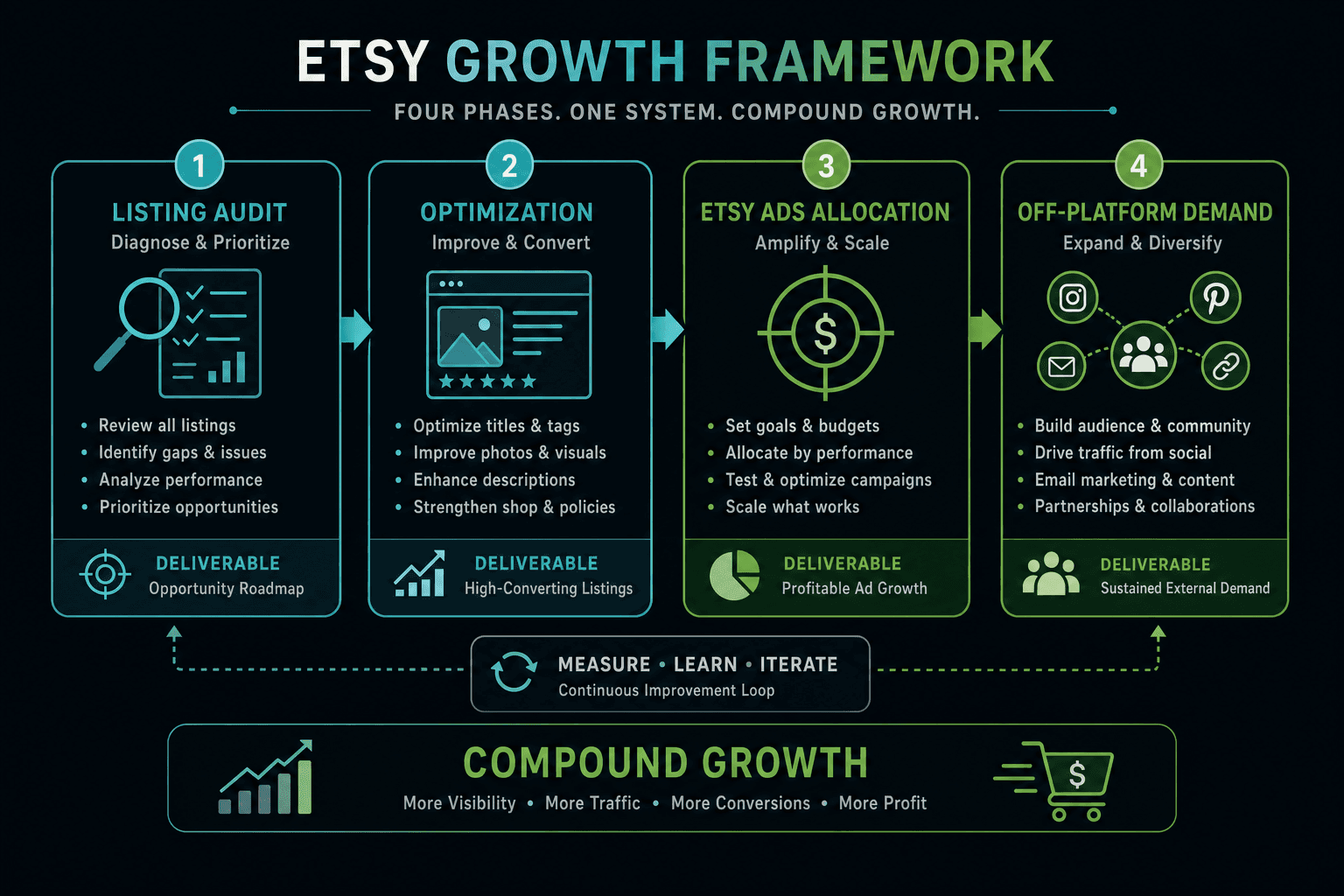
Your governing KPI is blended ROAS across Etsy Ads and off-platform campaigns, but listing quality score decides whether any ROAS target is reachable.
Phase one is always the listing audit, before any Etsy Ads change or Meta campaign: pull CTR, conversion rate, and views from Shop Manager → Stats → Listings, cross-reference Etsy Ads spend per listing, and sort listings into scale, fix, and pause.
Phase two is listing optimization: titles, tag coverage, attribute completeness, thumbnail testing, and pricing against search-result competitors. Per the 2025 guidance, lead with product identity ('Hand-Thrown Ceramic Coffee Mug'), add descriptors like size, style, and occasion, and move secondary keywords into tags and attributes.
Phase three moves your daily Etsy Ads budget to listings that convert: $30/day on three high-converting listings consistently beats the same spend across thirty average ones.
Phase four is off-platform demand generation: TikTok and Meta campaigns timed to Etsy's traffic peaks and seasonal sale events. Etsy doesn't show which listings it promotes offsite, so send traffic to strong listings with few or no Offsite Ads orders in Shop Manager.
Star Seller maintenance runs throughout: response-time systems, shipping label workflows, and review monitoring, because losing the badge drops you from a search filter.
The one number that governs this
Blended ROAS (total revenue ÷ total paid spend), with per-listing Etsy Ads ROAS as the main lever and listing conversion rate driving both.
How We Help
What We Would Do for Your Etsy Shop
We start with your listing catalog before touching Etsy Ads budget or off-platform campaigns. Each service maps to a strategy phase; none is there to pad the proposal.
Listing Quality Audit & Analytics
Phase one: we audit Shop Manager Stats against Etsy Ads spend per listing and deliver a tiered list of listings to scale, fix, or pause.
Etsy SEO & Listing Optimization
Phase two: we restructure titles per the 2025 guidance, audit tags with eRank and Marmalead data, complete attributes, optimize descriptions, and edit in place.
Creative & Thumbnail Testing
Phase two: thumbnail testing is the highest-ROI creative investment on a mobile-first platform, so we test AI-generated variants for Etsy Ads CTR before organic rollout.
Etsy Ads Management
Phase three: we move daily budget to listings earning placement, track ROAS by listing and campaign, and adjust promoted listings as quality scores shift.
Paid Social (TikTok & Meta)
Phase four: we target strong listings with few Offsite Ads orders, run process and maker-story TikTok ads for branded search, and retarget non-buyers on Meta.
Star Seller Operations Support
Ongoing: we build response workflows to prevent one missed thread from suspending the badge, configure shipping labels for Purchase Protection eligibility, and monitor reviews.
Who's Behind This
Who we are, and what makes us different
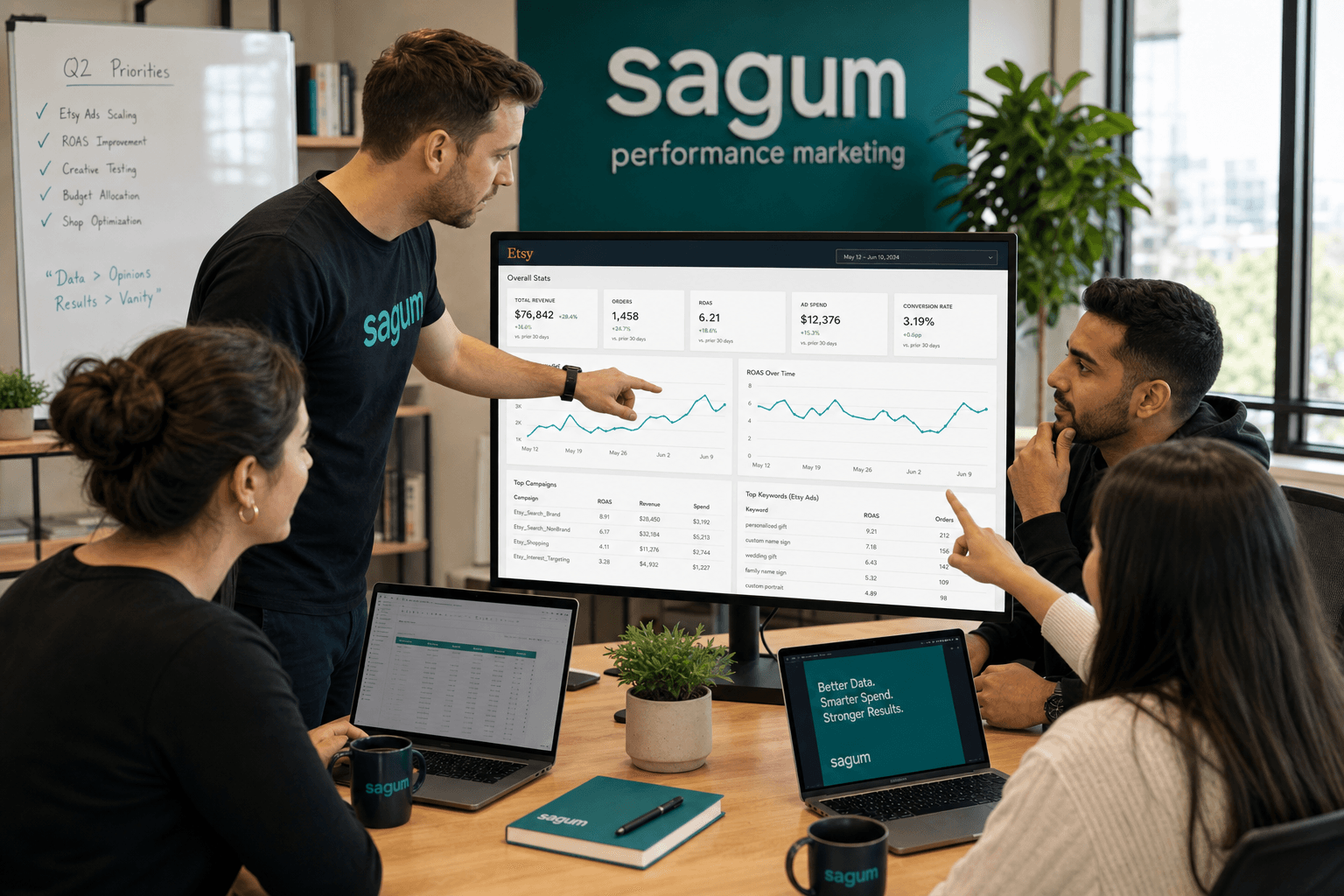
Sagum is a performance marketing agency founded in January 2017 in St. George, Utah. We've spent 8+ years growing real brands and being judged on KPIs, not vanity metrics.
We deliberately limit how many clients we take so each one gets senior attention. We treat your numbers like our own, we never run generic playbooks, and your strategy is built for your business, because shouldn't your brand's marketing be custom to your brand?
Sagum.ai is our AI arm: the same proven operators now build AI into the work wherever it creates real edge, not as theater, but as leverage applied with discipline.
- 8+ years growing brands on performance KPIs, not vanity metrics
- Limited client roster, with senior attention on every account
- An extension of your team; your success is tied to ours
- Custom strategy per brand, never a generic playbook
- AI built in where it moves a number; judgment over hype
“Sagum is a performance marketing agency that's spent 8+ years growing brands by treating their numbers like our own. We take on few clients, never run generic playbooks, and now build AI into the work wherever it creates real edge, not hype. Your strategy is built for your business, and our success is tied to yours.”
“Sagum roughly doubled our bottom line. They treat the work like it's their own business.”
Rachel Nilsson
CEO, RAGS
Proof
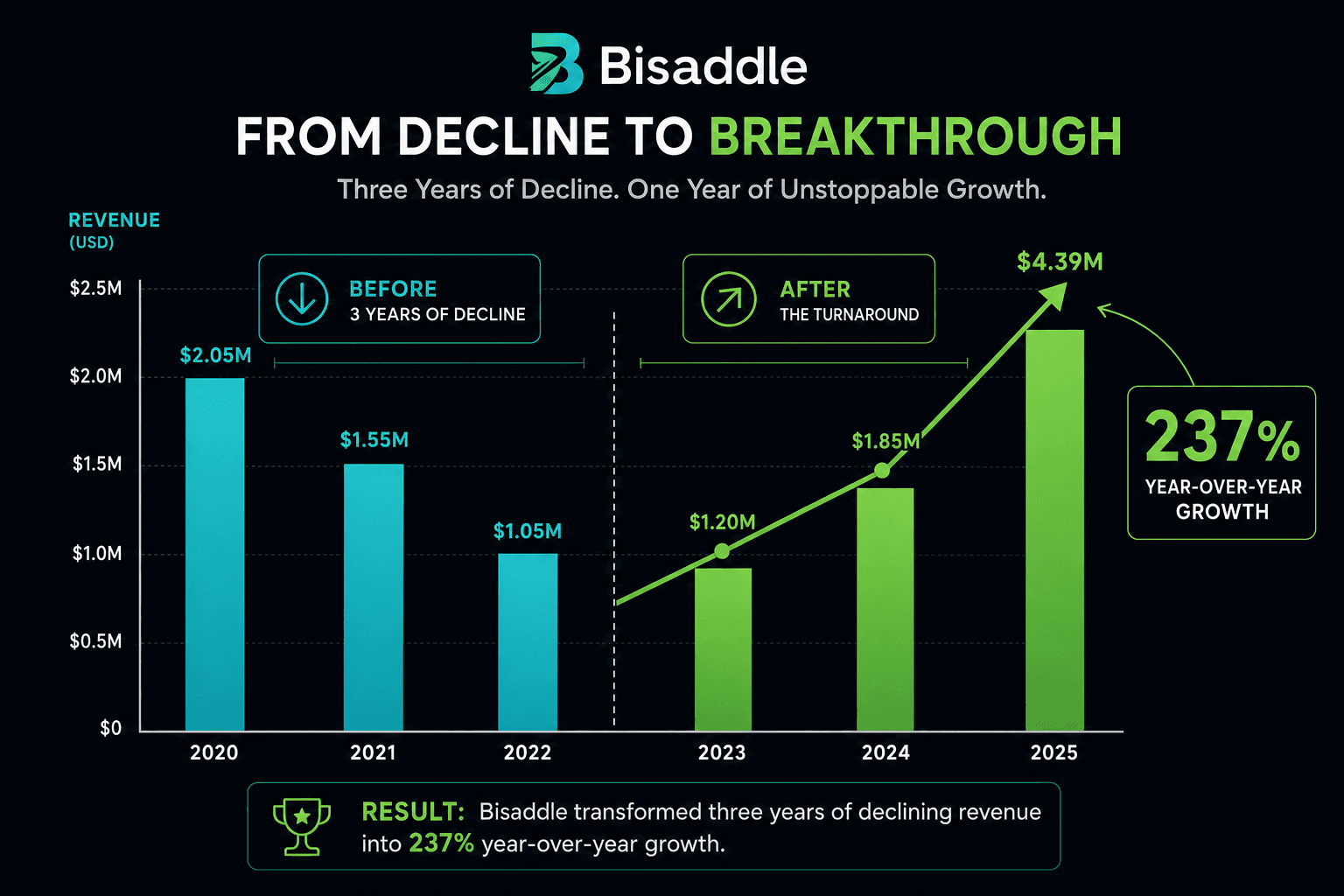
Reversed 3 years of decline to 237% YoY
Bisaddle
Challenge
Bisaddle was coming off three years of decline.
What we did
We redesigned Bisaddle's site, doubling its speed, and grew its email program.
Result
Bisaddle reversed the decline with 237% YoY growth, site conversion up 122%, and email at 48% of revenue. For your Etsy shop, the lesson is conversion first: fix listings before buying traffic.
See Where Your Etsy Shop's Growth Is Stuck and What We'd Do
No obligation. We'll review your real Shop Manager data (listing performance, Etsy Ads ROAS, Star Seller status) and tell you where growth is stuck and what we'd do, built for your shop, not a template.
Sagum · January 2017 · St. George, Utah · 8+ years