

8+ years growing brands on KPIs, now with AI
Real ROAS for eyewear brands, not more impressions
We drive down new-customer acquisition cost and build the repeat rate that proves your brand is working.
Google Ads · Meta · TikTok partner · 8+ years growing DTC brands on KPIs, not vanity metrics


Get your free Growth Gap Analysis
Senior strategist review · response within one business day
Prefer to reach out directly?
The Challenge
Eyewear Brands Face a Different Marketing Problem Than Most Categories
Value-tier brands sell prescription glasses for $6.95 a pair from their own factories in China. Warby Parker owns the mid-market with brand equity and a growing store footprint. EssilorLuxottica backs EyeBuyDirect, owns lens factories and retail chains, and bought Supreme for $1.5 billion. Competing on price is a slow exit.
Your growth lever is niche identity and community: an aesthetic, a fit story, a material (acetate, titanium, bio-based), a cultural moment. Paid media and creative must land it before CAC math breaks.
Eyewear is low-frequency: prescription glasses last one to two years; sunglasses are seasonal. Without multi-pair buying or contacts, LTV stays thin. With no CPG-style monthly repurchase, every acquisition dollar must work harder.
Need-based buyers (broken frames, expired prescription, new eye exam) decide fast; impulse buys (pre-summer, influencer drop, collab) close within 24 to 72 hours, so each needs its own campaigns. Buyers who can't try frames on, fear prescription upload, doubt lens quality, or can't use FSA/HSA funds abandon checkout or return orders; most agencies miss this.

The Opportunity
Eyewear Brands That Crack Creative and Retention Win the Category
Premium sunglasses carry 50–70% gross margins. If paid media works, with blended ROAS above 2.5x and nCAC below 33% of LTV, profit can grow faster than revenue, and brands that get there early scale without the margin-killing discount spiral.
TikTok 'frame on face' content converts at a rate static Meta creative hasn't hit in two years, and fashion and lifestyle micro-influencers beat celebrity placements on CPM-adjusted ROAS.
Two prescription spikes go mostly unclaimed. U.S. consumers burn flexible spending account balances from mid-November through December 31, yet almost no DTC brand runs a dedicated campaign for it. The back-to-school window, July through September, brings parents buying kids' prescription frames and students updating their look, a different buyer and brief than spring sunglass campaigns.
Brands pairing season-aware media with retention that drives second and third purchases hit and hold a 3:1 LTV:CAC.
What Most Get Wrong
What Most Eyewear Brands, and Their Agencies, Get Wrong
One creative strategy for prescription and sunglass buyers
A buyer who broke their only pair and needs lenses in five days wants urgency and Rx-upload reassurance; a TikTok-driven sunglass shopper wants social proof. Shared creative inflates both CACs.
Missing the FSA flush and back-to-school prescription spike
Most brands plan for spring sunglasses and Q4 gifting. Without FSA-acceptance messaging and Rx creative from mid-November through December 31, high-intent buyers go to LensCrafters and Warby Parker's stores.
Managing to platform ROAS instead of blended ROAS
Meta's pixel misses TikTok viewers who Googled you three days later and bought direct. Brands optimizing to it overfund retargeting and starve top-of-funnel creative; their agencies manage to a fiction.
Treating conversion rate optimization as a one-time project
Objections about PD measurement, a wrong prescription, and FSA resurface by segment and page, so one redesign leaves 10–20% of conversion rate on the table for good.
Neglecting retention because eyewear 'isn't a repurchase category'
Low frequency makes that costlier. If customers buy two or three pairs over their lifetime, you can support a 3:1 LTV:CAC; if they stop at one, acquisition can't scale profitably.
Why Now
The Next 12 Months Favor Eyewear Brands That Move First
Meta CPMs for fashion and eyewear buyers on Instagram keep rising, so brands on two-year-old static creative see blended ROAS compress while brands testing five angles a week, not one a month, pull ahead.
TikTok Shop is still early for eyewear. Brands that build there before CPMs normalize will own a CAC advantage for years, and the window is measured in months. Sunglass season is a fixed deadline: build and test creative, paid social, and your influencer pipeline before March, ahead of your highest-revenue window.
With AI, a two-person team at a $3M eyewear brand can now catch attribution errors before they compound and run creative testing and behavior-driven retention flows that once took eight people. Brands that build this now hit nCAC targets while competitors pull reports by hand.
The Mechanism
Where AI Gives Eyewear Brands an Edge
Real productivity, not AI theater. Here's where it actually moves a number for eyewear brands.
Creative
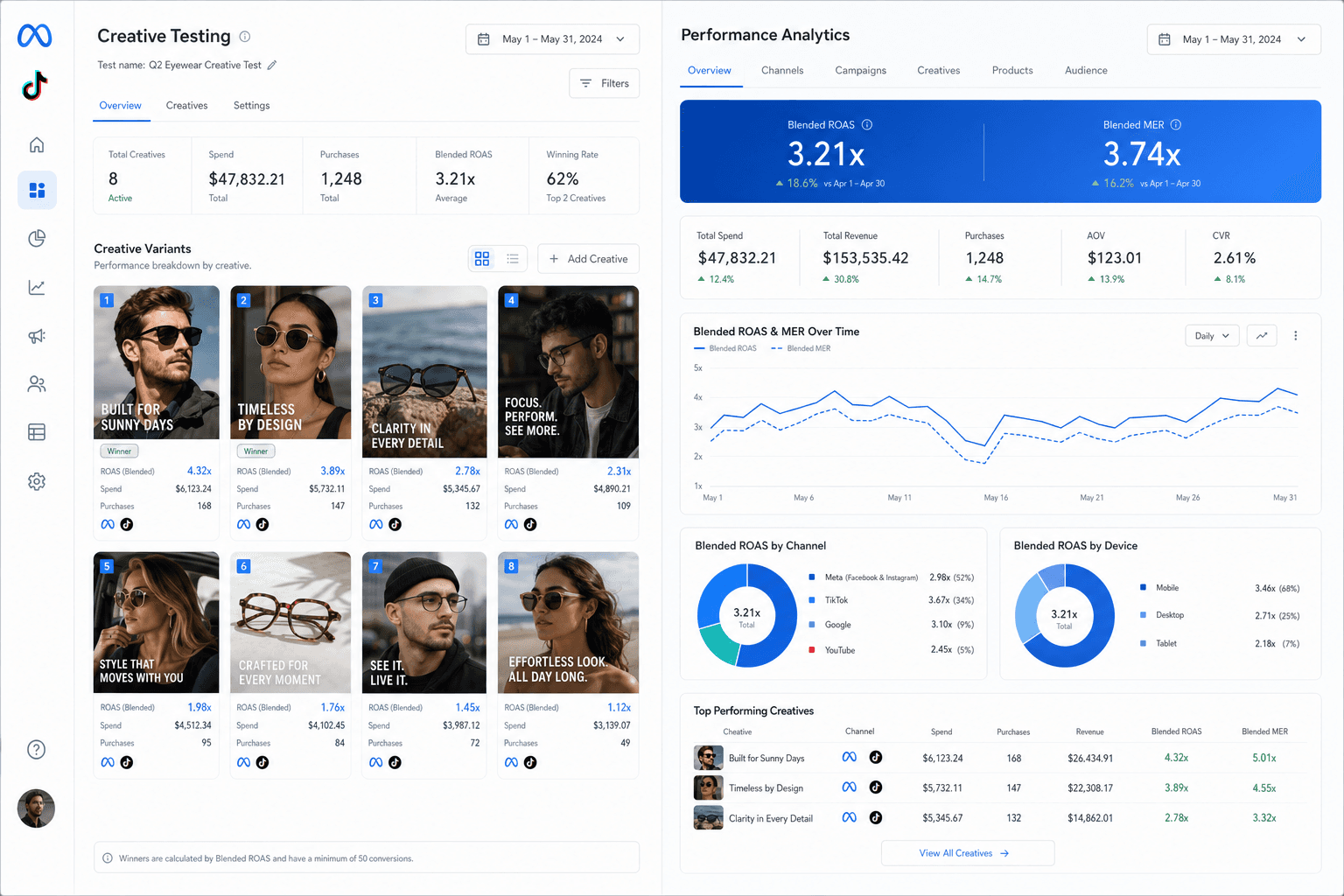
What AI does: Generate and test more concepts weekly on Meta and TikTok: frame aesthetics, 'frame on face' formats, lifestyle contexts, and objection angles (lens quality, PD measurement, FSA acceptance).
The result: You find the hooks that drive 3x+ ROAS before competitors do, and rotate winners into new audiences before fatigue sets in.
Why it matters here: Your ad is the product demo. Test faster and you find winners months sooner; in a 24–72-hour sunglass window, wrong creative loses the sale.
Analytics
What AI does: Pull Meta, TikTok, Google Shopping, email, and SMS into one blended ROAS report, with AI flagging misfiring pixels, double-counted conversions, and last-touch over-attribution.
The result: You see which channels win new customers and which claim credit for buyers who'd convert anyway, then shift budget.
Why it matters here: Eyewear buyers often find you on TikTok, check Instagram, then buy direct or via branded search days later, so fixing attribution beats any campaign tweak.
Social Media
What AI does: An AI-assisted pipeline finds fashion and lifestyle creators with 50K–300K followers and audiences matching your frame aesthetic, briefs them on 'frame on face' content, and tracks CPM-adjusted ROAS per creator.
The result: You get repeatable UGC and paid creative at a lower cost per acquisition than celebrities or broad prospecting.
Why it matters here: Influencers are the try-on a white-background product shot can't replicate. Running them as a system, not one-off PR, builds a content and acquisition moat.
What AI does: AI-triggered email and SMS flows fire on purchase signals: a blue-light sequence after a sunglass purchase, February seasonal drops to past sunglass buyers, and FSA-urgency flows from mid-November for lapsed Rx buyers.
The result: Repeat purchase rate climbs toward and above 30%, and a meaningful share of revenue needs no paid acquisition.
Why it matters here: Low frequency makes each retention dollar worth more, and email and SMS are the only channels you own.
Conversion Optimization
What AI does: Continuously test try-on tool placement, PD explainers, lens guarantee copy, FSA/HSA badges, prescription upload UI, landing page copy, and checkout flow, with AI flagging drop-off and ranking tests.
The result: Conversion rate keeps improving quarter over quarter instead of plateauing after one redesign.
Why it matters here: Eyewear objections silently kill conversion and surface differently by page and buyer, so continuous testing is a structural advantage one redesign can't match.
Ready to see what this looks like for your eyewear brands business?
No obligation. A senior strategist will show you exactly where the wins are.
The Strategy
How an Eyewear Brand's Marketing Should Run
Fix measurement before you scale. Report blended ROAS (total revenue divided by total ad spend) instead of trusting Meta's pixel alone or Google's last click, and track nCAC apart from returning customer revenue.
Paid social on Meta and TikTok is most eyewear brands' primary acquisition engine. It needs separate prescription and sunglass campaigns and a creative-testing discipline most teams lack. Prescription campaigns lead with lens quality and FSA/HSA acceptance; sunglass campaigns lead with 'frame on face' creative, micro-influencer UGC, and a short checkout.
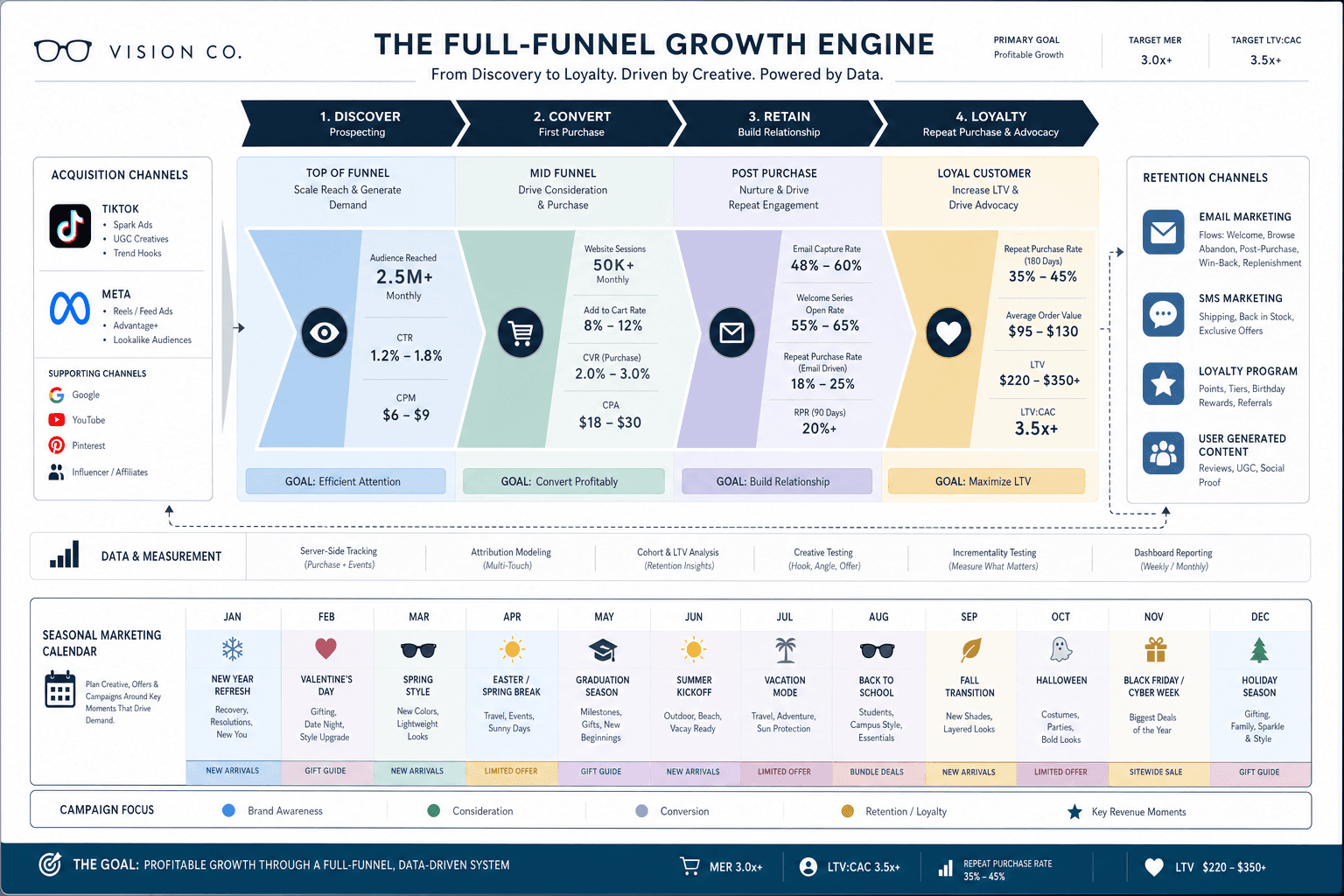
Follow eyewear's demand calendar: ramp sunglass spend in February before the March–June peak, run back-to-school prescription campaigns July through September and FSA-urgency campaigns from mid-November through December 31, and use January for retention, not acquisition. Flat monthly spend is a red flag.
Build TikTok now: short-form content, micro-influencers, and TikTok Shop for impulse sunglass buys are underpriced against where they'll be in 18 months.
Email and SMS retention multiplies everything else. The goal is a repeat purchase rate above 30%, driven by flows that pull first-time buyers into multi-pair buying, like a second optical frame in a different material. Leave retention on autopilot and you pay to acquire the same customer twice.
The one number that governs this
Blended ROAS across all channels, with nCAC tracked separately, governs every decision. Platform-reported ROAS is only a data point.
How We Help
What We Would Do for Your Eyewear Brand
We limit our roster so every client gets senior attention. For an eyewear brand, we start with measurement and build toward the paid social, influencer, and retention channels that compound.
Analytics & Attribution Setup
We fix pixels, build blended ROAS reporting you can trust, and split nCAC from returning-customer revenue before we touch a campaign.
Paid Social: Meta & TikTok
We run separate prescription and sunglass campaigns, each with its own brief, landing page, and conversion goal, and test multiple angles weekly.
Creative Development & Testing
We produce 'frame on face,' lifestyle, and objection-handling ads, with AI speeding up testing.
Influencer & UGC Pipeline
We source and brief micro-influencers, track ROAS per creator, and turn their content into paid ads.
Email & SMS Retention
We build multi-pair cross-sells, seasonal-drop announcements, and FSA-urgency flows to lift repeat purchase rate.
Conversion Rate Optimization
We test the page elements that answer eyewear objections, from try-on tool placement to FSA/HSA badges, as an ongoing practice.
Media Calendar & Seasonal Planning
We set budget to eyewear's demand calendar so spend follows buyers instead of a flat monthly plan.
Who's Behind This
Who we are, and what makes us different
Sagum is a performance marketing agency founded in January 2017 in St. George, Utah. We've spent 8+ years growing real brands and being judged on KPIs, not vanity metrics.
We deliberately limit how many clients we take so each one gets senior attention. We treat your numbers like our own, we never run generic playbooks, and your strategy is built for your business, because shouldn't your brand's marketing be custom to your brand?
Sagum.ai is our AI arm: the same proven operators now build AI into the work wherever it creates real edge, not as theater, but as leverage applied with discipline.
- 8+ years growing brands on performance KPIs, not vanity metrics
- Limited client roster, with senior attention on every account
- An extension of your team; your success is tied to ours
- Custom strategy per brand, never a generic playbook
- AI built in where it moves a number; judgment over hype
“Sagum is a performance marketing agency that's spent 8+ years growing brands by treating their numbers like our own. We take on few clients, never run generic playbooks, and now build AI into the work wherever it creates real edge, not hype. Your strategy is built for your business, and our success is tied to yours.”
“Sagum roughly doubled our bottom line. They treat the work like it's their own business.”
Rachel Nilsson
CEO, RAGS
Proof
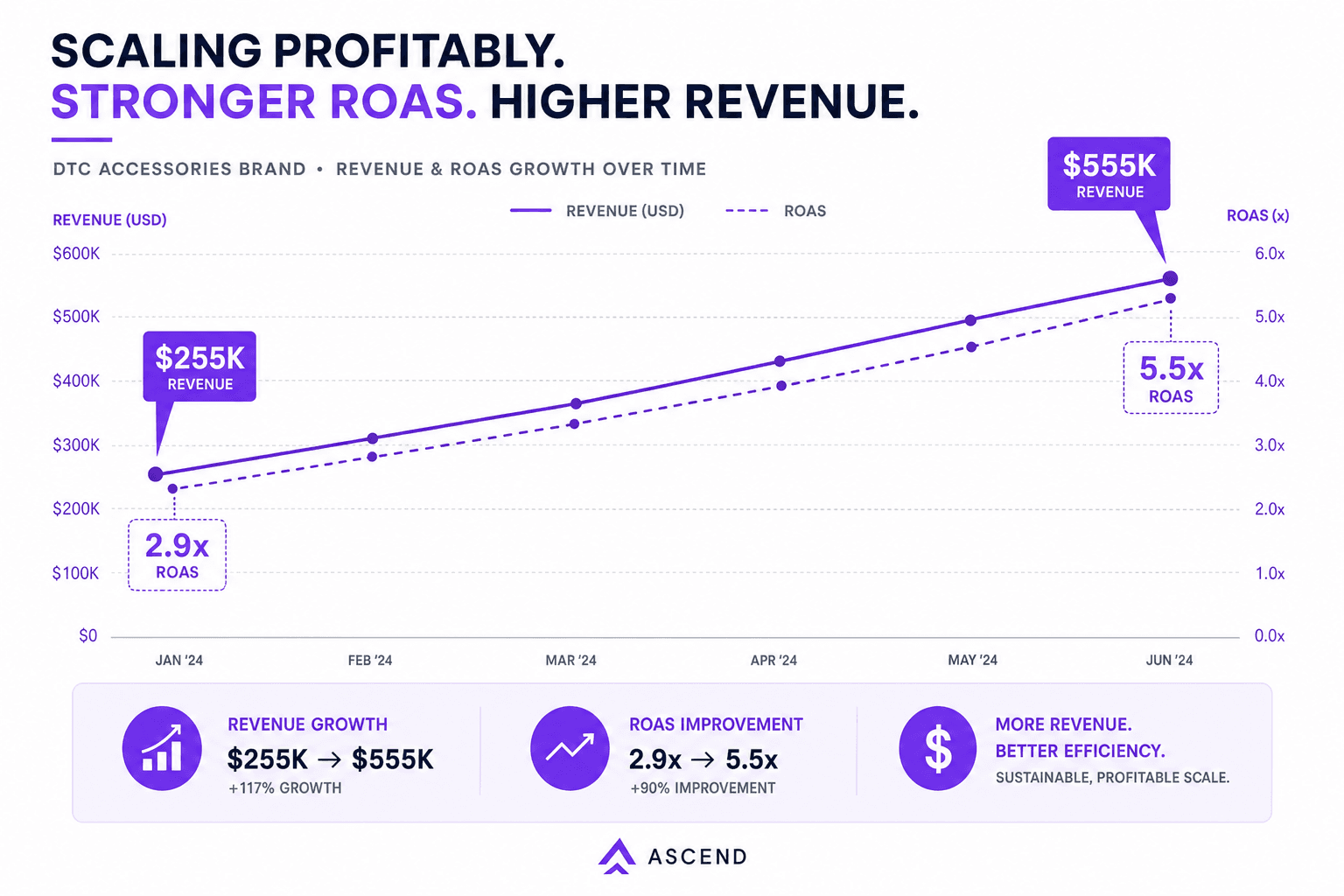
$255k → $555k in 2 months, ROAS 2.9x → 5.5x+
Nickel & Suede
Challenge
Nickel & Suede needed to scale revenue profitably on paid social.
What we did
We ran Meta and TikTok creative testing at volume, the same testing engine we'd build for an eyewear brand.
Result
Revenue grew from $255k to $555k in two months. ROAS moved from 2.9x to 5.5x+, peaking at 7.95x, and site conversion rose 34%.
- Revenue
- $255k → $555k (2 mo)
- ROAS
- 2.9x → 5.5x+ (peak 7.95x)
- Site conversion
- +34%
If Blended ROAS Is Compressing, Let's Talk About Which Lever to Pull
No obligation. We'll come prepared on your channels, seasonality, and conversion funnel, with a clear view of where your growth is and what it takes. If we're not the right fit, we'll say so.
Sagum · January 2017 · St. George, Utah · 8+ years