
8+ years growing brands on KPIs, now with AI
Hit real ROAS targets on your fitness brand
Creative-led paid media and testing tuned to your sub-vertical's unit economics, not a generic template.
8+ years growing DTC brands · Google Ads, Meta & TikTok partners · Results measured in ROAS, not impressions


Get your free Growth Gap Analysis
Senior strategist review · response within one business day
Prefer to reach out directly?
The Challenge
Running a Fitness Brand's Paid Media Is One of the Hardest Jobs in Ecommerce
You already know the numbers that matter: blended ROAS, contribution margin, CAC payback period, cohort LTV. The problem isn't understanding the metrics. It's the structural difficulty of hitting them in a category where the deck is stacked against you.
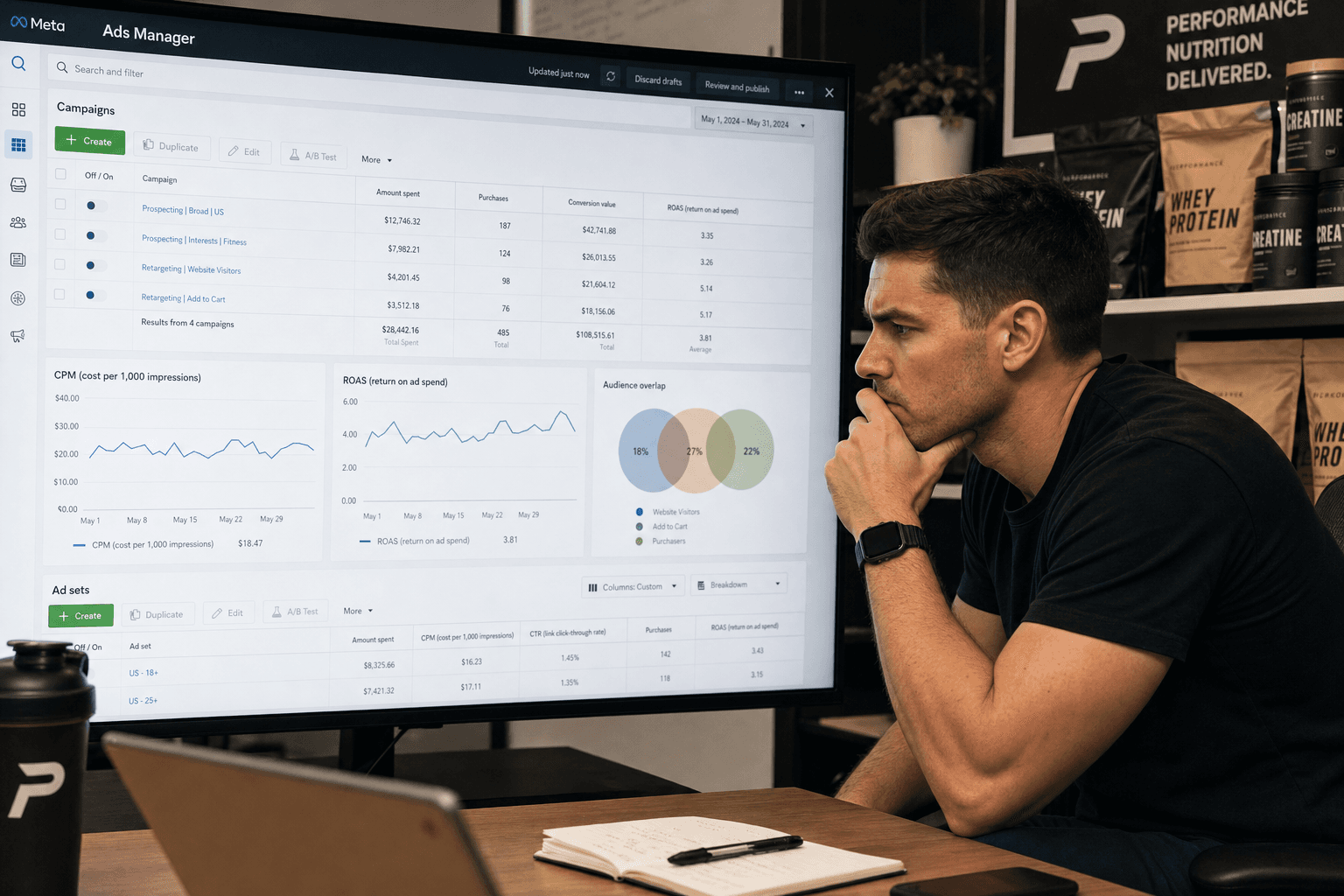
Health & Wellness CPMs on paid social run around $19.30, among the most expensive impression categories in ecommerce, because Gymshark, Alphalete, Alo Yoga, GHOST Supplements, and dozens of well-funded challengers are all bidding on the same Meta audiences and the same influencer rosters you are. Your cost to reach a qualified prospect is high before a single click happens.
Then there's the sub-vertical problem. A $60 AOV supplement brand with the median Meta CPA sitting at $38 is operating on razor-thin first-purchase margins. Every acquisition dollar has to be recovered through auto-ship enrollment and cohort LTV, which means your email and SMS flows aren't a nice-to-have, they're the actual business model. An activewear brand with an $80–$130 AOV has a completely different problem: without an active loyalty program, cohorts go one-and-done, and you're constantly refilling a leaky bucket.
Equipment and hard goods brands face a third reality: $110–$300+ tickets mean considered purchase cycles, low repeat rates, and a buyer who will comparison-shop for weeks before converting. The creative, funnel, and channel mix that works for a supplement subscription has almost nothing in common with what closes a $250 piece of home gym equipment.
And underneath all of it: attribution is broken. iOS privacy changes fragmented the signal. Platform-reported ROAS flatters the numbers. You've probably already learned, sometimes painfully, that what Meta says happened and what actually happened in your bank account are two different things.
The brands that grow through this environment don't do it by spending more. They do it by making better decisions faster (better creative decisions, better channel allocation decisions, better retention decisions) than the competitors sharing their audience.
The Opportunity
The Fitness Category Has Three High-Intent Windows a Year, and Most Brands Capture One
January is the single highest-intent acquisition window in fitness ecommerce. New Year's resolution demand is real and concentrated. Consumers are actively searching, clicking, and buying supplements, activewear, and equipment in the first two to three weeks of the month. The brands that win January aren't the ones who turn on ads on January 1st; they're the ones who built and tested their creative in November and December, so they enter the window with proven angles and healthy Quality Scores.
The spring and summer surge (March through July) is the second window, driven by warmer weather, outdoor activity, and the pre-summer body composition push. Hydration-focused supplement lines can see sales double or triple during this period. Activewear brands with the right creative ready in March can ride that demand curve for five months.
Q4 gift season (November–December) is the third window. High-ticket fitness equipment (think connected cardio machines, smart weights, premium recovery tools) sees some of its strongest performance as a gift category. Brands that have built retargeting audiences and email lists through the year convert that warm traffic efficiently in Q4 at a time when purchase intent is high and gifting justifies the ticket size.
The brands that capture all three windows, not just January, do it by treating the late August–September trough as a build period: testing new creative angles, warming up influencer partnerships, and building the email segments they'll need to activate when demand returns. That's where the real competitive separation happens.
There is also a structural opportunity in the channels themselves. Meta UGC-style creative dramatically outperforms studio production in this category. Micro and nano influencers (fitness creators with 5,000 to 50,000 followers) routinely drive 5–20% engagement rates versus the 1–3% you get from celebrity placements. Brands willing to build a systematic creator pipeline, rather than chasing one-off influencer deals, are building a durable acquisition asset their competitors can't easily copy.
What Most Get Wrong
What Fitness Brands (and the Agencies That Serve Them) Usually Get Wrong
Optimizing for platform-reported ROAS instead of blended MER
Meta will report a 4x ROAS. Your bank account will tell a different story. When attribution is broken, and in a post-iOS world it is for almost every fitness brand, optimizing to platform numbers means you're making budget decisions on flattering fiction. Brands that scale on reported ROAS without cross-referencing blended MER (total revenue ÷ total ad spend) routinely discover they've been subsidizing Meta's numbers with organic and email revenue they weren't tracking correctly.
Running the same creative strategy across supplement, apparel, and equipment sub-verticals
A $55 protein powder and a $249 adjustable dumbbell set are not the same purchase. One is an impulse buy driven by a 15-second UGC video; the other requires a considered-purchase funnel with comparison content, social proof, and a retargeting sequence. Agencies that run a single creative and funnel template across fitness sub-verticals are leaving conversion rate, and margin, on the table for every client whose product doesn't fit the template.
Ignoring email and SMS as a ROAS driver and treating them as a retention afterthought
Email delivers 6–10x ROAS in ecommerce when it's built correctly. For supplement brands where the business model depends on auto-ship enrollment and cohort LTV, the post-purchase flow isn't a retention tactic. It's the primary profit center. Brands that hand email to a junior team member or a templated tool while the agency focuses exclusively on paid acquisition are systematically underbuilding their highest-margin channel.
Treating TikTok as a direct-response channel and measuring it like Meta
TikTok is a discovery and awareness engine for fitness brands, not a bottom-funnel closer, especially for products above $80 AOV. Brands that judge TikTok spend on last-click ROAS will always underfund it and miss the top-of-funnel brand building that makes their Meta retargeting cheaper and their January surge larger. The right metric for TikTok in this category is new customer acquisition rate and downstream cohort behavior, not same-session conversion.
Scaling ad spend into creative fatigue without a systematic testing cadence
In the Health & Wellness category, where CPMs are already elevated, running an ad into creative fatigue is expensive in two directions: CTR drops, so you pay more per click; and CVR drops, so fewer of those clicks convert. Most fitness brands test one or two new creative angles per month. The brands that test eight to twelve, systematically, with a clear hypothesis for each, find winning angles faster, extend the life of their spend, and build a creative library that compounds over time.
The Specialist Edge
Fitness Isn't One Category, and Marketing It Like One Is Why Most Brands Stall
"Fitness" is not a category. It's three or four different businesses wearing the same label. A supplement brand, an activewear line, and a home-equipment company share a customer mindset and almost nothing else: not the price points, not the purchase cycle, not the repeat behavior, not the math that decides whether an acquisition dollar comes back. The single biggest reason capable fitness brands underperform their potential is that they hire a generalist who sees one category and runs one playbook across all of it.
Look at what actually changes between sub-verticals. A $60 AOV supplement is a subscription business in disguise: the first order often loses money, and the entire model lives or dies on auto-ship enrollment and cohort LTV. An $80–$130 activewear brand is a repeat-rate business: get the loyalty loop right and cohorts compound, get it wrong and you refill a leaky bucket forever. A $110–$300 equipment brand is a considered-purchase business: weeks of comparison shopping, low repeat rates, and a buyer who needs proof before they convert. Same ad account, three completely different funnels, creative formats, retention mechanics, and governing metrics.
A generalist agency can't price that complexity in. Their margins depend on reusing one creative template, one funnel structure, and one attribution setup across every client, so that's what your brand gets, whether or not it fits. The cost shows up quietly: conversion rate left on the table, margin subsidized by channels they aren't measuring, and a creative library full of angles built for the wrong kind of purchase. A specialist's advantage isn't working harder than a generalist. It's starting from the right model for your sub-vertical on day one, instead of discovering it on your budget.
This is why specialization is a durable advantage rather than a temporary one. The economics of a supplement subscription versus a one-time equipment purchase aren't a trend that resets next quarter; they're structural, and they'll be just as true two years from now. A partner who builds around your specific unit economics gets the funnel, the proof format, the retention engine, and the metric that governs every decision right from the start, then compounds that fit month after month. The brands that win in fitness aren't the ones that found a clever seasonal hook. They're the ones that stopped being marketed to like a generic ecommerce store.
The Mechanism
Where AI Actually Moves the Numbers for Fitness Ecommerce Brands
Real productivity, not AI theater. Here's where it actually moves a number for fitness brands.
Paid Social (Meta & TikTok)
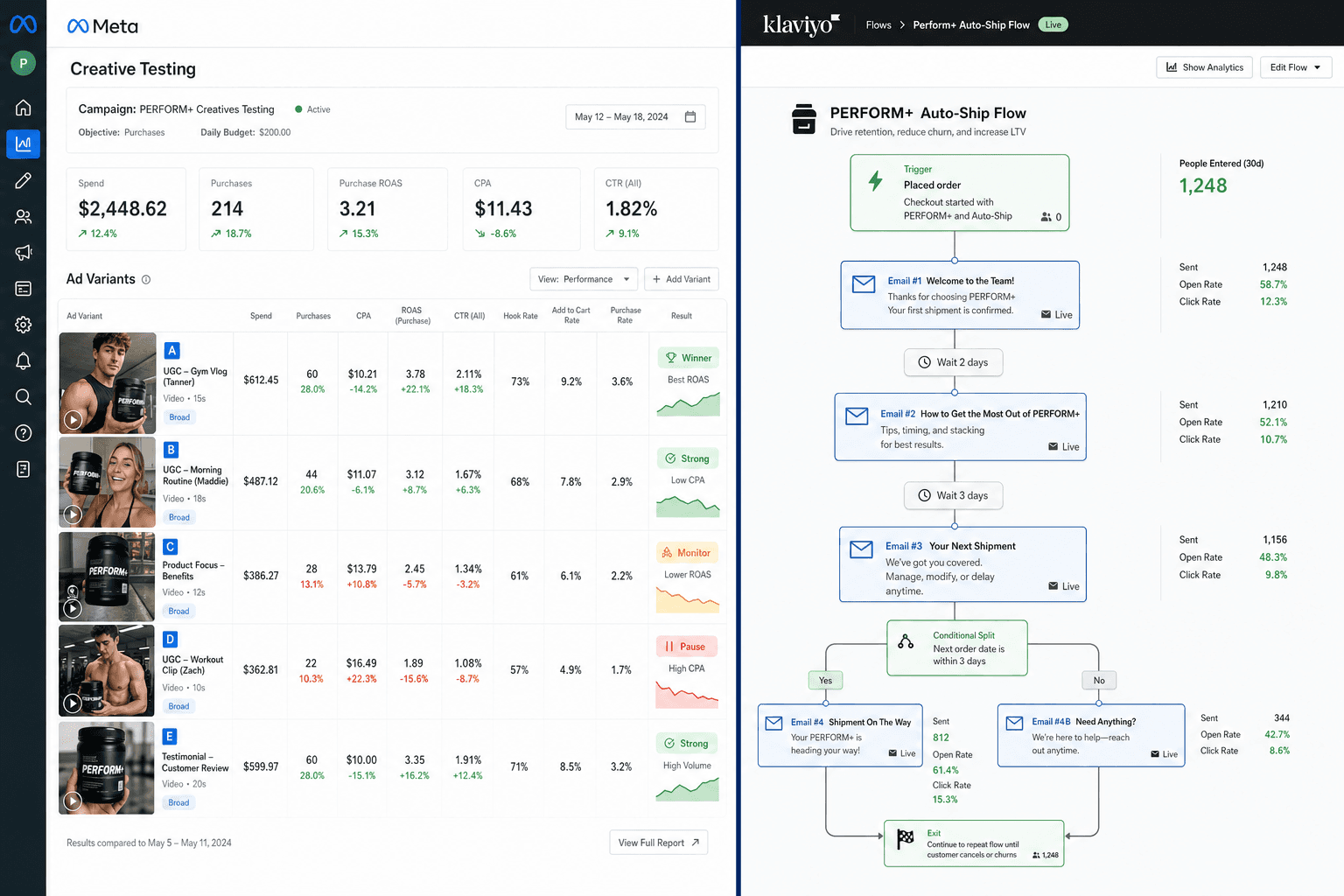
What AI does: AI-assisted creative production and systematic angle testing across Meta and TikTok: generating UGC-style hooks, scripts, and static concepts at volume, then using performance data to find which angles (transformation stories, ingredient efficacy, social proof, lifestyle aspiration) drive qualified new-customer clicks rather than just impressions, with bids and budget shifted toward what is working. Meta carries direct-response volume; TikTok runs as the discovery layer measured on new-customer acquisition, not last-click.
The result: Test 6–10 distinct creative angles per week instead of 1–2, compress the time from hypothesis to a proven winner, and hold new-customer ROAS in the 2.5–4x range as spend scales, so the January push launches with proven creative rather than a guess.
Why it matters here: In a category where Health & Wellness CPMs run around $19.30 and creative fatigue is the primary ROAS killer, the brand that finds a winning angle faster and extends its life longer wins the margin battle. UGC-style creative outperforms studio production in fitness, but it still needs systematic testing to surface the specific hook that converts for your product and audience, and TikTok discovery makes the downstream Meta retargeting cheaper.
Google Shopping
What AI does: AI-assisted bid and budget management on Google Shopping and Performance Max, concentrating spend on the branded and category terms from buyers already in purchase mode and pacing it to the three seasonal demand windows instead of a flat monthly number.
The result: Bottom-funnel branded and category searches captured at a 3–4x ROAS, with budget weighted into January, the spring surge, and Q4 rather than wasted in the late August–September trough.
Why it matters here: Google Shopping catches high-intent demand that paid social creates but doesn't always close, especially for considered equipment purchases where a buyer comparison-shops for weeks before converting on a branded search. Bundling it into a single 'digital ads' line hides whether that intent is actually being captured.
Analytics
What AI does: AI-powered attribution modeling that reconciles platform-reported ROAS against blended MER, surfaces cohort LTV by acquisition channel and creative angle, and flags a pixel misconfiguration or UTM break before you scale spend against bad data.
The result: A blended-MER view that typically exposes platform-reported ROAS as overstated by 30–50%, catches the tracking errors inflating Meta's numbers, and reveals the true CAC payback period by channel, so budget moves to the channels actually recovering acquisition cost through repeat purchase.
Why it matters here: Post-iOS attribution is broken for almost every fitness brand. A supplement brand on a $38 median CPA with a $60 AOV cannot afford to misread which channel is actually recovering that cost through auto-ship. Optimizing to blended MER with cohort visibility instead of platform ROAS is often the difference between scaling profitably and growing revenue while margin shrinks.
Email & Automation
What AI does: AI-built post-purchase flows, auto-ship enrollment sequences, and win-back campaigns, with dynamic segmentation based on purchase category (supplement vs. apparel vs. equipment), cohort behavior, and predicted churn risk, deployed and iterated faster than a manually-built Klaviyo setup.
The result: Auto-ship enrollment in the first 30 days lifted from a typical 15% toward 25–30%, email and SMS driving 25–35% of total revenue, and win-back flows reactivating 8–12% of churned subscribers before they buy from a competitor.
Why it matters here: For supplement brands where a 37.7% repurchase rate is achievable and 12-month LTV can reach $300–$600 per customer, the post-purchase email flow is the actual profit engine, not the acquisition campaign. AI-assisted segmentation and flow optimization means the email program is continuously improving based on real cohort behavior, not a set-it-and-forget-it template.
Conversion Optimization
What AI does: AI-assisted landing page and product page analysis and testing: identifying where fitness shoppers drop off (ingredient skepticism, shipping-threshold friction, subscription upsell placement) and running structured tests on bundle offers, subscribe-and-save positioning, and social proof sequencing.
The result: A higher conversion rate on paid traffic, AOV lifted through better bundle and upsell presentation, and a subscribe-and-save enrollment rate that reflects the real LTV opportunity, often the cheapest ROAS gain available because it improves every channel at once.
Why it matters here: Fitness consumers are skeptical by nature, so the landing page has to do real work: answer the 'does this actually work?' objection, present proof in the format that converts for the sub-vertical (before/after for transformation products, third-party testing for supplements, athlete endorsement for equipment), and make the subscription offer feel like the obvious choice. AI-assisted CRO means those tests run continuously, not quarterly.
Ready to see what this looks like for your fitness brands business?
No obligation. A senior strategist will show you exactly where the wins are.
The Strategy
The Advertising Strategy That Actually Works for a DTC Fitness Brand
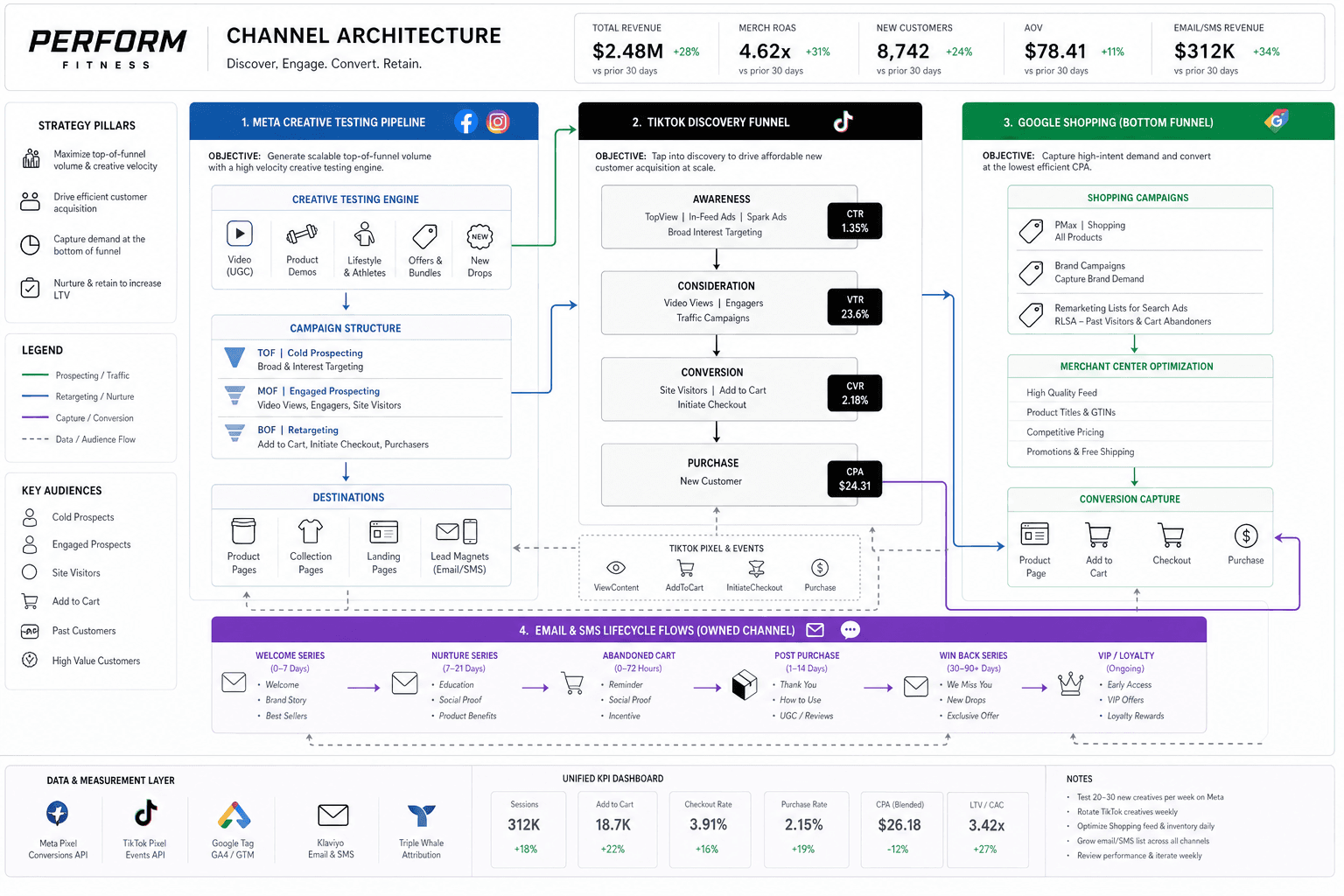
The foundation is channel clarity. Meta (Instagram and Facebook) is the primary acquisition engine for most fitness sub-verticals. It's where UGC-style creative drives volume at a 2.5–4x ROAS range when the creative is working. TikTok is the discovery and brand-building layer, best measured by new customer acquisition rate and downstream cohort behavior rather than last-click conversion. Google Shopping and Performance Max capture bottom-funnel intent: branded searches and category terms from buyers already in purchase mode, typically at 3–4x ROAS. These three channels are not interchangeable; each has a distinct job in the funnel.
Creative is the strategy. In a category where Health & Wellness CPMs are among the highest in paid social, the brand that finds a winning creative angle faster and extends its life longer wins the margin battle. That means a systematic testing cadence: not one or two new ads per month, but a structured program of eight to twelve distinct angles, each with a clear hypothesis (transformation narrative vs. ingredient transparency vs. community social proof), evaluated on new-customer ROAS and downstream LTV, not just CTR.
Email and SMS are not a retention afterthought. They are the margin engine. Post-purchase flows, auto-ship enrollment sequences, and win-back campaigns built around actual cohort behavior (not generic templates) are where the difference between a 1:1 and a 3:1 LTV-to-CAC ratio is made. For supplement brands especially, auto-ship enrollment rate in the first 30 days post-purchase is a leading indicator of whether the acquisition economics actually work.
Attribution has to be honest. Platform-reported ROAS is a starting point, not a source of truth. The governing metric is blended MER (total revenue divided by total ad spend) cross-referenced against cohort LTV by acquisition channel and creative angle. Supplement brands need to see CAC payback period by channel. Apparel brands need to see 90-day cohort repeat rate. Equipment brands need to see assisted conversion paths because the purchase cycle spans weeks.
Seasonal pacing is non-negotiable. The three demand windows (January, March–July, and Q4) are not equally accessible to brands that haven't prepared. The late August–September trough is the build period: creative testing, influencer negotiation, email segmentation rebuild. Brands that treat every month the same miss the windows that drive the majority of annual new customer acquisition.
Micro-influencer partnerships are a structural advantage, not a one-off tactic. Fitness creators with 5,000–50,000 followers routinely drive 5–20% engagement rates, far above what celebrity placements deliver, and their audiences have the sub-vertical specificity (powerlifting, trail running, yoga, supplement-focused) that makes the creative feel native rather than paid. A systematic creator pipeline that generates UGC for paid use is a durable asset.
The one number that governs this
The governing metric is blended ROAS (total revenue ÷ total ad spend) with a 3x+ target, not platform-reported channel ROAS. Secondary: LTV-to-CAC ratio ≥ 3:1, CAC payback period by channel, and auto-ship enrollment rate for consumable sub-brands.
How We Help
How Sagum Executes This for Your Fitness Brand
We'd start by getting your attribution honest: reconciling platform-reported numbers against your actual blended MER so every decision that follows is made on real data. From there, we build the channel architecture and creative program your sub-vertical actually needs, not a template that was built for a different kind of fitness brand.
Paid Media: Meta, TikTok & Google
We build and manage your Meta acquisition campaigns around UGC-style creative with a systematic testing cadence (8–12 new angles per month, each with a clear hypothesis), run TikTok as a discovery and new-customer acquisition layer measured by cohort behavior rather than last-click, and use Google Shopping/Performance Max to capture bottom-funnel branded and category intent, each channel with its own job, budget paced to your three seasonal demand windows.
Creative Strategy & Production
We design and produce the creative testing program (hooks, scripts, static concepts, and UGC briefs) using AI-assisted production to generate and test more angles per week than a traditional creative team can manage. We track which angles drive new-customer ROAS and downstream LTV, not just CTR, and build a compounding creative library your January push can launch with.
Email & SMS Automation
We build or rebuild your post-purchase flows, auto-ship enrollment sequences, and win-back campaigns in Klaviyo, segmented by sub-vertical (supplement vs. apparel vs. equipment), purchase behavior, and predicted churn risk. For supplement brands, auto-ship enrollment rate in the first 30 days is a primary KPI we optimize against.
Analytics & Attribution
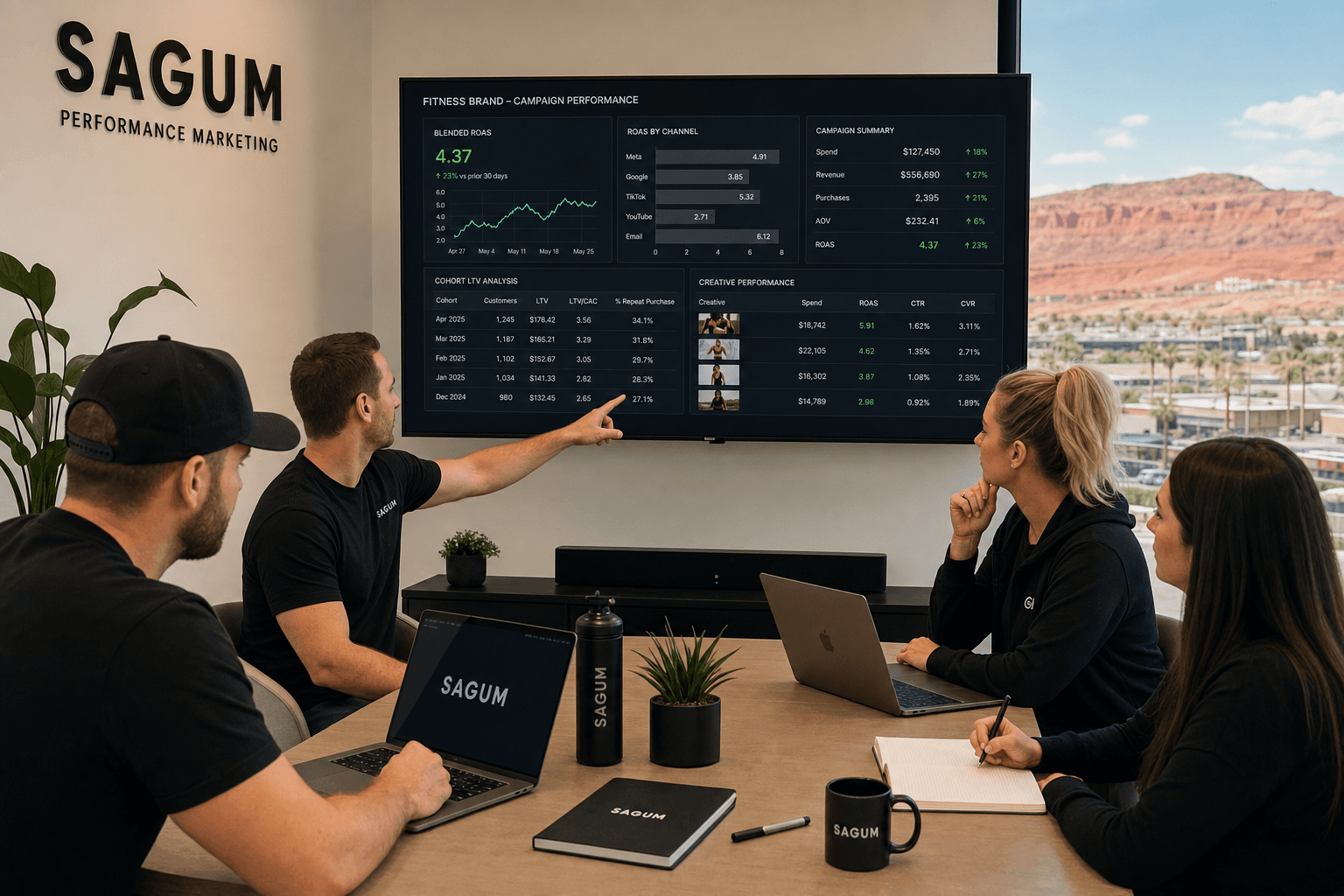
We implement blended MER tracking alongside platform reporting, build cohort LTV dashboards by acquisition channel and creative angle, and audit your pixel and UTM setup to catch the attribution errors that inflate numbers and lead to bad scaling decisions, the same foundation-first work that turns unreliable dashboards into confident scaling.
Conversion Optimization
We run structured landing page and product page tests targeting the specific friction points fitness shoppers hit (ingredient skepticism, shipping threshold drop-off, subscribe-and-save placement) with AI-assisted analysis identifying where to test and a clear hypothesis for each experiment, so your paid traffic converts at a rate that makes the channel economics work.
Who's Behind This
Who we are, and what makes us different
Sagum is a performance marketing agency founded in January 2017 in St. George, Utah. We've spent 8+ years growing real brands and being judged on KPIs, not vanity metrics.
We deliberately limit how many clients we take so each one gets senior attention. We treat your numbers like our own, we never run generic playbooks, and your strategy is built for your business, because shouldn't your brand's marketing be custom to your brand?
Sagum.ai is our AI arm: the same proven operators now build AI into the work wherever it creates real edge, not as theater, but as leverage applied with discipline.
- 8+ years growing brands on performance KPIs, not vanity metrics
- Limited client roster, with senior attention on every account
- An extension of your team; your success is tied to ours
- Custom strategy per brand, never a generic playbook
- AI built in where it moves a number; judgment over hype
“Sagum is a performance marketing agency that's spent 8+ years growing brands by treating their numbers like our own. We take on few clients, never run generic playbooks, and now build AI into the work wherever it creates real edge, not hype. Your strategy is built for your business, and our success is tied to yours.”
“After six years, Sagum is our most important partner: trusted, communicative, and caring about our business as if it's their own.”
Proof
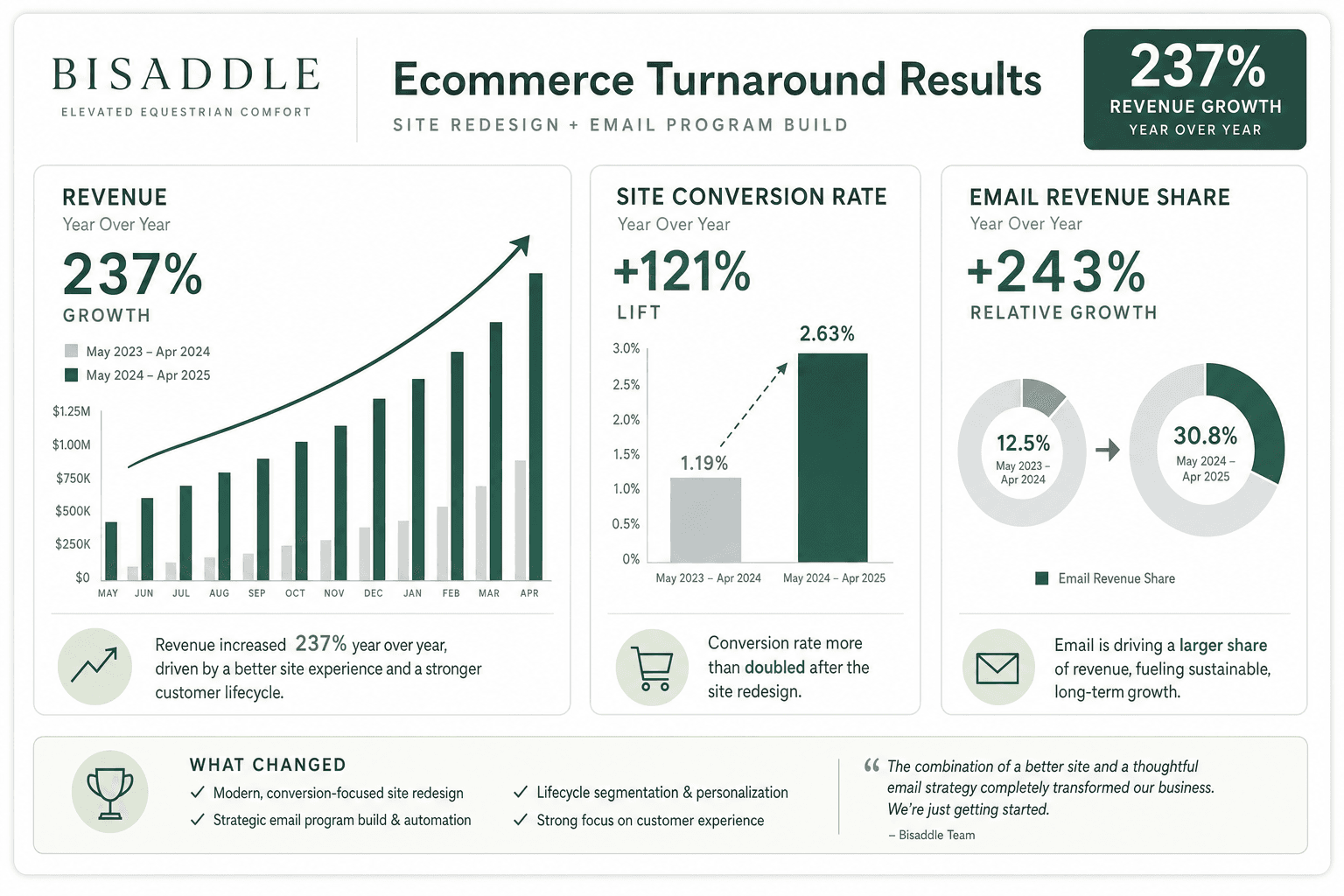
Reversed 3 years of decline to 237% YoY
Bisaddle
Challenge
Bisaddle, a DTC product brand, had hit three straight years of declining revenue. The fundamentals were sound, but the buying experience and the retention engine weren't pulling their weight, and more ad spend couldn't fix a slow, leaky site, the same trap a fitness brand falls into when it pours budget into acquisition while conversion and repeat purchase quietly erode.
What we did
We rebuilt the site for speed and conversion and built the email program into a real revenue channel rather than an afterthought, fixing the foundation so every acquisition dollar worked harder.
Result
Revenue grew 237% year over year. The site redesign doubled site speed and lifted conversion rate 122%, and email grew to 48% of total revenue. The lesson for fitness brands: a faster, higher-converting site and a real email engine often unlock more growth than another dollar of ad spend. Full details at sagum.com/case-studies/.
Ready to Build a Fitness Brand That Hits 3x+ Blended ROAS, and Holds It?
No obligation. We'll come to the session having looked at your current channel mix, creative cadence, and attribution setup, and give you a straight read on where the gaps are and what we'd do about them. Your strategy is built for your sub-vertical, not a fitness industry template.
Sagum · January 2017 · St. George, Utah · 8+ years