
8+ years growing brands on KPIs, now with AI
Protect food-brand margin while you grow revenue
We build every campaign around contribution margin, the number that actually keeps your brand alive.
8+ years growing DTC brands · Google Ads, Meta & TikTok partners · Verified case studies with published numbers


Get your free Growth Gap Analysis
Senior strategist review · response within one business day
Prefer to reach out directly?
The Challenge
Growing a Food Brand Is a Margin Math Problem First, and a Marketing Problem Second
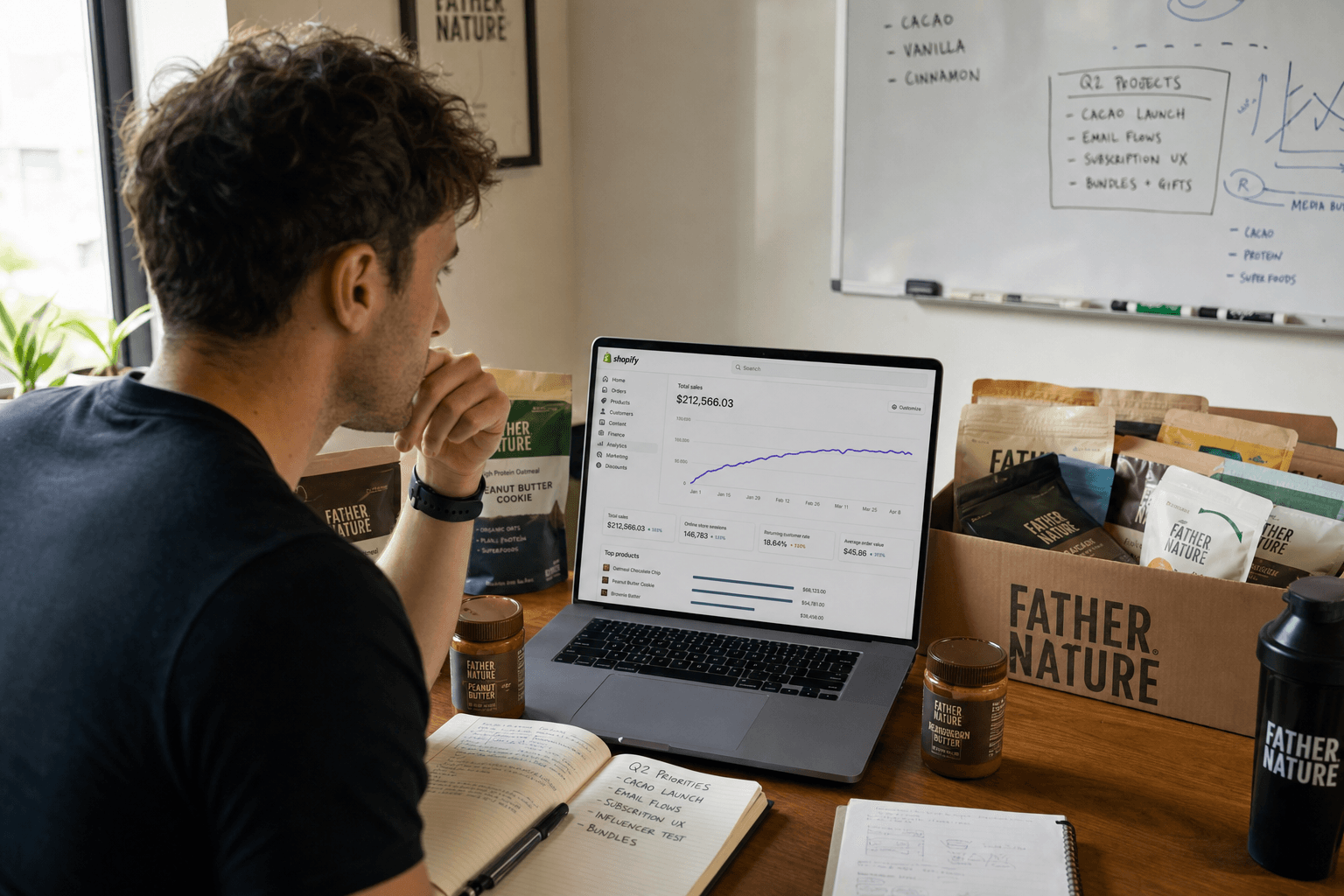
You already know the trap. Your Meta dashboard shows a 4× ROAS and your Shopify revenue is flat. That's because a 4:1 ROAS on a $20 snack box with a $15 cost of goods isn't growth: it's a slow bleed. Food gross margins run 30–50%, not the 70–80% a supplement or beauty brand can absorb. Every dollar of CAC has a much shorter runway before it turns unprofitable.
Your buying trigger isn't casual browsing. A first-time customer who tries your hero SKU and reorders on a 30-day replenishment cadence is worth $375 over a year. A customer who buys once and churns is worth $54. The entire game is whether your acquisition spend is pulling in the first type or flooding the funnel with the second, and most food brands can't tell the difference because their attribution is broken.
Then there's creative. Meta is still the workhorse for DTC food, but creative fatigue hits hard and fast. You need 20-plus variants in rotation to hold CPMs from creeping. Most founders are running three. The ads that work are almost always UGC (real people, real kitchens, real reactions), not brand-polished hero shots. Finding, testing, and scaling that creative fast enough to outrun fatigue is a full-time job on its own.
And Q4 is the whole year. November runs 64% more orders than your annual average. Miss the creative and budget ramp in September and you're watching competitors own your highest-intent window while you scramble. February is the dead zone: cash-light post-inventory, mentally exhausted, and staring at a ROAS number you don't fully trust. That cycle repeats every year unless you build the infrastructure to break it.
The Opportunity
The Brands Winning in DTC Food Have Cracked One Thing: Profitable Repeat Purchase at Scale
The top 25% of food and beverage DTC brands average a 13.35× blended ROAS. The median is 5.8×. That gap isn't luck: it's the difference between brands running acquisition-only and brands that have built a retention engine underneath their paid spend.
Food has the highest ecommerce conversion rate of any vertical at 2.73%, and a natural replenishment cadence that most categories would kill for. A customer who buys your coffee, your hot sauce, or your snack subscription doesn't need to be re-convinced. They just need to be reminded at the right moment, with the right offer, before they wander to a competitor or Amazon.
Email and SMS alone should be driving 30–35% of your revenue. Most food brands we talk to are capturing 10–15%. That gap is pure margin: no ad spend, no platform fees, no CPM creep. Closing it doesn't require more budget; it requires the right automation sequences built around your replenishment cadence.
On the acquisition side, there's a real creative arbitrage available right now. Brands using UGC in Facebook ads see 4× the CTR and 50% lower CPC than polished brand content. TikTok is still a discovery engine where emerging food brands can build awareness at a fraction of the Meta CPM, but only if the creative looks native, not like an ad. The brands moving fast on UGC-led creative testing are taking share from competitors still shooting studio content.
And your DTC channel is building something more valuable than revenue: first-party customer data and brand equity that opens retail conversations. The brands that cracked DTC first (Olipop, Magic Spoon, Liquid Death) used it as the proving ground that got them onto shelves. Your acquisition data, cohort LTV, and repeat purchase rate are the pitch deck for your next retail buyer. That's worth building correctly.
What Most Get Wrong
What Most Food Brands (and the Agencies They Hire) Get Wrong
Optimizing for platform ROAS instead of blended ROAS or MER
Meta says 5×, Shopify says something different, and your ops co-founder is asking why margins are compressing. Siloed platform numbers lie, especially post-iOS 14 where Meta's pixel is undercounting conversions and over-attributing others. Brands that don't track Marketing Efficiency Ratio across all spend are flying blind on whether they're actually profitable.
Running acquisition with no retention infrastructure underneath it
Paying $45–$53 to acquire a customer who buys once and churns is a money-losing proposition at food margins. Without a welcome series, a replenishment reminder, a subscription upgrade flow, and a win-back sequence, you're refilling a leaky bucket. Brands that layer retention on top of acquisition see LTV increase 64%, which means they can afford a higher CAC and still win on payback period.
Running three ad creatives when you need twenty
Meta's algorithm needs creative volume to find the audience. When you're running three static images and an audience has seen each of them a dozen times, CPMs rise, CTR drops, and ROAS collapses, not because the channel stopped working, but because you ran out of creative. Most food brands are one bad creative cycle away from a ROAS emergency.
Ignoring TikTok until it's too expensive
TikTok CPMs are still meaningfully lower than Meta for food content, and the discovery mechanic (recipe integration, taste tests, 'what I eat in a day' formats) is native to the platform in a way that suits food brands almost uniquely. Brands waiting to 'figure out TikTok later' are ceding ground to the early movers who will own those audiences before costs normalize.
Treating Q4 as an execution problem instead of a planning problem
November is 64% above your annual order average. If your creative isn't tested, your email flows aren't built, and your budget isn't ramped by October, you're scrambling during your most important window. The brands that own Q4 started planning in August. The brands that lose Q4 started planning in November.
Why Now
Why Right Now Is the Window, and Why It Closes Faster Than You Think
DTC food is in a consolidation moment. CAC is rising (88% of subscription brands reported higher acquisition costs in 2025), which means the brands with the most efficient creative testing and the tightest retention infrastructure are pulling away from the ones still running manual, gut-feel campaigns. The gap between the top 25% of F&B brands at 13.35× blended ROAS and the median at 5.8× is widening, not narrowing.
AI has changed what a disciplined operator can do with creative and analytics. A year ago, testing 20 creative variants per month required a full creative team and a production budget to match. Today, an operator using AI-assisted creative production and systematic UGC sourcing can run that volume at a fraction of the cost, and find the winning angle in weeks instead of quarters. Most of your competitors are not doing this yet. The ones who start now will have tested their way to a dominant creative formula before the window closes.
On the analytics side, AI-assisted attribution modeling is closing the gap that iOS 14 opened. Brands that get accurate MER visibility (not just what Meta reports, but what's actually driving Shopify revenue) can make budget decisions their competitors can't. That's a compounding advantage: better data leads to better allocation leads to lower effective CAC leads to more budget to reinvest.
The pre-Q4 planning window opens in August and September. Brands that come into October with tested creative, built email flows, and a ramped budget strategy own the season. Brands that start in October are already behind. If you're reading this in the planning window, the time to move is now, not after another manual creative cycle.
The Mechanism
Where AI Actually Creates an Edge for a DTC Food Brand (and Where It Doesn't)
Real productivity, not AI theater. Here's where it actually moves a number for food brands.
Creative
What AI does: AI-assisted UGC brief generation, creative variant production, and systematic A/B testing across Meta and TikTok, producing 15–25 testable variants per month instead of 3–5.
The result: Faster identification of the winning creative angle per SKU and a library of proven UGC formats to scale, with UGC-led ads typically driving around 4× the CTR and 50% lower CPC than polished brand content.
Why it matters here: Food creative fatigues faster than almost any other category because the audience is broad and the purchase is frequent. A brand that can test its way to a winning UGC format in two weeks instead of two months holds CPMs down and sustains ROAS through the full campaign lifecycle, not just the first two weeks of a new ad set.
Paid Social (Meta & TikTok)
What AI does: AI-driven budget pacing and bid strategy across Meta and TikTok, shifting spend toward the campaigns, SKUs, and audiences producing the lowest CAC payback period and pulling back from those inflating blended CAC without contributing to LTV.
The result: Acquisition weighted toward the repeat cohort worth about $375 a year rather than the $54 one-and-done buyer, lower effective CAC, and a paid mix paced to hold ROAS through the Q4 ramp when November runs 64% above the annual order average.
Why it matters here: A food brand's paid media strategy has to account for the fact that a $54 AOV customer who churns after one order and a $54 AOV customer who subscribes are worth completely different amounts. AI-assisted audience segmentation and campaign structure can separate those cohorts and bid accordingly, something a manual campaign manager optimizing for platform ROAS cannot do at the same speed or granularity.
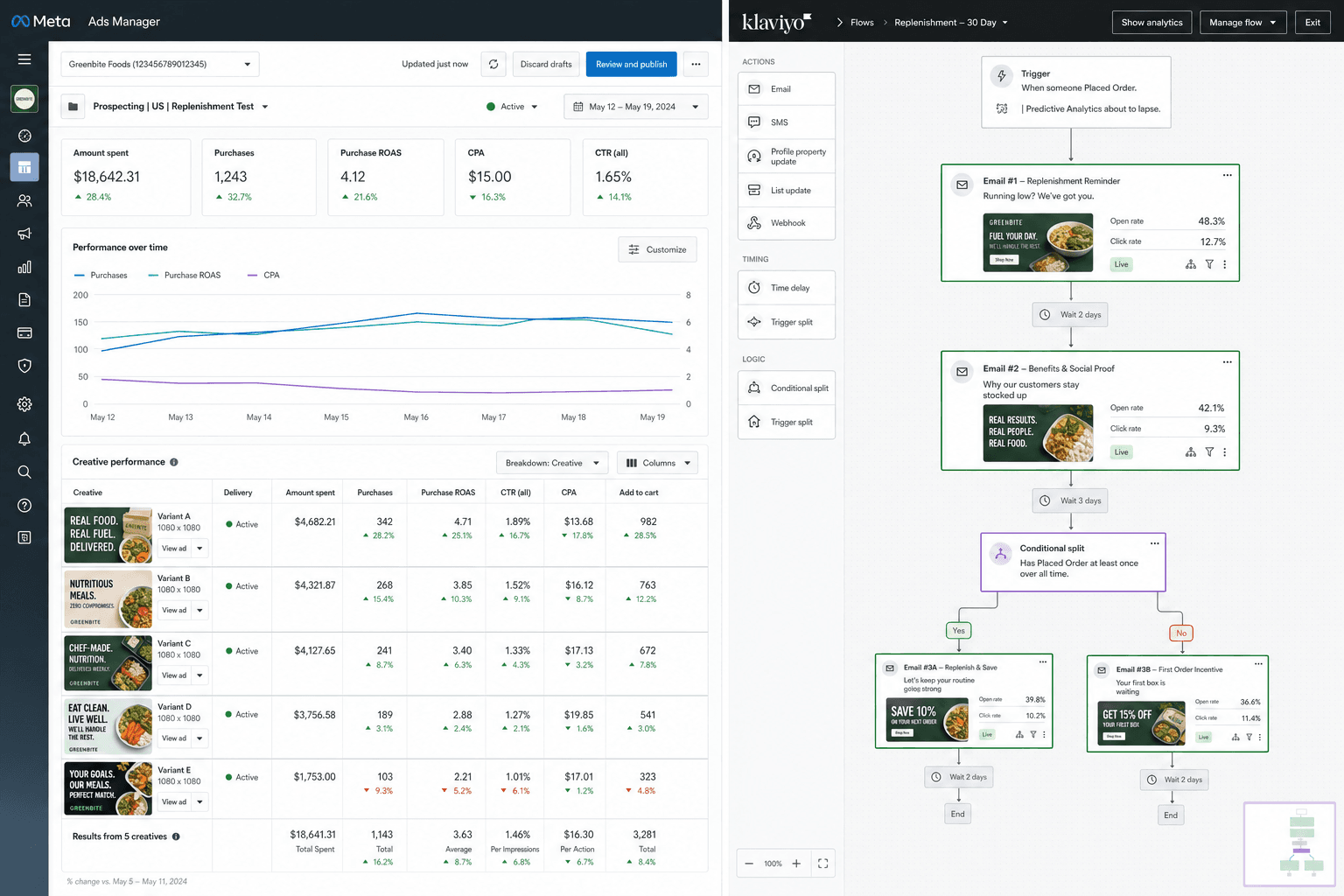
What AI does: AI-built and AI-optimized email and SMS automation flows (welcome series, replenishment reminders timed to your product's natural consumption cadence, subscription upgrade sequences, and churn win-back campaigns), each tested and refined continuously.
The result: Owned channel revenue growing toward the 30–35% of total revenue benchmark, up from the 10–15% most food brands capture, with LTV rising through repeat purchase and subscription attach rate, all without incremental ad spend.
Why it matters here: A food brand with a 30-day replenishment cadence that sends a replenishment reminder on day 25 captures the reorder before the customer goes to Amazon or a competitor. Most food brands send one welcome email and a monthly newsletter. The gap between those two approaches is the difference between 10% and 30% revenue from owned channels, all at near-zero marginal cost.
Analytics
What AI does: AI-assisted MER tracking and attribution modeling that reconciles Meta-reported ROAS against Shopify revenue, catches pixel misfires, and surfaces the true contribution margin per campaign rather than the platform number.
The result: Accurate blended ROAS visibility and early detection of attribution errors that inflate or deflate reported performance. Ballerina Farm's pixel was actively inflating their numbers before we caught it, so budget decisions stopped running on a fiction.
Why it matters here: Post-iOS 14, every food brand's Meta pixel is lying to them by some amount. Getting the math right is the prerequisite for every other optimization, because a budget allocation built on a misfiring pixel is built on noise. Accurate MER is what lets you scale spend with confidence instead of guessing.
Ready to see what this looks like for your food brands business?
No obligation. A senior strategist will show you exactly where the wins are.
The Strategy
What a Real DTC Food Marketing Strategy Actually Looks Like
Start with the math, not the channels. Before any ad goes live, we establish your contribution margin per SKU, your break-even ROAS, and your CAC payback period target. A food brand with a 35% gross margin and a 30-day replenishment cadence has a completely different viable CAC ceiling than one selling a $120 specialty box with a 90-day repurchase cycle. The strategy is built around your numbers, not a template.
Acquisition runs on Meta and TikTok, with Google capturing branded and high-intent diet/category queries. Meta is the workhorse: conversion campaigns with a UGC-led creative rotation of 15-plus active variants, tested systematically, with losing creative killed fast and winning angles scaled. TikTok runs a parallel creative track optimized for discovery: recipe integration, taste test formats, and influencer-adjacent UGC that looks native to the feed. Google captures the 'keto snacks delivered' and 'gluten-free pasta subscription' searchers who are already sold on the category and just choosing between you and a competitor.
Retention infrastructure runs in parallel from day one, not as a phase two. A welcome series that introduces your brand story and drives a second purchase within 14 days. A replenishment reminder timed to your product's natural consumption cadence: 25 days for a 30-day supply, not a calendar-based blast. A subscription upgrade flow for one-time buyers who've hit their second order. A win-back sequence for churned subscribers at 45, 60, and 90 days. Each flow is built, live, and tracked before we scale acquisition spend.
Attribution is not optional. We implement MER tracking from the start (total ad spend divided by total Shopify revenue, tracked weekly) alongside platform ROAS. We reconcile the two. When they diverge, we find out why. This is the infrastructure that lets you make budget decisions your competitors can't.
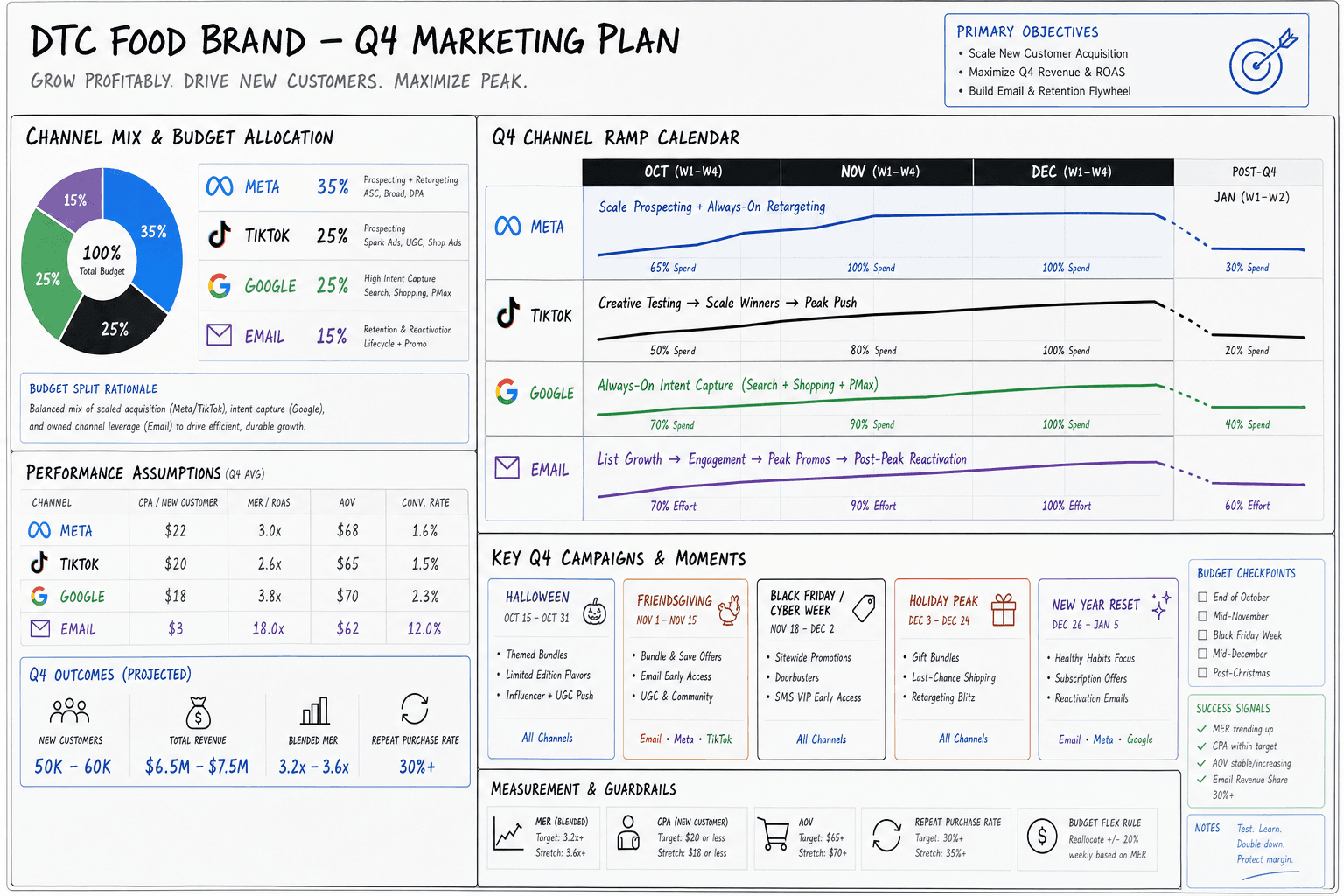
Q4 planning starts in August. Creative testing for holiday gifting angles runs in September. Budget is ramped by October 1. Email flows for holiday gifting, New Year's health-reset, and Valentine's Day are built and scheduled before November. The brands that own Q4 are not executing in Q4. They're executing a plan they built in Q3.
The one number that governs this
Governing KPI: Blended ROAS (total ad spend ÷ total Shopify revenue) and CAC payback period, tracked weekly, reconciled against platform numbers, reported transparently. Not a single channel's self-reported ROAS.
How We Help
Here's Specifically What We'd Do for a DTC Food Brand Like Yours
We take on a limited number of clients so every engagement gets senior attention, not a junior account manager running a playbook. Here's the sequence we'd actually run for a food brand at your stage, mapped directly to the strategy above.
Attribution Audit & MER Setup
Before touching ad spend, we audit your pixel, reconcile Meta-reported ROAS against Shopify revenue, and establish MER tracking. If your numbers are lying to you, like Ballerina Farm's misfiring pixel was, we find it and fix it before it compounds.
Paid Social (Meta & TikTok)
We build and run your Meta conversion campaigns and TikTok discovery campaigns with a UGC-led creative rotation of 15-plus active variants. Losing creative is killed fast; winning angles are scaled. Budget is managed against blended ROAS and CAC payback, not platform ROAS alone.
Google Ads (Branded & High-Intent Search)
We capture the high-intent search traffic (branded queries and category searches like 'keto snack subscription' or 'gluten-free pasta delivery') that's ready to convert and shouldn't be ceded to competitors or Amazon.
Email & SMS Automation
We build or rebuild your full retention infrastructure: welcome series, replenishment reminders timed to your product's consumption cadence, subscription upgrade flow, and churn win-back sequences. Goal: owned channel revenue toward 30–35% of total, without incremental ad spend.
AI-Assisted Creative Production
We use AI-assisted briefing and production workflows to generate and test creative volume that a traditional agency can't match at the same cost, so you're finding the winning UGC angle in weeks, not quarters.
Conversion Optimization
We audit and systematically test your product pages and subscription offer framing (hero SKU positioning, social proof placement, subscription vs. one-time purchase presentation) to convert the high-intent traffic your ad spend is buying.
Analytics & Reporting
Weekly MER reporting, cohort LTV tracking, and contribution margin visibility per campaign, so you and your ops co-founder have the numbers to make confident budget decisions, not platform dashboards you can't fully trust.
Who's Behind This
Who we are, and what makes us different
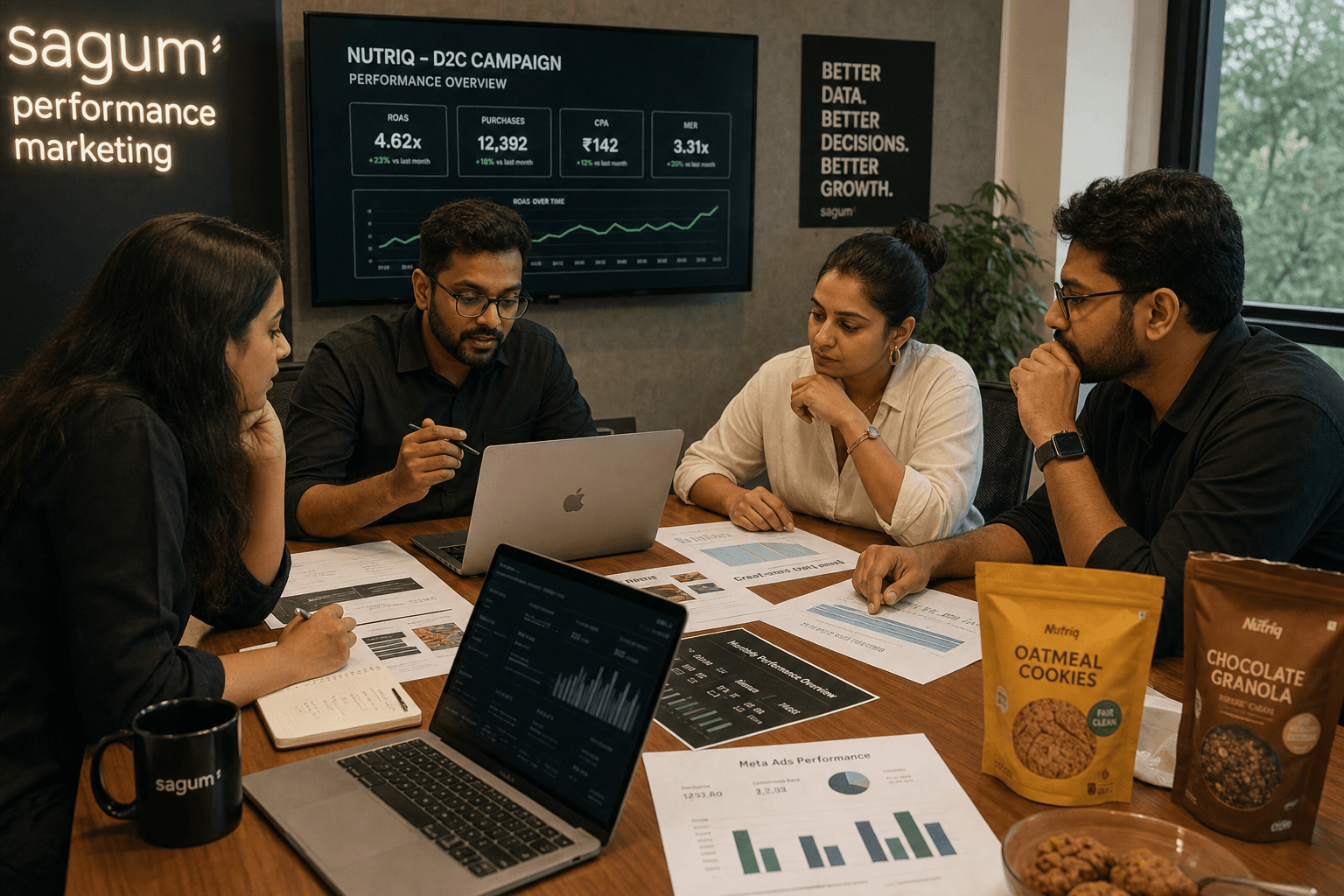
Sagum is a performance marketing agency founded in January 2017 in St. George, Utah. We've spent 8+ years growing real brands and being judged on KPIs, not vanity metrics.
We deliberately limit how many clients we take so each one gets senior attention. We treat your numbers like our own, we never run generic playbooks, and your strategy is built for your business, because shouldn't your brand's marketing be custom to your brand?
Sagum.ai is our AI arm: the same proven operators now build AI into the work wherever it creates real edge, not as theater, but as leverage applied with discipline.
- 8+ years growing brands on performance KPIs, not vanity metrics
- Limited client roster, with senior attention on every account
- An extension of your team; your success is tied to ours
- Custom strategy per brand, never a generic playbook
- AI built in where it moves a number; judgment over hype
“Sagum is a performance marketing agency that's spent 8+ years growing brands by treating their numbers like our own. We take on few clients, never run generic playbooks, and now build AI into the work wherever it creates real edge, not hype. Your strategy is built for your business, and our success is tied to yours.”
“After six years, Sagum is our most important partner: trusted, communicative, and caring about our business as if it's their own.”
Proof
95% growth in 6 months, 217% YoY after fixing a misfiring pixel
Ballerina Farm
Challenge
Ballerina Farm was scaling DTC spend but couldn't reconcile their platform ROAS with actual Shopify revenue: a misfiring pixel was actively inflating their reported numbers, meaning every budget decision was built on inaccurate data. They needed accurate attribution before they could confidently scale.
What we did
We caught the pixel misfire, corrected the attribution infrastructure, and then scaled their paid campaigns across TikTok, Google, and Pinterest with a creative and channel mix built on accurate performance data, not the numbers their dashboard had been showing.
Result
The result was 95% growth in six months and 217% year-over-year growth, with a 64% improvement in ROAS versus their original plan. Getting the math right first made every subsequent dollar of ad spend more effective.
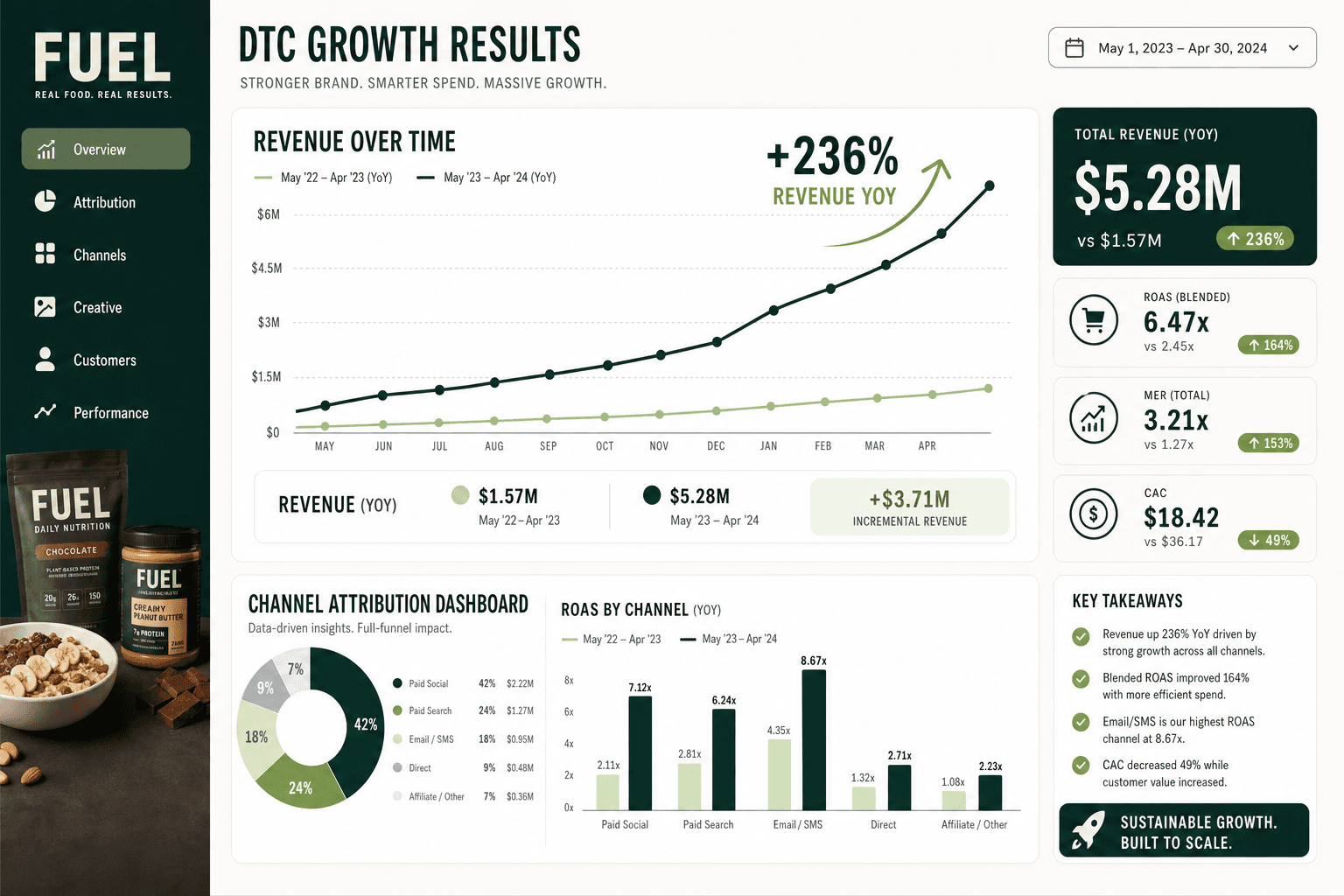
Your Blended ROAS Should Be Telling You the Truth. Let's Make Sure It Is.
No long-term contract required to start. We'll look at your current numbers (attribution, creative rotation, retention infrastructure) and tell you exactly where the gaps are. The session is built around your brand's specific unit economics, not a generic pitch deck.
Sagum · January 2017 · St. George, Utah · 8+ years