
8+ years growing brands on KPIs, now with AI
Furniture marketing for high-consideration buyers
We turn weeks-long, high-consideration research journeys into customers and track every dollar to ROAS.
8+ years growing ecommerce brands · Google, Meta & TikTok partner · Judged on ROAS, not vanity metrics


Get your free Growth Gap Analysis
Senior strategist review · response within one business day
Prefer to reach out directly?
The Challenge
Selling furniture online is a different problem than selling almost anything else.
Your buyer is a 35-year-old homeowner who just closed on a house or finally decided the hand-me-down sofa has to go. She's been pinning sofas on Pinterest for six weeks, has seventeen browser tabs open comparing your brand against Article and Joybird, and is one bad PDP experience away from driving to a showroom instead.
Seventy percent of furniture shoppers research online before buying, but online furniture conversion rates can run as low as 0.1% because the purchase is high-stakes in ways apparel never is. The dimensions have to be right. The quality has to be real, not just real-looking in a flat-lay. The delivery timeline has to be honest. And the return policy has to make a 200-pound sofa feel returnable.
Your AOV is real (mid-market sofas and beds run $800 to $2,000, and outdoor or premium pieces push $4,000), but your purchase frequency is naturally sparse. A customer who buys a sectional this spring might not buy again for three years, which means your cohort LTV accrues slowly and your nCAC math has to be right from day one.
Add to that a competitive landscape where Wayfair owns the SEO moat, Google Shopping CPCs keep climbing, and Meta CPMs have risen enough that brands running the same creative they used two years ago are watching their blended ROAS erode. The furniture category's average ecommerce ROAS dropped to 2.87x in 2025, and that's the average. The brands below it are burning cash. The brands above it are doing something different.

The Opportunity
The brands that get this right aren't just surviving. They're pulling away.
Sixty-two percent of online furniture searches are transactional: buyers who've already done their research and are ready to decide. That's a massive pool of high-intent traffic that Google Shopping and branded search can capture directly, if your campaigns are structured to win it and your PDP can close the deal.
Retargeting on Meta is the highest-leverage tactic in the category, full stop. Shoppers who viewed your sofa PDP and didn't convert are worth chasing hard. Retargeting campaigns in furniture routinely deliver 5x to 10x ROAS because the buyer already knows your product and just needs the right nudge (a room-set photo that helps them visualize it, a review that addresses their quality concern, a delivery guarantee that removes the last objection).
Email is the most underused asset in furniture ecommerce. Post-purchase upsell flows (a rug recommendation after a dining table purchase, an accent chair after a sofa) and cart abandonment sequences run at 10x to 20x ROAS because the audience is warm and the send cost is near zero. Most furniture brands have a list and a Klaviyo account. Few have flows that actually convert.
The brands pulling away right now are the ones treating their marketing as a system: Google Shopping capturing transactional intent, Meta building the funnel and retargeting hard, email converting and upselling, and creative that actually addresses the objections (dimensions, quality, returns, lead times) that kill furniture conversions. That system, run with discipline and real attribution, is where the margin lives.
What Most Get Wrong
What most furniture brands, and their agencies, get wrong.
Running Performance Max like a set-and-forget campaign
PMax will spend your budget. It's very good at that. But without proper asset group structure, negative keyword controls, and regular search term audits, it conflates your high-margin sofa traffic with low-intent browsing and inflates ROAS numbers that don't reflect actual profitable sales. You think it's working until you look at MER and it isn't.
Benchmarking ROAS against the wrong category
Furniture is not apparel. A 2.5x ROAS on a $1,400 sofa is a different business than a 2.5x ROAS on a $60 t-shirt. Agencies that set a 3x+ ROAS target without accounting for AOV, white-glove delivery margin, and return rates will either pull spend too early or chase a number that doesn't reflect your actual unit economics.
Ignoring the PDP as a conversion lever
Most furniture brands optimize their ads and then send traffic to a product page that doesn't answer the three questions killing the conversion: Will it fit? Is the quality real? What happens if I hate it? Missing dimensions callouts, no video walkthrough, no UGC showing the piece in a real home, and a vague return policy. Each one is a leak. Fixing them costs less than buying more traffic.
Treating Meta as a pure prospecting channel and ignoring retargeting
Furniture buyers deliberate for two to eight weeks. A shopper who visited your sofa PDP on Tuesday and didn't buy is not lost. She's thinking about it. Brands that don't run structured PDP retargeting sequences on Meta are leaving their highest-intent audience unworked, then wondering why their prospecting ROAS looks weak.
Skipping Pinterest entirely because it's hard to attribute
Pinterest is disproportionately powerful for furniture versus almost any other ecommerce category. Users actively save and return to furniture pins during multi-week research phases. It functions as a consideration engine that feeds Google and Meta conversions downstream. Brands that don't invest here cede the research phase to competitors who do, then wonder why their branded search volume is soft.
Why Now
Why the next 12 months are the window to pull ahead, before the gap closes.
The furniture ecommerce market is still fragmented. Eleven brands control 55% of the U.S. market, and most of those are traditional retail, not DTC operators who know how to run a performance marketing stack. The DTC brands that move now, while the competitive field is still sorting itself out, will compound their advantage in first-party data, cohort LTV, and brand equity in ways that are genuinely hard to replicate later.
The AI inflection point matters here in a specific way. Furniture creative has historically been expensive to produce: room-set photography, lifestyle shoots, video walkthroughs. AI-assisted creative production changes that math. A brand that can test eight different room-set angles and five different objection-handling ad concepts per week, instead of one or two per month, finds the winning message faster and at a fraction of the cost. The brands still running one creative concept per campaign cycle are operating with a structural disadvantage.
Attribution is also at an inflection point. Post-iOS14, the brands that built clean first-party data infrastructure and multi-touch attribution models are seeing reality clearly. The brands still relying on Meta's reported ROAS are making budget decisions on numbers that don't reflect what's actually happening. The gap between those two groups widens every quarter, and the window to fix it before your competitors do is now, not after the next BFCM.
The Mechanism
Where AI actually moves the numbers for furniture ecommerce.
Real productivity, not AI theater. Here's where it actually moves a number for furniture brands.
Creative
What AI does: AI-assisted production of room-set variations, lifestyle scene generation, and ad copy testing across objection angles (dimensions anxiety, quality proof, return policy, delivery timeline) at a volume that was previously cost-prohibitive for most DTC furniture brands.
The result: Test 6 to 10 distinct creative concepts per week instead of one or two per month, finding the message that converts high-consideration buyers faster and at lower CAC.
Why it matters here: Furniture creative has always been expensive because it requires staged rooms, professional photography, and lifestyle context. AI changes the production cost curve without sacrificing the visual quality that high-AOV buyers expect. The brand that iterates fastest on creative wins the PDP retargeting game.
Analytics
What AI does: AI-driven attribution modeling that reconciles Meta's reported ROAS against actual revenue in your ecommerce platform, catches pixel misfires inflating numbers, and surfaces which acquisition channels are producing customers with the highest 90-day LTV, not just the lowest initial CAC.
The result: Budget decisions made on MER and cohort LTV data that reflect reality, not platform-reported numbers that overcount assisted conversions and undercount view-through impact.
Why it matters here: In furniture, the wrong attribution model will tell you your Google Shopping campaigns are underperforming and your Meta prospecting is killing it, when the actual story is that Meta is doing top-of-funnel work that Google is closing. Misreading that kills your funnel by cutting the wrong channel.
Pinterest Paid
What AI does: AI-assisted Pinterest campaigns that put room-set and lifestyle pins in front of shoppers during the multi-week furniture research phase, with creative and audience signals tuned to the saves, board activity, and life-event triggers (new home, move, renovation) that precede a purchase.
The result: A growing pool of high-intent researchers entering the funnel weeks before a transactional Google search, the same warm audience Meta retargeting then converts at 5x to 10x ROAS, captured at a top-of-funnel CPM below Meta prospecting.
Why it matters here: Pinterest is disproportionately powerful for furniture: users actively save and revisit pins across the two to eight week consideration cycle, so the brand present here owns the research phase. Competitors who skip Pinterest because it's hard to attribute cede that demand, then wonder why their branded search volume is soft.
Digital Ads
What AI does: AI-powered bid management and audience signal layering across Google Shopping and Meta, with automated budget reallocation toward the campaigns and SKUs producing the strongest blended ROAS, adjusted in real time as seasonal demand shifts (spring move-in season, BFCM, Presidents' Day weekend).
The result: Media budget that follows actual demand signals instead of a flat monthly allocation, with spend concentrated on the transactional intent that furniture buyers exhibit right before they decide.
Why it matters here: Furniture has hard seasonal peaks (spring closings, Labor Day, BFCM) and a real trough in January. A system that shifts budget toward peaks and pulls back during low-intent periods outperforms a static monthly spend plan every time, especially as CPMs fluctuate around promotional weekends.
What AI does: AI-personalized post-purchase upsell flows triggered by purchase category (sofa → rug recommendation, dining table → accent chair, outdoor sectional → side table), and cart abandonment sequences that serve the objection-handling content (room visualizations, material close-ups, delivery guarantees) most relevant to what the shopper was considering.
The result: Email contributing 20%+ of total revenue at 10x to 20x ROAS, with upsell sequences that lift AOV within the first 90 days post-purchase, the window where top home goods brands earn $122 more per customer than average operators.
Why it matters here: Furniture purchase frequency is sparse, but the upsell window right after a major purchase is real and time-limited. A customer who just bought a sectional is actively thinking about their living room, and a well-timed rug or coffee table recommendation converts at rates that cold prospecting never will.
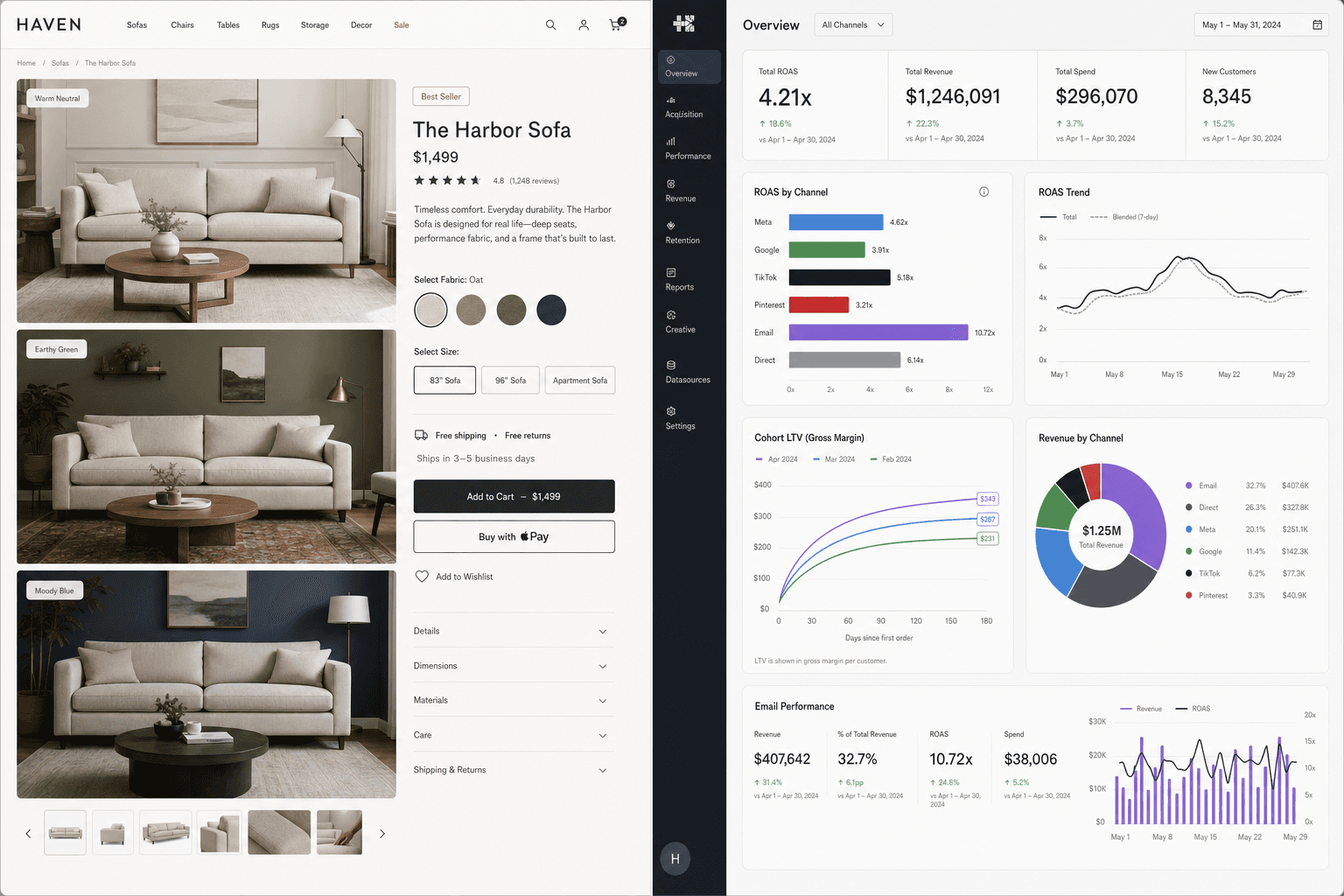
Ready to see what this looks like for your furniture brands business?
No obligation. A senior strategist will show you exactly where the wins are.
The Strategy
What a real furniture ecommerce marketing strategy looks like.
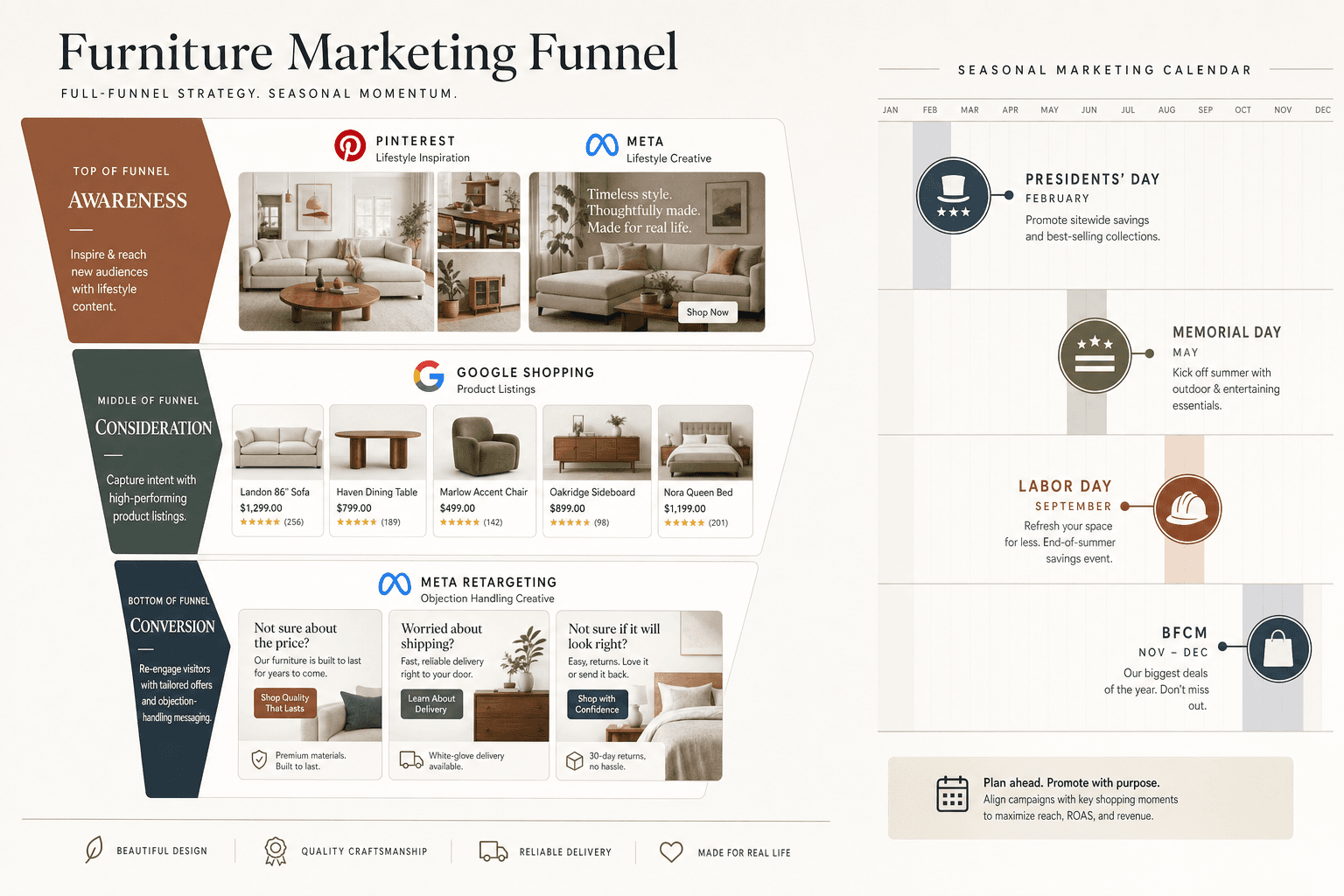
The funnel for a DTC furniture brand has three distinct jobs, and most brands are only doing one of them well.
At the top, you need to win the research phase. Furniture buyers spend two to eight weeks in consideration before they decide. Pinterest paid and organic, Meta prospecting with room-set creative, and YouTube pre-roll targeting new homeowner and life-event audiences: these are the channels that put your brand in the consideration set before the buyer runs a transactional Google search. Skipping this phase means you're only competing for buyers who already know you exist.
In the middle, Google Shopping and Performance Max capture the 62% of furniture searches that are transactional: buyers who've done their research and are ready to decide. This is where campaign structure matters enormously: your high-margin sofa SKUs need separate asset groups from your entry-level accent pieces, with bid strategies calibrated to the margin profile of each, not a blended target that optimizes toward your cheapest products.
At the bottom, Meta retargeting works the PDP abandoners who are still deciding. The creative here is different from prospecting: it's not lifestyle storytelling, it's objection handling. Dimension callouts. Customer reviews addressing quality concerns. Delivery timeline guarantees. A clear return policy. These are the ads that close the deliberation cycle.
Layered across all three stages: email and SMS automation handling cart abandonment, browse abandonment, and post-purchase upsell. And clean attribution (first-party data infrastructure, pixel health monitoring, and MER tracking) so every budget decision is made on numbers that reflect reality.
The promotional calendar governs budget pacing: Presidents' Day, Memorial Day, Labor Day, and BFCM are the four tent poles. January is the prospecting and awareness investment window, when CPMs are at their lowest and you're building the audience you'll convert in spring.
The one number that governs this
Governing KPI: Blended ROAS (MER) across all channels, with channel-level ROAS tracked separately for Google Shopping, Meta prospecting, Meta retargeting, and email. Target: 3x+ blended; 5x+ on retargeting and email. nCAC tracked by acquisition channel against 90-day cohort LTV.
How We Help
Here's specifically what we'd build for a furniture brand like yours.
We don't run a generic ecommerce playbook and call it a furniture strategy. Every engagement starts with your unit economics (your AOV by SKU category, your current blended ROAS, your attribution setup) and we build from there. Here's the sequence we'd actually run.
Attribution & Analytics Audit
Before touching a single campaign, we fix your measurement. Pixel health check, Meta reported ROAS vs. actual revenue reconciliation, MER baseline, and cohort LTV setup by acquisition channel, so every decision we make after this is grounded in numbers you can trust.
Google Shopping & Performance Max
Rebuild your Shopping campaigns with asset groups structured by SKU margin profile: high-ticket sofas and beds separated from entry-level accent pieces, with bid strategies calibrated to each. Negative keyword controls to block low-intent browsing traffic. Search term audits weekly.
Meta Paid Social (Prospecting + Retargeting)
Two distinct campaign tracks: prospecting with room-set lifestyle creative targeting new homeowner and life-event audiences, and a structured PDP retargeting sequence serving objection-handling creative (dimensions, quality proof, delivery guarantees) to the buyers who visited and didn't convert.
AI-Assisted Creative Production & Testing
Room-set variations, lifestyle scene generation, and ad copy testing across objection angles at a volume that moves the needle. We test 6 to 10 creative concepts per week, kill losers fast, and scale winners, finding the message that converts your high-consideration buyer faster than your competitors can.
PDP Conversion Optimization
AI-assisted audit of your product detail pages against the friction points that kill furniture conversions: missing dimension callouts, insufficient UGC, weak return policy copy, no delivery timeline. Continuous A/B testing of page variants. Higher conversion rate on the traffic you're already paying for.
Email & Automation (Klaviyo)
Build or rebuild your core flows: cart abandonment with objection-handling content, post-purchase upsell sequences triggered by purchase category (sofa → rug, dining table → accent chair), and browse abandonment for high-intent PDP visitors. Target: email at 20%+ of total revenue.
Promotional Calendar Planning
Budget pacing and creative planning around your four tent poles (Presidents' Day, Memorial Day, Labor Day, BFCM) with a January prospecting strategy that builds the audience you'll convert in spring at lower CPMs than your competitors are paying in peak.
Who's Behind This
Who we are, and what makes us different
Sagum is a performance marketing agency founded in January 2017 in St. George, Utah. We've spent 8+ years growing real brands and being judged on KPIs, not vanity metrics.
We deliberately limit how many clients we take so each one gets senior attention. We treat your numbers like our own, we never run generic playbooks, and your strategy is built for your business, because shouldn't your brand's marketing be custom to your brand?
Sagum.ai is our AI arm: the same proven operators now build AI into the work wherever it creates real edge, not as theater, but as leverage applied with discipline.
- 8+ years growing brands on performance KPIs, not vanity metrics
- Limited client roster, with senior attention on every account
- An extension of your team; your success is tied to ours
- Custom strategy per brand, never a generic playbook
- AI built in where it moves a number; judgment over hype
“Sagum is a performance marketing agency that's spent 8+ years growing brands by treating their numbers like our own. We take on few clients, never run generic playbooks, and now build AI into the work wherever it creates real edge, not hype. Your strategy is built for your business, and our success is tied to yours.”

“After six years, Sagum is our most important partner: trusted, communicative, and caring about our business as if it's their own.”
Proof
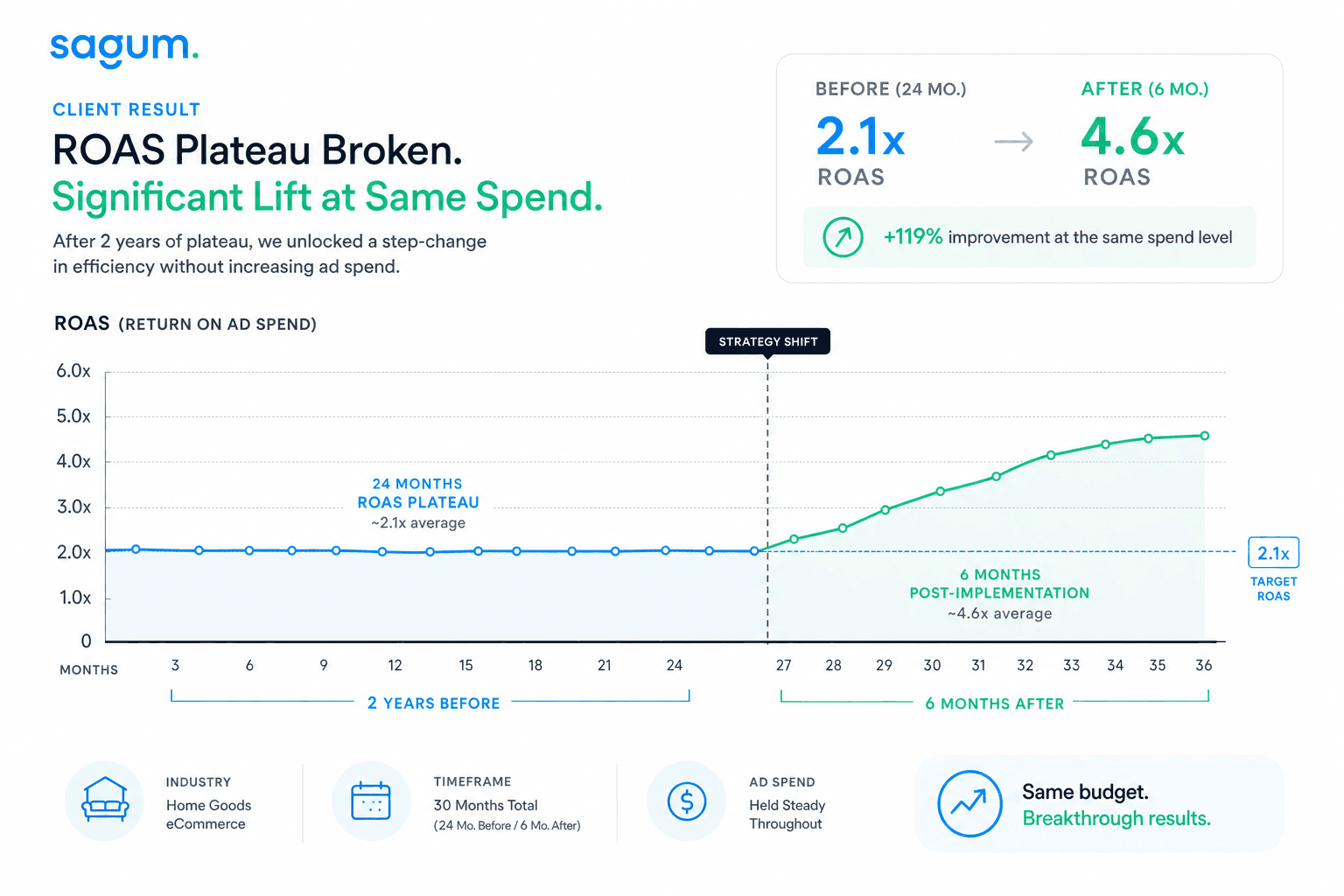
Broke a 2-year ROAS plateau with +115% ROAS at the same spend
House of Jade
Challenge
House of Jade, a home goods ecommerce brand, had hit a wall: two years of flat ROAS at the same spend level, with no clear path to improving efficiency without cutting into growth. The brand had strong creative and a real product, but the campaigns weren't converting that into better returns.
What we did
We rebuilt their campaign structure, fixed attribution to surface where margin was actually coming from, and redesigned the creative and targeting strategy around the channels and audiences that were producing the highest-LTV customers, not just the lowest reported CAC.
Result
House of Jade broke their two-year ROAS plateau with a 115% ROAS improvement at the same spend level, and delivered their biggest, most profitable Q4 on record. Same budget. Fundamentally different results, because the strategy was finally built around their actual unit economics.
Your furniture brand deserves a marketing strategy built around how furniture buyers actually buy.
No obligation. We'll come to the session having looked at your current setup (channels, attribution, creative) and give you a straight read on where the gaps are and what we'd do about them. If it's a fit, we'll talk about working together. If it isn't, you'll leave with something useful.
Sagum · January 2017 · St. George, Utah · 8+ years