

8+ years growing brands on KPIs, now with AI
Push gaming gear past a 2x ROAS ceiling
We build the creator and retention systems that lift blended returns before the Q4 window closes.
8+ years growing DTC brands · Google, Meta & TikTok partners · Blended ROAS reporting


Get your free Growth Gap Analysis
Senior strategist review · response within one business day
Prefer to reach out directly?
The Challenge
Gaming gear isn't typical ecommerce, yet most agencies treat it that way
Your hero SKU (flagship mouse, keyboard, or headset) drives 70% of revenue and lives or dies by community credibility. An r/MouseReview or r/MechanicalKeyboards thread can make or break a launch; a Twitch streamer using your product can spike Shopify sales in real time. That's a trust and discovery problem no Meta Ads playbook solves.
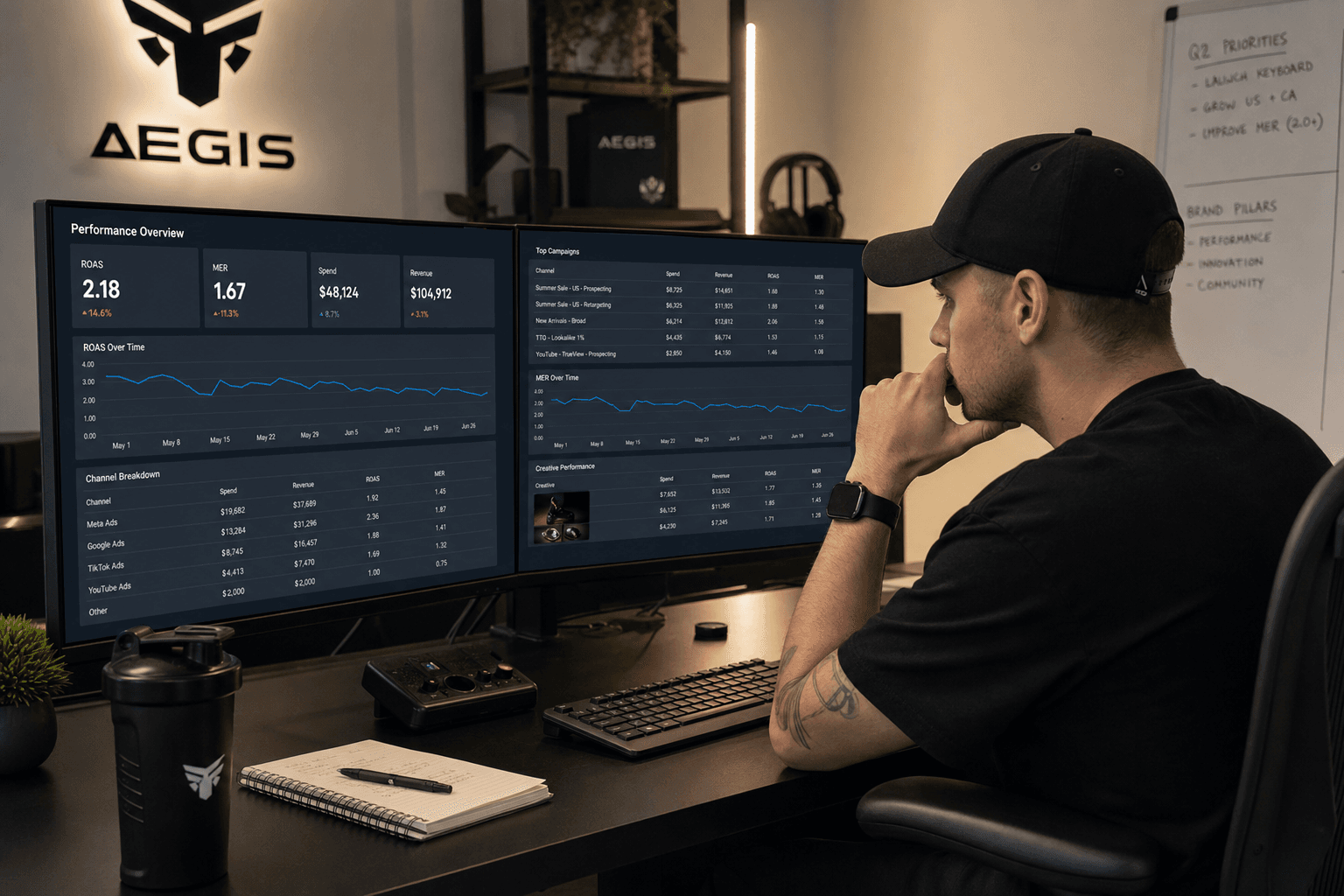
Buyers don't impulse-buy at $100. They spend 3–7 days checking your DPI specs against prosettings.net, watching YouTube teardowns, and looking for pro players using your gear. You need to be present and credible at every step of that research loop.
With 12–18 month replacement cycles and 12-month LTV around $150–$280 per repeat buyer, you lack the LTV cushion that lets apparel and CPG brands justify aggressive CAC. Only first-order profitability works, so your 3.5–5× blended ROAS target is a survival number.
Q4 (Black Friday, Cyber Monday, the holidays) brings roughly 50% of annual revenue, and December alone nearly 25%. If paid media, creative, and influencer relationships aren't ready by September, you're reacting instead of competing.
The Opportunity
Without outspending Razer, winning gaming gear brands out-execute on three channels
First, creator-driven acquisition is underpriced for its conversion power: 44% of Twitch viewers have bought a product because a streamer recommended it. Most sub-$5M brands skip influencer or run unmeasured one-off deals; systematic programs (affiliate codes, structured seeding, performance-based tiers) beat paid social alone on CAC.
Second, Google Shopping and Performance Max reach the highest-intent buyers, consistently returning 4–5× ROAS versus 2–2.5× on Meta cold prospecting. Someone searching 'best ultralight gaming mouse under $100' has decided to buy and is comparing you with competitors. Most brands underinvest here, over-rotating to Meta.
Third, email and SMS, your highest-margin retention channels, are underbuilt at most sub-$5M brands. If your 90-day LTV cohort is flat and repeat rate is under 20%, you can shift blended ROAS through post-purchase, launch, and win-back flows without touching ad spend.
What Most Get Wrong
What gaming gear brands and their agencies consistently get wrong
Treating Meta ROAS as ground truth
Post-iOS 14, Meta over-reports revenue 20–35% on average, more on view-through-heavy campaigns. A 3.5× in-platform ROAS can reconcile to 2.2× in Shopify, and brands trusting the dashboard scale losing campaigns.
Cold prospecting on Meta before the pixel is warm
On a $100+ considered peripheral, cold audiences aren't close to buying. Meta works as a retargeting and lookalike engine off a warm pixel; skipping that sequence wastes your highest-spend months.
Running influencer deals with no attribution structure
A one-off mid-tier streamer deal without promo code, affiliate link, or UTM can't show halo on direct traffic or pre/post organic search lift, so it's a donation, not an investment.
Ignoring Google Shopping until Q4
Your highest-intent buyers compare gaming mice on Google. With a thin feed, no negative keywords, and no margin-based target ROAS bidding, you hand them to Corsair and Razer.
Entering Q4 with an untested creative pipeline
Black Friday/Cyber Monday is the year's key week. Brands testing in October learn on the priciest traffic; Q4 winners test from July and know which hooks convert before CPMs spike.
Why Now
Why the months before Q4 decide a gaming gear brand's year
The brands that own Black Friday and Cyber Monday lock their creative pipeline, Google Shopping structure, and influencer seeding by September. Every week of testing before then is data you carry into Q4; every week after is learning on the year's priciest traffic.
Testing eight ad angles a week, from unboxing cuts to pro-player POV, used to take a full creative team. Today an operator using AI-assisted production can run that volume with a fraction of the headcount.
Brands that build this testing capability in the 60–90 days before September enter the holiday peak with the data, a tested creative library, and channel infrastructure, while competitors run the same two ads they launched in August.
The Mechanism
Where AI moves a gaming gear brand's numbers
Real productivity, not AI theater. Here's where it actually moves a number for gaming gear brands.
Creative
What AI does: AI-assisted production and structured testing run 6–10 angle variants per week (setup-culture UGC, unboxing formats, gameplay footage, spec-focused hooks) versus the 1–2 most brands manage manually.
The result: You find the hook for your buyer (r/MechanicalKeyboards enthusiast, casual FPS upgrader, or battlestation builder) in days instead of months, before competitors find theirs.
Why it matters here: Gamers trust community-style content over polished ads: setup shots, streamer reactions, spec comparisons. AI tests enough variants to find winners without a full production team.
Digital Ads
What AI does: AI shifts budget in real time across Google Shopping, Performance Max, and Meta toward campaigns and SKUs with contribution-margin-positive ROAS, and away from ones that lose money once reconciled to Shopify.
The result: Budget flows to high-intent search during a major title launch or esports tournament spike and pulls back in the January post-holiday trough.
Why it matters here: A new FPS launch or a pro player spotted with your mouse can spike search volume 3–4× overnight, so static monthly budgets are structurally wrong.
Analytics
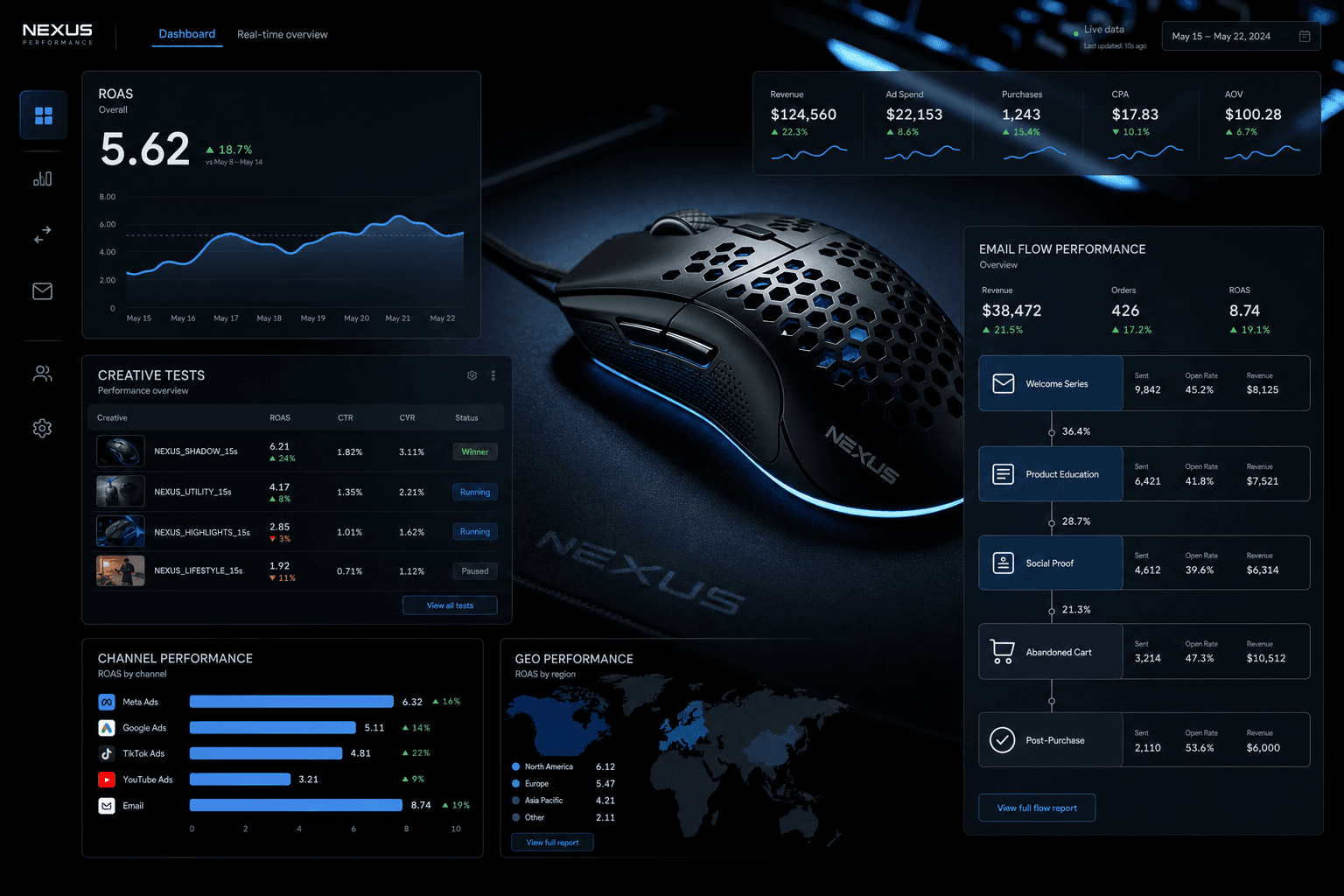
What AI does: Attribution built on blended ROAS reconciles in-platform ROAS from Meta and Google against actual Shopify revenue and flags the inflation gap from post-iOS 14 pixel degradation.
The result: You catch campaigns showing 3.5× ROAS in Meta but 2.2× in Shopify before scaling them, and fund modest-looking campaigns that drive direct and organic lift.
Why it matters here: Most $3M–$15M gaming gear brands have broken attribution. The first to fix it know their CAC payback, model first-order profitability, and scale on contribution margin.
What AI does: AI builds retention flows personalized by hero SKU purchased and browsing behavior, timing win-back to buyers who lapse past their 12-month hardware replacement window.
The result: Email and SMS reach 25–35% of total revenue without more ad spend, and a new colorway or limited keycap collab drop becomes a revenue event.
Why it matters here: Given thin LTV and long replacement cycles, re-engaging buyers at a title launch, upgrade cycle, or limited drop keeps you from constantly replacing churned customers.
Conversion Optimization
What AI does: AI finds where 3–7 day research-cycle buyers drop off (spec comparisons, review sections, size/compatibility questions) and continuously tests page elements answering their validators: RTINGS-style benchmark callouts, pro player endorsements, community review aggregation.
The result: Conversion rate (CVR) improves without more traffic spend; at $50k/month in paid media, a 1.5 percentage point lift beats an equivalent ad budget increase.
Why it matters here: Buyers arrive after Reddit, YouTube, and prosettings.net, already validating a choice. Your product page confirms it or sends them to a competitor.
Ready to see what this looks like for your gaming gear brands business?
No obligation. A senior strategist will show you exactly where the wins are.
The Strategy
The strategy that works for a DTC gaming gear brand
The foundation puts blended ROAS first, with triple attribution (in-platform, post-purchase survey, total-revenue calculation), so every channel decision runs on real contribution margin.
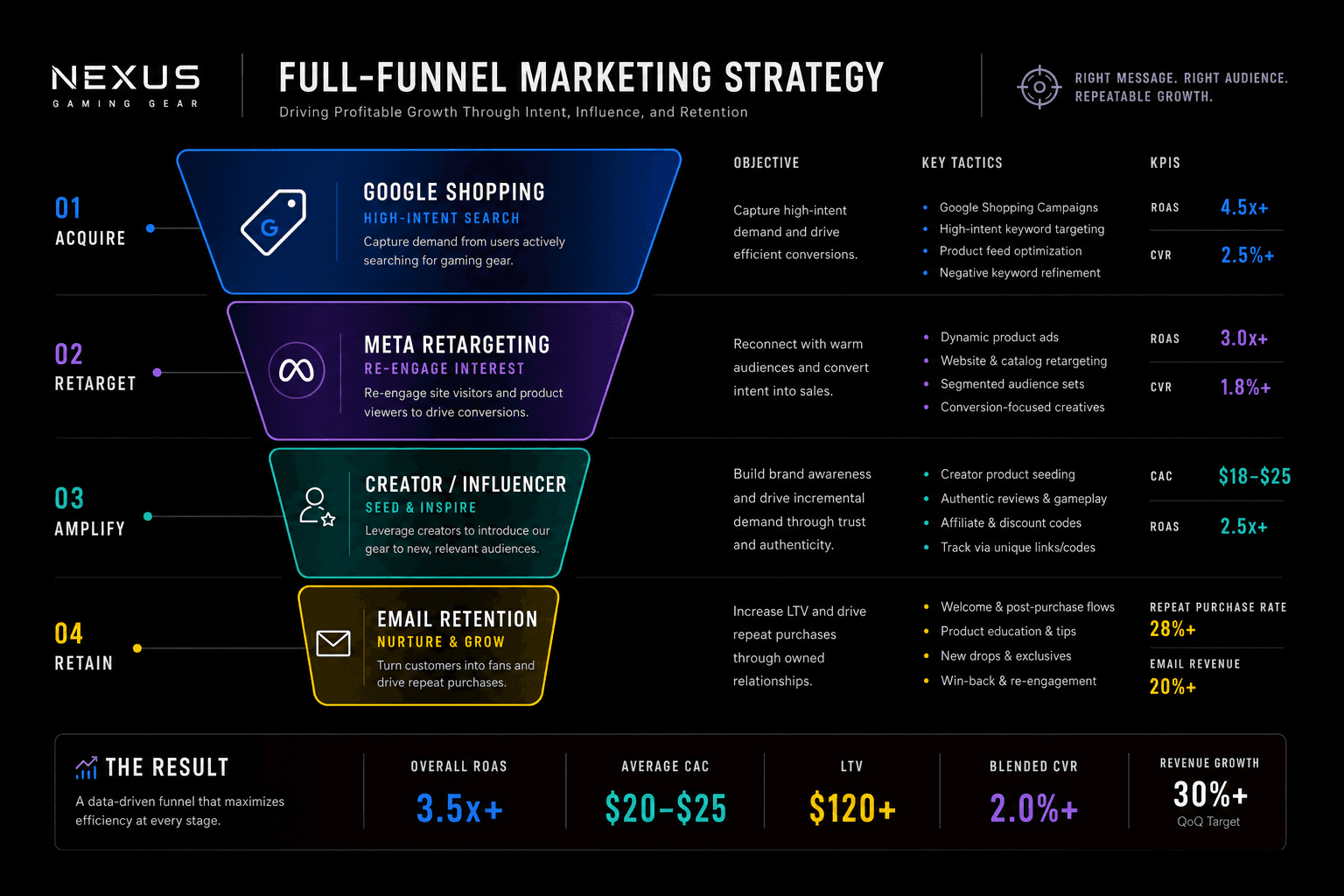
Channel one, Google Shopping and Performance Max, should be your first and highest-ROAS paid investment: a complete feed with accurate specs in the terms buyers search (DPI, polling rate, actuation force), margin-based target ROAS bidding, and negative keyword discipline.
Channel two is Meta: retarget product-page visitors and cart adds, build lookalikes off your best customer cohorts, and skip cold prospecting on a considered purchase. Keep creative UGC-style so it looks community-made.
Channel three, creators, is the category's highest-impact acquisition channel and the most underbuilt at sub-$5M brands. Seed mid-tier creators (10k–200k subscribers) who are category enthusiasts, attribute every deal with promo codes and affiliate links, measure halo effects on direct and organic traffic, and build a roster of 8–15 ongoing relationships.
Channel four is email and SMS flows: post-purchase, collab drop launches, hardware upgrade re-engagement at the 12-month mark, and win-back. With a healthy list, they should generate 25–35% of total revenue.
Pace it to the calendar: test creative in the January and June troughs, ramp influencer seeding in August, lock Q4 infrastructure by September 1, and push peak spend through November's Black Friday/Cyber Monday window.
The one number that governs this
Blended ROAS, total Shopify revenue divided by total ad spend across channels, governs every budget call. In-platform ROAS is a signal, not a decision.
How We Help
How we'd build this for your gaming gear brand
We keep our client list limited, so each client gets senior attention, not a junior account manager running a template. For a gaming gear brand, we'd start with measurement.
Attribution & Blended ROAS Setup
Before touching ad spend, we reconcile in-platform numbers to Shopify revenue, add post-purchase attribution, and build a blended ROAS dashboard as one source of truth.
Google Shopping & Performance Max
We build and manage your feed, margin-based target ROAS bidding, and negative keyword structure, and scale this channel first because it returns the highest ROAS.
Meta Paid Social (Retargeting & Lookalike)
We build audience architecture off your warm pixel and set a creative testing cadence, so budget reaches buyers near purchase, not cold audiences mid-research.
Creative Production & Testing
We test 6–10 AI-assisted creative variants weekly to find your converting angle before Q4 CPMs spike, so you enter the holidays with a proven library.
Creator & Influencer Program
We run channel three end to end: seeding, attribution on every deal, roster management, and halo measurement.
Email & SMS Retention
We build or rebuild your post-purchase, drop-launch, upgrade, and win-back flows so email and SMS become a major source of your highest-margin revenue.
Conversion Rate Optimization
We find where your research-cycle buyer drops off and keep testing the page elements that matter to them, from spec callouts to compatibility information.
Who's Behind This
Who we are, and what makes us different
Sagum is a performance marketing agency founded in January 2017 in St. George, Utah. We've spent 8+ years growing real brands and being judged on KPIs, not vanity metrics.
We deliberately limit how many clients we take so each one gets senior attention. We treat your numbers like our own, we never run generic playbooks, and your strategy is built for your business, because shouldn't your brand's marketing be custom to your brand?
Sagum.ai is our AI arm: the same proven operators now build AI into the work wherever it creates real edge, not as theater, but as leverage applied with discipline.
- 8+ years growing brands on performance KPIs, not vanity metrics
- Limited client roster, with senior attention on every account
- An extension of your team; your success is tied to ours
- Custom strategy per brand, never a generic playbook
- AI built in where it moves a number; judgment over hype
“Sagum is a performance marketing agency that's spent 8+ years growing brands by treating their numbers like our own. We take on few clients, never run generic playbooks, and now build AI into the work wherever it creates real edge, not hype. Your strategy is built for your business, and our success is tied to yours.”
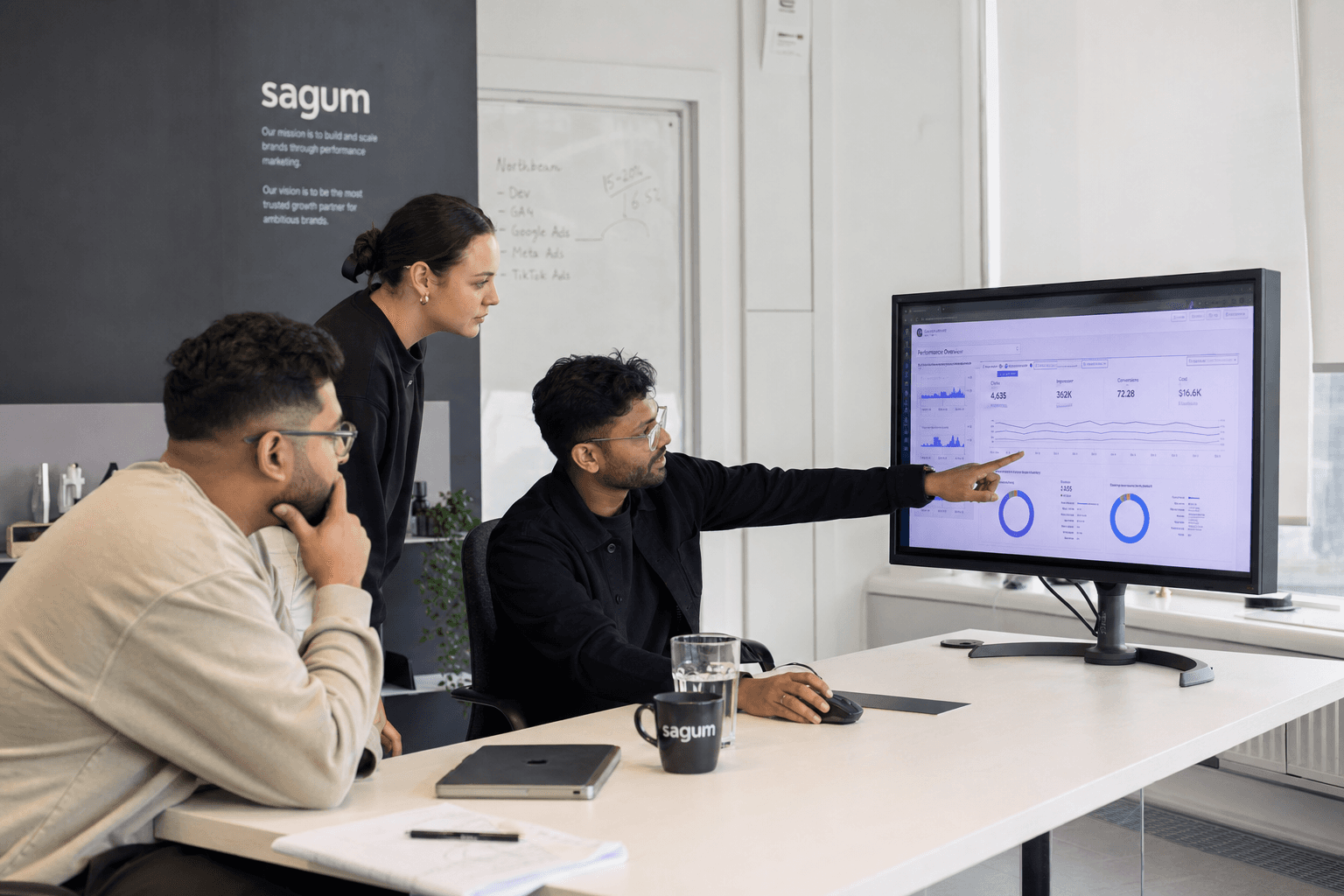
“Sagum roughly doubled our bottom line. They treat the work like it's their own business.”
Rachel Nilsson
CEO, RAGS
Proof
$255k → $555k in 2 months, ROAS 2.9x → 5.5x+
Nickel & Suede
Challenge
Nickel & Suede, an apparel and accessories brand, needed to scale revenue profitably on paid social.
What we did
We ran Meta and TikTok creative testing at volume, the same discipline we bring to gaming gear brands.
Result
Revenue grew from $255k to $555k in two months. ROAS moved from 2.9× to 5.5×+, peaking at 7.95×, and site conversion lifted 34%.
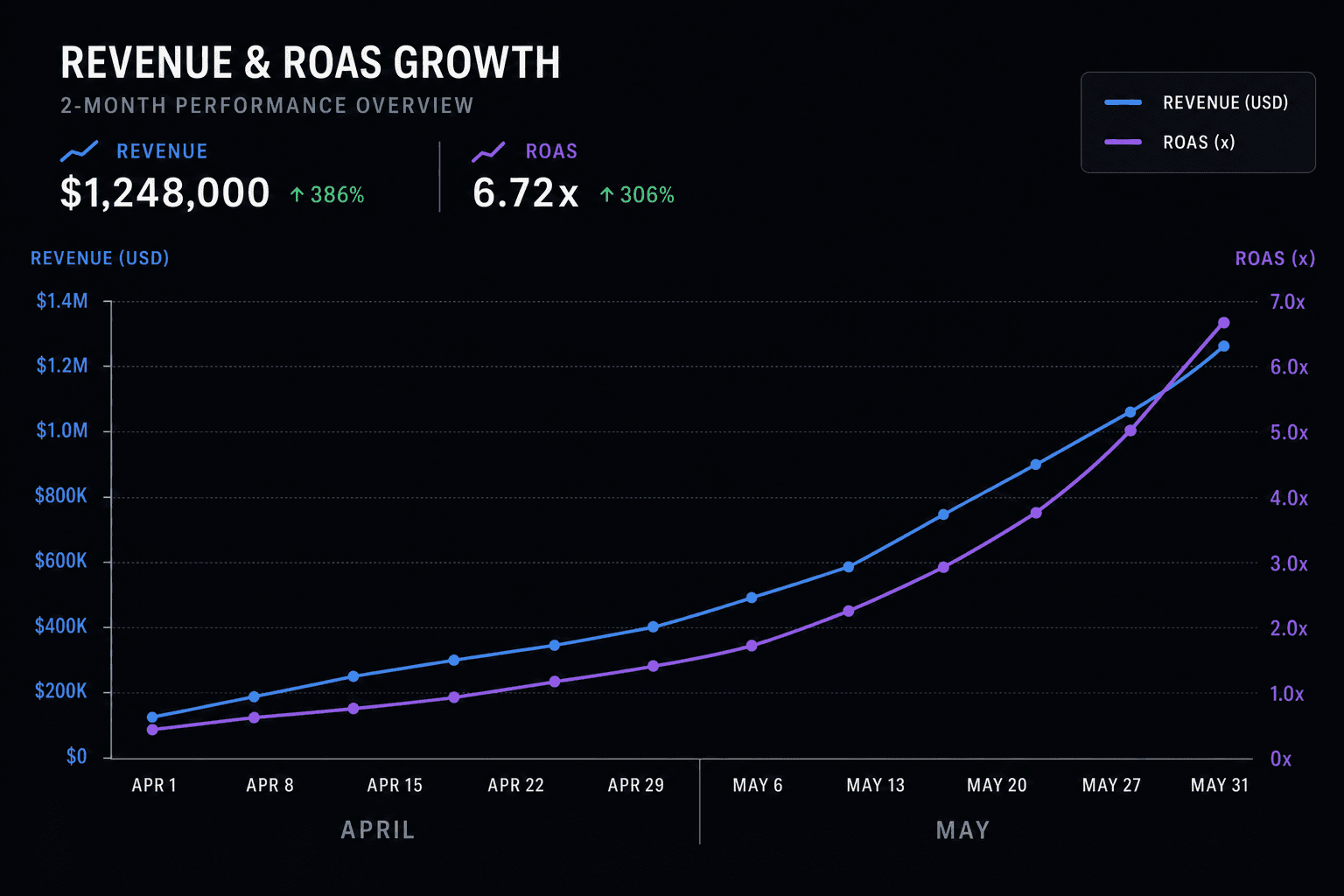
- Revenue
- $255k → $555k (2 mo)
- ROAS
- 2.9x → 5.5x+ (peak 7.95x)
- Site conversion
- +34%
Get a specific read on your gaming gear brand's numbers before Q4
There's no obligation and no generic pitch deck. We'll bring a specific read on your channel mix, the gap between your platform and blended ROAS, and your biggest growth lever, built around your numbers.
Sagum · January 2017 · St. George, Utah · 8+ years