

8+ years growing brands on KPIs, now with AI
Google Shopping That Moves Your Blended ROAS
Feed-first structure, brand isolation, and PMax discipline that lift blended revenue, not just platform-reported numbers.
Google Ads Partner · 8+ years performance marketing · Meta & TikTok


Get your free Growth Gap Analysis
Senior strategist review · response within one business day
Prefer to reach out directly?
The Challenge
Google Shopping ROAS looks healthy until you check Shopify
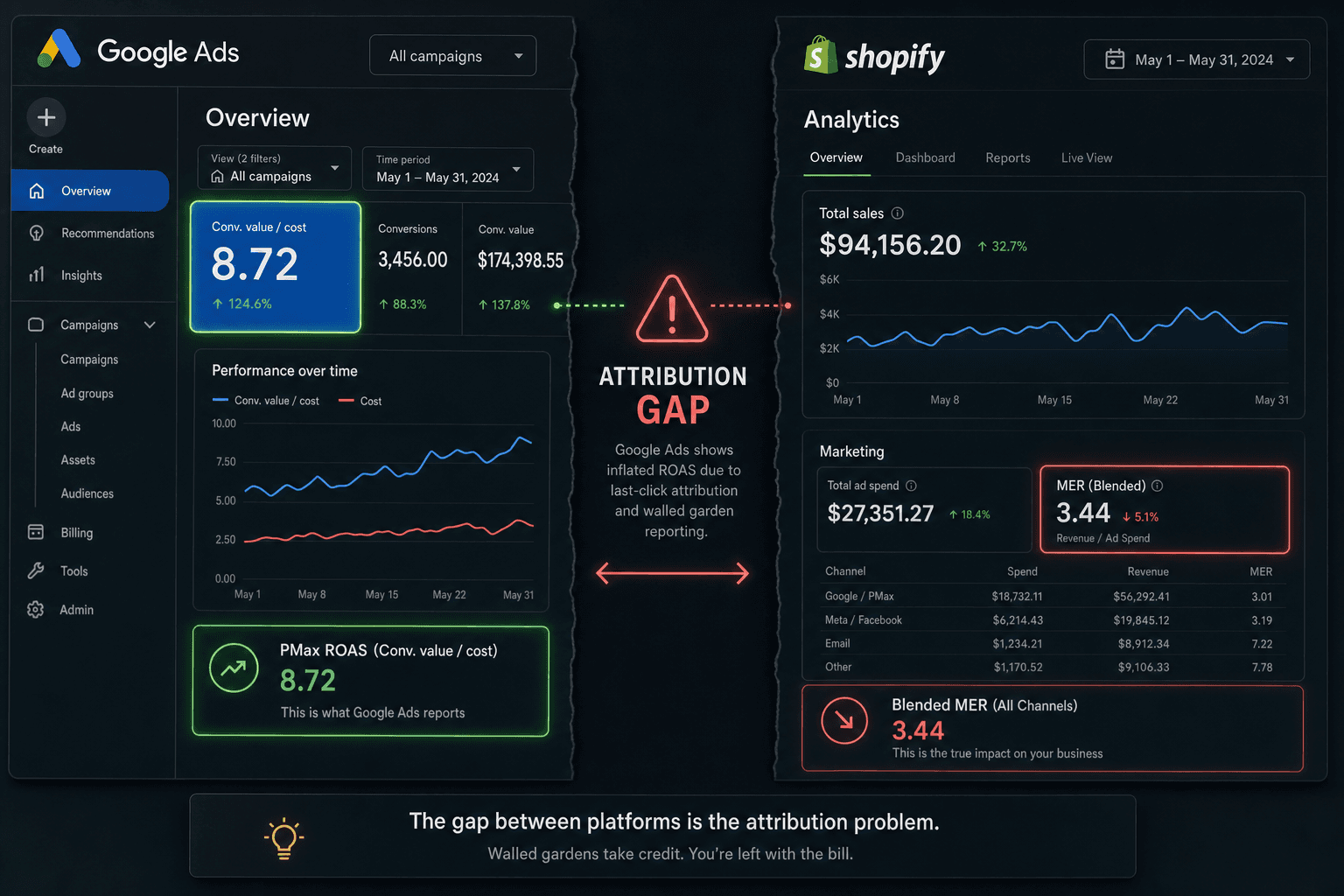
Your Performance Max (PMax) campaign reports a 7x ROAS and Standard Shopping 5.2x, but Shopify's total revenue divided by total ad spend gives a 2.6x blended ROAS. More than half the story disappeared between the platform report and the business.
The gap is structural. PMax is built to claim credit: it blends branded search, retargeting, and discovery traffic into what looks like prospecting wins. Isolated non-brand incremental performance is often 2x–4x, not the 7x on the dashboard.
Your Merchant Center feed does damage you can't see. A GTIN mismatch can trigger account-level warnings, and a price discrepancy between feed and landing page silently pulls products from auction. Your 40 new SKUs from last season's launch have never gotten an impression because PMax judged them too risky. They're zombie SKUs now.
You already know PMax is a black box with a marketing budget. You need an operator who knows where the Shopping levers are and has the discipline to pull them.
The Opportunity
Google Shopping winners rebuild structure, feeds, and bidding
Since October 2024, Google no longer auto-prioritizes PMax over Standard Shopping. Ad Rank decides which serves, so a well-built Standard campaign can beat PMax on the same query. Most brands and agencies haven't rebuilt for this, leaving an exploitable gap.
The strongest blended-ROAS operators run a Standard-PMax hybrid, isolate brand, and split budget per account by conversion volume and margin tier.
Feeds are the most-ignored, highest-return work: correct GTINs lift clicks 20% on average, per Google. A title's first 70 of 150 characters decide whether you show for high-intent queries. Most feeds read like product descriptions. The best read like keyword strategies, front-loading brand, product type, and differentiating attribute.
Most accounts skip profit-first bidding: margin-tier custom labels, Conversion Value Rules weighting higher-margin SKUs, and POAS-aware bids targeting contribution over revenue. Brands running it stop celebrating high ROAS on low-margin SKUs.
What Most Get Wrong
What most Google Shopping operators and agencies get wrong
Trusting PMax's reported ROAS, the highest of any campaign type
Bundling brand, retargeting, and prospecting, PMax often reports 5x–12x; isolated non-brand performance typically drops to 2x–4x. Agencies chasing platform over blended ROAS optimize what flatters the account, not the business.
Running PMax without brand exclusions or a Standard brand campaign
PMax shifts budget to low-CPC, near-certain branded wins, inflating ROAS and hiding whether new-customer acquisition pays. A controlled Haus.io experiment found excluding brand from PMax drove 24% more incremental revenue.
Ignoring feed health until a campaign drops
Mismatched price and availability between feed and landing page cause the most disapprovals. Most operators check GMC Diagnostics weeks too late.
Letting new and niche SKUs become zombies
PMax avoids SKUs without conversion history, so they never build any; 20–40% of a catalog stays invisible. Few accounts route them to Standard Shopping on Manual CPC or Maximize Clicks.
Running PMax without campaign-level negative keywords
PMax has supported campaign-level negatives since January 2025, yet accounts that never added them still pay for search terms with no purchase intent, inflating impressions and suppressing conversion rate.
Why Now
Rebuild your Google Shopping structure before your competitors do
Google's October 2024 change to PMax prioritization was one of Shopping's biggest structural shifts, and the old playbook (dump everything into PMax, set a tROAS, let Google decide) no longer works the same way. Yet most brands still run it, and most agencies still sell it.
Operators who rebuild their structure now will take the auction positions slower competitors vacate. AI compounds this. Applied correctly, it does continuously what once took a full-time feed manager: testing titles across hundreds of SKUs, flagging GTIN coverage gaps, spotting custom label segments that bleed margin.
Brands that rebuild at least two months before peak season enter Q4 with structures already past the 40–60 day learning phase. The rest spend Q4 catching up inside one.
The Mechanism
Where AI gives a Google Shopping account real edge
Real productivity, not AI theater. Here's where it actually moves a number for google shopping brands.
Merchant Center Feed Optimization
What AI does: AI checks titles against the 70-character display threshold and GTINs against Google's validation database, flags price and availability discrepancies before disapprovals, and writes front-loaded titles across hundreds or thousands of SKUs.
The result: The feed stays continuously healthy, GTIN coverage improves, and titles capture high-intent queries competitors miss.
Why it matters here: Shopping has no keyword field, so your feed title is your bid. A manually managed feed drifts between fixes. An AI-monitored one keeps improving.
Analytics & Attribution
What AI does: AI reconciles platform ROAS with Shopify revenue and ad spend into weekly blended ROAS, flags campaigns inflated by branded traffic, and checks campaign conversion volume against Smart Bidding thresholds before any split.
The result: You learn each week whether the business is working, and attribution inflation gets a number.
Why it matters here: High PMax ROAS and low blended ROAS routinely coexist in one account. That gap is the business problem.
Digital Ads (Campaign Structure & Bid Management)
What AI does: AI flags campaigns under about 60 monthly conversions, where Smart Bidding turns unreliable; finds zombie SKUs by impression-share-to-conversion ratio; and checks brand share in PMax Search Term Insights to confirm exclusions hold.
The result: Structural calls (splitting Standard from PMax, moving a SKU to Manual CPC, tightening or loosening tROAS) run on live data, not monthly reviews.
Why it matters here: Blind structural changes trigger PMax learning phases that burn 40–60 days of budget. AI-informed decisions mean fewer resets.
Creative (Asset Group Optimization)
What AI does: AI generates and tests headline, description, and image combinations per asset group, tracks asset-level ratings, and flags possible compliance risk in auto-generated assets, the copy Google writes for you.
The result: Asset groups keep improving after launch, and auto-generated asset risk gets caught before a suspension.
Why it matters here: Auto-generated PMax assets have caused violations that operators found only after account suspensions. At high spend, you can't skip this monitoring.
Conversion Optimization
What AI does: AI diagnoses low-converting SKU segments as bid, feed, or page problems, checks landing pages against feed price and availability, and finds product groups pulling AOV down inside PMax.
The result: Disapprovals get caught pre-auction, and conversion problems get diagnosed by SKU instead of by campaign.
Why it matters here: PMax drifts toward easy-converting, often lower-AOV SKUs. Standard Shopping holds AOV better only if its landing pages convert. Knowing which applies changes the structural decision.
Ready to see what this looks like for your google shopping brands business?
No obligation. A senior strategist will show you exactly where the wins are.
The Strategy
How to build a Google Shopping account for blended ROAS
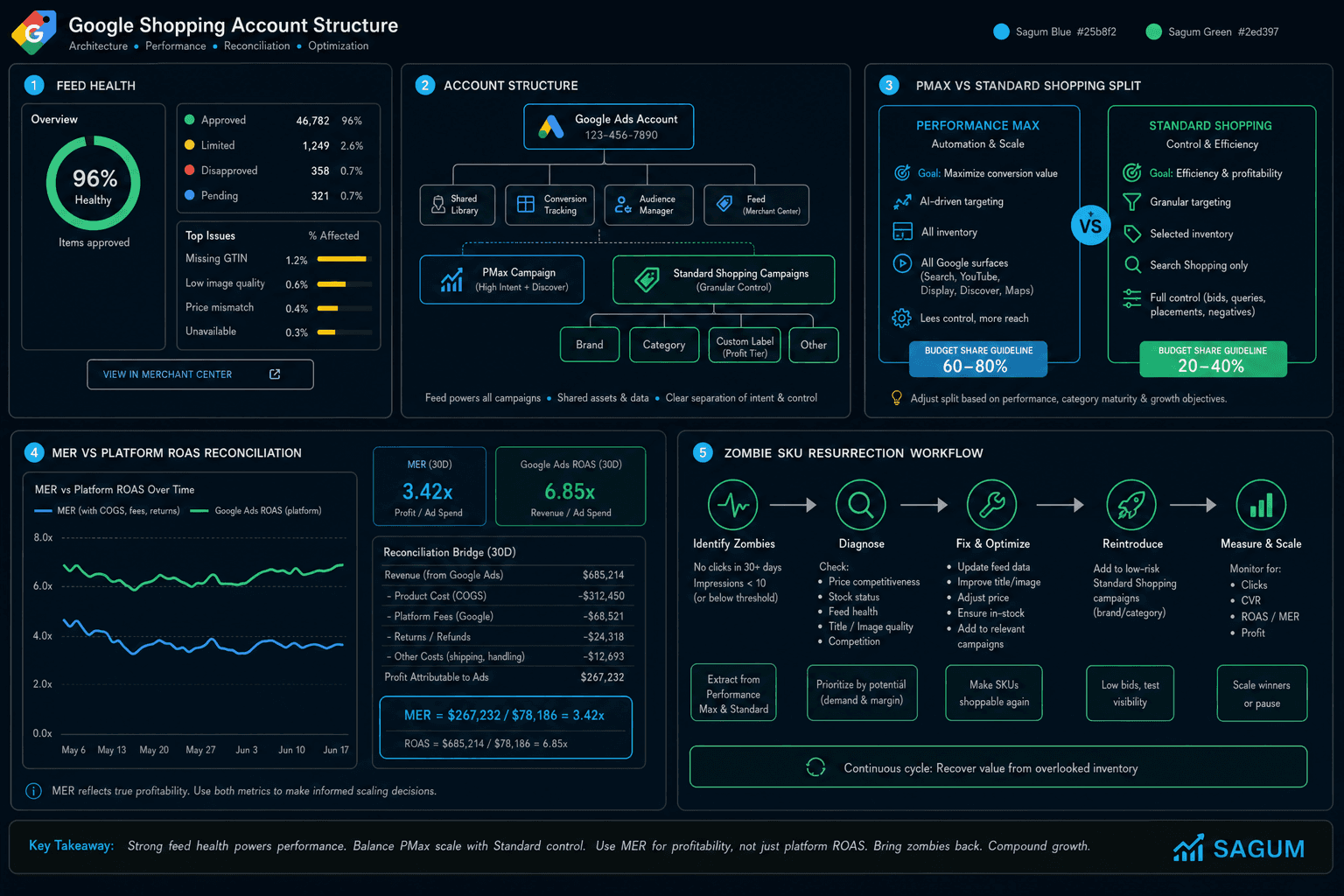
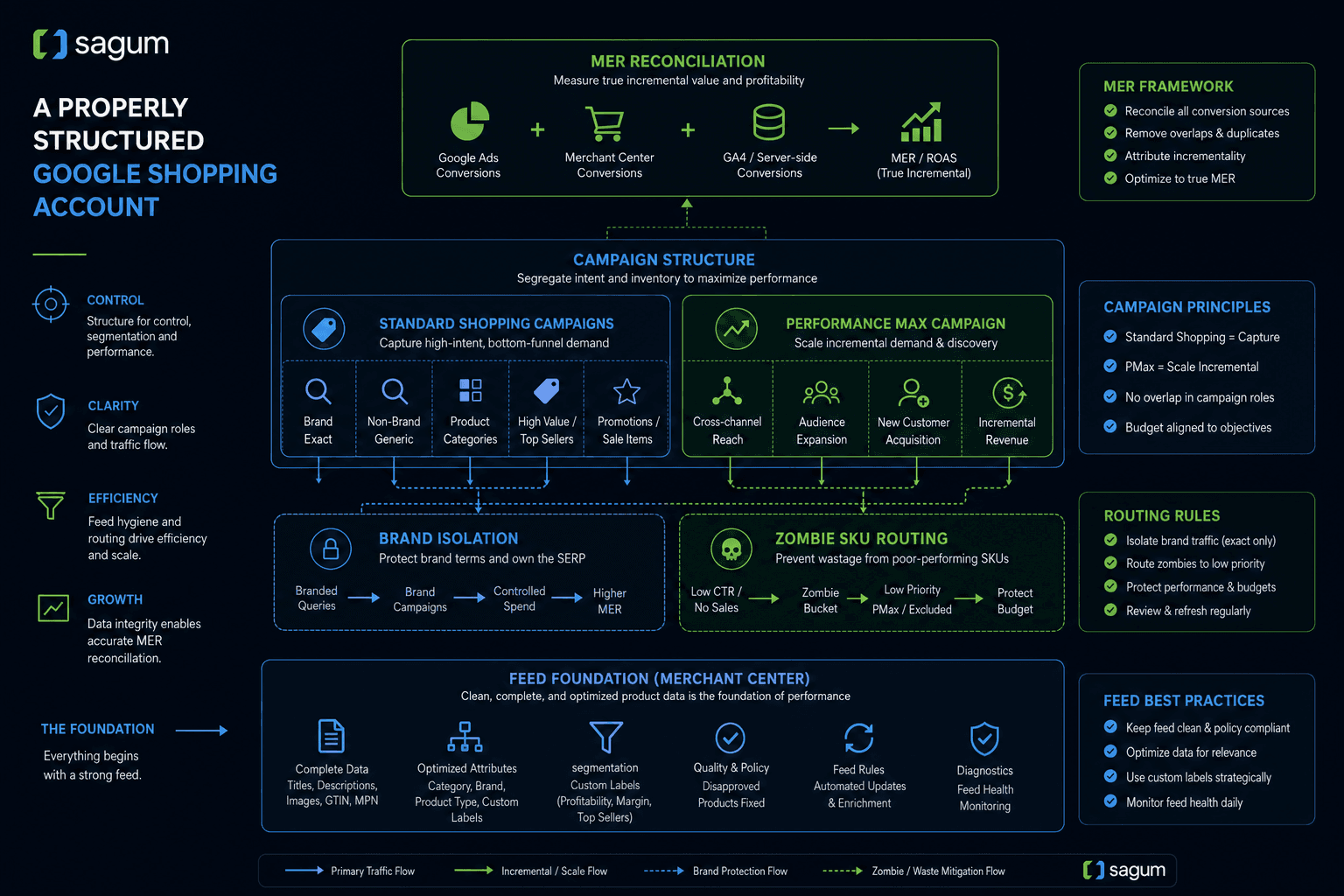
Audit the Merchant Center feed first: verify GTIN coverage, front-load titles, set margin-tier, velocity, and clearance custom labels, and confirm a Content API or high-frequency fetch schedule so price and availability stay current. A correct campaign on a drifting feed is still broken.
Structure follows conversion volume: at 500+ monthly conversions, run Standard Shopping on top-revenue SKUs with tight product group segmentation and explicit tROAS targets, and PMax on long-tail discovery and new audience expansion.
Budget typically splits 70/30 or 80/20 PMax-to-Standard, but Standard carries the strategic weight: margin protection, brand isolation, zombie SKU resurrection.
Isolate brand with PMax exclusion lists, a lower-priority Standard Shopping brand campaign, and weekly Search Term Insights audits that confirm brand share on non-brand campaigns stays near zero. Without it, you can't tell whether new-customer acquisition is profitable.
Zombie SKUs get a separate Standard Shopping campaign on Manual CPC or Maximize Clicks, with no Smart Bidding until they build history. The goal is impressions and first conversion data, not ROAS.
Blended ROAS (total Shopify revenue divided by total ad spend across every channel) is the governing metric, checked weekly, while Shopping and PMax ROAS are daily tactical signals. A wide gap between them points to attribution inflation, brand cannibalization, or unmeasured spend.
The one number that governs this
Blended ROAS is the north star. Shopping tROAS and PMax asset groups are daily levers. The blended-to-platform ROAS gap is your health check.
How We Help
What we'd do with your Google Shopping account
For most accounts we start with feed and attribution, because restructuring on a drifting feed or inflated attribution resets the clock without fixing anything.
Merchant Center Feed Audit & Rebuild
Before any campaign changes, we run the feed audit above, including custom labels by margin tier, velocity, and clearance.
Attribution & Blended ROAS Reconciliation
We set your true blended ROAS baseline and measure its gap to platform ROAS, quantifying attribution inflation.
Campaign Structure Rebuild (PMax + Standard Shopping Hybrid)
We build the Standard-PMax hybrid, sizing its budget split to your account's conversion volume.
Brand Isolation & Exclusion List Management
We set up the brand isolation above, with campaign priority controls, and audit brand share weekly.
Zombie SKU Resurrection
We give new and niche SKUs their own campaign to build history, then graduate them into the main structure on defined criteria.
AI-Assisted Feed Monitoring & Asset Group Optimization
We monitor GMC Diagnostics continuously for disapprovals, price mismatches, and GTIN errors, rotate asset groups, and review auto-generated assets for compliance risk.
Paid Media Management (Google Ads)
We adjust tROAS and reconcile platform ROAS against Shopify revenue weekly, track conversion volume per campaign, and maintain PMax's campaign-level negatives (supported since January 2025).
Who's Behind This
Who we are, and what makes us different
Sagum is a performance marketing agency founded in January 2017 in St. George, Utah. We've spent 8+ years growing real brands and being judged on KPIs, not vanity metrics.
We deliberately limit how many clients we take so each one gets senior attention. We treat your numbers like our own, we never run generic playbooks, and your strategy is built for your business, because shouldn't your brand's marketing be custom to your brand?
Sagum.ai is our AI arm: the same proven operators now build AI into the work wherever it creates real edge, not as theater, but as leverage applied with discipline.
- 8+ years growing brands on performance KPIs, not vanity metrics
- Limited client roster, with senior attention on every account
- An extension of your team; your success is tied to ours
- Custom strategy per brand, never a generic playbook
- AI built in where it moves a number; judgment over hype
“Sagum is a performance marketing agency that's spent 8+ years growing brands by treating their numbers like our own. We take on few clients, never run generic playbooks, and now build AI into the work wherever it creates real edge, not hype. Your strategy is built for your business, and our success is tied to yours.”
“After six years, Sagum is our most important partner: trusted, communicative, and caring about our business as if it's their own.”
Long-term partner
6-year client
Proof
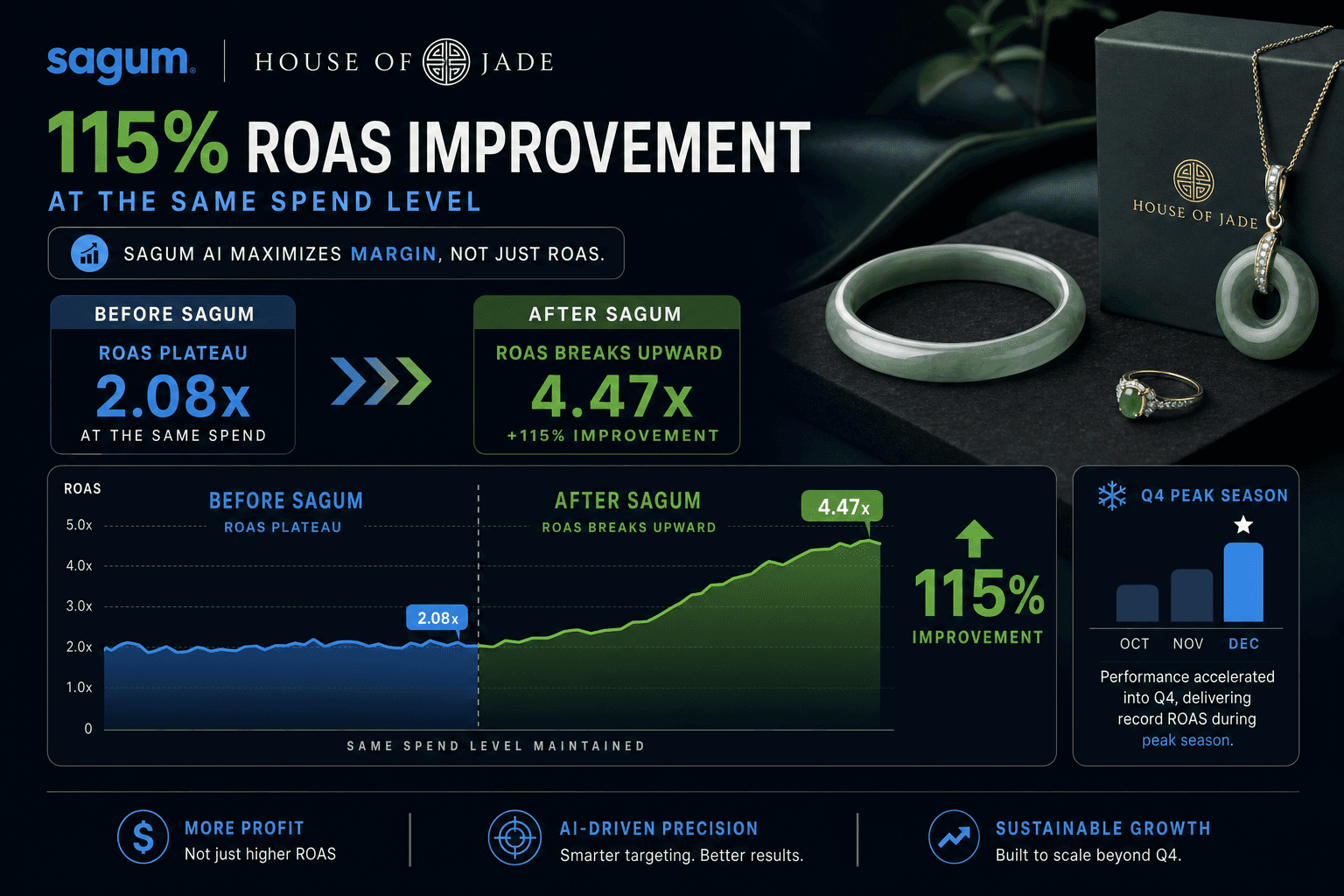
Broke a 2-year ROAS plateau with +115% ROAS at the same spend
House of Jade
Challenge
House of Jade, a home goods ecommerce brand, had been stuck on a ROAS plateau for two years.
What we did
We restructured its strategy without increasing spend.
Result
ROAS improved 115% at the same spend level, and House of Jade had its biggest, most profitable Q4. We bring the same discipline to your Shopping account.
Your blended and platform ROAS shouldn't be this far apart
No obligation. In one session we'll review your feed health, campaign structure, and blended ROAS gap, then show you which levers to pull, whether we work together or not.
Sagum · January 2017 · St. George, Utah · 8+ years