

8+ years growing brands on KPIs, now with AI
A handbag channel mix that doesn't collapse
We hit ROAS targets and lower acquisition costs without betting your growth on one fragile channel.
8+ years growing ecommerce brands · Google, Meta & TikTok partner · Performance-judged, never retainer-coasting


Get your free Growth Gap Analysis
Senior strategist review · response within one business day
Prefer to reach out directly?
The Challenge
Marketing a Handbag Brand Is a Different Problem Than Marketing Most Products
A $280 structured leather tote is a considered purchase: your buyer sees you on Instagram, checks your returns policy, Googles your brand, watches a TikTok unboxing, and opens two emails. Across 3–14 days and 4–7 touchpoints, last-click ROAS misleads you.
Meta, your core channel, costs more yearly and reveals less per iOS update; your blended ROAS has drifted with no clear cause. Agencies prescribe more Advantage+ sales campaigns, UGC, and spend, usually ending in creative fatigue and a CAC that outruns first-order contribution margin.
Handbags are low-repurchase, closer to a mattress than a moisturizer: LTV builds slowly through accessory cross-sells and gifting, not a new bag every 90 days, so the first order must roughly pay off.
Miss October–November, when fashion ecommerce sees a 64% surge in new buyer activity, and you miss the year; overspend at the wrong CPM with the wrong creative and the margin is gone. Winners acquire buyers cheaply in Q1 and enter Q4 gifting with a warm list, proven creative, and no single-platform dependence.

The Opportunity
Where Handbag Brands Can Grow Beyond Meta: Google, Pinterest, and Email
Google Shopping and Performance Max capture searches like 'structured leather tote under $300' and 'designer crossbody bag for work' at 3.4x–4.5x median ROAS in fashion ecommerce, yet most mid-market DTC handbag brands treat Google as an afterthought while fighting Dagne Dover, Cuyana, and Senreve over Meta inventory.
Handbag brands underuse Pinterest, where your target customer (a professional woman, 28–45) builds wish lists in an aspirational, low-resistance buying state. Organic pins last months, and a well-built Pinterest presence sends warm traffic that converts at a lower CAC than cold Meta prospecting.
Klaviyo email and SMS flows protect margin: a welcome flow teaching the quality story, an abandoned-cart flow with social proof, and a post-purchase cross-sell into wallets and straps can generate 25–35% of total revenue without more ad spend. Most brands have these flows set up; few have them optimized.
What Most Get Wrong
What Handbag Brands and Their Agencies Usually Get Wrong
Optimizing last-click ROAS instead of blended ROAS
Post-iOS, Meta's reported ROAS is partly fiction. Brands that don't track blended ROAS (total revenue ÷ total ad spend) cut working channels and fund ones that only look good in-platform.
Running the same creative for 6–8 weeks until it dies
Creative drives over half of Meta performance. Brands testing 1–2 concepts monthly lose share to rivals testing 15–25. Once frequency and CPA climb, you've already wasted 2–3 weeks' budget.
Discounting to manufacture urgency instead of using drop mechanics
A 20%-off sitewide sale moves units but permanently anchors price expectations and destroys brand equity. The healthiest-margin handbag brands use limited colorways, waitlists, and new-season drops, which reinforce desirability.
Ignoring resale interception on branded search
Buyers Googling your brand may land on a RealReal or Poshmark listing first. Without branded search campaigns and strong organic presence, warm traffic leaks there, unseen in your ad account.
Building email flows once and never touching them again
An 18-month-old placeholder welcome series and one abandoned-cart email isn't a retention strategy; 12-month LTV is built or lost in post-purchase accessory cross-sells, VIP early access, and a 120-day win-back.
Why Now
Why the Next 12 Months Favor Handbag Brands That Move First
Most DTC handbag competitors are small teams that manually test one or two concepts a month, hold budgets flat whatever CPMs do, and haven't touched email flows since setup.
With AI-assisted production and testing, you can run 15–25 ad angles a month, not the one or two a designer's gut feel picks, so you find winners faster, scale them, and retire them before fatigue. Add Google search, Meta retargeting and lookalikes, Pinterest wish-list traffic, and margin-protecting email, and you're harder to displace at the next platform disruption.
January–February CPMs run roughly 22% below the annual average. Acquire buyers cheaply into Klaviyo flows and you reach Mother's Day and Q4 with a warm list converting at a fraction of cold-prospecting cost; wait until October and you pay peak CPMs.
The Mechanism
Where AI Gives a Handbag Brand a Real Edge
Real productivity, not AI theater. Here's where it actually moves a number for handbag brands.
Creative
What AI does: With AI-assisted production, we generate and test 15–25 new ad concepts a month across Meta and TikTok instead of 1–2, and performance data feeds the next round.
The result: You find the angle that hits your new-customer CAC (nCAC) target sooner and retire creative before it fatigues.
Why it matters here: Creative drives over half of paid performance. A $350 handbag sells on its story (material quality, outfit-of-the-day, unboxing); find what converts before budget runs out.
Analytics & Attribution
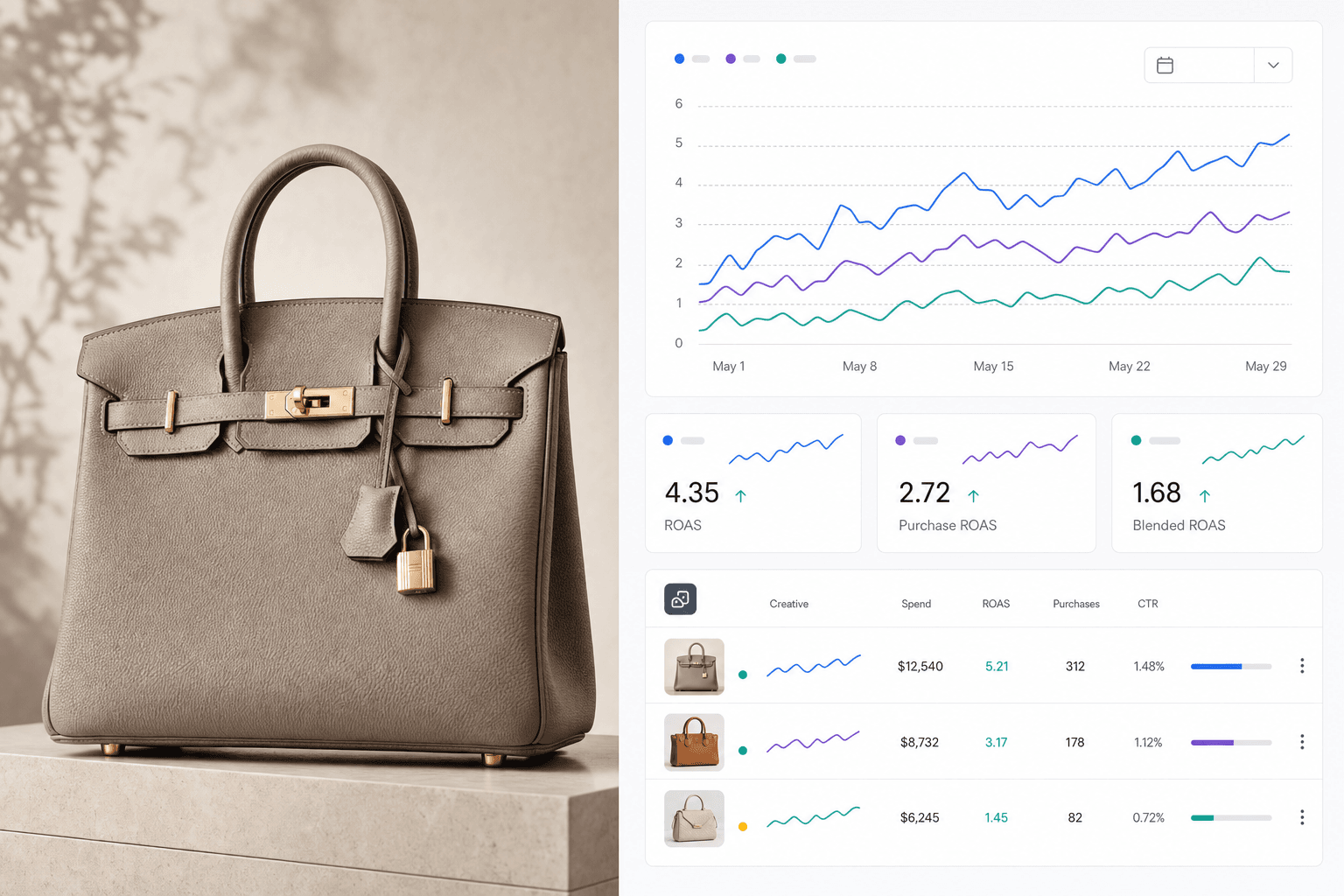
What AI does: We build a blended ROAS dashboard that sits above platform-reported ROAS and triangulates Meta Ads Manager, Google Analytics, and post-purchase surveys into a channel-level view of what drives revenue.
The result: You budget on what's working rather than Meta's attribution model; brands that optimize on it alone underfund the channels that close sales.
Why it matters here: Post-iOS, last-click misreads a multi-touch journey: a buyer converting from an abandoned-cart email was probably first touched by a Pinterest pin and retargeted on Meta.
Email & Automation
What AI does: We use AI to find drop-off points in your Klaviyo welcome series, abandoned-cart sequence, and post-purchase cross-sell, then rewrite and test those sequences against your cohort behavior.
The result: Flow revenue can climb toward 25–35% of total revenue, and your cross-sell moves wallets, straps, and small leather goods instead of sitting unread.
Why it matters here: A well-timed cross-sell into a $95 card wallet makes a $280 tote buyer worth $375. A generic thank-you and 60 silent days probably lose her.
Conversion Optimization
What AI does: We use AI to analyze scroll depth, click heatmaps, and session recordings, find where buyers hesitate on high-ticket SKUs, then test copy, imagery, and trust signals (material callouts, free-returns badge, BNPL options).
The result: Hero SKUs convert better without more ad spend, earning more revenue from traffic you already pay for.
Why it matters here: Buyers can't touch a $300+ handbag, so pages must explain feel, returns, and installments; missing Klarna or Afterpay is a documented conversion killer at $200–$500.
Digital Ads
What AI does: We use AI-assisted campaign structure and bidding across Google Shopping, Performance Max, and Meta, pacing spend into Q4 gifting, Mother's Day, and collection-drop weeks and out of the low-intent late-December lull.
The result: Full-year blended ROAS improves because spend follows buyer intent, not a flat monthly budget.
Why it matters here: Each moment in the handbag year (October–November gifting, early-May Mother's Day, cheap-CPM Q1 acquisition) needs its own budget posture.
Ready to see what this looks like for your handbag brands business?
No obligation. A senior strategist will show you exactly where the wins are.
The Strategy
What a Handbag Brand Marketing Strategy Should Look Like
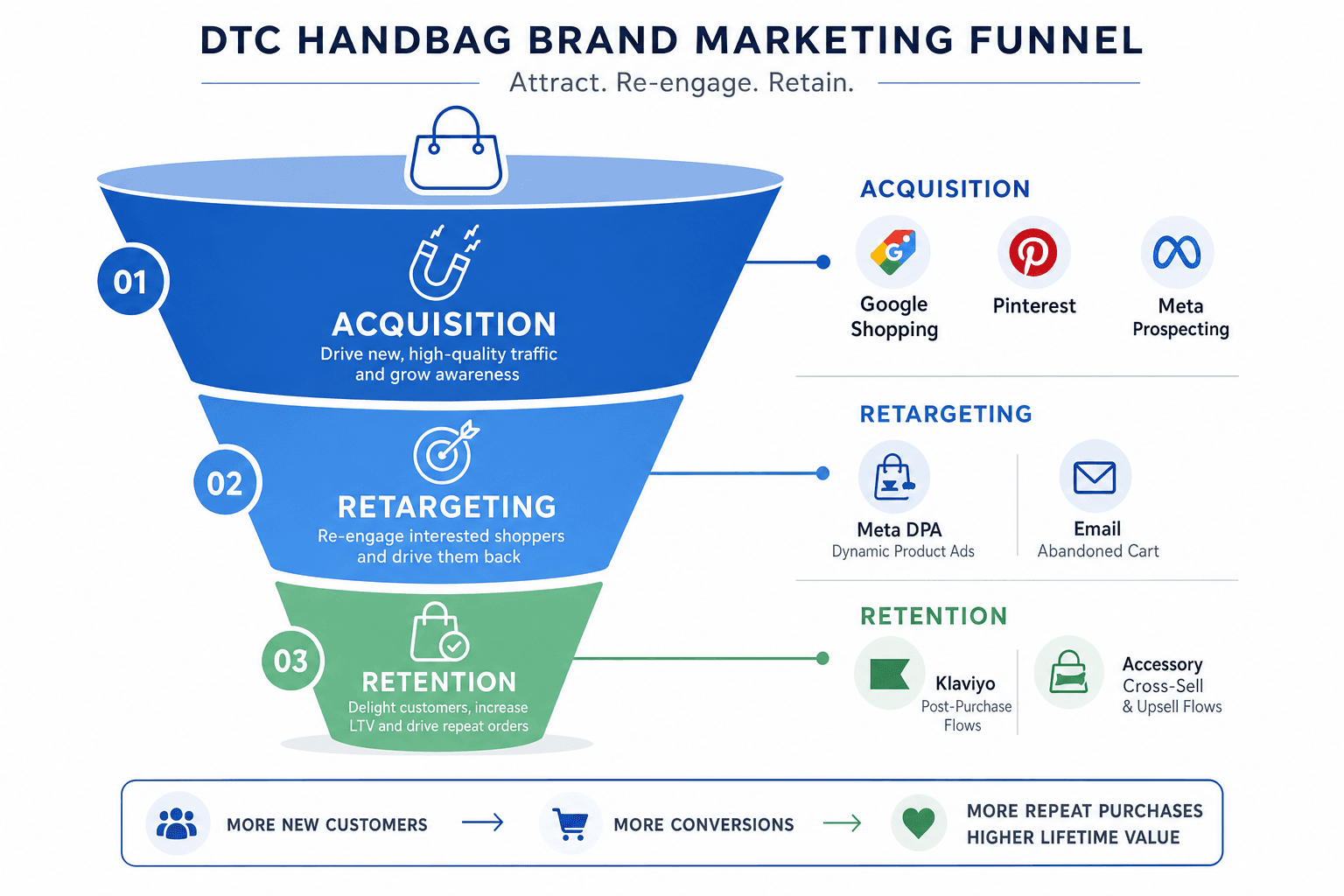
At $1M–$15M in revenue, your channel mix has three jobs: acquire customers at a workable first-order contribution margin, retarget and close consideration-cycle buyers who didn't convert on first touch, and build LTV through email so you don't pay to reacquire them.
Google Shopping and Performance Max, your highest-ROAS channel, catch high-intent product and brand-name searches.
Meta's job is reach and retargeting, not closing cold first sales: lifestyle creative for new audiences, dynamic product ads (DPA) for site visitors and email subscribers. Advantage+ sales campaigns are the right scaling structure, but without the creative volume and rotation most brands lack, they burn out your best ad.
Pinterest earns a dedicated budget line: its aspirational, female-skewing users browse in wish-list mode, and fewer DTC brands compete for them than on Meta. Paid prospecting there runs a lower CPM than Instagram.
Klaviyo flows (welcome, abandoned cart, accessory cross-sell, VIP early access to new drops) should generate 25–35% of total revenue; if they don't, fix the flows before adding ad spend.
Pace budget to the handbag calendar: build the list on cheap CPMs in Q1 (January–February), scale into Mother's Day with gift creative in Q2 (April–May), launch fall drops with pre-launch waitlists in Q3 (August–September), and go full-send on gifting in Q4 (October–November).
The one number that governs this
Blended ROAS is the governing metric, tracked weekly with new-customer CAC by channel; in-platform efficiency isn't a win if CAC breaks first-order contribution margin.
How We Help
What We'd Do for a Handbag Brand Like Yours
We'd fix measurement first, then rebuild Google and Meta, scale creative testing, add Pinterest, and tune Klaviyo and product pages, so your most important metrics move first.
Analytics & Attribution Setup
Before touching campaigns, we add post-purchase surveys and a channel-level view above platform-reported ROAS, so you budget on real data from day one.
Paid Media: Google Shopping & Performance Max
We rebuild Google Shopping around product, material, and occasion queries and give PMax the creative and audience signals that stop it defaulting to branded terms.
Paid Media: Meta (Advantage+ Sales & Retargeting)
We restructure Meta around Advantage+ sales campaigns for scaling and DPA retargeting across the 3–14 day consideration window, with budget paced to the handbag calendar.
Creative Production & Testing
We run systematic creative testing across lifestyle, material-detail, UGC, and unboxing formats, with AI-assisted production and a weekly review feeding winners forward.
Pinterest Strategy & Media
We build organic pin infrastructure and paid prospecting as a dedicated channel; Pinterest's handbag audience is often cheaper to reach than Meta's.
Email & SMS (Klaviyo)
We audit your flows and rebuild the ones that matter for a low-repurchase category: welcome, abandoned cart, and post-purchase cross-sell into accessories.
Conversion Optimization
We analyze your hero SKU pages, find where weak material trust signals, unclear returns, or hidden BNPL options stall high-ticket purchases, and test fixes.
Who's Behind This
Who we are, and what makes us different
Sagum is a performance marketing agency founded in January 2017 in St. George, Utah. We've spent 8+ years growing real brands and being judged on KPIs, not vanity metrics.
We deliberately limit how many clients we take so each one gets senior attention. We treat your numbers like our own, we never run generic playbooks, and your strategy is built for your business, because shouldn't your brand's marketing be custom to your brand?
Sagum.ai is our AI arm: the same proven operators now build AI into the work wherever it creates real edge, not as theater, but as leverage applied with discipline.
- 8+ years growing brands on performance KPIs, not vanity metrics
- Limited client roster, with senior attention on every account
- An extension of your team; your success is tied to ours
- Custom strategy per brand, never a generic playbook
- AI built in where it moves a number; judgment over hype
“Sagum is a performance marketing agency that's spent 8+ years growing brands by treating their numbers like our own. We take on few clients, never run generic playbooks, and now build AI into the work wherever it creates real edge, not hype. Your strategy is built for your business, and our success is tied to yours.”

“Sagum roughly doubled our bottom line. They treat the work like it's their own business.”
Rachel Nilsson
CEO, RAGS
Proof
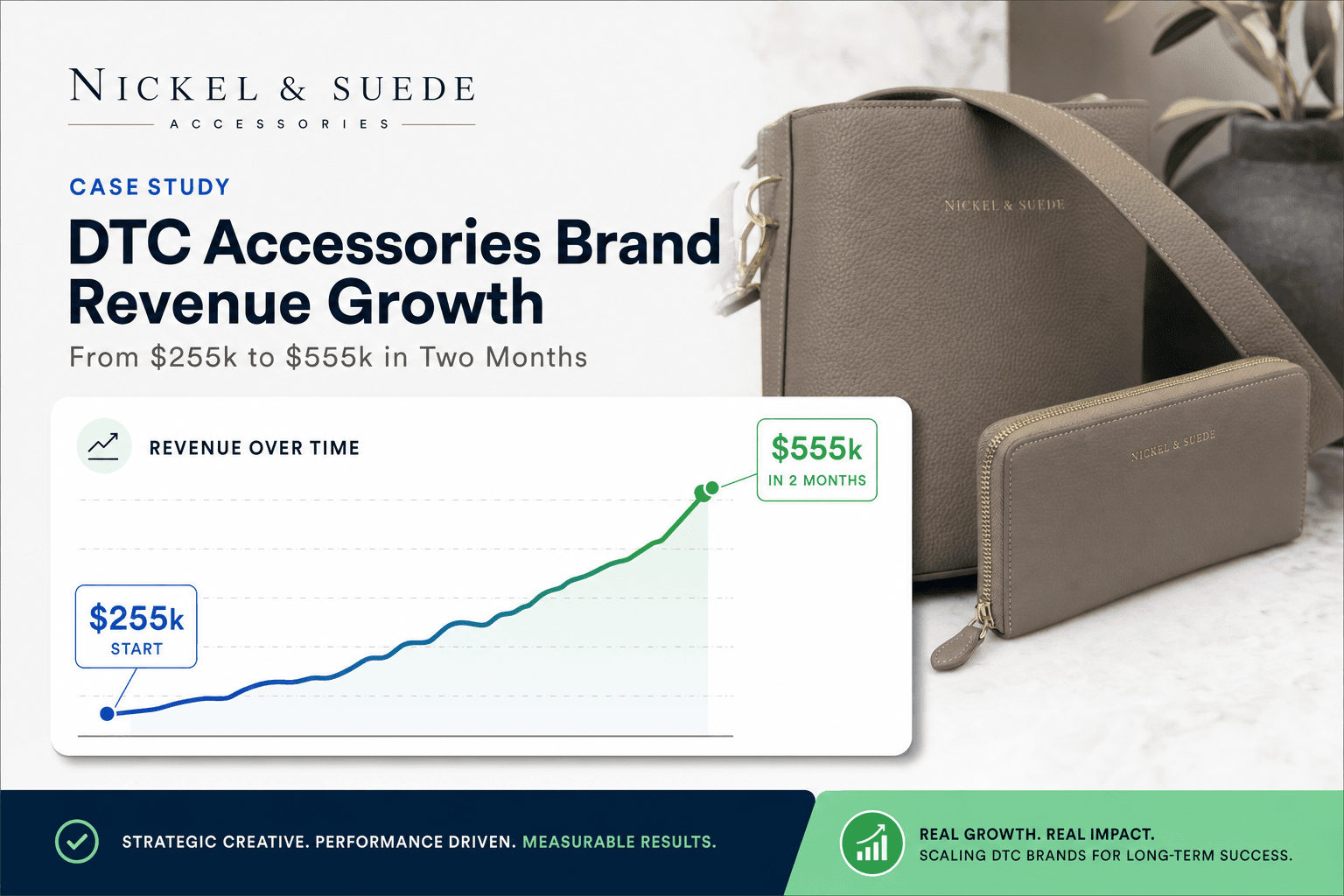
$255k → $555k in 2 months, ROAS 2.9x → 5.5x+
Nickel & Suede
Challenge
Nickel & Suede, an apparel and accessories brand, needed to scale revenue profitably on paid social.
What we did
We ran Meta and TikTok creative testing at volume, the same discipline we'd bring to a handbag brand.
Result
Revenue went from $255k to $555k in two months, ROAS from 2.9x to 5.5x+ (peaking at 7.95x), and site conversion rate rose 34%. Read the full case study at sagum.com/case-studies/.
- Revenue
- $255k → $555k (2 mo)
- ROAS
- 2.9x → 5.5x+ (peak 7.95x)
- Site conversion
- +34%
If Your ROAS Has Plateaued or Your CAC Is Climbing, Let's Talk
No obligation. We'll review your channel mix, attribution setup, and creative velocity and tell you honestly where the biggest gap is. If we're not the right fit, we'll say so.
Sagum · January 2017 · St. George, Utah · 8+ years