

8+ years growing brands on KPIs, now with AI
Close the home decor gap from browse to buy
Full-funnel strategy that converts weeks of browsing into buyers, measured in blended ROAS, not clicks.
Google, Meta & TikTok partner · 8+ years growing ecommerce brands · performance-judged, not retainer-comfortable


Get your free Growth Gap Analysis
Senior strategist review · response within one business day
Prefer to reach out directly?
The Challenge
Home decor is one of the hardest categories to market
Home decor averages a 1.4% conversion rate, second lowest in retail ecommerce, because it's a considered purchase triggered by life events: a move, renovation, new home office, or baby. Buyers pin room ideas and save Instagram posts for weeks, then forget which brand they saw first.
Meta CPMs hit $10.88 in Q1 2025, up nearly 20% year-over-year, and you compete with Wayfair, Anthropologie, and a dozen well-funded DTC peers setting the bar for lifestyle creative, free returns, and mobile checkout. Sixty-three percent of home decor orders are mobile, where product-on-white images barely show scale, texture, or room context.
Home decor AOV is $253–$373, with furniture past $420, but ecommerce net margin averages 4.6% and purchase frequency is low, so LTV:CAC decides if you're building a business or subsidizing acquisition. Unit economics work on the second order, yet most brands optimize for the first.
Trust is the category's #1 purchase blocker (shoppers fear the piece won't look like the photo in their room), and generic agency playbooks aren't built for it.
The Opportunity
Home decor brands that crack the funnel own the category
Demand is structural: US consumers spend an average of $1,598 a year on decor, and remote and hybrid work (over 75% of the workforce in some capacity) keeps it rising.
Traffic and intent exist: Instagram can deliver 8.83:1 ROAS for visual lifestyle categories with the right creative, Google Shopping averages 4.5:1 on high-intent search, and Pinterest, the highest-intent discovery platform for home decor, runs $0.50–$0.80 CPC, reaching buyers who've researched for weeks. Most brands lack full-funnel architecture that moves inspiration-mode browsers to a confident purchase.
Top brands match creative to each platform's mindset, build retention in from day one, and measure blended ROAS, not last-click.
Home & Garden brands showed the highest potential LTV among Shopify verticals: top performers earn nearly 3× the revenue in Month 1 and end Year 1 with $122 more per customer than average.
What Most Get Wrong
What most home decor brands and their agencies get wrong
Running product-on-white creative on Meta and Pinterest
Inspiration-mode shoppers on Instagram and Pinterest scroll past bare product shots. Top brands lead with room-set photography and UGC; agencies missing this burn your budget on creative that won't convert.
Treating TikTok like a direct-response channel
TikTok averages 1.4:1 ROAS for home decor, lowest of any major platform. Expecting Google Shopping-level ROAS from conversion campaigns for $350 AOV products leaks budget; use TikTok for top-of-funnel awareness.
Ignoring the confidence gap and losing sales to hesitation
Over 82% of consumers are willing to buy home decor online, but sales drop off when shoppers can't picture the product in their space, confirm scale, or get answers on-page.
Measuring last-click ROAS instead of blended ROAS
Last-click credits Google branded search for journeys started on Pinterest, so you underfund top-of-funnel and overfund demand capture. Without multi-touch attribution (Triple Whale, Northbeam), you optimize against a false number.
Running flat budgets through spring refresh and Q4
Q4 gifting season (October–December) accounts for up to 32% of annual revenue for many brands; spring (March–May) is the other peak. Flat spending misses both; pre-load creative and landing pages.
Why Now
Why AI gives home decor brands an edge right now
The home decor ecommerce market is projected to reach $202 billion globally by 2029. Brands building AI-augmented marketing now, while competitors still guess at attribution, will hold an advantage that's hard to dislodge.
AI now lets a focused operator do the work of a team three times the size: test five creative angles per week instead of one, catch attribution errors inflating numbers for months, shift spend as Pinterest searches for 'cozy bedroom ideas' climb in September, and adapt browse-abandonment emails by product category.
Most home decor brands and their agencies still run two-year-old Meta campaigns and read last-click dashboards while rising CPMs compress ROAS. Spring is your largest organic demand surge, Q4 needs creative and campaigns built months ahead, and waiting means buying into a pricier, more competitive market.
The Mechanism
Where AI moves the number for home decor brands
Real productivity, not AI theater. Here's where it actually moves a number for home decor brands.
Creative
What AI does: We use AI-assisted production and A/B testing to rotate more lifestyle, seasonal, and room-set variations per week than a traditional creative process allows.
The result: You learn faster which creative drives add-to-cart, whether that's a 'morning light linen bedroom' concept for spring or a 'cozy reading nook' frame for Q4.
Why it matters here: A room-set concept that performs in March is irrelevant by July, so you need to find the winning angle before the season peaks.
Analytics
What AI does: AI-powered attribution tracks the journey across Pinterest, Instagram, and Google, replacing last-click with a blended ROAS view of which channels create demand.
The result: You move budget toward the top-of-funnel touchpoints that start the 2–3 week consideration journey, away from channels that win last-click but add no incremental revenue.
Why it matters here: When a shopper who discovered you on Pinterest converts via Google Search 18 days later, misreading that data starves the channel that created the customer.
Conversion Optimization
What AI does: AI finds where product detail pages lose shoppers, which images underperform, and where the confidence gap (scale, texture, room context) costs sales, then tests fixes against the 1.4% category baseline.
The result: At $300+ AOV, conversion is the biggest lever: lifting it from 1.4% to 1.8% adds about $286k per $1M in revenue from the same traffic.
Why it matters here: Home decor converts poorly because shoppers stay unsure the piece will look right in their space; AI can test fixes faster than manual work.
Digital Ads
What AI does: Across Meta, Pinterest, and Google Shopping, AI helps adjust bids, refine audience signals, and pace budget to Pinterest search trends, weather patterns, and life-event triggers.
The result: Your spend follows real demand: it scales into spring refresh and Q4 peaks, pulls back in the January–February post-holiday trough, and reaches high-intent buyers mid-search.
Why it matters here: Home decor demand is event-driven and seasonal, so a budget that treats March like February gives up your peak-season advantage.
What AI does: AI personalizes post-purchase flows, browse-abandonment sequences segmented by category (soft goods, furniture, seasonal), and spring and fall refresh campaigns, while testing send times and subject lines.
The result: A customer who bought a throw blanket in October and reorders from a March 'spring refresh your bedroom' email justifies their acquisition cost.
Why it matters here: Purchase frequency is low, and the $1,598 a year consumers spend on decor doesn't default to one brand; it follows whoever stays present and well-timed.
Ready to see what this looks like for your home decor brands business?
No obligation. A senior strategist will show you exactly where the wins are.
The Strategy
The marketing strategy that works for DTC home decor
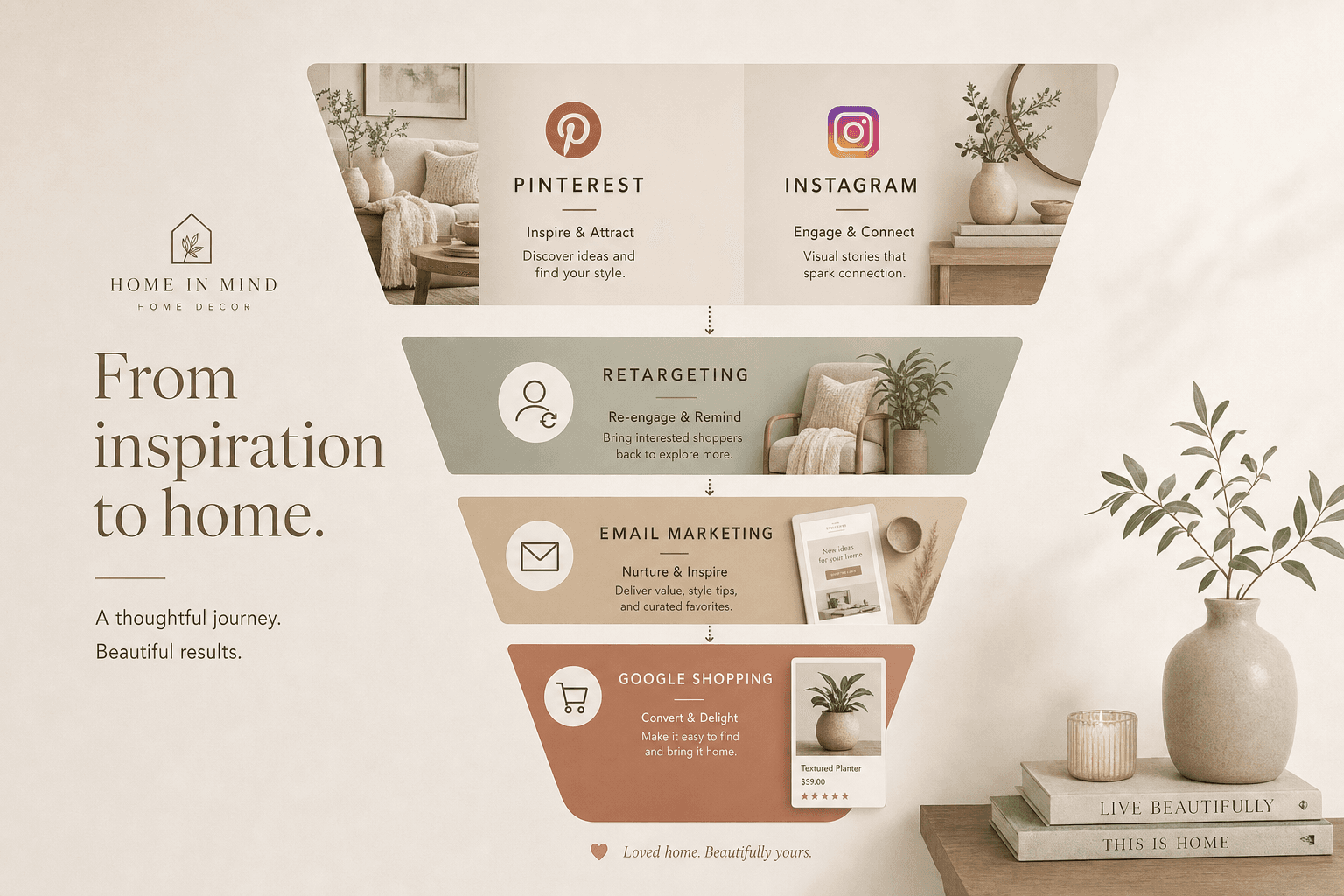
The funnel has three stages plus retention, and a typical brand builds for only one.
Pinterest and Instagram lead discovery, with ads that look like what shoppers pin: lifestyle room-sets, seasonal styling, real customer spaces. Pair Pinterest Shopping Ads with Idea Ads, run Instagram Reels and carousels, and keep TikTok to awareness for sub-$80 impulse items with visual 'wow factor.'
Most brands lose the sale mid-funnel. A shopper who viewed a product detail page (PDP) without buying is in a normal 2–3 week deliberation window, and Meta retargeting with confidence-gap creative (customer room photos, scale references, warranty and return reassurance) keeps you present.
Browse-abandonment emails split by category close the loop: someone who viewed a $400 rug gets a different sequence than someone browsing your $65 candle collection.
At the bottom, Google Shopping and Performance Max capture ready buyers through branded and high-intent category queries ('linen duvet cover queen,' 'rattan pendant light'), with campaigns structured by SKU category instead of broad catch-alls.
Retention builds LTV: post-purchase flows, spring and fall refresh campaigns, and SMS reorder prompts for high-AOV categories turn a 1× buyer into a 2× buyer.
Use multi-touch attribution to see which platforms create demand and which capture it, and pace budget to seasonal demand signals.
The one number that governs this
Steer by blended ROAS (total revenue ÷ total ad spend, target 4–6×), not last-click; track repeat purchase rate, AOV by channel, and cost-per-second-order.
How We Help
What we'd build for your home decor brand
We start where the money leaks. For most home decor brands that means fixing attribution first so you can trust your numbers, then building full-funnel infrastructure around how buyers shop.
Attribution & Analytics Setup
First we audit your pixel, GA4 configuration, and attribution model, then implement multi-touch attribution (Triple Whale or equivalent) so your blended ROAS is real.
Paid Social: Meta & Pinterest
We run Meta and Pinterest as one funnel: lifestyle discovery creative, confidence-gap retargeting, pre-built spring refresh and Q4 campaigns, and multiple angles tested weekly.
Google Shopping & Performance Max
We restructure Shopping around high-intent category and SKU-level queries, pace budget to seasonal demand, and judge results on blended ROAS.
Creative Production & Testing
Creative has a short shelf life, so we run ongoing production: room-set photography direction, UGC sourcing, seasonal calendars, and AI-assisted variant testing.
Email & SMS Automation
We build post-purchase, browse-abandonment, and seasonal refresh flows plus reorder prompts for high-AOV repeat categories, and run email as a revenue channel, not a newsletter.
Conversion Rate Optimization
We audit your PDPs for confidence-gap issues (missing scale references, weak room-context imagery, unclear return policies, slow mobile load times) and test fixes systematically.
Who's Behind This
Who we are, and what makes us different
Sagum is a performance marketing agency founded in January 2017 in St. George, Utah. We've spent 8+ years growing real brands and being judged on KPIs, not vanity metrics.
We deliberately limit how many clients we take so each one gets senior attention. We treat your numbers like our own, we never run generic playbooks, and your strategy is built for your business, because shouldn't your brand's marketing be custom to your brand?
Sagum.ai is our AI arm: the same proven operators now build AI into the work wherever it creates real edge, not as theater, but as leverage applied with discipline.
- 8+ years growing brands on performance KPIs, not vanity metrics
- Limited client roster, with senior attention on every account
- An extension of your team; your success is tied to ours
- Custom strategy per brand, never a generic playbook
- AI built in where it moves a number; judgment over hype
“Sagum is a performance marketing agency that's spent 8+ years growing brands by treating their numbers like our own. We take on few clients, never run generic playbooks, and now build AI into the work wherever it creates real edge, not hype. Your strategy is built for your business, and our success is tied to yours.”

“After six years, Sagum is our most important partner: trusted, communicative, and caring about our business as if it's their own.”
Long-term partner
6-year client
Proof
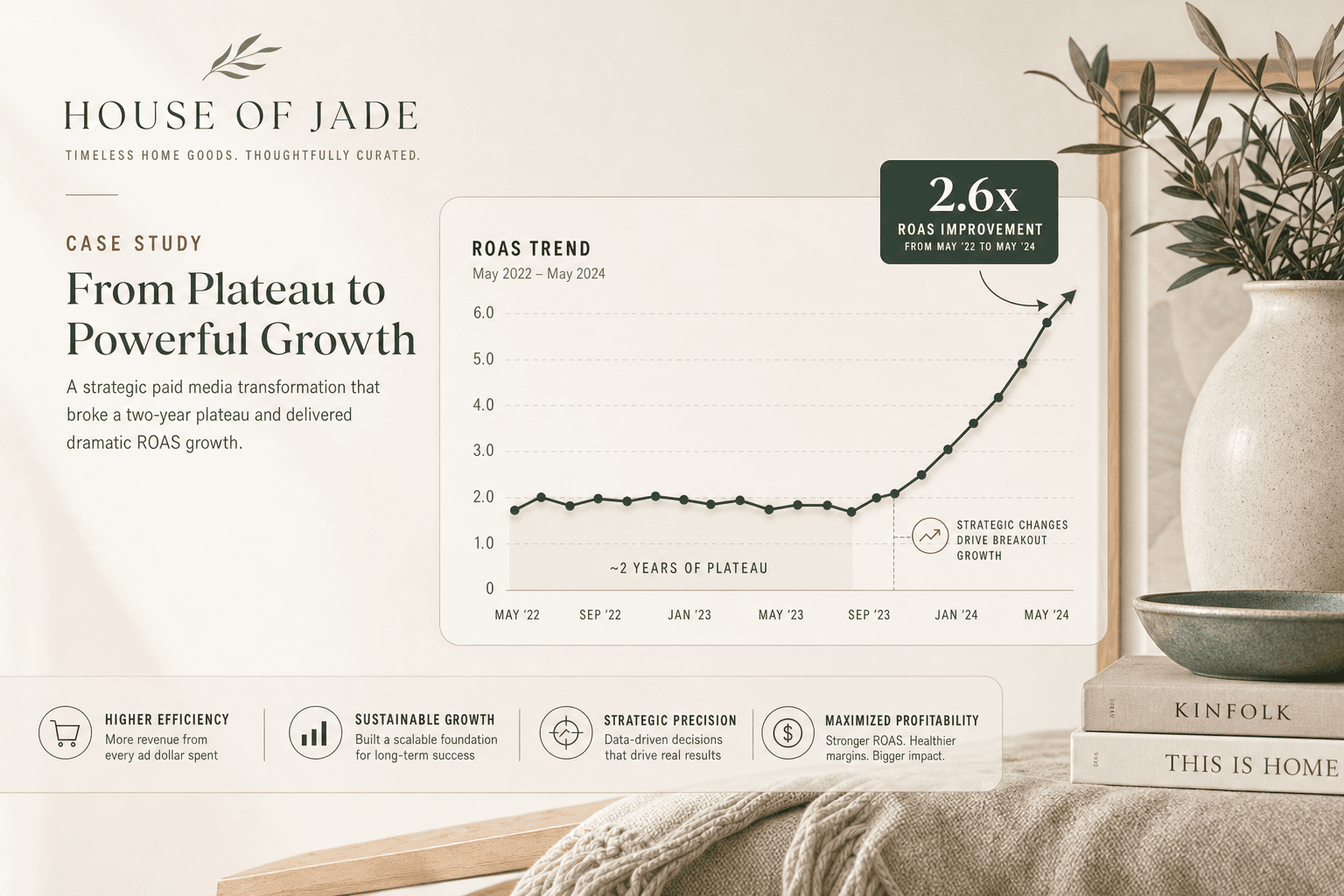
Broke a 2-year ROAS plateau with +115% ROAS at the same spend
House of Jade
Challenge
House of Jade, a home goods ecommerce brand, had been stuck on a two-year ROAS plateau.
What we did
We restructured its strategy without increasing spend, the same discipline we'd bring to a home decor brand.
Result
House of Jade improved ROAS 115% at the same spend and had its biggest, most profitable Q4.
Your buyers are already browsing. Let's make sure they buy from you.
No obligation, no generic pitch deck. We'll review your brand, channels, and numbers first, then tell you where we see growth for your business and what we'd do about it.
Sagum · January 2017 · St. George, Utah · 8+ years