

8+ years growing brands on KPIs, now with AI
Jewelry marketing beyond competing on price
We scale returns, cut acquisition cost, and build the retention engine that makes paid media profitable.
8+ years growing ecommerce brands · Google, Meta & TikTok partner · Proven ROAS results across DTC


Get your free Growth Gap Analysis
Senior strategist review · response within one business day
Prefer to reach out directly?
The Challenge
Jewelry Ecommerce Runs on Thin Margins, Slow Conversion, and Moving Prices
Gross margin looks healthy (55% to 75% for fine and demi-fine DTC), but SG&A, paid media, and 75-to-186 days of inventory carrying cost leave you cash-poor on a razor-thin operating margin.
Jewelry has the lowest ecommerce conversion rate of any major category (0.8% to 1.5%) because, unlike a supplement or $60 tee, it's a high-consideration, emotional purchase with quality anxiety. A shopper who finds you on TikTok on a Tuesday may not buy until a retargeting email lands three weeks later.
Then there's the visual confidence gap: 60% of online jewelry buyers hesitate without seeing a piece worn in context, so a white-background shot won't sell a $280 demi-fine ring; UGC, on-body video, and lifestyle creative do.
With gold and silver prices swinging sharply, you're repricing every SKU, so your creative, page copy, and margin math keep moving. Among 190,000-plus Shopify stores in jewelry and accessories, leaders out-test you on creative, out-sequence you on email, and out-convert you on landing pages without outspending you.

The Opportunity
Retention, TikTok Shop, and Creative Velocity Separate Jewelry's Winners
With strong creative and targeting, high AOV and gifting demand raise jewelry's ROAS ceiling above most ecommerce categories; recent blended benchmarks set a 4.0:1 floor, with best-in-class brands reaching 6.8:1.
Retention comes first: a 40% repeat rate versus 20% lets you absorb higher CAC and bad paid-media months while LTV compounds. Email and SMS move that rate; paid media doesn't.
TikTok Shop is second: global GMV hit $64.3 billion in 2025, up 94% year-over-year. Early-moving jewelry brands win impulse and trend-driven buyers at a CAC paid search can't match.
Creative velocity is third: brands testing the most variations weekly, not the biggest production spenders, find the angle (model, lighting, occasion) often separating 1.5x ROAS from 5x. If your repeat rate is under 30%, your creative library is stale, or you treat TikTok as awareness only, you have revenue to capture.
What Most Get Wrong
What Most Jewelry Brands (and Their Agencies) Get Wrong
Benchmarking against the wrong category
Jewelry is high-AOV ($364), low-frequency, and slow-turning. Founders and agencies using apparel or supplement benchmarks cut working campaigns, chase metrics that don't predict revenue, and hit ROAS targets without growing.
Retargeting for a 3-to-5 day window
Buyers often deliberate three weeks or more on anything over $80. Five-day, impulse-style abandoned-cart flows lose the buyer who found you on TikTok, saved a piece, and kept comparison-shopping.
Running static creative through a seasonal gifting calendar
Valentine's Day, Mother's Day, and graduation season each carry distinct intent, framing, and price points. Run August's evergreen creative into Q4 and you waste the year's highest-ROAS window.
Treating UGC and on-body video as optional
White-background shots fill the catalog but don't close the sale. Agencies that leave UGC sourcing and on-body creative out of production structurally cap conversion, however well ads are targeted.
Measuring ROAS per channel instead of blended ROAS
A buyer touches TikTok, Instagram, branded search, and two emails, then converts. Judging channels alone, you cut top-of-funnel TikTok and Pinterest; blended ROAS measures the system.
Why Now
AI, Metal Repricing, and TikTok Shop Reward Jewelry Brands That Move First
Most DTC jewelry brands still run a years-old playbook, with two or three Meta creative variants, a basic abandoned-cart email, and a Google Shopping feed unaudited for months, because changing the playbook by hand is slow and expensive.
With AI built into an agency's creative workflow, you can generate and evaluate five to ten creative angles per week instead of one or two per month.
Every metal price swing forces fine and demi-fine brands to reprice SKUs, and the brands fastest to reframe their messaging hold conversion while laggards' CAC climbs. A brand with a real content and creative strategy can still establish category authority on TikTok Shop before the channel gets as crowded as Meta did, and that window narrows with every gifting season.
The Mechanism
Where AI Gives a Jewelry Brand an Edge
Real productivity, not AI theater. Here's where it actually moves a number for jewelry brands.
Creative
What AI does: AI generates and stress-tests briefs by gifting occasion, persona (self-gifter vs. gift-giver), and price tier (demi-fine vs. fine hooks), so your team evaluates many more angles each week.
The result: You find each occasion's winning concept sooner, and that concept is often the one variable between a 1.5x and a 5x ROAS campaign.
Why it matters here: Occasion framing (Valentine's self-gifting vs. 'for her') can double conversion on the same piece; test more angles weekly and you outpace brands running static ads.
What AI does: AI extends retention flows to 21-plus days post-discovery, with occasion branches for Valentine's Day, Mother's Day, graduation, and Q4, plus dynamic recommendations from browse and purchase history.
The result: Repeat purchase rate rises, giving you a retention revenue floor that doesn't need paid media to reactivate past customers.
Why it matters here: Your own site and email carry much of your revenue; lifting repeat rate from 20% toward 40% changes LTV:CAC and raises your profitable CAC ceiling.
Analytics
What AI does: AI monitors attribution, flags gaps between reported and blended ROAS, and spots when last-click credit misstates a channel's contribution, especially TikTok and Pinterest, which seed conversions that close elsewhere.
The result: You set budget by what drives jewelry sales, whatever the platform dashboards claim.
Why it matters here: Jewelry buyers cross several channels over weeks before converting on email, so optimizing per-channel ROAS starves the top of the funnel.
Conversion Optimization
What AI does: AI audits product pages and checkout for jewelry trust signals (on-body imagery, UGC placement, BNPL visibility, quality and sourcing language) and surfaces the highest-impact gaps to test first.
The result: More of the paid shoppers already landing on your product pages buy the piece, with no added ad spend.
Why it matters here: Jewelry's cart abandonment, roughly 81%, is the highest of any major ecommerce category; fixing even part of it beats scaling spend into a leaky funnel.
Digital Ads
What AI does: AI shifts bids and budget across Google Shopping, Meta, and TikTok in real time toward what's converting in peak gifting windows, faster than a manual weekly review.
The result: Spend concentrates in the highest-ROAS windows: December, Valentine's Day, and graduation season.
Why it matters here: With December jewelry sales over double any other month's, pacing into peaks and pulling back in the July–August trough beats flat budgets on annual ROAS.
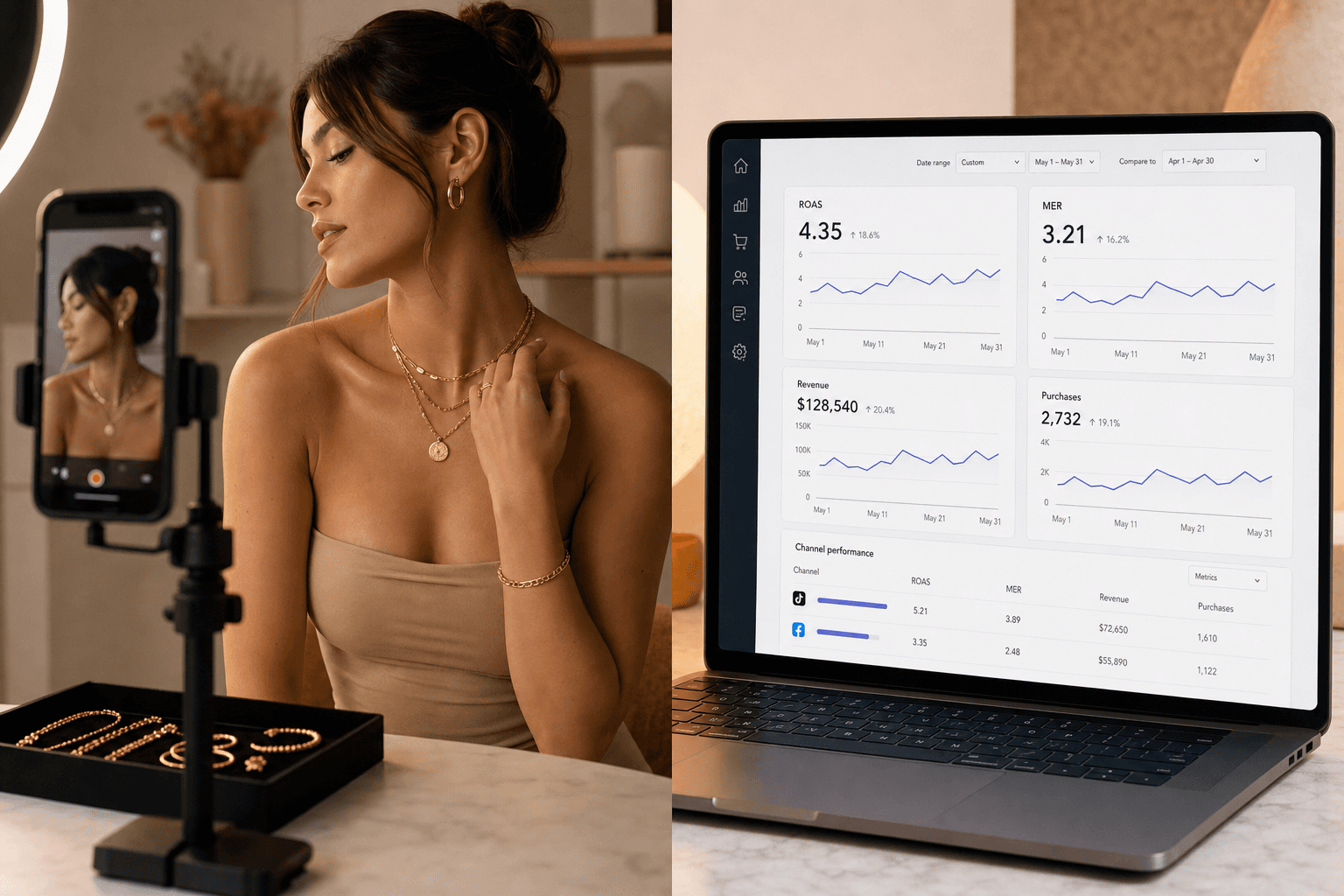
Ready to see what this looks like for your jewelry brands business?
No obligation. A senior strategist will show you exactly where the wins are.
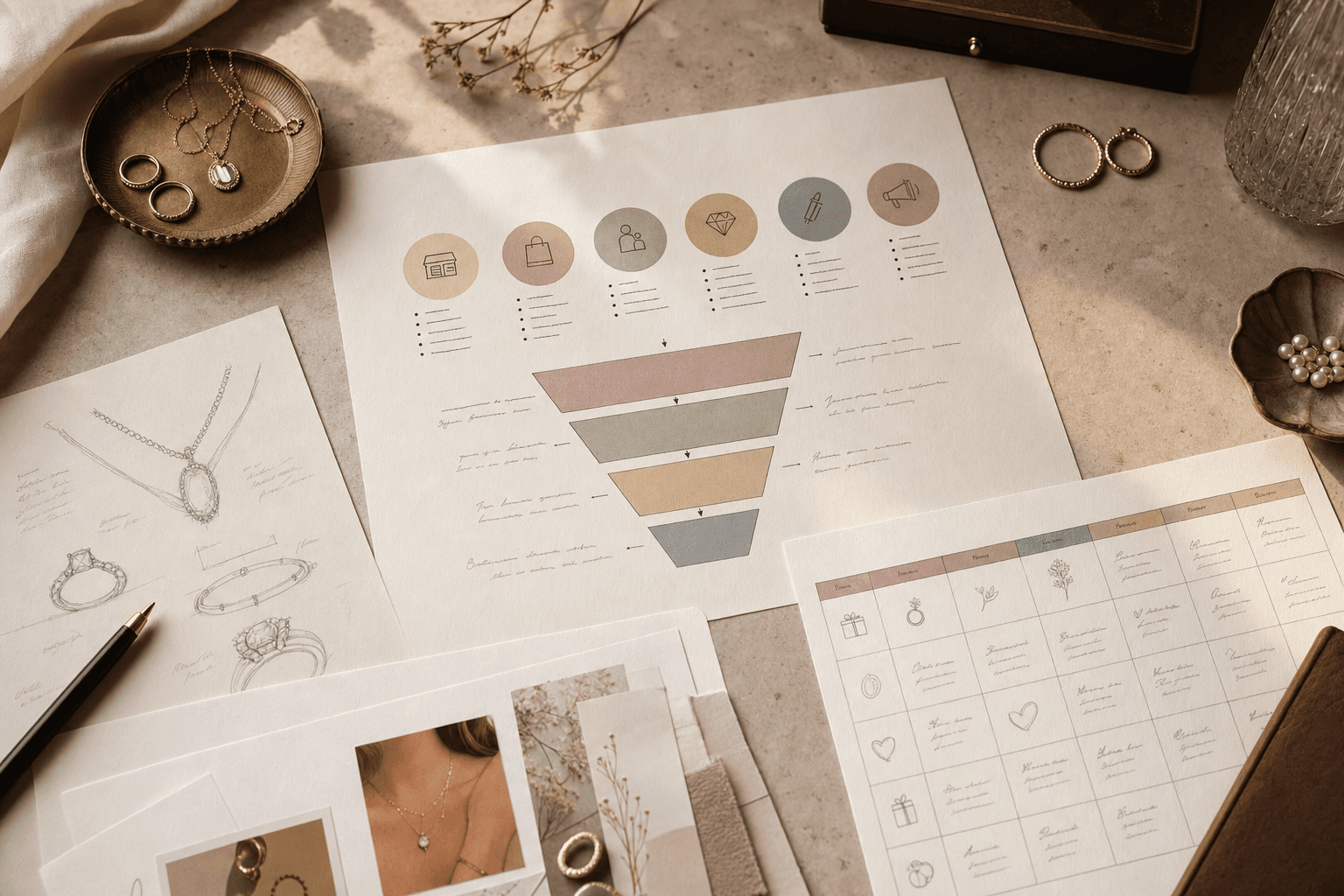
The Strategy
How to Run Marketing for a Jewelry Brand
Google Shopping and branded search capture buyers who've decided, so keep the product feed audited and negative keywords tight. Google retargeting extends the window for considered buyers who visited and left.
Use Meta and TikTok to reach self-gifters and gift-givers before they search, and build a content presence on TikTok, now a real jewelry acquisition channel, before it gets as crowded as Meta.
Pinterest is underrated for bridal and milestone gifting: its users are planning purchases, and jewelry brands see outsized ROAS there.
Email and SMS are your profit engine: most DTC jewelry brands already get 45% of revenue from their own site and email, and almost always underuse both. Run sequences as long as the deliberation cycle, occasion-triggered flows for each gifting peak, and post-purchase flows built to raise repeat purchase rate.
Build creative around the visual confidence gap: every campaign needs on-body video, UGC sourcing, and occasion-specific framing, and your creative library should rotate with weekly testing.
Whenever metal prices rise, your messaging has to justify new prices through craftsmanship, material quality, and occasion value so conversion holds as AOV climbs.
The one number that governs this
Blended ROAS (total revenue ÷ total ad spend), not Meta or Google ROAS, is the governing KPI: target 4.0:1 minimum; best-in-class jewelry brands reach 6.8:1.
How We Help
What We'd Build for Your Jewelry Brand
We'd fix leaks before spending more on acquisition, starting with attribution that makes your blended ROAS trustworthy, email matched to the deliberation cycle, and product-page trust signals for high-consideration purchases.
Paid Media: Google, Meta & TikTok
We run Google Shopping and branded search, Meta and TikTok prospecting on gifting and self-gifting briefs, and weeks-long retargeting, all measured on blended ROAS.
Creative Strategy & Production Briefing
We brief and test new angles weekly, including UGC sourcing and on-body video, so your creative library keeps rotating.
Email & SMS Retention System
We audit and rebuild flows: abandoned-cart and browse-abandonment sequences that run 21-plus days, gifting-calendar campaigns, and post-purchase sequences built to raise repeat rate and LTV:CAC.
Analytics & Attribution
We repair attribution, flag where platform ROAS disagrees with actual revenue, and build budget reporting that filters out dashboard noise.
Conversion Optimization
We audit product pages and checkout for jewelry trust signals, then run structured tests to cut cart abandonment before scaling traffic.
AI Systems & Agents
We add AI where it moves a number: brief generation and angle evaluation, gifting-season budget pacing, and continuous page audits for conversion leaks.
Who's Behind This
Who we are, and what makes us different
Sagum is a performance marketing agency founded in January 2017 in St. George, Utah. We've spent 8+ years growing real brands and being judged on KPIs, not vanity metrics.
We deliberately limit how many clients we take so each one gets senior attention. We treat your numbers like our own, we never run generic playbooks, and your strategy is built for your business, because shouldn't your brand's marketing be custom to your brand?
Sagum.ai is our AI arm: the same proven operators now build AI into the work wherever it creates real edge, not as theater, but as leverage applied with discipline.
- 8+ years growing brands on performance KPIs, not vanity metrics
- Limited client roster, with senior attention on every account
- An extension of your team; your success is tied to ours
- Custom strategy per brand, never a generic playbook
- AI built in where it moves a number; judgment over hype
“Sagum is a performance marketing agency that's spent 8+ years growing brands by treating their numbers like our own. We take on few clients, never run generic playbooks, and now build AI into the work wherever it creates real edge, not hype. Your strategy is built for your business, and our success is tied to yours.”

“Sagum roughly doubled our bottom line. They treat the work like it's their own business.”
Rachel Nilsson
CEO, RAGS
Proof
$255k → $555k in 2 months, ROAS 2.9x → 5.5x+
Nickel & Suede
Challenge
Nickel & Suede needed to scale revenue profitably on paid social.
What we did
We ran Meta and TikTok creative testing at volume. That high-velocity testing transfers directly to jewelry, where occasion and on-body angles decide conversion.
Result
Revenue went from $255k to $555k in two months. ROAS climbed from 2.9x to 5.5x+ (peaking at 7.95x), and site conversion rose 34%. Full details at sagum.com/case-studies/.

- Revenue
- $255k → $555k (2 mo)
- ROAS
- 2.9x → 5.5x+ (peak 7.95x)
- Site conversion
- +34%
Your Jewelry Brand's Growth Session: No Generic Decks, No Obligation
We keep a limited client roster so every brand gets senior attention. With no obligation, we'll talk through where the growth is, using your current ROAS, retention rate, and creative cadence.
Sagum · January 2017 · St. George, Utah · 8+ years