

8+ years growing brands on KPIs, now with AI
More Signed Kitchen Remodel Contracts
Fill your consultation calendar with qualified homeowners using a system built around how remodel buyers actually decide.
Google Ads · Meta · TikTok Partner | 8+ Years Growing Local Service Businesses


Get your free marketing audit
Senior strategist review · response within one business day
Prefer to reach out directly?
The Challenge
Kitchen Remodeling Is One of the Hardest Local Services to Market Well
Your buyer isn't calling because something broke. She has pinned kitchens on Pinterest for eight months, toured two showrooms, watched a dozen YouTube walkthroughs, and is quietly comparing you with three other firms.
A full kitchen remodel takes four to six months from first search to signed contract, and projects average $55,000 to $120,000. The buyers, typically a 45–65-year-old homeowner couple, are excited about the new kitchen and terrified of the disruption: she drives the design vision, he controls the budget, and you usually have to sell both at once.
Generic marketing brings in renters, homeowners with a $12,000 budget asking for a full gut renovation, and people who want one cabinet door replaced. At $200 per raw lead from those campaigns, each bad lead burns real dollars, estimator time, and your sales manager's patience.
Meanwhile the $75,000 design-build jobs in the right zip codes go to competitors who showed up first in search when the homeowner decided to act. Timing and trust decide this category.

The Opportunity
Most Kitchen Remodeling Demand Goes to Whoever Shows Up Best
Whoever is visible in Q1 builds the year's pipeline: roughly 40% of homeowners who renovate kitchens decide then, and another 27% in Q2.
Eighty-six percent of homeowners hire a professional for kitchen renovations, and 88% of them research contractors online first, judging your website, reviews, and ads.
Good marketing pays: a $75,000 remodel at a 40% gross margin yields $30,000 gross profit. At $250 per qualified consultation through owned channels and a 25% close rate, a project costs around $1,000 to acquire, or $30 of gross profit per acquisition dollar before overhead. That homeowner's referral, statistically likely within 18 months, doubles the return.
The best projects go to firms with the best marketing infrastructure, not crew size or experience. They show up first, qualify leads with landing pages before the phone rings, and book consultations before competitors call back.
What Most Get Wrong
What Most Kitchen Remodelers and the Agencies They Hire Get Wrong
Bidding on broad terms like 'kitchen ideas' and 'kitchen cabinets'
Those clicks bring renters, material-only shoppers, and homeowners with $12,000 budgets wanting a full gut, so your estimator loses Tuesday afternoon to three calls that could never close.
Using a generic 'contact us' form with no qualification layer
Without scope, budget, homeownership, and timeline questions, your sales team runs consultations for cabinet resurfacing, not $65,000 remodels. A structured intake form is the highest-return change most remodelers can make.
Flat ad spend that ignores the Q1 decision window
If January's budget matches August's, you spend no more in peak decision months than when few homeowners are in market. Surge spend in Q1, then retarget long-cycle prospects in summer.
No call and form attribution by campaign, keyword, or ad
You optimize for lead volume instead of cost per qualified consultation or signed contract, then cut the campaigns booking real jobs and keep the ones sending tire-kickers.
Quitting after two follow-ups on a months-long buying cycle
A February lead who signs in May is normal. She calls whoever sent a portfolio in March, a financing offer in April, and a 'spring start availability' note in May.
Why Now
Why Kitchen Remodelers Who Build Before Q1 Decision Season Win
Q1 is the decision quarter, when the largest share of buyers builds shortlists. Firms visible then fill spring and summer construction calendars; the rest chase scraps all year.
The competitive gap in AI-assisted marketing is widest now. Most kitchen remodelers still run the Google campaigns they built two years ago, with the same keywords, ad copy, landing page, and flat budget. They don't test creative weekly, shift budget with search volume, or use AI to find qualification leaks in landing pages and build nurture sequences for a four-to-six-month buying cycle.
Put smarter campaign structure, AI-assisted creative testing, proper attribution, and automated nurture in place before Q1 shortlists form, and you'll own your market's pipeline of qualified consultations before the summer construction peak. Wait past Q1 and results slip a year.
The Mechanism
Where AI Gives Kitchen Remodelers a Real Advantage
Real productivity, not AI theater. Here's where it actually moves a number for kitchen remodelers.
Digital Ads
What AI does: AI-assisted budget pacing and bid optimization follow search volume, weighting spend toward the decision window and the zip codes and keywords producing qualified consultations.
The result: Ad dollars follow demand, so cost per qualified consultation drops in the peak booking window.
Why it matters here: A dollar reaching a homeowner ready to act is worth ten spent in August, so flat monthly spend is a structural disadvantage.
Creative
What AI does: Where a competitor tests one ad a month, AI tests many angles a week: before/after carousels, financing-led offers, room transformations (white oak island, quartz waterfall edge, custom pantry), and objection handling.
The result: You find the angles that resonate with the dual-income homeowner couple sooner, earning higher click-through rates and lower cost-per-click without needing a full creative team.
Why it matters here: On Meta and Pinterest, offer and visual format outweigh targeting; five tested angles beat one static image on the same budget.
Conversion Optimization
What AI does: AI-built landing pages qualify the lead before the consultation is booked (project scope selector, budget range confirmation, homeownership check, timeline question), and AI keeps reviewing them for conversion and qualification leaks.
The result: Fewer unqualified consultations eat estimator time, and a higher share of form fills are worth calling back within five minutes.
Why it matters here: Your estimator's calendar is the constraint, so every unqualified consultation takes a slot a high-value remodel could have filled.
Analytics
What AI does: Call tracking and UTM attribution tie every call, form fill, and booked consultation to its campaign, keyword, and ad.
The result: You optimize for cost per signed contract and see which marketing dollars produce gross profit.
Why it matters here: Most remodelers optimize blind, and one misattributed campaign decision can cost $30,000 in lost gross profit.
What AI does: AI-built nurture sequences (portfolio sends, financing timing, seasonal availability triggers, before/after showcases) keep your firm in front of homeowners who didn't sign after the consultation, across the four-to-six-month research-to-contract arc.
The result: A meaningful percentage of those warm leads convert later in the cycle without more ad spend.
Why it matters here: Kitchen buyers take months to sign, so the firm with a structured nurture sequence gets the contract.
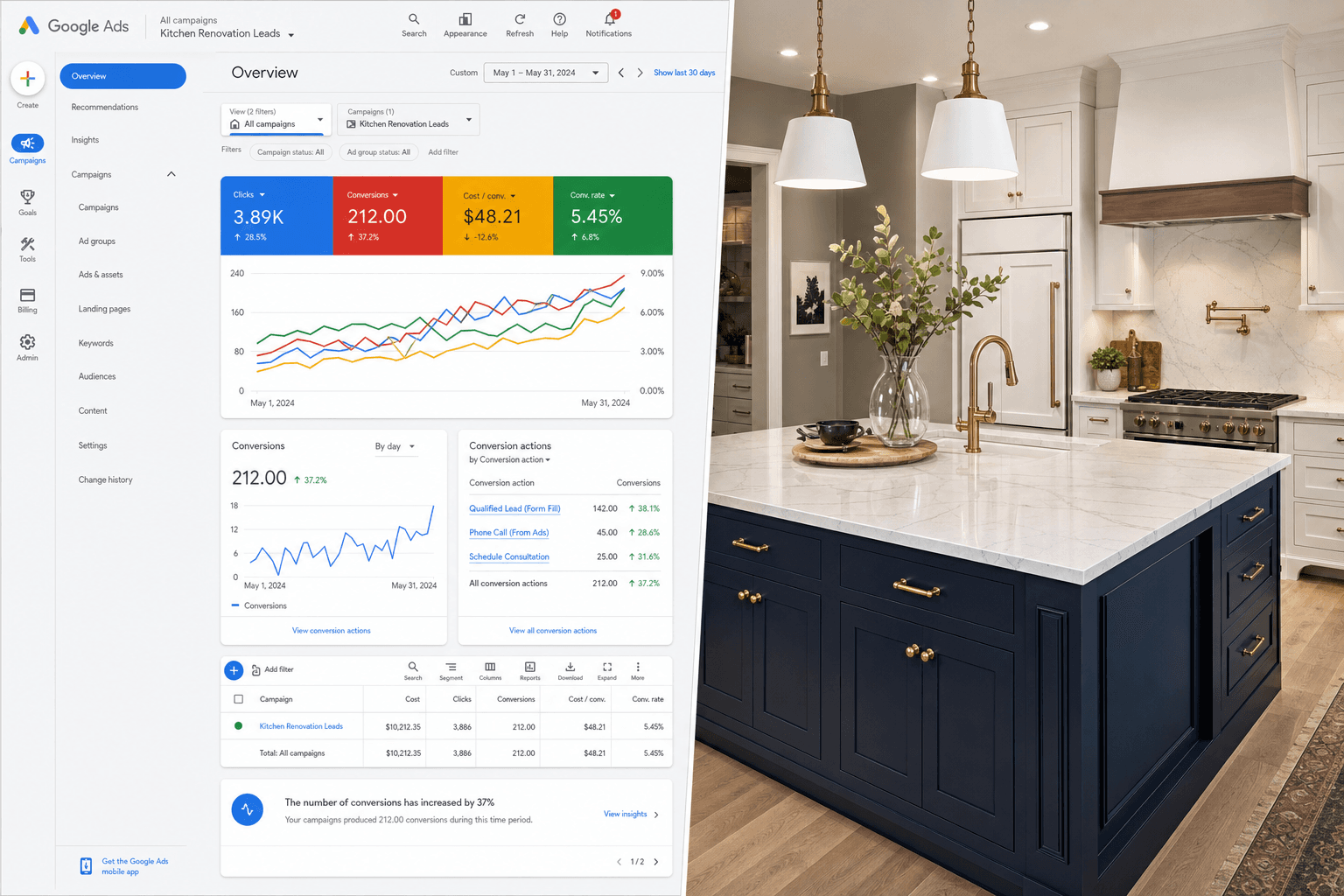
Ready to see what this looks like for your kitchen remodelers business?
No obligation. A senior strategist will show you exactly where the wins are.
The Strategy
How a Design-Build Kitchen Remodeler Should Run Its Marketing
Judge every campaign by cost per qualified design consultation and cost per signed contract, tracing each contract to its campaign and keyword through CRM-connected call tracking.
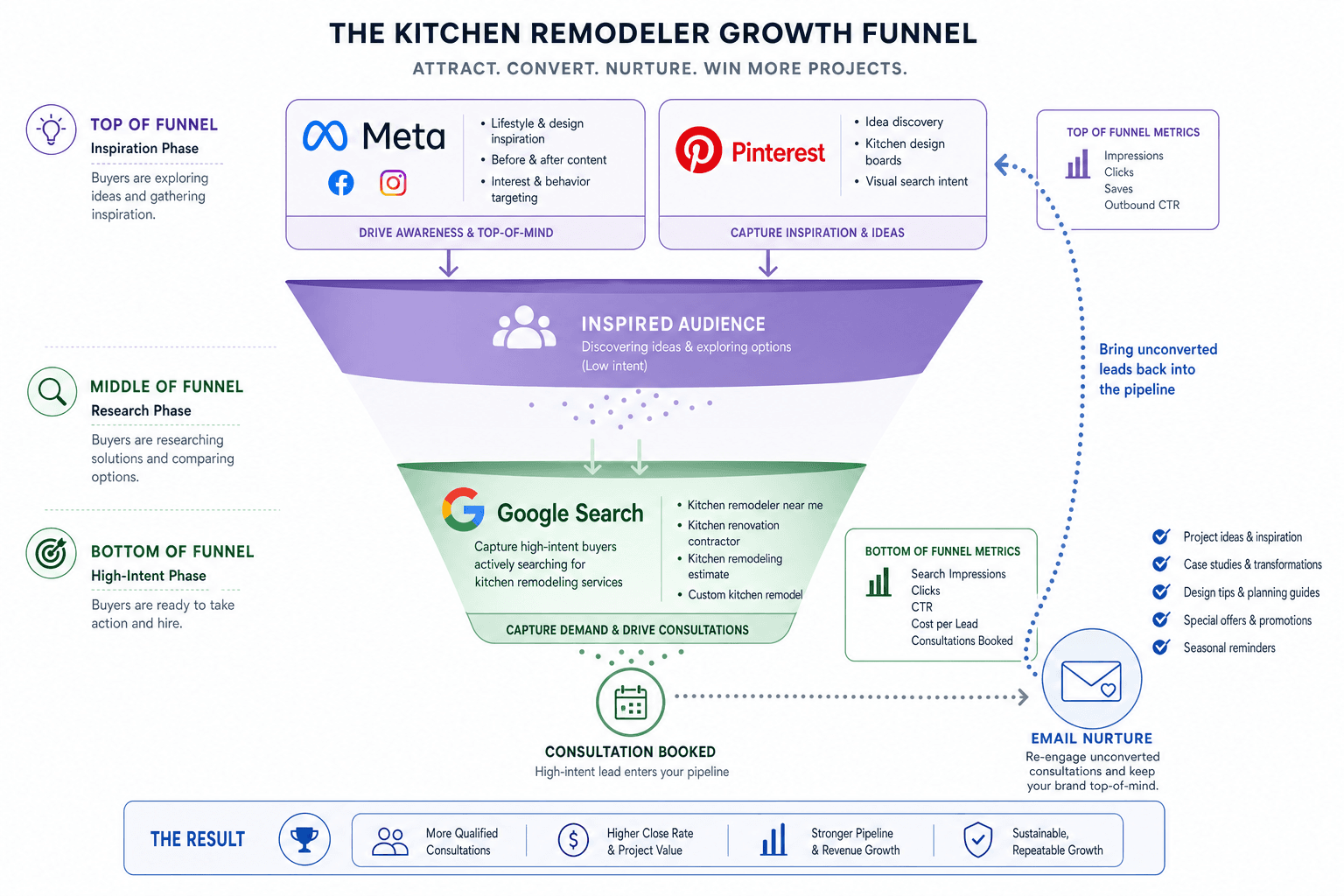
Google Search, your highest-intent channel, gets the largest budget share, focused on bottom-funnel contractor keywords: 'kitchen remodeling company near me,' 'kitchen renovation contractor [city],' 'kitchen remodel estimate,' 'custom kitchen cabinets installation.' They cost more per click and produce far better leads.
Run Local Services Ads (LSA) alongside Search: the Google Verified badge reassures homeowners making a decision this large.
Meta and Pinterest reach your buyer in the inspiration phase, long before she searches for a contractor, and fill the top of the funnel that Search converts. On Pinterest, run promoted pins for 'transitional kitchen remodel' or 'quartz countertop ideas.'
Surge budget January through March, hold through Q2, then shift in the fall to 'book now, start in spring' campaigns with financing offers aimed at the November-to-February off-season, when contractor rates are 10 to 20% lower and permits process faster.
Service-area pages by city and neighborhood, with local before/after photos, are non-negotiable for local SEO and improve Quality Score on paid campaigns targeting those zip codes.
Most remodelers skip lead nurture; a six-month email sequence for unconverted consultations recovers a meaningful share of warm leads.
The one number that governs this
Governing KPI: cost per qualified design consultation (homeowner, confirmed $30K+ budget, starting within 6 months) and cost per signed contract, not raw lead volume.
How We Help
How We Would Run Your Kitchen Remodeling Marketing
We would fix attribution first so the numbers are trustworthy, then build the campaigns and the qualification layer.
Call Tracking and Attribution Setup
Before touching a campaign, we install call tracking and CRM-connected UTM parameters to report cost per qualified consultation and signed contract.
Google Search and LSA Campaign Build
We segment keywords by project type (full remodel, cabinet replacement, design-build), block renter, repair-only, and material-only searches with negative keyword lists, and add LSA.
Qualifying Landing Pages
Each campaign type gets its own landing page, with a structured intake form that qualifies leads before booking.
Meta and Pinterest Campaigns
We retarget site visitors and reach past-client lookalikes on Meta with before/after carousels, project walkthroughs, and financing-led offers; Pinterest pins reach the female decision-maker.
AI-Assisted Creative Testing
We test more angles per week than a traditional agency workflow allows, then scale what books consultations.
Seasonal Budget Pacing
We pace spend to the decision window and the fall 'book now, start in spring' push.
Lead Nurture Sequences
We build the email nurture that keeps warm leads engaged until they're ready to sign.
Local SEO and Service-Area Pages
We build service-area pages to improve organic rankings for 'kitchen remodeling in [suburb]' and raise Quality Score on paid campaigns in your zip codes.
Who's Behind This
Who we are, and what makes us different
Sagum is a performance marketing agency founded in January 2017 in St. George, Utah. We've spent 8+ years growing real brands and being judged on KPIs, not vanity metrics.
We deliberately limit how many clients we take so each one gets senior attention. We treat your numbers like our own, we never run generic playbooks, and your strategy is built for your business, because shouldn't your brand's marketing be custom to your brand?
Sagum.ai is our AI arm: the same proven operators now build AI into the work wherever it creates real edge, not as theater, but as leverage applied with discipline.
- 8+ years growing brands on performance KPIs, not vanity metrics
- Limited client roster, with senior attention on every account
- An extension of your team; your success is tied to ours
- Custom strategy per brand, never a generic playbook
- AI built in where it moves a number; judgment over hype
“Sagum is a performance marketing agency that's spent 8+ years growing brands by treating their numbers like our own. We take on few clients, never run generic playbooks, and now build AI into the work wherever it creates real edge, not hype. Your strategy is built for your business, and our success is tied to yours.”

“After six years, Sagum is our most important partner: trusted, communicative, and caring about our business as if it's their own.”
Long-term partner
6-year client
Proof
From a $20 CPL goal to $13 CPL and 300+ leads/mo
Rizzoli's Automotive
Challenge
Rizzoli's Automotive set a goal of 100 qualified leads a month at roughly $20 per lead.
What we did
We rebuilt their paid search around high-intent service queries and built a custom landing page designed to drive phone calls.
Result
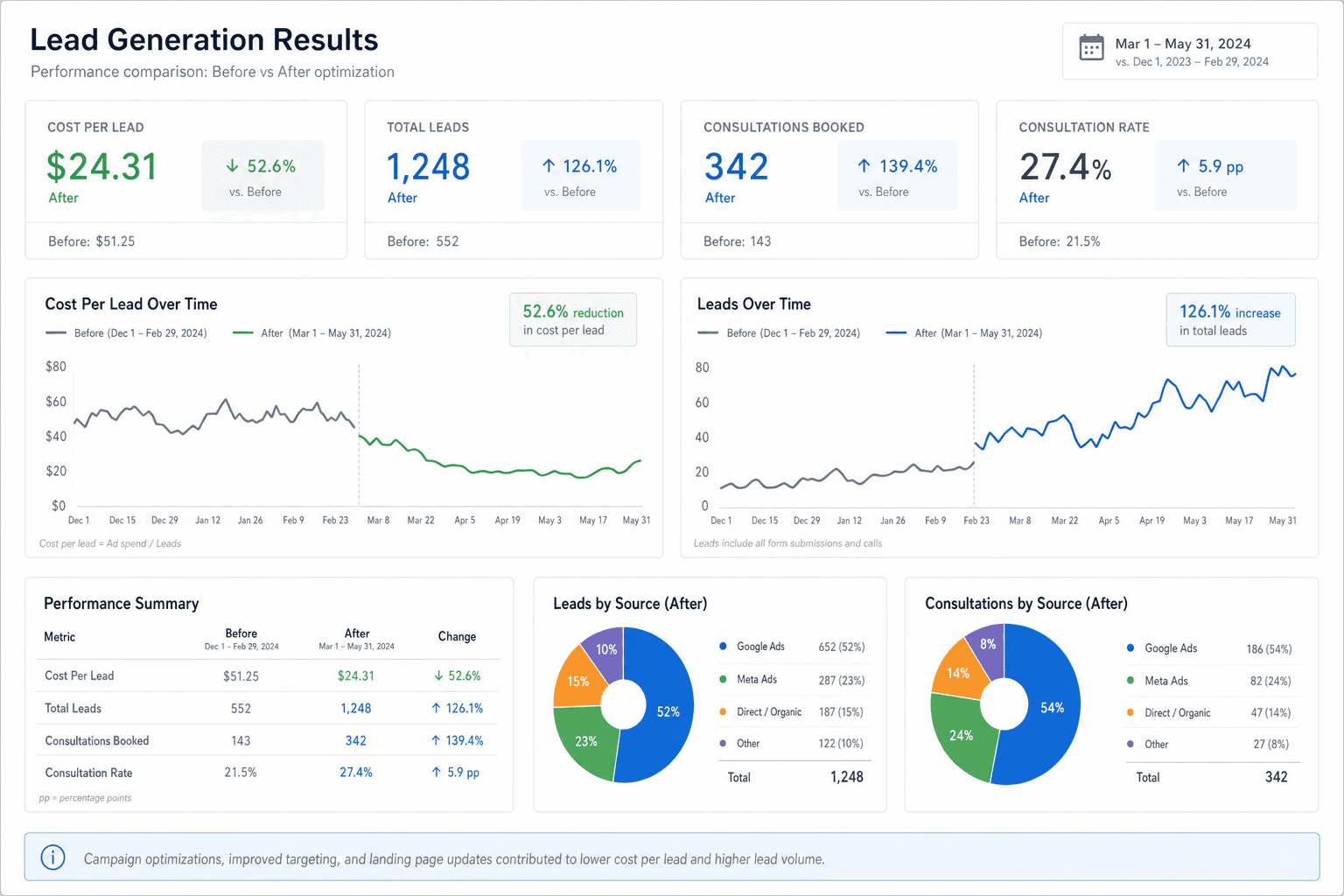
Cost per lead came in at $13, with 300-plus leads a month and 60%-plus landing-page conversion; the client opened multiple new locations. That high-intent search method carries over to remodeling.
- Cost per lead
- $13
- Leads / month
- 300+
- Landing-page conversion
- 60%+
Find Out Where Your Kitchen Remodeling Marketing Loses Qualified Consultations
There's no obligation and no generic audit template. We review your campaigns, attribution, and landing pages, then show you where qualified consultations leak and what it would take to fix it.
Sagum · January 2017 · St. George, Utah · 8+ years