

8+ years growing brands on KPIs, now with AI
More Revenue From Your Klaviyo Program
We build the flow architecture and segmentation discipline that moves email from 20% to 33–40%+ of store revenue.
8+ years growing DTC brands · Google, Meta & TikTok partner · AI-augmented execution


Get your free Growth Gap Analysis
Senior strategist review · response within one business day
Prefer to reach out directly?
The Challenge
Your Klaviyo flows run, but email revenue lags
Most DTC brands on Klaviyo run the 4 or 5 flows everyone builds first (welcome, abandoned checkout, maybe post-purchase) and send campaigns whenever someone finds time. Email often sits near 20% of revenue, below Klaviyo's roughly 27% average, while top programs run 33–40%+.
Klaviyo flows earn roughly $1.58 per recipient on average versus $0.06 for broadcast campaigns, so your build is what falls short: flow architecture, segmentation and deliverability. Most brands' flows cover 4–6 customer actions versus 12–16 for top performers, and each gap (a browse abandonment flow overlapping welcome, a post-purchase flow stopping at order confirmation, a winback with no sunset step) is uncaptured revenue.
Your open rates probably mislead you: roughly 64% of B2C email subscribers use Apple Mail, whose Mail Privacy Protection (MPP) fires false opens. Leading operators judge performance on RPR (revenue per recipient), placed order rate and click-to-open rate.
If your paid and email teams run separately, your blended numbers are almost certainly wrong: Klaviyo's default attribution windows double-count revenue across flows and campaigns.
The Opportunity
Your list already holds the revenue you're missing
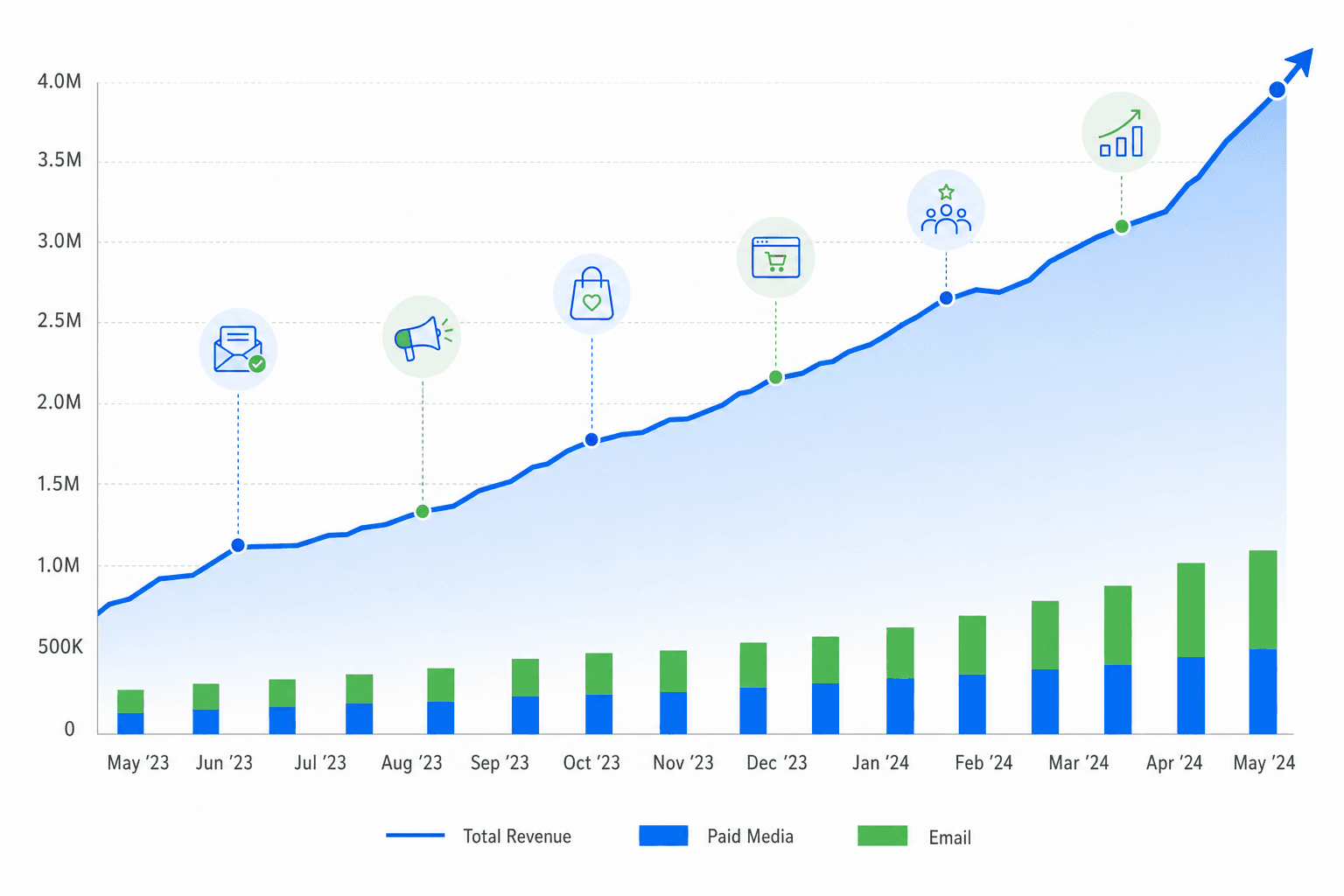
Klaviyo's benchmark average is roughly 27% of revenue from email; top programs run 33–40%+. If email drives 20% of a $3M store's revenue, reaching 33% adds $390,000 a year and 40% adds $600,000, without new ad spend.
Multiple abandoned cart emails beat one: Klaviyo's guide notes they drive about 69% more orders. Welcome flows, your most efficient acquisition-to-activation lever, place orders at 2.32% per send, roughly 18× a broadcast campaign's conversion rate.
Post-purchase sequences running 30+ days after the first order cut returns, speed repeat purchase and compound LTV in ways paid acquisition can't. Top owned-channel programs run the same platform and stay in the inbox while competitors slide into Promotions.
Well-run email/SMS is your strongest lever on blended ROAS (total revenue ÷ total ad spend), raising it and lowering blended CAC without changing paid channel ROAS.
What Most Get Wrong
What most Klaviyo programs, and their agencies, get wrong
Smart Sending left on in abandonment flows
Klaviyo's costliest default blocks your highest-intent triggers: a shopper who started checkout 40 minutes ago misses Email 1 because they got a campaign this morning, and you lose the sale.
A discount in abandonment Email 1
It trains many buyers to abandon and wait for a code, cutting margin on customers who'd pay full price. Hold it until Email 3, after two value-led touchpoints.
Optimizing open rate over RPR and placed order rate
A flow with a 45% open rate and 0.8% placed order rate trails one at 28% and 3.5%; teams testing subject lines chase a metric that no longer predicts revenue.
No attribution reconciliation between Klaviyo and Shopify
Default last-touch windows let a flow and a campaign both claim one order; without checking Shopify actuals, you scale what looks good in Klaviyo.
A bloated list with no engagement suppression
Klaviyo bills on active profiles (roughly $850/month at 50,000, $1,700 at 100,000), and mailing Never Engaged profiles instead of sunsetting them drags down inbox placement for everyone else.
Why Now
Why top Klaviyo programs are pulling ahead now
Programs pulling 33–40%+ of revenue from email/SMS win on tighter systems, not better copywriters. Their third-party tools (GlockApps, Inbox Monster) catch placement problems before revenue drops. Most brands haven't activated Klaviyo's Extended ID, which identifies more site traffic and feeds paid visitors into browse and checkout flows; early adopters build a lead in list growth.
Weekly RPR analysis, A/B testing and Shopify reconciliation once took a full-time senior strategist; AI-assisted teams can now do them faster and catch flow decay (flows running an outdated offer) earlier.
Google, Yahoo and Microsoft have tightened bulk-sender rules since 2024 and now require SPF, DKIM and DMARC; Google and Yahoo also require RFC 8058 one-click unsubscribe. An incomplete authentication stack risks outright rejection, so fix it before a peak-season bounce forces an emergency rebuild.
The Mechanism
Where AI gives Klaviyo programs an edge
Real productivity, not AI theater. Here's where it actually moves a number for klaviyo email brands.
Email automation and flow architecture
What AI does: AI-assisted audits check every flow against your catalog, pricing and offer on a schedule, flagging decay, conditional split errors, and filter misconfigurations that suppress high-intent triggers such as abandoned checkout.
The result: Decay gets caught in weeks instead of quarters; abandoned checkout suppression errors disappear; core flows reach benchmark placed order rates (3.33% average, top performers 7.69%).
Why it matters here: Flow decay is the most common quiet drag: an 18-month-old welcome series built for an old offer still logs revenue while it underperforms.
Segmentation and list hygiene
What AI does: AI maintains 30/60/90/120/180-day engaged segments, Never Engaged suppression and a sunset flow so 70% of campaign sends reach engaged profiles.
The result: Spam complaint rates stay below 0.08%, bounces below 0.5%, and dropping costly unengaged profiles trims your Klaviyo bill.
Why it matters here: Klaviyo bills on every active profile, so automated suppression lowers your bill and protects inbox placement at the same time.
Analytics and attribution
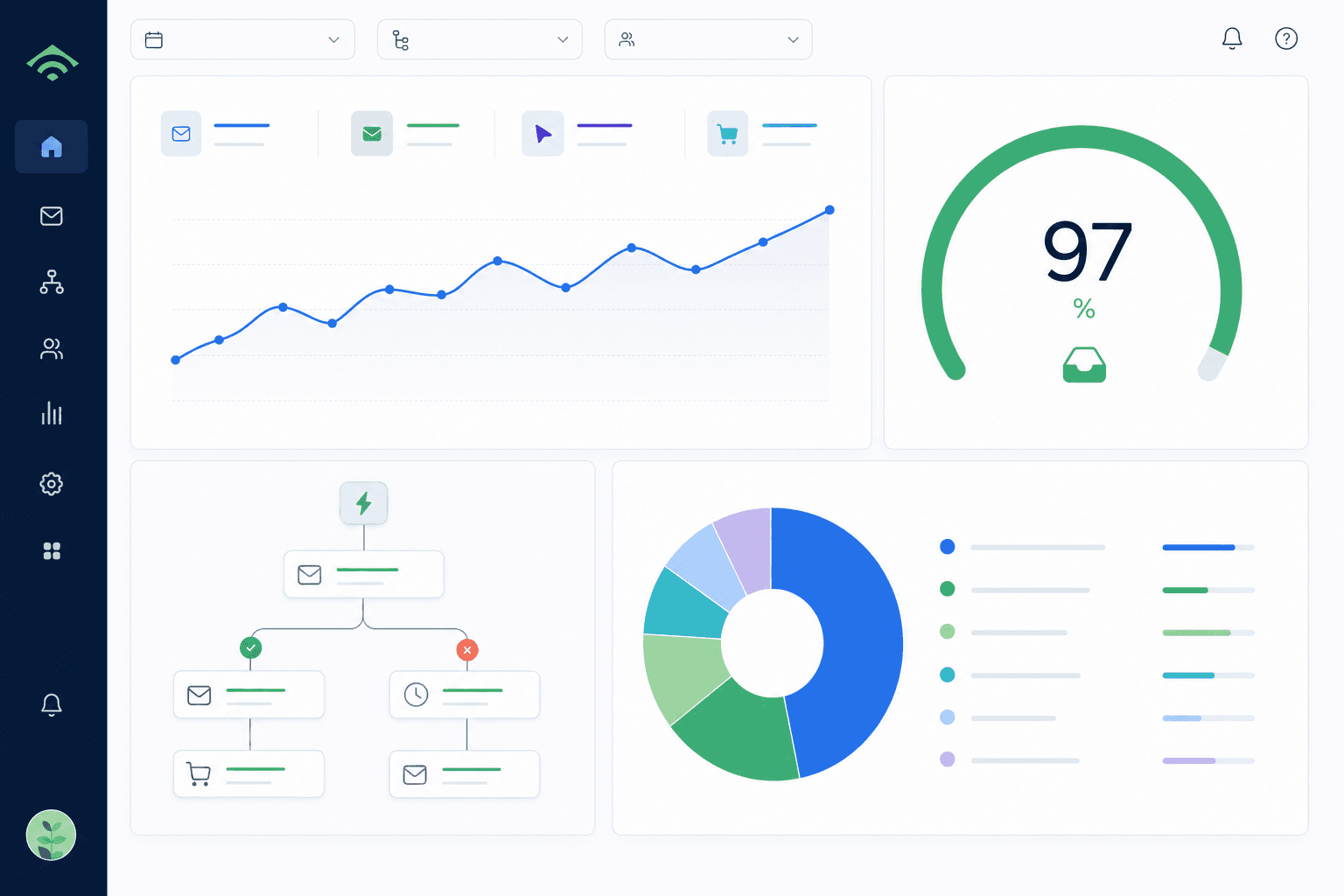
What AI does: AI reconciles Klaviyo flow and campaign revenue against Shopify orders weekly, flagging double-counted orders and RPR anomalies by flow.
The result: You see which flows and campaigns drive orders, and you can use blended ROAS to show how email revenue lowers blended CAC.
Why it matters here: The gap between Klaviyo-reported and real Shopify revenue compounds every week nobody reconciles it.
Creative and copy testing
What AI does: AI drafts subject line and preview text variants and runs send-delay tests (1-hour vs. 4-hour on abandonment Email 1) and SMS-vs-email sequencing tests, getting more reads per month than manual testing.
The result: You learn sooner which subject line, timing and channel sequence maximizes each flow's placed order rate, improving flows continuously rather than at quarterly creative refreshes.
Why it matters here: Flows earn 28× broadcast RPR, so in-flow timing and sequencing tests beat broadcast subject-line tests, and faster testing compounds RPR gains over a program year.
Deliverability monitoring
What AI does: AI-assisted third-party monitoring tracks inbox vs. Promotions vs. spam placement continuously and alerts on slippage before it shows up as lost revenue.
The result: Inbox placement holds at 95%+ and the authentication stack stays verified.
Why it matters here: Klaviyo shows Promotions-tab slides only after revenue drops; at 2–4 weekly campaigns, a slide missed for two weeks costs revenue and 30+ days of warming.
Ready to see what this looks like for your klaviyo email brands business?
No obligation. A senior strategist will show you exactly where the wins are.
The Strategy
How a best-in-class Klaviyo program runs
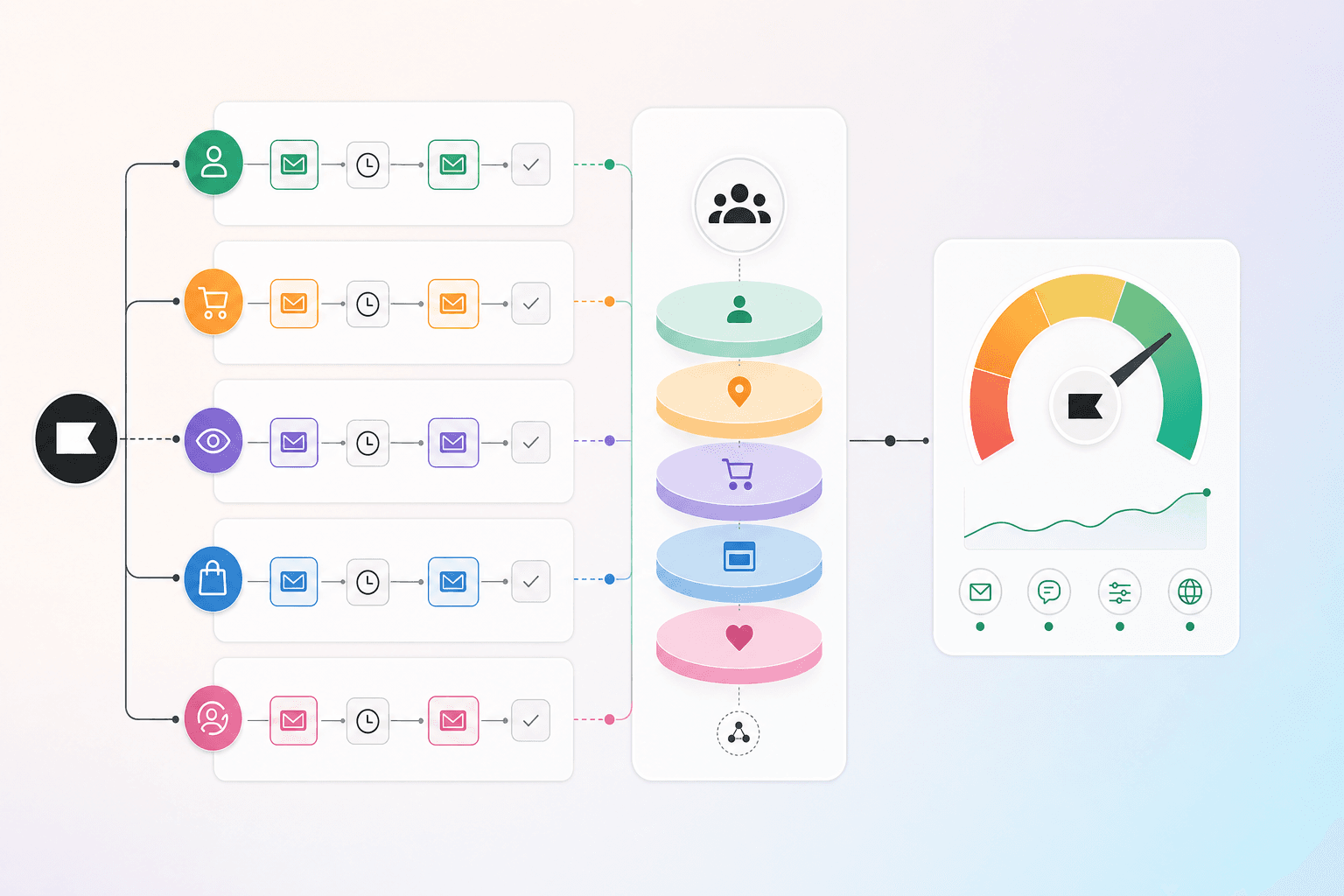
Start with a one-week audit of Klaviyo-vs-Shopify attribution, flow decay, authentication and segmentation. It almost always surfaces 2–3 immediate fixes worth more than months of incremental optimization.
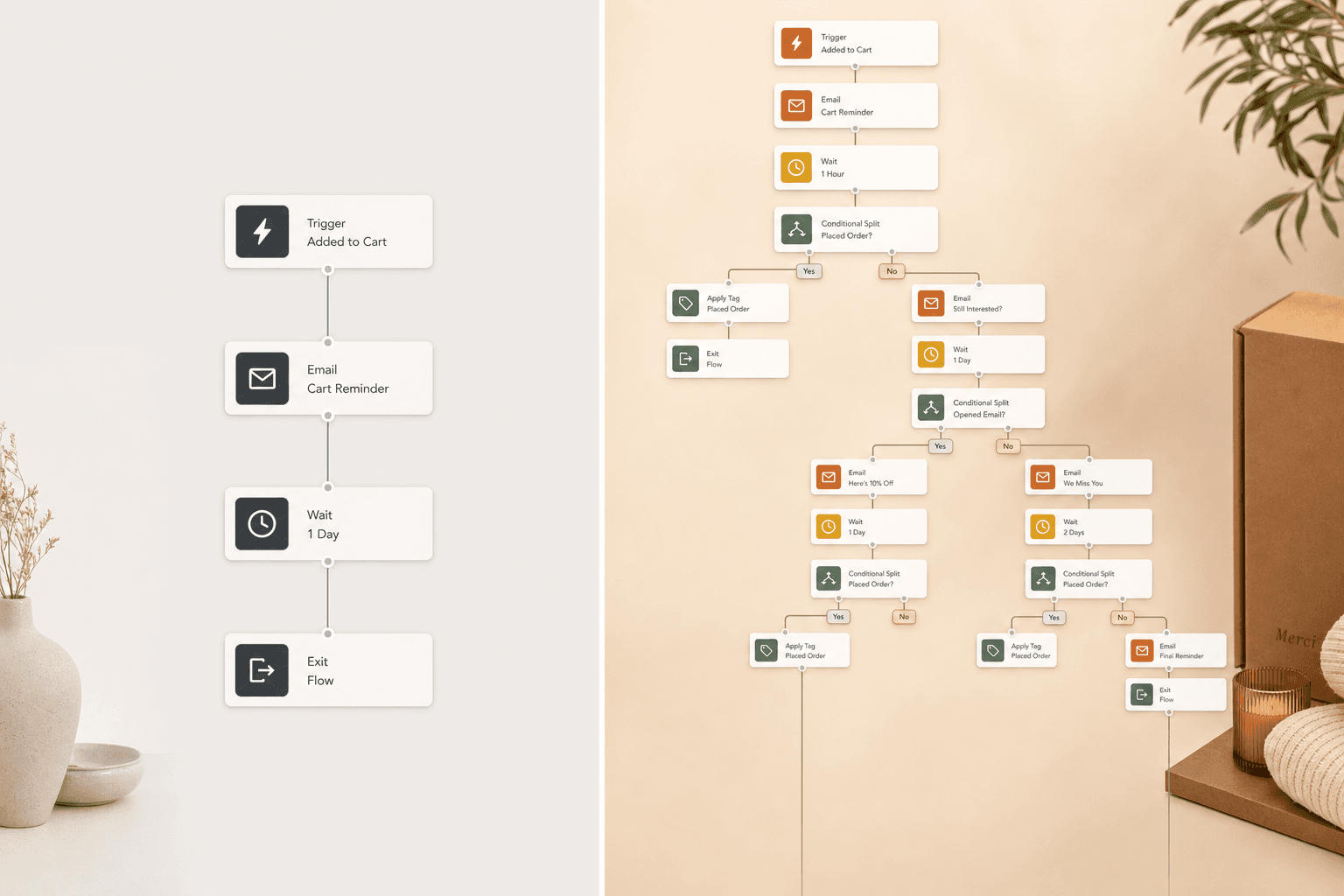
Rebuild flows by revenue impact: abandoned checkout first, unless it already runs three emails with Smart Sending off and the discount held until Email 3. Update the welcome series to your current offer.
Give browse abandonment filter logic that prevents overlap with welcome and checkout. Extend post-purchase past order confirmation with product education, a review request at 14–21 days and a cross-sell or replenishment trigger. End winback with an explicit sunset step to protect sender reputation.
Weight campaign sends 70/20/10 across engaged profiles, a broader audience and the full list. Sunset, then suppress, Never Engaged profiles.
Send 2–4 campaigns every week; mailbox providers read uneven volume as a deliverability warning. Review RPR, placed order rate, Shopify-reconciled revenue, and spam and bounce rates weekly.
Layer SMS into abandoned checkout and winback where it lifts placed order rate, and activate Extended ID to pull unidentified paid traffic into flows.
Report % of revenue from email/SMS to leadership against the 33–40%+ that top programs reach, and add blended ROAS framing so paid and email teams share a scorecard.
The one number that governs this
The governing metric is % of revenue from email/SMS (industry average ~27%, top programs 33–40%+); judge decisions by it, not open rate or list size.
How We Help
What we do inside your Klaviyo account
We start where the audit points and sequence the strategy above by revenue impact. We take few clients, give each senior attention and treat your email revenue like our own.
Klaviyo Program Audit and Attribution Reconciliation
In week one we reconcile Klaviyo to Shopify, audit flows for decay, Smart Sending and filter errors, and verify authentication.
Flow Architecture Build and Optimization
We build or rebuild the five core flows (abandoned checkout, welcome, browse abandonment, post-purchase, winback) in priority order.
Segmentation and List Hygiene
We maintain engaged segments and tiered send weights, sunset Never Engaged profiles, and activate Extended ID.
Campaign Calendar Management
We hold campaigns to the consistent weekly cadence set above, manage creative and copy, and read every A/B test on RPR and placed order rate.
Deliverability Monitoring
We monitor placement with third-party tools beyond Klaviyo's dashboard, review spam and bounce rates weekly, and flag slides into the Promotions tab early.
Analytics, Attribution, and Blended ROAS Reporting
We reconcile weekly to Shopify, report RPR by flow, make % of revenue from email/SMS the primary KPI, and show leadership blended ROAS and CAC.
SMS Integration
We layer SMS into abandoned checkout and winback, test its sequencing and timing, and never broadcast it independently.
Who's Behind This
Who we are, and what makes us different
Sagum is a performance marketing agency founded in January 2017 in St. George, Utah. We've spent 8+ years growing real brands and being judged on KPIs, not vanity metrics.
We deliberately limit how many clients we take so each one gets senior attention. We treat your numbers like our own, we never run generic playbooks, and your strategy is built for your business, because shouldn't your brand's marketing be custom to your brand?
Sagum.ai is our AI arm: the same proven operators now build AI into the work wherever it creates real edge, not as theater, but as leverage applied with discipline.
- 8+ years growing brands on performance KPIs, not vanity metrics
- Limited client roster, with senior attention on every account
- An extension of your team; your success is tied to ours
- Custom strategy per brand, never a generic playbook
- AI built in where it moves a number; judgment over hype
“Sagum is a performance marketing agency that's spent 8+ years growing brands by treating their numbers like our own. We take on few clients, never run generic playbooks, and now build AI into the work wherever it creates real edge, not hype. Your strategy is built for your business, and our success is tied to yours.”

“Sagum roughly doubled our bottom line. They treat the work like it's their own business.”
Rachel Nilsson
CEO, RAGS
Proof
187% YoY, $8+ ROAS on Meta, +79% web conversion
Clean Monday Meals
Challenge
Clean Monday Meals, a food DTC brand, needed to grow across channels.
What we did
We scaled Meta and took over the brand's email and Amazon channels. What transfers to your Klaviyo account is the method: email and paid media run by one team.
Result
The brand grew 187% year-over-year, with $8+ ROAS on Meta and a 79% lift in web conversion. See sagum.com/case-studies/.
Find out exactly where your Klaviyo program is leaking revenue
There's no obligation. We'll review your flows, attribution and deliverability and tell you what we'd fix first, based on your program rather than a template.
Sagum · January 2017 · St. George, Utah · 8+ years