

8+ years growing brands on KPIs, now with AI
Luggage marketing where the first order pays
High AOV, low repurchase, brutal acquisition pressure, so every first transaction has to carry its weight.
Google Ads · Meta · TikTok Partner | 8+ Years Growing DTC Brands | ROAS-Obsessed, Not Vanity-Metric Obsessed


Get your free Growth Gap Analysis
Senior strategist review · response within one business day
Prefer to reach out directly?
The Challenge
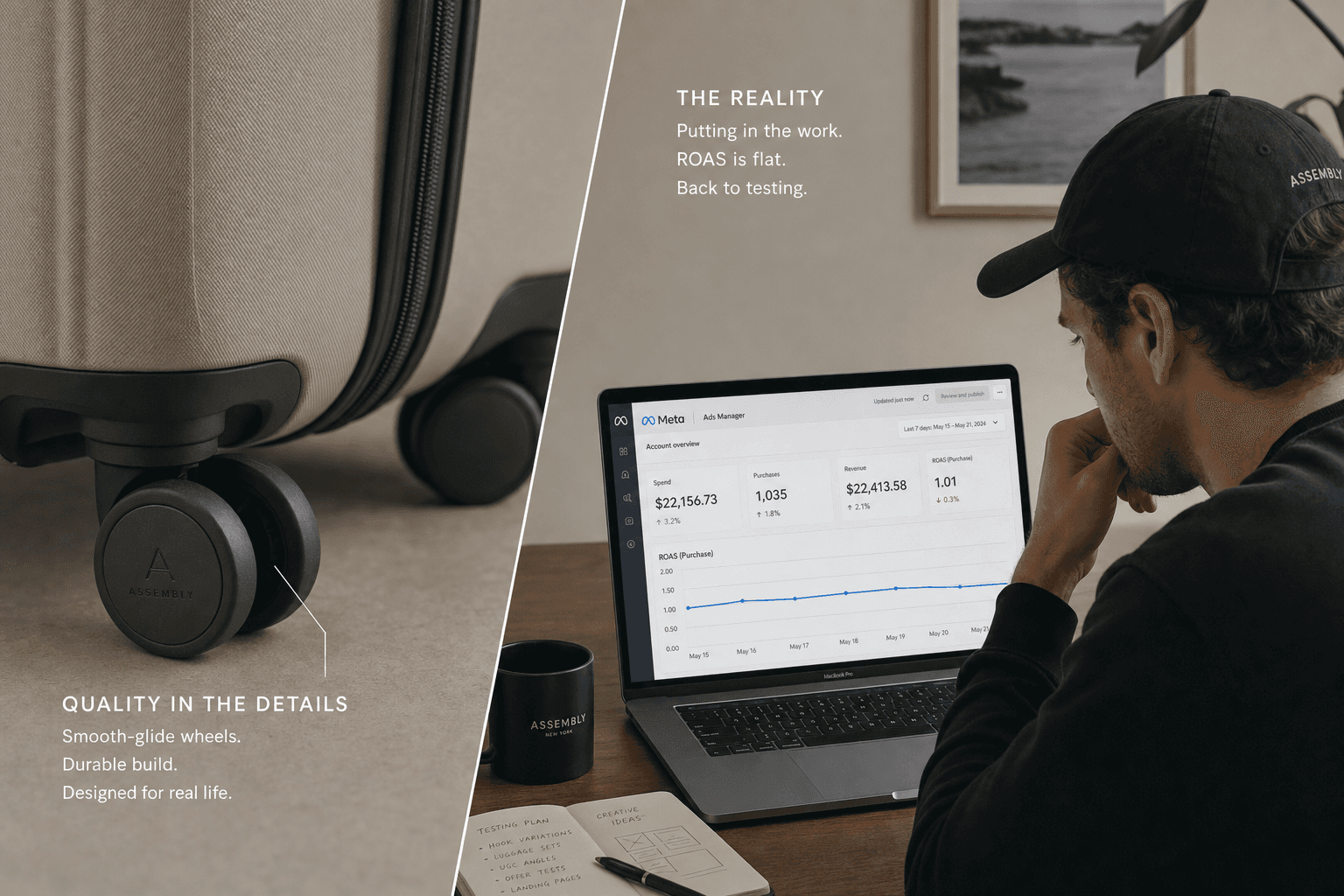
Luggage Is One of the Hardest DTC Categories to Market Profitably
You sell a high-AOV product ($200 to $350 per unit, sets pushing $500) to a buyer who rarely buys again, since good suitcases last a decade. With no replenishment cycle or subscription smoothing CAC, your strategy rests on first-order profitability.
Shoppers buy after an event (a booked trip, graduation, or airline-damaged wheel) and a 3-to-14-day research window spent on Reddit threads, YouTube unboxings, and checking whether your carry-on meets the common 22×14×9-inch airline limit. They compare your spinners to Rimowa and your warranty to Away.
Demand peaks twice: a spring ramp cresting in July, and November BFCM, when luggage orders run 64% above the annual average because a hardshell spinner makes a good gift. January, February, and September are quiet; spend, creative, and inventory must follow that rhythm.
Amazon lists Coolife and Rockland 30–50% below your price on nearly identical specs, and Samsonite has $2.9B in revenue and distribution everywhere. Brand story, aesthetic, and trust are your only moat, so marketing must replace the retail shelf and physical touch.
The Opportunity
Luggage Brands Win on Creative Velocity and Conversion, Not Price
Brand story and emotive travel creative earned Away almost double Samsonite's search interest. The US market alone is $5.7B, and slow legacy brands leave profitable share for DTC operators with sharp creative and tight attribution.
Most luggage brands running ads test one or two angles a month; testing faster takes creative infrastructure and iteration discipline, not budget.
Google Shopping and Performance Max catch mid-research searches like 'hardshell luggage under $300', yet most brands skip Shopping or run feeds too thin for Google to surface their products. On Meta, whose visual format suits buyers weighing durability and aesthetics, real-traveler UGC outconverts studio photography at a fraction of the cost.
Brands that set tight new-customer CAC targets, run post-purchase email, and answer durability and warranty objections in creative will own profitable growth for years; building that before CPMs rise further costs less.
What Most Get Wrong
What Most Luggage Brands (and Their Agencies) Get Wrong
Running the same creative budget and cadence year-round
Spreading spend over all twelve months overpays for impressions in January and February, as shoppers recover from holiday spend, and underfuels the May-through-July and November BFCM peaks.
Optimizing for platform ROAS instead of blended ROAS
Trusting Meta's natively attributed ROAS without reconciling it against blended ROAS overfunds in-platform winners and underfunds incremental channels, a dangerous error when first-order margin must justify spend.
Ignoring the durability and warranty objection in ad creative
Durability anxiety is the number-one reason clicks don't convert, since shoppers can't test wheels or zippers online. Lifestyle-only ads without UGC stress tests or warranty callouts lose them to competitors.
Treating email as a newsletter instead of an LTV engine
A shipping confirmation plus a discount code six months later wastes your highest-ROI automation window. Packing tips, warranty registration, and cross-sells in the first 90 days determine your LTV.
Competing on price against Amazon instead of on brand
Promos against Coolife and Rockland erode margin and train buyers to wait for sales. DTC luggage is won on aesthetic, story, and warranty confidence, none of which CPA-chasing builds.
Why Now
Why Luggage Brands Should Build AI Marketing Before the Next Peak
Air travel has rebounded past pre-pandemic levels and keeps growing, which means more broken wheels, worn zippers, and replacement and upgrade demand. Most competitors still market like it's 2021: a few static assets, broad-targeted Meta campaigns, and a Google Shopping feed set up once and never touched.
With AI and the right infrastructure, a luggage brand with one marketing lead can now test creative at a pace that once took a full in-house creative team. AI-assisted feed optimization tunes Shopping listings to converting queries, and automated monitoring catches a misfiring pixel or a campaign spending into the wrong audience segment early.
Build this infrastructure before your next summer travel peak or BFCM and you enter it with a tested creative library; wait, and you rebuild when CPMs are highest.
The Mechanism
Where AI Gives a Luggage Brand's Marketing a Real Edge
Real productivity, not AI theater. Here's where it actually moves a number for luggage brands.
Creative
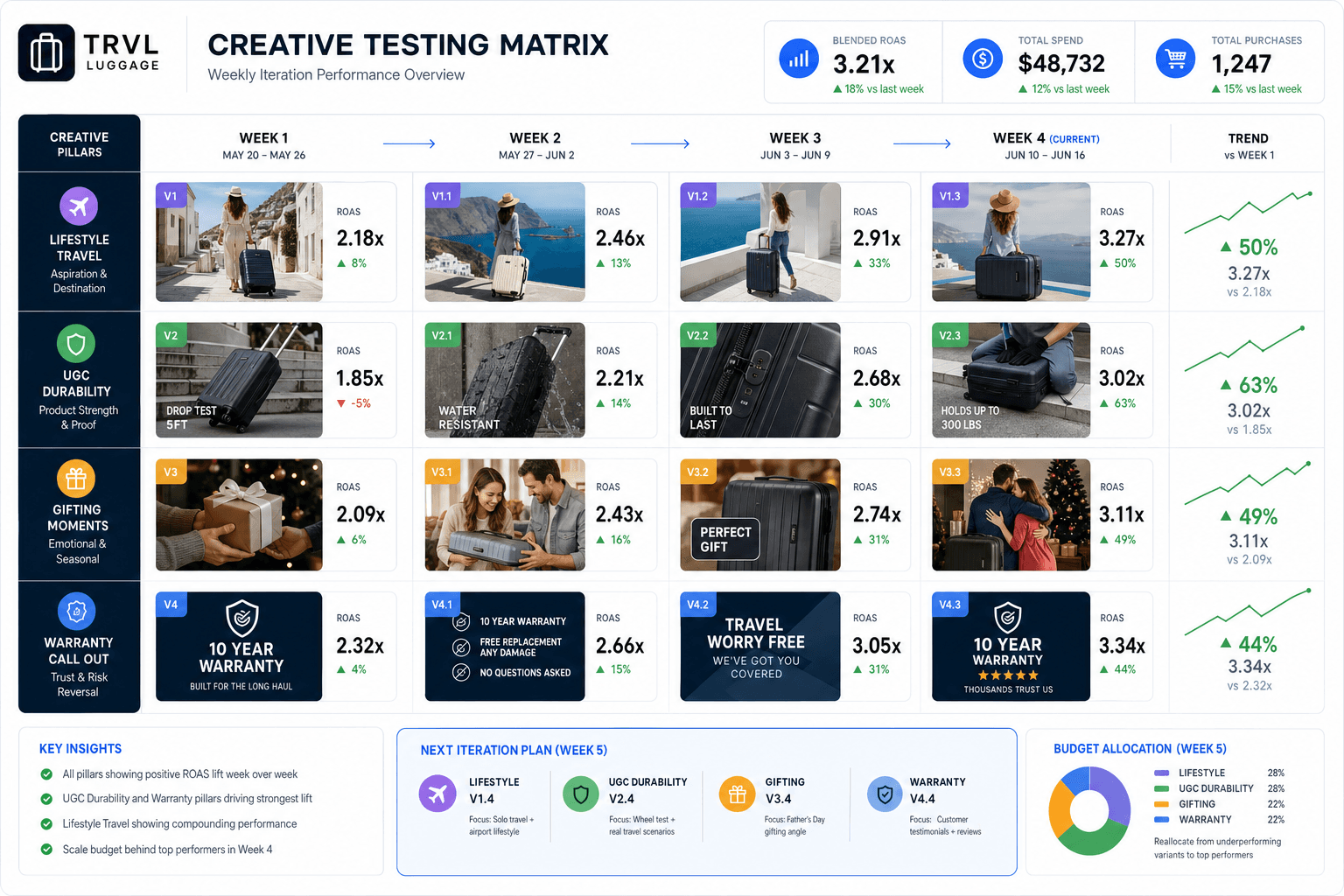
What AI does: AI generates and tests multiple concepts per week across hooks, formats (UGC-style, studio, motion), and copy framings.
The result: Brands testing 5+ variants weekly see 2–3x the ROAS improvement of those testing fewer than 2, and finding the winning angle faster multiplies revenue.
Why it matters here: Durability anxiety and brand story close luggage sales, and finding the angle that makes shoppers confident takes testing volume.
Digital Ads
What AI does: AI monitors Google Shopping, Performance Max, and Meta, adjusting bids, shifting budget to campaigns whose new-customer CAC (nCAC) is improving, flagging segments where spend isn't converting, and pacing to both seasonal peaks.
The result: Budget scales into the May–July travel ramp and BFCM and pulls back in January and February.
Why it matters here: Brands scaling into peaks and pulling back in troughs end the year with better blended ROAS than brands on a flat monthly budget.
Analytics
What AI does: AI reconciles platform ROAS against blended ROAS, catching misfiring pixels, double-counted conversions, and view-through attribution inflating Meta's numbers. Incrementality signals separate channels winning new customers from those claiming credit for organic intent.
The result: You see which channels drive first-order profitable revenue, and nCAC discipline built on that decides whether you build a profitable business or a subsidized one.
Why it matters here: In a high-AOV, low-repurchase category, a misfiring pixel or over-attributed Meta campaign can make money-losing acquisition look profitable for months before cash flow catches up.
Conversion Optimization
What AI does: AI finds where high-intent traffic bounces on PDPs (missing weight specs, carry-on dimensions and warranty below the fold, thin social proof), and we build and test paid landing pages against those objections.
The result: Paid traffic converts better: at a $250 AOV and 10,000 monthly visitors, a 1-percentage-point conversion lift adds $25,000 in monthly revenue without extra acquisition spend.
Why it matters here: Shoppers in a 3-to-14-day research window, spending $200–$350, leave for a competitor if they must scroll for dimensions, warranty terms, or proof the wheels last.
What AI does: AI-assisted post-purchase sequences prompt warranty registration within 48 hours, send packing tips in weeks 1–4, cross-sell packing cubes, luggage tags, and travel wallets in weeks 6–12, and prompt holiday and graduation gifting.
The result: One-time buyers become accessories buyers and gifters, the two main LTV levers in a category with a decade-long repurchase cycle.
Why it matters here: A real post-purchase flow adds accessory and gifting revenue on top of first orders that must clear your 3–5x new-customer ROAS target.
Ready to see what this looks like for your luggage brands business?
No obligation. A senior strategist will show you exactly where the wins are.
The Strategy
How a DTC Luggage Brand's Marketing Should Be Run
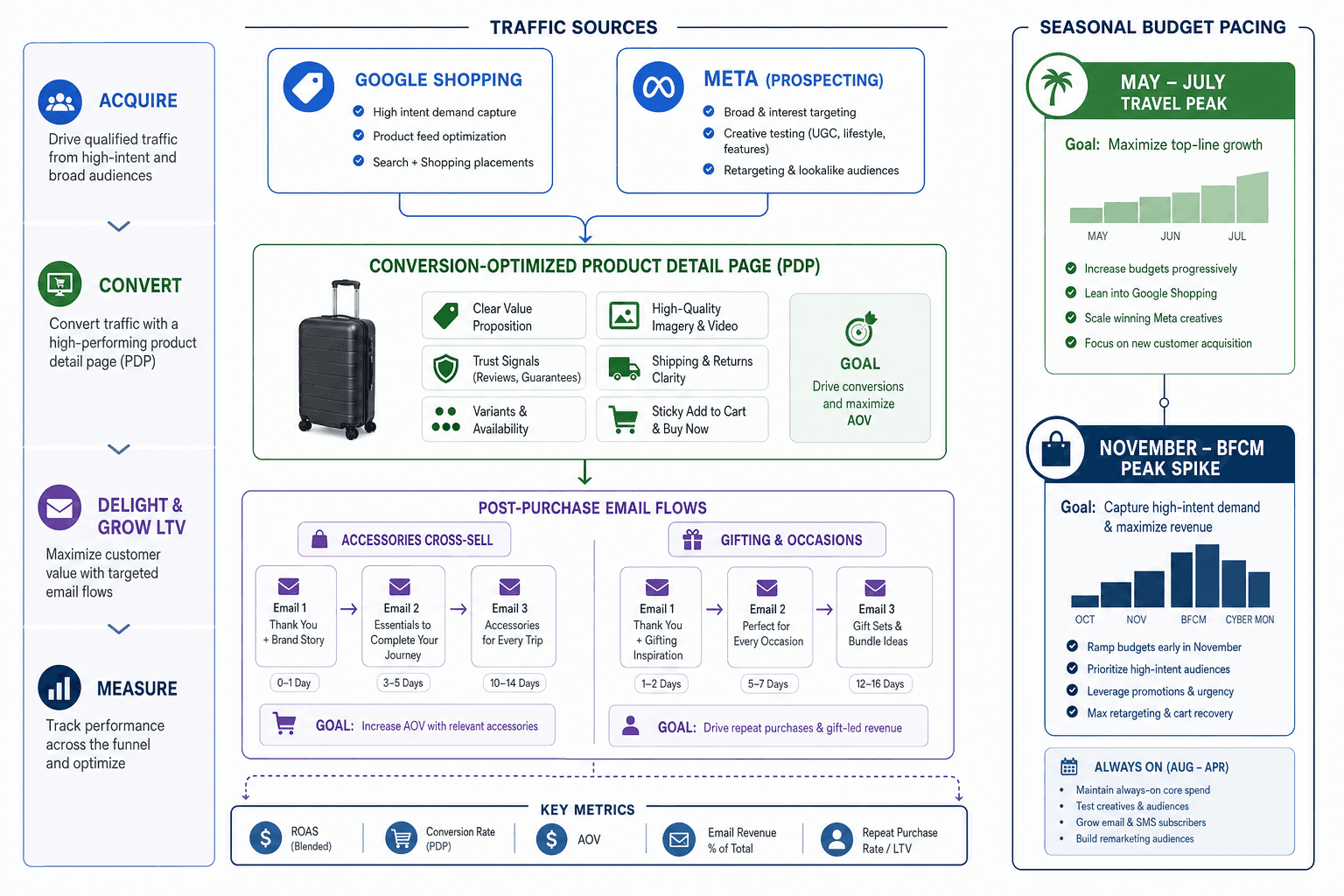
Justify every acquisition dollar on first-order margin, starting from your nCAC target: the most you can spend on a new customer and still profit on the first transaction.
Lead with Google Shopping and Performance Max. Shoppers searching 'best lightweight carry-on under $300' or 'hardshell luggage with TSA lock' convert faster, at higher AOV, than cold social traffic, so get feed quality, product titles, and replacement-intent bidding right first.
Meta and Instagram are your cold prospecting engine, built on visual storytelling, real-traveler UGC, and social proof that answers durability anxiety early.
Creative velocity outweighs targeting and bidding. Brands winning on Meta test weekly across four hooks: durability proof (stress test videos, traveler testimonials), lifestyle aspiration (the trip ahead), gifting (graduation, honeymoon, new job), and warranty confidence (when an airline damages it). The winning angle is rarely the one you'd expect.
From May through July, travel intent runs high and CPMs sit below Q4, so scale acquisition. BFCM in November, your highest-volume window, needs a tested creative library and sufficient inventory in place first.
Spend January and February building creative at discounted CPMs and tuning post-purchase flows, not pushing acquisition. Post-purchase email is your LTV mechanism: the customers it keeps buy accessories, refer friends, and upgrade within five years, well before replacement.
The one number that governs this
The governing KPI is new-customer ROAS (nCAC-adjusted), targeting 3–5x, reconciled monthly against blended ROAS. First-order profitability is non-negotiable; LTV from accessories and gifting is upside.
How We Help
What We'd Do for Your Luggage Brand
We start by reconciling platform reports against your revenue, then build creative infrastructure, nCAC-tuned acquisition, and a post-purchase email engine.
Analytics & Attribution Audit
Before any campaign work, we verify your pixel fires correctly, map conversion events to revenue, and reconcile blended ROAS with platform ROAS.
Google Shopping & Performance Max
We rebuild Shopping feeds for high-AOV queries like 'lightweight checked luggage set', aim Performance Max at in-market buyers, and measure spend against your nCAC target.
Meta Paid Social (Creative-Led Prospecting & Retargeting)
We run five or more variants weekly across the four hooks and build retargeting around objections killing high-AOV conversions: dimension specs, wheel quality, returns policy.
Creative Production & AI-Assisted Testing
We generate variants with AI and prioritize UGC, stress tests, and traveler testimonials over studio creative, because they convert better for durability-anxious buyers.
Post-Purchase Email & LTV Automation
We build timed warranty, packing-tip, cross-sell, and gifting flows that grow LTV and, over time, turn buyers into brand advocates.
Conversion Rate Optimization
We audit PDPs and landing pages for dimensions, spinner video, warranty, and social proof. Of levers adding no acquisition spend, conversion lift returns the most.
Who's Behind This
Who we are, and what makes us different
Sagum is a performance marketing agency founded in January 2017 in St. George, Utah. We've spent 8+ years growing real brands and being judged on KPIs, not vanity metrics.
We deliberately limit how many clients we take so each one gets senior attention. We treat your numbers like our own, we never run generic playbooks, and your strategy is built for your business, because shouldn't your brand's marketing be custom to your brand?
Sagum.ai is our AI arm: the same proven operators now build AI into the work wherever it creates real edge, not as theater, but as leverage applied with discipline.
- 8+ years growing brands on performance KPIs, not vanity metrics
- Limited client roster, with senior attention on every account
- An extension of your team; your success is tied to ours
- Custom strategy per brand, never a generic playbook
- AI built in where it moves a number; judgment over hype
“Sagum is a performance marketing agency that's spent 8+ years growing brands by treating their numbers like our own. We take on few clients, never run generic playbooks, and now build AI into the work wherever it creates real edge, not hype. Your strategy is built for your business, and our success is tied to yours.”
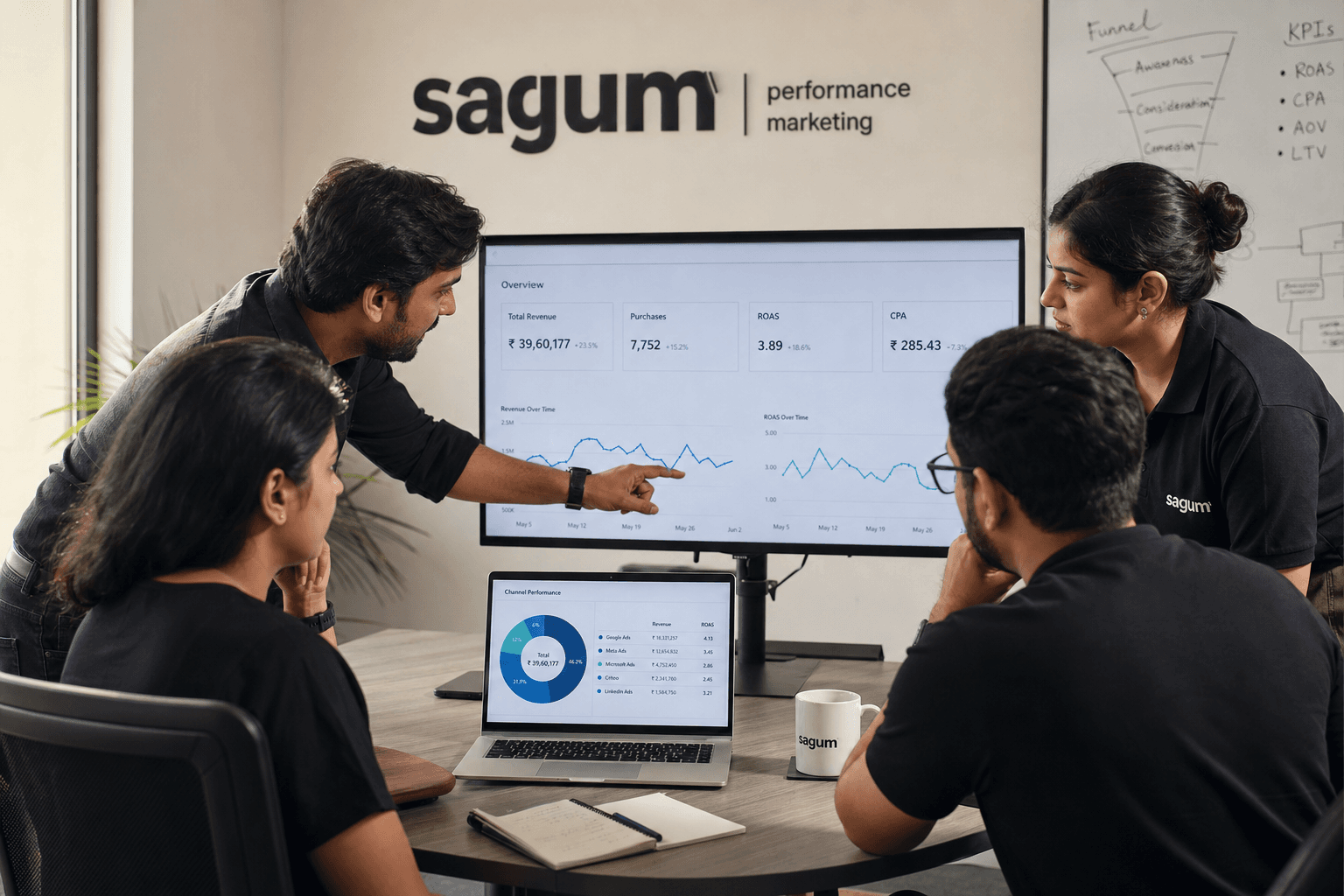
“Sagum roughly doubled our bottom line. They treat the work like it's their own business.”
Rachel Nilsson
CEO, RAGS
Proof
$255k → $555k in 2 months, ROAS 2.9x → 5.5x+
Nickel & Suede
Challenge
Nickel & Suede needed to scale revenue profitably on paid social.
What we did
We ran Meta and TikTok creative testing at volume. That testing method transfers to luggage, a visual product sold through a screen.
Result
Revenue grew from $255k to $555k in two months, ROAS rose from 2.9x to 5.5x+ (peaking at 7.95x), and site conversion lifted 34%.
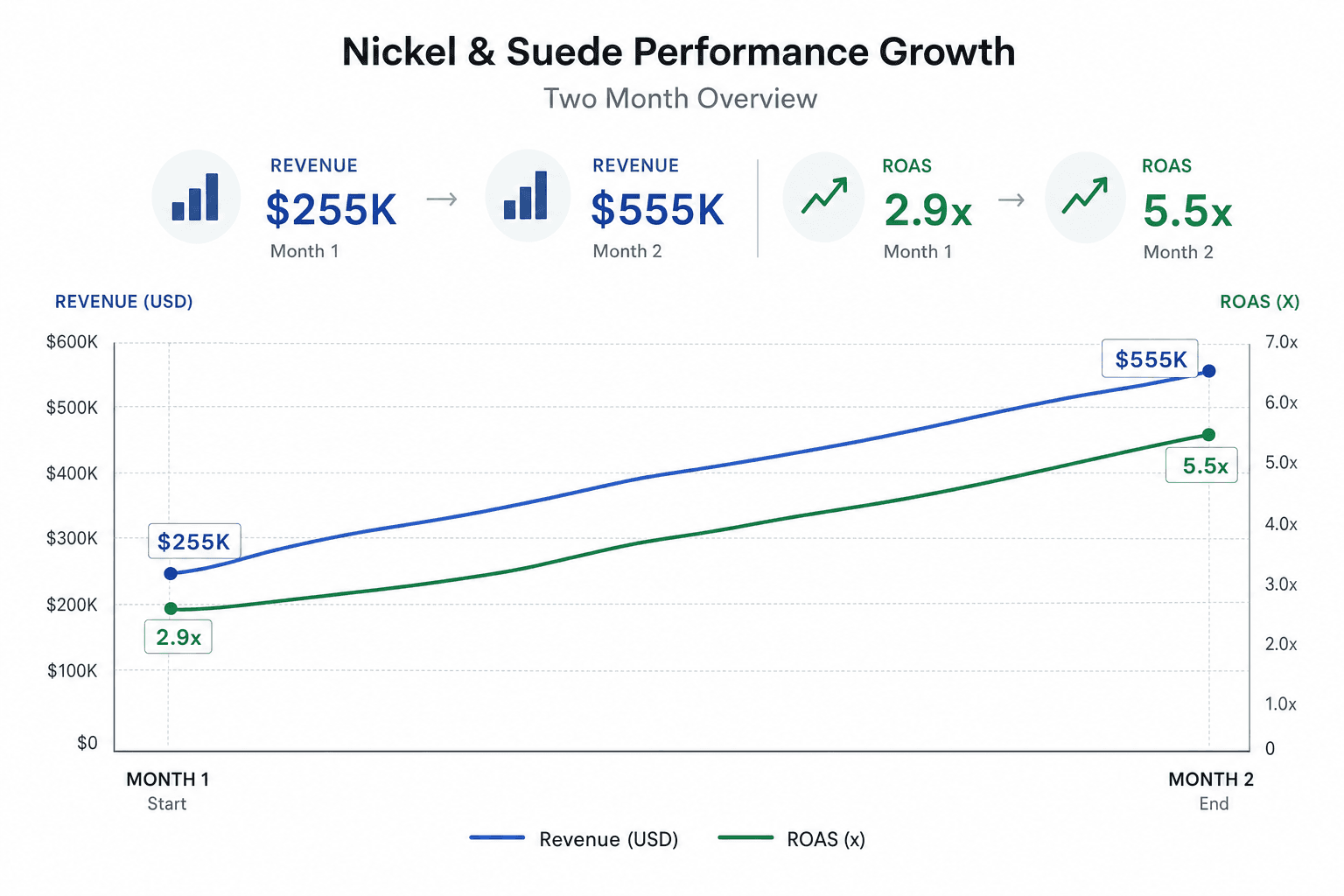
- Revenue
- $255k → $555k (2 mo)
- ROAS
- 2.9x → 5.5x+ (peak 7.95x)
- Site conversion
- +34%
Luggage Marketing Built for First-Order Profitability, Not Generic Ecommerce Playbooks
No obligation. We'll review your ROAS, nCAC target, and creative testing cadence and show where the gap is and how we'd close it. Fit or not, you leave with a clearer picture of your marketing.
Sagum · January 2017 · St. George, Utah · 8+ years