

8+ years growing brands on KPIs, now with AI
More Revenue From Your Mailchimp List
We rebuild broken flows, activate predictive segments, and turn your email list into 25–35% of GMV.
8+ years growing ecommerce brands · Google, Meta & TikTok partner · now with AI


Get your free Growth Gap Analysis
Senior strategist review · response within one business day
Prefer to reach out directly?
The Challenge
Mailchimp gets harder to run as your ecommerce brand grows
You started on Mailchimp because it was free, or close to it, and fine for a newsletter to a few hundred customers. At real volume, the cracks show.
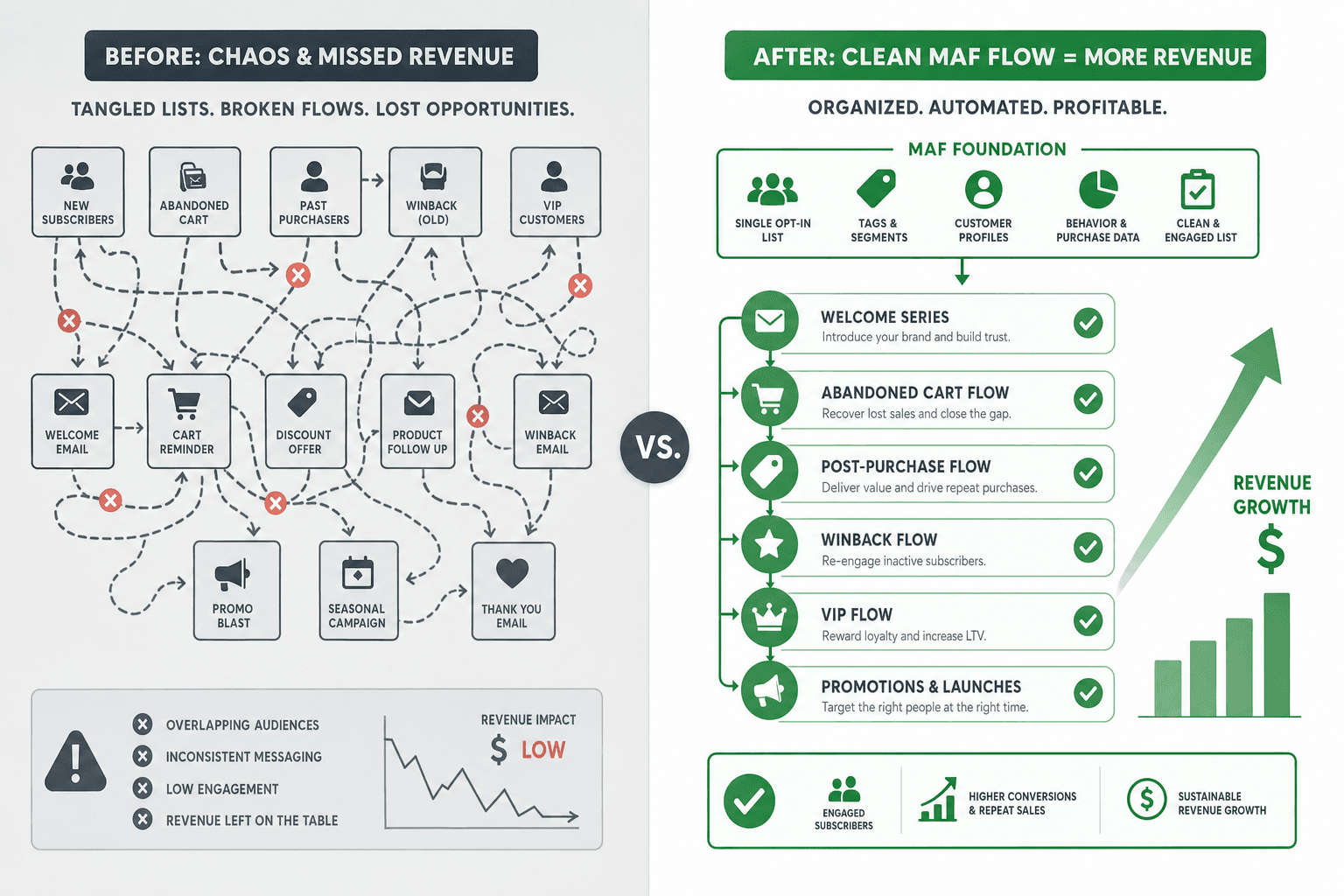
If your abandoned cart, welcome, post-purchase, or win-back flows were built in Classic Automations and you haven't rebuilt them in Marketing Automation Flows (MAF), they've been archived since June 2025 and take no new contacts. Mailchimp's reporting has no 'this flow stopped working' alert, so you may notice only when revenue stops.
Mailchimp's audience-first data model probably leaves your tags, groups, and segments a tangle nobody trusts, so you send to broad lists. Deliverability is a black box: unlike Klaviyo, Mailchimp has no centralized sender-reputation dashboard, so problems surface when open rates drop. Send from free Gmail or an unauthenticated domain and campaigns land in spam or show 'via mcsv.net' beside your brand name without you knowing.
Email probably drives 15–20% of your revenue when it should drive 25–35%, and that gap costs you every month.
The Opportunity
Your Mailchimp list is your highest-margin channel, but it isn't working yet
Every dollar a rebuilt flow recovers costs no incremental ad spend, so it lowers blended CAC and improves your blended ROAS. It's the closest thing to free revenue in ecommerce.
Mailchimp reports that automation flows generate up to 9x more revenue than bulk campaigns, and predictive segmented emails (Standard and Premium) deliver up to 88% more revenue than non-predictive segmented ones. Standard users who skip predicted CLV, purchase likelihood, and churn-risk segments pay for unused features.
The Classic Automation sunset left a gap many brands, likely including your competitors, still haven't closed. The brand that rebuilds correctly, with MAF trigger architecture, tag-based behavioral logic, and deliverability hygiene, owns the inbox.
A $500K-a-year DTC brand that moves email from 18% to 30% of GMV adds $60,000 without touching ad budget; at $2M GMV, it's $240,000.
What Most Get Wrong
What most Mailchimp brands and their agencies get wrong
Leaving Classic Automations archived and calling it fine
Since June 1, 2025, Classic flows you haven't migrated to MAF take no new contacts: new subscribers get nothing, carts go unrecovered, and the loss is silent and ongoing.
Conflating groups, tags, and segments
Most SMBs treat subscriber-selected groups, operator-applied tags, and dynamic segments as interchangeable, so MAF triggers misfire or never fire. A tag applied at purchase should trigger your post-purchase flow.
Ignoring deliverability until open rates tank
Without external monitoring and suppression of contacts who haven't opened in 90+ days, you find sender-score damage late, and spam-folder recovery takes weeks of sending to a tiny engaged segment.
Staying on Essentials and expecting segmentation to work
Predicted segments and advanced segmentation (up to 10 conditions) both need Standard or Premium, so Essentials flows get neither. Most generic agencies don't know Mailchimp well enough to warn you.
Judging email by open rate instead of revenue per recipient
Agencies that optimize for opens chase a deliverability signal, not revenue. What matters is email's GMV share and revenue per recipient, read against Mailchimp's last-touch windows (5-day open, 30-day click).
Why Now
Rebuild your Classic Automations while many Mailchimp brands still haven't
Mailchimp's June 2025 shutdown of Classic Automations was its biggest forced rebuild for SMB ecommerce. Thousands of brands ran sequences there, and many of those sequences are still dark. Each month they stay dark, their revenue flows to brands that rebuilt.
Where a human might test one subject-line variant per campaign, AI can run five angles simultaneously and route to the winner within 48 hours. It can flag engagement decay and churn risk continuously across a 10,000-contact list that a human might audit once a quarter.
Klaviyo's February 2025 switch to active-profile billing raised costs for many legacy accounts, leading some brands to compare platforms, including Mailchimp. Brands that rebuild now gain an advantage that compounds monthly as purchase data accumulates; brands that wait rebuild into a more competitive inbox.
The Mechanism
Where AI gives your Mailchimp program an edge
Real productivity, not AI theater. Here's where it actually moves a number for mailchimp email brands.
Email automation and flow architecture
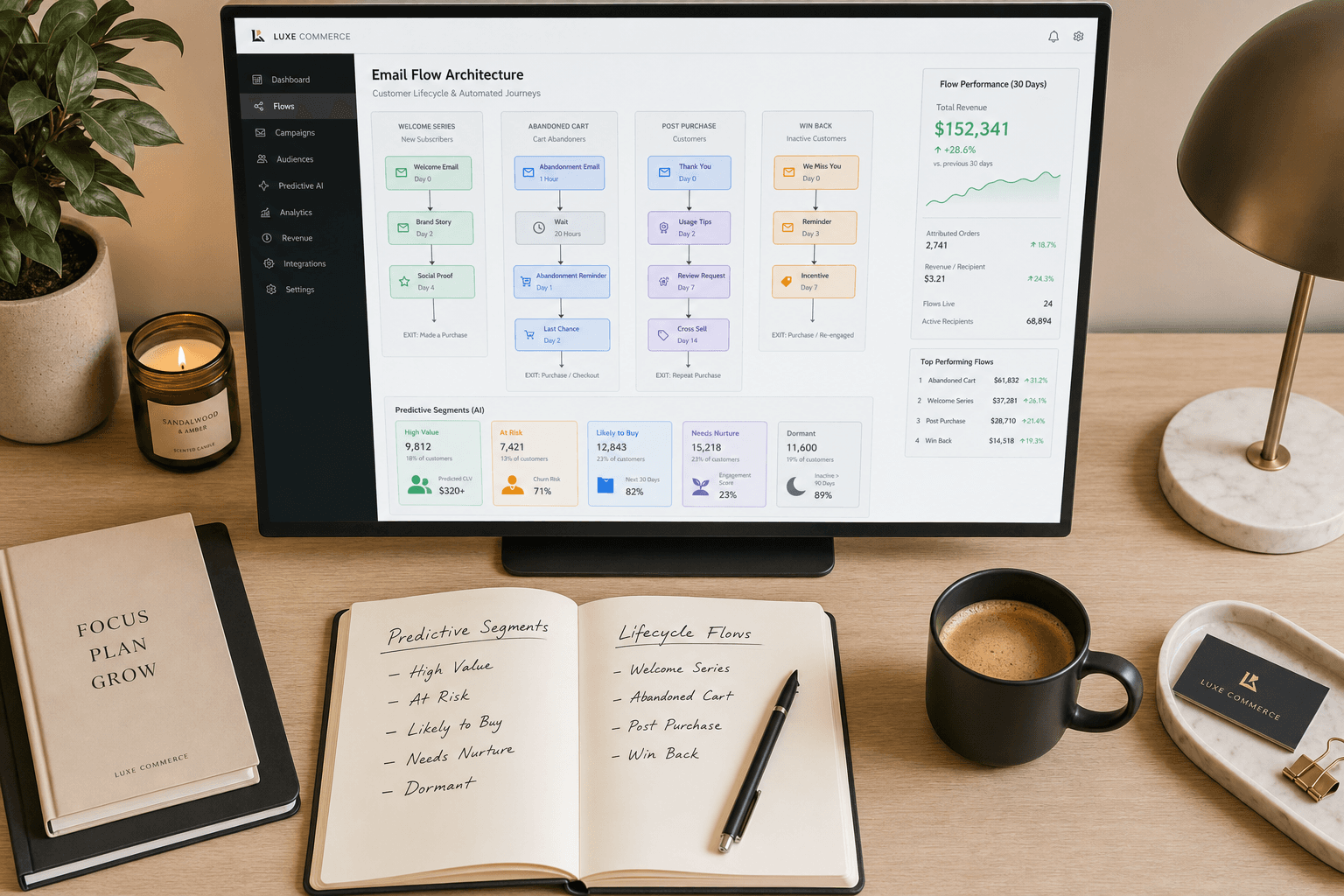
What AI does: AI maps your tag and purchase data to find missing, misfiring, or cannibalizing MAF triggers, then generates the flow logic (triggers, if/then splits, delay timing) from welcome through win-back.
The result: You get a complete post-Classic rebuild in days, not weeks, with behavioral branching a manual audit would take months to design.
Why it matters here: Rebuilding is your highest-ROI fix: correct triggers, splits, and delays that hold post-purchase emails until orders ship let flows outearn broadcasts.
Creative and subject-line testing
What AI does: AI generates five or more subject-line and preview-text variants per campaign, runs multivariate tests on engaged segments, and identifies winning angles (offer framing, urgency type, personalization token) within the first send window.
The result: Weekly signal replaces a once-a-month test and compounds into a playbook of what your list responds to.
Why it matters here: Send Time Optimization (Standard+) picks when to send; AI picks what to say. Weekly tests build a conversion edge invisible to competitors watching open rates.
Segmentation and predictive segment activation
What AI does: AI audits your audience data (tags, connected-store purchase history, engagement recency), maps contacts to predictive and custom behavioral segments your plan supports, and builds send logic for each.
The result: On Standard and Premium, predictive campaigns go live on a feature you already pay for and have left unused.
Why it matters here: For a $1M GMV brand moving email from 18% to 30% of GMV, activating these segments alone can deliver $50,000–$100,000 of that annual gain.
Deliverability monitoring and list hygiene
What AI does: AI monitors engagement decay by cohort, flags contacts nearing the 90-day unengaged threshold before they hurt sender reputation, and builds the suppression and re-engagement logic Mailchimp lacks natively.
The result: You protect sender reputation and inbox placement while they're still healthy, before open rates fall.
Why it matters here: Mailchimp has no native list-cleaning tool, and every other email metric depends on reaching the inbox.
Analytics and revenue attribution
What AI does: AI builds on Mailchimp's Reports → E-commerce tab and Audience Dashboard to track email's GMV share by campaign type, flow, and segment, adjusted for last-touch windows, and adds a blended ROAS dashboard.
The result: You see what email generates by flow vs. broadcast and segment vs. full list, and how much it offsets paid media CAC.
Why it matters here: Campaign-level revenue in Reports can't show whether your abandoned cart flow works, which segments carry the program, or how much email cuts paid acquisition spend.
Ready to see what this looks like for your mailchimp email brands business?
No obligation. A senior strategist will show you exactly where the wins are.
The Strategy
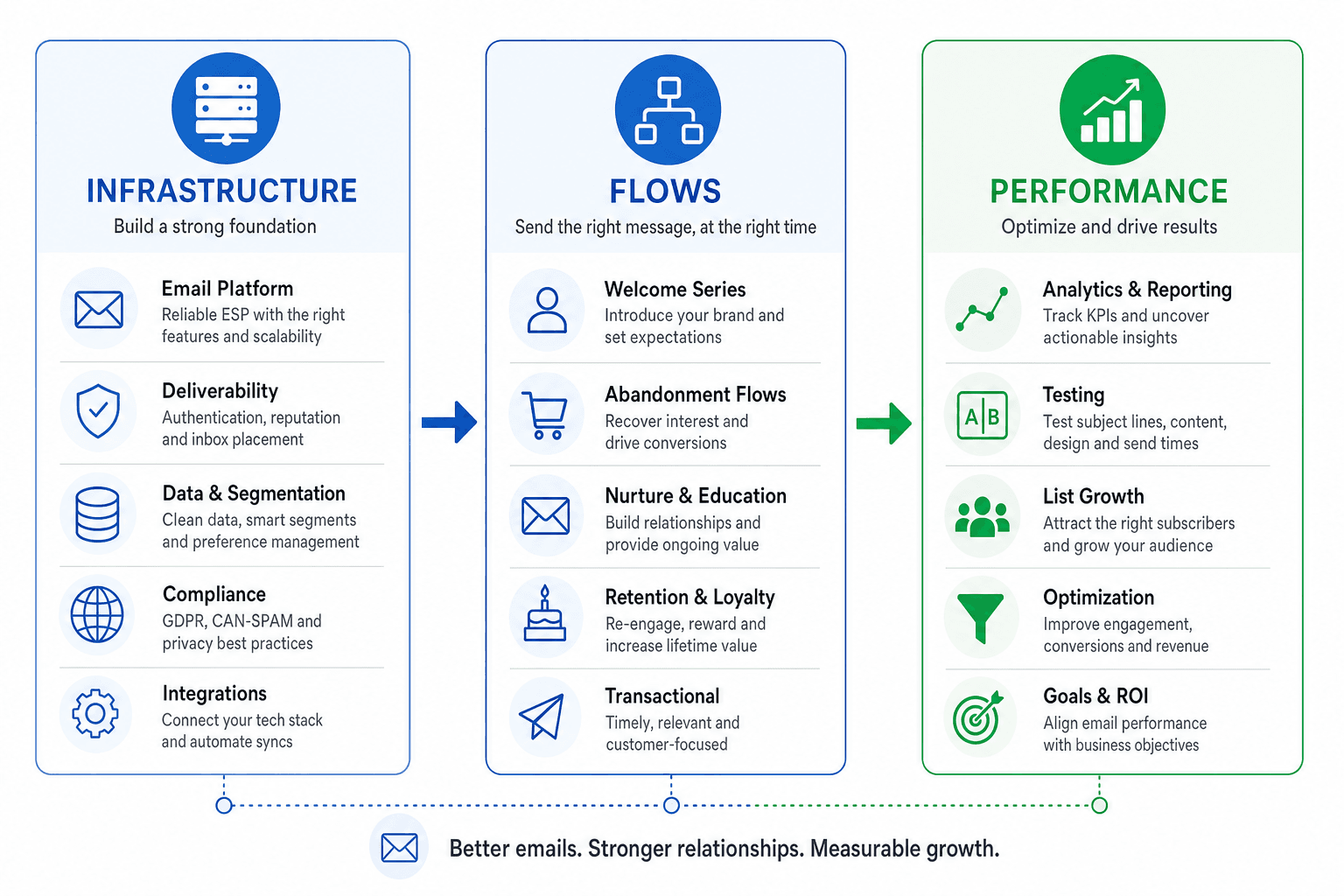
How a Mailchimp brand moves email from 18% to 30%+ of GMV
Run three layers in sequence; each enables the next. Layer one is infrastructure: authenticate your domain (SPF, DKIM, DMARC), connect your store so purchase data reaches the Audience Dashboard, clean up tags so triggers fire reliably, and suppress unengaged contacts before anything else goes out.
In layer two, rebuild every Classic sequence in MAF: welcome series, abandoned cart, post-purchase, browse follow-up via custom audience rules, and win-back to the pre-built 'Lapsed Customers' segment (anyone with no purchase in 8+ months). With a connected store, abandoned cart can send as soon as an hour after abandonment.
Use tag-based if/then splits to give first-time and repeat buyers different post-purchase sequences, and set delays to match your product's consideration cycle.
In layer three, run weekly broadcasts to engaged segments only, with Send Time Optimization on and subject-line variants tested every send. On Standard/Premium, send your highest-AOV offers to high predicted-CLV contacts, time-sensitive campaigns to purchase-likelihood contacts, and re-engagement to churn-risk contacts before they lapse.
The governing metric is email revenue as a percentage of total GMV, tracked monthly alongside blended ROAS.
The one number that governs this
Aim for email at 25–35% of GMV, measured monthly. Blended ROAS comes second; revenue per recipient by flow and segment is the tactical metric.
How We Help
What we do inside your Mailchimp account
Before any pitch, we audit your flow status, tag architecture, deliverability signals, and connected-store revenue and show the gaps and their cost. Then we build and run the program.
Email infrastructure audit and setup
For layer one, we authenticate your domain, verify your store connection, clean up tags, and run the initial suppression before new sends.
Marketing Automation Flow rebuild
For layer two, we rebuild every lost Classic sequence in MAF, with tag-based branching and delays calibrated to your AOV.
Predictive segment activation
For layer three, we activate predictive segments, including predicted next-purchase date, on Standard and Premium accounts and build campaign logic for each segment.
Ongoing campaign management and creative testing
We run layer three's weekly broadcasts to engaged segments with AI subject-line testing, Send Time Optimization, and a monthly creative debrief on revenue per recipient.
Deliverability monitoring and list hygiene
We monitor engagement decay by cohort, suppress contacts nearing the threshold, and run reputation-repair protocols if inbox placement is damaged.
Revenue analytics and blended ROAS reporting
We report email's share of GMV by flow and campaign type, adjusted for last-touch windows, and its contribution to blended ROAS.
Paid media (Google, Meta, TikTok), optional
For list growth, paid social and search feed new subscribers into rebuilt flows; we measure paid and email as one system against blended ROAS.
Who's Behind This
Who we are, and what makes us different
Sagum is a performance marketing agency founded in January 2017 in St. George, Utah. We've spent 8+ years growing real brands and being judged on KPIs, not vanity metrics.
We deliberately limit how many clients we take so each one gets senior attention. We treat your numbers like our own, we never run generic playbooks, and your strategy is built for your business, because shouldn't your brand's marketing be custom to your brand?
Sagum.ai is our AI arm: the same proven operators now build AI into the work wherever it creates real edge, not as theater, but as leverage applied with discipline.
- 8+ years growing brands on performance KPIs, not vanity metrics
- Limited client roster, with senior attention on every account
- An extension of your team; your success is tied to ours
- Custom strategy per brand, never a generic playbook
- AI built in where it moves a number; judgment over hype
“Sagum is a performance marketing agency that's spent 8+ years growing brands by treating their numbers like our own. We take on few clients, never run generic playbooks, and now build AI into the work wherever it creates real edge, not hype. Your strategy is built for your business, and our success is tied to yours.”

“After six years, Sagum is our most important partner: trusted, communicative, and caring about our business as if it's their own.”
Long-term partner
6-year client
Proof
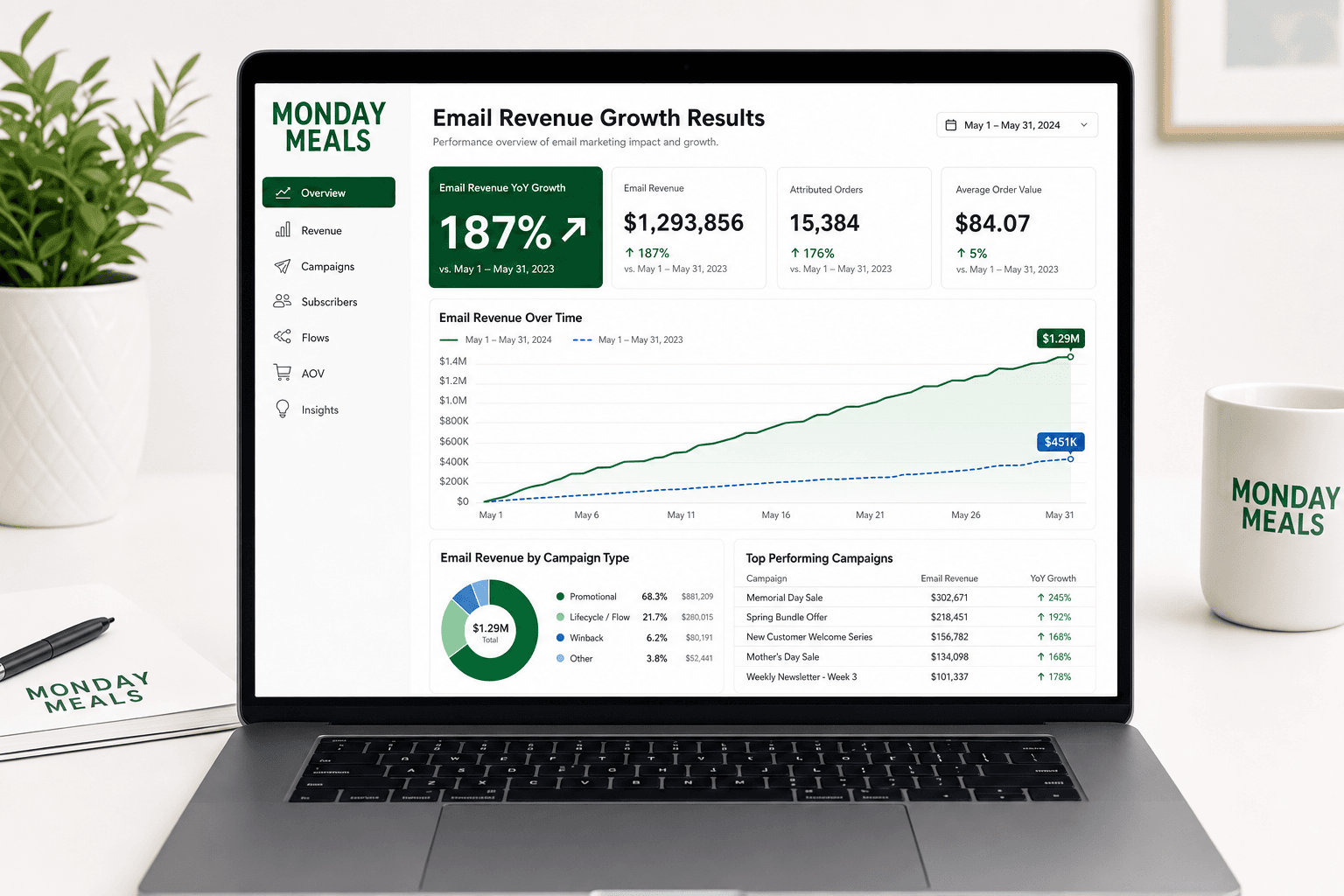
187% YoY, $8+ ROAS on Meta, +79% web conversion
Clean Monday Meals
Challenge
Clean Monday Meals, a food DTC brand, needed to grow across channels.
What we did
We scaled Meta Ads and took over the brand's email and Amazon channels. What transfers to your Mailchimp account is the method: one team running email and paid media together.
Result
The brand grew 187% year-over-year, with $8+ ROAS on Meta and a 79% lift in web conversion. Details are at sagum.com/case-studies/.
Find out what your Mailchimp program is leaving on the table
No obligation. We audit your flows, segmentation, deliverability, and revenue attribution, then show you the specific gaps and what fixing them is worth.
Sagum · January 2017 · St. George, Utah · 8+ years