

8+ years growing brands on KPIs, now with AI
Profitable makeup acquisition as CAC rises
We turn compressing returns into scalable customer acquisition for indie and growth-stage makeup lines.
Google Ads · Meta · TikTok Partners · 8+ Years Growing Ecommerce Brands


Get your free Growth Gap Analysis
Senior strategist review · response within one business day
Prefer to reach out directly?
The Challenge
DTC Makeup Brands Fight Dupes, Rising CPMs, and Weak Repurchase
You now compete with more than other indie brands. Sephora's private label, Amazon surfacing dupes below your price point, and TikTok Shop white-label sellers undercutting you on cost give your customers more choices than ever, and they're pickier.
Meta CPMs are up, and platform-reported ROAS flatters Meta: a shopper sees your Instagram ad Monday, Googles you Tuesday, gets retargeted Wednesday, buys direct Thursday, and Meta claims full credit. Your real blended ROAS is probably lower than your dashboard shows.
Beauty's unit economics punish you at scale. Decile's 2026 averages: beauty first orders recover 84% of CAC, yet only 35% of buyers return. Most makeup brands bleed margin in the gap between buying once and coming back. At 1.4x LTV:CAC, the beauty ecommerce average, you're on a treadmill.
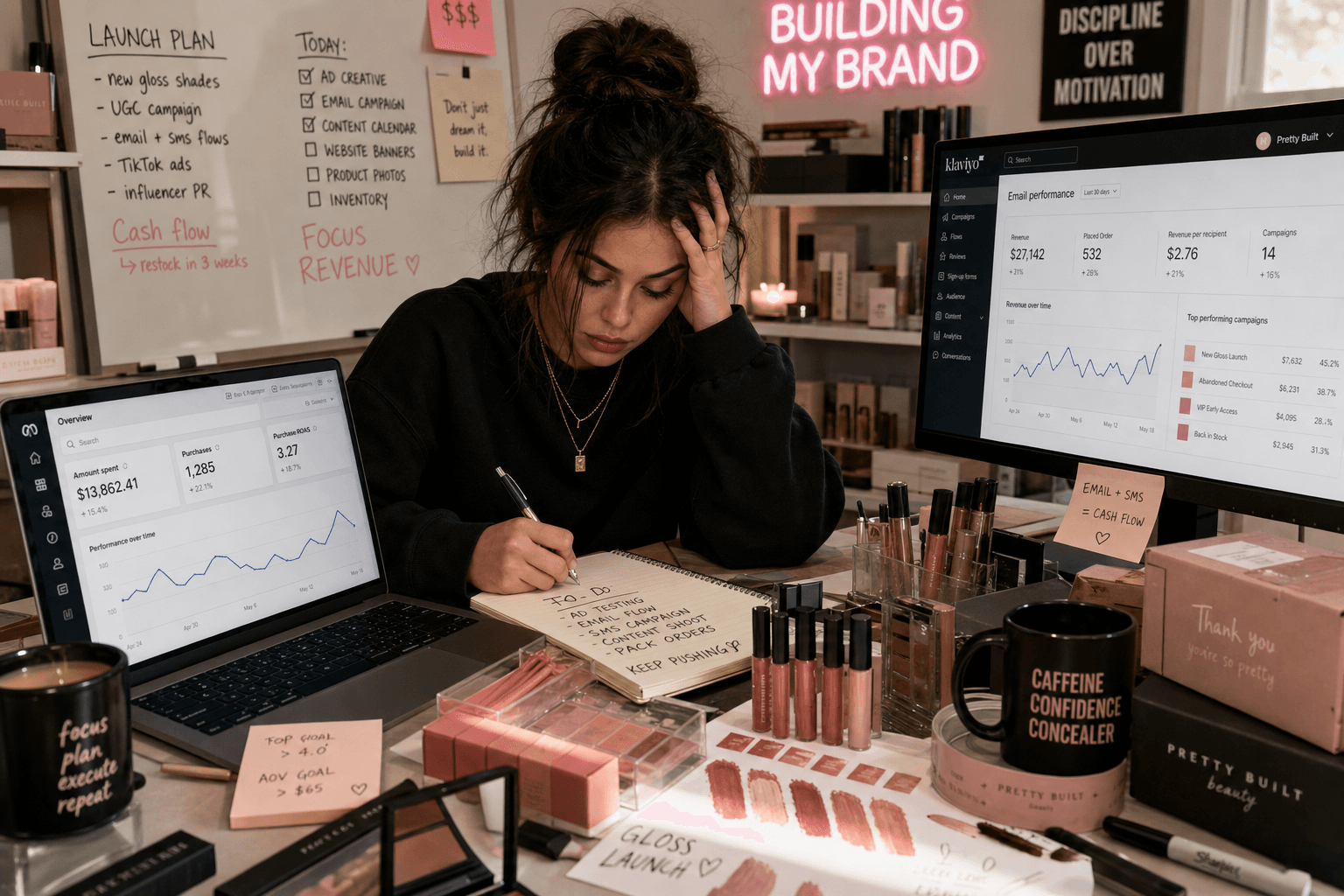
You're probably the CMO, CFO, and creative director at once, and in triage mode. The last thing you need is an agency that can't tell a hero SKU from a seasonal bundle or see why Klaviyo flows matter as much as Meta spend.
The Opportunity
Makeup Brands That Fix Repurchase and TikTok Build Growth That Compounds
Beauty is high-intent and high-repeat: a hero-SKU buyer who repurchases within 90 days is worth far more than AOV suggests. Top beauty brands earn $40 more per customer by Month 12 by optimizing that window.
Most indie makeup brands misuse TikTok, the most underpenetrated high-ROAS channel. In 2024, beauty products on TikTok Shop sold one per second on average, five per second at November's peak. Beauty and personal care brands consistently hit 3.5x ROAS there; winners post shoppable UGC that looks like someone's morning routine.
Meta retargeting returns 3.5x+ ROAS for beauty brands that fix attribution and test creative at volume.
Email is probably your most underworked asset: you need abandoned cart, post-purchase upsell, replenishment, and birthday flows. Beauty repeat buyers reorder about every 107 days (makeup nearer 70); replenishment sent before then can lift LTV:CAC from 1.4x toward 3x.
What Most Get Wrong
What Most Makeup Brands (and Their Agencies) Get Wrong
Optimizing for first-order ROAS over repurchase rate
A 3x first-order ROAS looks great until 65% of those customers never buy again. Without 90-day LTV cohorts you're building a leaky bucket, and most agencies never report cohorts.
Running one or two creative concepts until they die
Meta and TikTok buyers tire of a beauty hook in days. A brand testing one concept monthly against AI-assisted competitors testing ten weekly loses the auction before its campaign launches.
Trusting platform-reported ROAS as the truth
A buyer who finds you on TikTok, gets retargeted on Instagram, and buys direct shows up as three platform wins. Without blended ROAS and attribution tooling, you budget on fiction.
Treating TikTok like a scaled-down Meta
Repurposed Meta statics or polished video underperform and actively suppress your account's reach. A founder's foundation routine in imperfect lighting beats a studio shoot almost every time.
Neglecting Klaviyo flows until after the launch push
Stopping at abandoned cart misses LTV in post-purchase flows (day 3 education, day 14 complementary SKU, pre-reorder replenishment). Build them before scaling paid and every ad dollar works harder.
Why Now
Makeup Consolidation and Q4 CPMs Reward Brands That Build Early
Makeup is consolidating: investors buy indie brands for repeatable, profitable growth (clean unit economics, rising repurchase, scalable ROAS), not follower counts. Most competitors still run the 2021 Meta playbook (static creative, flat budgets, no cohort measurement) and blame the market for ROAS compression they cause.
With AI, a well-instrumented team can test ten creative angles weekly, not one monthly, without a big production budget, and fix ROAS-inflating attribution errors within days, before scaling spend.
Q4 makes the beauty year: over Black Friday/Cyber Monday 2024, Meta ROAS rose 17% and conversion rates 32%. But CPMs spike 30–50% above annual average, so brands with inventory, creator content, and campaigns ready by September win, while October starters pay premium CPMs. Build your creative engine, attribution, and Klaviyo retention flows well before next September.
The Mechanism
Where AI Creates an Edge for a Makeup Brand
Real productivity, not AI theater. Here's where it actually moves a number for makeup brands.
Creative
What AI does: AI-assisted workflows generate and test many more concepts weekly across Meta and TikTok: UGC-style hooks, founder POV angles, before/after formats, and product demo variations.
The result: At ten concepts a week, you find the winning hook in days rather than months, before fatigue pushes CPMs up.
Why it matters here: Makeup creative is targeting: a founder applying lip liner in natural light, a dupe-check ad, or a shade-range callout decides whether cold audiences stop scrolling.
Analytics
What AI does: AI reconciles platform-reported ROAS against blended ROAS, flags Meta, TikTok, and Google claiming the same purchase, and surfaces true new-customer CAC by channel.
The result: Budget decisions rest on real numbers, and you see which channels drive first-order payback and 90-day repurchase.
Why it matters here: Beauty buyers move through TikTok discovery, Instagram retargeting, Google brand search, and direct checkout; misread that path and you scale the wrong channels.
What AI does: AI builds the post-purchase Klaviyo flows, adds a GWP offer timed ahead of your reorder window, and keeps optimizing subject lines and send times.
The result: Customers return without ad spend, lifting repurchase from the beauty-average 35% toward the 50%+ that separates profitable brands from treadmill brands.
Why it matters here: Skip re-engagement on that reorder cycle and you forfeit your highest-margin revenue; every dollar spent on a one-time buyer needed 3x+ ROAS to break even.
Social Media
What AI does: AI shows which hooks and formats drive the highest add-to-cart rates from your TikTok Shop affiliates, the micro-tier creators we recruit and brief to post shoppable UGC on commission.
The result: Your TikTok channel earns consistent 3x+ ROAS from native-feeling content, and your creator roster grows stronger as you find and scale top affiliates.
Why it matters here: Beauty winners on TikTok Shop run creator operations; building your affiliate roster before competitors build theirs is a durable advantage.
Conversion Optimization
What AI does: AI helps test PDPs and landing pages on beauty's conversion levers: shade-finders, before/after image sequencing, UGC reviews above the fold, bundle and GWP presentation, and mobile checkout friction.
The result: Paid traffic you already buy converts better, improving blended ROAS without more ad spend.
Why it matters here: When Meta CPMs reach $25–$40 at peak, a PDP converting 1.8% instead of 3.5% effectively doubles CAC. Fix PDPs before you raise budgets.
Ready to see what this looks like for your makeup brands business?
No obligation. A senior strategist will show you exactly where the wins are.
The Strategy
What a Makeup Brand Growth Strategy Should Look Like
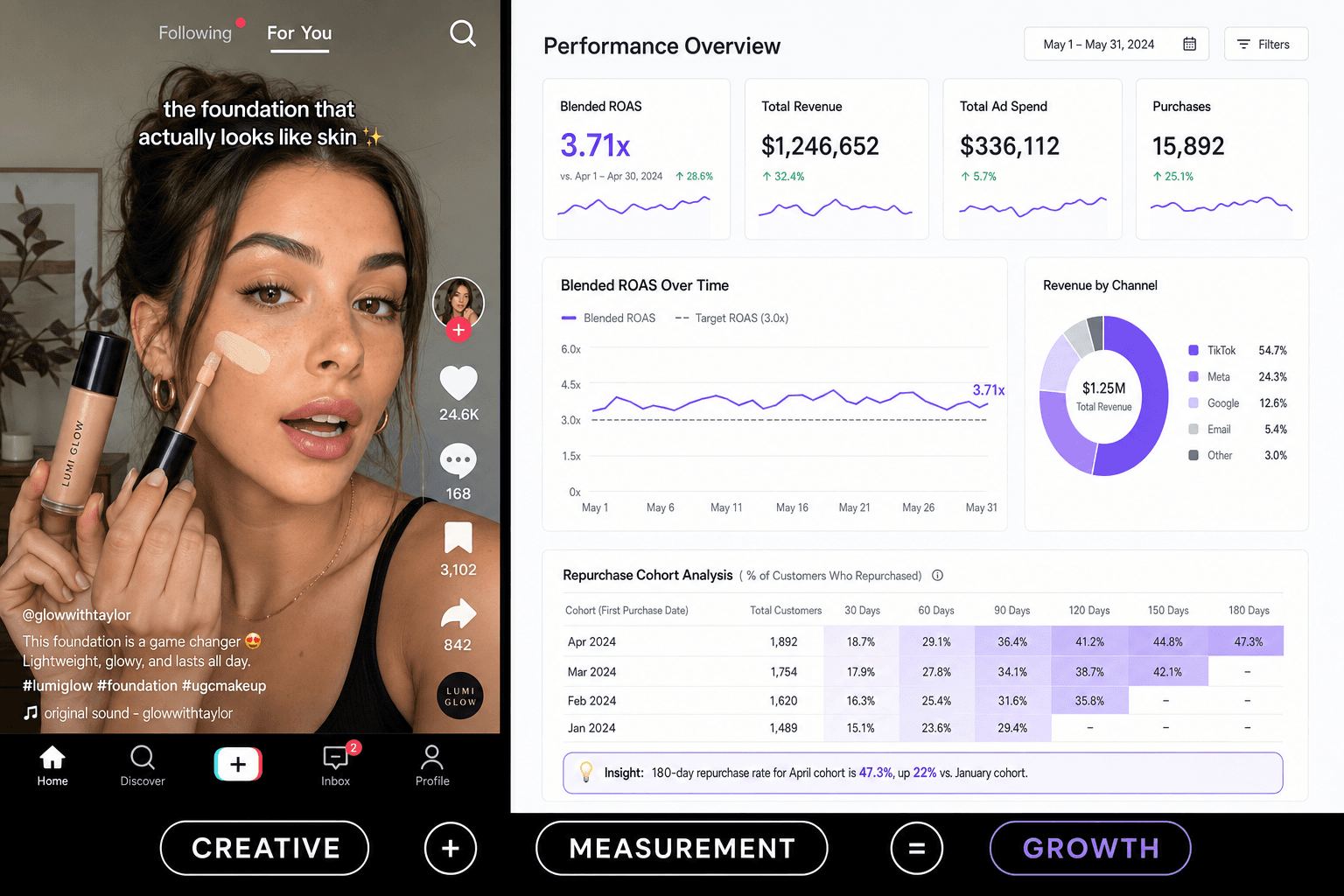
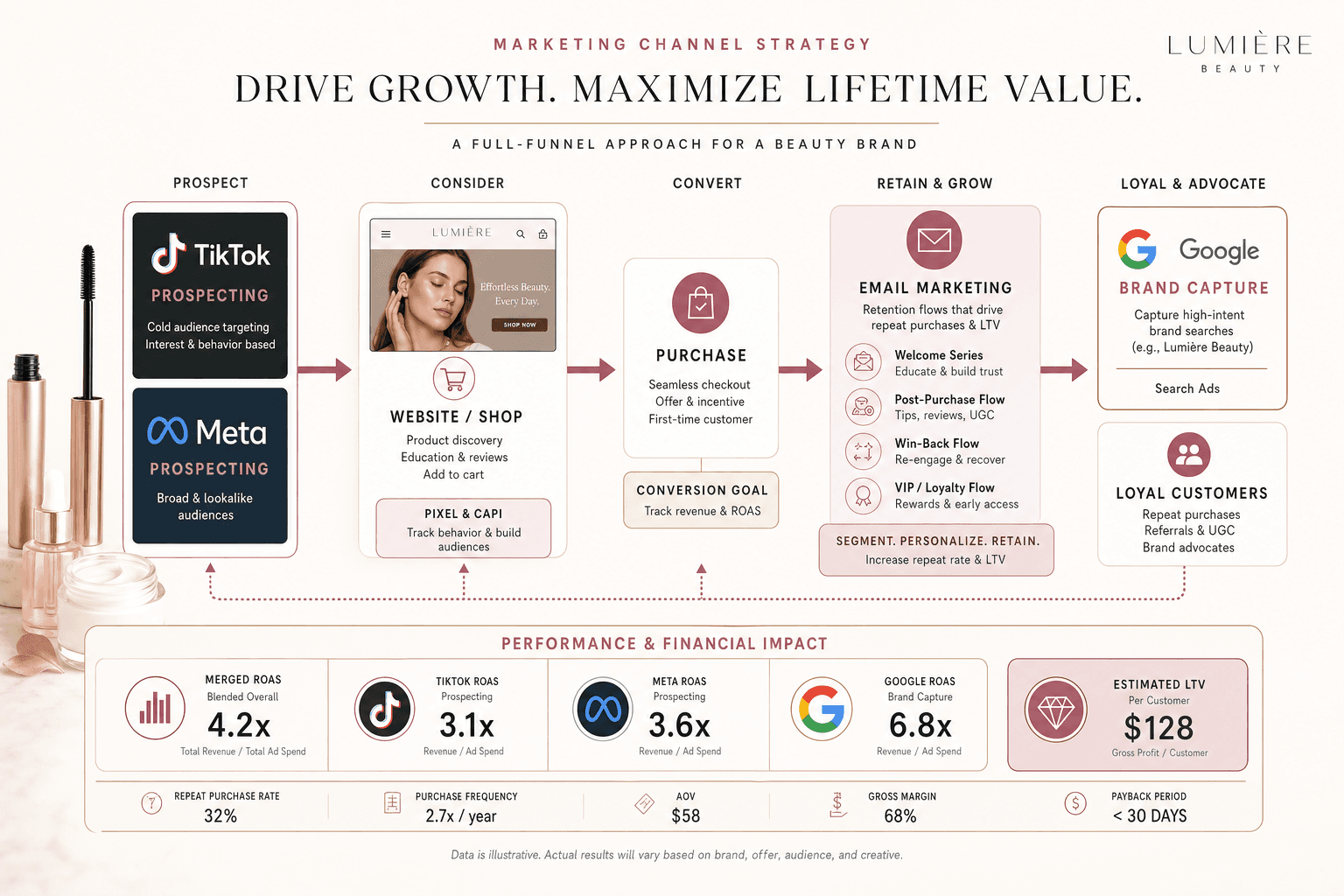
Measurement comes first: before we touch an ad, we audit your pixel, Klaviyo attribution, and Google Analytics against Shopify so your blended ROAS (total revenue ÷ total ad spend) is trustworthy. Most brands we talk to make six-figure budget decisions on numbers off by 30–50%.
Meta is your prospecting and retargeting workhorse, but only if you test new hooks every week. TikTok is your fastest-growing acquisition channel when run as a creator operation, with UGC-style content and TikTok Shop affiliates instead of repurposed Meta video.
Google Shopping and brand search close the high-intent buyers that social has already put in your funnel. Don't use them to prospect.
Build Klaviyo email and SMS in parallel with paid, since retention flows compound every acquisition dollar.
Pace budget to the beauty calendar: Q4 (October through December) carries the CPM spike, and Valentine's Day and Mother's Day call for bundles and limited editions. January and June, efficiency months with lower CPMs and less competition, are for testing new creative and building your TikTok creator roster.
The one number that governs this
Blended ROAS, not platform ROAS, is the governing KPI, tracked weekly, with new-customer CAC and 90-day repurchase showing whether it's sustainable or a one-cohort fluke.
How We Help
What We'd Do for a Makeup Brand Like Yours
We audit attribution and baseline blended ROAS, then sequence paid, retention, and creative so they compound. We limit client numbers so you get senior attention, and answer to your KPIs.
Paid Social (Meta & TikTok)
We rebuild Meta prospecting and retargeting around weekly creative testing and run TikTok as a native, UGC-driven content operation.
Creative Strategy & Production
An AI-assisted workflow tests many more angles weekly to find the hook that gives your hero SKU its lowest CAC before competitors do.
Analytics & Attribution
We audit attribution and build a blended ROAS dashboard that reconciles Meta, TikTok, Google, and Klaviyo against Shopify revenue.
Email & SMS (Klaviyo)
We build post-purchase flows, from day 3 education to a GWP offer timed ahead of your reorder window.
TikTok Shop & Creator Management
We build your TikTok Shop affiliate roster, recruiting, briefing, and tracking micro-tier creators who post shoppable content on commission.
Conversion Optimization
We test PDPs and landing pages on beauty conversion levers, from UGC review placement to mobile checkout, to lift conversion on paid traffic.
Google Ads (Shopping & Brand Search)
We run Shopping and brand search to close buyers warmed by social, without cannibalizing organic or overfunding Google, which isn't indie beauty's main prospecting driver.
Who's Behind This
Who we are, and what makes us different
Sagum is a performance marketing agency founded in January 2017 in St. George, Utah. We've spent 8+ years growing real brands and being judged on KPIs, not vanity metrics.
We deliberately limit how many clients we take so each one gets senior attention. We treat your numbers like our own, we never run generic playbooks, and your strategy is built for your business, because shouldn't your brand's marketing be custom to your brand?
Sagum.ai is our AI arm: the same proven operators now build AI into the work wherever it creates real edge, not as theater, but as leverage applied with discipline.
- 8+ years growing brands on performance KPIs, not vanity metrics
- Limited client roster, with senior attention on every account
- An extension of your team; your success is tied to ours
- Custom strategy per brand, never a generic playbook
- AI built in where it moves a number; judgment over hype
“Sagum is a performance marketing agency that's spent 8+ years growing brands by treating their numbers like our own. We take on few clients, never run generic playbooks, and now build AI into the work wherever it creates real edge, not hype. Your strategy is built for your business, and our success is tied to yours.”

“Sagum roughly doubled our bottom line. They treat the work like it's their own business.”
Rachel Nilsson
CEO, RAGS
Proof
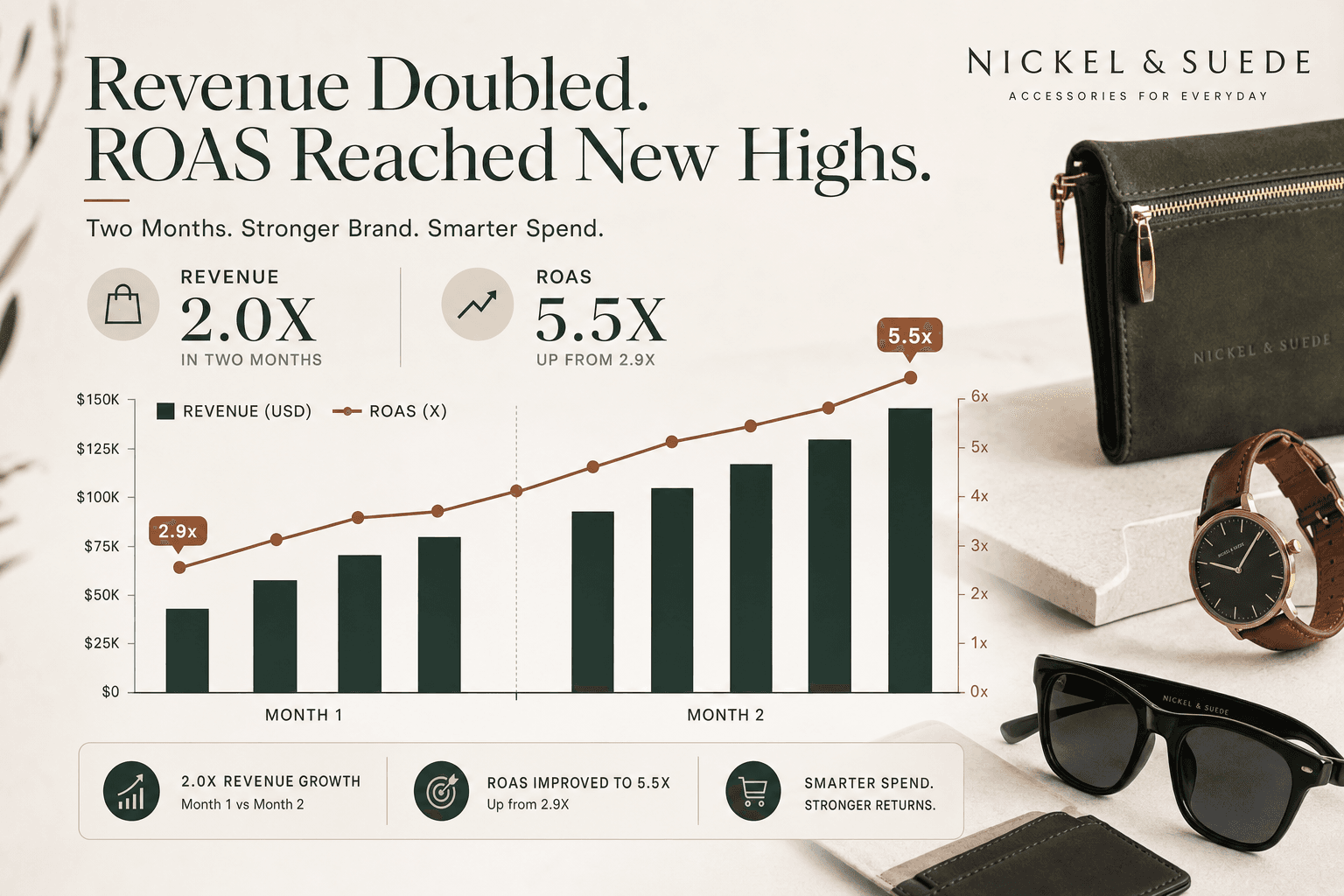
$255k → $555k in 2 months, ROAS 2.9x → 5.5x+
Nickel & Suede
Challenge
Nickel & Suede needed to scale revenue profitably on paid social.
What we did
We ran Meta and TikTok creative testing at volume, the same lever a makeup brand scales on.
Result
Revenue went from $255k to $555k in two months. ROAS rose from 2.9x to 5.5x+ (peaking at 7.95x) and site conversion rate improved 34%. Full case study at sagum.com/case-studies/.
- Revenue
- $255k → $555k (2 mo)
- ROAS
- 2.9x → 5.5x+ (peak 7.95x)
- Site conversion
- +34%
Your Makeup Brand Has a Real Growth Opportunity. Let's Build Your Strategy.
No obligation. You get one focused conversation about your channels, unit economics, and where the real growth is, built around your makeup brand.
Sagum · January 2017 · St. George, Utah · 8+ years