

8+ years growing brands on KPIs, now with AI
In menswear, ROAS isn't profit
We combine apparel discipline with creative testing, measured in contribution margin, not vanity numbers.
Google Ads · Meta · TikTok Partners · 8+ Years · Apparel DTC Case Studies


Get your free Growth Gap Analysis
Senior strategist review · response within one business day
Prefer to reach out directly?
The Challenge
Why Menswear Growth Stalls: Higher CAC, Lost Signal, Tight Margins
Every menswear brand runs the same stack (Shopify Plus, Klaviyo, a reviews app, a loyalty platform, UGC, SMS) and chases the same 28–45-year-old professional male with disposable income and a short attention span. Tooling no longer sets you apart.
CAC has climbed 25–40% structurally: iOS 14 signal loss is permanent and platforms are saturated. Ads Manager ROAS misleads: the pixel misses half the conversions it once saw.
Your AOV is probably $120–$250, your average customer buys fewer than two times in their lifetime, and median EBITDA margin at eight-figure DTC brands is around 7–8%. At those margins, arbitrage can't carry your channel strategy; you need repeat customers at a CAC your contribution margin can absorb.
October–November drives most of your annual revenue while CPMs inflate 30–60% as every apparel brand bids for the same eyeballs; July is quiet. Unless you plan each phase, you overspend in the dead months or underinvest when demand peaks. Generic advice like 'run Advantage+, test some creatives, build your email list' isn't a strategy here.

The Opportunity
Where Menswear Brands Are Winning: Creative Velocity, TikTok, and Email
Impressions are cheap; your constraint is creative quality and testing velocity: apparel paid social CPMs average around $10.93, below health, wellness, and consumer finance.
Menswear brands pulling ahead, whose BFCM results show up in founder Slack groups, test 10–20 creative variants a month. Through systematic testing, they've found the hook, visual, and social proof angle that converts their buyer, and can scale it confidently.
TikTok is a real menswear channel now: fashion grew 147% year-over-year there in 2024, creator-led content outconverts polished brand ads, and brands that cracked it early acquire customers at CACs that make competitors' blended ROAS look broken.
Email is your highest-margin retention channel. Strong programs drive 25–35% of total revenue from email and SMS at almost no cost once built, while brands with incomplete flows or flat segmentation often sit 15–20 percentage points below that share.
What Most Get Wrong
What Most Menswear Brands (and Their Agencies) Get Wrong
Trusting Ads Manager ROAS as the governing number
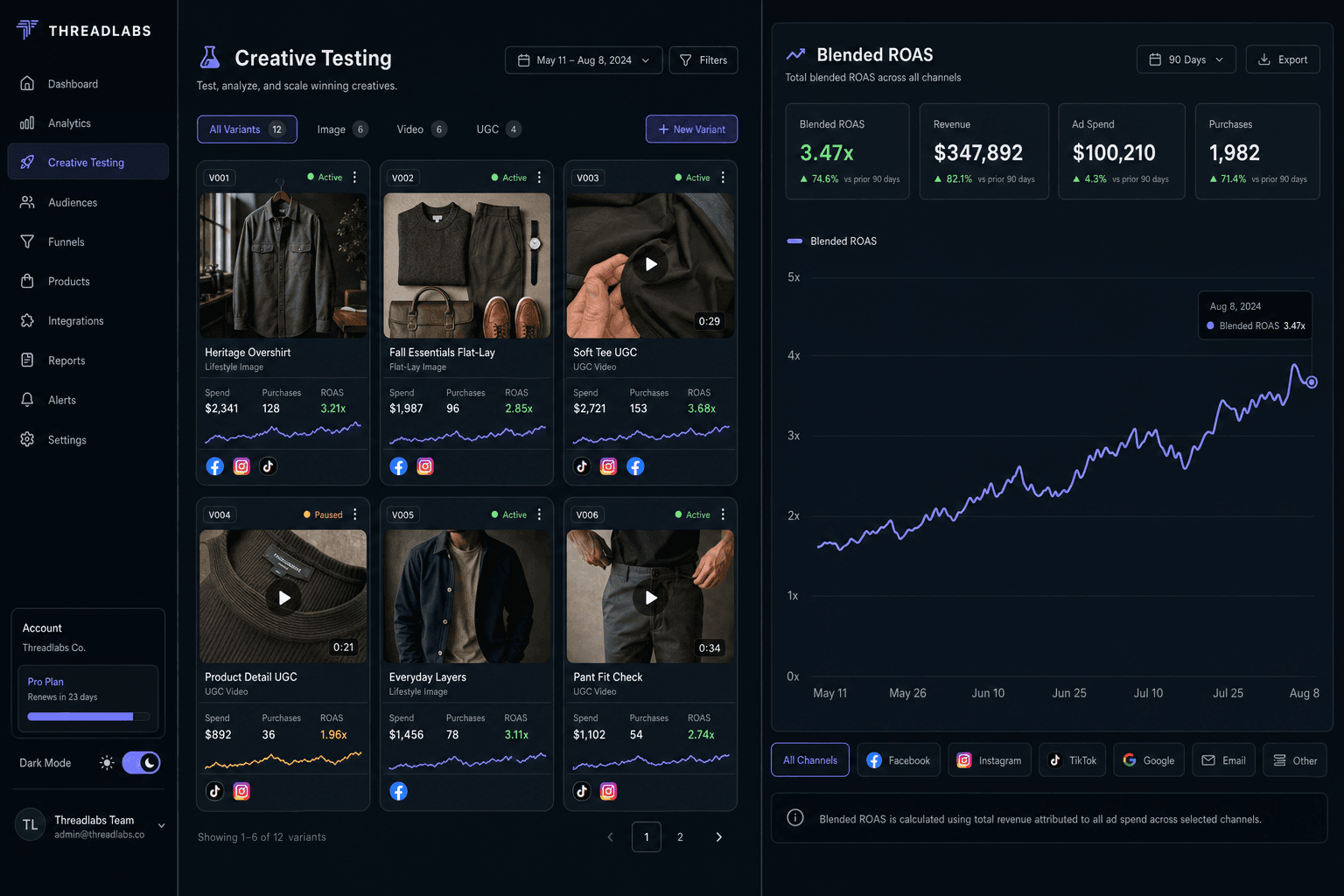
Meta's pixel misses conversions, so you often overspend on campaigns that look great in Ads Manager. Use blended ROAS, calculated from actual revenue and spend.
Running 2020-style creative: one or two polished ads, tested slowly
Creative is the targeting now: Meta's Advantage+ and TikTok's algorithm find the audience. Brands testing one or two ads a month get out-learned by competitors testing 10–20.
Treating BFCM as a revenue event, not a margin event
Customers acquired cold at peak CPMs carry the highest CAC and may not return. Winners build retargeting, email, and SMS audiences in shoulder months, then aim BFCM spend at them.
Chasing revenue growth while ignoring new-customer CAC (nCAC) and LTV
Revenue from returning customers buying sale inventory isn't new-customer acquisition. If you can't separate nCAC from returning revenue, a retention tailwind can mask a broken acquisition engine.
Hiring a generalist agency with no menswear context
They reuse skincare Advantage+ playbooks, missing that unqualified traffic raises return rates on trousers and dress shirts and that men back from summer drive August's 'new year, new wardrobe' spike.
Why Now
Why Menswear Brands That Build Before Peak Season Pull Ahead
AI-assisted creative lets you test 10–20 variants a month in the time it took to brief, shoot, and approve three. Build it now, and competitors can't match your creative learning rate by your next BFCM.
For a menswear brand running Meta, Google Shopping, TikTok, and Klaviyo, AI-assisted analytics can now reconcile Ads Manager, Shopify, email, and SMS data without a data analyst, showing which channel drives new-customer revenue and which only assists.
Most $2M–$15M menswear brands still run lean creative operations and trust siloed metrics. Brands that fix creative testing, attribution, and retention before peak season reach BFCM with lower nCAC, higher repeat rates, and trusted numbers. Competitors can't close that lead in one quarter. Once AI tools are commoditized, early starters keep the lead, since operational discipline takes time.
The Mechanism
Where AI Gives Menswear Ecommerce an Edge
Real productivity, not AI theater. Here's where it actually moves a number for menswear brands.
Creative
What AI does: Generates hooks, copy angles, and visuals faster than a creative team alone, testing fit narrative, material quality, and founder story angles against each other across static, video, and UGC formats.
The result: You find the creative that converts your buyer in weeks rather than quarters, with data to scale it.
Why it matters here: Menswear brands testing 10–20 variants a month consistently find winners beating best-guess creative by 2–4x, a gap that compounds over a year.
Analytics
What AI does: Reconciles Ads Manager, Shopify, Klaviyo, and TikTok data into one blended ROAS view, separates nCAC from returning-customer revenue, and flags platform-reported ROAS that drifts from blended results.
The result: You budget on real numbers, seeing which channel drives sustainable nCAC and which inflates ROAS by over-crediting returning customers.
Why it matters here: Post-iOS 14, multi-channel menswear brands without blended attribution fly blind. Brands that fixed this first confidently scale channels competitors dropped when in-platform numbers looked bad.
What AI does: Matches cohorts (first-time buyers of one category, lapsed customers at the 90-day mark, high-AOV customers without a second category) to the messages they respond to, then automates flow sequencing.
The result: Owned-channel revenue, your highest-margin lever once you have customers, grows as a share of the total at near-zero incremental CAC.
Why it matters here: Without active retention, the average menswear customer buys fewer than two times; flows like second-category cross-sell can raise that for a fraction of new-acquisition cost.
Digital Ads
What AI does: Paces budget and optimizes bids across Meta Advantage+, Google Shopping, and TikTok, shifting spend in real time on blended performance signals.
The result: Spend tracks actual revenue, scaling down in high-CPM BFCM windows and up as CPMs normalize, favoring warm audiences over peak-rate cold traffic.
Why it matters here: Menswear brands that build audiences in August and September, then convert them in Q4, consistently beat brands that spread the same annual budget evenly.
Conversion Optimization
What AI does: Finds where fit-anxious shoppers drop off (sizing charts, return policy placement, social proof positioning) and keeps testing product and landing page elements against their objections.
The result: You convert more paid traffic without more spend, which improves blended ROAS and lowers effective nCAC.
Why it matters here: Men, more reluctant than women to return items, hesitate on trousers and dress shirts from untried brands; fixing that on-page beats extra ad spend.
Ready to see what this looks like for your menswear brands business?
No obligation. A senior strategist will show you exactly where the wins are.
The Strategy
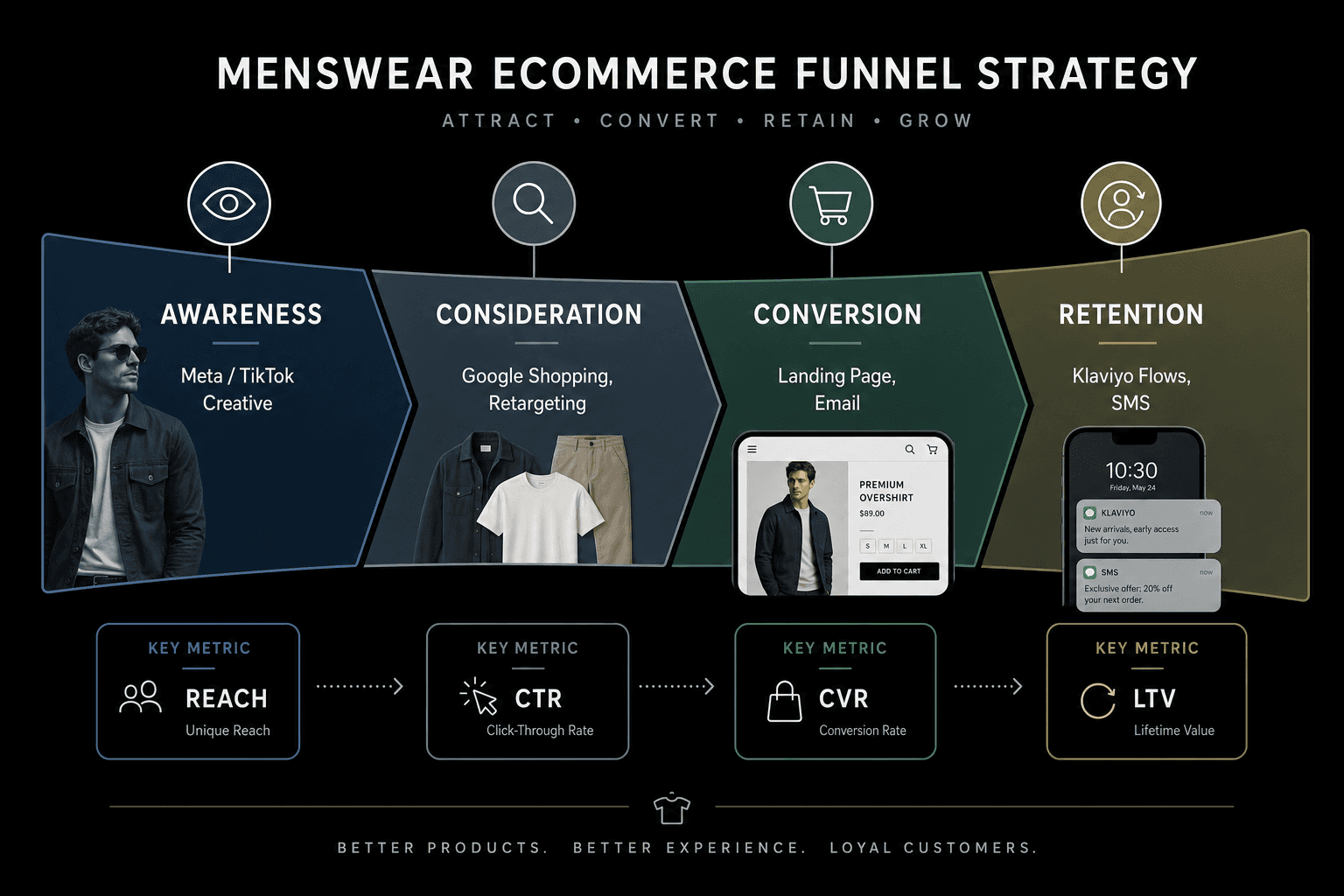
The Menswear Ecommerce Strategy: Measure, Test, Retain, Pace
Build the DTC menswear funnel in order. Scaling paid before retention, or optimizing in-platform ROAS before fixing blended attribution, grows revenue while margins shrink.
First, fix measurement: set up UTM architecture, reconcile platform data against Shopify, build a blended ROAS view of revenue against total ad spend, and set an nCAC baseline by cohort. Until then, every budget call is a guess.
Second, build a creative engine shipping 10–20 ad variants monthly on Meta and TikTok, testing hooks (including social proof), formats, and offers: free shipping, a first-order discount, or none.
Third, build retention: Klaviyo flows for abandoned cart, post-purchase cross-sell into a second category within 30 days, 90-day win-back, and seasonal reactivation, plus SMS for back-in-stock and limited drops. Target 25–35% of revenue from owned channels.
Fourth, pace budget to the calendar: build audiences in August's back-to-school and workwear window, scale through September before CPMs climb, retarget warm audiences through October, convert at BFCM, and reserve January's trough for creative testing and email nurture.
Run Meta Advantage+ for cold acquisition and retargeting; Google Shopping for high-intent searches ('slim fit merino wool sweater', 'dress shirts under $150 men'); TikTok for creator-led prospecting, especially if you target men under 35; email and SMS for retention; and SEO for long-term buying-intent keywords.
The one number that governs this
Manage to blended ROAS (total revenue ÷ total ad spend), not Ads Manager ROAS. A healthy menswear DTC target is 2.5–3.5x.
How We Help
How Sagum Executes This for Your Menswear Brand
For a menswear brand at your stage, we sequence the work to move blended ROAS, starting with measurement, not to look impressive in an agency deck.
Attribution & Measurement Setup
We reconcile Shopify revenue against Ads Manager, Google, TikTok, and Klaviyo for a trustworthy blended ROAS and an nCAC baseline by cohort.
Paid Media Management (Meta, Google, TikTok)
We run Meta Advantage+, Google Shopping, and TikTok in the roles above, pacing budget to the menswear calendar.
AI-Assisted Creative Testing
We test hooks, formats, and offers, using AI for concept generation, to find winning angles faster than competitors testing one or two ads a month.
Email & SMS (Klaviyo / Attentive)
We build and optimize the retention flows above to reach that owned-channel revenue target at near-zero incremental CAC.
Conversion Rate Optimization
We test product and landing pages against fit confidence, sizing clarity, return policy framing, and social proof placement to lift paid conversion without more spend.
AI Systems & Reporting
We build one weekly view of blended ROAS, nCAC by channel, and cohort repeat rate.
Who's Behind This
Who we are, and what makes us different
Sagum is a performance marketing agency founded in January 2017 in St. George, Utah. We've spent 8+ years growing real brands and being judged on KPIs, not vanity metrics.
We deliberately limit how many clients we take so each one gets senior attention. We treat your numbers like our own, we never run generic playbooks, and your strategy is built for your business, because shouldn't your brand's marketing be custom to your brand?
Sagum.ai is our AI arm: the same proven operators now build AI into the work wherever it creates real edge, not as theater, but as leverage applied with discipline.
- 8+ years growing brands on performance KPIs, not vanity metrics
- Limited client roster, with senior attention on every account
- An extension of your team; your success is tied to ours
- Custom strategy per brand, never a generic playbook
- AI built in where it moves a number; judgment over hype
“Sagum is a performance marketing agency that's spent 8+ years growing brands by treating their numbers like our own. We take on few clients, never run generic playbooks, and now build AI into the work wherever it creates real edge, not hype. Your strategy is built for your business, and our success is tied to yours.”

“Sagum roughly doubled our bottom line. They treat the work like it's their own business.”
Rachel Nilsson
CEO, RAGS
Proof
Global ROAS from 2.32:1 to nearly 6:1, +40% YoY
Everyman
Challenge
Everyman, a menswear brand, needed to increase global ROAS, grow sales revenue, and successfully launch product line expansions.
What we did
We ran Facebook and Google paid media tuned to ROAS targets, scaled an email program, and layered in affiliate campaigns and strategic product launches.
Result
Global ROAS hit nearly 6:1 in Q4 2020, up from 2.32:1 in 2019, and the brand grew 40% year over year from 2020 to 2021 alongside successful product line launches.
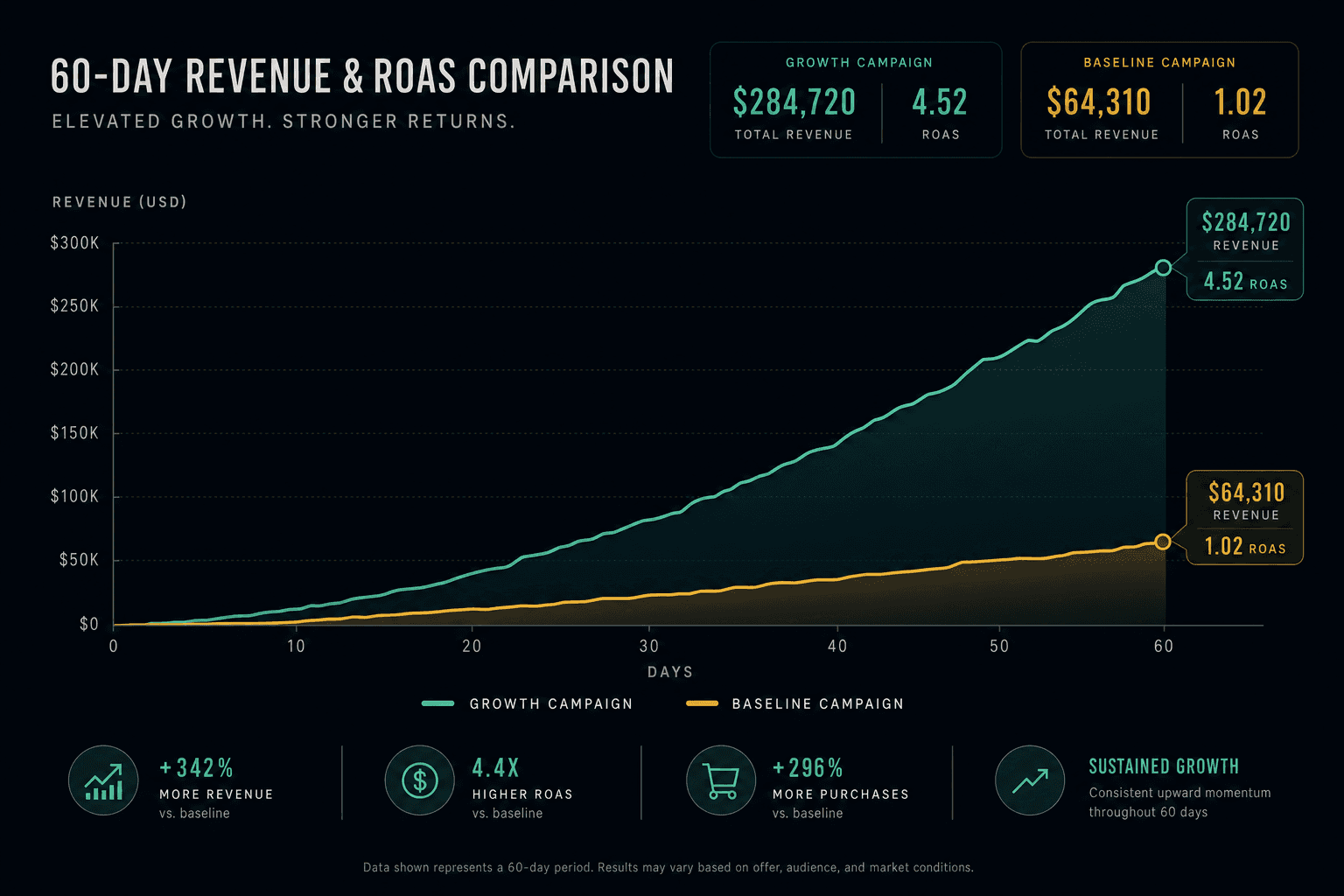
- Global ROAS
- 2.32:1 → ~6:1
- YoY growth
- +40%
- Product lines
- Successfully launched
Let's Build the Strategy That Raises Your Blended ROAS
No obligation. We'll spend one focused session on your brand's actual numbers, channels, and stage, not a generic agency pitch.
Sagum · January 2017 · St. George, Utah · 8+ years