

8+ years growing brands on KPIs, now with AI
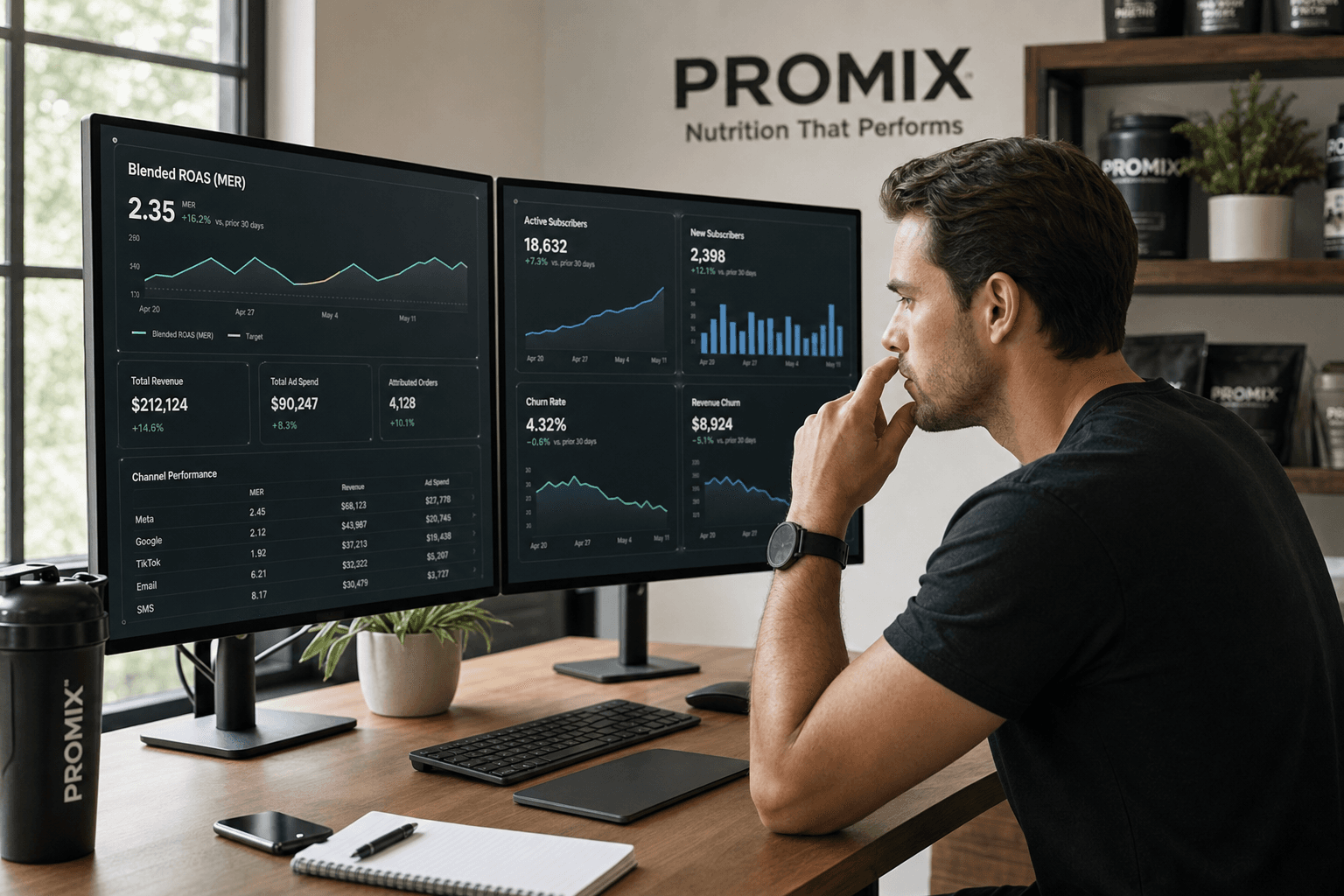
Nutrition brands live and die by blended ROAS
We acquire subscribers at a profitable payback and build the retention backend that makes the math work.
Google Ads · Meta · TikTok · 8+ years growing ecommerce brands on KPIs, not vanity metrics


Get your free Growth Gap Analysis
Senior strategist review · response within one business day
Prefer to reach out directly?
The Challenge
For Nutrition Brands, Growth Is a Unit-Economics Problem, Not a Marketing Problem
You know the playbook: Meta for acquisition, Klaviyo for retention, Google for branded and ingredient-intent capture. The math gets harder to close each quarter. Meta's Health and Wellness CPMs average $19.30, among its highest, because AG1, Ritual, Hims, and Thorne bid on the same inventory.
Your nCAC runs $68–$120 depending on category, and the first order rarely pays it back; the second and third do, so your model bets on subscription retention.
Meta and Google both claim the same conversion, and iOS changes broke your attribution. Creative fatigues in two to three weeks, and UGC-style ads convert but demand production volume you have no system to deliver. In Q4, when every brand spends, CPMs run 30–50% above the annual average.
Seasonality splits by SKU. Protein and weight-loss brands need creative and budget loaded by December 26 for January, their Super Bowl. Immune support peaks October through January and can dip 30–40% below peak in summer, when electrolyte and hydration brands peak. Flat monthly spend ignores this and costs revenue.
The Opportunity
Nutrition Brands That Out-Execute the Mid-Market Capture Rising Retention
Shopify supplement brands hit a 37.7% repurchase rate in 2024, up from 33.1% the year before, a gain only brands with post-purchase systems capture. Even at three $80 orders a year for two to three years, a retained subscriber is worth $480–$720, so a first order below nCAC still pays off if subscriptions convert.
Instead of outspending AG1, out-execute the mid-market: $5M–$50M brands on similar Meta and Klaviyo playbooks, testing one creative a month. Breakout brands test five to ten angles a week, think in incrementality, and run email and SMS as revenue engines. Match them before peak season to outlast the next CPM rise.
Pausing TikTok, many brands report, shrinks Google branded search and Meta retargeting pools, so TikTok drives cross-channel demand.
Meta-only brands underuse Google, where ingredient queries like 'magnesium glycinate sleep' carry intent Meta prospecting can't match.
What Most Get Wrong
What Most Nutrition Brands (and Their Agencies) Get Wrong
Optimizing for platform ROAS instead of blended ROAS
Meta reports 4:1 ROAS and Google reports 5:1, but revenue divided by total ad spend is 2.1. You scale the wrong channels and erode margin while dashboards look healthy.
Treating the first purchase as the profit event
One order won't repay a $68–$120 nCAC; the second and third do, and agencies reporting first-purchase ROAS never count them. Unless buyers subscribe within 90 days, you're funding expensive sampling.
Running one creative per ad set for weeks
UGC-style ads beat studio content but fatigue fast at scale. Running one or two creatives a month puts most spend on tired assets while your best angle stays undiscovered.
Treating January like August in budget pacing
Protein brands loading after late December overpay for January inventory or miss resolution buyers. Immune brands spending equally in July and November waste summer budget and underfund the fall peak.
Hiring an agency that doesn't know FTC/FDA compliance
Claiming 'cures,' 'treats,' or 'prevents' gets a supplement ad rejected or the account flagged. Without DSHEA-compliant copywriting, agencies ship ads that don't run or copy too diluted to convert.
Why Now
Why Nutrition Brands Win by Moving Before Their Next Peak
Most nutrition brands and their agencies still brief a designer, wait a week, test one angle, and read results in 30 days, while those using AI-assisted production and structured testing find winners in days. Post-iOS attribution is solvable now: brands that correctly configure AI analytics like Triple Whale or Northbeam build 12–18 months of clean data while competitors guess.
TikTok's health and wellness ad costs still run below Meta's, and TikTok Shop adds an in-feed purchase path. Move before rising competition closes the cost gap.
Roughly 90% of DTC supplement brands close by year five, most because they scaled acquisition without a retention system. Brands that build creative velocity, attribution clarity, and a subscription backend before their next peak season reach the $20M+ tier, where the math gets easier.
The Mechanism
Where AI Moves the Numbers for a Nutrition Brand
Real productivity, not AI theater. Here's where it actually moves a number for nutrition brands.
Creative
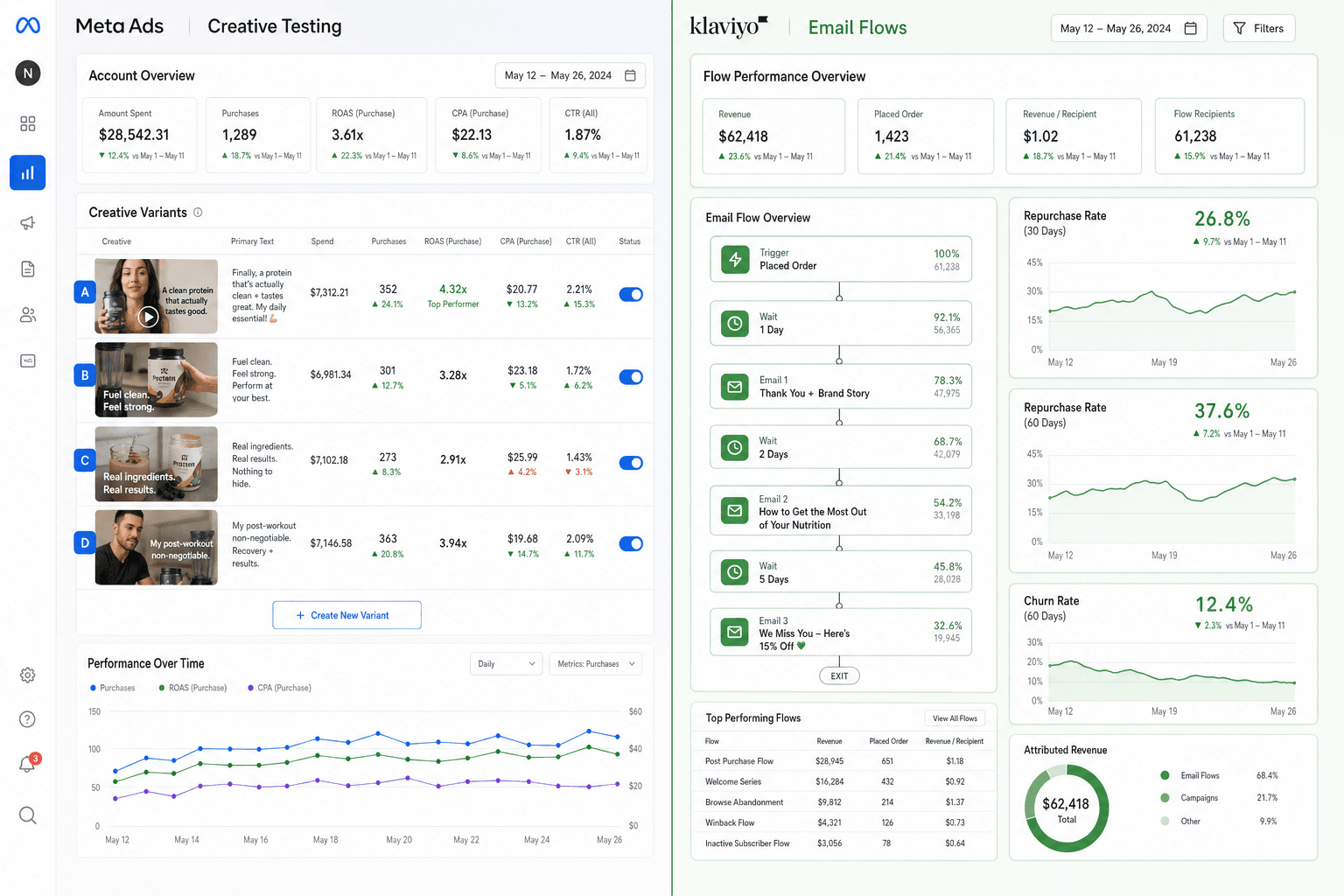
What AI does: AI-assisted briefing and production generates 8–12 UGC-style ad variants per week, varying hooks, benefit angles, and social proof formats, structured for A/B testing across Meta and TikTok.
The result: Winning angles surface in days instead of months, and a continuously refreshed library prevents the fatigue that inflates CPMs on tired assets.
Why it matters here: At Meta's $19.30 category CPMs, creative velocity is the primary mid-market lever; at $50k/month, finding a winning hook two weeks before rivals cuts CPA meaningfully.
Analytics
What AI does: AI-assisted attribution analysis across Meta, Google, and TikTok surfaces incrementality signals, flags conversions that two platforms both claim, and calculates a clean blended ROAS.
The result: You allocate budget on what drives new-customer revenue, not on each platform's self-reported dashboard.
Why it matters here: Founders think in blended ROAS, yet most set budgets from double-counting dashboards. AI catches pixel misfires or view-through inflation that can erode margin for months.
What AI does: AI tunes your Klaviyo post-purchase and replenishment flows with dynamic send-time optimization, subject line testing at scale, and churn-risk scoring that triggers win-back before a subscriber cancels.
The result: Higher 90-day repurchase rates and lower subscription churn improve your CAC payback period and LTV:CAC ratio.
Why it matters here: Acquisition spend is a loan your flows repay: 3:1 LTV:CAC takes two to three repeats, and catching churn early separates 37% from 50% repurchase rates.
Digital Ads
What AI does: AI paces budget across Meta, Google, and TikTok on blended ROAS, creative, and seasonal signals, scaling into January resolution and fall immune peaks, pulling back non-immune SKUs when Q4 CPMs outpace return.
The result: Spend tracks demand and margin, so you capture seasonal windows without overpaying for Q4 inventory.
Why it matters here: Multi-SKU brands face two to three seasonality curves at once (protein, immune, hydration), and a flat monthly budget misallocates across all of them.
Conversion Optimization
What AI does: AI reviews landing and product detail pages, testing bundle presentation, subscribe-and-save (S&S) discount framing, social proof placement, and free-shipping threshold messaging so more first-time buyers choose subscription.
The result: A higher S&S attach rate on the first order compresses CAC payback and improves LTV:CAC without more ad spend.
Why it matters here: Lifting first-order subscribe rates from 25% to 40%, with subscribers reordering $80 monthly, cuts CAC payback from 90 days to under 60.
Ready to see what this looks like for your nutrition brands business?
No obligation. A senior strategist will show you exactly where the wins are.
The Strategy
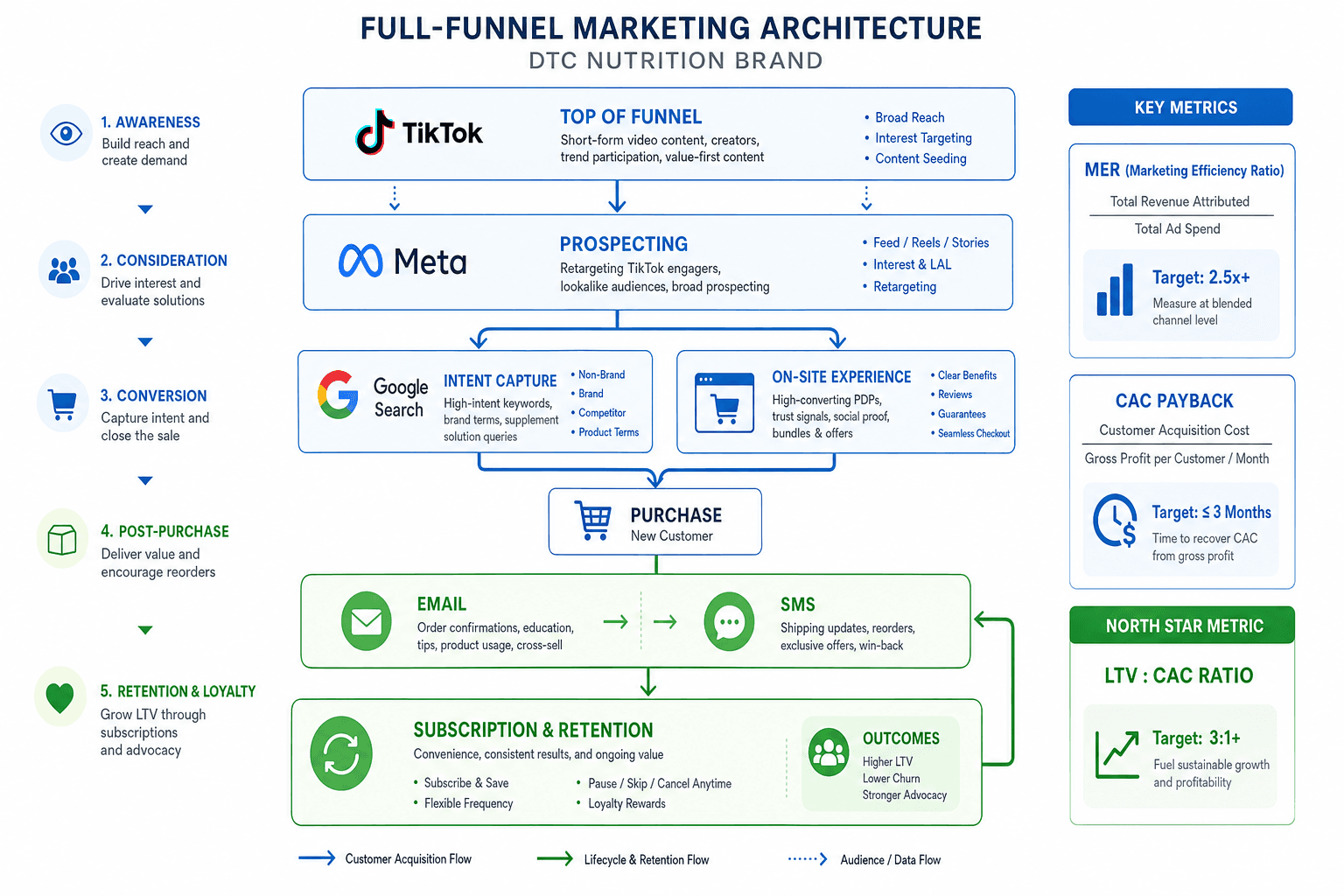
The Marketing Architecture That Makes Nutrition Unit Economics Work
Fix attribution before touching ad spend: reconcile Triple Whale, Northbeam, or equivalent against Shopify revenue and treat platform ROAS as directional only. If your pixel has ever misfired, you've been budgeting on bad data.
Meta is the primary acquisition engine: run 8–12 UGC-style variants per week, prospect with audiences built from your highest-LTV customers, retarget with your subscription offer, and keep every brief DSHEA-compliant.
Google Search and Shopping capture demand Meta creates. Bid on branded, ingredient ('creatine monohydrate 5g,' 'magnesium glycinate 400mg,' 'AG1 alternative'), and competitor-adjacent terms. At a 4.5:1 median ROAS, Search is the highest-return channel for in-market buyers, so don't underfund it versus Meta.
TikTok gets less budget, but creator UGC drives top-of-funnel demand and grows the retargeting pool that makes Meta and Google more efficient; use TikTok Shop for the right SKUs.
Klaviyo email and SMS are the profit center: build post-purchase flows that convert one-time buyers to subscribers within 30 days, inside the 90-day subscribe window; replenishment reminders for 30-day or 90-day supplies; and churn-risk win-back before cancellation.
Pace budget by SKU seasonality: protein and weight-loss brands pre-load by December 26, immune brands scale October–January, hydration into May. When Q4 CPMs spike, shift non-immune spend toward January pre-loading; chasing holiday shoppers means a 40% inventory premium.
The one number that governs this
Governing KPI: blended ROAS (total revenue ÷ total ad spend) ≥ 3.0, new-subscriber CAC payback under 60 days, measured in your analytics, not platform dashboards.
How We Help
How Sagum Runs This for Your Nutrition Brand
We work in strategy order with few clients, so each gets senior attention. Our success tracks your blended ROAS and CAC payback, not a retainer that runs regardless of results.
Attribution & Analytics Infrastructure
We configure your analytics layer first, reconcile it to Shopify revenue for a clean blended ROAS, and find and fix any misfired pixel.
Meta Ads (Prospecting + Retargeting)
We run your Meta prospecting for new subscribers, retarget with your subscription offer, and own the weekly creative tests.
Google Search & Shopping
We capture the in-market demand your Meta spend creates by bidding on branded, ingredient-specific, and competitor-adjacent searches, so Google closes what Meta starts.
TikTok Ads & TikTok Shop
We seed creator UGC on TikTok and launch TikTok Shop beside your DTC site for the right SKUs.
Creative Production & Testing Systems
We run structured briefing, AI-assisted production, and a weekly testing cadence, so you find winning hooks and keep DSHEA-compliant UGC fresh on Meta and TikTok.
Email & SMS (Klaviyo)
We build post-purchase, replenishment, and win-back flows and run them as a primary revenue channel, with AI scoring that flags churn risk.
Conversion Optimization
We test the levers behind your first-purchase S&S attach rate and use AI-assisted page analysis to find and close conversion leaks continuously.
Who's Behind This
Who we are, and what makes us different
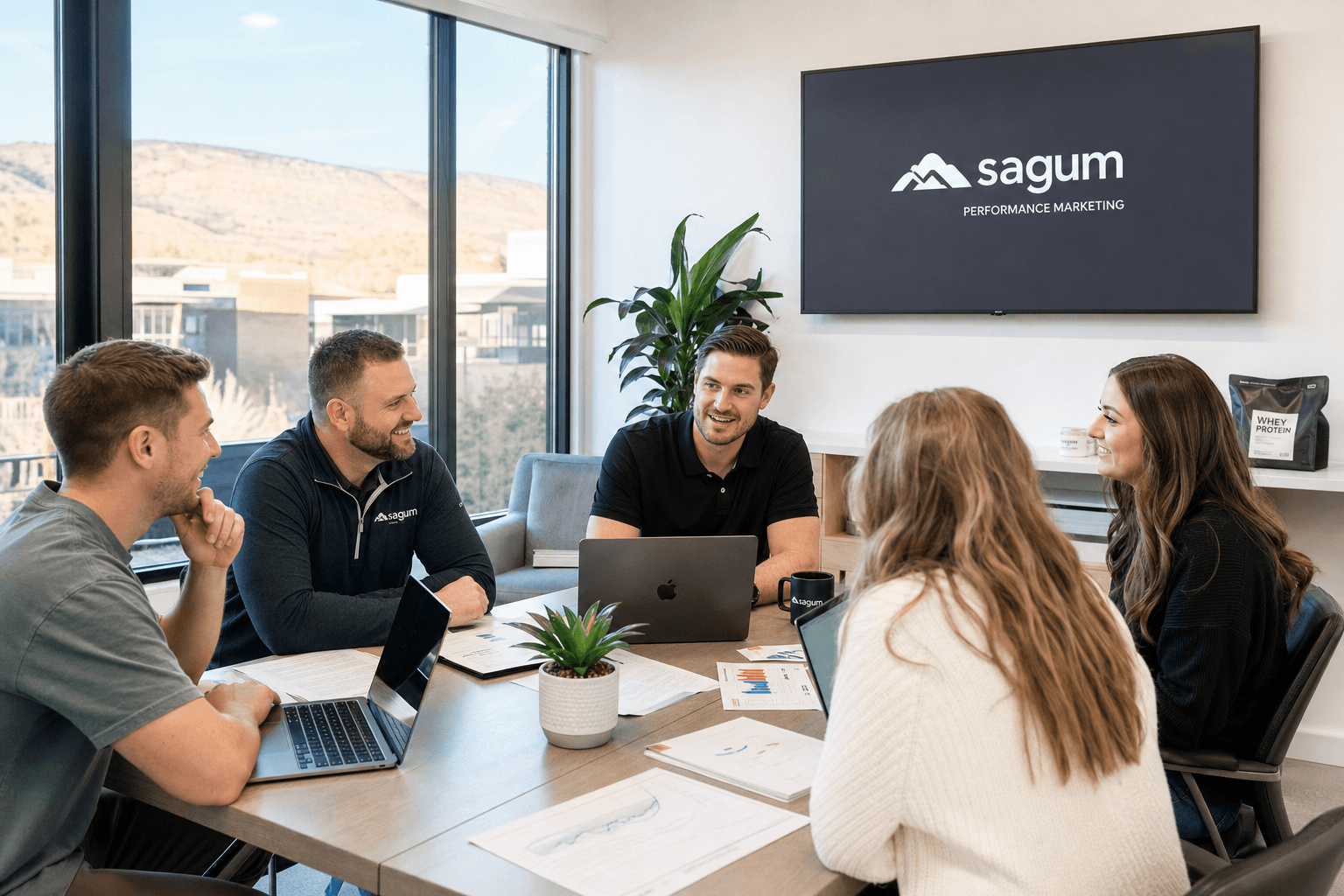
Sagum is a performance marketing agency founded in January 2017 in St. George, Utah. We've spent 8+ years growing real brands and being judged on KPIs, not vanity metrics.
We deliberately limit how many clients we take so each one gets senior attention. We treat your numbers like our own, we never run generic playbooks, and your strategy is built for your business, because shouldn't your brand's marketing be custom to your brand?
Sagum.ai is our AI arm: the same proven operators now build AI into the work wherever it creates real edge, not as theater, but as leverage applied with discipline.
- 8+ years growing brands on performance KPIs, not vanity metrics
- Limited client roster, with senior attention on every account
- An extension of your team; your success is tied to ours
- Custom strategy per brand, never a generic playbook
- AI built in where it moves a number; judgment over hype
“Sagum is a performance marketing agency that's spent 8+ years growing brands by treating their numbers like our own. We take on few clients, never run generic playbooks, and now build AI into the work wherever it creates real edge, not hype. Your strategy is built for your business, and our success is tied to yours.”
“Sagum roughly doubled our bottom line. They treat the work like it's their own business.”
Rachel Nilsson
CEO, RAGS
Proof
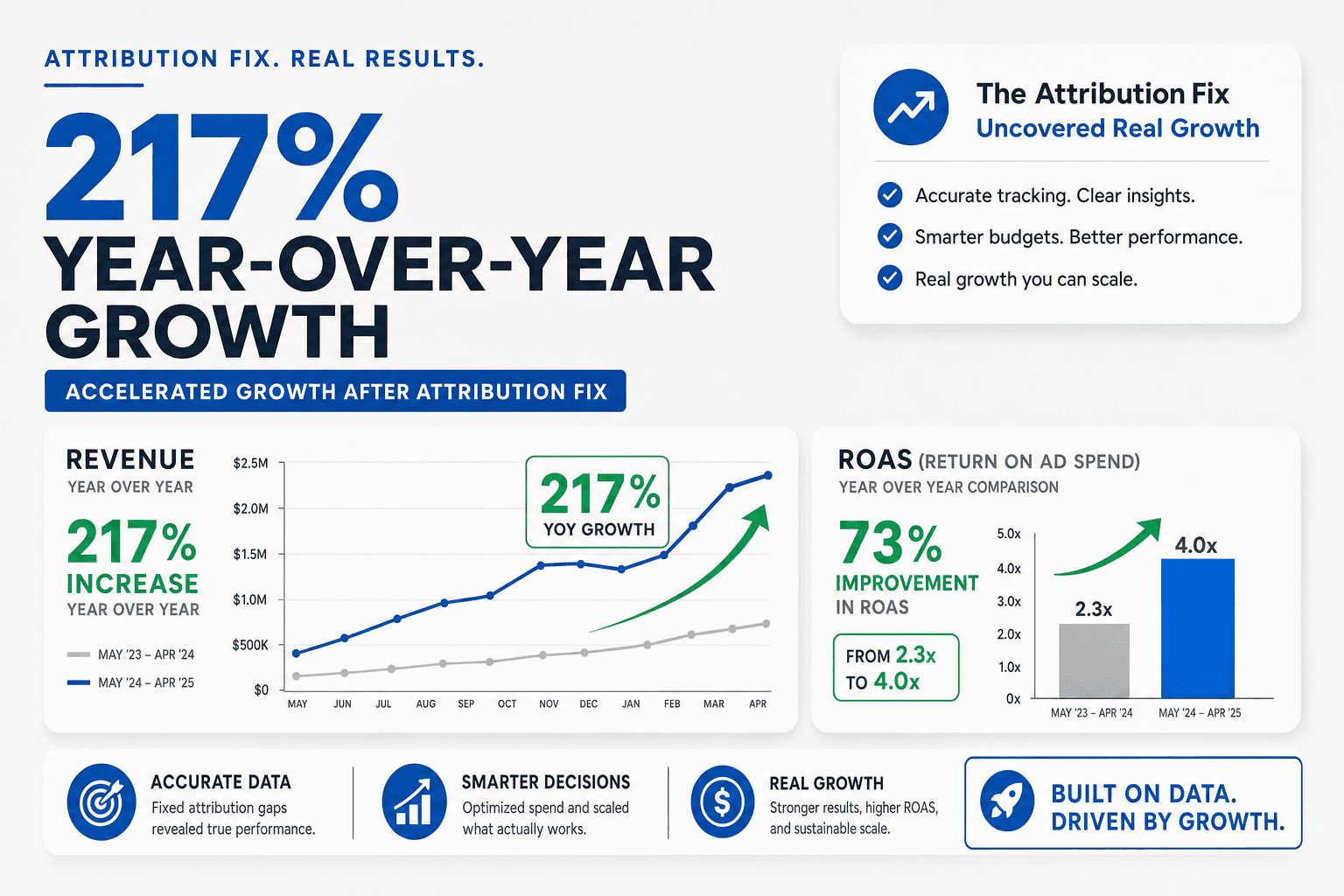
95% growth in 6 months, 217% YoY after fixing a misfiring pixel
Ballerina Farm
Challenge
At Ballerina Farm, a DTC food brand, a misfiring pixel was inflating numbers and hiding true performance.
What we did
We fixed the tracking, then scaled TikTok, Google, and Pinterest.
Result
The brand grew 95% in six months and 217% year over year, with ROAS 64% better than planned. A multi-SKU nutrition brand needs the same tracking-first discipline.
Your Nutrition Brand's Unit Economics Are Solvable With the Right Infrastructure
No obligation. We'll audit your blended ROAS, attribution setup, and creative velocity against your SKUs, seasonality, and subscription model, and show you exactly where the gaps are.
Sagum · January 2017 · St. George, Utah · 8+ years