

8+ years growing brands on KPIs, now with AI
More Revenue From Omnisend
We build and optimize the flows, segments, and campaigns that turn your email and SMS list into a reliable revenue engine.
8+ years growing DTC brands · Google, Meta & TikTok partner · Omnisend strategy built for your list


Get your free Growth Gap Analysis
Senior strategist review · response within one business day
Prefer to reach out directly?
The Challenge
Running Omnisend Is Easy. Extracting Real Revenue From It Isn't.
You chose Omnisend to run email, SMS, and web push in one place without the Klaviyo price tag. It does that well, with a good automation canvas, fast-launch recipes, and pricing that holds as your list grows.
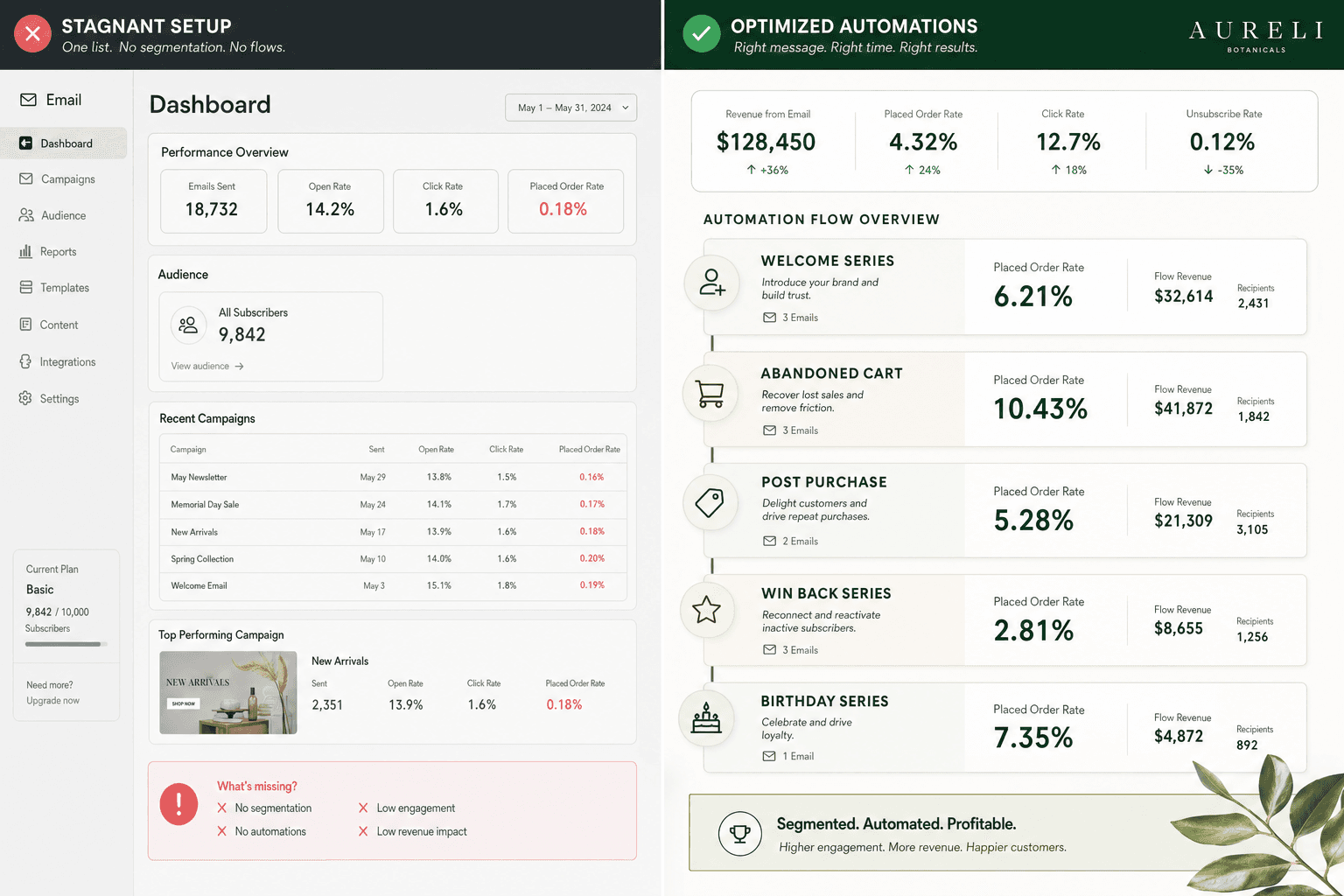
Most brands stall between 'flows are live' and a 25–35% owned-channel revenue share. The welcome series is untouched since launch, cart abandonment runs the default three-step sequence, and campaigns go to 'all subscribers' because building engagement and AOV tiers never makes the weekly list. The Automation Report tab shows Placed Order Rate, but nobody A/B tests delays or channel sequencing.
By default, Omnisend credits sales to any email open or click within 7 days, Apple Mail Privacy Protection (MPP) opens included, so ghost opens can inflate '% of revenue from email' and hide email's true contribution.
The SMS credit system confuses most brands, who under-send to avoid surprise charges or blast everyone and burn sender reputation. Omnisend has the tools; few teams have the discipline to test flows, tier segments, and audit attribution.
The Opportunity
Your List Is Worth More Than Your Campaigns Return
The upside is revenue already in your account: flows that are off, on defaults, or segmented too broadly. By Omnisend's numbers, automated flows make up about 2% of email sends but drive 30% of email-attributed revenue. Automated emails earn $2.87 per send on average; campaigns, which eat 80% of most brands' time, earn $0.18.
Abandoned-cart SMS makes about $3.50–$11 per message for the middle half of Postscript's brands (2026 benchmarks), and during BFCM 2024, 64% of shoppers who clicked an Omnisend welcome email bought. Cart, welcome, and browse abandonment flows drove 87% of Omnisend's automated orders in 2024, yet brands often skip or neglect browse abandonment.
For a brand doing $3M in annual GMV, moving email and SMS from 15% to 30% of revenue is a $450,000 shift at near-zero incremental CAC, with no new channel or added ad spend.
What Most Get Wrong
What Most Omnisend Brands Get Wrong (And What Generic Agencies Miss)
Running default automation recipes without auditing them
Default delays, generic subject lines, and no SMS fallback for unopened emails leave the pre-built cart and welcome flows running at half capacity.
Blasting 'all subscribers' instead of engagement-tiered segments
Most brands never build past Omnisend's default lists, and mailing unengaged contacts sinks opens, lifts unsubscribes, and quietly erodes sender reputation before BFCM, the worst time to find out.
Trusting reported revenue without auditing attribution settings
Omnisend credits sales to any email open or click within 7 days, Apple MPP opens included. Many accounts never change these defaults and risk deciding owned-channel investment on inflated numbers.
Treating SMS as a campaign-only channel
Automated SMS averages $0.74 per send, five times the $0.15 campaign average. Credits go to blasts while cart recovery, post-purchase cross-sell, and win-back SMS sit off or lack suppression logic.
Skipping monthly list cleanup in the Deliverability tab
Mailing degraded lists before BFCM or flash sales spikes spam complaints, risking promotions-tab or junk placement. With MPP opens counted by default and no documented bot-click filter, damage compounds unnoticed.
Why Now
Why Omnisend Brands Can Pull Ahead on Owned Channels Now
Paid media CAC rose roughly 40% between 2023 and 2025 across DTC ecommerce, while list revenue comes from customers you've already acquired. Brands holding or improving blended ROAS get 25–35% of total revenue from email and SMS, not 12–15%. Running Omnisend on defaults costs points of blended ROAS.
After Yotpo discontinued email and SMS, many of its brands moved to Omnisend, which offers free import of contacts, opt-in status, tags, and engagement history. Brands leaving Klaviyo over cost keep arriving and often start on defaults, so tuning before BFCM puts you ahead.
The bottleneck is usually one generalist marketer juggling the account among ten other priorities. AI-assisted flow auditing, subject line testing at scale, segment-build logic, and send-time optimization let one disciplined operator do a dedicated email team's work.
The Mechanism
Where AI Creates an Edge Inside an Omnisend Account
Real productivity, not AI theater. Here's where it actually moves a number for omnisend email brands.
Email and SMS Automation
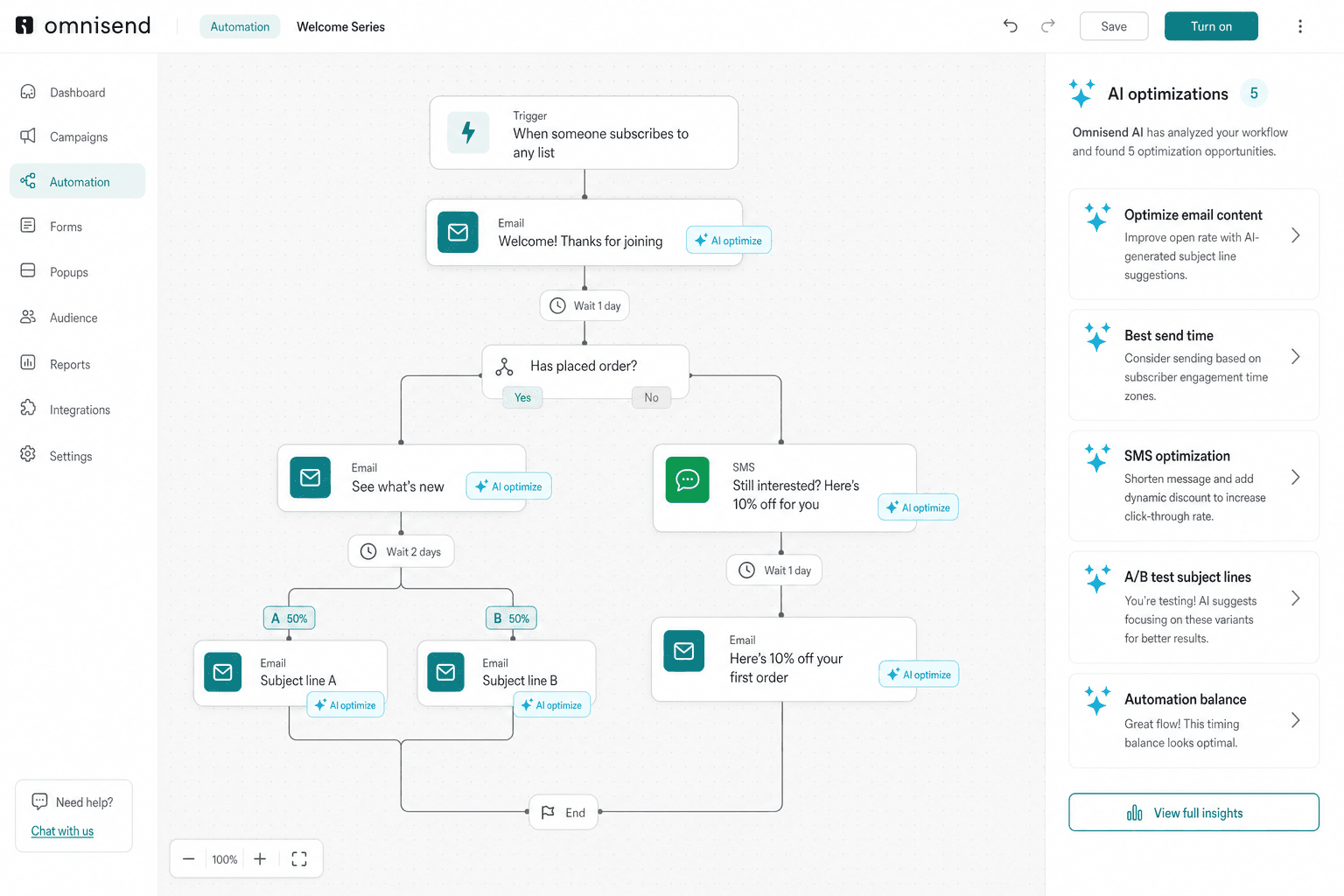
What AI does: AI audits cart, browse, welcome, and win-back flows against Omnisend benchmarks, flags delay and sequencing gaps, and generates A/B variants of subject lines, SMS copy, and send-time logic.
The result: Set-and-forget flows become tested, sequenced systems running at your list's performance ceiling.
Why it matters here: Automation is where Omnisend ROI lives, and AI cuts the time to fix its gaps from months of manual A/B testing to weeks.
Segmentation
What AI does: AI builds engagement-tiered segments with AND/OR filters across purchase history, AOV, total spent, email engagement window, and browsing behavior, each mapped to a cadence and suppression rules.
The result: Unengaged contacts are suppressed before BFCM, VIP and high-AOV segments are sequenced separately, and sender reputation holds.
Why it matters here: Most brands barely use Omnisend's segmentation. On shared infrastructure, shallow segments are the fastest path to deliverability damage, which stays invisible until it's expensive.
Creative and Campaign Strategy
What AI does: AI writes and tests subject lines, preview text, SMS variants, and Campaign Booster resends for non-openers, while Product Picker pulls live catalog data into templates so creative production isn't the bottleneck.
The result: Each campaign earns more per contact because the inbox gets the version that tested best, not the first approved draft.
Why it matters here: Omnisend click-to-conversion jumped 53% year-over-year in 2025: shoppers clicked less but bought more when they did. Creative and subject lines drive conversion; test gains compound.
Analytics and Attribution
What AI does: AI audits Sales attribution settings, estimates how much attributed revenue rests on opens alone, and builds a view of what email and SMS add to blended ROAS net of MPP ghost opens.
The result: You decide owned-channel spend on real numbers, and blended ROAS becomes accurate enough to guide paid media budgets.
Why it matters here: Omnisend's Exclude Apple MPP opens setting is off by default, so unaudited accounts can plan on overstated data. Every optimization depends on accurate owned-channel revenue.
Conversion Optimization
What AI does: AI reviews signup forms (Wheel of Fortune vs. exit-intent, SMS vs. email opt-in rate, popup timing and triggers) and tests variants to grow the list and SMS subscribers.
The result: The list grows faster with dual email and SMS opt-ins, widening automated flows' reach without more paid media spend.
Why it matters here: At $0.74 per automated send, SMS subscribers are your highest-value contacts. A 1-point rise in SMS opt-in rate compounds across every flow for their lifetime.
Ready to see what this looks like for your omnisend email brands business?
No obligation. A senior strategist will show you exactly where the wins are.
The Strategy
How an Omnisend Brand Should Run Owned Channels
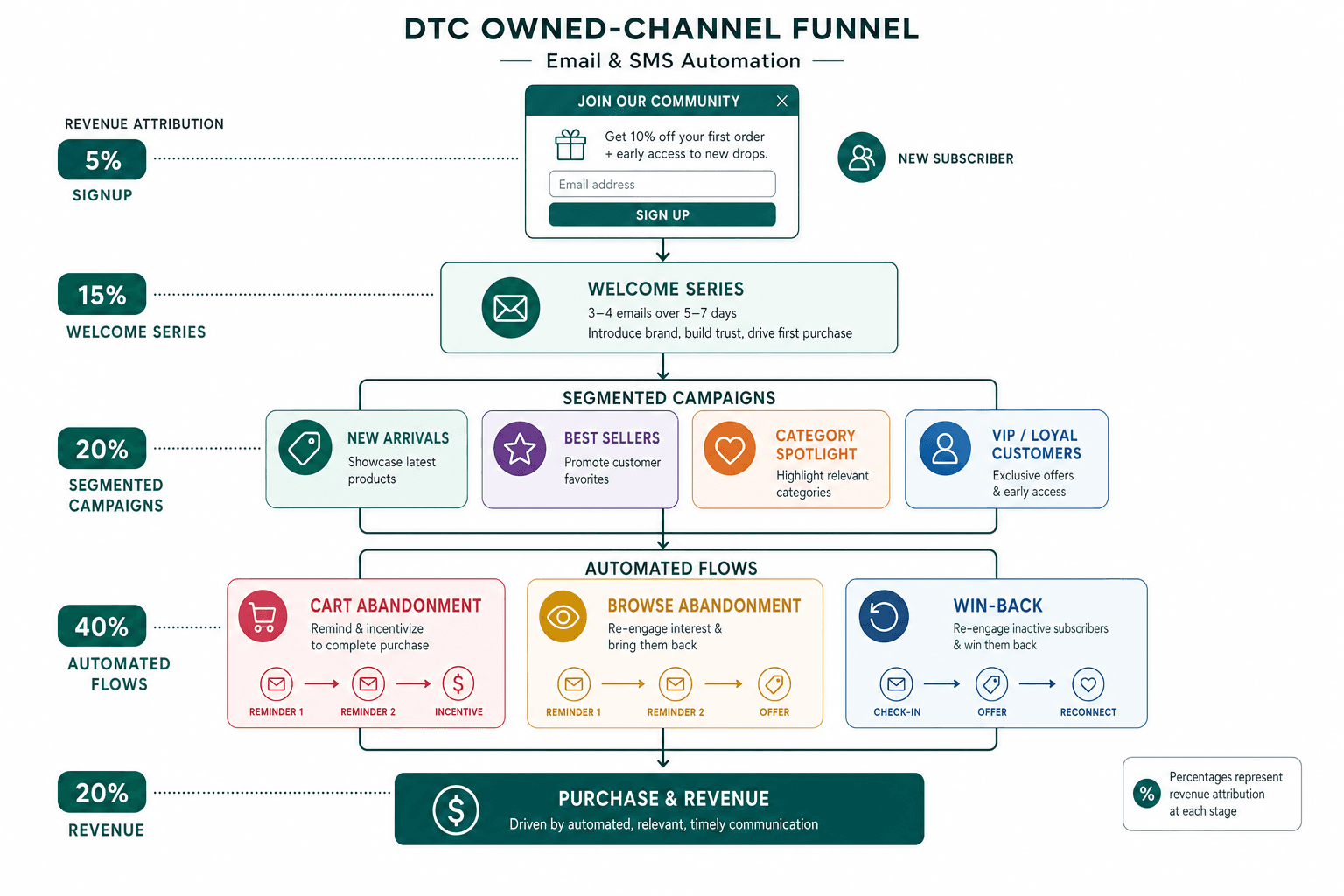
The governing KPI is the share of total revenue from email and SMS, earned at near-zero incremental CAC. Open rate, list size, and send volume are inputs.
Start with automation, where ROI is densest: rebuild cart, browse, and welcome flows to send email first, fall back to SMS if unopened within a set window, with web push as a third touch for opted-in subscribers. A/B test delays, subject lines, and SMS copy until Placed Order Rate stabilizes.
In parallel, tier contacts by engagement (active 30-day, active 90-day, lapsed, unengaged), purchase behavior (one-time, repeat, VIP by AOV or total spent), and SMS opt-in status, and give each tier its own send cadence. Suppress unengaged contacts and move them to a re-engagement flow before they hurt sender reputation.
Fix attribution early: turn on Exclude Apple MPP opens in Sales attribution settings, then reconcile reported email revenue with blended ROAS.
Run SMS as two budget lines: high-ROI automated SMS always runs, while credit budget and suppression logic cap campaign SMS, so credit spend stays predictable.
BFCM prep starts eight weeks out with list cleanup in the Deliverability tab, which flags fake and inactive contacts and grades list health good, fair, or poor. Build tiered segments, configure Campaign Booster, and review flow suppression.
The one number that governs this
Track owned-channel share of revenue against blended ROAS. At $1M–$20M GMV, target 25–35%; below 20%, the gap is in automation and segmentation, not the platform.
How We Help
What We Do Inside Your Omnisend Account
Brands winning on blended ROAS treat Omnisend as a revenue system, not a newsletter tool. We run yours that way: audit first, then the strategy above in sequence.
Automation Flow Build and Optimization
Rebuild cart, browse, welcome, win-back, and post-purchase flows to sequence email, then SMS, then web push, and test them until Placed Order Rate stabilizes.
Segmentation Architecture
Build and maintain engagement and purchase-behavior segments, each mapped to a campaign cadence and suppression rules.
Attribution Audit and Blended ROAS Reconciliation
Audit your Sales attribution settings, including the window and MPP exclusion, then build a blended ROAS view net of MPP ghost opens and bot clicks.
Campaign Strategy and Creative
Run weekly segmented campaigns with tested subject lines, SMS variants, and Campaign Booster resends.
SMS Strategy and Credit Management
Split automated and campaign SMS into distinct budget lines with suppression logic, so automation always stays funded.
List Growth and Signup Form Optimization
Test popup formats, timing, and triggers to grow the list faster with subscribers who opt into both channels.
BFCM and Peak Season Preparation
Clean the list, build tiered sequences, configure Campaign Booster, and review flow suppression so automation and campaigns don't compete in the year's highest-revenue window.
Who's Behind This
Who we are, and what makes us different
Sagum is a performance marketing agency founded in January 2017 in St. George, Utah. We've spent 8+ years growing real brands and being judged on KPIs, not vanity metrics.
We deliberately limit how many clients we take so each one gets senior attention. We treat your numbers like our own, we never run generic playbooks, and your strategy is built for your business, because shouldn't your brand's marketing be custom to your brand?
Sagum.ai is our AI arm: the same proven operators now build AI into the work wherever it creates real edge, not as theater, but as leverage applied with discipline.
- 8+ years growing brands on performance KPIs, not vanity metrics
- Limited client roster, with senior attention on every account
- An extension of your team; your success is tied to ours
- Custom strategy per brand, never a generic playbook
- AI built in where it moves a number; judgment over hype
“Sagum is a performance marketing agency that's spent 8+ years growing brands by treating their numbers like our own. We take on few clients, never run generic playbooks, and now build AI into the work wherever it creates real edge, not hype. Your strategy is built for your business, and our success is tied to yours.”
“After six years, Sagum is our most important partner: trusted, communicative, and caring about our business as if it's their own.”
Long-term partner
6-year client
Proof
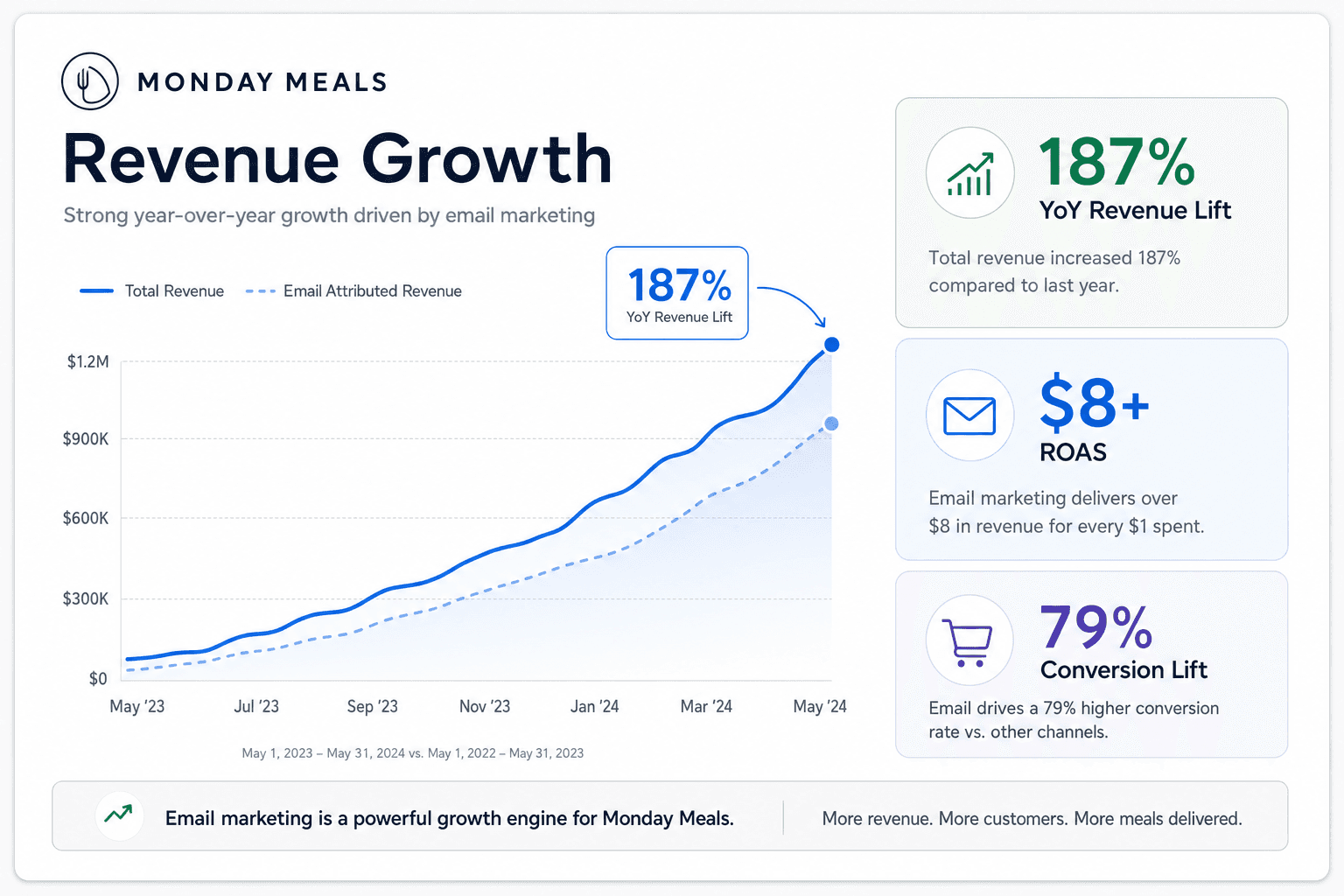
187% YoY, $8+ ROAS on Meta, +79% web conversion
Clean Monday Meals
Challenge
Clean Monday Meals, a DTC food brand, needed to grow across channels.
What we did
We scaled Meta and took over email and Amazon.
Result
The brand posted 187% year-over-year growth, $8+ ROAS on Meta, and a 79% web-conversion lift. For an Omnisend brand, the transferable part is running email alongside paid media.
Find Out What Your Omnisend Account Should Be Returning
No obligation. We audit your flows, segmentation, attribution, list health, and SMS setup, then show you, on your own numbers, the gap between what your account returns and what it should.
Sagum · January 2017 · St. George, Utah · 8+ years