
8+ years growing brands on KPIs, now with AI
Orthodontic Exams That Turn Into Treatment Starts
Marketing built around how parents choose a practice and how adults decide on clear aligners, so your chairs stay full.
Google Ads, Meta & TikTok Partner | 8+ Years Growing Local Service Businesses | Performance-Judged


Get your free marketing audit
Senior strategist review · response within one business day
Prefer to reach out directly?
The Challenge
Orthodontic Marketing Is Nothing Like General Dentistry Marketing
You are not selling a service people buy on autopilot. You are selling a $6,000-plus treatment decision to three completely different buyers who each need a different message, a different channel, and a different reason to choose your practice over the one down the street.
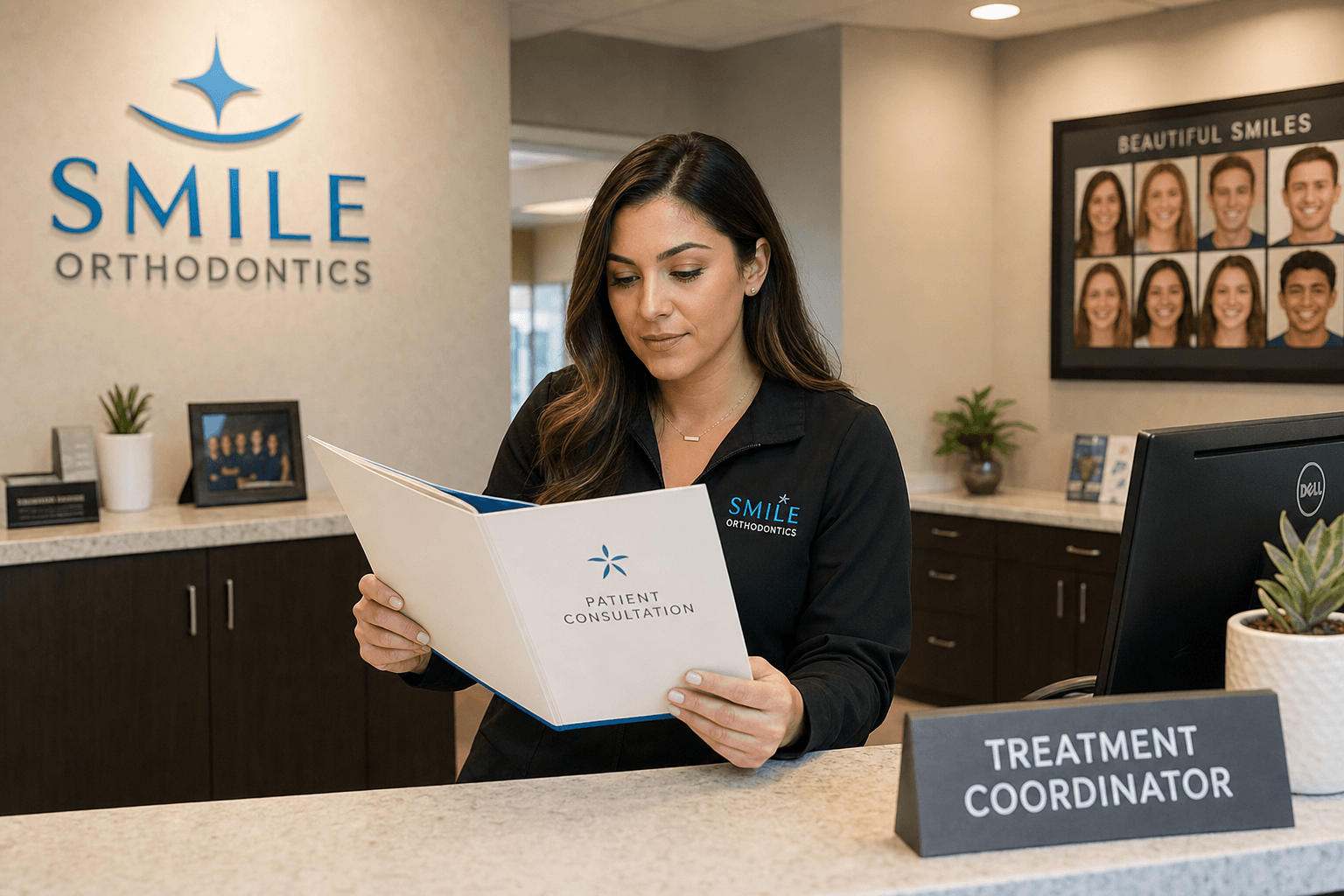
The parent of a seven-year-old is holding a referral slip from a general dentist, mildly overwhelmed by timing questions, and comparing your practice against two others simultaneously. She will not call you back if your front desk does not answer within minutes. She will not book online if your form is buried three clicks deep.
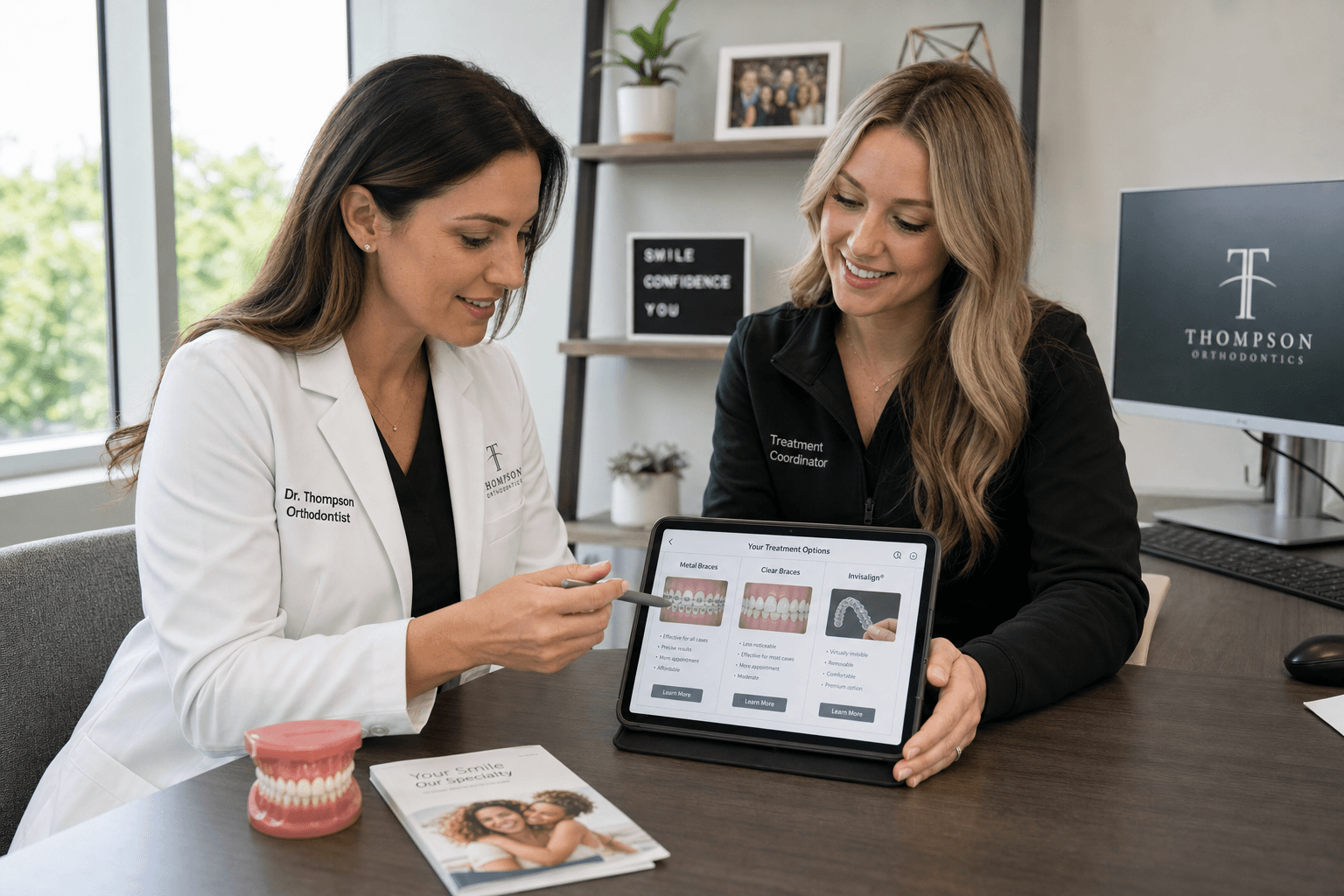
The parent of a fourteen-year-old is making a financial decision while also managing a teenager who has strong opinions about whether metal brackets are going to ruin the next two years of school photos. You have to sell both of them at once.
The adult aligner patient found you after routing through Invisalign's own marketing, a few Instagram before-and-afters, an AI search assistant, and a passing thought about whether her general dentist could just handle it for less. By the time she lands on your site she is skeptical, image-conscious, and fully aware that cheaper alternatives exist.
Demand is also sharply seasonal. July and August can bring far more case volume than an average month. September and October go quiet as school schedules absorb parent bandwidth. Practices running a flat ad budget year-round are overspending when it does not matter and underspending when it does. That mismatch alone costs real money in exam volume and treatment starts.
The Opportunity
The Revenue Is Already There. Most Practices Are Just Not Capturing It.
A practice doing 30 consultations a month at a $5,500 average case fee sits at a fork. A 65 percent exam-to-start conversion rate produces a certain revenue number. An 85 percent conversion rate at the same volume produces roughly $396,000 more per year in production. Same ad spend. Same chairs. The difference is follow-up speed, financial presentation clarity, and how well your pending-start pipeline is worked.
On the acquisition side, the gap between a practice that shows up first for 'orthodontist near me' and 'Invisalign [city]' and one that appears on page two is not marginal. High-intent local search converts at rates that almost no other channel matches for this category, and most markets still have meaningful room to own that position.
General dentists refer a steady stream of orthodontic cases every year. Practices with a structured referral program and consistent outreach to their referring doctor network capture a disproportionate share of that flow. Most practices treat this channel as passive. It is not.
Adults now account for roughly one-third of all orthodontic case volume, and adult patient numbers are at an all-time high. That funnel is underserved by most practice marketing because the messaging, the channels, and the objections are completely different from the parent-and-child funnel. A practice that builds a dedicated adult aligner campaign, separate from its teen and Phase 1 campaigns, is competing in a lane most orthodontists have left wide open.
What Most Get Wrong
What Most Orthodontic Practices and Their Agencies Get Wrong
Running one campaign for all three buyer profiles
A parent researching Phase 1 treatment for a seven-year-old and an adult comparing clear aligner options need completely different messages, landing pages, and offers. Blending them into one campaign produces mediocre relevance for everyone, drives up cost per click, and hands the conversion to whoever speaks to each buyer specifically.
Flat ad budgets that ignore the orthodontic calendar
July and August can produce far more consultation volume than a slow month. September and October reliably go quiet. Practices spending the same amount in October as in July are wasting budget when intent is low and starving their pipeline when it matters most. Seasonal calibration alone can meaningfully lower CPL compared with flat-budget campaigns.
Ignoring the pending-start pipeline
Families who attended a consultation and did not sign that day are not lost. They are the warmest leads in the building. Most practices do no structured follow-up beyond one or two generic emails. A consistent, personalized pending-start sequence that addresses financing questions and removes uncertainty converts a meaningful share of those families within 30 to 60 days of the exam.
Burying payment plan information
A $6,000-plus treatment fee is the number-one objection in this category. Practices that lead with monthly payment options ($199 per month, zero percent interest, with the required credit terms disclosed) in their ads, on their landing pages, and in their exam presentation close more same-day starts. Practices that disclose financing only after the clinical presentation lose families who self-disqualified on cost before the conversation even happened.
No call tracking or broken attribution
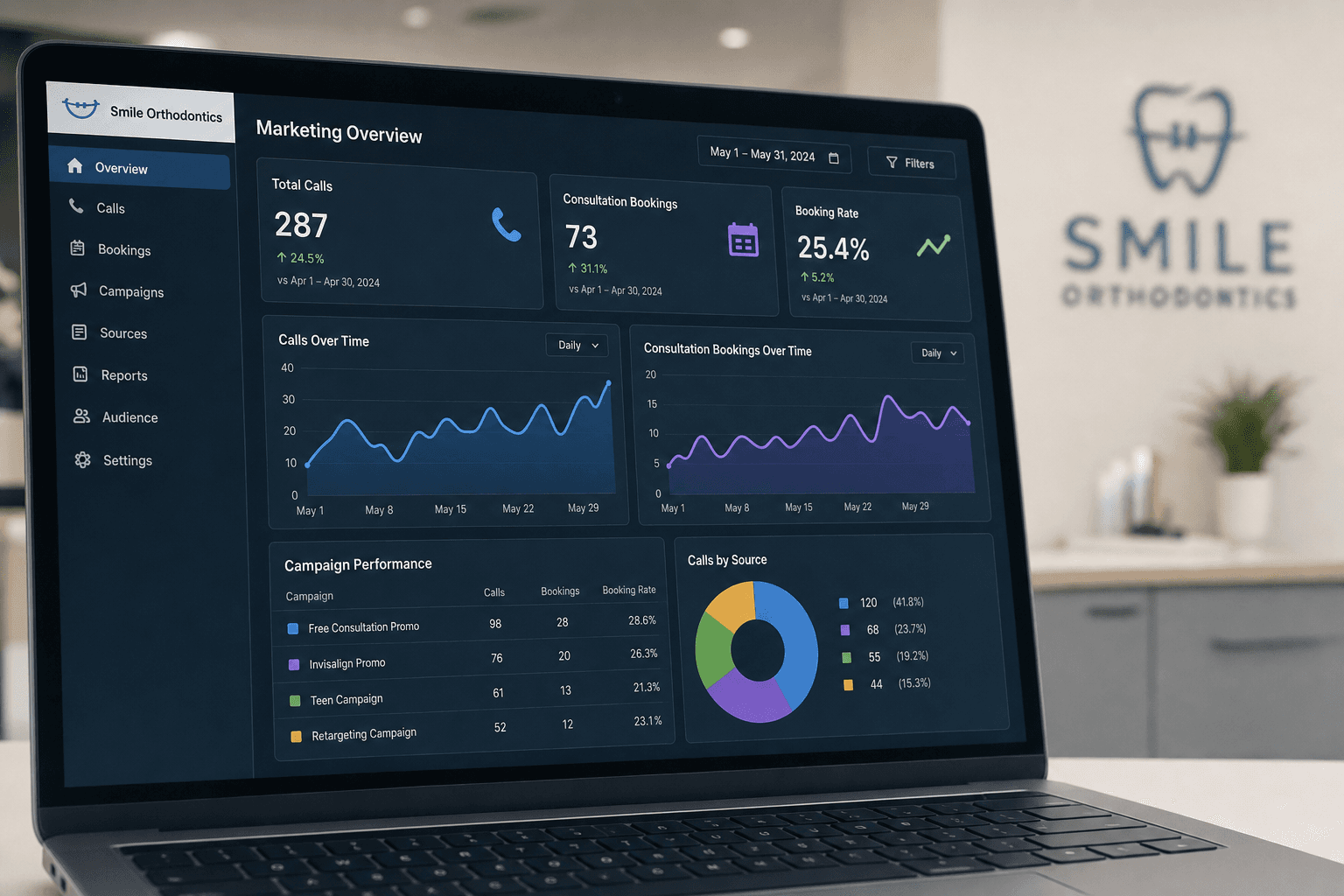
Most orthodontic consultations are booked by phone, not through a web form. If your ads platform is not tracking inbound calls to specific campaigns, you are flying blind. You cannot tell which keywords are booking exams and which are generating tire-kicker calls. Agencies that report on clicks and impressions without tying activity to booked exams are measuring the wrong things entirely.
Why Now
Why the Practices That Move Now Will Own Their Markets Through the Next Growth Cycle
Most orthodontic practices are still running the same paid search setup they had three years ago: a handful of keywords, a generic ad pointing to the homepage, a phone number as the only conversion path, and no structured follow-up for leads that did not book immediately. That approach worked when competition was thinner. It is increasingly expensive and increasingly ineffective as more general dentists enter the aligner space and DSOs expand into suburban markets.
The practices pulling ahead right now are doing something different. They are running separate, tightly-built campaigns for each buyer profile, with landing pages and offers matched to each. They are using AI to test creative and messaging at a pace a single-office practice could never manage manually. They are tracking every inbound call to the campaign that generated it. And they are running structured pending-start sequences that recover revenue that used to walk out the door.
The adult aligner funnel is the most underbuilt opportunity in this category right now. DTC brands have weakened significantly since SmileDirectClub shut down in 2023, leaving a segment of cost-conscious adult patients who still want professional oversight but are not sure where to find it. A practice with a clear, benefit-forward adult aligner campaign, positioned around specialist training and clinical safety, can capture that demand before competitors notice the opening.
Next summer is the next major peak. Practices that have their campaigns, landing pages, call handling, and follow-up sequences built before May will capture the volume. Practices that start building in June will spend the peak season figuring out their setup.
The Mechanism
Where AI Actually Moves the Numbers for an Orthodontic Practice
Real productivity, not AI theater. Here's where it actually moves a number for orthodontists.
Digital Ads
What AI does: AI-driven bid management that shifts budget toward the campaigns and time windows generating booked exams, not just clicks. Separate bidding logic for the parent-and-child funnel versus the adult aligner funnel, with automated budget reallocation as seasonal intent patterns shift.
The result: Lower cost per booked exam during peak months and automatic pullback during low-intent windows like September and October, without requiring manual daily adjustments.
Why it matters here: Orthodontic demand is sharply seasonal and split across distinct buyer profiles. A flat, manual bidding approach overspends when intent is low and misses volume when it peaks. AI-managed bidding responds to actual search behavior in real time rather than a monthly budget plan made in advance.
Creative
What AI does: Generate and test multiple ad creative angles per week across the parent funnel (Phase 1 timing reassurance, teen aesthetics, payment plan clarity) and the adult funnel (specialist credentials, smile transformation, DTC cautionary contrast). AI identifies which angle is driving exam bookings, not just engagement.
The result: Faster identification of the message that books consultations, with losing angles cut before they burn significant budget.
Why it matters here: The three buyer profiles in orthodontics respond to completely different creative signals. A parent worried about Phase 1 timing is not moved by the same message as an adult comparing clear aligner providers. Testing more angles faster means finding the right message for each segment before a competitor does.
Conversion Optimization
What AI does: AI-reviewed landing pages built separately for each funnel, with continuous analysis of where visitors drop off before booking. Includes call-to-action placement, online booking friction reduction, and payment plan visibility testing. AI flags conversion leaks as they appear rather than in a quarterly review.
The result: Higher percentage of landing page visitors who book an exam, and faster identification of the page elements that are costing you consultations.
Why it matters here: Most orthodontic practices send paid traffic to a generic homepage or a single treatment page that was not built to convert a specific buyer. A parent researching Phase 1 timing and an adult comparing aligner options need different pages with different offers. A landing page built and continuously optimized for each funnel converts at a materially higher rate than a shared page.
Analytics
What AI does: Privacy-safe call tracking tied to specific campaigns and keywords, so every inbound consultation call is attributed to the ad that generated it. AI-assisted attribution catches discrepancies between reported clicks and actual booked exams, including the common problem of a misfiring conversion tag inflating reported performance.
The result: A clean, trustworthy picture of which campaigns are producing booked exams and treatment starts, not just traffic.
Why it matters here: Orthodontic consultations are primarily booked by phone. Without call tracking tied to campaign-level data, you cannot tell whether your $4,000 monthly ad spend is generating exams or generating calls that your front desk is not converting. You cannot optimize what you cannot measure accurately.
What AI does: Automated pending-start sequences that deploy personalized follow-up to families who attended a consultation but did not sign a treatment contract. Sequences address the specific objections common at each stage: financing questions in the first week, clinical timing questions in the second, a limited-time offer or payment plan reminder at 30 days.
The result: A higher percentage of pending starts converted to signed contracts within 30 to 60 days of the consultation, recovering revenue that previously stalled and went cold.
Why it matters here: The gap between a 65 percent and 85 percent exam-to-start conversion rate at 30 consultations per month is roughly $396,000 per year in production. Most of that gap lives in the pending-start pipeline. Automated, personalized follow-up is the most direct way to close it without adding headcount.
Ready to see what this looks like for your orthodontists business?
No obligation. A senior strategist will show you exactly where the wins are.
The Strategy
What a Purpose-Built Orthodontic Marketing Strategy Actually Looks Like
The foundation is local search. Every dollar spent on Google Search should be pointed at high-intent queries: 'orthodontist near me,' 'braces [city],' 'Invisalign [city],' and the Phase 1 variants parents use when their general dentist has just handed them a referral. These searches represent a buyer who has already decided to get orthodontic treatment and is now choosing a practice. That is the highest-value moment in the funnel and the one where your cost per booked exam is lowest.
Each physical office location needs its own Google Business Profile actively managed for review recency, photo count, and Q&A. The map pack drives a significant share of local consultation calls, and it is governed by signals most practices treat as an afterthought.
Paid social runs on a separate logic from search. Meta and Instagram campaigns target parents aged 28 to 45 with children in the household for the kid and teen funnel, and adults aged 25 to 45 with cosmetic improvement interest for the aligner funnel. Video creative showing real smile transformations outperforms static in this category. Retargeting captures recent website visitors, served with financing and payment plan messaging that addresses the cost objection directly.
The adult aligner campaign is built as a standalone funnel, not a variation of the teen campaign. The landing page, the offer, the objection handling, and the follow-up sequence are all different. The primary message addresses specialist training and clinical oversight as the counter to general dentists and the cautionary history of DTC brands.
Budget pacing follows the orthodontic calendar deliberately. Spend increases in May through August and again in late November through December when consultation intent peaks. September and October budget shifts toward pending-start follow-up and referral doctor outreach rather than new patient acquisition. January carries a dedicated FSA and insurance-benefit promotional cadence.
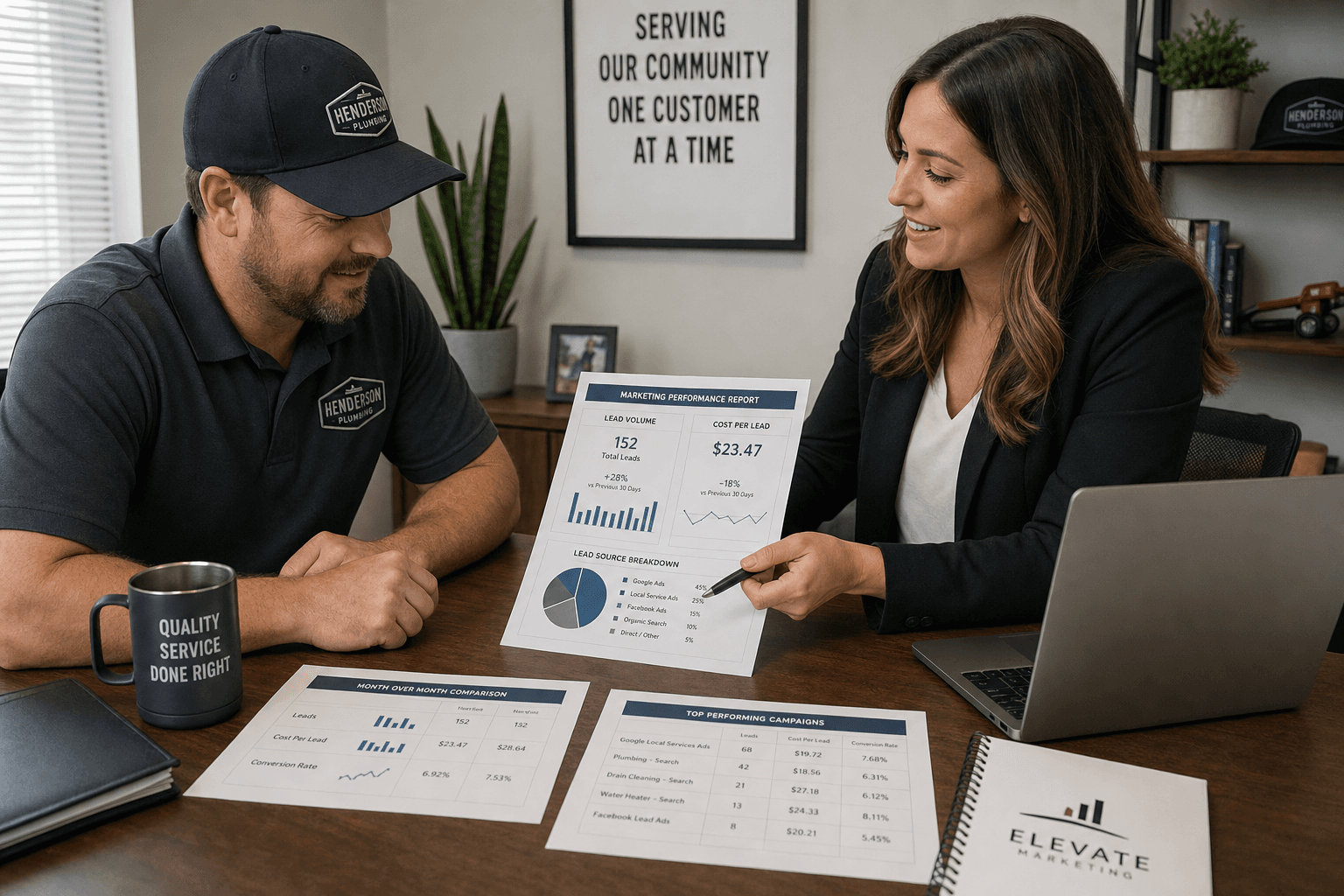
Every inbound call is tracked to the campaign that generated it. The governing KPIs are cost per new patient exam and cost per treatment start. Clicks, impressions, and website sessions are reported as context, not as measures of success.
The one number that governs this
Governing KPIs: cost per new patient exam and cost per treatment start. Every campaign decision is made against these two numbers.
How We Help
How We Build and Run This for Your Practice
We start where the numbers are broken and work forward from there. For most orthodontic practices that means fixing attribution first, so you know what is actually generating exams, then rebuilding campaigns around the buyer profiles and seasonal patterns that drive this category. Here is the specific sequence we follow.
Call Tracking and Attribution Setup
Every inbound consultation call is tied to the campaign and keyword that generated it before we touch a single bid. Without this, optimization is guesswork.
Google Search Campaign Build (Multi-Funnel)
Separate campaigns for Phase 1 intent, teen comprehensive intent, and adult aligner intent, each with its own keyword set, ad copy, and landing page. High-intent local queries only. No broad-match waste.
Google Business Profile Management (Per Location)
Review generation cadence, photo updates, Q&A responses, and local citation consistency for each physical office. Map pack visibility is non-negotiable for local consultation volume.
Paid Social (Meta and Instagram)
Parent-targeted campaigns for the kid and teen funnel, adult-targeted campaigns for the aligner funnel, with video creative showing smile transformations and retargeting sequences serving financing messaging to warm visitors.
Landing Page Development and Conversion Optimization
Purpose-built pages for each funnel with online booking, payment plan visibility, and continuous AI-assisted review for conversion leaks. No sending paid traffic to the homepage.
Pending-Start Email Automation
Personalized follow-up sequences for families who attended a consultation but did not sign, addressing financing, timing, and clinical questions at the right intervals to recover stalled starts.
Seasonal Budget Management
Planned budget increases in May through August and late November through December, deliberate pullback in September and October, and a January FSA promotional cadence built into the annual plan from day one.
Performance Reporting Against Governing KPIs
Monthly reporting built around cost per booked exam and cost per treatment start. We do not report on vanity metrics. If a campaign is not producing exams at an acceptable cost, we change it.
Who's Behind This
Who we are, and what makes us different
Sagum is a performance marketing agency founded in January 2017 in St. George, Utah. We've spent 8+ years growing real brands and being judged on KPIs, not vanity metrics.
We deliberately limit how many clients we take so each one gets senior attention. We treat your numbers like our own, we never run generic playbooks, and your strategy is built for your business, because shouldn't your brand's marketing be custom to your brand?
Sagum.ai is our AI arm: the same proven operators now build AI into the work wherever it creates real edge, not as theater, but as leverage applied with discipline.
- 8+ years growing brands on performance KPIs, not vanity metrics
- Limited client roster, with senior attention on every account
- An extension of your team; your success is tied to ours
- Custom strategy per brand, never a generic playbook
- AI built in where it moves a number; judgment over hype
“Sagum is a performance marketing agency that's spent 8+ years growing brands by treating their numbers like our own. We take on few clients, never run generic playbooks, and now build AI into the work wherever it creates real edge, not hype. Your strategy is built for your business, and our success is tied to yours.”

“After six years, Sagum is our most important partner: trusted, communicative, and caring about our business as if it's their own.”
Proof
From a $20 CPL goal to $13 CPL and 300+ leads/mo
Rizzoli's Automotive
Challenge
Rizzoli's Automotive needed a predictable, high-volume lead flow at a cost per lead that made the economics work. Their goal was 100 qualified leads per month at roughly $20 per lead.
What we did
We rebuilt their campaigns around the highest-intent local search queries and built a purpose-built landing page designed specifically to drive inbound calls.
Result
Cost per lead dropped from a $20 target to $13. Monthly lead volume grew to more than 300. The landing page converted at over 60 percent. The client used the predictable lead flow to support opening multiple new locations. The same principles, purpose-built local search and call-driving landing pages, are the foundation of how we would run your practice's campaigns.
- Cost per lead
- $13
- Leads / month
- 300+
- Landing-page conversion
- 60%+
Find Out Exactly Where Your Practice Is Losing Exam Volume and Treatment Starts
No obligation. We will review your current campaigns, attribution setup, and funnel by buyer profile and show you specifically where the gaps are. Built around your practice, your markets, and your peak season.
Sagum · January 2017 · St. George, Utah · 8+ years