
8+ years growing brands on KPIs, now with AI
Stronger MER without more outdoor gear spend
Profitable new-customer acquisition and creative that converts, built around how buyers research and compare.
8+ years growing ecommerce brands · Google, Meta & TikTok partner · results measured in ROAS, not impressions


Get your free Growth Gap Analysis
Senior strategist review · response within one business day
Prefer to reach out directly?
The Challenge
Growing a DTC Outdoor Gear Brand in 2026 Is a Three-Front War
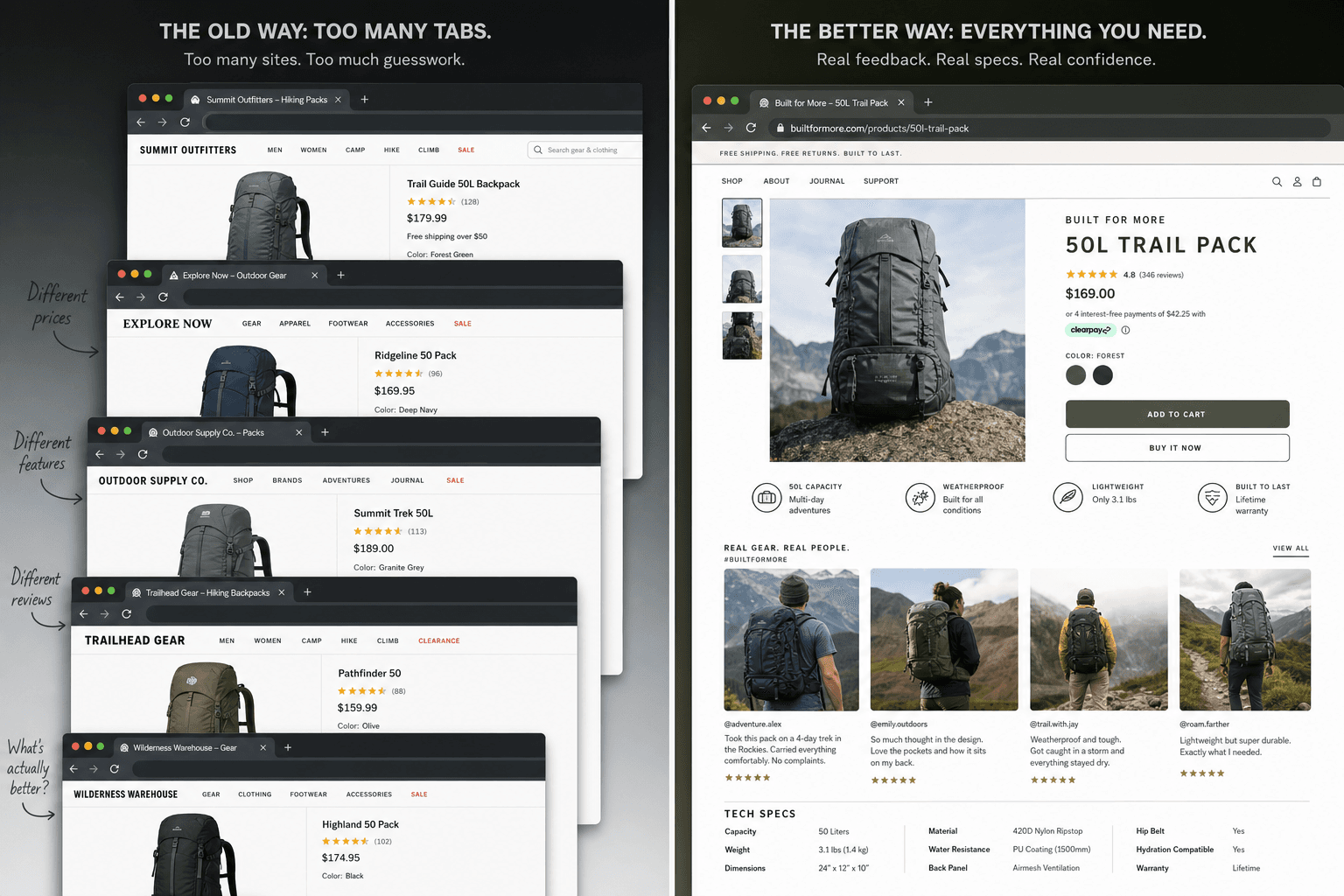
You're not just competing against other gear brands. You're competing against REI.com, Backcountry, Amazon, and Dick's, all of whom your prospective customer has open in adjacent browser tabs, using the endless aisle to compare your $189 fleece against six alternatives before they ever hit Add to Cart.
On top of that, the post-pandemic outdoor boom has corrected hard. The first-time campers and hikers who bought their initial kit during lockdowns have mostly kitted out. They're not back in market, and the brands that grew fast on that wave are now sitting on excess inventory and running promotions that have trained consumers to wait for a deal. The average price of REI and Patagonia products dropped nearly 25% since late 2023, and that discount conditioning is now your problem too.
Then there's the margin math. Google, Meta, and Amazon together can consume 15–40% of your revenue in acquisition costs before you've paid a dollar of fulfillment or COGS. Add UPS or FedEx at 15–20% and card processing at 3–3.5%, and you can run a seven-figure revenue line and still be unprofitable. The question your marketing has to answer isn't 'what's a good ROAS?' It's 'what ROAS do I need to actually hit my contribution margin target?'
And the buying cycle doesn't make it easier. A $40 hydration accessory might convert in the same session. A $450 sleeping bag gets 2–4 weeks of Reddit threads, YouTube gear reviews, and Wirecutter comparisons before someone pulls the trigger, and they might buy it somewhere else after your ad introduced them to it. Your marketing has to work across that entire spectrum simultaneously.
The Opportunity
The Brands Winning Right Now Are Doing One Thing Differently
Despite the noise, over half of all sports equipment dollars are now sold online, and that number keeps climbing. The demand is real and it's growing. The gap is between brands that are capturing it profitably and brands that are buying revenue at a loss.
The brands outperforming in this environment share a specific profile: strong brand identity that commands premium pricing (Yeti's expansion into bags and outdoor accessories is the clearest recent example), multi-channel discipline across DTC and retail, and creative that earns trust before it asks for a click. They're not winning on price. They're winning on credibility.
For a DTC outdoor brand with a genuine product and a real community, the opportunity is in three places. First, Google Shopping and PMax for high-intent buyers who already know what they want: the 'ultralight 3-season sleeping bag' searcher is ready to buy and your competitors are often bidding sloppily. Second, TikTok and Instagram for the gorpcore and adventure-adjacent consumer who discovers gear through content before they know they need it. Third, email and SMS to re-engage seasonal buyers before each peak window opens, because a customer who bought a tent from you two summers ago is far cheaper to win back than a cold prospect.
The brands that invest in these three channels with discipline (and measure everything against contribution margin, not vanity ROAS) are growing. The ones running generic ad playbooks and hoping for the algorithm to figure it out are the ones running promotions to clear inventory.
What Most Get Wrong
What Most Outdoor Gear Brands (and Their Agencies) Get Wrong
Optimizing for ROAS when they should be optimizing for MER
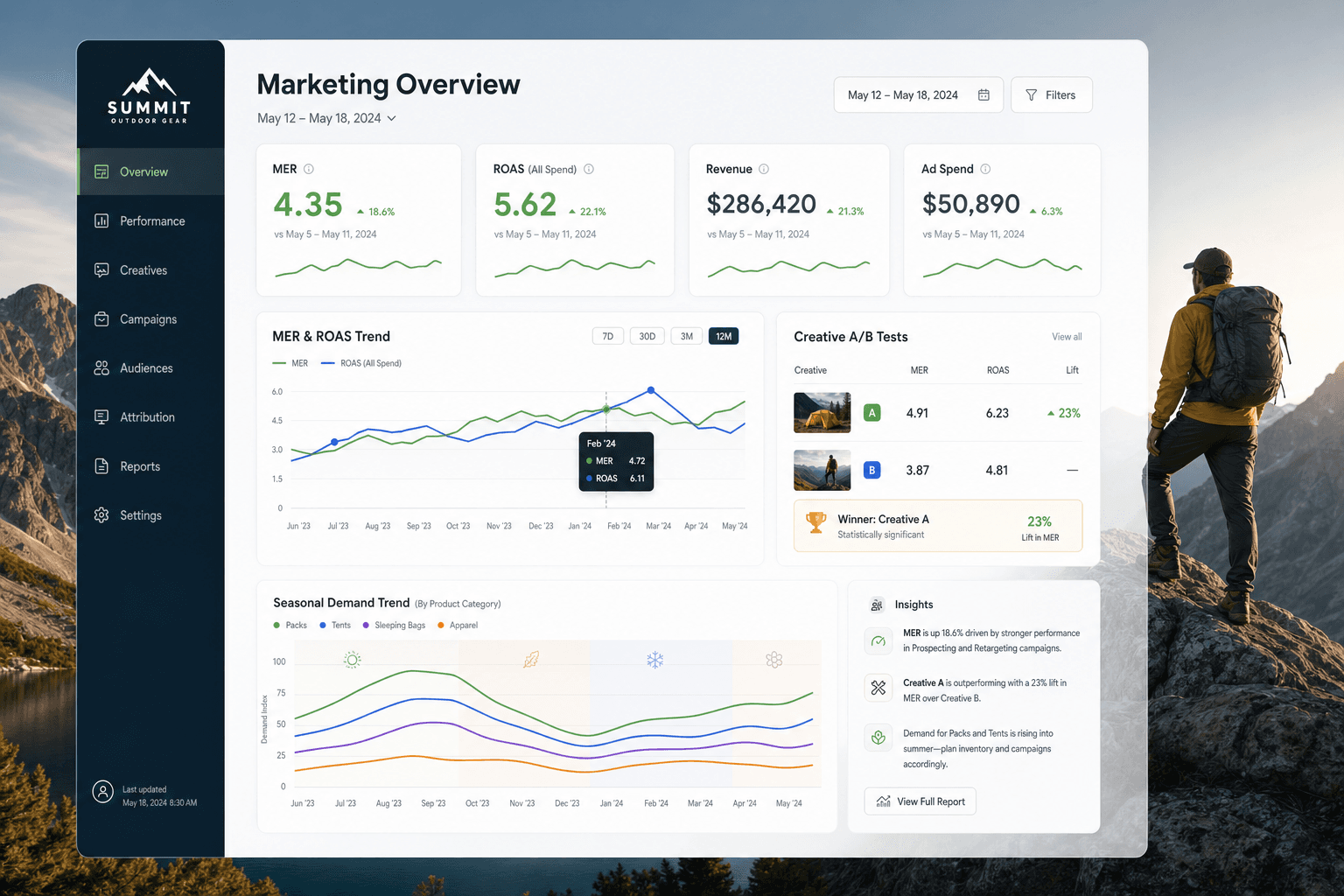
Platform-reported ROAS is broken post-iOS 14. If your Meta dashboard says 3.2× but your blended MER (total revenue ÷ total ad spend) is 1.8×, you're losing money while your agency sends you a green report. Brands that don't track MER alongside contribution margin are flying blind.
Running the same budget and creative year-round
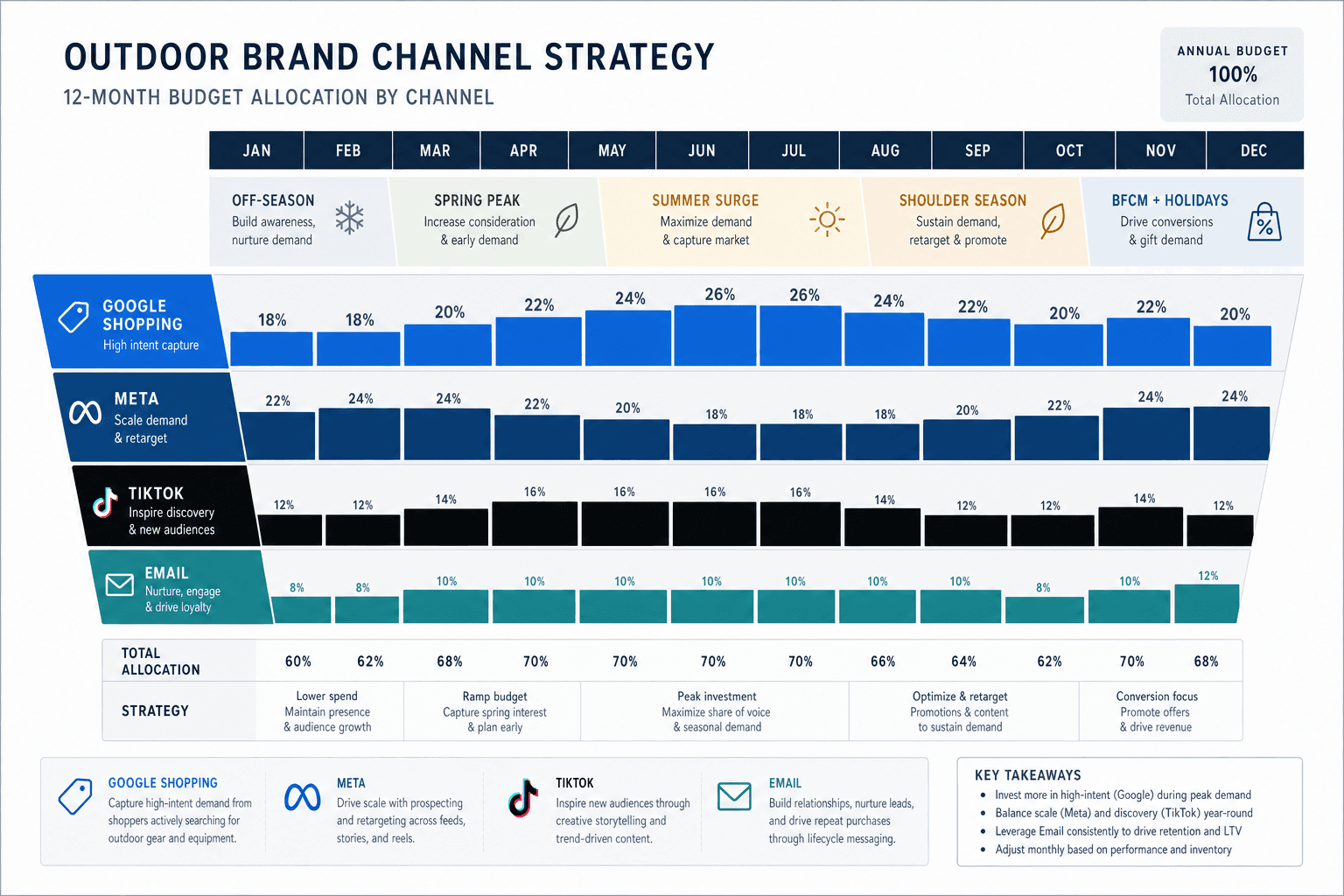
Outdoor demand is sharply seasonal: sleeping bag and camping gear searches spike in March through May, summer travel gear peaks June through August, and September/October go quiet. Brands that spend evenly across all twelve months are wasting budget in the troughs and under-investing during the peaks when buyers are actually in market.
Treating Google Shopping as a set-and-forget channel
PMax campaigns left unmanaged will optimize toward your easiest conversions, often branded queries from people who already know you, while ignoring the high-intent non-branded searches ('lightweight 2-person tent under $300') where you can actually acquire new customers. New customer acquisition cost (nCAC) never improves because the algorithm is just retargeting warm audiences.
Ignoring the research-phase content that drives big-ticket conversions
A $450 sleeping bag doesn't convert from a single ad impression. The buyer spends 1–4 weeks on Reddit, YouTube, and gear review sites before deciding. Brands with no presence in that research ecosystem lose the sale to whoever shows up there, often REI or Backcountry with better SEO and more UGC. The ad that runs during the purchase window gets the credit; the content that built the trust did the actual work.
Letting email go dormant between peak seasons
Outdoor consumers don't stop caring about their sport in January. They switch from doing it to reading and planning. A customer who bought trail runners from you in June and never heard from you again is a lost repeat purchase. Brands with automated win-back flows and seasonal re-engagement sequences capture that second and third purchase; brands without them pay full nCAC to re-acquire the same customer next spring.
Why Now
Why the Next 12 Months Are the Window That Matters
The outdoor gear market is in a reset. Excess inventory from the pandemic boom has mostly cleared, promotional pressure is easing, and the category is entering a new growth cycle, but on different terms. The brands that establish strong digital acquisition infrastructure now will own the customer relationships when demand normalizes. The ones still running 2021 playbooks will be competing on price.
At the same time, AI has created a real gap between operators who use it with discipline and those who don't. Testing one creative concept per month used to be the norm. Now a disciplined team can test five or more per week, identify the angle that converts fastest, and scale it before competitors have finished their creative brief. On Google Shopping, AI-assisted feed optimization and bidding adjustments that used to take days happen in hours. The brands moving fastest on this are compressing their nCAC while competitors hold flat.
There's also a specific creative opportunity in the gorpcore crossover moment. The fashion-meets-outdoor aesthetic is pulling a new consumer segment (one that discovers gear through TikTok and Instagram content, not gear review sites) into the category. Brands with strong visual creative and a presence in that content ecosystem are acquiring customers at lower CPMs than traditional outdoor advertising, because the competition for that audience hasn't caught up yet.
This window won't stay open. As more brands adopt AI-assisted creative testing and the gorpcore trend matures, CPMs will rise and the creative edge will compress. The advantage belongs to whoever builds the system first.
The Mechanism
Where AI Actually Moves the Numbers for Outdoor Gear Brands
Real productivity, not AI theater. Here's where it actually moves a number for outdoor gear brands.
Creative
What AI does: AI-assisted creative production and systematic A/B testing across ad angles (product-led, lifestyle, UGC-style, technical spec callouts, and ambassador content) running simultaneously rather than sequentially.
The result: Test 5× more creative angles per week and surface the winning hook in days instead of months, with the right angle routinely lifting CTR 30–40% and pulling nCAC down on the same product before competitors have finished their next creative brief.
Why it matters here: In outdoor gear, the difference between a 'technical performance' angle and a 'this is what your Saturday looks like' lifestyle angle can be a 40% difference in CTR for the same product. Finding that faster is a direct lever on your MER.
Digital Ads
What AI does: AI-powered Google Shopping feed optimization: product titles, descriptions, and custom labels structured around the high-intent queries that actually convert new customers ('ultralight 3-season tent,' 'waterproof trail running shoe men'), plus automated bid adjustments tied to seasonal demand signals.
The result: Budget follows actual purchase intent rather than a flat monthly allocation; spend accelerates into the March–May spring peak and the summer surge, pulls back in September–October when the category goes quiet.
Why it matters here: Most outdoor gear brands run PMax campaigns that optimize toward branded and warm-audience conversions because that's what the algorithm finds easiest. Structured AI-assisted feed management forces the campaign toward genuine new customer acquisition, the only kind that actually grows the business.
Analytics
What AI does: MER tracking and cross-channel attribution modeling that reconciles platform-reported ROAS against actual blended performance, catching discrepancies between what Meta says it's driving and what's showing up in revenue, and flagging pixel or conversion tracking errors before they corrupt optimization decisions.
The result: Catch the misfiring pixel or duplicated conversion event that was inflating a channel's reported ROAS by 30–50%, then redirect the spend it was hiding into the channels actually producing revenue, so budget decisions follow real blended performance instead of each platform's self-report.
Why it matters here: Post-iOS 14, a DTC outdoor brand running three paid channels without a unified MER view is making budget allocation decisions based on incomplete and often contradictory data. One misfiring pixel can inflate ROAS by 30–50% and cause you to scale a losing channel.
What AI does: AI-driven segmentation and send-time optimization for seasonal re-engagement sequences, identifying which past buyers are most likely to be entering a new gear purchase cycle based on purchase history, category, and time-since-purchase, then triggering the right message before the peak window opens.
The result: Re-engage lapsed seasonal buyers at a fraction of the nCAC it would cost to re-acquire them cold through paid channels.
Why it matters here: An outdoor gear customer who bought a sleeping bag 18 months ago and went quiet is probably planning their next camping season right now. A well-timed February email about complementary gear (camp kitchen, hydration, apparel) costs almost nothing to send and converts at dramatically higher rates than cold prospecting.
Conversion Optimization
What AI does: AI-assisted product page audits focused on the trust signals that matter for high-consideration outdoor gear purchases (fit guides, 360° product views, field-test UGC, technical spec clarity, warranty callouts) plus landing page variants for paid traffic that match the creative angle that drove the click.
The result: Higher conversion rate on the traffic you're already paying for, with specific improvements to big-ticket product pages where a 1–2% conversion lift has an outsized revenue impact.
Why it matters here: A $450 tent buyer who lands on a product page with thin specs, no real-world photos, and a buried return policy will leave. The research they did on YouTube and Reddit built intent; your product page either closes it or loses it to REI.
Ready to see what this looks like for your outdoor gear brands business?
No obligation. A senior strategist will show you exactly where the wins are.
The Strategy
What a Purpose-Built Outdoor Gear Marketing Strategy Actually Looks Like
The foundation is measurement you can trust. Before a dollar of paid spend is optimized, you need a unified MER view (total revenue divided by total ad spend) reconciled against platform-reported ROAS so you know where the discrepancies are. This means a clean pixel setup, proper conversion event configuration on Google and Meta, and a dashboard that shows blended performance across all channels simultaneously. Without this, every optimization decision is a guess.
Channel priority follows purchase intent. Google Shopping and PMax handle high-intent buyers who already know what category they want. These campaigns are structured around non-branded product queries ('men's waterproof hiking boots size 11') with product feeds optimized for the terms that actually convert new customers, not just branded searches. This is your highest-ROAS channel and it should be funded accordingly during the spring and summer peaks.
Meta runs a different job. It's prospecting and retargeting: finding the adventure-adjacent consumer who doesn't know your brand yet and introducing them through visual creative, then following up with the buyer who visited your tent collection page but didn't convert. Meta's platform ROAS (~2.2× benchmark) is lower than Google's, but it's doing top-of-funnel work that Google Shopping can't. Budget allocation between the two should be based on MER contribution, not platform-reported ROAS.
TikTok earns a place in the mix for brands with the creative to support it. The gorpcore crossover consumer (who discovers gear through adventure content, not gear review sites) lives on TikTok and Instagram Reels. Short-form video that shows the product in actual use (not a studio) performs disproportionately well here, and the CPMs are still lower than Meta for this audience.
Email and SMS are the retention engine. Seasonal re-engagement sequences timed to the spring planning window (February–March emails to past buyers), BFCM flows for accessories and apparel, and post-purchase sequences for big-ticket items that introduce complementary gear are the mechanisms that turn a one-time tent buyer into a 2–3 purchase-per-year customer and move your LTV:CAC ratio toward 3:1.
Budget pacing is tied to the outdoor calendar, not a flat monthly allocation. Aggressive investment in March through August, a pull-back in September and October (redirect to SEO and content), a targeted BFCM push in November for accessories and apparel, and a lean January–February. Every dollar should be working harder during the windows when buyers are actually in market.
The one number that governs this
The governing metric is blended MER (Marketing Efficiency Ratio), total revenue ÷ total ad spend, tracked weekly and reconciled against contribution margin. Platform-reported ROAS is a directional input, not the decision-making metric.
How We Help
Here's Specifically What We'd Do for Your Outdoor Gear Brand
We'd start where most agencies skip: fixing your measurement. A unified MER dashboard, clean conversion tracking across Google and Meta, and a pixel audit to catch any attribution errors inflating your numbers. Then we build the acquisition and retention infrastructure around your actual outdoor calendar, not a generic ecommerce template.
Paid Media: Google Shopping & PMax
Build and manage Google Shopping campaigns with product feeds optimized for high-intent non-branded queries; structure PMax to prioritize new customer acquisition over warm-audience retargeting; pace budget to the spring and summer peaks.
Paid Media: Meta (Facebook & Instagram)
Run prospecting and retargeting campaigns with creative matched to funnel stage; manage budget allocation against MER contribution, not platform-reported ROAS; test UGC and lifestyle creative angles systematically.
Paid Media: TikTok
Build and test short-form video creative for the gorpcore and adventure-adjacent consumer; identify the content angles that drive the lowest nCAC before scaling spend.
Creative Production & Testing
Produce and A/B test multiple creative angles per week across channels (product-led, lifestyle, UGC-style, technical spec callouts) using AI-assisted production to increase testing velocity and compress time-to-winning-creative.
Analytics & Attribution
Build and maintain a unified MER dashboard; reconcile platform-reported ROAS against blended performance; conduct ongoing pixel and conversion tracking audits to ensure optimization decisions are based on accurate data.
Email & SMS Automation
Build seasonal re-engagement sequences timed to the outdoor calendar; set up post-purchase complementary gear flows; manage BFCM campaigns for accessories and apparel; optimize for repeat purchase rate and LTV.
Conversion Optimization
Audit and improve high-ticket product pages for the trust signals that close big-consideration purchases: fit guides, field-test UGC, technical spec clarity, warranty callouts; build paid-traffic landing pages matched to creative angles.
Who's Behind This
Who we are, and what makes us different
Sagum is a performance marketing agency founded in January 2017 in St. George, Utah. We've spent 8+ years growing real brands and being judged on KPIs, not vanity metrics.
We deliberately limit how many clients we take so each one gets senior attention. We treat your numbers like our own, we never run generic playbooks, and your strategy is built for your business, because shouldn't your brand's marketing be custom to your brand?
Sagum.ai is our AI arm: the same proven operators now build AI into the work wherever it creates real edge, not as theater, but as leverage applied with discipline.
- 8+ years growing brands on performance KPIs, not vanity metrics
- Limited client roster, with senior attention on every account
- An extension of your team; your success is tied to ours
- Custom strategy per brand, never a generic playbook
- AI built in where it moves a number; judgment over hype
“Sagum is a performance marketing agency that's spent 8+ years growing brands by treating their numbers like our own. We take on few clients, never run generic playbooks, and now build AI into the work wherever it creates real edge, not hype. Your strategy is built for your business, and our success is tied to yours.”

“After six years, Sagum is our most important partner: trusted, communicative, and caring about our business as if it's their own.”
Proof
20% YoY growth on 22% less traffic, +32% conversion
Ravean
Challenge
Ravean makes premium heated apparel: a seasonal, higher-consideration DTC product with a concentrated demand window and real pressure to hit growth targets without simply buying more traffic. They came in with a mandate to grow year-over-year while the category was getting more competitive and paid media costs were rising.
What we did
We rebuilt their paid media strategy around their actual seasonal demand curve, tightened creative testing to find the angles that converted during the peak window, and focused optimization on conversion rate rather than just traffic volume, so every visitor worked harder.
Result
Ravean hit 20% YoY growth on 22% less traffic, with a 32% higher conversion rate. Growing the business while spending less to acquire each customer is the outcome every outdoor gear brand is chasing. This is what it looks like when the strategy is built around your actual unit economics instead of a generic ecommerce playbook.
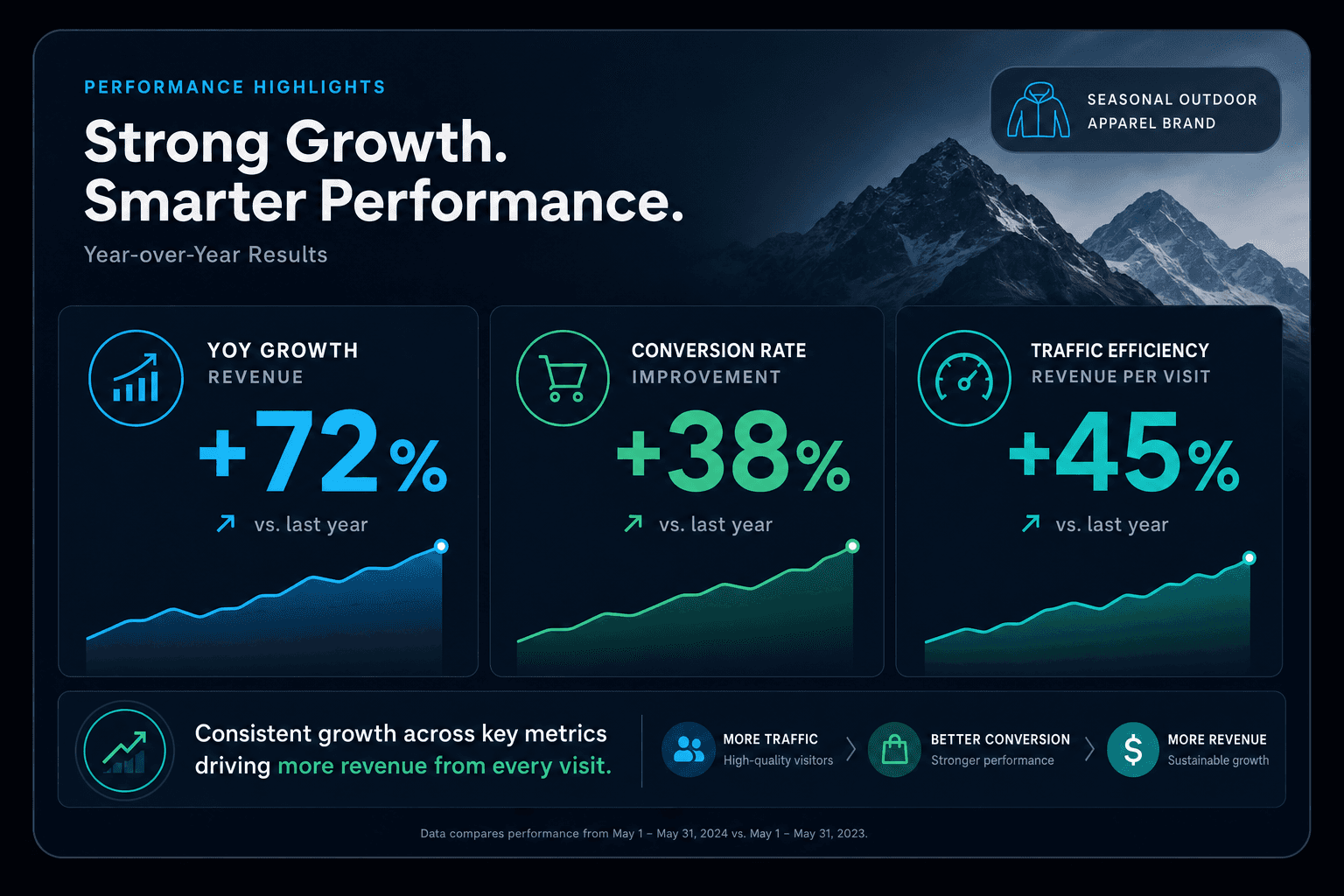
- YoY growth
- 20% (mandate hit)
- Traffic
- -22%
- Conversion rate
- +32%
Let's Build a Marketing System Around Your Outdoor Brand's Actual Numbers
No obligation. We'll come prepared with a read on your current channel mix, MER, and where the biggest growth levers are, built around your brand, not a template.
Sagum · January 2017 · St. George, Utah · 8+ years