

8+ years growing brands on KPIs, now with AI
Turn personal care buyers into high-LTV subscribers
We shorten CAC payback and protect blended returns with retention built for how these customers buy.
Google Ads · Meta · TikTok · 8+ years growing DTC brands · judged on ROAS, not vanity metrics


Get your free Growth Gap Analysis
Senior strategist review · response within one business day
Prefer to reach out directly?
The Challenge
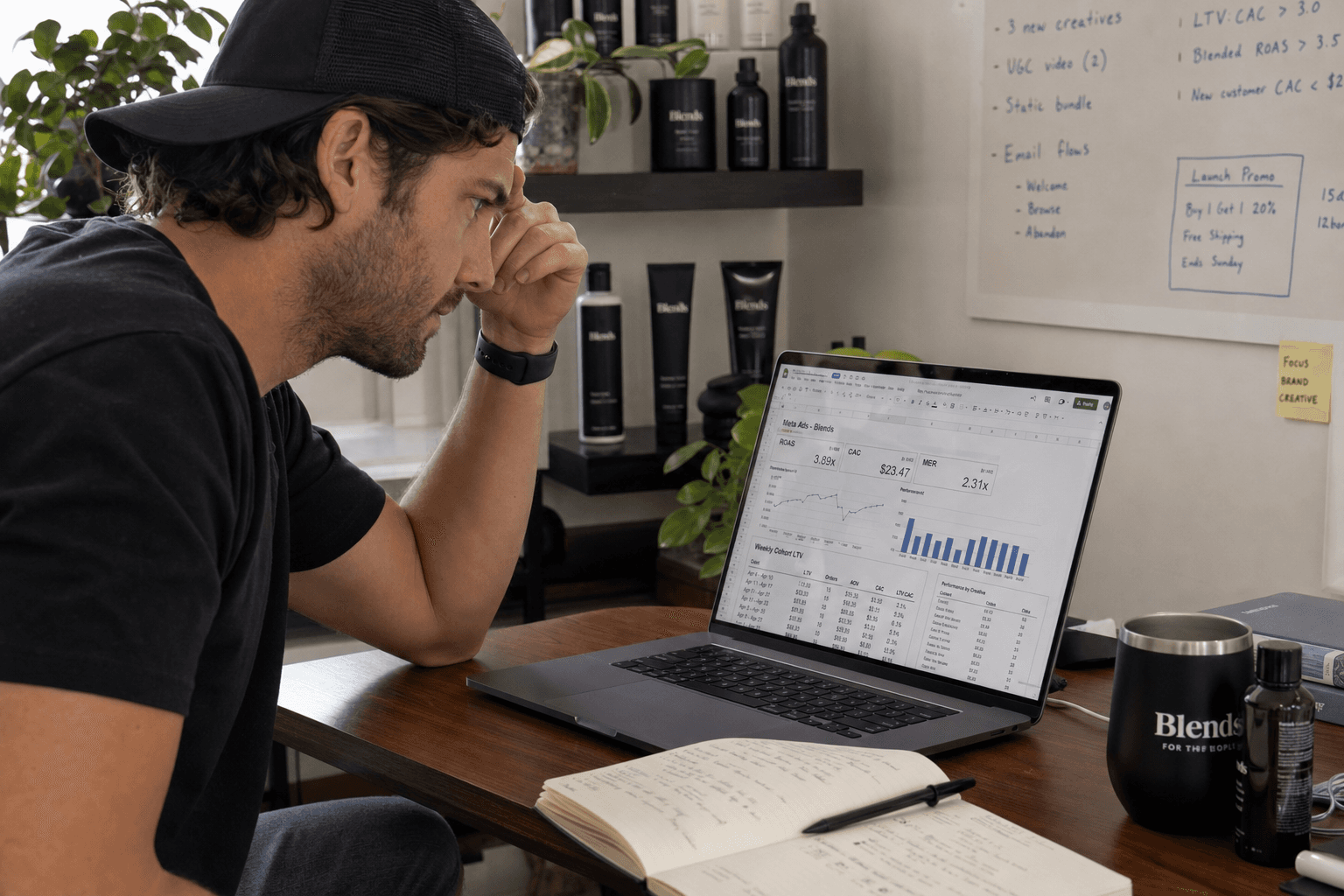
Personal Care Economics Hinge on the Second Purchase
Your hero SKU drives 60–80% of revenue, your AOV hovers around $60–$84, and your business depends on customers replenishing within the first 90 days. Those who skip that first replenishment cycle almost never become high-LTV buyers.
You compete with well-funded incumbents on Meta who can sustain negative first-order margins, Korean beauty brands pricing aggressively on TikTok Shop, and Amazon private label undercutting you on head terms. Health and beauty CPMs on Meta run around $16, among the platform's most expensive, and post-iOS attribution has made reported ROAS unreliable, so you watch blended ROAS and contribution margin.
TikTok delivers a 3.5x ROAS for beauty and personal care, its strongest category, but doesn't share customer data the way Meta does, so buyers acquired there are harder to own and retain.
You know a healthy LTV:CAC is 3:1 or better and a scalable DTC contribution margin is around 20%, and you only reach either if the second purchase happens. Most agencies you've talked to optimize first-order ROAS, the wrong scoreboard for your business.
The Opportunity
The Demand Is There for Personal Care Brands Built Around Replenishment
Buyers want indie brands whose formulations target specific skin concerns; mass is a race to the bottom. Online is projected to reach nearly a third of global beauty sales by 2030, up from about 26%, and premium DTC is growing at nearly 9% CAGR through the decade's end.
Brands capturing this growth build Klaviyo flows that fire on replenishment cycles and post-purchase behavior, run UGC and creator-seeded content, and track NC-ROAS beside blended ROAS.
Most personal care brands still run a pre-iOS 14, Meta-first playbook; brands pulling ahead use TikTok Shop affiliates and Spark Ads for discovery at costs Meta can't currently match, plus Google Shopping and Search for high-intent buyers.
Your peaks are predictable: holiday, Valentine's Day, Mother's Day, and the late-May/early-June SPF and body care surge. Brands that plan for them win outsized share at lower CPAs.
What Most Get Wrong
What Most Personal Care Brands and Their Agencies Get Wrong
Optimizing for first-order ROAS instead of CAC payback period
Platform-reported 3x ROAS can hide a $110 CAC on a $65 order, a loss on every one-time buyer. Without 90-day modeling, you find out when margin turns negative at scale.
Relying on Meta alone for prospecting as $16 CPMs climb
Brands with no TikTok prospecting (TikTok Shop affiliates, Spark Ads, creator seeding) pay Meta's top rates to reach buyers who increasingly discover personal care products elsewhere.
Treating a welcome sequence and monthly newsletter as retention
Cheeky Wipes earns 47% of revenue from email with flows built on replenishment, post-purchase behavior, and winback timing. If your flows ignore product-specific reorder windows, your highest-margin channel sits idle.
Using branded creative when UGC converts at 8.7x the rate
Buyers trust what looks real: real skin, routines, and before/afters. Agencies selling polished content skip the category's most conversion-efficient format; without a systematic UGC program, you're competing at a handicap.
Trusting last-click attribution instead of blended ROAS and incrementality
Post-iOS, Meta-reported ROAS is almost certainly overstated. Skip blended ROAS (total revenue ÷ total ad spend) and incrementality tests, and you scale channels that only look good in the dashboard.
Why Now
Why Personal Care Brands That Build Before Peak Season Win
Personal care DTC grew roughly 7% annually from 2022 to 2024, but saturation and shifting preferences pressure it. Brands with better retention, creative testing, and measurement systems will win next-cycle share; bigger budgets alone won't.
AI lets a focused brand test five creative angles per week versus one, catch attribution errors, and adapt Klaviyo flows to each buyer's purchase cadence, work that once took a large in-house team.
Brands that replace the old Meta-first playbook (static creative, broadcast email, last-click) with multi-channel prospecting, systematic UGC, and replenishment-based retention will compound CAC efficiency while rivals' Meta-reported CPAs creep past $30 and true CAC runs higher. Your next peak is a deadline: brands with creative libraries built, TikTok affiliate programs seeded, and retention flows tuned capture it more cheaply than scrambling rivals.
The Mechanism
Where AI Gives Personal Care Brands a Real Edge
Real productivity, not AI theater. Here's where it actually moves a number for personal care brands.
Creative
What AI does: AI drafts UGC briefs, tests angles, and speeds iteration on hooks and formats, so you run five concepts per week across Meta, TikTok, and Google instead of one.
The result: You find the angles that sell your hero SKU (a skin-concern hook, routine integration, or before/after format) in weeks instead of quarters.
Why it matters here: Creative moves ROAS more than almost anything in a saturated category, and testing at volume is how you find the skin-concern message that sells.
Analytics
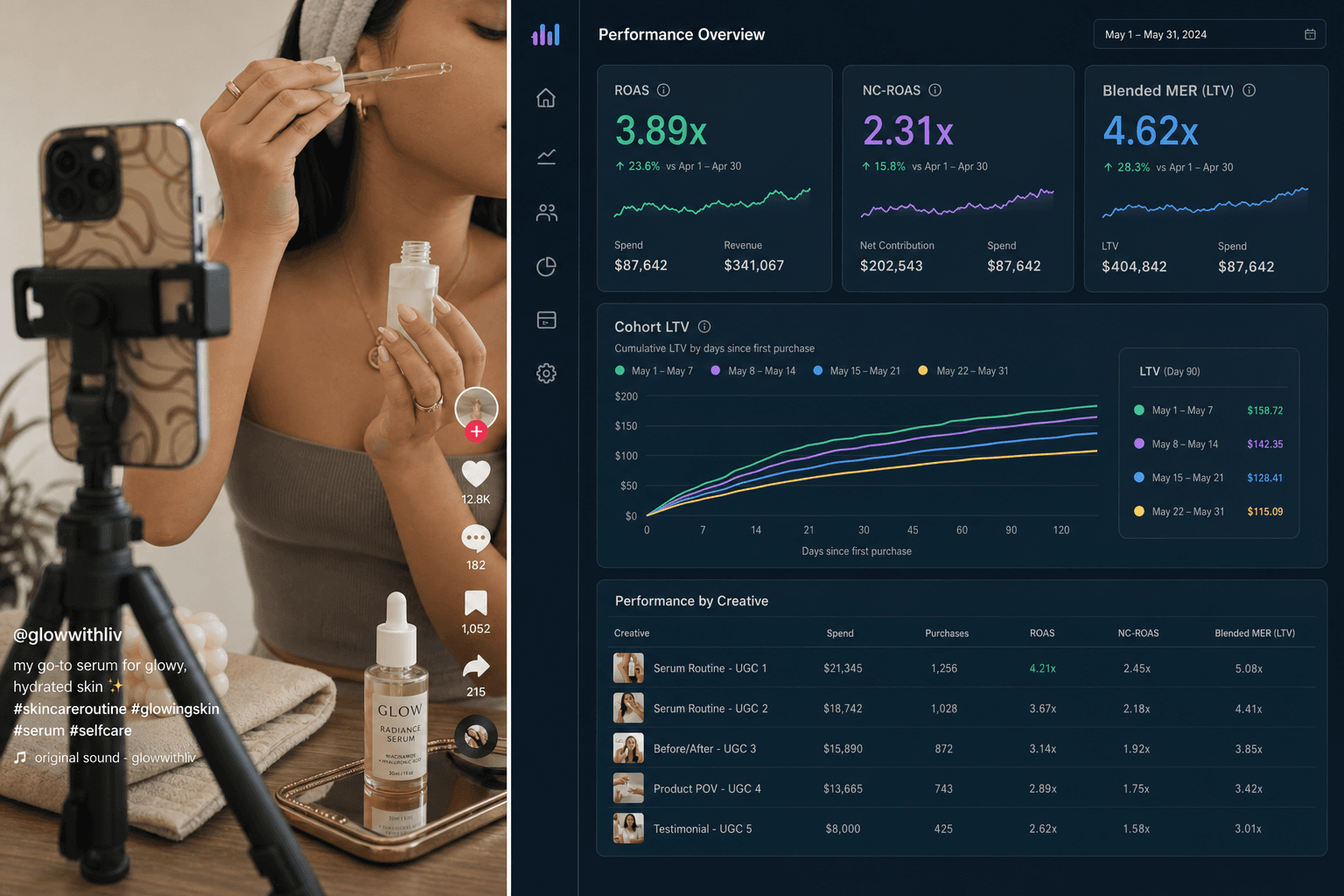
What AI does: AI builds blended ROAS tracking, NC-ROAS modeling, and cohort LTV analysis into one reporting layer, so you budget off blended efficiency and new-customer payback period.
The result: Spend goes to what drives profitable new customers, and you see a channel's contribution margin compressing early.
Why it matters here: Personal care founders who think in cohorts and payback periods know last-click is broken; AI attribution modeling and blended ROAS dashboards make incrementality-based decisions practical.
What AI does: AI builds Klaviyo flows triggered by product-specific replenishment windows, post-purchase behavior, and subscription attach opportunities, so each flow adapts to the customer's purchase cadence.
The result: Flows catch customers in the window after acquisition where a second purchase happens or doesn't, raising subscription attach rate and 90-day LTV.
Why it matters here: Most brands underinvest in email. A 30-day and a 60-day replenishment product need different winback timing; AI makes that segmentation practical without a retention team.
Digital Ads
What AI does: AI-assisted pacing moves budget across Meta, TikTok, and Google Shopping, shifting spend in real time to what performs and pre-loading budget before each seasonal peak.
The result: You capture peak-season demand at the lowest possible CPA and stop spending the same in January as in November.
Why it matters here: Personal care demand spikes on a known calendar; operators using AI to pre-load creative and budget capture it at structurally lower CAC than reactive bidders.
Conversion Optimization
What AI does: AI tests bundle and GWP (gift with purchase) offers, subscription attach, and free shipping thresholds on landing and product pages to lift AOV, and flags conversion leaks.
The result: You get higher AOV from the same traffic, better subscription attach on hero SKUs, and product pages that convert high-intent TikTok-discovered buyers new to you.
Why it matters here: At a $60–$84 AOV, a brand that lifts it from $68 to $82 with bundles and subscription attach changes unit economics without more ad spend.
Ready to see what this looks like for your personal care brands business?
No obligation. A senior strategist will show you exactly where the wins are.
The Strategy
The Right Digital Advertising Strategy for a Personal Care Brand
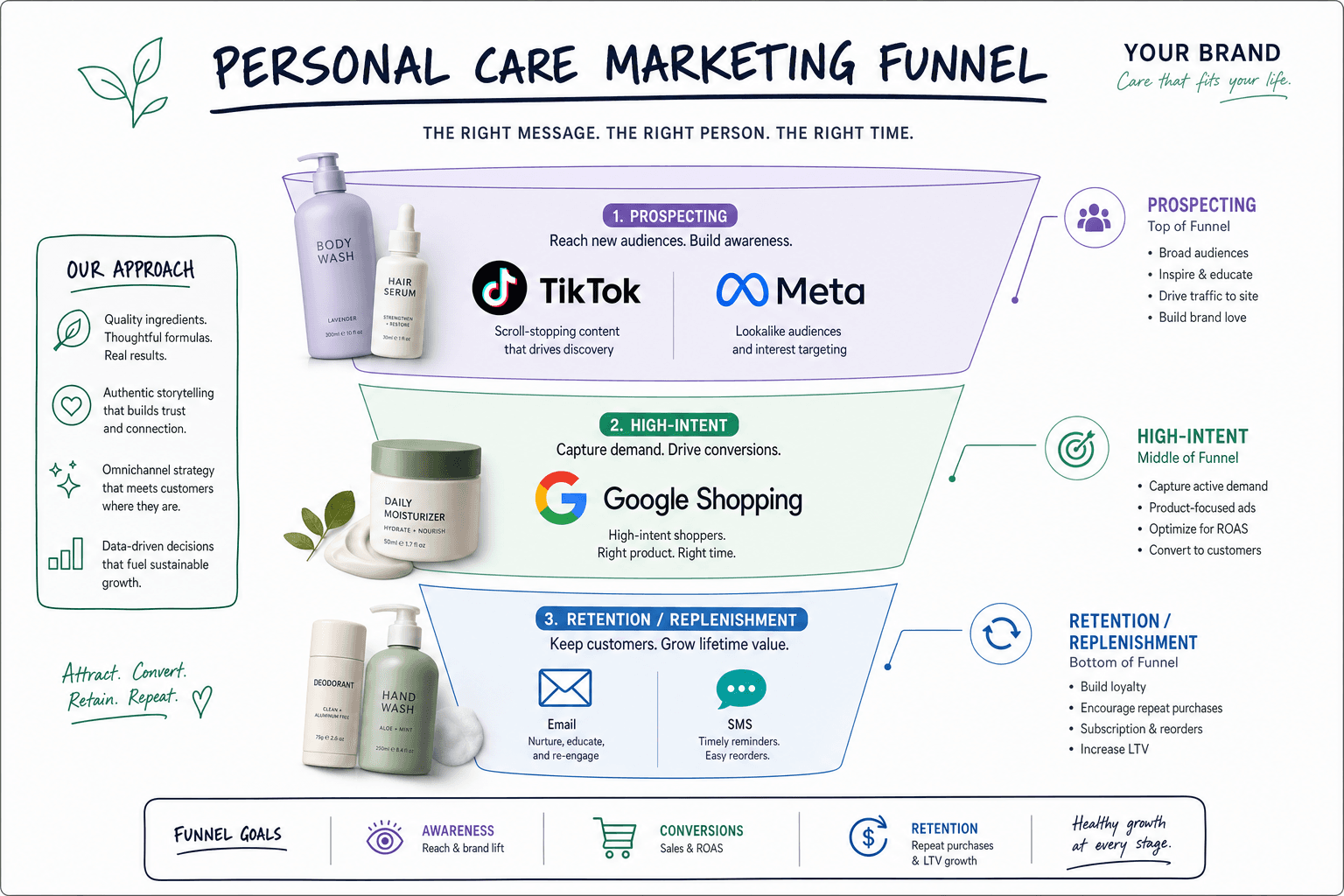
You're solving two problems at once: profitable new-customer acquisition and the retention that makes it worthwhile. Most brands optimize one; the ones that compound have built both.
Each prospecting channel has its own job: TikTok for discovery and top-of-funnel reach, Meta for lookalike and interest-based prospecting with UGC-led creative, and Google Shopping for high-intent buyers choosing between you and a competitor.
For repurchase and retargeting, Google Search captures brand-aware buyers ready to reorder; give those high-intent, high-CVR clicks their own campaign and creative. Meta retargeting answers the objection (ingredients, price, reviews) that stopped an engaged buyer.
Your retention layer sets whether CAC payback is 60 days or 6 months: Klaviyo flows built on your replenishment cycle, subscription attach prompts timed after purchase, and winbacks triggered when a customer is overdue to reorder.
Pace budget to the calendar: pre-fund holiday by September, add budget for Valentine's Day and Mother's Day gifting, and plan late-May SPF and body care creative in March so you aren't building it mid-peak.
Judge everything on blended ROAS, NC-ROAS, and CAC payback period, not platform-reported ROAS alone.
The one number that governs this
Governing KPI: CAC Payback Period (months), read alongside Blended ROAS, NC-ROAS, 90-Day LTV, and Contribution Margin
How We Help
How Sagum Executes This for Personal Care Brands
We fix measurement first so every later decision is trustworthy, then build the acquisition channels, then the retention system that makes acquisition pay off.
Analytics & Attribution Setup
We audit pixel, GA4, and Klaviyo event tracking before touching spend, then build blended ROAS dashboards with NC-ROAS and cohort LTV instead of platform ROAS.
Paid Media: Meta, TikTok, Google
We rebuild your Meta, TikTok (creator and UGC content), Google Shopping, and Search campaigns so each does its own job, with seasonally paced budget.
Creative Strategy & UGC Systems
We build a UGC and creator-seeding program (briefs, outreach, weekly testing) and iterate on the hooks that convert for your hero SKU and skin-concern positioning.
Email & SMS: Retention Infrastructure
We build or rebuild Klaviyo flows around your replenishment cycle: welcome, post-purchase, replenishment trigger, winback, and subscription attach, timed to catch the second purchase.
Conversion Optimization
We test bundles, GWP thresholds, subscription attach prompts, and free shipping triggers, tune product pages for TikTok-discovered buyers, and judge every test on contribution margin.
AI Systems & Agents
We build AI into briefs, budget pacing, and landing page and flow reviews, so you test more, catch attribution errors faster, and time replenishment better.
Who's Behind This
Who we are, and what makes us different
Sagum is a performance marketing agency founded in January 2017 in St. George, Utah. We've spent 8+ years growing real brands and being judged on KPIs, not vanity metrics.
We deliberately limit how many clients we take so each one gets senior attention. We treat your numbers like our own, we never run generic playbooks, and your strategy is built for your business, because shouldn't your brand's marketing be custom to your brand?
Sagum.ai is our AI arm: the same proven operators now build AI into the work wherever it creates real edge, not as theater, but as leverage applied with discipline.
- 8+ years growing brands on performance KPIs, not vanity metrics
- Limited client roster, with senior attention on every account
- An extension of your team; your success is tied to ours
- Custom strategy per brand, never a generic playbook
- AI built in where it moves a number; judgment over hype
“Sagum is a performance marketing agency that's spent 8+ years growing brands by treating their numbers like our own. We take on few clients, never run generic playbooks, and now build AI into the work wherever it creates real edge, not hype. Your strategy is built for your business, and our success is tied to yours.”

“Sagum roughly doubled our bottom line. They treat the work like it's their own business.”
Rachel Nilsson
CEO, RAGS
Proof
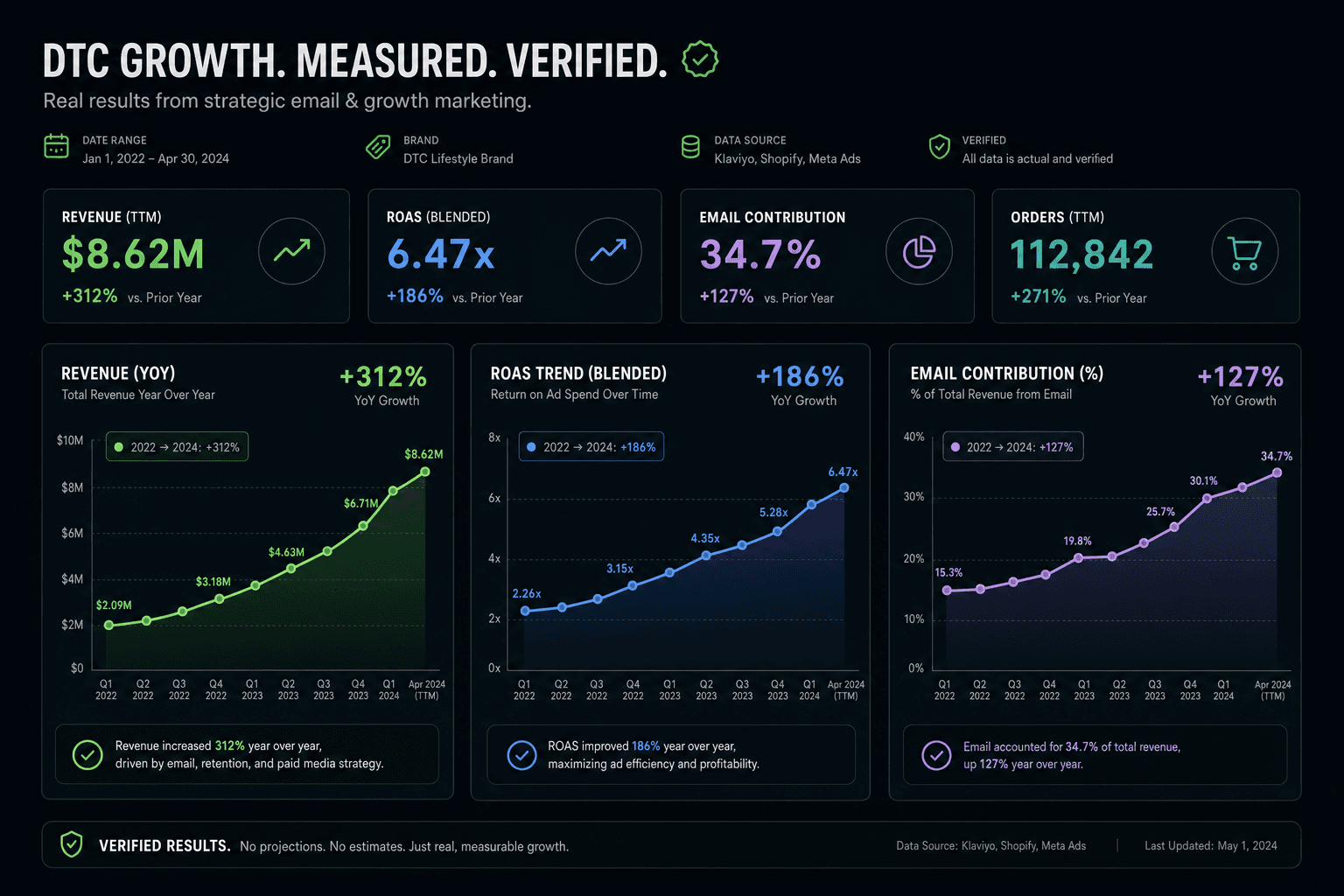
187% YoY, $8+ ROAS on Meta, +79% web conversion
Clean Monday Meals
Challenge
Clean Monday Meals set out to grow its food DTC brand across channels.
What we did
Sagum scaled Meta and took over email and Amazon, the same multichannel approach we'd bring to a personal care brand built on replenishment.
Result
The brand grew 187% year-over-year, hit $8+ ROAS on Meta, and lifted web conversion 79%.
Build Your Personal Care Growth System Before Your Next Peak Season
No obligation. We'll come to the session with a point of view on your channel mix, creative strategy, and retention gaps, built around your brand, not a generic personal care template.
Sagum · January 2017 · St. George, Utah · 8+ years