

8+ years growing brands on KPIs, now with AI
Pet brands win on LTV, not first-order ROAS
We convert one-time buyers into autoship subscribers and build the list that ends your Q4 CPM tax.
8+ years growing ecommerce brands · Google, Meta & TikTok partner · judged on your KPIs, not ours


Get your free Growth Gap Analysis
Senior strategist review · response within one business day
Prefer to reach out directly?
The Challenge
You Know Pet LTV Math. Making It Work Is the Hard Part.
You sell about $52 average orders at 45–60% gross margin, and free shipping eats contribution margin. A subscriber is worth $400–$800 in LTV; a one-time buyer, $100–$250.
At that AOV and margin, you net $23–$31 gross profit per order before fulfillment. Meta CPMs in pet run around $15.95, high for DTC, because you, Chewy, Amazon's Wag brand, and a celebrity-backed entrant that raised $10M compete for affluent pet parents.
First purchases barely break even, so the model lives on repeats: 27% of customers return after a first purchase, 49% after a second. Most pet brands treat the 30 days after checkout, your best marketing real estate, as an afterthought.
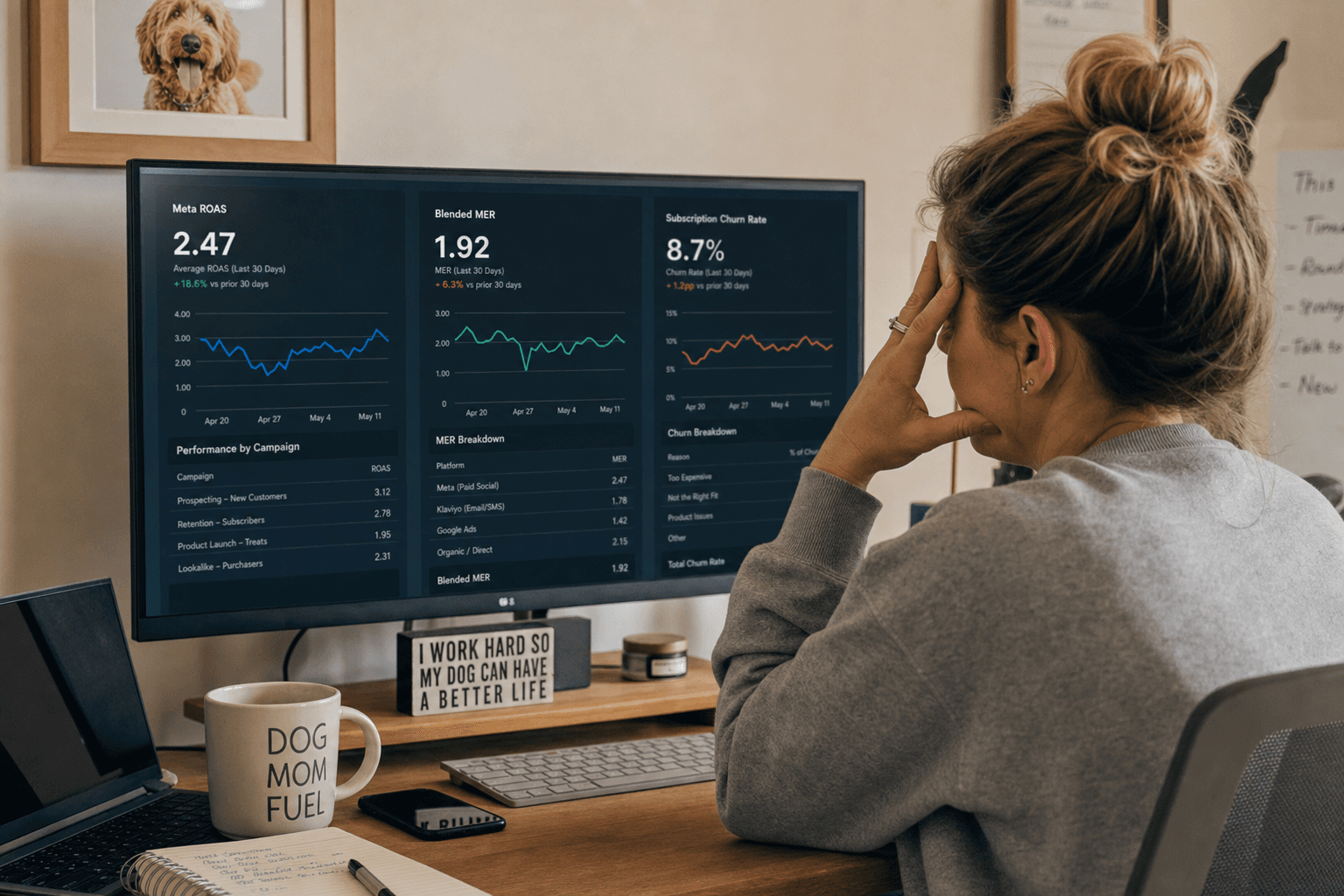
You don't trust your numbers: Meta's attribution window burned you, TikTok's last-click ROAS is understated, and blended ROAS (total revenue ÷ total ad spend) lives in a spreadsheet because no dashboard tells the truth. Meanwhile Amazon holds 59% of online pet market share, and your Chewy wholesale account may be teaching your best customers to reorder somewhere cheaper.
The Opportunity
Pet Brands That Seed Subscriptions Build Businesses Amazon Can't Touch
Pets & Animals was the only industry to improve Google Ads ROAS in calendar 2025. Brands capturing that high-intent demand treat paid acquisition as a subscription-seeding engine, not a revenue line.
Chewy (Autoship at 83.3% of net sales; $591 per active customer overall) proves the model. At $50/month, 2,000 subscribers bring $1.2M in predictable annual revenue before new acquisition spend. That raises the CAC you can afford, which changes your competitive position.
Chewy, PetSmart, and Petco are losing site traffic as attention shifts to DTC brands, niche retailers, and content-first discovery platforms. Pet parents seeking freeze-dried raw food, breed-specific supplements, or vet-formulated fresh diets find them through TikTok, Instagram recommendations, and Google ingredient-claim searches, not on Amazon.
The pet calendar gives you predictable windows: Spring (March–May) is the highest-intent new-pet acquisition window, and health resolution season runs through January.
What Most Get Wrong
What Most Pet Brands (and Their Agencies) Get Wrong
Optimizing for platform ROAS instead of blended ROAS
Meta says 3.8x, Google 6.2x, and your bank account tells another story. Agencies that don't reconcile to blended ROAS often scale campaigns that look profitable but destroy contribution margin.
Treating TikTok like a direct-response channel
On TikTok, pet orders average $12.84, well under your ~$52 AOV, and cost about $13.46 each to win, so first baskets rarely pay back. Use it for seeding and discovery.
Ignoring the first-to-second purchase window
Generic post-purchase emails lose buyers at the biggest LTV leak. A consumption-timed subscription offer, bundle, or refill reminder wins more second orders; second-order buyers return at 49%, first-order at 27%.
Starting Q4 audience-building in October
Pet owner research starts climbing in August. Waiting for BFCM means paying Q4 CPMs for what August CPMs would do for 30–50% less. By November you should be converting.
Running creative that looks like an ad
An owner's shaky iPhone video of a rescue dog going wild for a freeze-dried treat outconverts a $5,000 production shoot. Agencies without systematic UGC testing miss the category's best format.
Why Now
The Months Before Spring and Q4 Decide Your Pet Brand's Year
Most DTC pet brands still run a set-and-forget playbook (set a Meta campaign, check it weekly, and hope), which leaves you an opening. Where UGC authenticity decides which pet ads win, AI-assisted testing lets an operator evaluate five times as many angles per week as a manual team, and the first to find the winning hook keeps that edge.
AI-assisted reconciliation catches the attribution errors you suspect in your Meta and TikTok reporting, so you budget on clean signal every month while brands still guessing misallocate spend.
Spring adoption and Q4 both reward brands that build audiences months ahead. Start now with clean attribution, tested creative, and consumption-timed retention emails, and you enter the next window first. Wait until it opens and you build from scratch against higher CPMs.
The Mechanism
Where AI Creates Real Edge for Pet Brands
Real productivity, not AI theater. Here's where it actually moves a number for pet brands.
Creative
What AI does: AI helps brief and generate more UGC-style concepts each week, with hooks on ingredient claims, transformation stories, breed-specific use cases, and subscription value propositions, all systematically tested against each other.
The result: You find the angle that converts sooner than you would running one or two ads for weeks.
Why it matters here: Owner-generated creative beats polished production in pet, so the brand testing more angles finds a winner that keeps running while competitors guess.
Analytics
What AI does: AI reconciliation catches misfiring pixels, attribution windows that inflate Meta's credit, TikTok view-through credit overlapping Google's last-click, and double-counting, then surfaces a clean blended ROAS that reflects your bank account.
The result: You budget on real contribution margin data. Platform ROAS may be inflating the picture by 20–40%.
Why it matters here: One misfiring pixel separates scaling a profitable campaign from scaling a losing one, so clean signal comes first.
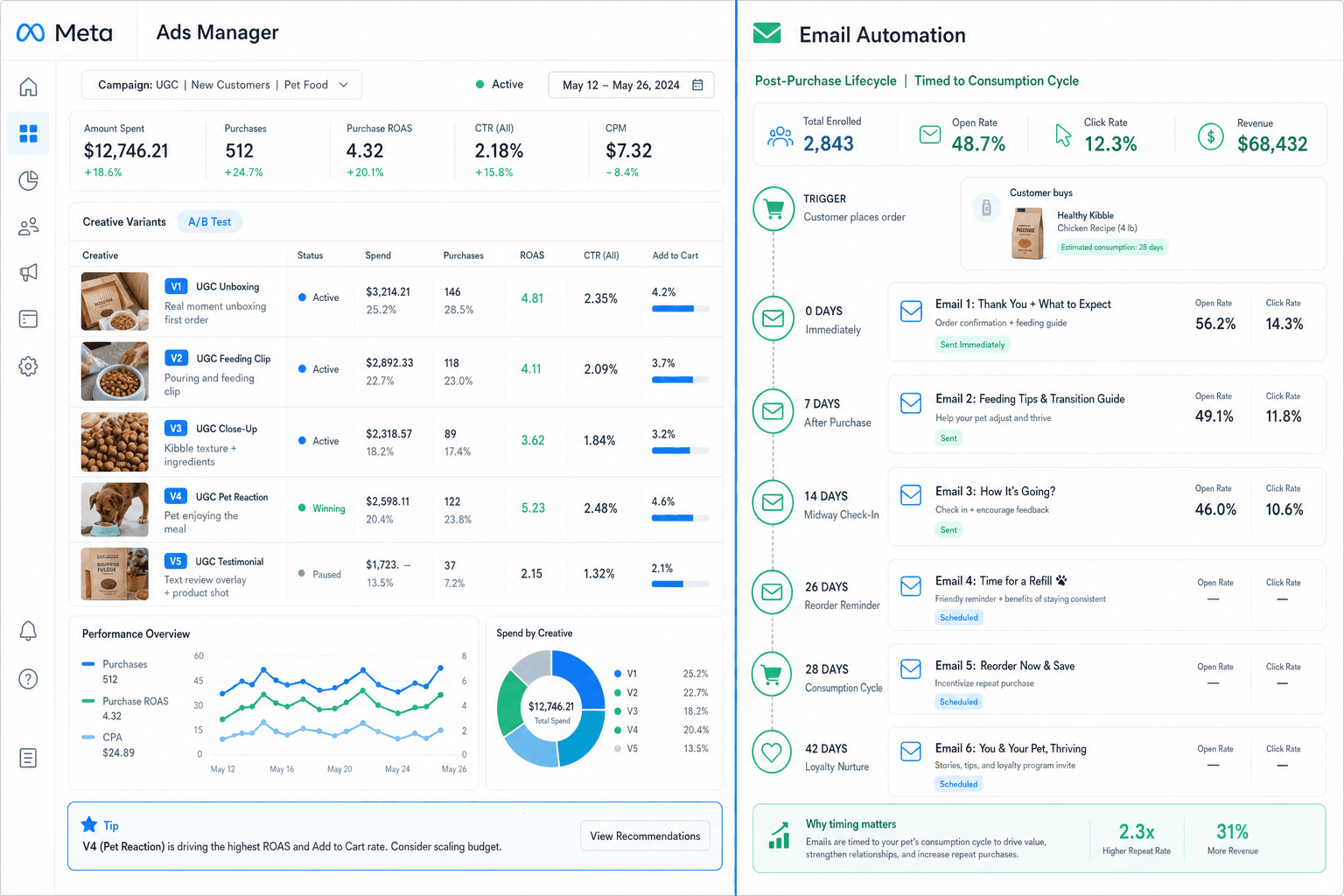
What AI does: AI times post-purchase sequences to consumption cycles (a day-22 replenishment prompt for a 30-day bag of kibble, a day-14 supplement check-in) and triggers subscription offers from behavioral signals, not the calendar.
The result: More first-time buyers reorder and your autoship base grows; autoship is the primary driver of LTV in pet.
Why it matters here: Closing the gap between purchases one and two beats any acquisition campaign per dollar.
Digital Ads
What AI does: AI-assisted pacing shifts spend to Google Shopping in the Spring and January intent windows and to Meta for subscription upsells to existing buyers, calibrated to a 70/30 demand-capture vs. demand-creation split.
The result: A flat monthly budget gives way to spend that follows purchase intent through pet's seasonal demand.
Why it matters here: Using Shopping for demand capture and Meta for retention and subscription conversion works with pet's demand structure, not against it.
Conversion Optimization
What AI does: AI reviews landing and product pages for drop-off in subscription sign-up, bundle upsell, and first-purchase checkout, and flags the copy, trust signal, or offer change most likely to fix it.
The result: Subscription opt-in at checkout and first-order conversion rise.
Why it matters here: At a ~$52 AOV, a 10% lift in conversion or subscription attach rate materially changes CAC payback, and well-timed trust signals win skeptical pet parents.
Ready to see what this looks like for your pet brands business?
No obligation. A senior strategist will show you exactly where the wins are.
The Strategy
How DTC Pet Brand Marketing Should Be Run
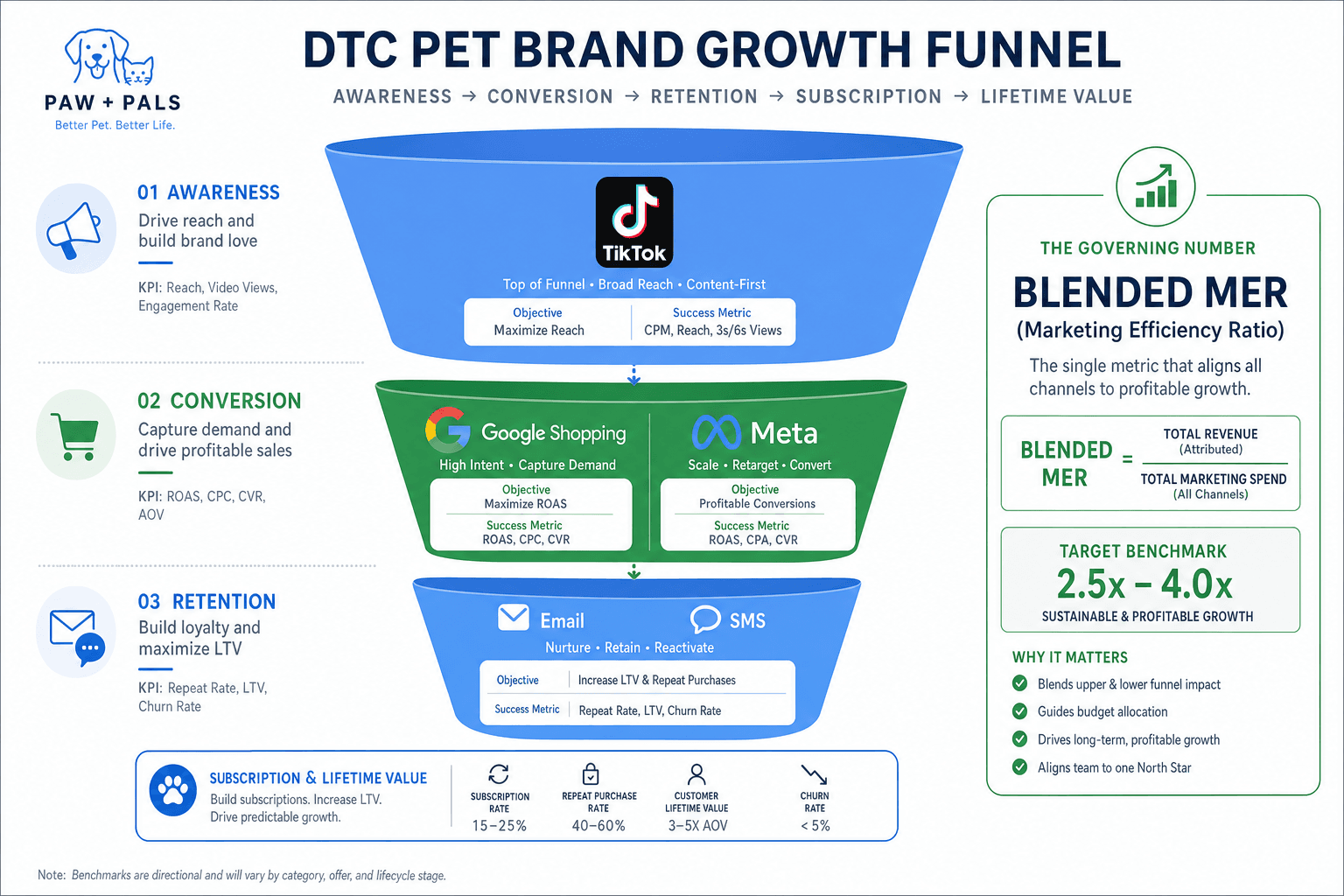
Acquire customers at a CAC you can recover from gross profit within 6–8 months, then retain them into subscription so LTV compounds. Every channel decision follows from that.
Google Shopping captures demand: searches like 'freeze-dried raw dog food,' 'grain-free puppy kibble,' and 'vet-recommended cat supplement' bring your highest-converting clicks. Pets & Animals was the only industry to improve Google Ads ROAS in calendar 2025, so put 60–70% of paid budget here.
Meta handles subscription seeding and retention, not primary acquisition: prospect broadly with UGC-style creative, then retarget first-time buyers with a timed subscription offer, since a buyer at day 22 of their kibble bag is a different prospect than a cold audience.
TikTok builds top-of-funnel audiences for Meta and Google to convert, especially for premium-format products (freeze-dried, fresh, functional supplements) where the pet's reaction is the ad. The AOV math rules out optimizing it for conversion.
Email and SMS are your highest-ROI retention channels and primary defense against Q4 CPM inflation: a list built in the months before Q4 gets monetized in November at zero incremental acquisition cost. Post-purchase sequences for the first-to-second window are non-negotiable; LTV is won or lost there.
The one number that governs this
Your KPI is blended ROAS, reviewed weekly against contribution margin. Platform ROAS is an input.
How We Help
What We'd Do for Your Pet Brand
We run the engagement in this order, fixing what's broken before scaling anything, because scaling on bad data destroys margin fastest.
Attribution & Analytics Audit
Before touching any campaign, we reconcile pixels, attribution windows, and blended ROAS against revenue and fix errors like Meta claiming Google-driven sales.
Google Shopping Campaigns
We build or rebuild Shopping around the ingredient and format searches your best customers run ('freeze-dried raw,' 'grain-free,' 'vet-formulated'), paced to Spring and January.
Meta Paid Social
We run two separate Meta campaigns: broad UGC-style prospecting, and a retention campaign that offers first-time buyers a subscription timed to their product's consumption cycle.
Creative Production & Testing
We run systematic UGC testing that puts multiple new hooks in market weekly, so you find the next winning angle before the current ad fatigues.
Email & SMS Automation
We build consumption-timed post-purchase sequences with behavior-triggered subscription offers to close the first-to-second purchase gap and grow your autoship base.
Conversion Optimization
We audit subscription sign-up, upsell, and checkout friction, and place vet formulation, third-party testing, and NASC certification signals where skeptical pet parents hesitate.
TikTok Campaigns
For premium-format products where the visual story sells, TikTok seeds the audiences our Meta and Google campaigns convert profitably.
Who's Behind This
Who we are, and what makes us different
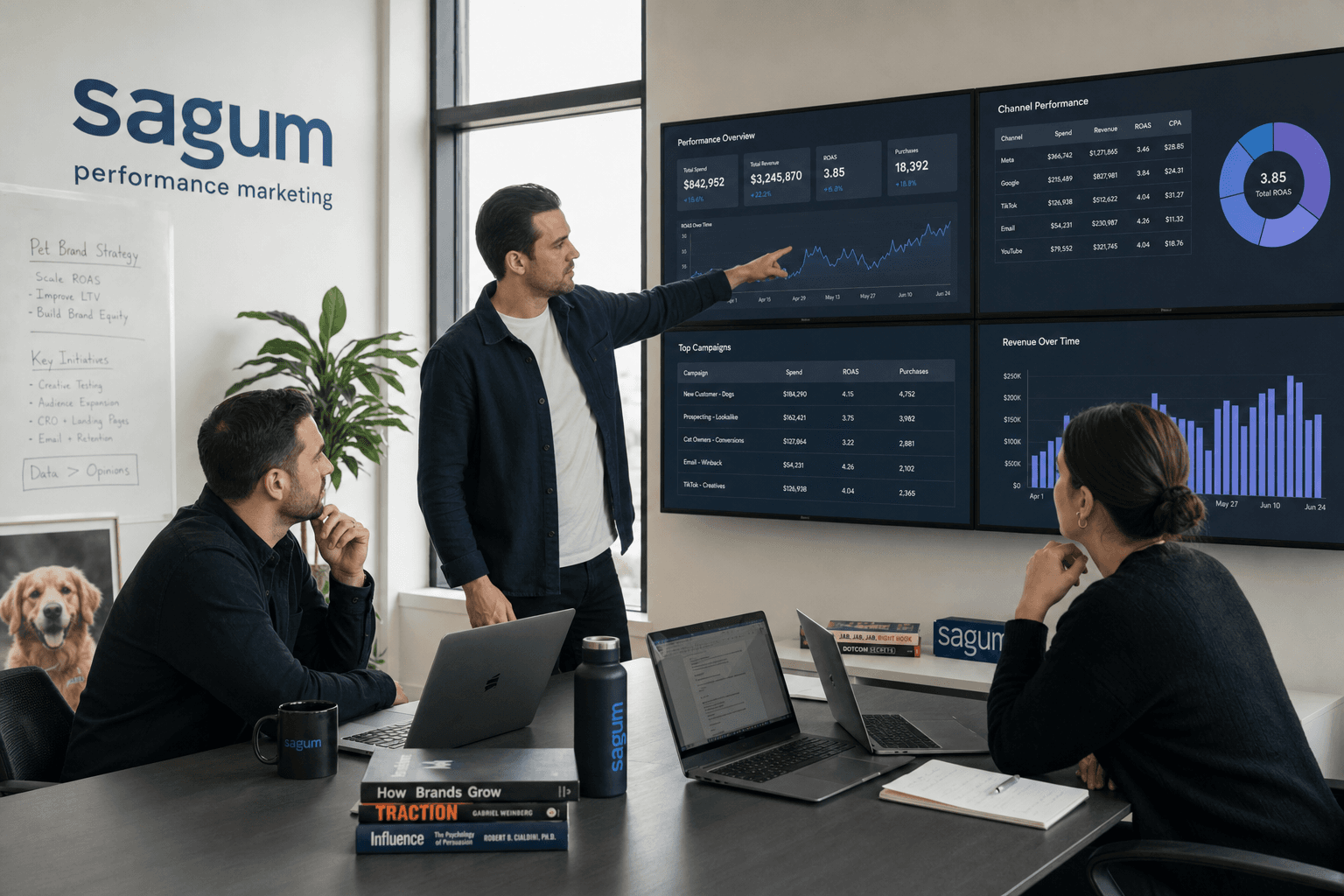
Sagum is a performance marketing agency founded in January 2017 in St. George, Utah. We've spent 8+ years growing real brands and being judged on KPIs, not vanity metrics.
We deliberately limit how many clients we take so each one gets senior attention. We treat your numbers like our own, we never run generic playbooks, and your strategy is built for your business, because shouldn't your brand's marketing be custom to your brand?
Sagum.ai is our AI arm: the same proven operators now build AI into the work wherever it creates real edge, not as theater, but as leverage applied with discipline.
- 8+ years growing brands on performance KPIs, not vanity metrics
- Limited client roster, with senior attention on every account
- An extension of your team; your success is tied to ours
- Custom strategy per brand, never a generic playbook
- AI built in where it moves a number; judgment over hype
“Sagum is a performance marketing agency that's spent 8+ years growing brands by treating their numbers like our own. We take on few clients, never run generic playbooks, and now build AI into the work wherever it creates real edge, not hype. Your strategy is built for your business, and our success is tied to yours.”
“Sagum roughly doubled our bottom line. They treat the work like it's their own business.”
Rachel Nilsson
CEO, RAGS
Proof
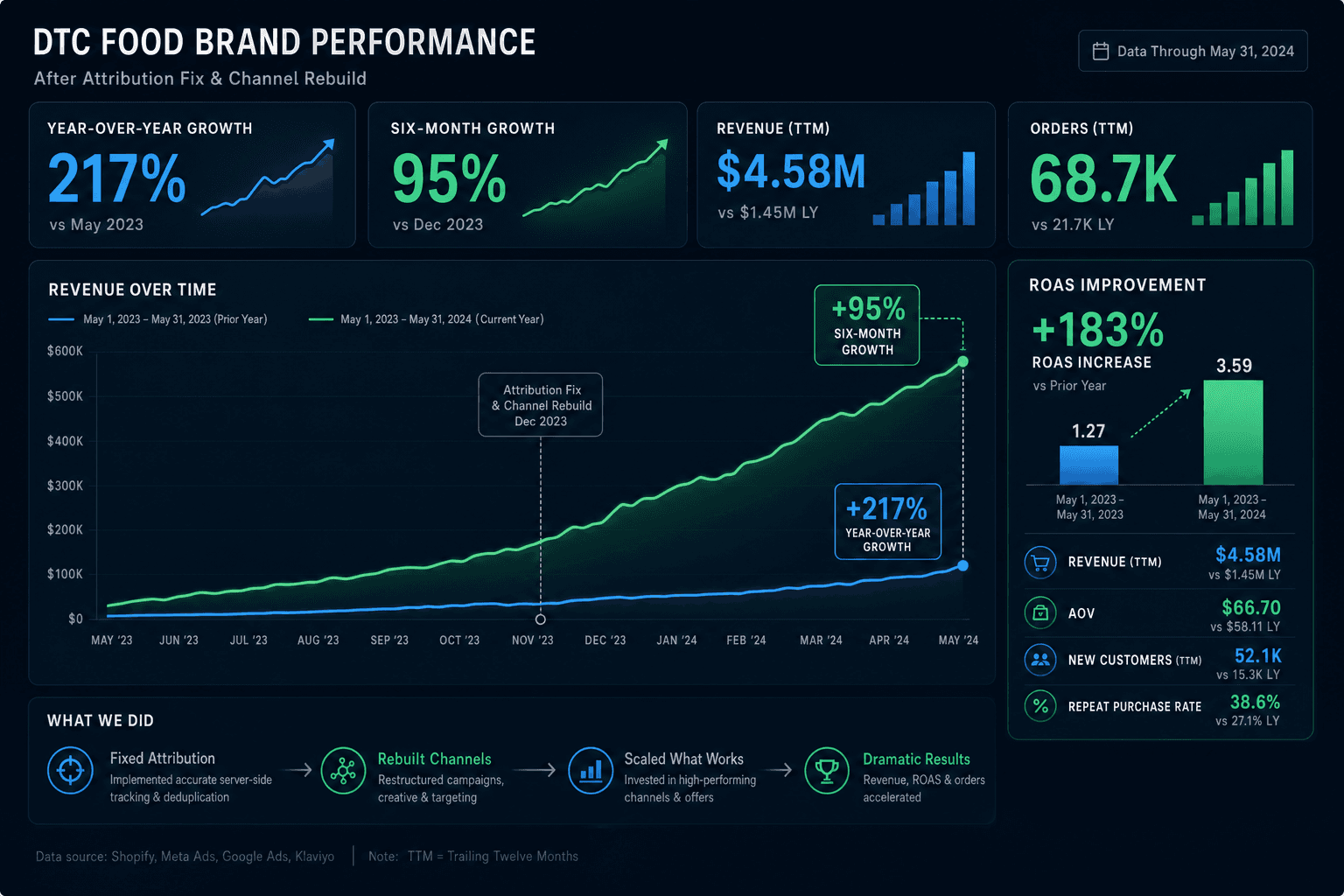
95% growth in 6 months, 217% YoY after fixing a misfiring pixel
Ballerina Farm
Challenge
At Ballerina Farm, a misfiring pixel was inflating the numbers and hiding true performance.
What we did
We fixed tracking first, then scaled TikTok, Google, and Pinterest.
Result
They grew 95% in 6 months and 217% year-over-year, with ROAS 64% better than planned. We bring the same fix-the-data-first discipline to pet brands.
Build a Pet Brand That Compounds, Not One Chasing CPMs Every November
No obligation. We'll bring a view on your unit economics, attribution setup, and the one or two highest-impact moves for your stage, built on your numbers, not a generic pitch deck.
Sagum · January 2017 · St. George, Utah · 8+ years