
8+ years growing brands on KPIs, now with AI
Plastic Surgeons: More Consults That Become Surgeries
Procedure-specific campaigns that fill your surgical calendar with qualified patients, not injectable tire-kickers.
8+ years growing service businesses on Google, Meta, and TikTok


Get your free marketing audit
Senior strategist review · response within one business day
Prefer to reach out directly?
The Challenge
Marketing a Plastic Surgery Practice Is a Different Problem Than Most Agencies Understand
Your best cases are not booked impulsively. A rhinoplasty patient often researches for months before she picks up the phone. A mommy makeover patient has been watching surgical vlogs on YouTube, cross-referencing your RealSelf profile, and studying your before-and-after gallery for weeks before she fills out a form. By the time she contacts your practice, she is not browsing. She is vetting.
That research cycle creates a problem most agencies miss entirely. They optimize for CPL and declare victory when the lead count goes up. But a $33 lead that never books a consultation, or books and no-shows, is not a win. It is noise on your patient coordinator's calendar and a surgeon whose high-margin surgical slots are crowded out by injectable inquiries that were never going to convert.
Layer on the compliance reality: Meta and Google both restrict how cosmetic procedure ads can be written, what before-and-after imagery can appear in paid placements, how audiences can be targeted, and what patient data can flow into your tracking pixels. HIPAA and state health privacy laws mean a single misconfigured pixel can expose your practice to regulatory risk. Most agencies have never navigated this. They run the same creative they use for a DTC skincare brand and wonder why the account gets flagged.
Then there is the calendar math. Your peak surgical demand arrives in October through January, when patients are planning holiday recovery windows, and again in January through March for pre-summer procedures. If your campaigns are not fully funded and converting ninety to one hundred twenty days before those windows, your surgical slots fill with your competitors' patients instead of yours.
The Opportunity
The Demand Is There. The Question Is Whether Your Practice Captures It or Your Competitor Does.
Procedure-specific search intent is among the highest-value traffic in any local service category. A patient searching 'board certified rhinoplasty surgeon [city]' or 'tummy tuck after c-section [city]' is not early in her research. She is close to a booking decision, and geo-targeted procedure queries typically convert far better than general terms. That traffic exists in your market right now.
The economics justify serious investment. A breast augmentation runs $6,500 to $12,000 all-in. A mommy makeover is $15,000 to $30,000 or more. A facelift and blepharoplasty combination in a major metro can reach $35,000. When you account for revision procedures, combination surgeries, and non-surgical maintenance over a three-to-five year relationship, patient lifetime value regularly exceeds $10,000. A well-run marketing program that delivers booked surgical consultations at a fraction of the case value is not a cost. It is one of the highest-return investments your practice makes.
Financing availability changes the math further. Practices that surface CareCredit, PatientFi, or Alphaeon messaging early in the patient journey see more consultations convert to scheduled surgeries, because cost stops being the silent objection. Most practices mention financing on a buried FAQ page. The ones growing fastest lead with it.
The practices capturing this demand are not necessarily the ones with the most talented surgeons. They are the ones whose digital presence earns trust faster, whose landing pages convert inquiry to booked consultation before the patient clicks back to a competitor, and whose patient coordinators follow up within five minutes of a form submission. Those are operational and marketing problems, and they are solvable.
What Most Get Wrong
What Most Plastic Surgery Practices and Their Agencies Get Wrong
Optimizing for leads instead of booked consultations
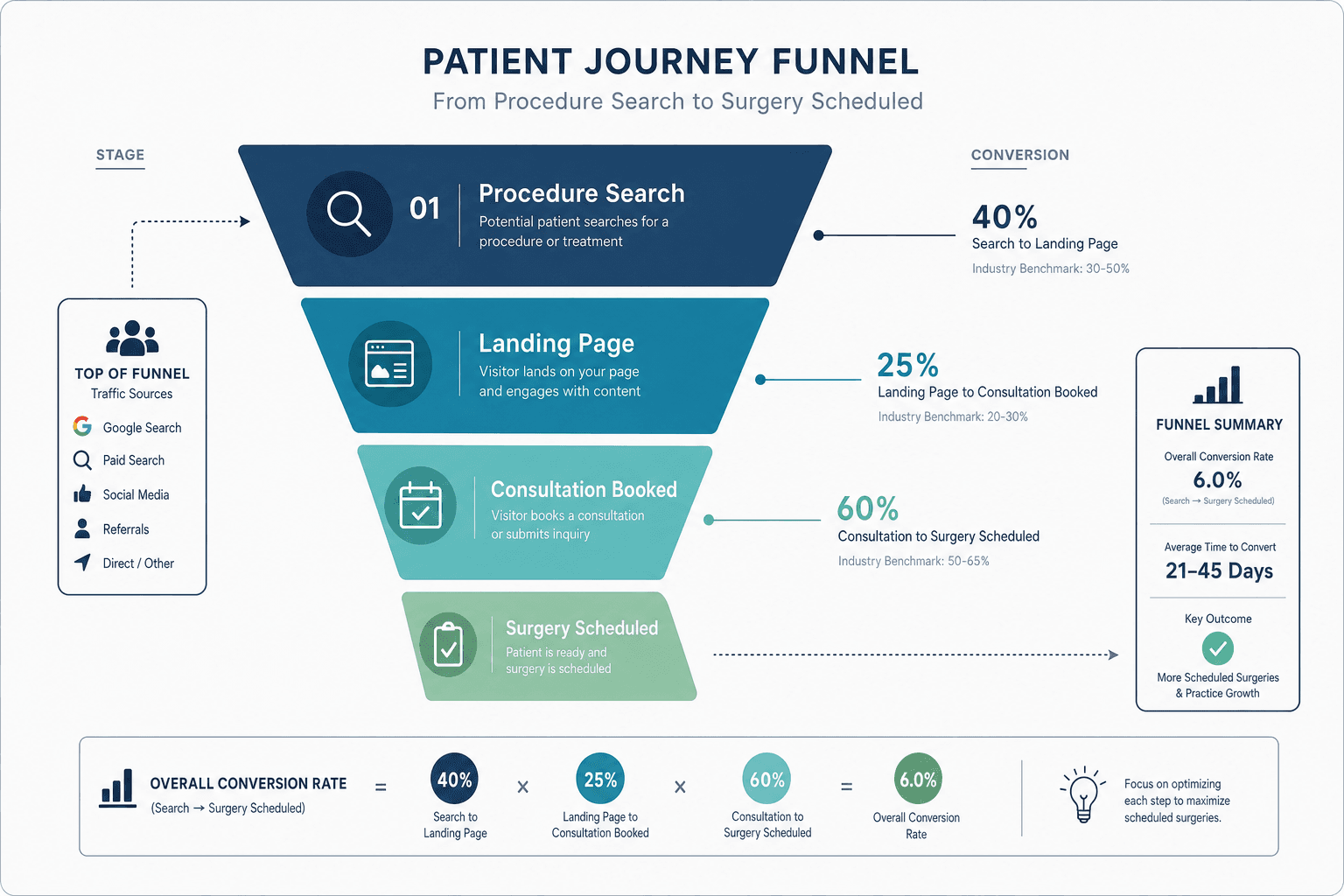
A $50 CPL looks great in a dashboard. But if your lead-to-booked-consultation rate is 4 percent, the true cost of a booked consult is over $1,200 before any optimization. Agencies that report CPL and stop there are measuring the wrong variable. The number that connects to revenue is cost per booked consultation and, downstream, cost per scheduled surgery.
Running surgical and non-surgical demand in the same campaigns
Lumping 'Botox' and 'breast augmentation' into one ad group or one budget destroys your ability to manage either intelligently. Injectable inquiries are high-volume, low-ticket, and fast-cycle. Surgical inquiries are low-volume, high-ticket, and long-cycle. Mixed campaigns produce blended metrics that obscure what is actually working, and they route injectable tire-kickers into a surgical coordinator's calendar, which is among the most expensive mistakes a practice can make.
Ignoring HIPAA-safe tracking and then flying blind
Standard Google and Meta pixels can capture health-related URL parameters and form field data, which can be an impermissible PHI disclosure for a covered entity. Most agencies either ignore this and expose the practice to regulatory risk, or they strip tracking so aggressively that the account has no signal to optimize against. Neither is acceptable. The answer is server-side tracking with PHI filtering, and most agencies have never built it.
Flat monthly ad budgets regardless of the surgical calendar
If your campaigns are not fully funded by July for the holiday recovery window, or by October for pre-summer procedures, your surgical slots fill with competitors' patients. Running a flat monthly budget year-round means overspending during the summer slow season on injectable traffic and underspending during the ninety-day window that determines whether your Q4 surgical calendar is full.
Generic before-and-after creative that violates platform policy and fails to convert
Meta restricts before-and-after imagery in paid placements. Ads that show direct body comparisons get flagged and paused, often during the highest-intent periods of the year. Practices that have not built a compliant creative library are left dark exactly when they need to be visible. Beyond compliance, generic 'transformation' creative does not do the trust-building work a $12,000 decision requires. Procedure-specific, surgeon-named content with real patient stories converts at a fundamentally different rate.
Why Now
Why the Next Six Months Are a Specific Window for Plastic Surgery Practices That Market Well
AI Overviews in Google search results are compressing organic click-through for generic procedure queries. Pew Research found that users clicked a traditional Google result only 8 percent of the time when an AI summary appeared, versus 15 percent when there was no AI summary. Practices that have relied on organic rankings for 'breast augmentation [city]' are already seeing that traffic erode. The practices that win the next cycle are the ones investing in procedure-specific paid search, brand-specific queries, and long-tail keywords that AI summaries do not fully absorb.
At the same time, AI applied with discipline is creating a real operational edge for the practices that use it correctly. Testing five times as many compliant ad creative angles per week, catching attribution errors before they inflate your CPL numbers, and building landing pages that are continuously reviewed for conversion leaks are all things a disciplined operator can now do faster and more precisely than was possible two years ago. Most of your competitors are not doing this. They are running the same static campaigns they ran in 2022.
The seasonal timing is also specific. The pre-summer surgical planning window opens in January and runs through March. The holiday recovery window requires campaigns funded by July. If you are reading this before either of those windows, the lead time to build compliant campaigns, establish tracking infrastructure, and fill your consultation calendar is exactly what you have right now. Practices that start this work after the window opens are chasing their competitors' leftovers.
The Mechanism
Where AI Creates a Real Edge in Plastic Surgery Marketing
Real productivity, not AI theater. Here's where it actually moves a number for plastic surgeons.
Digital Ads
What AI does: AI-assisted bid management and audience segmentation continuously shifts budget toward the procedure-specific campaigns and keywords that are actually producing booked consultations, not just form fills. It separates surgical intent signals from non-surgical ones in real time.
The result: Budget follows the highest-converting procedure queries instead of a static allocation that treats rhinoplasty and Botox as equivalent traffic sources.
Why it matters here: In plastic surgery, an expensive click on a high-intent surgical keyword is a better investment than a cheap click on a generic injectable term. AI bid logic makes that distinction automatically and continuously, which a human checking campaigns weekly cannot replicate.
Analytics and Attribution
What AI does: Server-side, HIPAA-compliant tracking that filters protected health information before it touches ad platform pixels, then reconstructs the full patient journey from first ad touch through booked consultation and scheduled surgery date.
The result: You know which campaigns, keywords, and creative are producing surgical cases, not just leads, while keeping protected health information out of ad platforms.
Why it matters here: Most plastic surgery practices are either flying blind because their tracking was stripped for compliance reasons, or they are sitting on a HIPAA violation they do not know about. Accurate attribution that is also legally defensible is the foundation every other optimization decision depends on.
Creative
What AI does: Rapid generation and systematic testing of policy-compliant ad creative variations: surgeon-named testimonial formats, procedure-specific benefit angles, financing-forward messaging, and recovery timeline framing, across Meta and Google simultaneously.
The result: Finding the creative angle that drives consultation bookings in weeks rather than months, without the compliance risk of running before-and-after imagery in restricted placements.
Why it matters here: A patient who has been researching rhinoplasty for four months responds to completely different creative than a patient three days into her research. Testing enough angles to find that message fast is the difference between a campaign that converts and one that produces expensive, low-quality leads.
Conversion Optimization
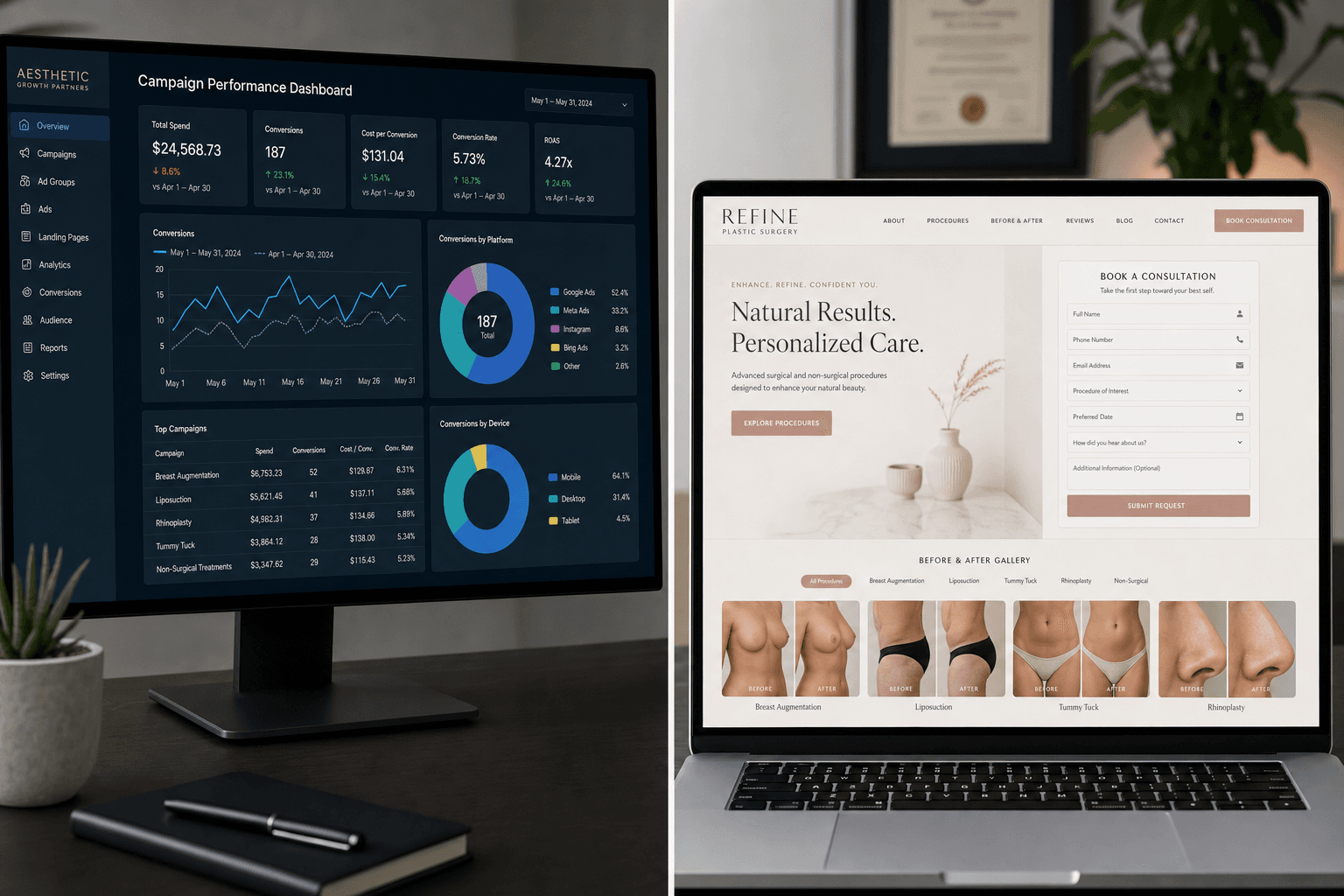
What AI does: AI-reviewed landing pages built around the specific trust signals that move a vetting patient to book: named surgeon credentials, accredited facility badges, procedure-specific before-and-after galleries, financing calculator, and a consultation request flow that routes to a patient coordinator within five minutes.
The result: A landing page that converts at the rate of a well-run consultation call, not a generic contact form.
Why it matters here: A landing page rebuild can cut cost per acquisition sharply on the same traffic, because the new page does the trust-building work the old one did not. For a $10,000 to $30,000 procedure decision, the landing page is not a formality. It is the first consultation.
Ready to see what this looks like for your plastic surgeons business?
No obligation. A senior strategist will show you exactly where the wins are.
The Strategy
What a Marketing Strategy Actually Built for a Plastic Surgery Practice Looks Like
The foundation is campaign architecture that separates surgical and non-surgical demand from day one. Breast augmentation, tummy tuck, rhinoplasty, facelift, and body contouring each get their own campaign, their own budget, their own landing page, and their own KPI. Injectables and skin treatments run separately with separate targets. Mixed campaigns produce mixed metrics and mixed results.
Procedure-specific Google Search is the primary paid channel for surgical cases. Long-tail keywords, 'board certified tummy tuck surgeon [city]', 'rhinoplasty after septoplasty [city]', 'mommy makeover financing [city]', capture patients at or near the booking decision. These keywords are expensive. They are worth it because the patient behind them is worth $10,000 to $30,000 in lifetime value. Every dollar is measured against cost per booked consultation, not cost per lead.
Meta runs as a retargeting and social proof channel, not a cold conversion channel. Website visitors, video viewers, and Instagram engagers see policy-compliant creative: surgeon-named content, financing availability, patient testimonials in compliant format, and procedure-specific benefit messaging. Cold Meta traffic for surgical cases is expensive and low-converting. Warm Meta traffic for patients who have already found you organically or via search is a different proposition entirely.
The consultation flow is engineered to convert. A procedure-specific landing page with the named surgeon, accredited facility credentials, a procedure-relevant before-and-after gallery, financing calculator, and a consultation request form that triggers a patient coordinator response within five minutes. Consult deposits are surfaced at booking to reduce no-shows. Patients who do not book immediately enter a nurture sequence calibrated to a months-long research cycle, not a seven-day email drip.
Budget pacing follows the surgical calendar. Campaigns for the holiday recovery window (October through January) are funded by July. Campaigns for the pre-summer window (March through June procedures) are funded by October. The summer slow season runs injectable and skin campaigns with lower CPL targets, and feeds the surgical nurture pipeline for fall.
The one number that governs this
Every campaign is governed by cost per booked consultation and cost per scheduled surgery. Raw lead count is reported but never used as a success metric.
How We Help
What We Would Actually Do for Your Practice
Here is how Sagum's capabilities map to the strategy above. We take on a limited number of clients so every engagement gets senior attention. We treat your cost per booked consultation the same way we treat our own numbers, because our success is tied to yours.
Paid Search (Google Ads)
Build procedure-specific campaign architecture with separate ad groups, budgets, and landing pages for each surgical category. Target long-tail, high-intent procedure and geo keywords. Manage bids against cost per booked consultation, not CPL.
HIPAA-Compliant Tracking and Attribution
Implement server-side tracking with PHI filtering so no protected health information flows into ad pixels. Reconstruct the full patient journey from first ad touch through booked consultation and scheduled surgery so you know exactly which campaigns are producing surgical cases.
Paid Social (Meta: Instagram and Facebook)
Build and manage policy-compliant retargeting campaigns for website visitors and video viewers. Develop surgeon-named creative, financing messaging, and procedure-specific social proof content that passes platform review and converts warm audiences.
Conversion Optimization
Design and continuously test procedure-specific landing pages built around the trust signals that move a vetting patient to book: named surgeon credentials, accredited facility badges, before-and-after galleries, financing calculator, and a consultation request flow with sub-five-minute coordinator response.
Creative Development
Produce and systematically test compliant ad creative across formats and angles: surgeon-named testimonial formats, procedure benefit messaging, financing-forward copy, and recovery timeline framing. Test volume is the variable that finds the converting message fastest.
Email and Nurture Automation
Build nurture sequences calibrated to the months-long surgical research cycle. Segment by procedure interest. Surface financing options, surgeon credentials, and patient stories at the cadence that matches how this patient actually makes a $15,000 decision, not a seven-day drip designed for ecommerce.
Analytics and Reporting
Report on the metrics that connect to revenue: cost per booked consultation, consultation-to-surgery conversion rate, cost per scheduled surgery, and patient LTV by acquisition channel. Never lead with raw lead count.
Who's Behind This
Who we are, and what makes us different
Sagum is a performance marketing agency founded in January 2017 in St. George, Utah. We've spent 8+ years growing real brands and being judged on KPIs, not vanity metrics.
We deliberately limit how many clients we take so each one gets senior attention. We treat your numbers like our own, we never run generic playbooks, and your strategy is built for your business, because shouldn't your brand's marketing be custom to your brand?
Sagum.ai is our AI arm: the same proven operators now build AI into the work wherever it creates real edge, not as theater, but as leverage applied with discipline.
- 8+ years growing brands on performance KPIs, not vanity metrics
- Limited client roster, with senior attention on every account
- An extension of your team; your success is tied to ours
- Custom strategy per brand, never a generic playbook
- AI built in where it moves a number; judgment over hype
“Sagum is a performance marketing agency that's spent 8+ years growing brands by treating their numbers like our own. We take on few clients, never run generic playbooks, and now build AI into the work wherever it creates real edge, not hype. Your strategy is built for your business, and our success is tied to yours.”

“After six years, Sagum is our most important partner: trusted, communicative, and caring about our business as if it's their own.”
Proof
From a $20 CPL goal to $13 CPL and 300+ leads/mo
Rizzoli's Automotive
Challenge
A local auto service business came to us with a goal of 100 qualified leads per month at roughly a $20 cost per lead, and needed a paid search program that could hit both numbers.
What we did
We rebuilt paid search around the highest-intent service queries and built a custom landing page engineered to drive phone calls.
Result
Cost per lead came in at $13 against the $20 goal, volume grew past 300 leads per month, and the landing page converted at over 60 percent. The client went on to open multiple new locations. The same operational model applies directly to a plastic surgery practice optimizing for booked surgical consultations.

- Cost per lead
- $13
- Leads / month
- 300+
- Landing-page conversion
- 60%+
Find Out Exactly Where Your Practice Is Leaving Surgical Consultations on the Table
No obligation. We will review your current campaigns, tracking setup, and landing page against the benchmarks for your procedure mix and market, and tell you specifically where the gap is. Built around your practice, not a template.
Sagum · January 2017 · St. George, Utah · 8+ years