

8+ years growing brands on KPIs, now with AI
More Revenue Per SMS Send
We build and optimize Postscript programs that make SMS a top-three revenue channel for your Shopify store.
Google · Meta · TikTok Partner | 8+ years performance marketing | Postscript-native operators


Get your free Growth Gap Analysis
Senior strategist review · response within one business day
Prefer to reach out directly?
The Challenge
Why Most Postscript Programs Fall Short of Real Store Revenue
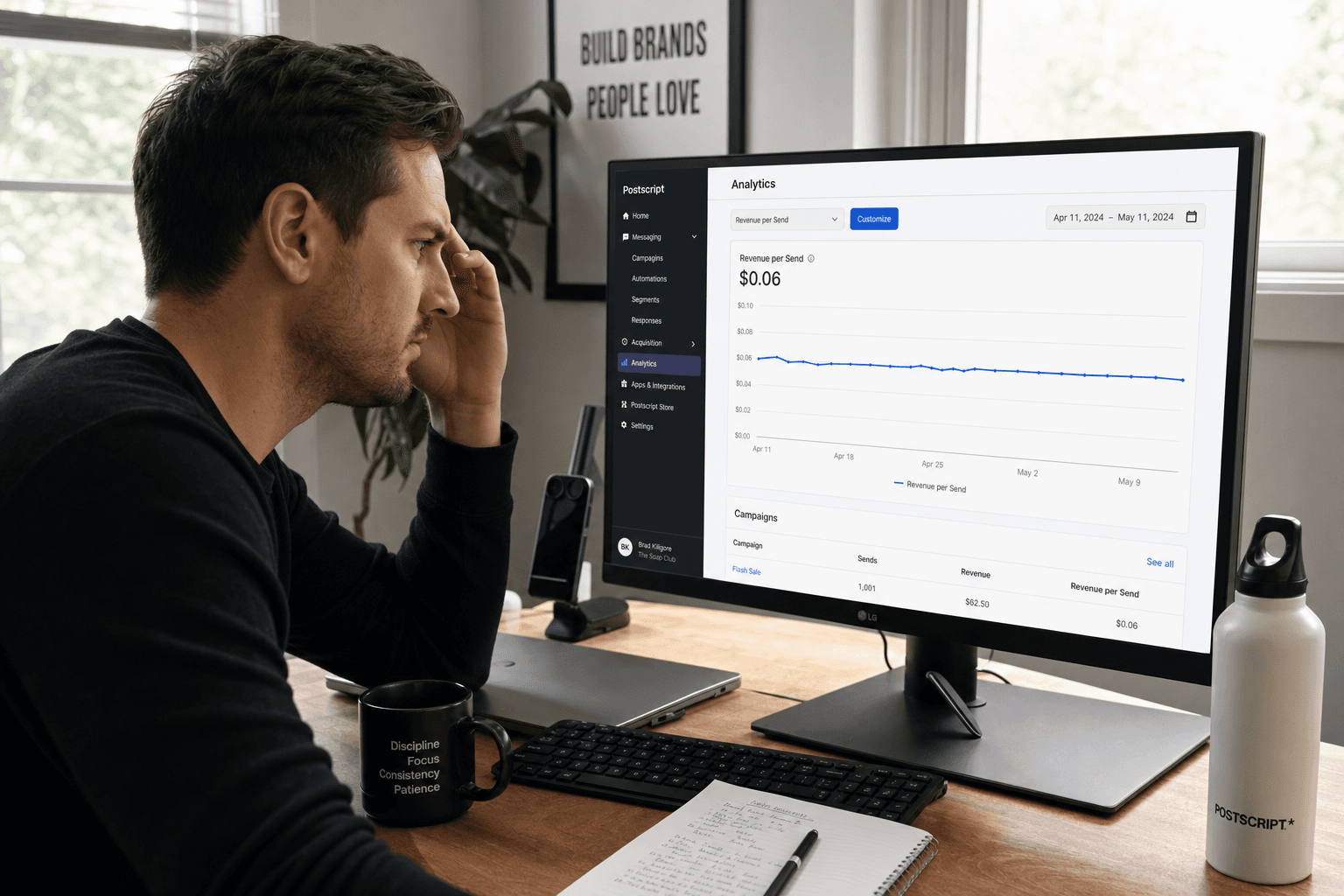
You run a welcome series, an abandoned cart flow, maybe browse abandonment, and twice-monthly campaigns. Postscript shows decent attributed revenue, yet SMS barely moves your blended ROAS for a channel supposed to return 25–50x on spend.
Most Shopify brands sit between a live account and a performing one: flows run untuned, campaigns hit the full list, and abandoned cart earnings per message (EPM) sits low in the $3.52–$10.95 benchmark range because trigger logic and copy date from launch.
Lists are saturating: ecommerce revenue-per-send flattened year-over-year for the first time in five years, and marginal subscribers from 2025–2026 respond materially less than those from 2022. Brands still growing SMS revenue rely on segmentation, automation architecture, and list health.
Compliance is zero-tolerance. TCPA violations run $500–$1,500 per unsolicited message, and state mini-TCPA laws stack: one non-compliant text to a Floridian can trigger TCPA and Florida FTSA claims, doubling exposure to $1,000–$3,000 per message. Unregistered 10DLC traffic risks a major-carrier block of 30+ days, cutting off at least a third of your list.
The Opportunity
A Well-Run Postscript Program Should Drive 10–20% of Total Store Revenue
That's the benchmark for correctly built programs. In Postscript's 2026 benchmarks, top-decile brands earn $4.54 or more in revenue per message (RPM) across all sends. At equal list size, $0.80 and $3.50 RPM programs often differ only in architecture: which flows fire, when, and to which Shopify segment.
Automation depth is the biggest lever most brands haven't pulled. Postscript abandoned cart flows average a 9.1% conversion rate and $8.11 EPM across all industries. Browse abandonment fires at peak intent, when a tracked subscriber views a product without buying. Back-in-stock and win-back flows recover silently lost revenue. These flows separate bottom-quartile programs ($0.41 RPM or less) from top-decile ones ($4.54+).
Most brands underuse Postscript's AI tools: Infinity Testing and Shopper, its AI shopping assistant. With tuned flows and list growth, they complete a program whose revenue shows in your blended ROAS.
What Most Get Wrong
What Most Shopify Brands Get Wrong on Postscript
Treating campaigns and automations as equals
Abandoned cart automations drive $3.52–$10.95 per message; campaigns drive $0.11–$0.55. Give campaigns equal time and you shortchange flows; leave flows unaudited for six months and you forfeit the highest-EPM messages.
Blasting the full list despite 45+ Shopify segment filters
RPM drops, persuadable subscribers burn out, and opt-outs approach the top of the 0.34–0.84% per-send range across DTC categories. Unlike email, re-texting an opted-out subscriber legally requires fresh explicit opt-in.
Trusting Postscript's 7-day click-through attribution as the truth
The platform-standard window inflates SMS's contribution versus blended ROAS. Reporting those numbers to finance often overstates incrementality and drives bad budget calls; GA4 or a third-party attribution layer corrects it.
Underbuilding list growth, then over-sending to a stagnant list
Without checkout opt-in and CashBack, the list shrinks and ages, and raising frequency to compensate speeds opt-outs and compresses RPM. Fix it upstream: compound the list, then cap per-subscriber frequency.
Assuming compliance is Postscript's job
Postscript handles quiet hours and opt-outs; opt-in consent is yours. Each text to an imported email list violates TCPA; unregistered 10DLC sends risk a major-carrier block of 30+ days.
Why Now
Why Durable SMS Programs Get Built Before Your Next BFCM
Marginal subscribers on mature DTC lists keep converting worse, and the decline speeds up as SMS adoption matures and inboxes fill. Brands winning the next three years build structural advantages now instead of running batch-and-blast.
Postscript's AI suite is today's structural advantage, and most brands haven't operationalized it. Infinity Testing needs someone to set up holdout groups, interpret results, and feed learnings into flows. RCS support adds new creative formats, and none of it runs itself.
Most of the market has a Postscript account; a small group runs a full program (systematic Infinity Testing, subscriber-level caps, Shopify segmentation on every send, CashBack growth without margin erosion) and is pulling away. Join that group before your next BFCM, while these advantages still set you apart.
The Mechanism
Where AI Gives Your Postscript Program an Edge
Real productivity, not AI theater. Here's where it actually moves a number for postscript sms brands.
Creative & Messaging (Infinity Testing)
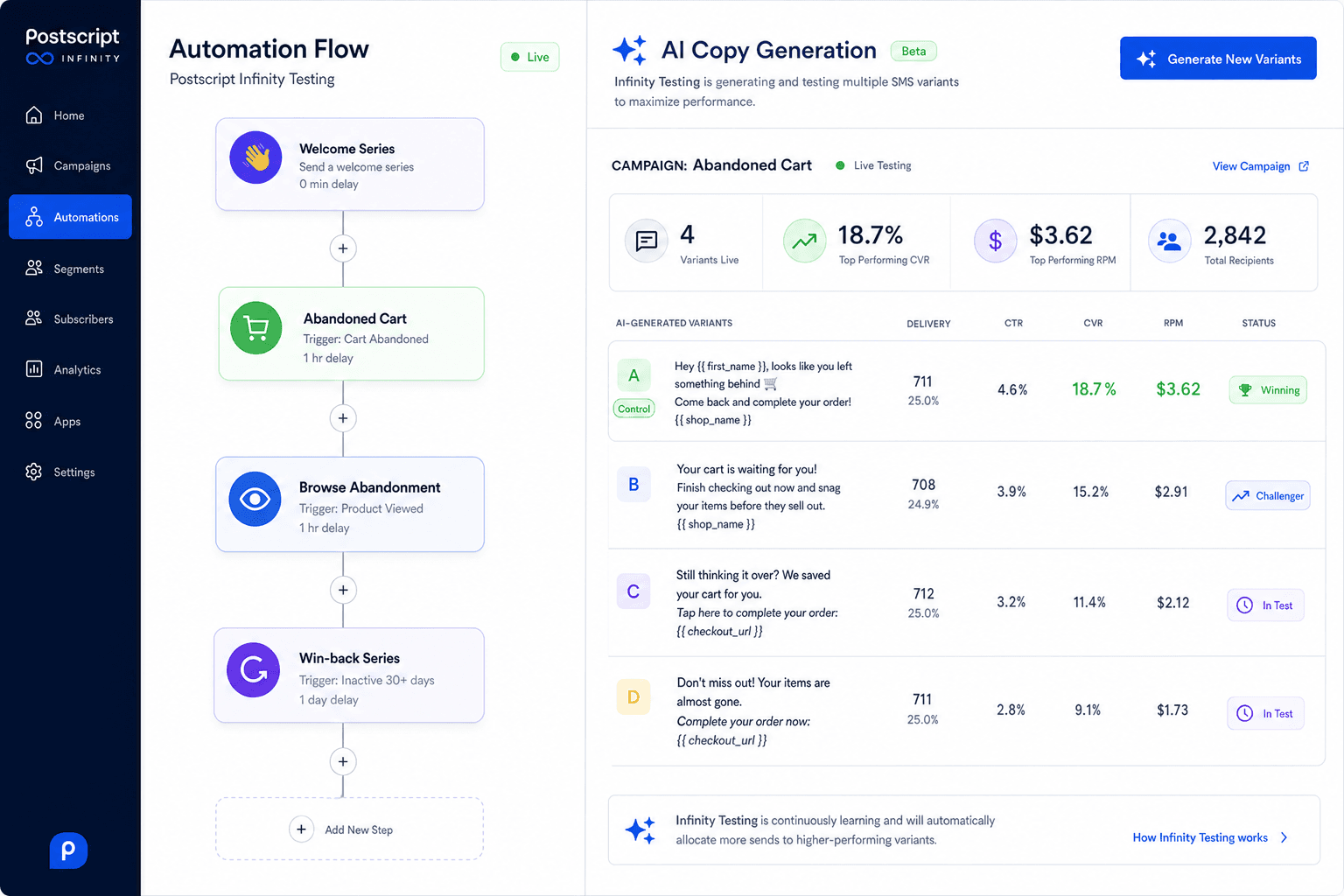
What AI does: Infinity Testing uses generative AI to write hundreds of on-brand variants and test them against holdout groups. We train Brand Center on your voice and run tests continuously.
The result: Postscript reports average lifts of 38% in campaign EPM and 20% in automation revenue, which is material at 500,000 messages a month and $1.50 RPM.
Why it matters here: Hand-testing one or two variants per campaign takes months to learn what Infinity Testing learns continuously. As marginal subscribers weaken, per-send EPM matters most.
Conversational Commerce (Shopper AI)
What AI does: We configure Shopper AI, Postscript's 24/7 inbound SMS agent, trained on your catalog and Brand Center voice. It answers product questions, makes inventory-aware recommendations from Shopify data, and guides subscribers to purchase.
The result: Shopper-enabled conversational flows averaged a ~10% revenue add on top of their original attributed revenue during BFCM 2025; that lift stacks on every running automation.
Why it matters here: Replies to an abandoned cart text far outconvert passive clicks; Shopper answers them without a live agent and cuts friction around SKUs, sizing, and bundles.
Analytics & Attribution
What AI does: We build an attribution layer outside Postscript's native 7-day click-through window, reconciling Google Analytics 4, Postscript, and Shopify revenue data into one weekly view of SMS's true contribution against blended ROAS.
The result: Brands that reconcile Postscript against GA4 and blended ROAS typically find true SMS contribution 15–30% lower than the platform reports, grounding every later optimization decision.
Why it matters here: If a subscriber clicks a cart text, then buys via Google three days later, Postscript credits SMS; blended ROAS doesn't. Klaviyo users reconcile two models.
Segmentation & Flow Architecture
What AI does: We rebuild flows on 45+ Shopify-native filters (LTV tier, SKU or collection bought, days since last order, subscription status, checkout abandonment stage, Shopify tags), then add subscriber-level caps and pixel-based browse abandonment.
The result: Subscriber-level caps can lower monthly opt-outs versus campaign-level caps at equal volume. Unsegmented abandoned cart flows tend to fall below Postscript's 9.1% all-industry average.
Why it matters here: Shopify data is Postscript's moat: segments separate a hero-SKU buyer who ordered twice in 90 days from someone who bought once, discounted, six months ago.
List Growth & Acquisition
What AI does: We rebuild the opt-in stack: checkout checkbox; CashBack via Fondue, replacing discount codes; keywords and Text-to-Join for packaging, social, and events; and pop-up sequencing. We review each for TCPA and 10DLC compliance.
The result: Checkout opt-in grows lists 30–50% faster than pop-ups. Per Postscript's CashBack integration, store-credit or prepaid-Visa CashBack lifts list growth rate 31% and welcome-series revenue 20–40%.
Why it matters here: Only list quality and growth sustainably lift SMS revenue as revenue-per-send flattens. CashBack signups out-retain 15%-off popup signups, with higher LTV and fewer early opt-outs.
Ready to see what this looks like for your postscript sms brands business?
No obligation. A senior strategist will show you exactly where the wins are.
The Strategy
How a High-Performance Postscript Program Is Built
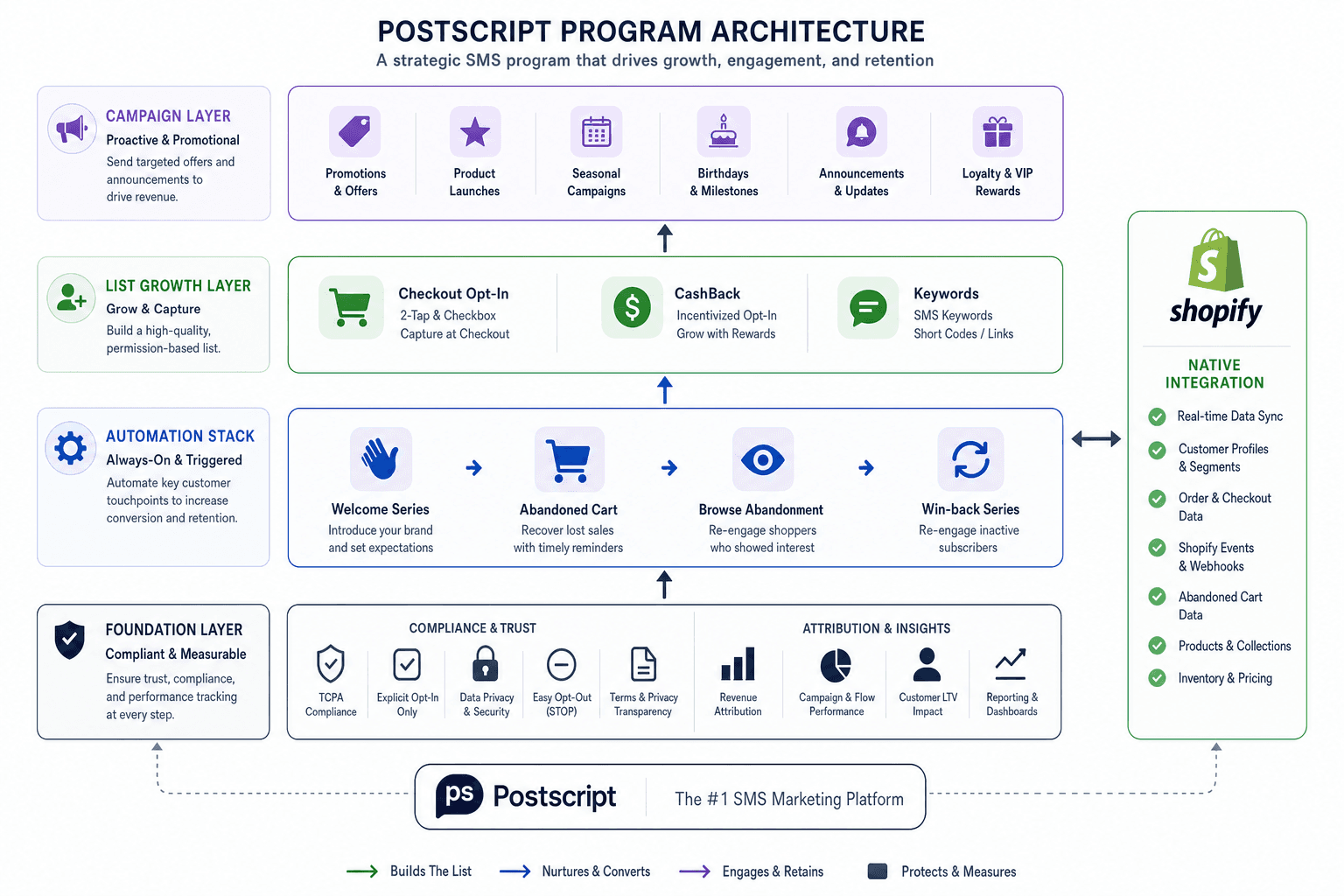
Start with the foundation, before any flow or campaign: confirm 10DLC registration, audit consent language at every opt-in surface, and build attribution outside Postscript's native window so you optimize toward a number you trust.
Automations come next: Welcome Series, Abandoned Cart, Browse Abandonment (pixel-tracked, identified subscribers only), Back in Stock, Post-Purchase, and Win-back. Segment each on Shopify data and set subscriber-level caps at the flow level. That architecture, not Postscript's default setup, moves abandoned cart EPM toward the top of its $3.52–$10.95 benchmark range.
List growth runs in parallel. Configure checkout opt-in first, the highest-volume surface and one most brands underuse, then swap welcome-series discount codes for CashBack and add keywords and Text-to-Join. With correct acquisition, the elite benchmark of 97–99% subscriber retention in the first 30 days is achievable.
Campaigns layer on top. Segmentation decides who gets each send, Infinity Testing runs continuously, and Shopper AI covers the highest-intent automations. Use MMS deliberately, modeling its cost against expected EPM lift, since MMS runs 3–5x the cost of SMS at every tier.
Reporting is anchored to blended ROAS from day one, with Postscript's native attribution as a secondary number.
The one number that governs this
The governing KPI is revenue per message (RPM) across all sends, reported against blended ROAS; EPM is the same measure for one flow or campaign.
How We Help
What We Do Inside Your Postscript Account
We take a few Shopify brands at a time so each gets senior attention and hands-on work inside your Postscript account, not a strategy deck or PDF.
Compliance & Foundation Audit
We audit 10DLC, consent language, timezone quiet hours, and opt-outs, and close TCPA exposure, including Florida and Texas mini-TCPA stacking, before it's a legal bill.
Attribution Layer Build
We build the view reconciled to GA4 and blended ROAS, flag where the native window inflates results, and set the corrected baseline for optimization.
Automation Architecture (Flows)
We audit or build the six flows and the browse pixel, segment each on Shopify data, and cap subscribers at 4–6 messages per 30 days.
List Growth Stack
We configure the opt-in stack and review every surface's consent language, aiming for 30–50% faster list growth and 97%+ retention in the first 30 days.
Infinity Testing & Creative Operations
We set up Brand Center, run Infinity Testing with holdouts that measure true incrementality, and segment every campaign send.
Shopper AI Configuration
We train Shopper AI on your catalog, sizing and fit logic, bundles, and brand voice, then put it on abandoned cart and browse abandonment first.
Ongoing Reporting & Optimization
Weekly reports cover RPM, flow and campaign EPM, per-send opt-outs, 30-day retention, list growth, and SMS revenue share against blended ROAS; we set the agenda.
Who's Behind This
Who we are, and what makes us different
Sagum is a performance marketing agency founded in January 2017 in St. George, Utah. We've spent 8+ years growing real brands and being judged on KPIs, not vanity metrics.
We deliberately limit how many clients we take so each one gets senior attention. We treat your numbers like our own, we never run generic playbooks, and your strategy is built for your business, because shouldn't your brand's marketing be custom to your brand?
Sagum.ai is our AI arm: the same proven operators now build AI into the work wherever it creates real edge, not as theater, but as leverage applied with discipline.
- 8+ years growing brands on performance KPIs, not vanity metrics
- Limited client roster, with senior attention on every account
- An extension of your team; your success is tied to ours
- Custom strategy per brand, never a generic playbook
- AI built in where it moves a number; judgment over hype
“Sagum is a performance marketing agency that's spent 8+ years growing brands by treating their numbers like our own. We take on few clients, never run generic playbooks, and now build AI into the work wherever it creates real edge, not hype. Your strategy is built for your business, and our success is tied to yours.”
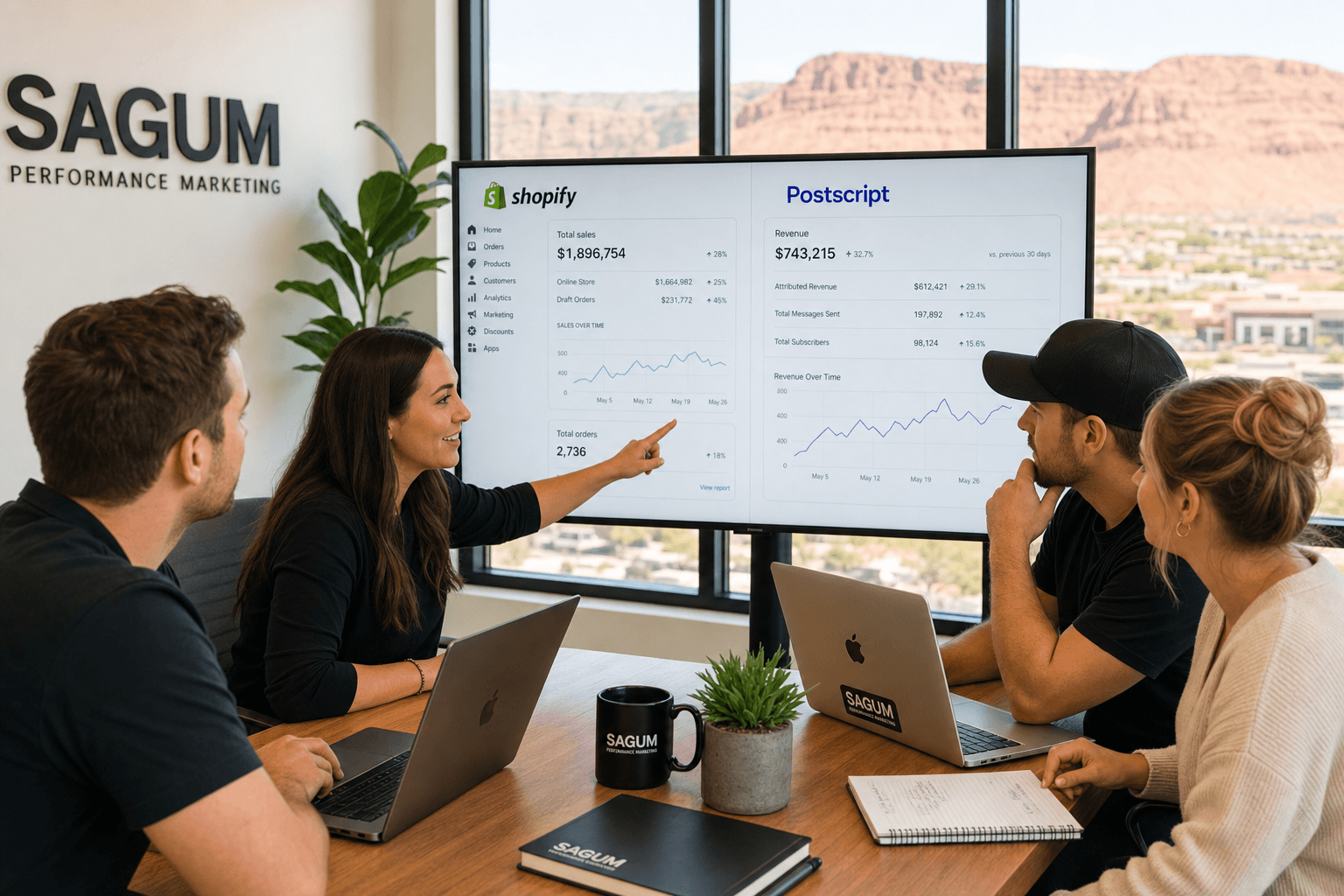
“After six years, Sagum is our most important partner: trusted, communicative, and caring about our business as if it's their own.”
Long-term partner
6-year client
Proof
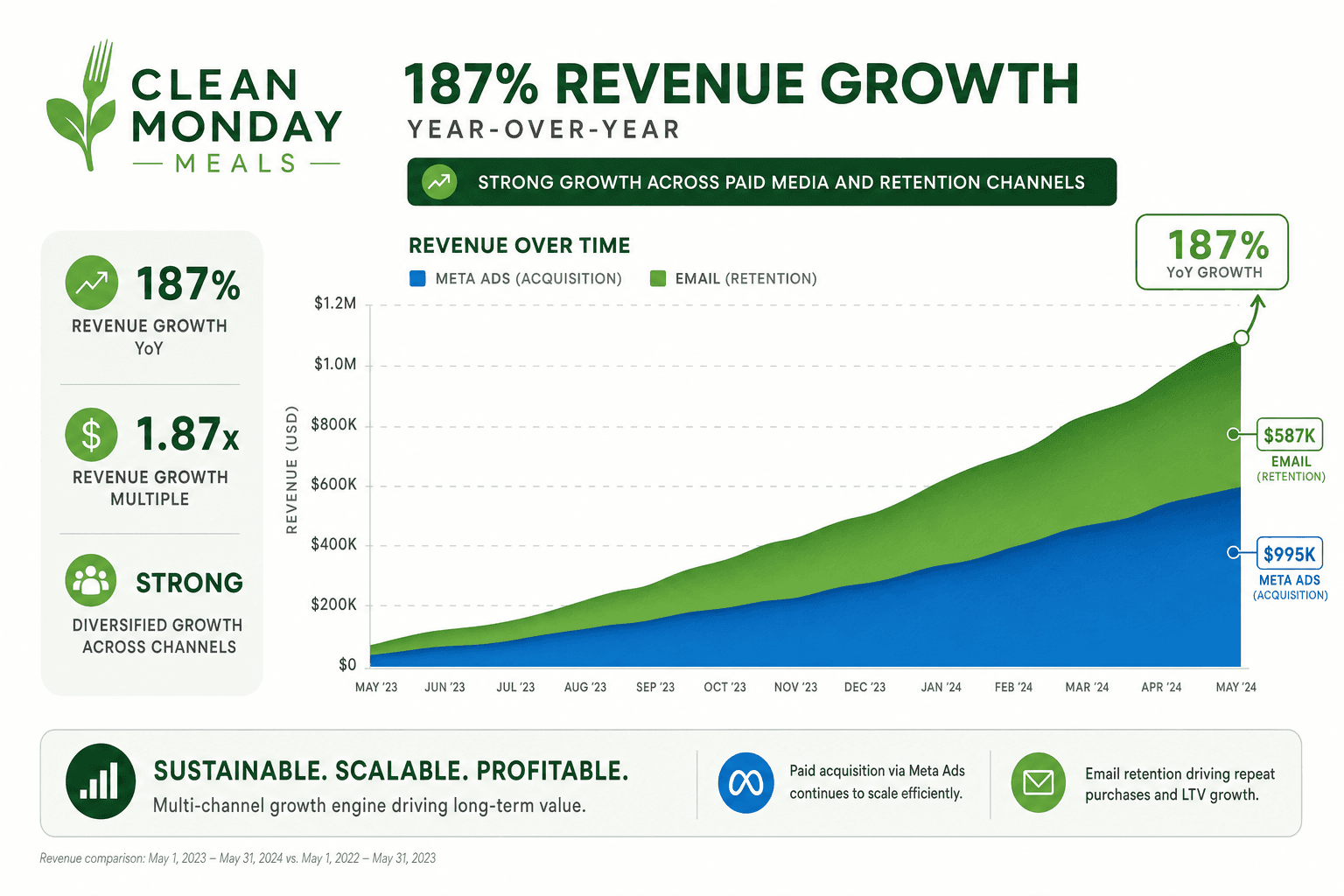
187% YoY, $8+ ROAS on Meta, +79% web conversion
Clean Monday Meals
Challenge
Clean Monday Meals set out to grow its food DTC brand across channels.
What we did
Sagum scaled Meta and took over email and Amazon.
Result
The program delivered 187% year-over-year growth, $8+ ROAS on Meta, and a 79% lift in web conversion. We'd run your Postscript program with the same multichannel discipline.
Find Out What Your Postscript Program Is Worth
No obligation. We audit your flows, attribution, list health, and compliance, then show you where the revenue gap is and what closing it takes for your Shopify store, not a generic SMS template.
Sagum · January 2017 · St. George, Utah · 8+ years