

8+ years growing brands on KPIs, now with AI
More Margin Per Order for POD Brands
Performance marketing built around your base costs, break-even ROAS, and the channels where POD buyers actually convert.
Google Ads · Meta · TikTok · 8+ years growing ecommerce brands


Get your free Growth Gap Analysis
Senior strategist review · response within one business day
Prefer to reach out directly?
The Challenge
POD Looks Simple Until You Do the Margin Math
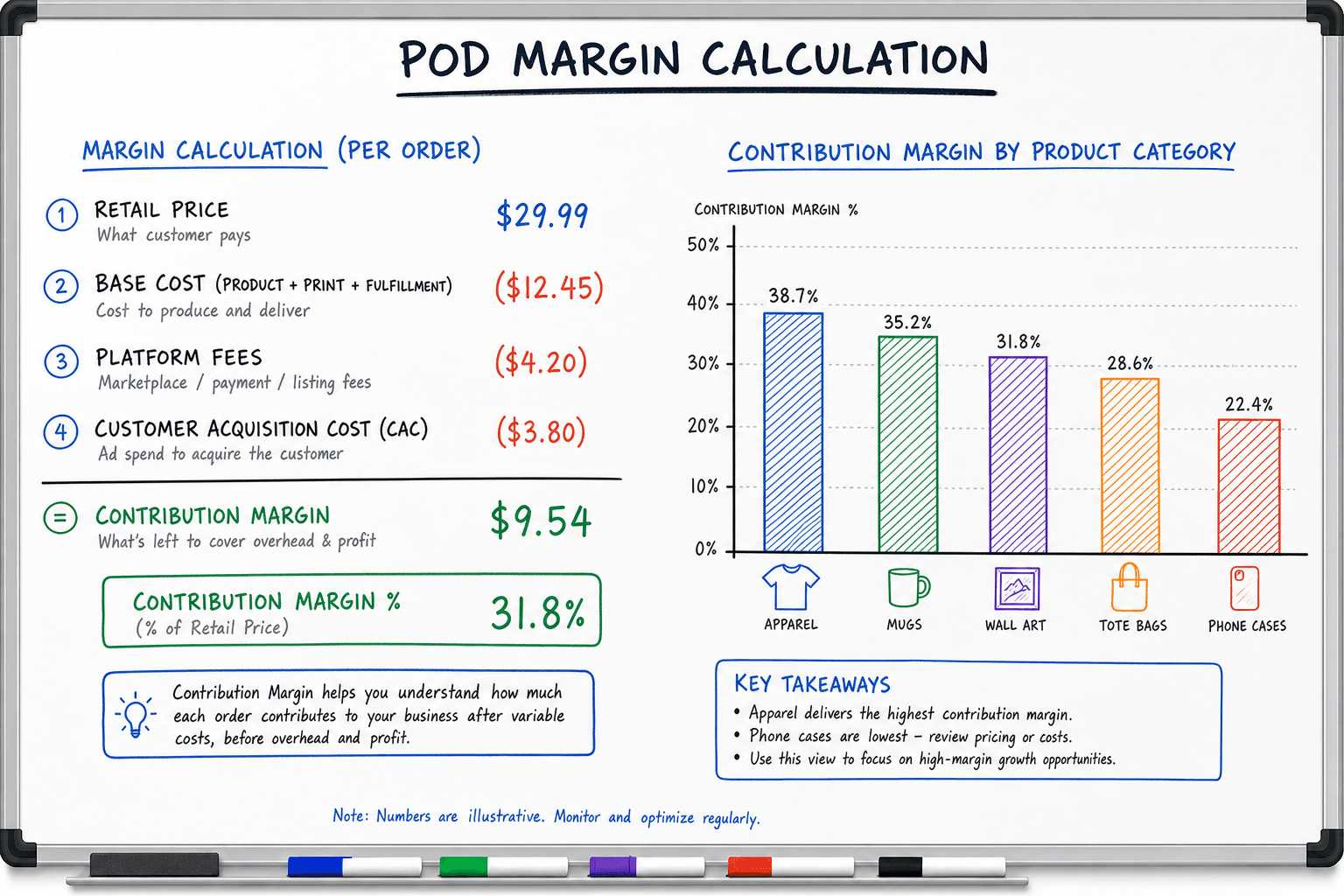
The no-inventory, no-warehouse pitch holds until you run paid acquisition. Contribution margin per order is retail minus base cost, shipping, Etsy's 6.5% transaction fee plus $0.20 per listing renewal, platform processing, and customer acquisition cost (CAC). Most POD sellers on standard apparel keep 20 to 40 cents per dollar before ad spend and returns.
One return on a $24.99 tee can erase the profit from three or four sales. If your provider misses its SLA around Mother's Day, a wave of 1-star reviews tanks your Etsy Listing Quality Score, sometimes permanently for that listing.
TikTok Shop buyers expect near-Amazon delivery, which Printify or Printful won't match without express fulfillment or pre-printed stock. That makes TikTok Shop, your easiest-looking growth lever, the one most likely to blow up your reviews when a provider has a bad week.
Your Meta pixel fires inconsistently on Shopify, so you budget on numbers you can't fully trust. Your Etsy shop is one algorithm update from a traffic cliff.

The Opportunity
Winning POD Brands Know Their Margins and Test Faster
Growing POD brands almost always know which orders are profitable before scaling. Mugs run 35 to 40% margins, embroidered items 30 to 60%, and home décor and wall art can hit 60 to 82%. Layering these against standard apparel can lift blended gross margin to 40 to 45%, funding paid acquisition that thin-margin tees can't.
They run a niche-testing loop: list micro-niche mockups on Etsy or TikTok Shop, test with $5 to $10 in Etsy Ads or one organic TikTok, and kill or scale within a week. Each round is a micro-drop: three to five trending SKUs for a niche community or seasonal moment.
Most sellers neglect TikTok Shop, whose single-digit referral fee plus creator commissions can undercut most paid channels at scale. Sellers investing in short-form content, creator affiliates, and GMV Max Ads reach buyers Etsy's algorithm doesn't.
What Most Get Wrong
What Most POD Sellers (and Their Agencies) Get Wrong
Scaling ads without knowing your real break-even ROAS
At a $14 all-in unit cost and $24.99 retail, break-even ROAS is roughly 2.3x, so 1.8x on Meta loses money. Most sellers calculate it without platform fees or average shipping.
Advertising the whole catalog instead of your highest-margin SKUs
A Bella+Canvas tee ($9.04 Printify base, $24.99 retail) leaves little room for ads; a framed poster (about $28 base, $69.99 retail) has room. Whole-catalog ads burn budget on zero-margin orders.
Ignoring provider arbitrage until a peak-season SLA failure
Sophisticated operators split providers by region or keep backups for Q4 and Valentine's Day. With one provider, one delay brings 1-star reviews that permanently damage Listing Quality Score.
Relying on Etsy SEO alone with no off-platform audience
An Etsy policy change or ranking update can crater traffic overnight. With no email list or Shopify DTC layer, you're a tenant in someone else's building with zero recourse.
Hiring agencies that don't know Printful Growth from Printify Premium
A generic ecommerce agency hits ROAS targets that ignore base cost, shipping, and platform fees while your contribution margin per order goes negative. POD math isn't standard ecommerce math.
Why Now
Why POD Brands Win or Lose Before Each Peak Starts
TikTok Shop's POD infrastructure is mature enough to convert, but most sellers underuse the affiliate program, GMV Max Ads, and Seller Center's Product Opportunities tool. Sellers building creator outreach now acquire customers at costs that won't last once the channel matures and CPMs rise, as happened on Meta between 2018 and 2022.
AI now produces mockup variants, Etsy listing copy for long-tail buyer-intent keywords, and TikTok scripts that once took hours per SKU. Operators using it well can run five times the niche tests in the same time window.
Q4 is POD's biggest peak: custom gifts, holiday apparel, seasonal home décor. Brands entering each peak with clean attribution, proven creative angles, and a tested TikTok Shop presence scale efficiently. Those still debugging their pixel and guessing break-even ROAS overspend mid-peak.
The Mechanism
Where AI Gives a POD Brand a Real Edge
Real productivity, not AI theater. Here's where it actually moves a number for print-on-demand brands.
Creative
What AI does: AI writes mockup copy variations, ad hooks, and TikTok video scripts in batches by niche, product category, and seasonal moment.
The result: At five niche tests per week instead of one, you find winning designs and angles in a fraction of the time and waste less spend.
Why it matters here: In POD your designs are your ad creative, so creative velocity is the core competitive lever: whoever tests faster wins the niche.
Analytics
What AI does: AI reconciles per-SKU contribution margin, matching base cost from your print provider's API against order revenue, platform fees, and ad spend.
The result: You stop scaling losses that look like wins and fund the SKUs with the highest true contribution margin per order, not the highest gross revenue.
Why it matters here: Base cost, shipping, and platform fees vary by provider, region, and product category, so manual reconciliation at scale is impossible, and errors are expensive.
Digital Ads
What AI does: AI monitors Meta and TikTok campaigns continuously and moves budget to creative angles and audience segments at or above break-even ROAS, without waiting for a weekly check-in.
The result: Spend follows performance in near real time, which matters most in peaks like Valentine's Day and Mother's Day.
Why it matters here: At a 30% gross margin the break-even ROAS window is narrow; days of unchecked losing campaigns can turn a profitable peak into a loss.
Conversion Optimization
What AI does: AI reviews Shopify product pages and Etsy listings for conversion leaks (weak mockup sequencing, missing social proof, pricing that undersells the design) and ranks fixes by likely impact.
The result: Higher conversion on existing traffic raises effective ROAS without more ad spend, which is often the best move on thin POD margins.
Why it matters here: Listing Quality Score depends on click-through and conversion rate, so better conversion compounds into higher organic rank and lower effective Etsy Ads cost per sale.
What AI does: AI builds behavior-triggered post-purchase and browse-abandonment flows for your Shopify DTC layer, segmented by category: mug and framed-poster buyers differ in repurchase windows and cross-sell candidates.
The result: Email earns meaningful revenue from customers you already paid to acquire, lowering effective CAC through an owned channel that survives Etsy algorithm updates.
Why it matters here: Without an off-platform email list, you run a listing portfolio instead of a business.
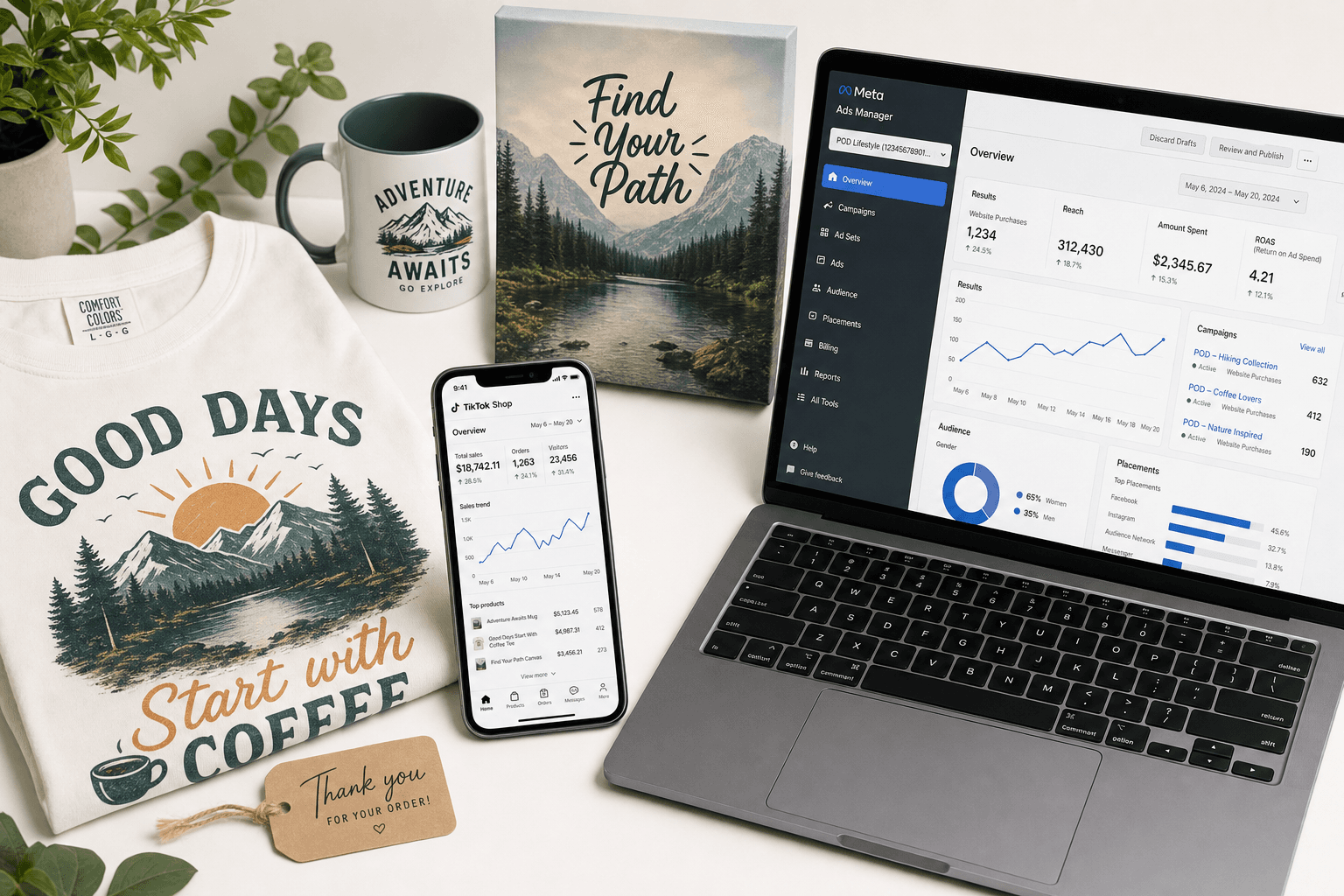
Ready to see what this looks like for your print-on-demand brands business?
No obligation. A senior strategist will show you exactly where the wins are.
The Strategy
POD Marketing Built Around Contribution Margin per Order
We first establish contribution margin per order by SKU and by channel: base cost by provider, shipping, platform fees, and your current CAC. Until that number is clean, every budget decision is a guess.
We then rank channels by realistic CAC against your margin. For most POD brands, that's Google Shopping and Meta for Shopify DTC, Etsy Ads managed against Listing Quality Score and conversion rate (not raw ROAS alone), and TikTok Shop as a growth channel with its own content and affiliate strategy.
We run the niche-testing loop on a structured cadence, testing with small Etsy Ads budgets or organic TikToks, scaling paid behind the winners, and killing designs that don't convert in the test window.
We fix attribution before scaling. A misfiring Meta pixel or Etsy Ads data that doesn't reconcile against actual profitable orders means you're optimizing on bad numbers, which is worse than running no ads.
Provider strategy is part of marketing strategy. Switching providers can add more margin than any paid channel delivers when your highest-margin SKUs sit with a provider that has inconsistent SLAs. Printify Premium cuts base costs by up to 20%, and some Printify providers undercut Printful on comparable products.
The one number that governs this
Contribution margin per order, not gross ROAS or revenue, governs every channel and campaign: what an order leaves you after all costs and ad spend.
How We Help
How We Execute This for Your POD Brand
We take on a limited number of clients so every engagement gets senior attention. This is how we'd run it for a POD brand at your stage.
Attribution Audit and Tracking Setup
Before we touch your ad spend, we validate the Meta pixel, reconcile Shopify order-level COGS into per-SKU contribution margin, and review Etsy Ads data.
Paid Media: Meta and Google
We anchor Meta and Google Shopping to break-even ROAS by SKU category, prioritizing high-margin products and evaluating or cutting low-margin ones.
Etsy Ads Management
We manage Etsy Ads to raise Listing Quality Score through better conversion rate and CTR, after checking keywords and niche demand in eRank and EverBee.
TikTok Shop Strategy and GMV Max Ads
We check designs against real search volume in Product Opportunities, set content cadence, recruit affiliate creators via Kalodata, and amplify winners with GMV Max Ads.
Creative Production and Niche Testing
We feed the niche-testing loop with AI-assisted mockup copy, ad hooks, and TikTok scripts, scale the winners, and cut the rest on a defined timeline.
Email and Owned Audience
We automate post-purchase and abandonment flows, segmented by product category and purchase behavior, turning acquired customers into repeat revenue on an owned channel.
Conversion Optimization
We fix conversion leaks on your Shopify product pages and top Etsy listings in order of likely impact, lifting effective ROAS and Listing Quality Score.
Who's Behind This
Who we are, and what makes us different
Sagum is a performance marketing agency founded in January 2017 in St. George, Utah. We've spent 8+ years growing real brands and being judged on KPIs, not vanity metrics.
We deliberately limit how many clients we take so each one gets senior attention. We treat your numbers like our own, we never run generic playbooks, and your strategy is built for your business, because shouldn't your brand's marketing be custom to your brand?
Sagum.ai is our AI arm: the same proven operators now build AI into the work wherever it creates real edge, not as theater, but as leverage applied with discipline.
- 8+ years growing brands on performance KPIs, not vanity metrics
- Limited client roster, with senior attention on every account
- An extension of your team; your success is tied to ours
- Custom strategy per brand, never a generic playbook
- AI built in where it moves a number; judgment over hype
“Sagum is a performance marketing agency that's spent 8+ years growing brands by treating their numbers like our own. We take on few clients, never run generic playbooks, and now build AI into the work wherever it creates real edge, not hype. Your strategy is built for your business, and our success is tied to yours.”

“Sagum roughly doubled our bottom line. They treat the work like it's their own business.”
Rachel Nilsson
CEO, RAGS
Proof
$255k → $555k in 2 months, ROAS 2.9x → 5.5x+
Nickel & Suede
Challenge
Nickel and Suede needed to scale revenue profitably on paid social, the same problem a POD brand faces when it raises ad spend on thin per-order margins.
What we did
We ran Meta and TikTok creative testing at volume, the same discipline a POD catalog needs to learn which designs sell profitably.
Result
Revenue went from $255k to $555k in two months. ROAS rose from 2.9x to 5.5x+, peaking at 7.95x, and site conversion lifted 34%.
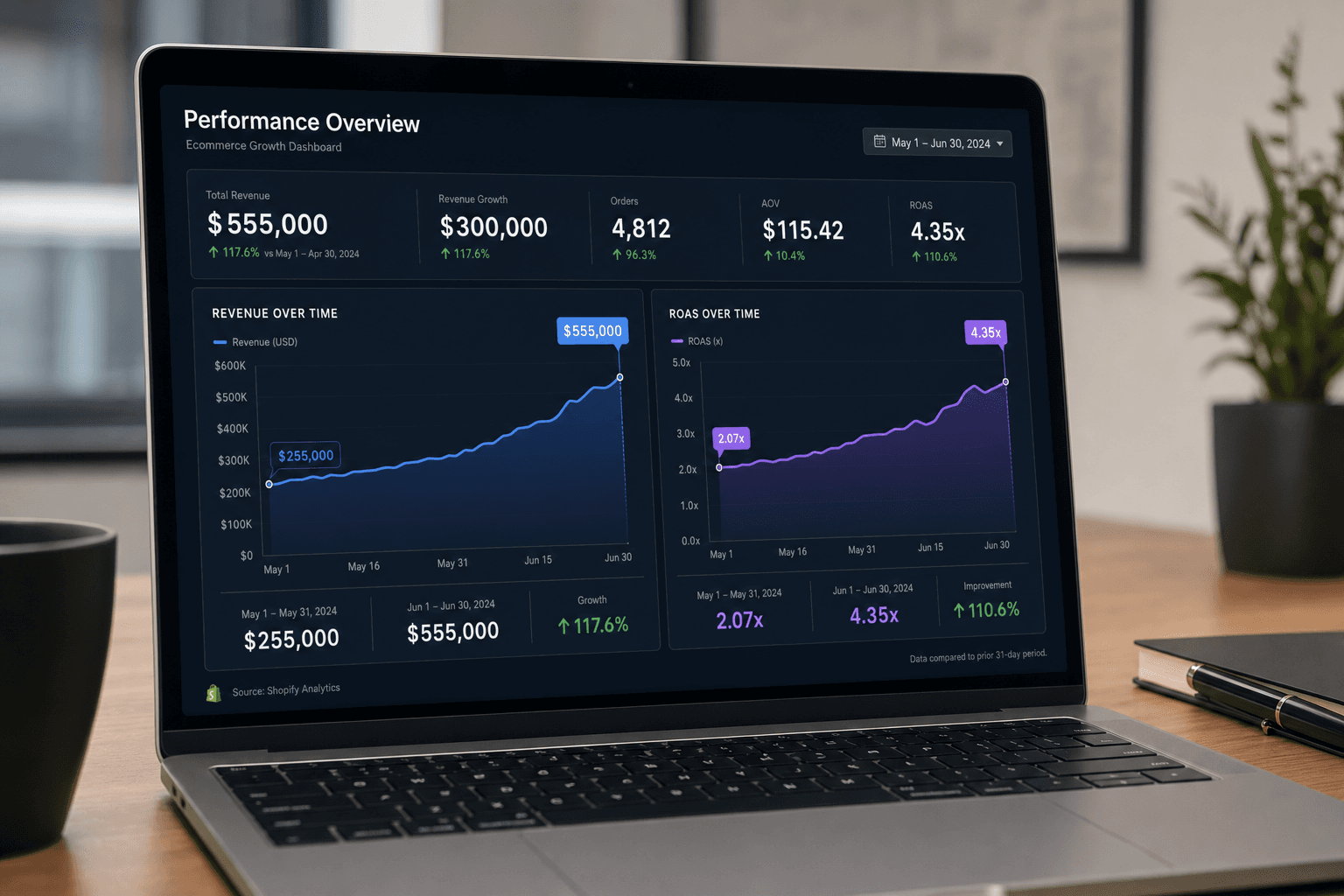
- Revenue
- $255k → $555k (2 mo)
- ROAS
- 2.9x → 5.5x+ (peak 7.95x)
- Site conversion
- +34%
Find Where Your POD Brand Leaves Contribution Margin on the Table
No obligation. We'll review your margin math, channel mix, and creative testing cadence, and show you the real growth levers for your specific stack.
Sagum · January 2017 · St. George, Utah · 8+ years