

8+ years growing brands on KPIs, now with AI
Stop Leaking MRR on Recharge
We build retention and acquisition systems that grow subscriber LTV, cut churn, and compound your recurring revenue.
8+ years growing DTC brands · Google, Meta & TikTok Partner · AI-powered where it moves the number


Get your free Growth Gap Analysis
Senior strategist review · response within one business day
Prefer to reach out directly?
The Challenge
Your Recharge Revenue Engine Leaks in Slow Motion
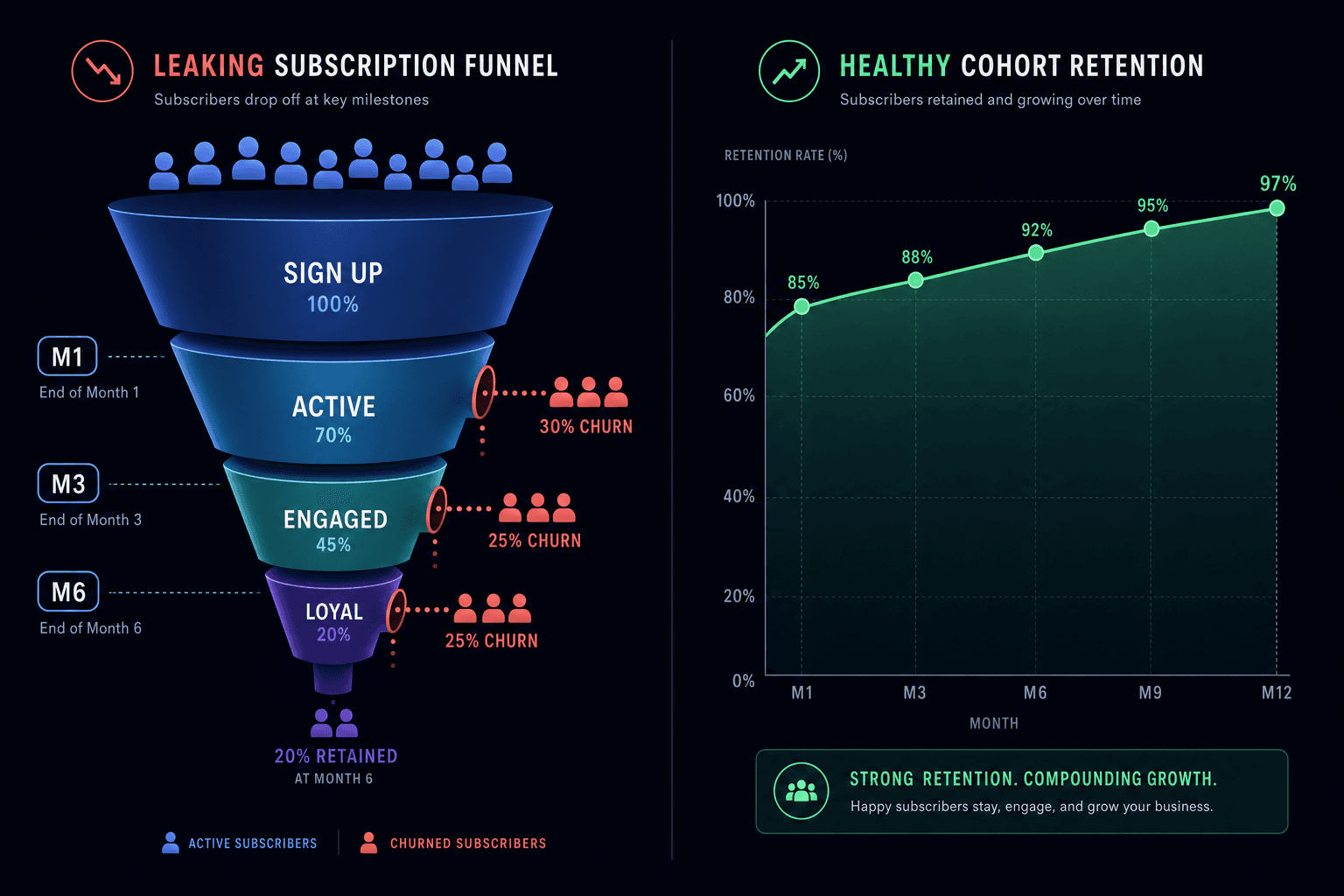
Your Recharge dashboard tells you what happened, but rarely why, or where the leak is before it compounds. Stable MRR can hide a collapsing cohort: a 6% blended churn number may mask a failed-payment queue never properly dunned, a normalized M1→M3 drop-off, and a cancellation flow sending 40% of save-offer traffic to a dead-end page.
The first renewal is the M1 cliff: between 40 and 60 percent of churn decisions happen after the first delivery. If your onboarding is a single confirmation email and a 'your next box ships in 30 days' Klaviyo message, you lose subscribers before they turn loyal.
Meta and Google see the $49 your subscriber paid on day one, not the $420 they're worth over 12 months, so your ROAS targets are calibrated to the wrong number and you underspend on cohorts that build MRR.
At $5M to $50M ARR, net revenue retention (NRR) drifting from 92% to 84% is a $400K-plus annual revenue hole your new-customer dashboards won't show until the damage is done.
The Opportunity
Subscription Brands That Compound MRR Win on Infrastructure, Not Product
Recharge's 2025 State of Subscription Commerce data shows the top- vs. bottom-quartile NRR gap widened to 34 percentage points, driven by automation infrastructure. The 32% of brands layering tooling on their billing platform get 2.1x higher NRR than the 68% on defaults, where most of your competitors sit.
Reason-routed cancellation flows retain 3 to 5 times more cancelling subscribers than one 'are you sure?' modal. Brands with six-plus touchpoints between sign-up and third renewal see 42% lower voluntary churn, and annual prepaid cuts churn 51% versus monthly.
Multi-channel dunning doubles built-in recovery: at 5,000 monthly orders, $50 AOV, and 3.5% failed payments, moving recovery from 28% to 55–65% adds $28,000 to $39,000 yearly.
Anchoring ROAS to subscriber LTV by cohort and channel lets you outspend competitors still bidding to 2.5x on first-order revenue when LTV runs $420 over 12 months.
What Most Get Wrong
What Most Recharge Brands and Their Agencies Get Wrong
Running blended churn as the only churn metric
Blended 6% monthly churn can hide 2% voluntary (a cancellation-flow fix) and 4% involuntary (a dunning fix), so you fix neither. Healthy DTC gross revenue retention (GRR) runs 60–75%.
Calling the M1 cliff 'normal churn'
Onboarding is your retention strategy. A three-email welcome series that skips product usage, expectation-setting, and subscription value loses subscribers a properly sequenced flow would keep.
Optimizing acquisition ROAS to first-order revenue
Meta and Google then find you one-time buyers. Brands compounding MRR feed subscriber LTV back to the platforms and bid to 12-month value, so they can outspend you.
Leaving Recharge's default three-retry dunning in place
Built-in dunning recovers 28% of failed payments on average; multi-channel email, SMS, and smart-retry sequences reach 55–65%. For most Recharge brands at scale, that upgrade is the highest-ROI infrastructure investment.
Putting off Recharge's Shopify Checkout Integration (SCI) migration
Shopify retired checkout.liquid (Plus by August 2025, others by August 2026). On SCI, competitors lift conversion with Functions discounts, post-purchase upsells, and Shop Pay; Recharge's hosted checkout blocks all three.
Why Now
Why Recharge Brands That Optimize Retention Now Pull Ahead
Recharge acquired Skio in April 2026 for a reported $105 million, putting two of the largest Shopify subscription platforms under one parent.
Consolidation gives some brands a reason to revisit their platform. Most Recharge brands still run defaults, so the brands optimizing fastest compound MRR while competitors debate platforms instead of retention.
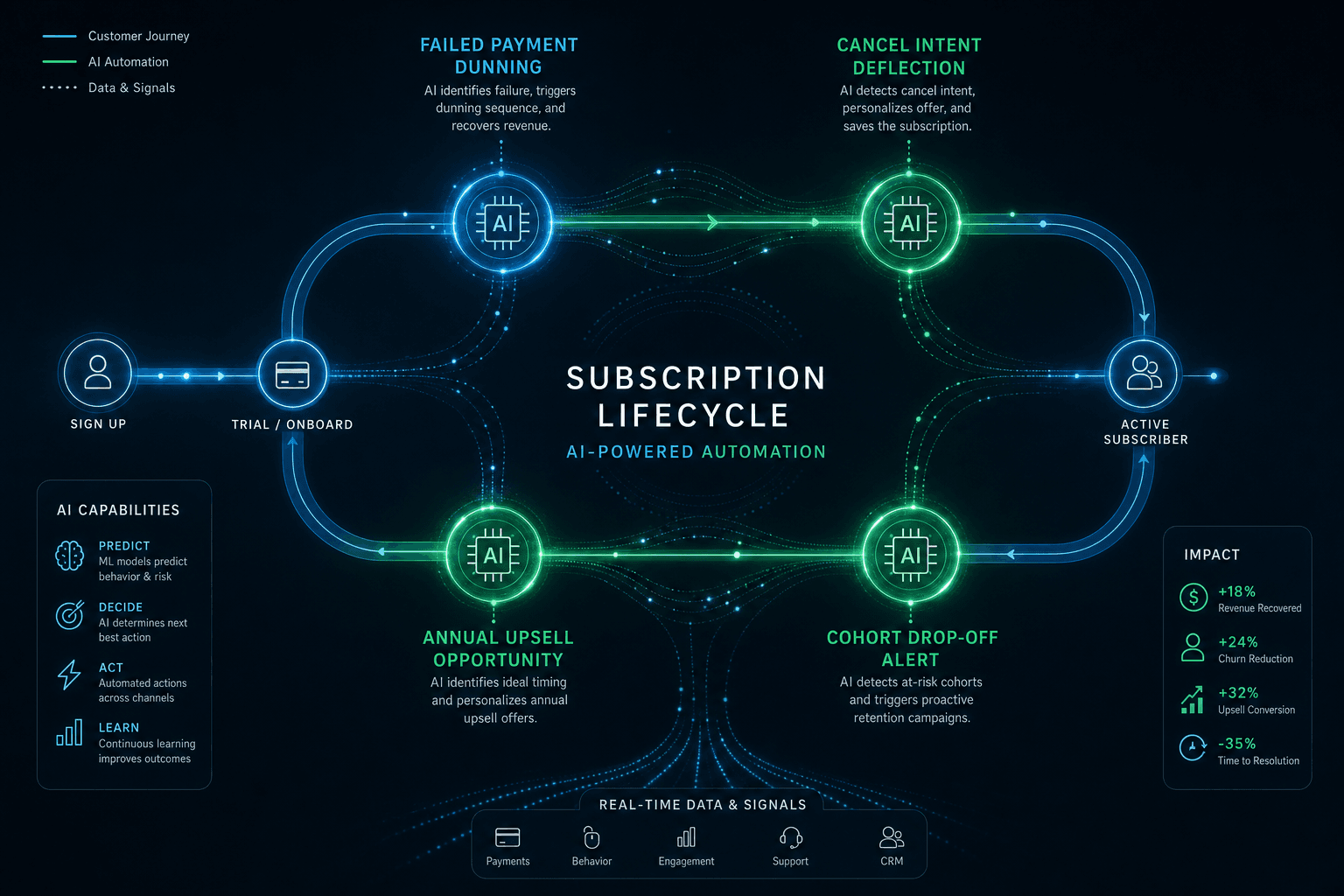
AI payment-retry logic, replacing fixed-interval dunning, recovers failed payments that fixed schedules often miss. AI-personalized cancel flows route save offers by stated reason and subscriber tenure, keeping subscribers that static flows lose. AI cohort analysis can surface an M2 churn signal in a subscriber's third week, before they cancel.
The Mechanism
Where AI Gives Recharge Subscription Brands an Edge
Real productivity, not AI theater. Here's where it actually moves a number for recharge subscription brands.
Analytics and Cohort Intelligence
What AI does: AI tracks Recharge cohorts at M1, M3, M6, and M12 by channel, offer, and product, separates active churn (cancellations) from passive churn (failed payments), and flags decaying cohorts and spiking cancellation reasons.
The result: You catch the M1 cliff in time to re-engage and stop treating blended churn as one number with one fix.
Why it matters here: At $10M ARR, NRR drifting from 92% to 84% costs $800K yearly. Catching cohort decay six weeks sooner than monthly manual review lets you intervene.
Email and Klaviyo Flow Architecture
What AI does: We build Klaviyo flows on Recharge events (failed charge, upcoming order, skip, cancel intent, reactivation), and AI tests subject lines, send times, and offer sequencing faster than manual A/B tests.
The result: Dunning escalates across email and SMS, pre-ship flows cut skips, and cancel-intent flows route save offers by stated reason.
Why it matters here: The M1 cliff is the most valuable intervention point. For replenishment subscriptions at 4–7% monthly churn, cutting voluntary churn even 1.5 points compounds MRR.
Paid Acquisition Anchored to Subscriber LTV
What AI does: We restructure Meta and Google around subscriber LTV by cohort and channel, then feed value data to AI bidding so the platforms optimize toward customers who stay 12 months.
The result: Your ROAS targets reflect a subscriber's 12-month worth (about 8.6x a $49 first order), and you scale channels with the best M6 and M12 retention.
Why it matters here: With 12-month LTV at $420 on a $49 first order, bidding to LTV instead of first-order ROAS moves MRR more than any single retention tactic.
Conversion Optimization for Subscription Checkout
What AI does: AI-assisted analysis finds checkout leaks (offer placement, subscribe-and-save framing, prepaid vs. pay-as-you-go) and tests fixes faster than manual CRO. On SCI, we build discount logic, prepaid term options, and gift subscription flows.
The result: More subscribers opt in and choose annual prepaid, and checkout works with Shop Pay, Apple Pay, and Google Pay.
Why it matters here: Annual subscribers are 2.4x more profitable than monthly ones, so presenting prepaid at frequency selection shifts your mix toward them before any retention tactic runs.
Creative for Subscription Acquisition and Retention
What AI does: We test subscription angles (convenience, savings, discovery, community) to find which bring subscribers who stay, and AI helps generate win-back creative matched to each cancellation reason.
The result: You get 5x more testable angles per week than traditional production, with results segmented by retention outcome instead of click-through rate or first-order ROAS alone.
Why it matters here: Winning subscribers who cancel after one box is worse than winning fewer who stay 12 months, so test creative against M3 retention, not just CPA.
Ready to see what this looks like for your recharge subscription brands business?
No obligation. A senior strategist will show you exactly where the wins are.
The Strategy
How to Run Subscription Marketing on Recharge
Most agencies treat subscription brands as ecommerce stores with a recurring billing plugin: they optimize first-order ROAS, build one welcome email, and call retention done.
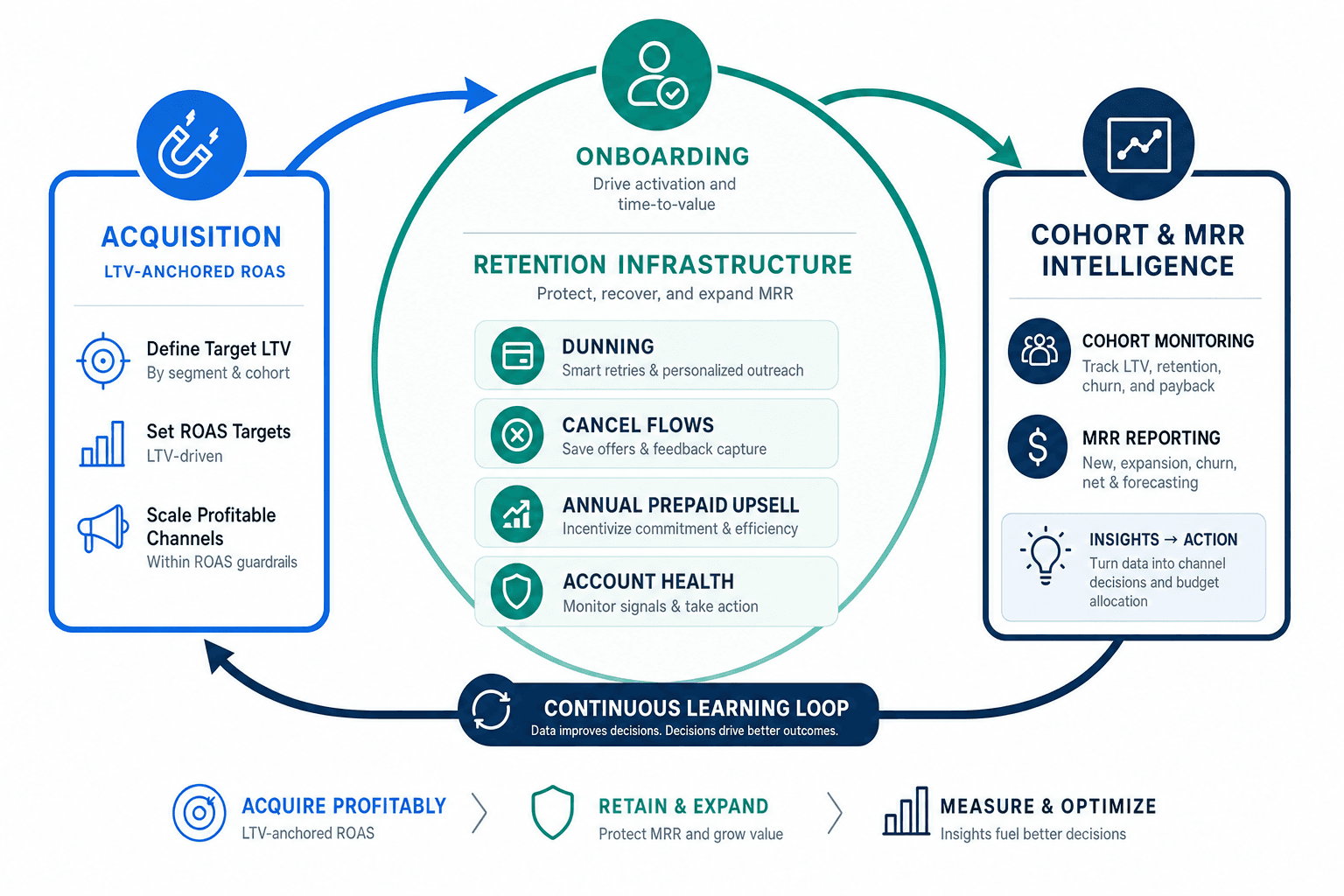
A Recharge strategy starts with the MRR model, works back to subscriber LTV by channel, and builds acquisition and retention around those numbers.
Google Search captures high-intent queries like 'monthly coffee subscription' and 'supplement subscription box,' while Meta and TikTok handle prospecting in campaigns structured around subscriber LTV cohorts. Each channel's cost-per-subscriber must be justified by 12-month subscriber value.
Every Recharge subscriber event triggers its own Klaviyo flow. Cancel flows route each stated reason (price, frequency, product dissatisfaction) to a pause, frequency reduction, or discount. The goal is to make cancelling harder than staying, without manipulating anyone.
We track retention by channel and offer, intervene when M1→M2 retention falls outside baseline, and handle passive and active churn with separate tools.
Annual prepaid is the highest-impact retention lever on Recharge, since annual prepaid subscribers churn at roughly half the rate of monthly subscribers. Checkout optimization, a post-purchase upsell to annual, and annual-offer campaigns go in from the start.
The one number that governs this
The governing metrics: MRR growth rate, NRR (trailing 3-month average), active vs. passive churn split, LTV by channel, and acquisition ROAS anchored to 12-month LTV.
How We Help
What We'd Build for Your Recharge Brand
We take a limited number of subscription clients so each gets senior attention, and we start with the highest-impact infrastructure.
Subscription Analytics and Cohort Audit
First, we establish your real GRR vs. NRR, active vs. passive split, and M1/M3/M6/M12 curves by channel, and expose any blended number masking the problem.
Recharge-to-Klaviyo Flow Architecture
We build the Recharge-triggered Klaviyo stack (email + SMS dunning, pre-ship, cancel intent, win-back) to reach six-plus touchpoints between sign-up and third renewal.
Dunning and Failed Payment Recovery
We audit dunning against the 28% baseline, tune retries, and add magic-link portal access so login friction turns fewer recoverable failed payments into passive churn.
Cancellation Flow Optimization
We build Recharge Smart Cancellation Prevention flows with reason-based offers, smart branching, and A/B testing to keep improving deflection rates.
LTV-Anchored Paid Acquisition (Google, Meta, TikTok)
We rebuild Google Search and Meta/TikTok prospecting so each campaign is judged on cost-per-subscriber against 12-month LTV.
Checkout and Prepaid Conversion Optimization
We tune frequency selectors, subscribe-and-save framing, and prepaid terms (with Shopify Functions and Checkout Extensibility for brands on SCI) to shift subscribers to annual prepaid.
Subscription-Native Creative Production and Testing
We produce and test acquisition creative against M3 retention cohorts, so the campaigns that scale are the ones bringing in subscribers who stay.
Who's Behind This
Who we are, and what makes us different
Sagum is a performance marketing agency founded in January 2017 in St. George, Utah. We've spent 8+ years growing real brands and being judged on KPIs, not vanity metrics.
We deliberately limit how many clients we take so each one gets senior attention. We treat your numbers like our own, we never run generic playbooks, and your strategy is built for your business, because shouldn't your brand's marketing be custom to your brand?
Sagum.ai is our AI arm: the same proven operators now build AI into the work wherever it creates real edge, not as theater, but as leverage applied with discipline.
- 8+ years growing brands on performance KPIs, not vanity metrics
- Limited client roster, with senior attention on every account
- An extension of your team; your success is tied to ours
- Custom strategy per brand, never a generic playbook
- AI built in where it moves a number; judgment over hype
“Sagum is a performance marketing agency that's spent 8+ years growing brands by treating their numbers like our own. We take on few clients, never run generic playbooks, and now build AI into the work wherever it creates real edge, not hype. Your strategy is built for your business, and our success is tied to yours.”

“After six years, Sagum is our most important partner: trusted, communicative, and caring about our business as if it's their own.”
Long-term partner
6-year client
Proof
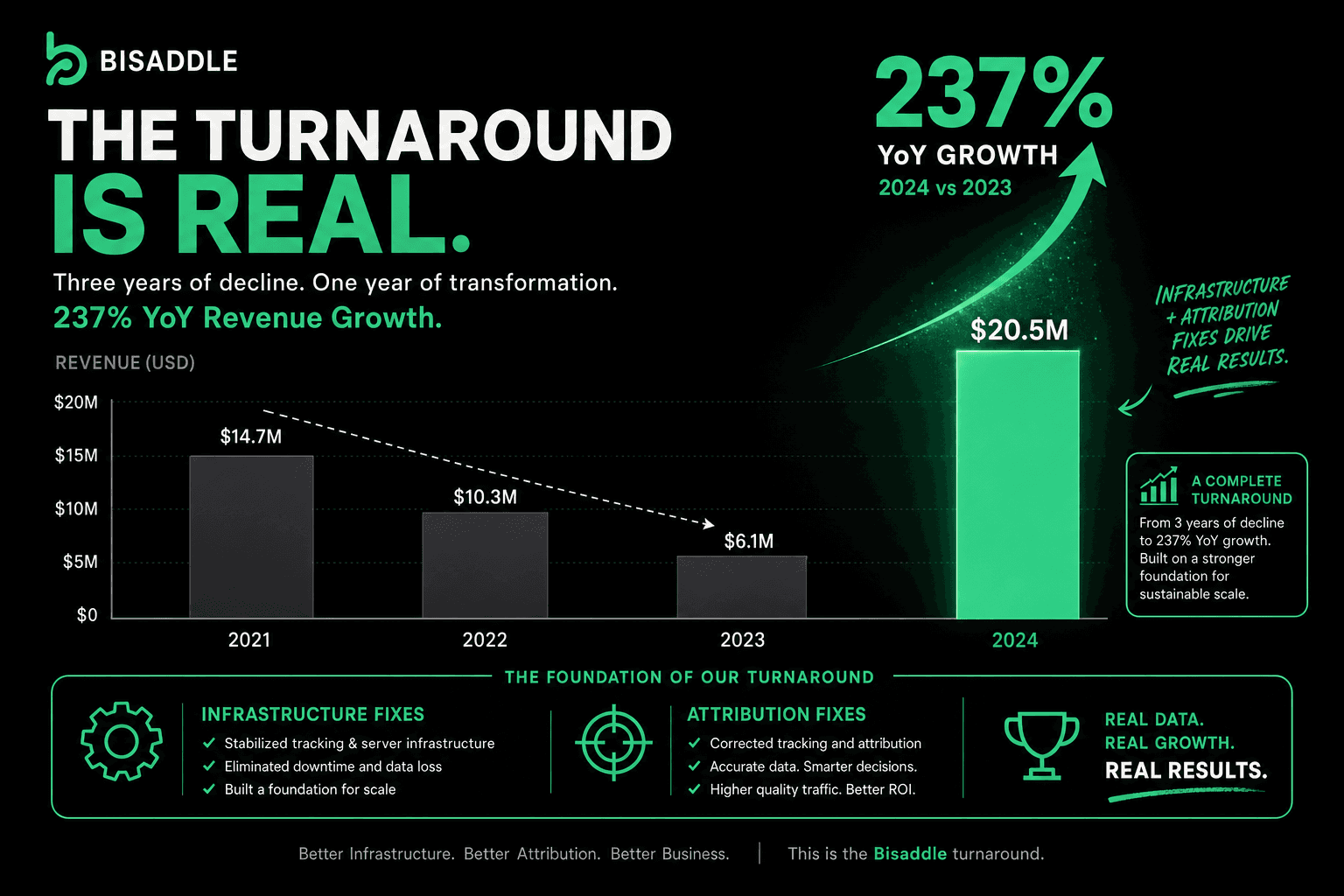
Reversed 3 years of decline to 237% YoY
Bisaddle
Challenge
Bisaddle came to us after three straight years of decline.
What we did
We redesigned the site, which doubled its speed, and grew email to 48% of revenue.
Result
Bisaddle reversed the decline with 237% YoY growth, and the redesigned site lifted conversion 122%. For a subscription brand, the method that transfers is a faster site and owned email revenue.
Find Your Recharge MRR Leaks Before They Compound
No obligation. We'll audit your Recharge setup, cohort retention, and acquisition ROAS anchoring, and tell you exactly where your highest-impact opportunities are.
Sagum · January 2017 · St. George, Utah · 8+ years