

8+ years growing brands on KPIs, now with AI
More Booked Roof Inspections, Fewer Wasted Calls
Marketing built around storm-event demand, insurance tracks, and the cost per sold roof that actually runs your business.
8+ years growing local service businesses · Google Ads · Meta · TikTok


Get your free marketing audit
Senior strategist review · response within one business day
Prefer to reach out directly?
The Challenge
Roofing Marketing Is Two Different Problems Wearing the Same Jacket
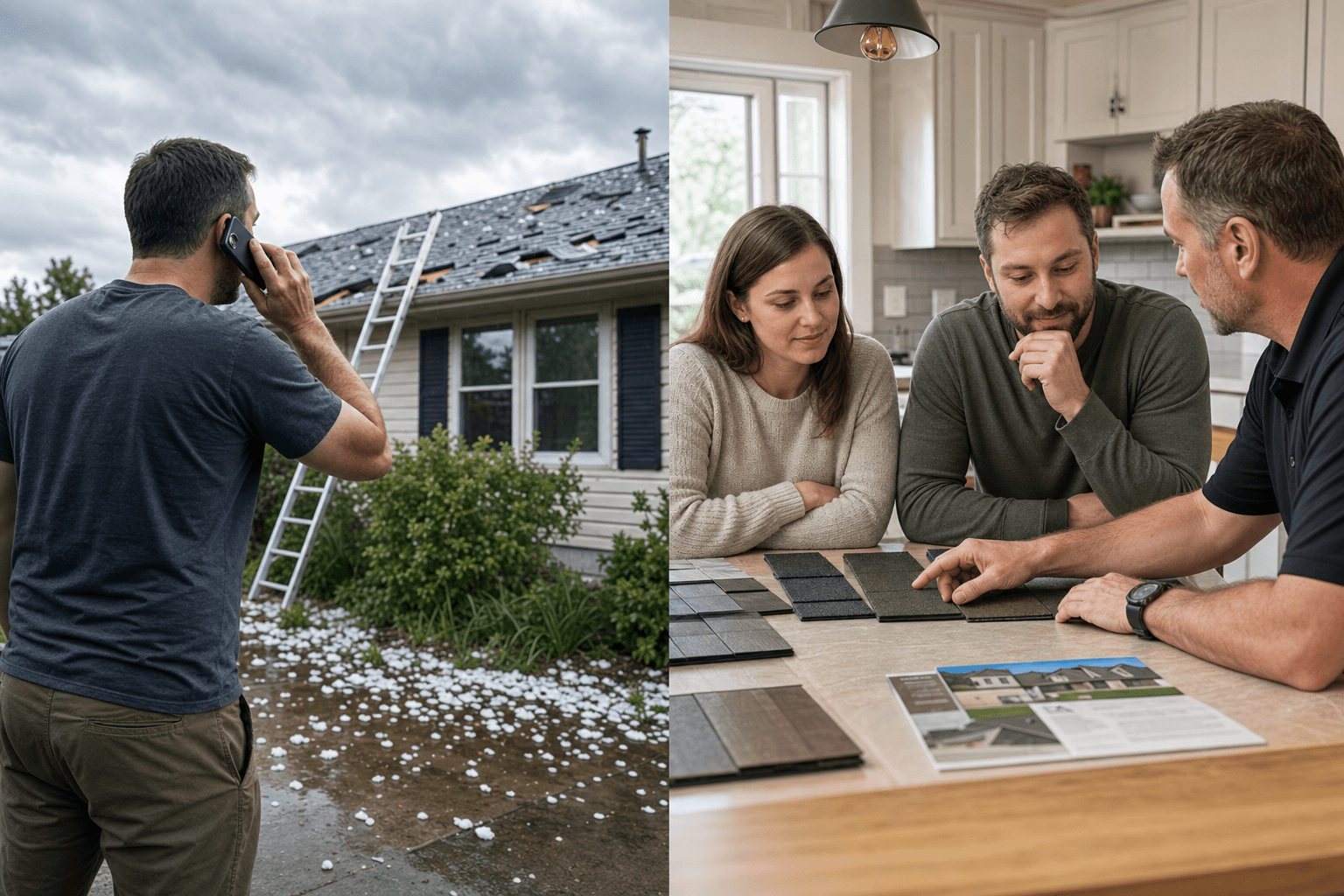
Hail hits Tuesday. By Wednesday, out-of-state storm chasers are knocking doors two streets over and callers want someone on the roof by Thursday. Homeowners sign with the first credible roofer, so speed and trust signals (license, verified reviews, the Google Verified badge) decide the job.
Then there's the retail buyer: a 21-year-old roof, a $400 bill for a water-stained ceiling, three bids, 40 reviews, and three weeks to decide. Lead with $17,000 instead of '$189 a month for 84 months' and you lose half the room.
The two buyers need separate messages, landing pages, intake flows, and attribution. Lump repairs, insurance inspections, and retail replacements into one campaign and a flood of $300 repair calls can make a slow month look busy while cost per sold roof climbs past what your margin can bear.
Add storm-event budget pacing, service-area geo-fencing, adjuster timelines, crew limits, and no-show estimates that waste slots a competitor would have filled, and you have one of the most complex local marketing problems in the trades.
The Opportunity
Most Local Roofers Leave Storm and Aging-Roof Demand on the Table
Storm demand is accelerating: hail damaged over 12 million U.S. properties in 2024 and accounts for 45.5% of homeowners insurance claims nationwide. U.S. billion-dollar weather disasters average roughly 23 yearly, and AccuWeather's 2026 season outlook put potential damages above $50 billion.
Aging roofs add predictable demand: 17 to 18 percent of Northeast and Midwest roofs, the country's oldest, are 31 years or older, and homes with roofs over 20 years old are three times likelier to file wind or hail claims.
Replacement tickets rank among residential contracting's highest: the U.S. average hit $17,631 in 2025, about 33 percent above the 2021–2024 average, and premium systems pass $30,000.
Winning roofers aren't the biggest spenders. They control cost per booked inspection, answer within five minutes, and hold 80-plus verified Google reviews, so even closing 27 to 40 percent of qualified inspections pays.
What Most Get Wrong
Where Roofers and Their Agencies Go Wrong
Mixing repair calls into replacement reporting
A repair call and a $17,000 replacement count as the same 'lead', so cost per lead (CPL) looks fine while cost per sold roof eats your margin.
Running a flat monthly budget with no storm-event pacing
You spend the same $4,000 in quiet March as after hail hits, when a dollar is worth five times more. Storm pacing is table stakes that most local roofers lack.
No call tracking, so budget decisions are guesses
You can't tell if your Google Local Services Ad (LSA), Search campaign, yard sign, or door-knock referral rang the phone; the cheapest-looking campaigns often drive repair calls, not replacements.
One generic ad and page for insurance and retail buyers
Insurance buyers want a roofer who knows Xactimate, attends the adjuster meeting, and won't vanish like a storm chaser. Retail buyers need financing math first. One pitch converts both poorly.
Slow lead response when the fastest roofer wins
Over 40 percent of roofing leads go to whoever responds first, often an out-of-state crew with a faster CRM. Answer within five minutes to be 21 times likelier to win.
Why Now
Why Roofers Should Set Up Before the Next Storm Season Peaks
Storm losses keep climbing, and each season's first hail event arrives with little warning. Roofers who have campaigns structured, landing pages live, LSA profiles verified, and lead-response automation running before that first event will capture the surge; latecomers will spend three weeks chasing a window that already closed.
AI also lets a local roofer do what once took a full marketing team: weekly creative tests, automatic budget shifts, attribution checks, and an AI receptionist that books after-hours storm calls before a competitor's voicemail picks up.
Most competitors run set-and-forget campaigns, check in with their agency monthly, and treat their Google Business Profile as a listing, not a ranking signal. The gap between them and AI-assisted roofers widens each season and is easier to close before the next hail event.
The Mechanism
Where AI Gives Roofing Marketing an Edge
Real productivity, not AI theater. Here's where it actually moves a number for roofing contractors.
Digital Ads
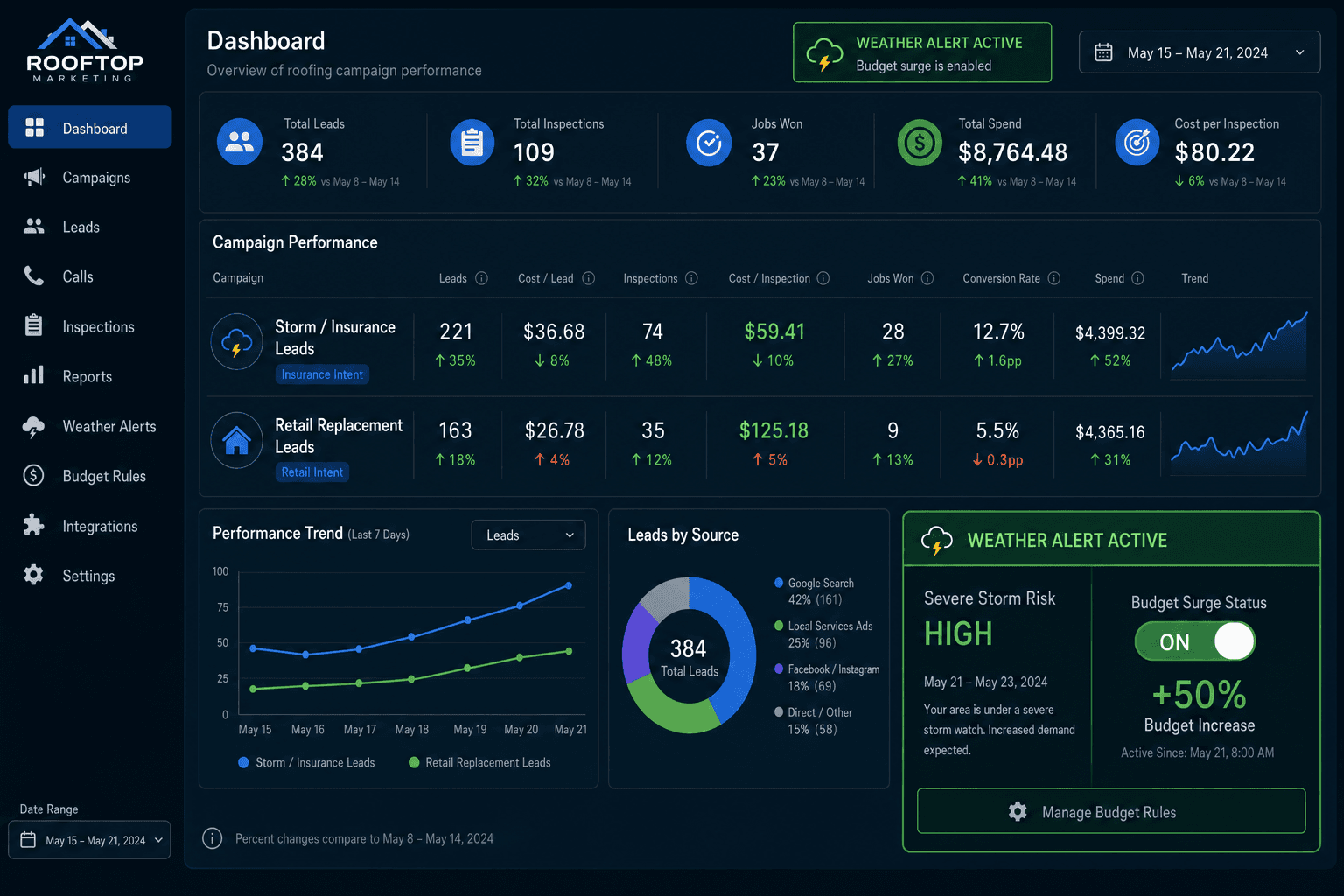
What AI does: When NOAA or HailTrace flags hail in your service area, AI surges spend to your highest-intent campaigns before competitors react manually.
The result: Spend concentrates in the 48-hour post-storm window, when intent peaks.
Why it matters here: Leads run $235 in a normal week, $550 at storm peak, so timing matters as much as budget. Three days late, you miss the job.
Analytics
What AI does: Separate conversion tracking for each job type (repair, inspection, insurance claim, residential replacement, commercial) keeps cost per qualified inspection and cost per sold roof clean of repair calls.
The result: You see each job type's acquisition cost, which campaigns drive replacements versus repair calls, and where close rates drop by source and salesperson.
Why it matters here: Lead volume can mask a shrinking roofing business: if repair calls double and replacements stay flat, blended CPL looks fine until average job size falls.
Conversion Optimization
What AI does: AI continuously reviews separate storm/insurance and retail landing pages for form friction, weak financing CTAs, and missing trust signals (license badge, manufacturer certification, workmanship warranty).
The result: Insurance pages lead with claims-navigation expertise and an adjuster-meeting commitment; retail pages lead with financing math and before-and-after local project photos.
Why it matters here: A homeowner fresh off a hailstorm and one pricing a 22-year-old shingle replacement are in different mindsets.
Creative
What AI does: AI tests ad angles weekly rather than monthly across Google and Meta: local trust signals, financing offers, storm-urgency messaging, manufacturer certification callouts.
The result: You find your market's inspection-booking message sooner than a competitor testing one static ad per quarter and retire weak angles early.
Why it matters here: Storm chasers flood markets with volume. Local roofers win on trust only if they know what moves homeowners: GAF Master Elite here, financing there.
Ready to see what this looks like for your roofing contractors business?
No obligation. A senior strategist will show you exactly where the wins are.
The Strategy
How Roofing Marketing Should Be Run
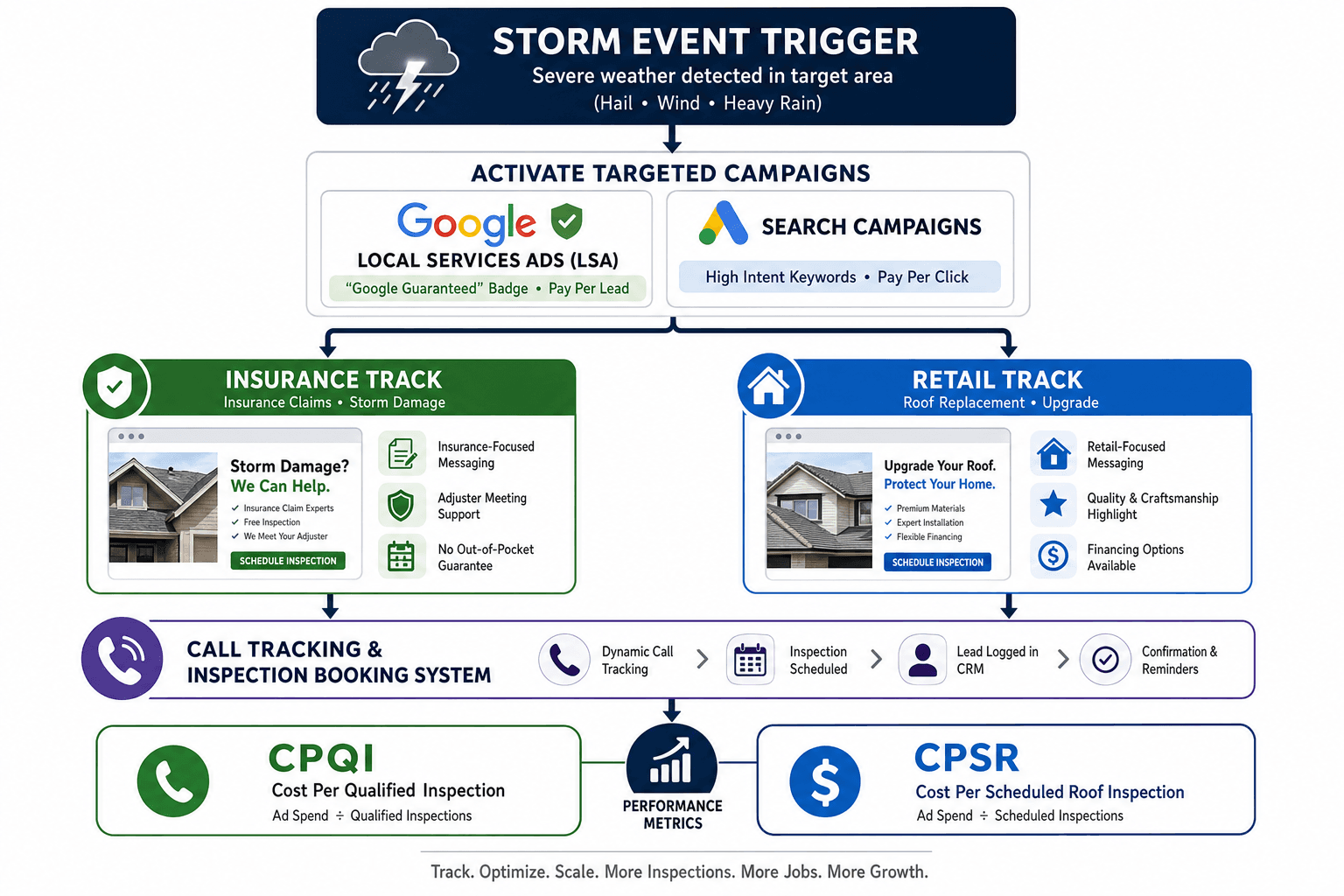
Start with separation: each job type gets its own campaign, landing page, and conversion event, or reporting is fiction and optimization is guesswork.
Run LSAs first: they charge per lead, show the Google Verified badge, and appear above paid search. Since November 2024 they require a verified Google Business Profile (GBP); since July 2025 all LSA reviews flow through GBP, and review velocity is a direct LSA ranking signal.
Google Search runs alongside on replacement and inspection queries and excludes low-ticket repair keywords, with a $3,000 to $5,000 monthly floor. Smaller budgets yield too little data and too few leads.
In competitive markets, roofing leads cost $235 to $310 normally and pass $550 in storm season. Pause-and-surge rules tied to storm alerts push spend into the post-event window.
Meta retargeting supports the retail buyer with financing offers and local project social proof. It isn't the primary channel for emergency intent.
Every campaign, landing page, and LSA gets a tracked number. After hours, an AI receptionist qualifies storm callers, confirms property ownership, and books inspections before morning.
If average job size falls while close rates hold, the lead mix shifted or reps stopped upselling decking, ridge vent, or synthetic underlayment.
The one number that governs this
The governing KPIs are cost per qualified roof inspection (CPQI) and cost per sold roof (CPSR), split by job type and lead source, never blended.
How We Help
What We'd Do for Your Roofing Company
We fix tracking first, since nothing else is trustworthy until then, and then build the campaign structure that shows what every dollar produced.
Attribution & Call Tracking Setup
Put tracked numbers on every campaign and landing page so job types stay separate. Verify your GBP and connect it to LSA to protect ranking.
Google Local Services Ads Management
Earn and keep the Google Verified badge, manage review velocity, and surge spend in storm windows, when pay-per-lead economics are best.
Google Search (PPC), Segmented Campaign Build
Build separate replacement, storm/insurance, and commercial campaigns, geo-fenced to your service radius, paced to storm alerts, with negative keywords blocking repair intent.
Inspection-Booking Landing Pages
Build the separate insurance and retail pages, with AI reviewing both for conversion leaks.
Lead-Response Automation & AI Receptionist
Connect form fills to an SMS/email sequence that qualifies homeowners and books inspections within minutes, and route after-hours storm calls to the AI receptionist.
Creative Testing
Test ad angles weekly across Google and Meta, retiring losers and scaling what books inspections.
Performance Reporting Against CPQI and CPSR
Report weekly on CPQI and CPSR by job type and source.
Who's Behind This
Who we are, and what makes us different
Sagum is a performance marketing agency founded in January 2017 in St. George, Utah. We've spent 8+ years growing real brands and being judged on KPIs, not vanity metrics.
We deliberately limit how many clients we take so each one gets senior attention. We treat your numbers like our own, we never run generic playbooks, and your strategy is built for your business, because shouldn't your brand's marketing be custom to your brand?
Sagum.ai is our AI arm: the same proven operators now build AI into the work wherever it creates real edge, not as theater, but as leverage applied with discipline.
- 8+ years growing brands on performance KPIs, not vanity metrics
- Limited client roster, with senior attention on every account
- An extension of your team; your success is tied to ours
- Custom strategy per brand, never a generic playbook
- AI built in where it moves a number; judgment over hype
“Sagum is a performance marketing agency that's spent 8+ years growing brands by treating their numbers like our own. We take on few clients, never run generic playbooks, and now build AI into the work wherever it creates real edge, not hype. Your strategy is built for your business, and our success is tied to yours.”
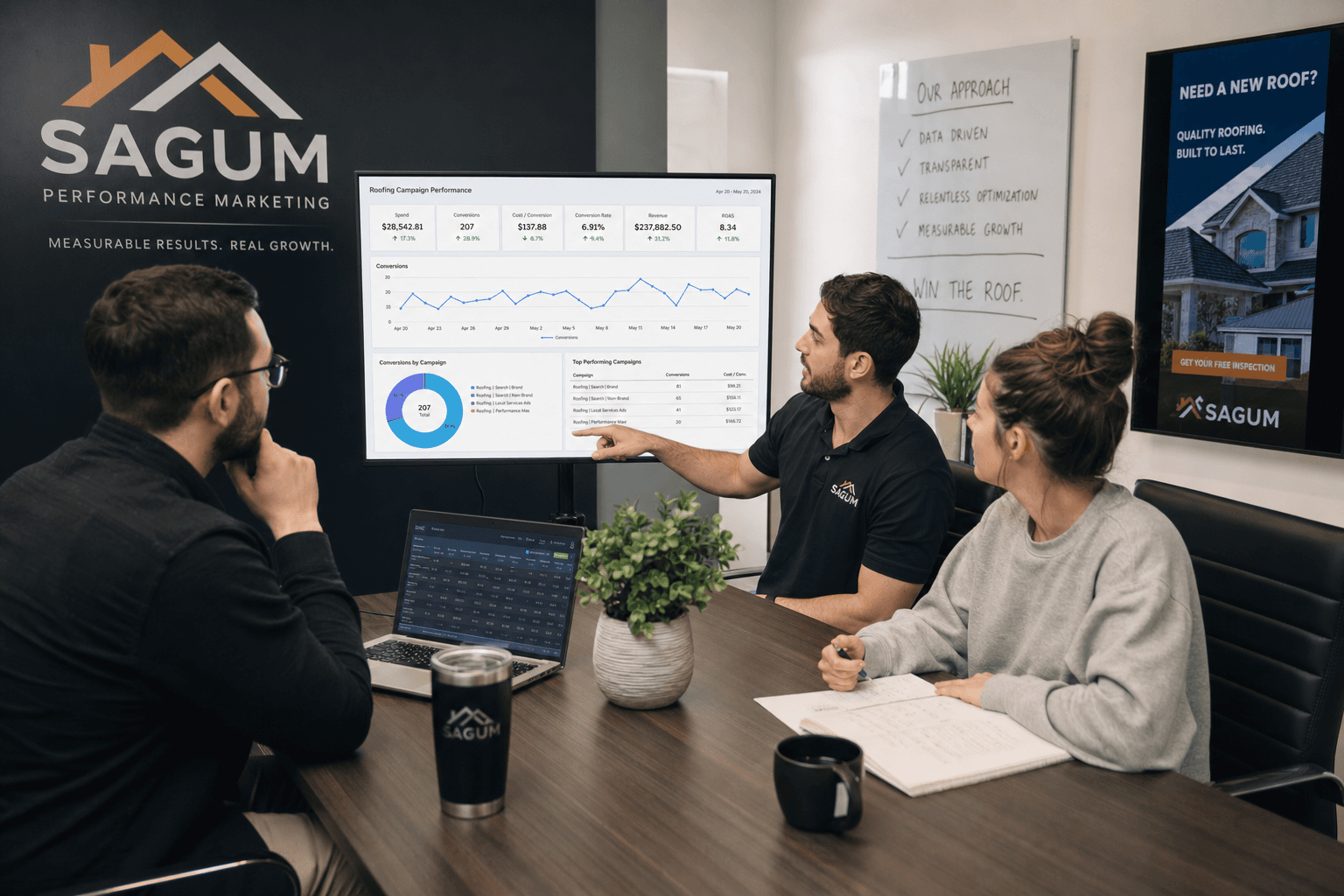
“After six years, Sagum is our most important partner: trusted, communicative, and caring about our business as if it's their own.”
Long-term partner
6-year client
Proof
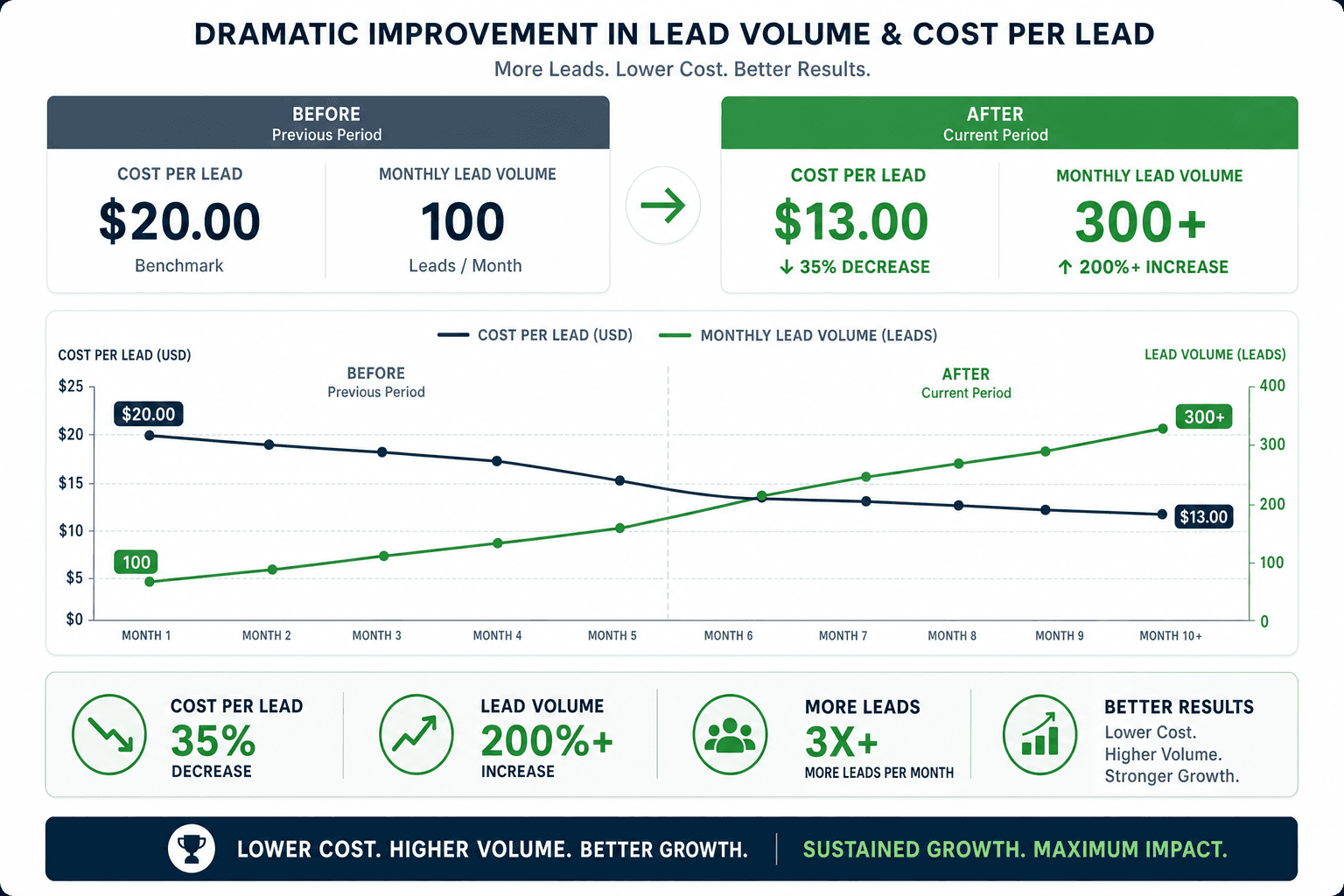
From a $20 CPL goal to $13 CPL and 300+ leads/mo
Rizzoli's Automotive
Challenge
Rizzoli's Automotive wanted 100 qualified leads per month at roughly $20 per lead, the same kind of cost-per-lead target a roofer sets.
What we did
We built a custom call-driving landing page and rebuilt paid search around high-intent service queries. Roofing needs the same pairing.
Result
Leads reached 300-plus per month at $13 per lead, beating both goals; the landing page converted 60 percent or better, and the client opened multiple new locations.
- Cost per lead
- $13
- Leads / month
- 300+
- Landing-page conversion
- 60%+
See What Each Qualified Inspection Costs You and Where Your Margin Goes
No obligation. We work from your service area, job mix, and actual numbers, not a generic roofing template.
Sagum · January 2017 · St. George, Utah · 8+ years