

8+ years growing brands on KPIs, now with AI
Grow Your Shopify Store Profitably
We build performance marketing systems for Shopify operators who measure success in blended ROAS, not what Meta claims.
8+ years growing DTC brands · Google, Meta & TikTok · Shopify & Shopify Plus


Get your free Growth Gap Analysis
Senior strategist review · response within one business day
Prefer to reach out directly?
The Challenge
Running a Shopify store means problems your dashboard hides
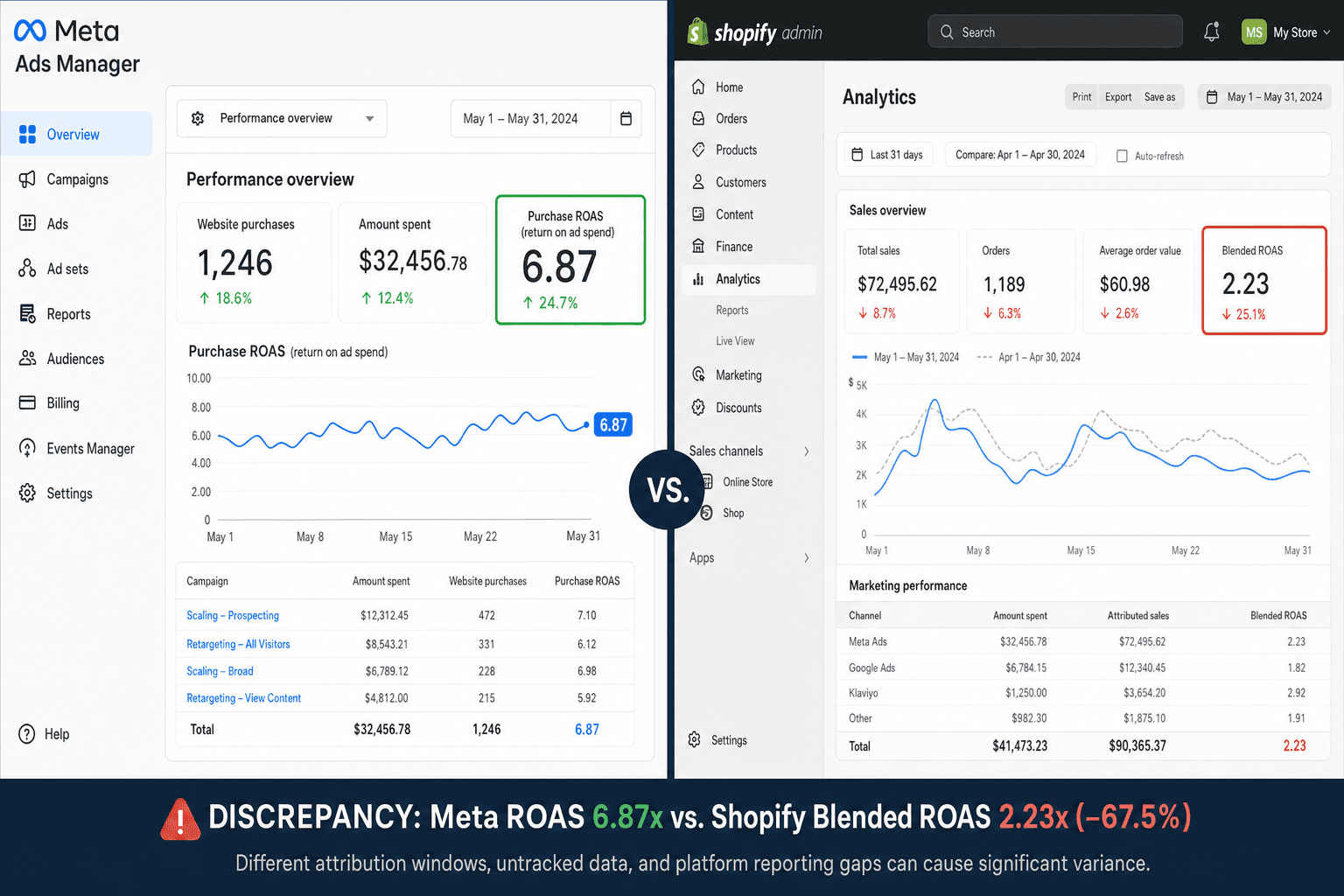
Modeled ROAS looks fine in Triple Whale, but Shopify Admin's First-time vs. returning customers report shows a different new-customer number. Meta claims 4.2x ROAS; blended ROAS is closer to 2.1x. Each measures something different; only blended shows if you're growing.
Post-iOS 14, browser-only setups lose much of their signal: Safari and iOS in-app browsers block third-party cookies and cap script-set cookies at seven days; Firefox blocks tracking cookies. Meta reads that as low intent and pulls back delivery. Your Klaviyo browse- and cart-abandonment flows miss iOS shoppers whose sessions expired before they returned.
Brands not on Checkout Extensibility by the August 2025 checkout.liquid sunset lost pixels, loyalty scripts, and post-purchase upsells overnight. If you haven't rebuilt Shopify Scripts as Shopify Functions, your discount logic (tiered pricing, bundle rules, B2B net terms) is broken or running on workarounds that won't survive the next update.
Summed channel CAC hides the real cost: one brand we audited showed $52 reported CAC vs. $178 blended, a 3.4x gap that funded a bad scaling decision.
The Opportunity
Shopify operators who fix their foundation first scale cleanly
Bad data and an under-optimized stack hide growth at most $250K–$2M/month Shopify brands. The demand is there; the gap is execution.
Shopify Plus has tools most agencies never touch. Checkout UI Extensions run post-purchase upsells without a third-party app, and Shopify Functions run discount logic server-side in WebAssembly at near-native speed. Flow automations can tag a customer VIP once their order crosses $200, hand that tag to Klaviyo, and suppress them from acquisition ads without a developer.
Healthy DTC brands earn 25–40% of revenue from email and SMS at near-zero marginal cost per send once flows are built correctly. Most brands we audit sit at 15% or below, paying Meta to reach customers they own.
Winning brands lock in server-side tracking for clean Meta signal, creative testing that outruns fatigue, and Shopify order data as one reconciled source of truth.
What Most Get Wrong
What most Shopify brands (and their ad agencies) get wrong
Optimizing to platform ROAS instead of blended ROAS
Meta, Google, and Klaviyo each claim the same customer across overlapping attribution windows, so platform ROAS routinely runs 30–60% above blended. Brands scaling on it often hit negative contribution margin.
Running browser-only tracking after iOS 14
Without Meta CAPI and server-side event matching (Elevar or similar), Meta optimizes on degraded signal toward shoppers it can see, not the likeliest buyers. CPMs rise; CVR drops.
Treating Klaviyo flows and winbacks as set-and-forget
App updates, schema changes, and integration refreshes can silently break cart-abandonment flows for weeks. Most brands send one-time buyers and customers with six orders and 4x AOV the same winback.
Letting app bloat add SaaS cost and slow checkout
Apps that injected into checkout pre-extensibility are migration projects or liabilities. A one-second checkout delay measurably reduces conversion, and most Plus merchants have never audited which apps earn their seat.
Agency reports that never reconcile to Shopify Admin
Ads Manager numbers never checked against Shopify's first-time vs. returning customer report create a false sense of progress. Shopify order data is the only honest ground truth for new-customer CAC.
Why Now
Shopify brands that fix checkout and signal now pull away
Shopify's Checkout Extensibility migration is complete. If you built your Plus checkout correctly, you hold a structural advantage over brands on workarounds, and that lead has never been wider. As Meta's Advantage+ and Google's Performance Max grow more AI-driven, creative and signal quality outweigh manual bids.
Disciplined AI, not a dashboard feature, separates testing two ad angles a week from testing 8 to 12. Brands building that weekly rhythm before competitors crowd their category will own their new-customer CAC curve; late movers will spend two years paying more per click to catch up.
Q4 is DTC's highest-stakes window. BFCM send volumes, checkout extension QA, Klaviyo warm-up cadences, and server-side pixel dedup audits must be in place weeks before Black Friday so you can scale peak-season spend without infrastructure breaking.
The Mechanism
Where AI moves the numbers for a Shopify operator
Real productivity, not AI theater. Here's where it actually moves a number for shopify brands.
Creative
What AI does: AI drafts structured creative briefs and ad variants at scale, then reads Meta and TikTok results for the hooks, formats, and value propositions driving new-customer conversions rather than clicks alone.
The result: You evaluate 8–12 creative angles per week instead of 2, finding winners before creative fatigue compounds your CAC.
Why it matters here: Creative fatigue is Shopify brands' main scaling bottleneck on Meta. CAC is up 40–60% across DTC categories; brands refreshing faster than competitors hold their CAC.
Analytics
What AI does: AI reconciles platform-reported ROAS against blended ROAS from Shopify order data, flags attribution discrepancies, and surfaces CAC creep before you scale on bad numbers. Incrementality tests assign credit honestly across channels.
The result: Every budget decision runs off one reconciled number, with Shopify Admin as ground truth.
Why it matters here: Reported and blended CAC can differ by 3x or more. For most Shopify brands, fixing measurement is the highest-value move available before any campaign change.
What AI does: AI audits Klaviyo flows for broken triggers and segmentation gaps, ranks fixes by flow revenue, and models LTV cohorts to decide which segments get winback and which get suppressed from paid acquisition.
The result: Owned-channel revenue climbs toward the 25–40% healthy range, reducing paid media dependency without reducing total revenue.
Why it matters here: For a $500K/month brand, doubling email from 15% to 30% of revenue beats most paid optimizations. Brands usually lose that money at the Flow-to-Klaviyo handoff.
Conversion Optimization
What AI does: AI analyzes checkout drop-off by device, traffic source, and customer segment, then ranks Checkout UI Extensions, post-purchase upsell placements, and Functions-powered discount rules by estimated revenue impact before any dev work.
The result: You improve AOV and checkout conversion rate natively on the Checkout Extensibility framework in Shopify Plus, without third-party apps that slow load time.
Why it matters here: A 1% lift in checkout conversion on a $1M/month store recovers $10K/month and compounds with paid spend. Few Plus merchants run structured checkout CRO post-migration.
Digital Ads
What AI does: AI watches Meta, Google, and TikTok in near-real time, shifting budget to new-customer campaigns with the lowest blended CAC and away from ones hitting ROAS targets on paper while cannibalizing returning customers.
The result: New-customer CAC governs paid spend, so scaling decisions track real growth.
Why it matters here: Advantage+ and Performance Max optimize only as well as your signal; clean CAPI events put you in a different auction from brands on browser-only pixels.

Ready to see what this looks like for your shopify brands business?
No obligation. A senior strategist will show you exactly where the wins are.
The Strategy
How performance marketing should work for a Shopify brand
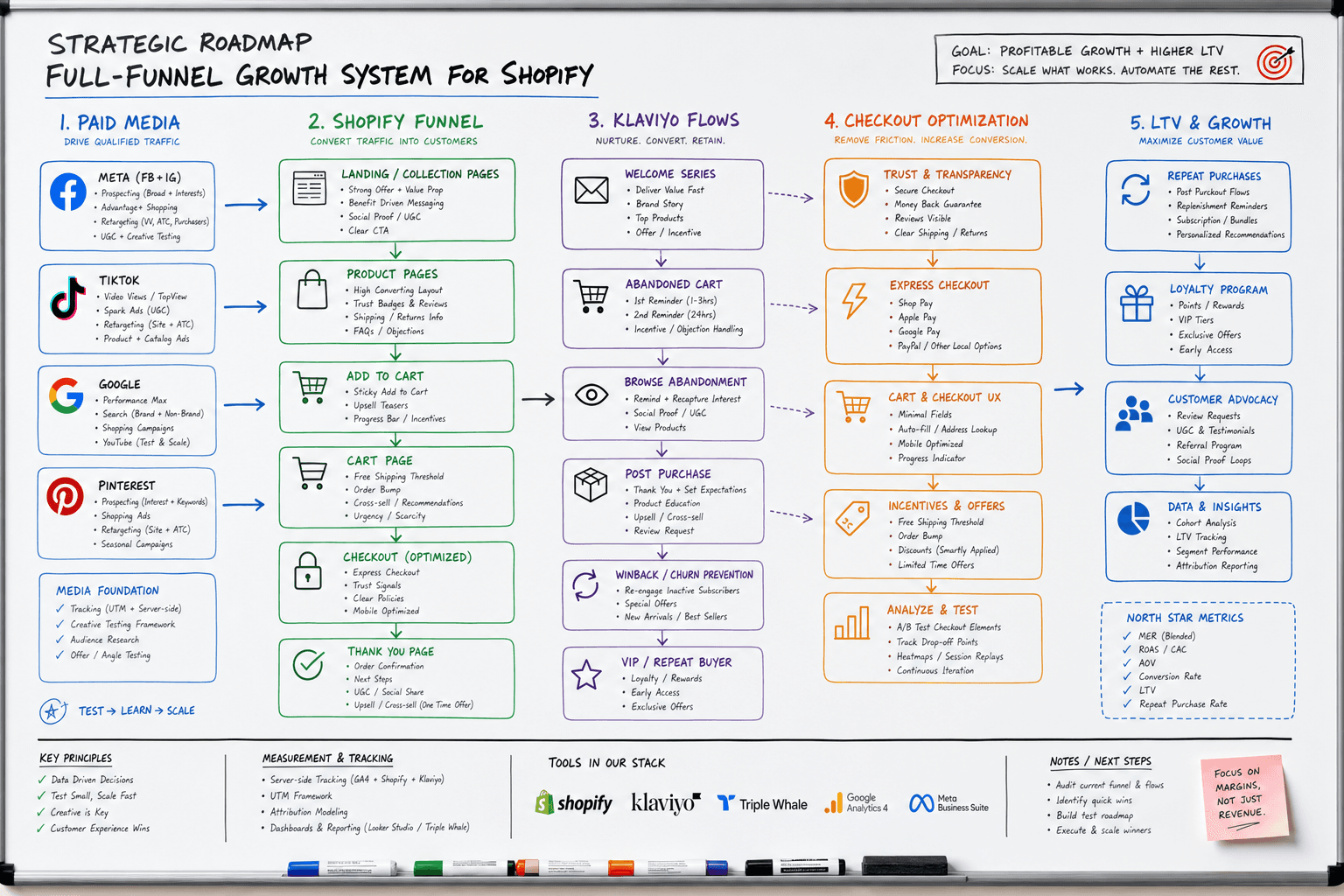
Measurement comes first. We confirm server-side event matching and pull new-customer CAC and blended ROAS from Shopify Admin; if platform and blended ROAS disagree, we close that gap before scaling.
Meta and TikTok drive creative-led new-customer prospecting for most Shopify brands, and Google captures high-intent branded and category search. We separate new- from returning-customer campaigns so cheap repeat purchases can't flatter CAC.
Klaviyo runs as a revenue channel with its own P&L and an owned-revenue target, not a batch-and-blast tool. Klaviyo flows cover welcome, browse abandon (with iOS session-expiry mitigation), cart abandon, post-purchase, and LTV-cohort winback, and we build the Flow-to-Klaviyo tag handoff as a first-class integration.
Checkout Extensibility is a growth lever: upsells, Functions-powered discounts, and Checkout UI Extensions go live only when AOV and conversion data support them.
Every week we generate and launch new Meta and TikTok creative angles and judge them on Shopify order data, so new-customer CAC doesn't drift as competition grows.
The one number that governs this
We judge budgets, tests, and channel allocation on Shopify new-customer CAC and blended ROAS (total revenue ÷ total ad spend), the system-wide executive guardrail.
How We Help
What we do for Shopify brands
We keep a small Shopify and Shopify Plus roster so you get senior attention, not a junior account manager's templated playbook. For your brand, we'd work in this order.
Attribution Audit & Server-Side Tracking Setup
First, we verify Meta CAPI is live and blended ROAS is trustworthy, installing Elevar for Plus brands with technical resources or Aimerce for leaner stacks.
Paid Media: Meta, Google & TikTok
We split prospecting from retargeting, test Meta and TikTok creative weekly, cover Google branded and category search, and budget by blended ROAS and new-customer CAC.
Creative Strategy & Production
We ship 8–12 new angles per week across Meta and TikTok, score them on Shopify new-customer data, and feed winners back into campaigns.
Klaviyo Flow Architecture & Owned-Channel Growth
Starting with top-revenue Klaviyo flows, we fix broken triggers and segmentation gaps, wire the Flow-to-Klaviyo handoff, and assign winback or paid suppression by LTV cohort.
Checkout Extensibility & Shopify Functions
We evaluate your Checkout UI Extensions and Functions against AOV and conversion data for upsell, discount, and app-consolidation wins, and rebuild Scripts-era workarounds as Functions.
Analytics & Reporting
We build one weekly reconciled report from Shopify order data covering blended ROAS, new-customer CAC, and Klaviyo flow revenue, with no dashboard theater.
Who's Behind This
Who we are, and what makes us different
Sagum is a performance marketing agency founded in January 2017 in St. George, Utah. We've spent 8+ years growing real brands and being judged on KPIs, not vanity metrics.
We deliberately limit how many clients we take so each one gets senior attention. We treat your numbers like our own, we never run generic playbooks, and your strategy is built for your business, because shouldn't your brand's marketing be custom to your brand?
Sagum.ai is our AI arm: the same proven operators now build AI into the work wherever it creates real edge, not as theater, but as leverage applied with discipline.
- 8+ years growing brands on performance KPIs, not vanity metrics
- Limited client roster, with senior attention on every account
- An extension of your team; your success is tied to ours
- Custom strategy per brand, never a generic playbook
- AI built in where it moves a number; judgment over hype
“Sagum is a performance marketing agency that's spent 8+ years growing brands by treating their numbers like our own. We take on few clients, never run generic playbooks, and now build AI into the work wherever it creates real edge, not hype. Your strategy is built for your business, and our success is tied to yours.”

“After six years, Sagum is our most important partner: trusted, communicative, and caring about our business as if it's their own.”
Long-term partner
6-year client
Proof
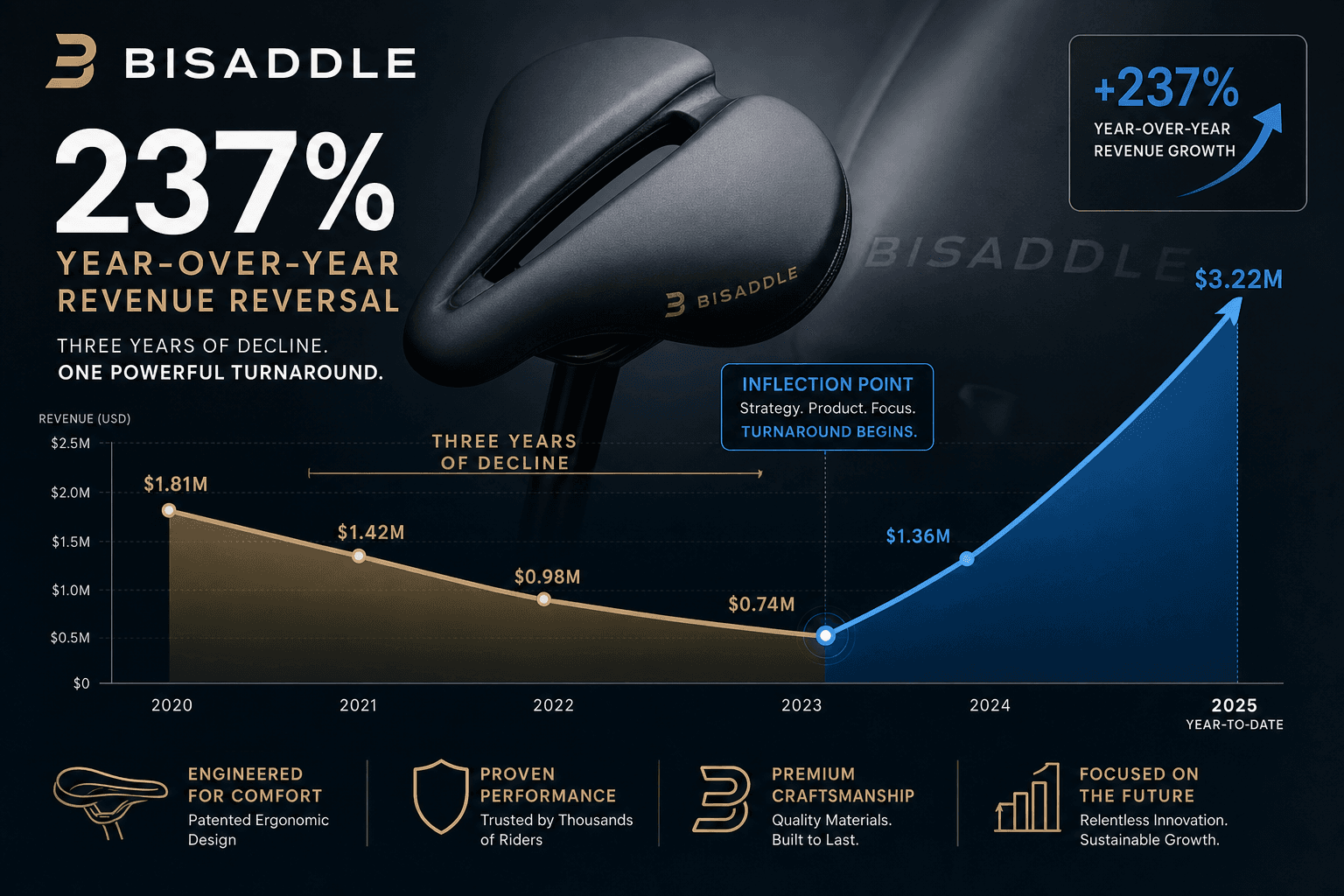
Reversed 3 years of decline to 237% YoY
Bisaddle
Challenge
Bisaddle came to us after three consecutive years of decline.
What we did
We ran a site redesign and grew email revenue. For your Shopify store, the method that transfers is a faster site and an owned email channel.
Result
Bisaddle turned decline into 237% YoY growth. The redesign doubled site speed and lifted conversion 122%, and email grew to 48% of revenue.
If blended and platform ROAS disagree, let's fix the foundation first
No obligation. We'll review your Shopify numbers (blended ROAS, new-customer CAC, owned-channel share) and tell you honestly where the gap is and what we'd do. Your strategy is built for your store alone.
Sagum · January 2017 · St. George, Utah · 8+ years