

8+ years growing brands on KPIs, now with AI
Grow Your Shopify Plus Revenue
Performance marketing anchored to blended ROAS, built for enterprise Shopify Plus operators scaling past $10M.
Google Ads · Meta · TikTok · 8+ years of performance results


Get your free Growth Gap Analysis
Senior strategist review · response within one business day
Prefer to reach out directly?
The Challenge
Shopify Plus Marketing Is a Different Problem Than Shopify Marketing
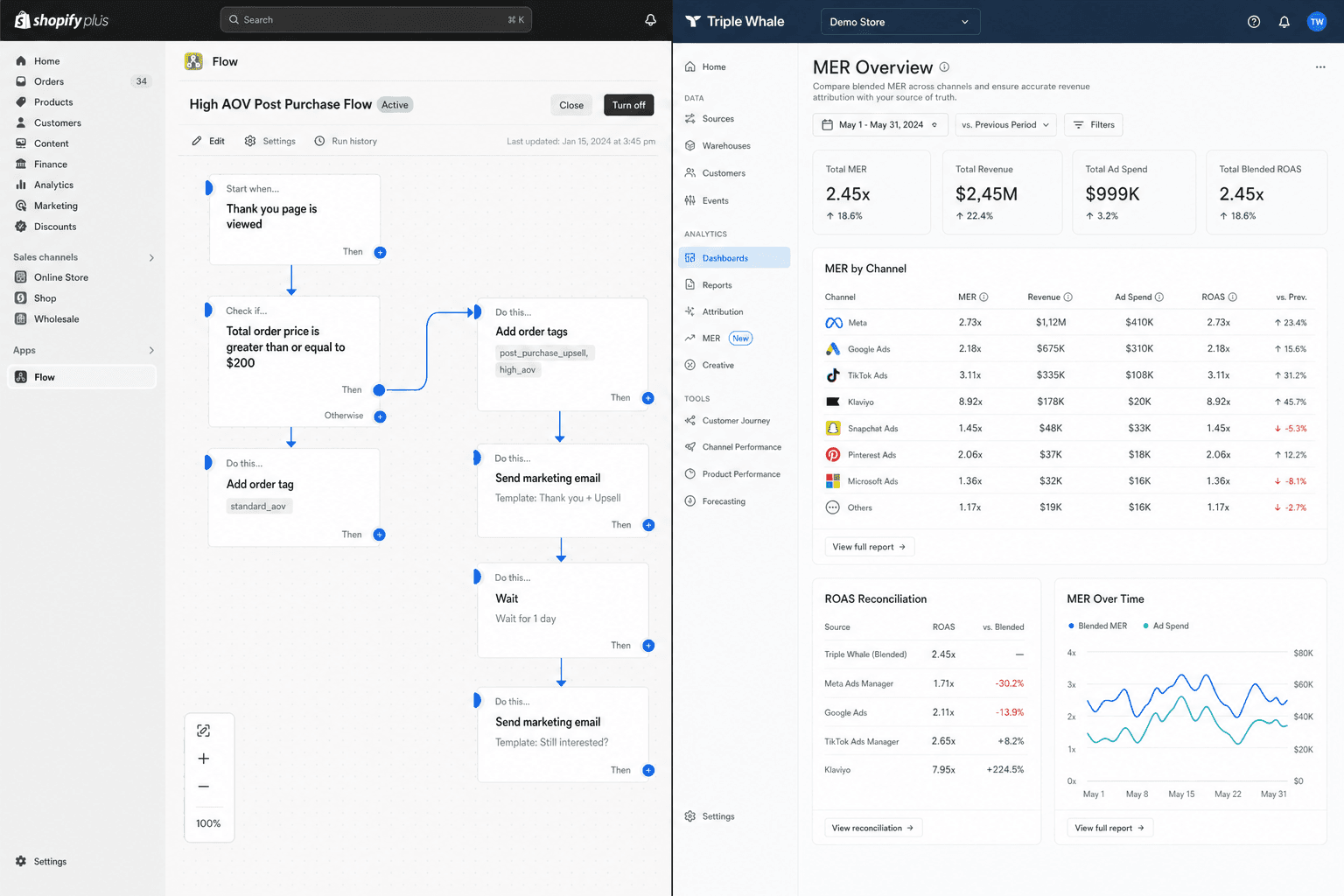
Plus adds levers: Checkout UI Extensions, Shopify Functions, Flow, B2B, and Markets. The fastest growers pull them in the right order and report blended ROAS, because iOS 14 made channel ROAS unreliable. Agency playbooks for $500k stores running one Meta campaign don't translate.
Your CFO checks blended ROAS daily; your media buyer tunes channel ROAS. Most Plus brands fly partially blind in the attribution stack between those views: Triple Whale reconciled in a spreadsheet, or Northbeam for multi-touch. Each added channel widens the gap between platform ROAS and the bank account.
BFCM is a 90-day prep window around a four-day sale. Stores starting 90 days out beat 30-day starters by two to three times in revenue. Launchpad, load-tested extensions, and Flow automations (VIP tagging, fraud routing) must run cleanly before traffic hits.
A Magento, Salesforce Commerce Cloud, or WooCommerce migration in the last 18 months may have left Meta pixel, GTM, and GA4 tracking half-installed. A broken pixel can drop reported ROAS 60% or more unnoticed while budget gets cut.
The Opportunity
Shopify Plus Levers Most Competitors and Agencies Leave on the Table
Treat checkout extensibility as a conversion surface: a post-purchase offer extension tested against a clean control can lift AOV by double digits.
Functions replaced Scripts and run natively without lag at peak. Brands that moved discount logic, tiered pricing, and payment routing before the June 30, 2026 Scripts shutdown run cleaner checkouts.
On acquisition, close the gap between platform-reported and blended ROAS. Channel ROAS overstates Meta and understates channels with longer attribution windows. Brands optimizing to contribution margin by channel, measured against new-customer LTV cohorts, find misallocated budget to redeploy.
If you sell wholesale, native B2B (company-scoped catalogs, ACH, and partial payments for made-to-order work) is revenue most Plus brands enable but few market. Markets runs 130+ currencies, multi-language, duties and taxes, localized domains, and international SEO from one store. Brands using submarkets instead of expansion stores skip content-sync overhead.
What Most Get Wrong
What Most Shopify Plus Brands (and Their Agencies) Get Wrong
Optimizing to channel ROAS instead of blended ROAS
Meta says 4.2x, Google 6.1x; the CFO sees 8% growth and shrinking margins. Brands allocating by platform ROAS instead of blended ROAS routinely misallocate five and six figures monthly.
Treating BFCM as a 30-day problem
Q4 winners start 90 days out, with Launchpad and email segments ready before October. An agency's BFCM plan arriving in late October is built for a store half your size.
Ignoring the pixel and attribution stack after a platform migration
Meta pixel events misfire, GA4 event IDs map to wrong triggers, and GTM keeps dead tags. Teams move budget on bad data while blaming creative or audience, sometimes for months.
Running B2B and DTC on the same Flow workflows
Auto-tagging VIPs by order value suits DTC. On a quarterly bulk order from a net-30 B2B buyer, the same Flow tags wrong accounts, sends wrong sequences, and muddies LTV cohorts.
Hiring a generalist agency that doesn't speak the Plus stack
Agencies that never configured Checkout UI Extensions, migrated Scripts to Functions, or anchored media to blended ROAS sell generic playbooks. Checkout conversion, B2B acquisition, and Markets architecture need operator-level knowledge.
Why Now
Shopify Plus Brands Rebuilding Checkout, Attribution, and Creative Now Pull Ahead
The Checkout Extensibility migration is complete: checkout.liquid and Scripts are gone, and every Plus store shares one upgrade-safe architecture. Brands that rebuilt in Functions and UI Extensions pull ahead; those still diagnosing breakage run slower checkouts at the same ad spend.
The fastest growers closed the attribution gap by making blended ROAS their governing metric and reporting channel margin. Most brands haven't; those that have make better weekly budget calls.
A brand testing five to eight AI-assisted angles weekly on Meta finds its winning new-customer message faster, at lower CAC before Q4, than a rival testing one or two monthly. Most Plus brands run agencies built for the pre-extensibility, pre-iOS-14 era. Switching to a partner fluent in Functions, blended ROAS, and AI-assisted creative shows in the numbers within a quarter.
The Mechanism
Where AI Gives Shopify Plus Operators a Real Edge
Real productivity, not AI theater. Here's where it actually moves a number for shopify plus enterprise brands.
Creative
What AI does: Drafts five to eight distinct angles a week (hooks, value propositions, formats), each isolating one testable variable, where a traditional workflow yields one or two a month.
The result: Testing weekly, not monthly, builds six months of compounding learnings before BFCM, and new-customer CAC drops as you scale winning angles before competitors find them.
Why it matters here: Paid social creative is your primary new-customer lever. Meta and TikTok need volume to find buyers, so testing one or two concepts monthly falls behind.
Analytics
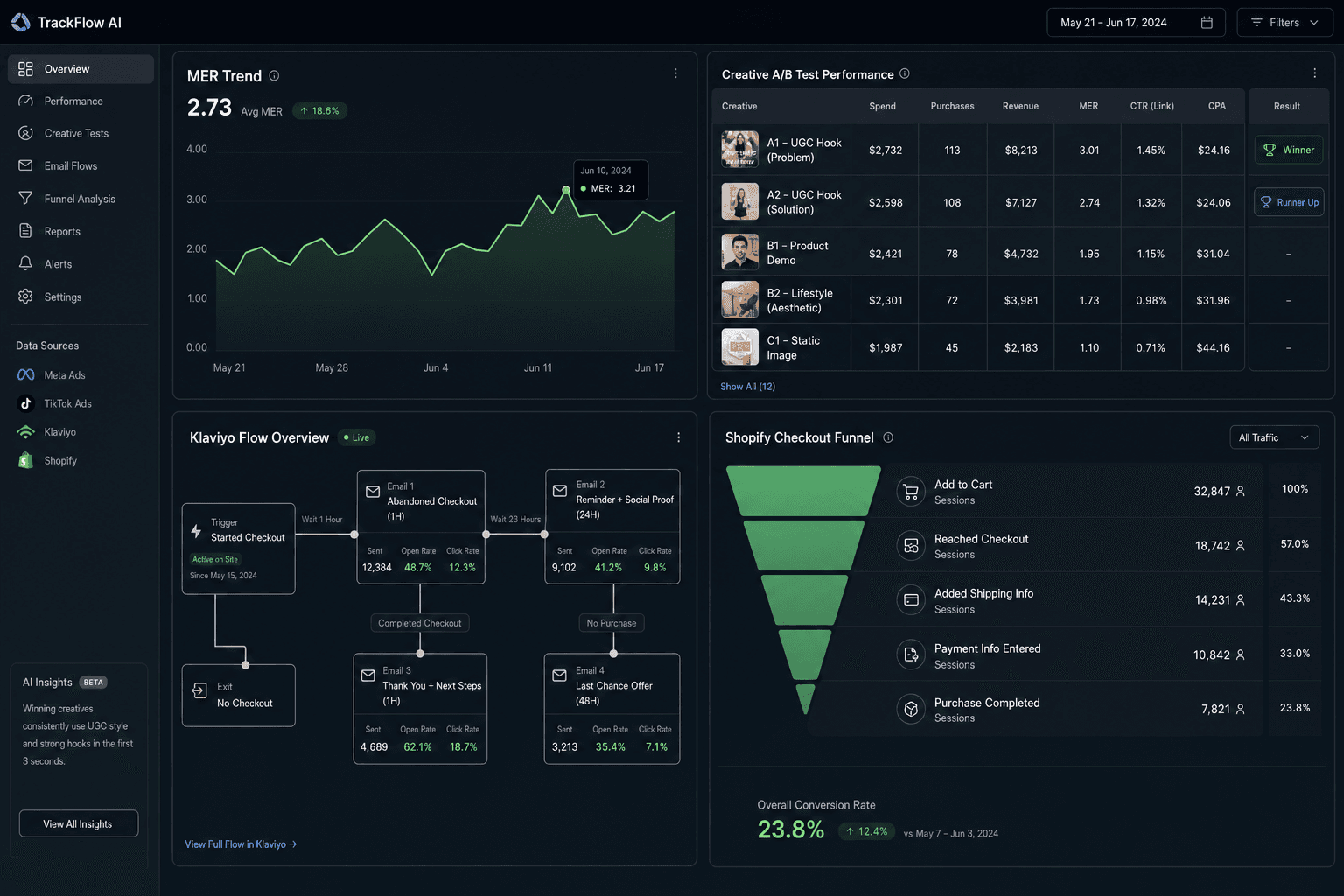
What AI does: Reconciles Triple Whale's channel ROAS with the CFO's blended ROAS, flags discrepancies and misfiring pixel events, and produces a weekly contribution-margin report that media and finance both read.
The result: You find misallocated spend and redeploy it to channels that move the bank account.
Why it matters here: Triple Whale can show efficiency as spend over revenue (25%), which most CFOs read as 4x blended ROAS. Reconciliation catches that before any budget call.
Conversion Optimization
What AI does: Audits where UI Extensions, upsell blocks, and trust signals sit, which form fields add friction, and how the B2B checkout shows terms, then monitors checkout completion by device, market, and customer segment.
The result: Systematic UI Extension testing can lift checkout conversion 10% or more. At $5M annual revenue, a 10% lift recovers $500k from the same traffic.
Why it matters here: Shopify replaced checkout.liquid with UI Extensions to allow modular, upgrade-safe conversion testing. Treating checkout as fixed leaves the platform's most valuable real estate underused.
What AI does: Structures Klaviyo flows by LTV cohort, purchase frequency, and acquisition channel, with send-time optimization and subject-line testing at volume. B2B gets separate Shopify Flow tracks: payment-terms reminders, cadence-based reorder triggers, VIP escalation.
The result: Email and SMS contribution to revenue rises as flows match LTV cohorts, and separate B2B tracks keep consumer promotions away from wholesale buyers.
Why it matters here: LTV compounds fastest when a Meta buyer on a first-purchase discount gets different flows than a full-price buyer from organic search. AI makes that scalable.
Digital Ads
What AI does: Flags Google PMax cannibalizing branded search, or Meta delivery drifting to lower-LTV audiences without a creative change, so weekly budget calls across Meta, Google, and TikTok rest on contribution margin by channel.
The result: Spend follows blended ROAS, not each platform's self-reported ROAS. At $10M+ in revenue, closing a 15% blended ROAS gap is worth seven figures a year.
Why it matters here: Three or more channels claim the same conversion under their own attribution. Without a governing blended ROAS reconciled weekly, teams chase the most optimistic number.
Ready to see what this looks like for your shopify plus enterprise brands business?
No obligation. A senior strategist will show you exactly where the wins are.
The Strategy
How a Shopify Plus Brand at Scale Should Run Marketing
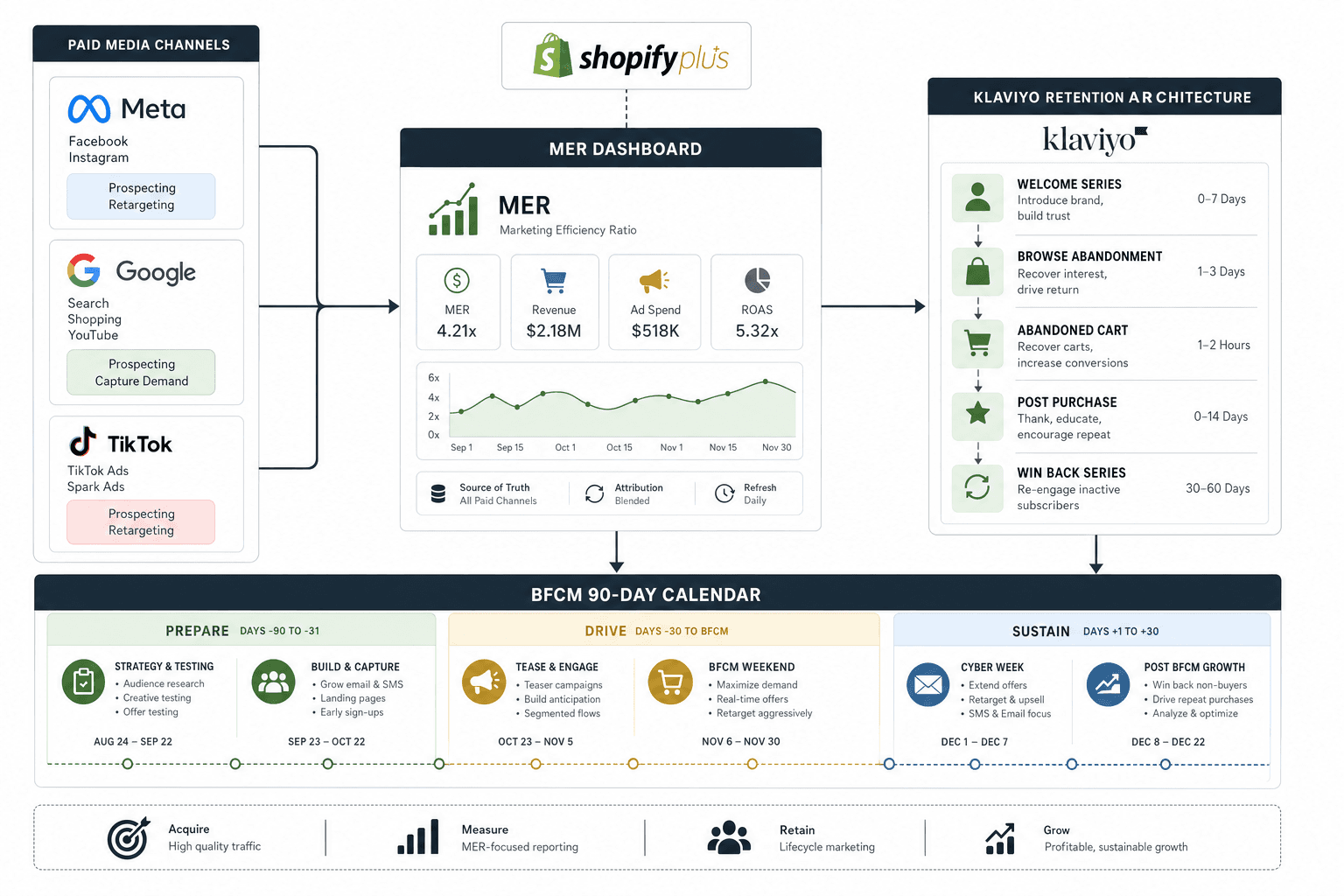
A $10M+ Plus brand needs a different channel mix, attribution, creative cadence, and retention than a $1M store.
Fix attribution before moving budget: clean Web Pixels in Checkout Extensibility and Triple Whale or Northbeam reconciling blended ROAS with the bank account. If you migrated in the last 18 months, audit your pixels instead of assuming they work. A pixel skewing ROAS is a Plus brand's costliest invisible problem.
Blended ROAS governs paid media: channel ROAS only tunes dials, and budget shifts weekly on channel contribution margin.
Meta and TikTok win new customers with creative-led prospecting tested weekly and retargeting by LTV cohort. Google covers high-intent branded and category search, with PMax checked for branded cannibalization.
Test each checkout UI Extension against a clean control, and configure B2B separately: payment terms, a PO number field, and volume pricing tiers at the variant level.
Run Klaviyo retention by LTV cohort and acquisition channel on separate DTC and B2B Flow tracks, tracking email and SMS contribution weekly. Integrate Recharge or Skio with LTV reporting so your media team sees which channels bring subscribers versus one-time buyers.
BFCM prep means Launchpad tested in development, checkout extensions load-tested at Plus's 7,000 checkouts per minute, creative in production by October, and segments validated against LTV cohorts.
The one number that governs this
Weekly blended ROAS (total revenue over total ad spend) against the 30-day average, read with channel contribution margin, gives finance and media the same numbers.
How We Help
How Sagum Runs This for Your Shopify Plus Brand
For most Plus brands we audit attribution first, because broken pixels drive confidently wrong decisions. Then we sequence media, creative, checkout, and retention to reach your blended ROAS target fastest.
Attribution Audit and Blended ROAS Foundation
We audit Web Pixels and GA4 event mapping, configure Triple Whale or Northbeam, and build a weekly blended ROAS reconciliation that media and finance read.
Paid Media: Meta, Google, TikTok
We reallocate spend weekly against contribution margin by channel and run creative-led Meta and TikTok prospecting plus Google Search and Shopping with PMax monitoring.
AI-Assisted Creative Production and Testing
Weekly angle tests, each isolating one variable, build your BFCM creative library from six months of performance data.
Checkout Conversion Optimization
We deploy and test UI Extensions (upsell blocks, trust signals, custom fields) against clean controls and audit B2B checkout separately.
Email and SMS Retention Architecture
We build Klaviyo flows with separate DTC and B2B tracks and report email and SMS contribution weekly by LTV cohort to inform acquisition.
BFCM Readiness Program
We start BFCM prep in August, test Launchpad, load-test checkout extensions, get creative into production by October, and validate segments before the first send.
Analytics and Contribution Margin Reporting
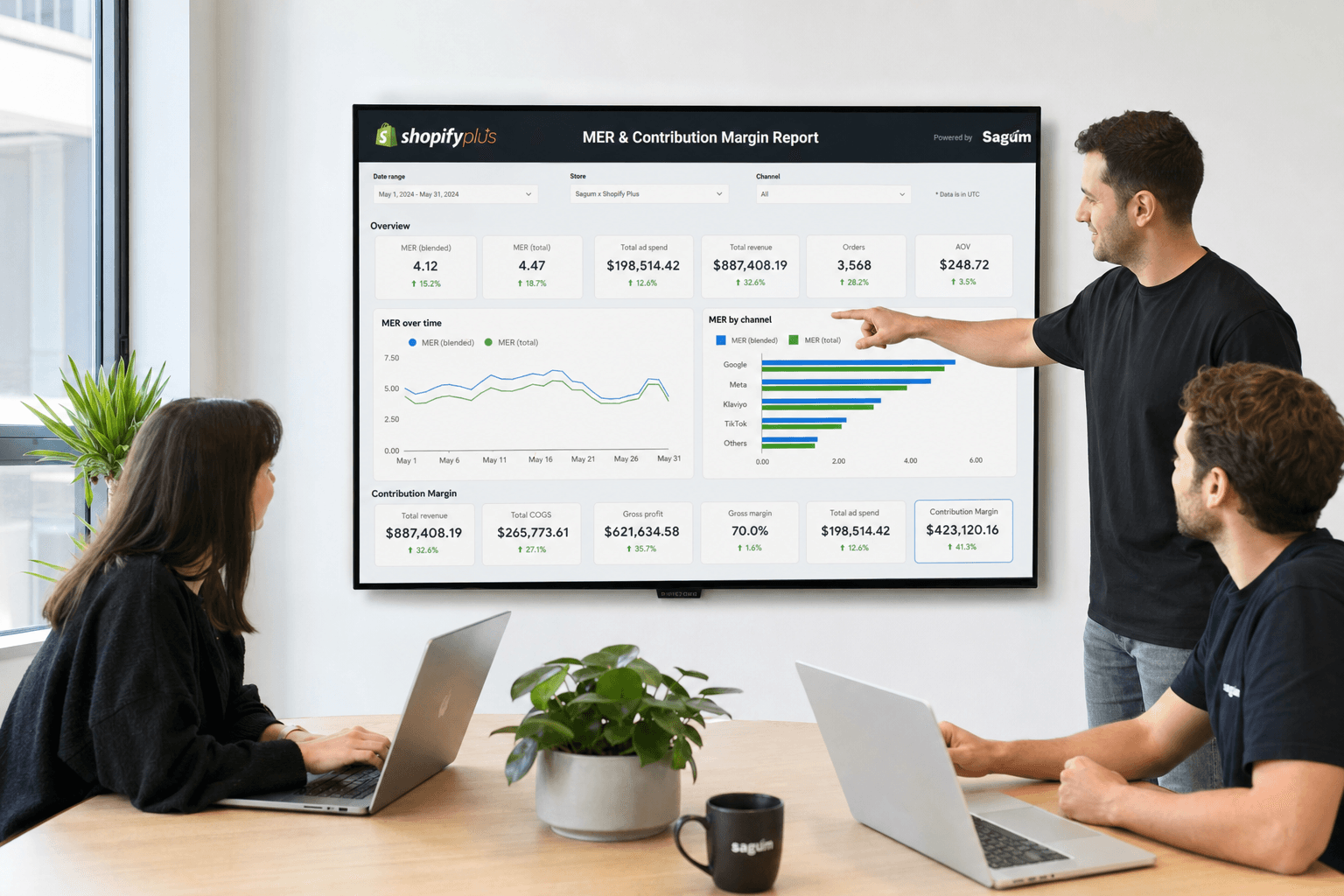
One dashboard gives your media buyer and CFO weekly blended ROAS, new-customer CAC vs. LTV by acquisition cohort, and repeat purchase rate by segment.
Who's Behind This
Who we are, and what makes us different
Sagum is a performance marketing agency founded in January 2017 in St. George, Utah. We've spent 8+ years growing real brands and being judged on KPIs, not vanity metrics.
We deliberately limit how many clients we take so each one gets senior attention. We treat your numbers like our own, we never run generic playbooks, and your strategy is built for your business, because shouldn't your brand's marketing be custom to your brand?
Sagum.ai is our AI arm: the same proven operators now build AI into the work wherever it creates real edge, not as theater, but as leverage applied with discipline.
- 8+ years growing brands on performance KPIs, not vanity metrics
- Limited client roster, with senior attention on every account
- An extension of your team; your success is tied to ours
- Custom strategy per brand, never a generic playbook
- AI built in where it moves a number; judgment over hype
“Sagum is a performance marketing agency that's spent 8+ years growing brands by treating their numbers like our own. We take on few clients, never run generic playbooks, and now build AI into the work wherever it creates real edge, not hype. Your strategy is built for your business, and our success is tied to yours.”
“After six years, Sagum is our most important partner: trusted, communicative, and caring about our business as if it's their own.”
Long-term partner
6-year client
Proof
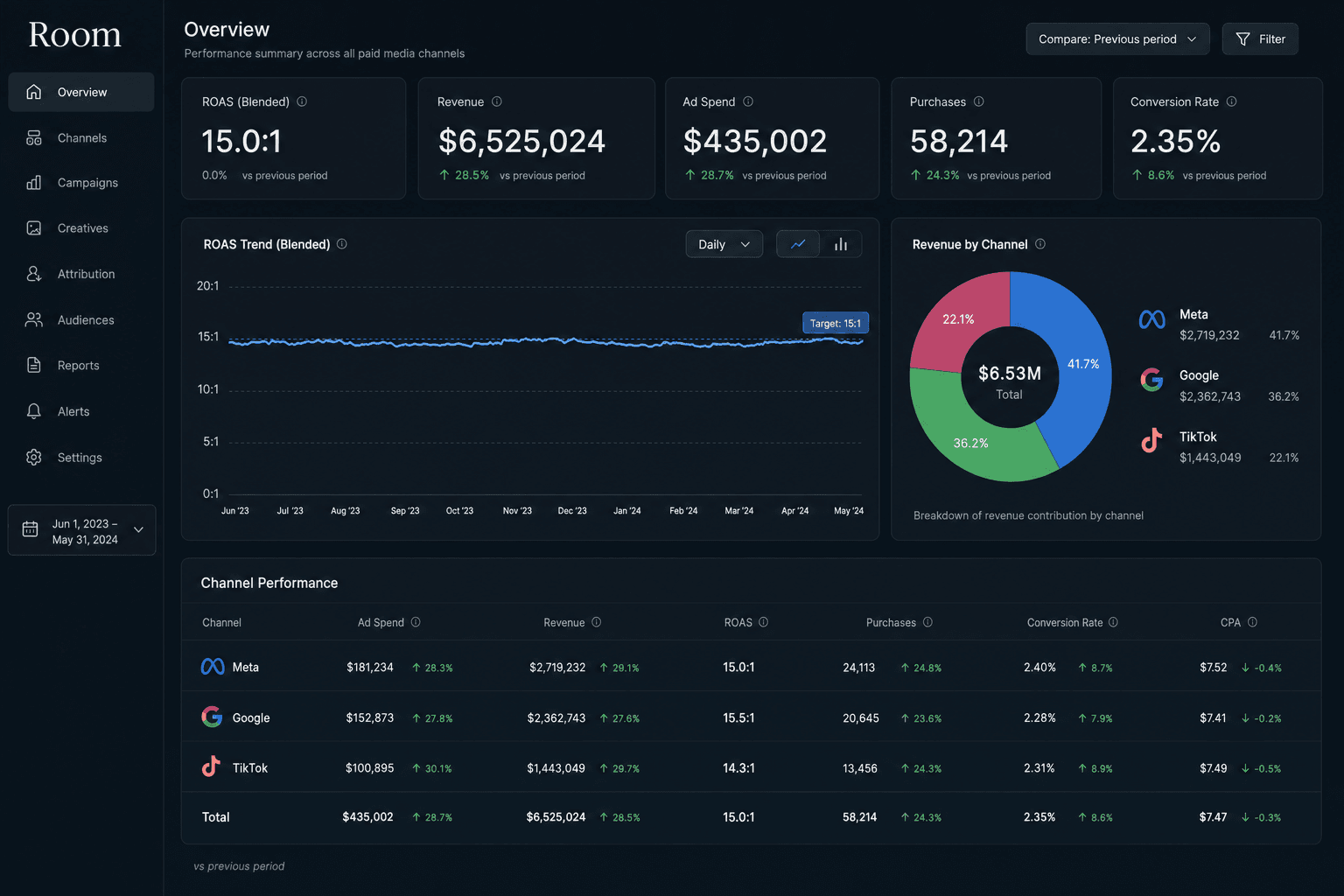
15:1 ROAS on a longer purchase-consideration cycle
Create Room / Original Scrapbox
Challenge
Create Room (Original Scrapbox) sells a higher-ticket DTC product with a longer purchase-consideration cycle.
What we did
Sagum built the strategy around that considered buying cycle. For a Plus brand with high-AOV lines, the same method transfers: plan around how long your buyers take to decide.
Result
Create Room held a 15:1 ROAS while respecting the longer consideration window. Full details are at sagum.com/case-studies/.
Shopify Plus Has Levers Most Agencies Miss. Let's Pull the Right Ones.
No obligation. We'll bring a specific read on your current blended ROAS, attribution stack, and highest-payoff growth gaps for your stage, built on your numbers.
Sagum · January 2017 · St. George, Utah · 8+ years