

8+ years growing brands on KPIs, now with AI
Skincare marketing engineered around real CAC
We run paid media, creative, and email on blended ROAS, not dashboard numbers that flatter while margin erodes.
8+ years growing ecommerce brands · Google Ads, Meta & TikTok partners · Judged on your KPIs, not ours


Get your free Growth Gap Analysis
Senior strategist review · response within one business day
Prefer to reach out directly?
The Challenge
Skincare Marketing Is Harder Than It Looks From the Outside
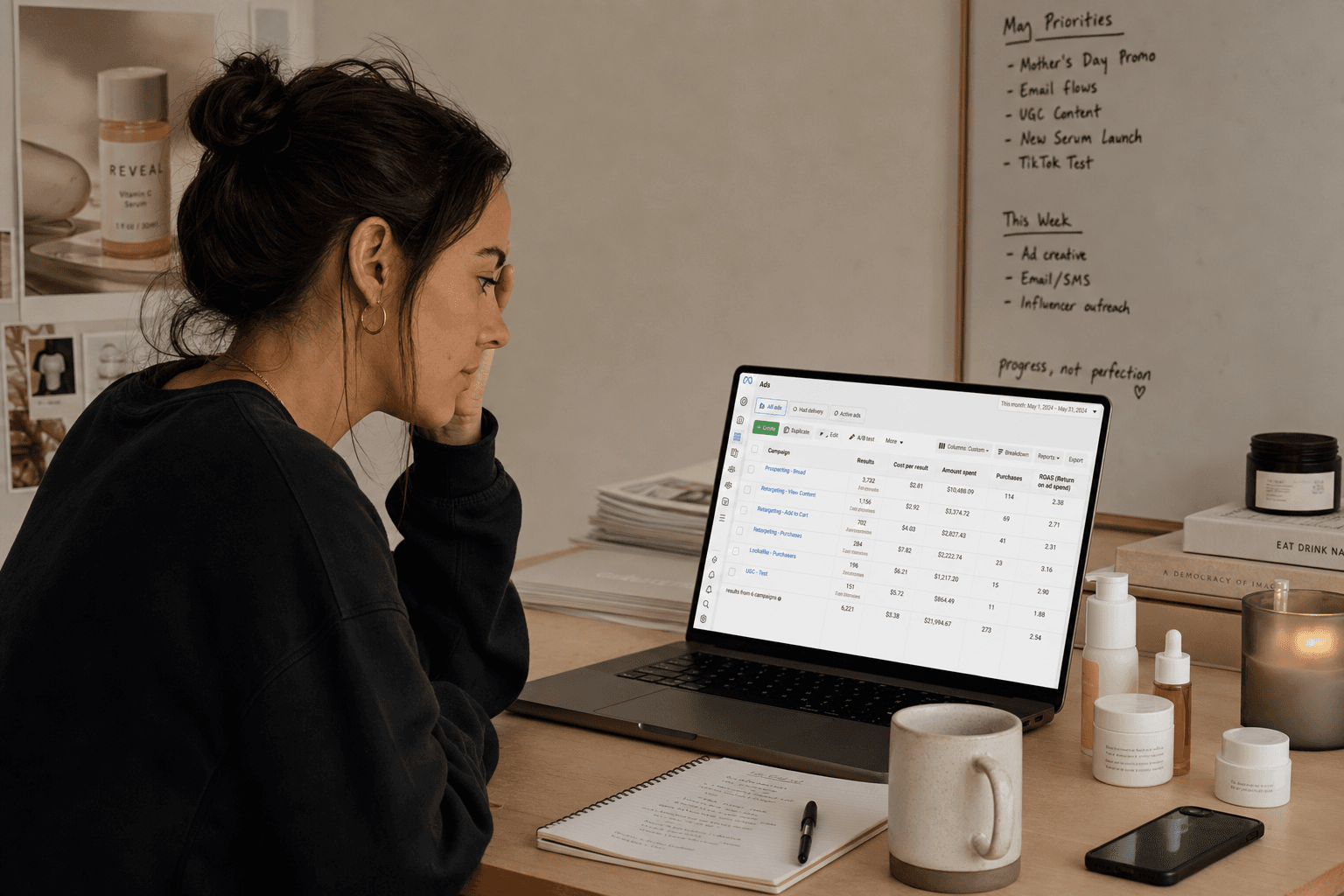
At 7am you watch Meta CPMs climb, brief UGC creators, weigh whether TikTok Shop cannibalizes your DTC margin, and prep a Sephora pitch that needs DTC velocity you haven't fully cracked. Skincare CPMs averaged $14.20 in Q4 2025, up 38% year-over-year.
Your AOV runs roughly $73 to $120, depending on how premium your positioning is. Repurchase is probably around 23% (the beauty ecommerce average), so roughly 77% of customers you paid for never reorder. A $65 CAC against a $90 LTV is a unit economics problem, not a growth problem; more spend accelerates it.
Anti-aging, acne treatment, and ingredient efficacy claims sit in a gray zone under active FDA scrutiny, and 2026 digital advertising guidance targets the category. One non-compliant ad can trigger a warning letter.
The white space indie DTC brands once owned is now a battleground where conglomerates pour millions into paid social, search, and the creator economy. K-beauty brands like Medicube and Beauty of Joseon win on TikTok Shop, undercutting Western DTC prices and knowing its algorithm.
The Opportunity
Skincare Brands That Crack LTV:CAC Now Will Own Their Category
Most brands overspend on acquisition and underbuild highest-margin retention levers: email flows, SMS, subscription attach. Customers acquired through gift-with-purchase (GWP) have 78% higher LTV than standard first-order customers, and abandoned cart flows convert at 4.64%, twenty-seven times a broadcast newsletter's rate.
TikTok Shop's beauty dollar sales grew 107.7% year-over-year in the 52 weeks ending December 2025, and TikTok nano-influencers out-engage celebrity partnerships costing fifty times more.
November orders run 64% above the annual average, January peaks again, and Mother's Day in May moves gift sets at elevated AOVs. October, which most brands treat as Q4 prep, is a bottom-three month: shoppers wait for Black Friday. Brands pacing media to this calendar capture outsized share at each peak.
Above 3x LTV:CAC, growth turns durable; brands that get there through retention, creative testing, and blended-ROAS measurement reach the Sephora shelf and stay.
What Most Get Wrong
What Most Skincare Brands and Their Agencies Get Wrong
Optimizing for first-order ROAS instead of LTV:CAC
Beauty ecommerce brands average 84% first-order payback but 23% repurchase rates. Campaigns that look channel-efficient can destroy long-term economics; split new-customer CAC from returning-customer revenue or your dashboard flatters you.
Running creative that violates FDA skincare claim guidelines
Most performance agencies treat anti-aging, acne, and ingredient efficacy claims like supplement or apparel copy. One non-compliant creative set can cost $50,000+ in legal fees and force a peak-season pullback.
Treating TikTok Shop as experimental instead of primary
Health and beauty were nearly 80% of TikTok Shop U.S. sales in 2024, about $1.34 billion. Brands that wait another year fall behind early movers already building creator relationships.
Under-investing in email and SMS flows while over-spending on prospecting
Win-back, post-purchase education, and subscription upsell sequences are your highest-margin revenue. Most brands leave them half-built while their Meta budget scales, so acquisition outruns what retention can support.
Testing one or two creative angles monthly instead of ten
First-time buyers average 8.3 hours of research, so winning angles are hard to predict. At two concepts a month, finding one takes six months; at ten, about five weeks.
Why Now
Why Skincare Brands Should Build Before the Next Seasonal Peak
AI lets a disciplined operator generate and rotate UGC-style concepts every week, at a pace once reserved for large in-house teams, without proportional production cost. Most competitors still run static creative sets and flat media budgets that ignore the skincare calendar.
Build AI-assisted creative and retention systems before your next seasonal peak (November, or the January 'new year, new skin' surge) and before incumbents pull further ahead in TikTok Shop's beauty algorithm. Creator relationships, review velocity, email list quality, and algorithm familiarity all compound, so starting later means starting from a worse position.
Most agencies aren't building skincare claim rules into their creative workflows. A compliant, high-volume testing workflow built now gives you a durable production advantage over competitors still having ads pulled for claim violations.
The Mechanism
Where AI Moves the Numbers for Skincare Ecommerce
Real productivity, not AI theater. Here's where it actually moves a number for skincare brands.
Creative
What AI does: AI generates UGC-style concepts (ingredient explainers, before/after framings, routine-builder hooks, dermatologist-voice scripts) faster than a manual team can; each is reviewed against FDA skincare claim guidelines before production.
The result: You test 8–12 creative angles per month, up from 2, find winners in weeks, and keep a compliant pipeline without legal review on every hook.
Why it matters here: Skincare buyers convert on specific ingredient interests, skin concern language, and trust signals; most brands underestimate how many tests it takes to find the winner.
Analytics
What AI does: AI tracks Meta, TikTok Shop, Google, and email attribution together, flagging channel ROAS that diverges from blended ROAS, new-customer CAC trends, and pixel misfires, often the reason numbers look too good.
The result: You see acquisition economics shift within days, well before month-end reporting, and can reallocate before you burn budget on a channel that's quietly underperforming.
Why it matters here: Skincare brands live and die by blended ROAS and new-customer CAC; channel numbers routinely flatter dashboards while contribution margin erodes, so clean attribution comes first.
What AI does: AI builds the full Klaviyo flow architecture (abandoned cart, post-purchase ingredient education, replenishment timed to the 107-day average reorder cycle, subscription upsell, GWP-triggered win-back) and keeps testing subject lines, timing, and offers.
The result: Abandoned cart flows hit the 4.64% benchmark, replenishment lifts 90-day repurchase rate, and subscription attach turns single purchases into recurring revenue.
Why it matters here: The average skincare customer places 1.6 orders, and only about 23% repurchase; email and SMS are your highest-margin levers for raising both.
Social Media / TikTok Shop
What AI does: AI ranks nano- and micro-creator formats by engagement-to-conversion ratio and builds a briefing system that scales winners (ingredient deep-dives, skin transformation routines, 'what's in this' transparency content) without full-time creator relations staff.
The result: You get a systematic creator program rather than one-off viral moments that don't repeat.
Why it matters here: Health and beauty were nearly 80% of TikTok Shop U.S. sales in 2024, and category nano-influencers average 10.3% engagement; creator programs built now keep compounding.
Conversion Optimization
What AI does: AI audits product and landing pages against skincare buyers' decision criteria (ingredient transparency, clinical evidence signals, skin concern specificity, review credibility) and tests variants built for their long research journey.
The result: Add-to-cart and purchase rates rise on traffic you already pay for.
Why it matters here: Skincare is beauty's highest-research category; impulse-optimized pages are the wrong tool. AI can test which answers to buyer questions convert, faster than manual CRO can.
Ready to see what this looks like for your skincare brands business?
No obligation. A senior strategist will show you exactly where the wins are.
The Strategy
The Advertising Strategy That Works for DTC Skincare Brands
Fix measurement first: clean cross-channel attribution, new- and returning-customer revenue tagged separately, and a pixel audit before any new budget goes in.
Meta Advantage+ sales campaigns, your highest-volume prospecting engine, are non-negotiable at any spend level, but creative drives their results.
Test and rotate UGC-style concepts weekly, including skin concern framings. Brands winning on Meta test 8–12 concepts per month, not 2. Every concept is reviewed against FDA skincare claim guidelines before launch.
TikTok Shop is a primary channel. Pair a systematic nano-influencer program (1K–10K followers) with organic content, and run TikTok Shop alongside DTC as a complement, not a competitor.
Google Search catches high-intent shoppers searching 'best niacinamide serum,' 'retinol for sensitive skin,' or 'vitamin C serum for hyperpigmentation' at the end of an 8.3-hour journey through ingredient reviews and before/after content. Early-stage skincare brands underuse it, leaving you a real arbitrage opportunity.
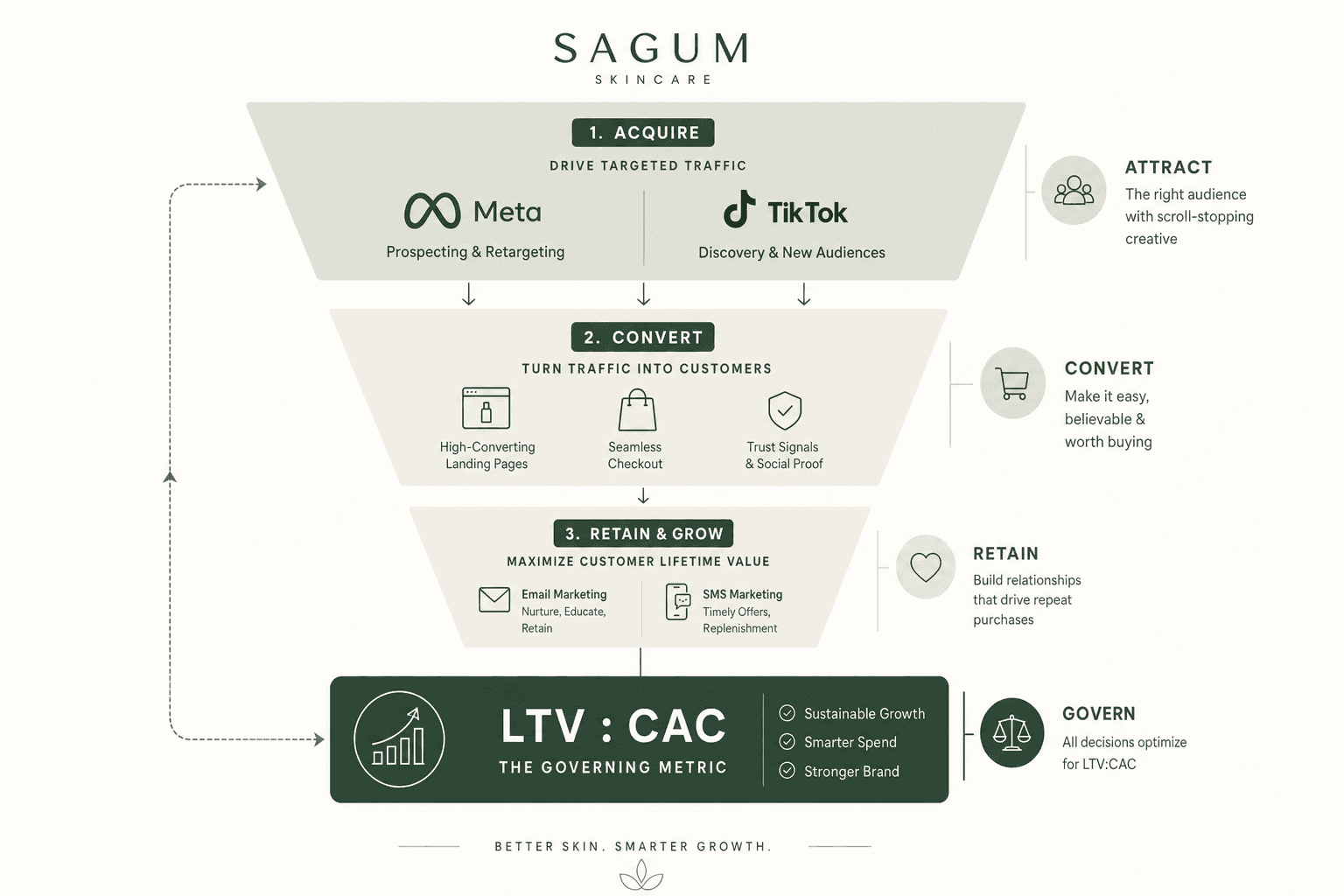
Klaviyo email and SMS are your highest-margin retention channel and main LTV:CAC lever, so build every flow before scaling acquisition. Acquiring customers into a broken retention system keeps brands stuck at a 1.4 LTV:CAC ratio.
Pace media to the skincare calendar: scale spend in November and January, reduce prospecting and increase retention focus in October, and test creative cheaply in low-CPM trough months (February, mid-July).
The one number that governs this
Every decision is measured against blended ROAS and new-customer CAC. Meta, Google, and other channel metrics are diagnostic inputs, not the scorecard.
How We Help
How We'd Run Marketing for Your Skincare Brand
We start where money leaks, which for skincare almost always means attribution cleanup, then build retention before scaling the channels that move new-customer CAC.
Analytics & Attribution Audit
First, we audit your pixel, verify new- vs. returning-customer revenue tagging, and set clean baselines for blended ROAS and new-customer CAC.
Email & SMS Flow Architecture (Klaviyo)
We build or rebuild every Klaviyo flow before acquisition spend scales.
Meta Paid Social (Advantage+ Sales)
We run Meta as your primary prospecting engine, rotating creative weekly and pacing budget to the skincare calendar.
TikTok Shop & Paid TikTok
We run a nano-influencer program alongside paid TikTok, in formats built for TikTok Shop's beauty algorithm, with organic and paid managed as one system.
Google Search (Ingredient-Intent Campaigns)
We build Search campaigns on specific ingredient and skin concern queries. Capturing those high-intent researchers is the arbitrage most skincare brands leave on the table.
AI-Assisted Creative Production
We produce UGC-style concepts at the weekly volume your testing needs, each checked against FDA skincare claim guidelines before production.
Conversion Optimization
We audit and test your product and landing pages against how skincare buyers research, iterating toward higher purchase rates from existing traffic.
Who's Behind This
Who we are, and what makes us different
Sagum is a performance marketing agency founded in January 2017 in St. George, Utah. We've spent 8+ years growing real brands and being judged on KPIs, not vanity metrics.
We deliberately limit how many clients we take so each one gets senior attention. We treat your numbers like our own, we never run generic playbooks, and your strategy is built for your business, because shouldn't your brand's marketing be custom to your brand?
Sagum.ai is our AI arm: the same proven operators now build AI into the work wherever it creates real edge, not as theater, but as leverage applied with discipline.
- 8+ years growing brands on performance KPIs, not vanity metrics
- Limited client roster, with senior attention on every account
- An extension of your team; your success is tied to ours
- Custom strategy per brand, never a generic playbook
- AI built in where it moves a number; judgment over hype
“Sagum is a performance marketing agency that's spent 8+ years growing brands by treating their numbers like our own. We take on few clients, never run generic playbooks, and now build AI into the work wherever it creates real edge, not hype. Your strategy is built for your business, and our success is tied to yours.”

“Sagum roughly doubled our bottom line. They treat the work like it's their own business.”
Rachel Nilsson
CEO, RAGS
Proof
$0 → $500k/mo in months at a 4:1 ROAS target
Viori
Challenge
Viori was a new DTC brand that needed to scale from zero.
What we did
We built and scaled Viori's paid acquisition to a 4:1 ROAS target. Scaling against a set ROAS target is the discipline that carries over to a DTC skincare brand.
Result
Viori went from $0 to $500k per month in months at a 4:1 ROAS target.
Your Skincare Brand Deserves a Marketing Partner Who Understands the Category
No obligation. We'll come prepared on your brand, channel mix, and where blended ROAS and new-customer CAC could move. If it's not a fit, you'll leave with a clearer picture of where your growth is.
Sagum · January 2017 · St. George, Utah · 8+ years