

8+ years growing brands on KPIs, now with AI
Grow MRR for Subscription Box Brands
We build acquisition and retention systems around your churn cohorts and dunning recovery, not generic ecommerce playbooks.
8+ years growing DTC brands · Google, Meta & TikTok partner · performance-judged, not retainer-comfortable


Get your free Growth Gap Analysis
Senior strategist review · response within one business day
Prefer to reach out directly?
The Challenge
Subscription box economics punish generic marketing harder than other ecommerce models
Most agencies miss that you run a recurring-revenue business, not a store. Your blended monthly churn probably runs 8% to 12%. At 10%, you replace nearly your whole base every ten months to stay flat, a structural leak no winback email fixes.
First-month churn is worse: across verticals, 12–30% of new subscribers cancel or fail to convert before their second billing cycle. The photo that sold the first box won't hold them through month two, and the first 30 to 60 days shape 12-month retention more than anything after.
Involuntary churn stays invisible on most dashboards: expired cards, replaced payment methods, renewal-day bank declines. It is often a third or more of churn. At 5,000 monthly orders and a $50 AOV, $250,000 renews each month, and multi-channel recovery wins back failed payments that basic retries miss.
Subscriber CAC averaged $70–$78 in 2025. Target 3:1 LTV:CAC or better, and recover CAC within about three billing cycles, before churn eats the margin. Paid acquisition without coordinated retention fills a leaking bucket.

The Opportunity
Low-churn subscription box brands win on annual plans and churn data
Annual subscribers churn less and prepay a year, so each is worth far more. A deliberate annual-plan conversion push is one of your highest-ROI moves, yet most brands bury the option at checkout or never surface it after signup.
Brands at sub-5% monthly churn and 50%+ gross margins stand apart in how they use data. They split voluntary from involuntary churn, track month-three churn by cohort, know LTV:CAC by channel, and treat cancel-flow saves as a live KPI: pause or skip offers keep 30–40% of canceling subscribers.
At 2,000 subscribers, 8% monthly churn, and two-thirds of it voluntary, a 35% save rate keeps about 37 subscribers a month, compounding into MRR.
Email and SMS drive 25–35% of total revenue for the healthiest subscription DTC brands, through lifecycle-triggered Klaviyo flows. The window to build these systems before competitors do is open.
What Most Get Wrong
What subscription box brands and their agencies get wrong
Chasing new subscriber volume instead of net MRR
ROAS looks healthy and the agency reports a winning month on paid social while MRR flatlines. Without cohort visibility and a parallel retention system, paid acquisition is expensive churn replacement.
Blending voluntary and involuntary churn into one rate
Blended, you fix neither: voluntary needs messaging, portal UX, and cancel flows; involuntary, often a third or more of churn, needs smart dunning, not the basic retries many brands run.
Running ads with no first-30-days retention system
When onboarding is one welcome email and a shipping confirmation, a meaningful share of each cohort is gone before month two, and the ad spend that acquired them is wasted.
Ignoring the annual plan as an acquisition and retention lever
Most brands offer annual plans but build no ad creative, post-signup flows, or portal prompts to convert monthly subscribers, so the higher-value annual cohort never gets built.
Relying on Shopify's native cohort reports for analytics
Built for transactional ecommerce, they can't separate cohort from blended churn, model channel LTV, or flag early warnings, so you learn months late whether new channels bring keepers or churners.
Why Now
Why subscription box operators building retention now will be hard to catch
Recharge's $105 million acquisition of Skio in April 2026 marked consolidation and a maturing platform layer. The gap between brands using these tools well and those on default settings is widening.
AI now lets a lean team run what once took a data team: payment retries timed by day of week, time of day, and day of month; high-volume creative testing to find the lowest-churn angle; and Klaviyo flows that react to lifecycle signals in real time.
Most box brands still run acquisition-only marketing on flat monthly budgets, with basic dunning, Shopify's native cohort reports, and a never-optimized welcome series. Build retention in the months before your peak season (Q4 gifting, Valentine's, Mother's Day), not during it: spend on Q4 subscribers who churn in January is the year's most expensive.
The Mechanism
Where AI creates measurable edge for subscription box brands
Real productivity, not AI theater. Here's where it actually moves a number for subscription box brands.
Analytics and attribution
What AI does: AI-assisted cohort modeling separates voluntary from involuntary churn, tracks LTV:CAC by channel and cohort, and flags early warnings before blended churn shows them.
The result: You know within weeks whether a new channel brings high-LTV subscribers or 60-day churners.
Why it matters here: Brands that run Lifetimely or RetentionX with AI-assisted segmentation set each channel's budget on predicted LTV rather than last-month ROAS.
Email and SMS automation
What AI does: AI optimizes Klaviyo flows on Recharge or Skio events: pre-renewal reminders, failed-payment recovery with AI send-time optimization, skip/pause education, and cancel-flow intervention triggered by cancellation intent.
The result: Email and SMS climb toward the healthiest brands' revenue share as flows take over the profitable work, and failed-payment recovery improves materially over basic retries.
Why it matters here: Badly timed recovery emails recover a fraction of what AI-timed, multi-touch recovery does (email on day one, SMS on day two, email on day five).
Creative
What AI does: AI-assisted production lets you test multiple hooks each week (first-box reveal, what's-inside-this-month, cancel-anytime trust) to find which one draws the lowest-churn cohort.
The result: You find sooner which angle acquires subscribers who stay past month three, and your LTV-adjusted CAC falls.
Why it matters here: Cheap clicks often mean costly subscribers: $4 CPM creative drawing first-month churners costs more per retained subscriber than $9 CPM creative drawing annual-plan converters.
Conversion optimization
What AI does: AI-assisted landing page and checkout optimization targets signup and the post-signup annual-plan upsell, using Shopify Checkout Extensibility to keep Shop Pay one-click on first purchase.
The result: Trial-to-paid conversion rises, and measurably more subscribers who would have defaulted to monthly choose annual.
Why it matters here: A 5-percentage-point lift in annual-plan conversion at checkout compounds into a materially different LTV curve for every later cohort.
Digital ads
What AI does: AI-assisted pacing and bidding on Meta and Google shift spend toward peak acquisition windows, inside campaigns structured around subscriber LTV signals.
The result: Spend concentrates in the windows that bring subscribers who stay, improving blended LTV:CAC across the year.
Why it matters here: The best window is when new subscribers are likeliest to stay through month six, which isn't always when conversion peaks.
Ready to see what this looks like for your subscription box brands business?
No obligation. A senior strategist will show you exactly where the wins are.
The Strategy
How to run subscription box marketing, from acquisition to retained MRR
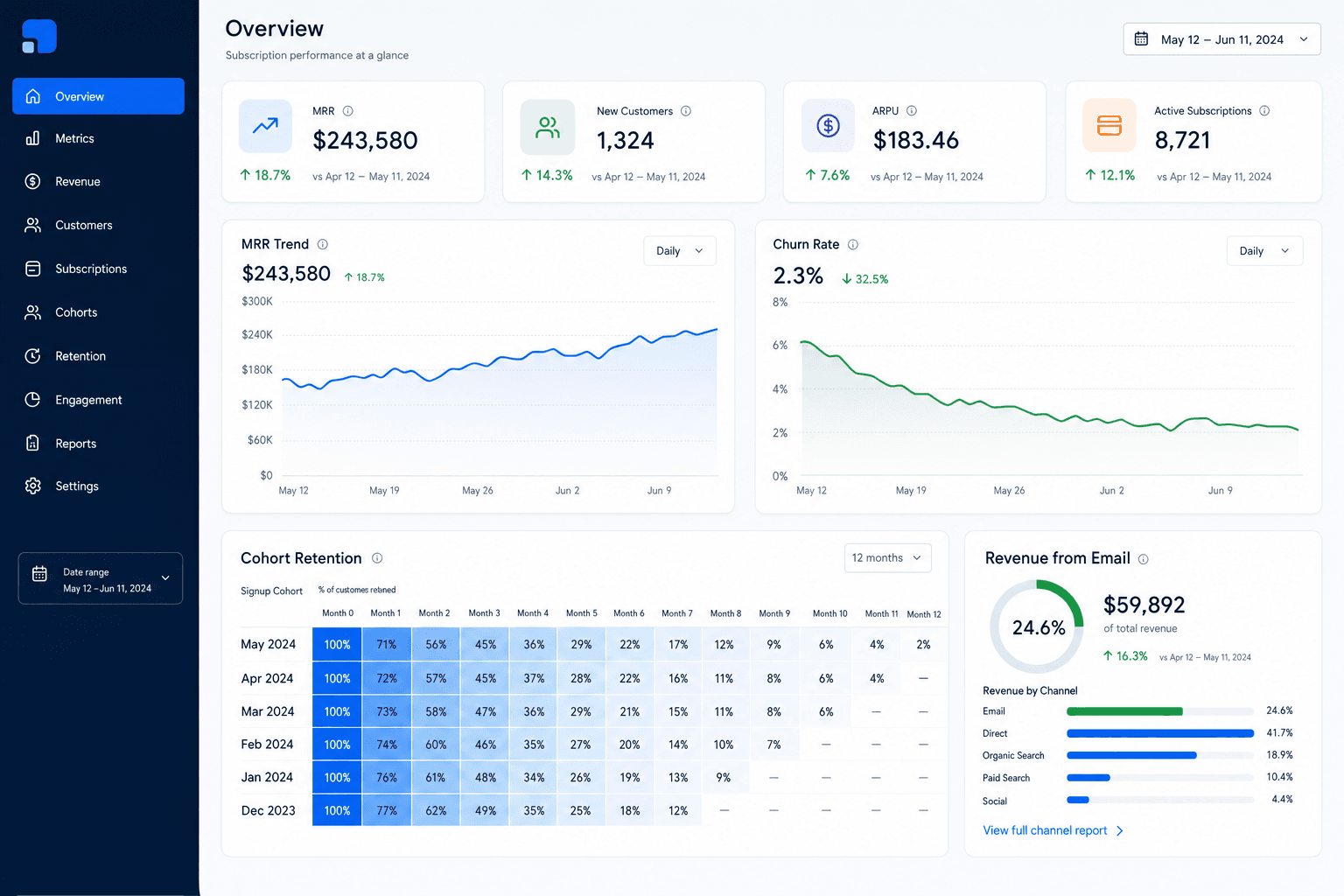
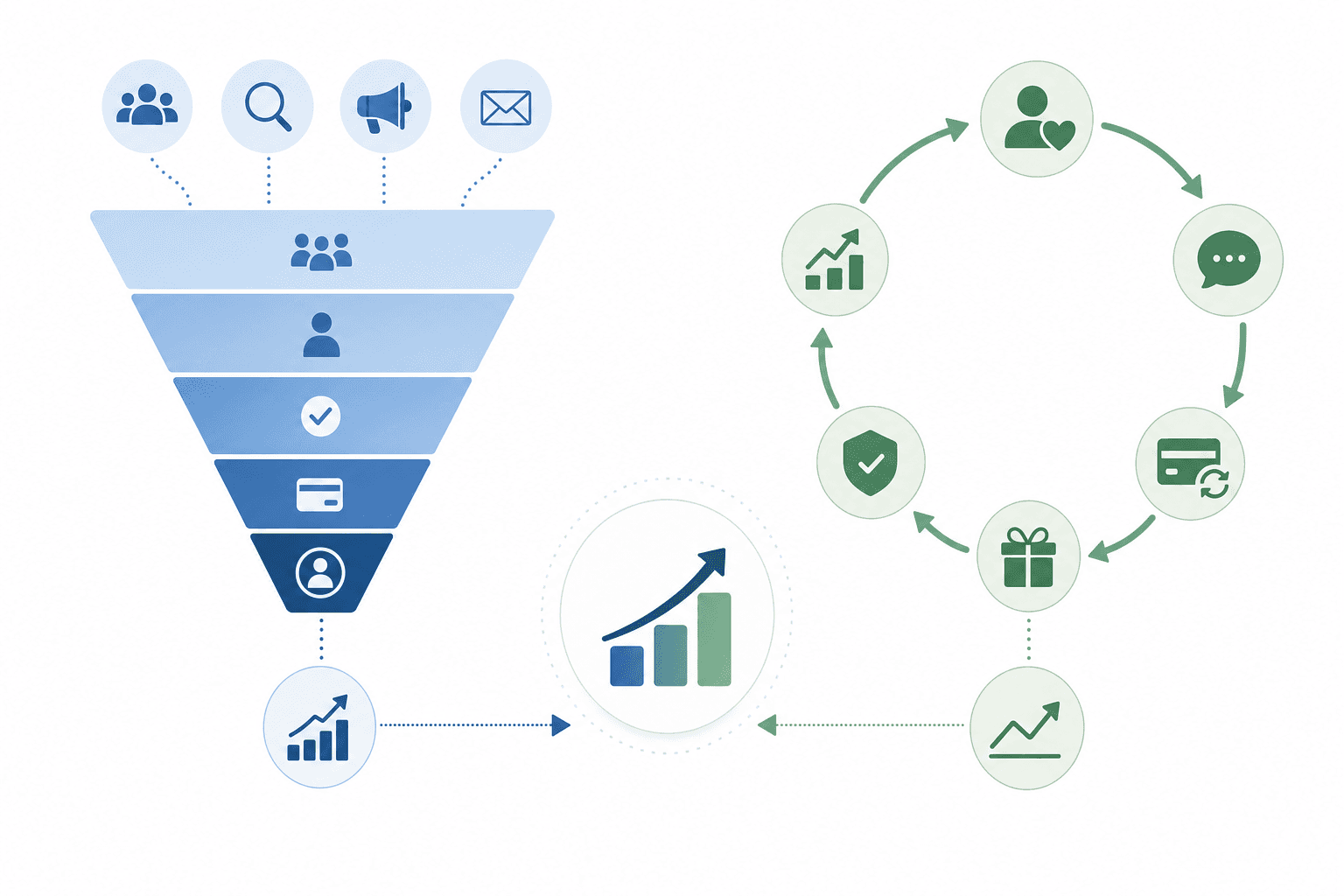
Cohort-level LTV:CAC is the governing framework. Blended ROAS is the acquisition input, and net MRR retention is the output that decides whether the math works.
Meta and TikTok carry creative-led prospecting, testing multiple hooks weekly and shifting toward angles that attract stayers. Google covers branded search and high-intent category queries. Pace budget to your acquisition calendar, putting most spend into seasonal and vertical-specific peaks.
Retention runs in parallel from day one of the engagement. Klaviyo flows on Recharge or Skio events start with a three-email welcome series over ten days that confirms the subscription, teaches skip and pause, and reinforces value before the second charge.
Add a pre-renewal reminder three days before each billing cycle, multi-touch failed-payment recovery with direct payment-update links, a cancel flow offering pause or skip, and winback timed to cohort churn windows.
Analytics is the operating system: add a dedicated cohort analytics tool to Shopify's reports, split churn by type from the start, review cohort curves weekly, and budget on LTV:CAC by channel and creative angle.
Give annual-plan conversion its own program: post-signup flows at month two and month three, subscriber portal prompts, and paid retargeting to existing subscribers. It builds your highest-LTV cohort.
The one number that governs this
Net MRR growth is the KPI, with LTV:CAC at 3:1 or better. Split churn is the diagnostic; email/SMS at 25–35% of revenue signals retention health.
How We Help
What we would build for your subscription brand
We take on a limited number of clients so each gets senior attention, and we build acquisition and retention in parallel, tied to net MRR and LTV:CAC.
Attribution and cohort analytics setup
Before touching ads, we split churn by type, build cohort curves by channel, track LTV:CAC, and, on Recharge or Skio, connect a cohort analytics layer.
Paid social acquisition (Meta and TikTok)
We pace creative-led prospecting to your peak windows, test multiple angles weekly, and read cohort retention to shift spend toward angles that attract stayers.
Google Ads (branded search and category intent)
We run Google as a safety net, protecting branded search and catching category-intent buyers already primed by social or word of mouth.
Klaviyo retention architecture
We build or rebuild every flow on your Recharge or Skio events, from onboarding to annual-plan conversion, and own email/SMS revenue share as a KPI.
Dunning and involuntary churn recovery
For many subscription brands this is the highest-ROI intervention: we audit retry logic, configure smart retry timing, build multi-touch recovery, and track recovery rate separately.
Conversion optimization (subscription signup and annual plan upsell)
We optimize signup and annual-plan upsell within Shopify Checkout Extensibility, keeping Shop Pay one-click, then prompt monthly subscribers toward annual.
Creative production and testing
We test creative in volume, judged on cohort retention, not just CTR, to find the lowest-churn angle faster than competitors testing one ad a month.
Who's Behind This
Who we are, and what makes us different
Sagum is a performance marketing agency founded in January 2017 in St. George, Utah. We've spent 8+ years growing real brands and being judged on KPIs, not vanity metrics.
We deliberately limit how many clients we take so each one gets senior attention. We treat your numbers like our own, we never run generic playbooks, and your strategy is built for your business, because shouldn't your brand's marketing be custom to your brand?
Sagum.ai is our AI arm: the same proven operators now build AI into the work wherever it creates real edge, not as theater, but as leverage applied with discipline.
- 8+ years growing brands on performance KPIs, not vanity metrics
- Limited client roster, with senior attention on every account
- An extension of your team; your success is tied to ours
- Custom strategy per brand, never a generic playbook
- AI built in where it moves a number; judgment over hype
“Sagum is a performance marketing agency that's spent 8+ years growing brands by treating their numbers like our own. We take on few clients, never run generic playbooks, and now build AI into the work wherever it creates real edge, not hype. Your strategy is built for your business, and our success is tied to yours.”

“After six years, Sagum is our most important partner: trusted, communicative, and caring about our business as if it's their own.”
Long-term partner
6-year client
Proof
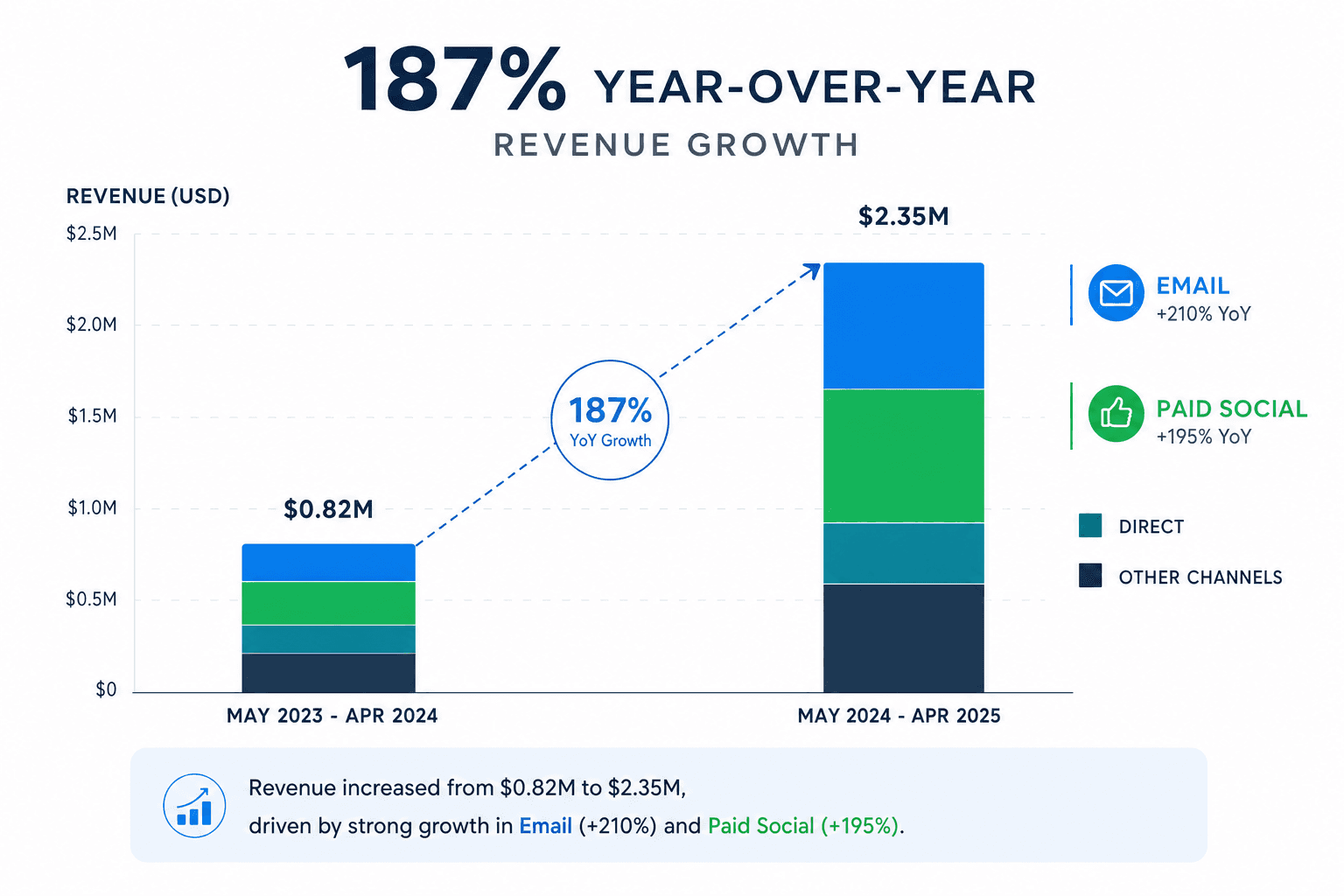
187% YoY, $8+ ROAS on Meta, +79% web conversion
Clean Monday Meals
Challenge
Clean Monday Meals, a food DTC brand, needed to grow across channels.
What we did
We scaled Meta and took over email and Amazon. For a subscription box, the same discipline applies to paid acquisition and the email flows that keep subscribers renewing.
Result
Clean Monday Meals posted 187% year-over-year growth, $8+ ROAS on Meta, and a 79% lift in web conversion. The full case study is at sagum.com/case-studies/.
Your subscriber base should be compounding, not churning in place
No obligation. We'll review your MRR trend, churn split, and acquisition setup, then use your own numbers to show you the highest-ROI lever: retention infrastructure, dunning recovery, or acquisition creative.
Sagum · January 2017 · St. George, Utah · 8+ years