

8+ years growing brands on KPIs, now with AI
Your toy brand can't afford to miss Q4
We hit blended ROAS targets and walk you into peak season with creative already tested, not fingers crossed.
Google Ads · Meta · TikTok Partner | 8+ Years Growing Ecommerce Brands | Case-Backed Results


Get your free Growth Gap Analysis
Senior strategist review · response within one business day
Prefer to reach out directly?
The Challenge
Toy Marketing Is a Year-Long Sprint Toward Q4
More than half of toy sales happen in Q4, and that shapes every decision from July on: inventory, ad timing, list building, and creative testing.
Your buyer shops with intent: a parent with a birthday in two weeks, a grandparent chasing the toy a grandkid saw on YouTube, or a kidult collector who spotted a limited TikTok drop. Anything under $30 often sells in one session; if your ad doesn't stop the scroll, a competitor's does.
Unit economics are brutal: mass-market ASPs hover around $10–$11, and even premium DTC brands face a median Meta CPA in the high thirties. That math needs a high enough AOV, efficient creative, and a true blended ROAS, not platform numbers inflated by view-through attribution and last-click double-counting.
You need Amazon to capture demand, but its algorithm, private-label products, and third-party undercutters also make your biggest channel your most dangerous competitor. Parents comparison-shop in real time, so a $5 price gap loses the sale. Fads add risk too: toy trends average roughly eight months.

The Opportunity
Where Toy Brands Can Win Share and Margin
Creative, not budget, wins toy demand: paid social, nearly 60% of it on Meta, drives over half of in-market traffic, and in Facebook ads UGC earns 4x the CTR and 50% lower CPC than polished creative.
Brands building shoppable content on TikTok Shop will own it before CPMs climb: it's less saturated than Meta, yet already a top-three traffic source for toy brands.
Kidults (adults buying toys for themselves) beat parent buyers on AOV and repeat rate, buy year-round, and drive $6.7 billion in U.S. revenue, 17% of toy sales; LEGO, Funko, and collectible brands fight for them.
Email is the margin protection most toy brands underinvest in: when items sell out, you can announce waitlists, alternatives, and restock windows to keep the sale. Subscription and collectible mechanics can lift LTV 40% or more in this low-repeat category.
What Most Get Wrong
What Most Toy Brands and Their Agencies Get Wrong
Running one creative format all year
Polished photography that works in January loses to UGC in Q4. Without seasonal and funnel-stage rotation, CTR decays and CPMs rise.
Trusting platform ROAS over blended ROAS
Meta can report 4x ROAS on a campaign your bank account puts at 1.8x. Overlapping Meta, Google, and Amazon spend invites double-counting, and founders burned once stop trusting agency numbers.
Starting Q4 creative testing in September
You pay premium CPMs to learn what you could have learned in July and August, when ad inventory was cheaper.
Spending into a trend after its peak
An agency's set-and-forget campaign on a fidget or collectible trend that peaked six months ago burns contribution margin on a dying SKU bound for clearance.
Ignoring the IP release window
Licensed toys, 34% of sales, grew 18% in a recent year. For movie, show, or gaming tie-ins, generic agencies miss your best paid-spend window: the 8–12 week release halo.
Why Now
Toy Brands Should Fix Creative and Attribution Before Peak Season
Brands entering October with tested creative, clean attribution, and a dialed-in blended ROAS target will beat brands still fixing their funnel at peak CPMs, so fix attribution first and start creative testing in Q2.
AI lets disciplined operators test five creative angles a week instead of one a month and find the converting unboxing format or kid-reaction hook before competitors do.
Most of your competitors still run an outdated Meta playbook: broad targeting, polished creative, last-click attribution. Moving now to UGC-led testing, blended ROAS tracking, and AI-assisted budget pacing builds a lead that compounds before the holidays.
The Mechanism
Where AI Moves a Toy Brand's Numbers
Real productivity, not AI theater. Here's where it actually moves a number for toy brands.
Creative
What AI does: We pair AI-assisted production with systematic UGC testing to generate multiple angles weekly (unboxing hooks, kid reaction cuts, parent testimonials, collectible reveals) and find winners faster than manual iteration.
The result: You find the converting format before Q4 CPMs spike instead of paying peak rates to learn it.
Why it matters here: When creative must be proven by October and fads run short, a competitor testing one ad a month never catches you testing five a week.
Analytics
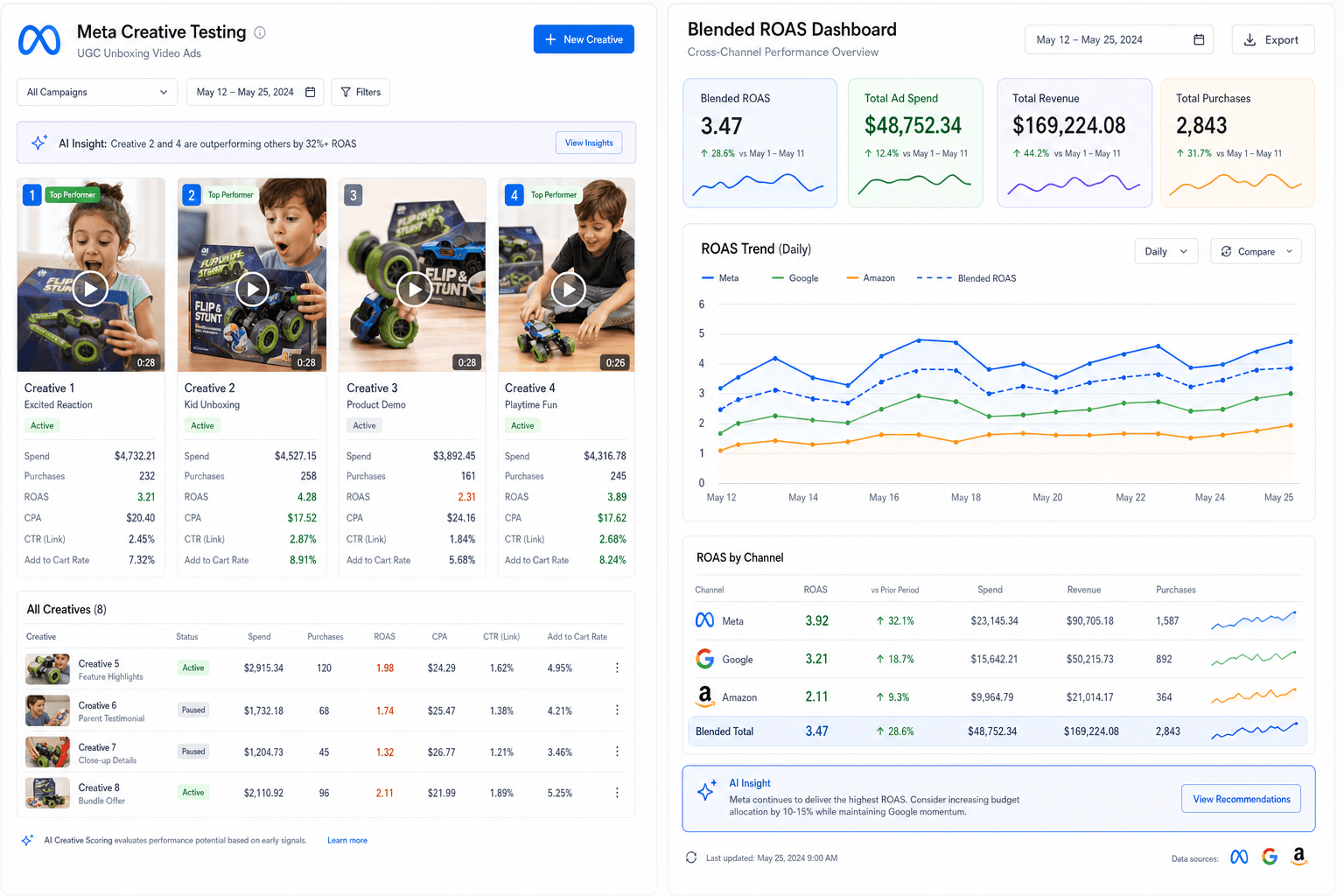
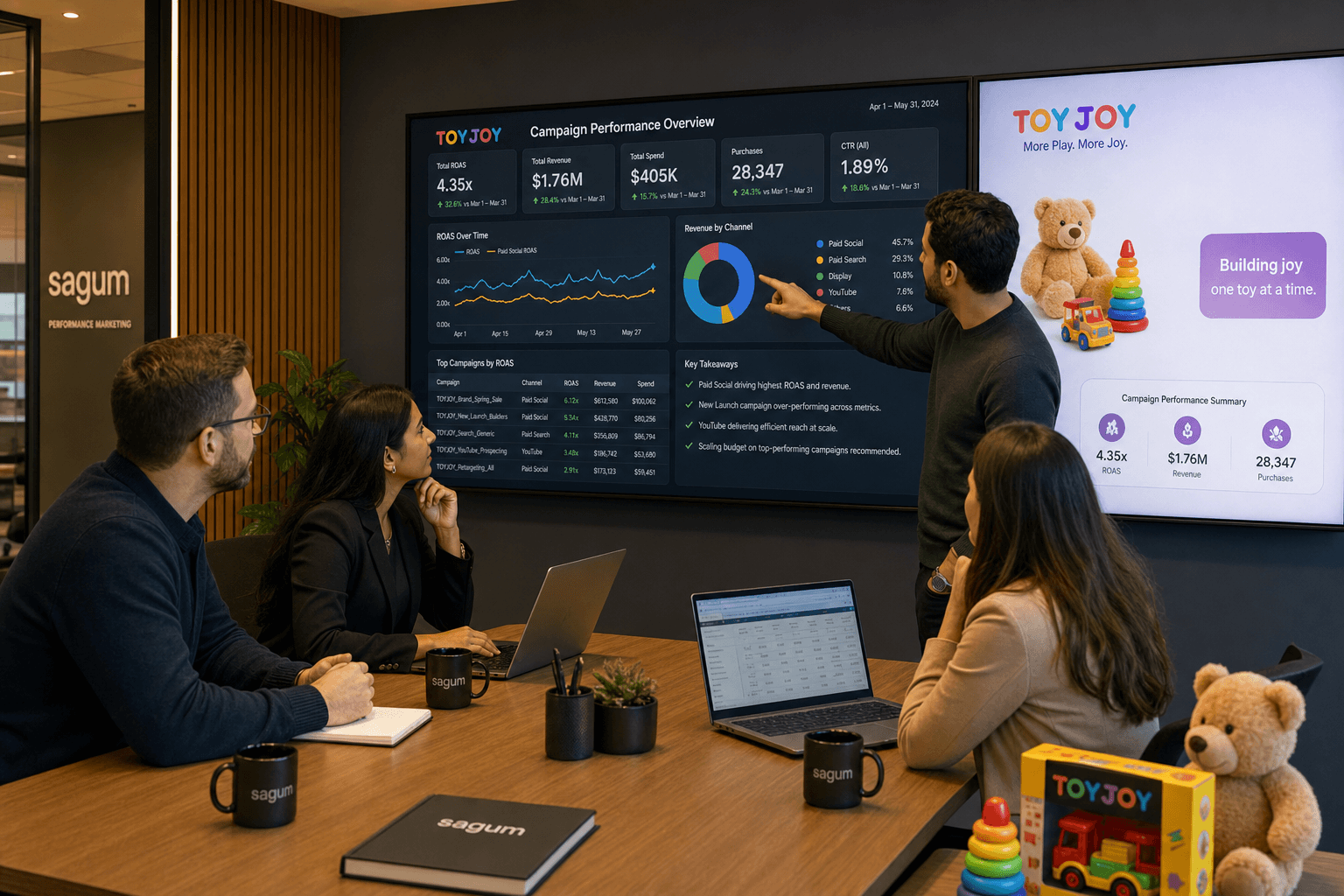
What AI does: We build a blended ROAS dashboard across Meta, Google, and Amazon spend and revenue, and AI flags misfiring pixels, view-through inflation, and cross-channel double-counting.
The result: Budget decisions rest on your true blended ROAS, and founders burned by last-click attribution get numbers they can trust and show their board.
Why it matters here: With overlapping social, search, and marketplace spend, toys rank among ecommerce's most attribution-vulnerable categories; a misfiring pixel or Amazon attribution tag can inflate platform-reported ROAS.
Digital Ads
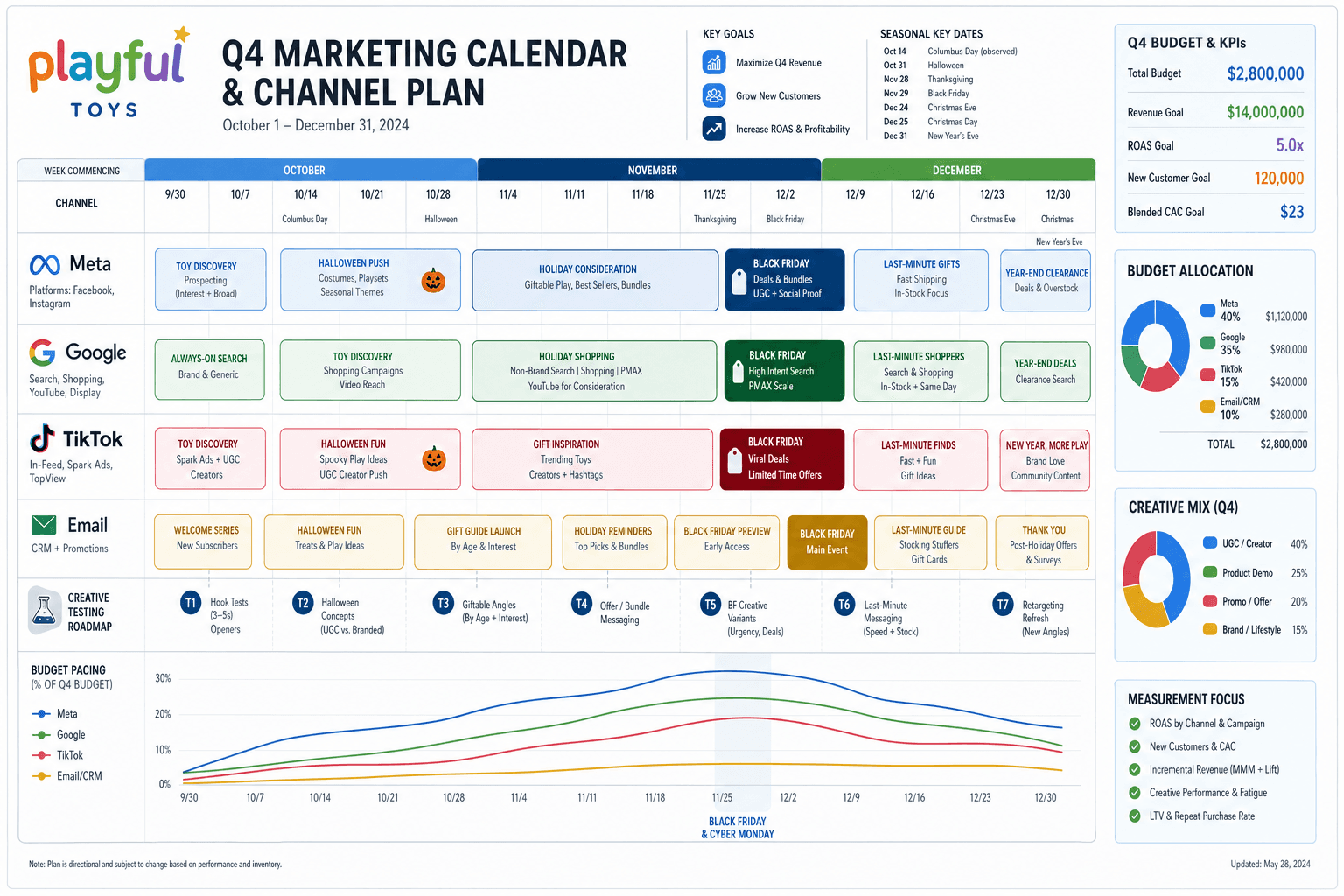
What AI does: We use AI to pace budget across Meta, Google, and TikTok on real-time signals (trending SKU velocity, creative fatigue, seasonal demand curves) instead of a static monthly plan.
The result: Spend follows IP windows, trend curves, and conversion rates, not a spreadsheet locked in July, and concentrates on the Q4 days and SKUs that convert.
Why it matters here: With over half of toy sales landing in Q4, flat pacing wastes budget: a Q4 month's first two weeks and last week convert differently.
Social Media
What AI does: We build shoppable content on TikTok Shop and Meta (creator briefs, affiliate and UGC sourcing, influencer content tracking); AI spots rising creator formats and product categories before they peak.
The result: Shoppable social becomes a revenue channel: a toy brand co-branded with a major YouTuber hit 67.7% purchase intent (2.3x the category benchmark) with platform-native content.
Why it matters here: Toy sales are now 65% online; younger parents trust TikTok and Instagram for discovery. Early creator relationships lock in reach before rates climb.
Conversion Optimization
What AI does: AI tests landing and product pages for AOV-lifting mechanics (bundles above the free-shipping threshold, subscription/collectible upsells, less checkout friction) and watches for conversion leaks at peak traffic.
The result: AOV climbs toward and past the free-shipping threshold without more ad spend, lifting per-order contribution margin. Q4 checkout failures, your costliest operational event, surface early.
Why it matters here: 40% of consumers say they'll switch retailers over a holiday out-of-stock or checkout problem; a 10% conversion lift is worth most in Q4.
Ready to see what this looks like for your toy brands business?
No obligation. A senior strategist will show you exactly where the wins are.
The Strategy
How to Run Toy Brand Marketing
Attribution comes before ads: we audit your pixel setup, Amazon Attribution tags, and GA4 so you trust your blended ROAS before any strategy rests on it.
Paid social, led by Meta, is your primary traffic driver, so creative matters more than targeting. Starting in Q2, we test UGC formats weekly on your must-win SKUs, so we know which angles convert before October CPMs spike.
Google Search captures high-intent, price-comparing parents. We build campaigns around product categories and IP-adjacent terms and bid Shopping by margin tier: a $12 impulse item and a $79 STEM kit get different bids.
TikTok gets dedicated budget as a shoppable discovery layer, especially for collectibles and trending SKUs, with creator briefs and tracking by content format.
Email and SMS are your owned safety net for Q4 out-of-stock moments and waitlists, and we use them for post-purchase sequences designed to lift repeat rates. If you sell subscriptions or collectibles, email is where you build LTV.
We pace budget dynamically around key dates (IP release windows, holiday weeks, birthday season peaks); a flat monthly budget is a tax on performance.
The one number that governs this
Blended ROAS, revenue over all-channel ad spend, is the governing KPI; new customer CAC, 90-day repeat rate, and contribution margin per order are secondary.
How We Help
What We'd Do for Your Toy Brand
We fix your data first, then build creative and channel infrastructure. We take few clients, so senior people run your account, not a junior media buyer with a template.
Analytics & Attribution Audit
We audit your tracking and build a blended ROAS dashboard you can trust.
Paid Social (Meta & TikTok)
We run Meta on weekly UGC tests and build your TikTok Shop presence as a discovery layer for trending SKUs and collectibles.
Creative Production & Testing
We produce and test multiple angles weekly, with UGC sourcing, creator briefs, and tracking built in.
Google Ads (Search & Shopping)
We build Search around high-intent product and IP-adjacent queries and bid Shopping by margin tier.
Email & SMS Automation
We run post-purchase, waitlist, restock, and subscription upsell flows to lift repeat rates and protect revenue when items sell out in Q4.
Conversion Optimization
We test AOV mechanics and watch for checkout failures at Q4 peak.
AI Systems & Budget Pacing
We use AI to shift budget across channels and SKUs based on trending product velocity, creative fatigue, and upcoming IP release windows.
Who's Behind This
Who we are, and what makes us different
Sagum is a performance marketing agency founded in January 2017 in St. George, Utah. We've spent 8+ years growing real brands and being judged on KPIs, not vanity metrics.
We deliberately limit how many clients we take so each one gets senior attention. We treat your numbers like our own, we never run generic playbooks, and your strategy is built for your business, because shouldn't your brand's marketing be custom to your brand?
Sagum.ai is our AI arm: the same proven operators now build AI into the work wherever it creates real edge, not as theater, but as leverage applied with discipline.
- 8+ years growing brands on performance KPIs, not vanity metrics
- Limited client roster, with senior attention on every account
- An extension of your team; your success is tied to ours
- Custom strategy per brand, never a generic playbook
- AI built in where it moves a number; judgment over hype
“Sagum is a performance marketing agency that's spent 8+ years growing brands by treating their numbers like our own. We take on few clients, never run generic playbooks, and now build AI into the work wherever it creates real edge, not hype. Your strategy is built for your business, and our success is tied to yours.”
“Sagum roughly doubled our bottom line. They treat the work like it's their own business.”
Rachel Nilsson
CEO, RAGS
Proof
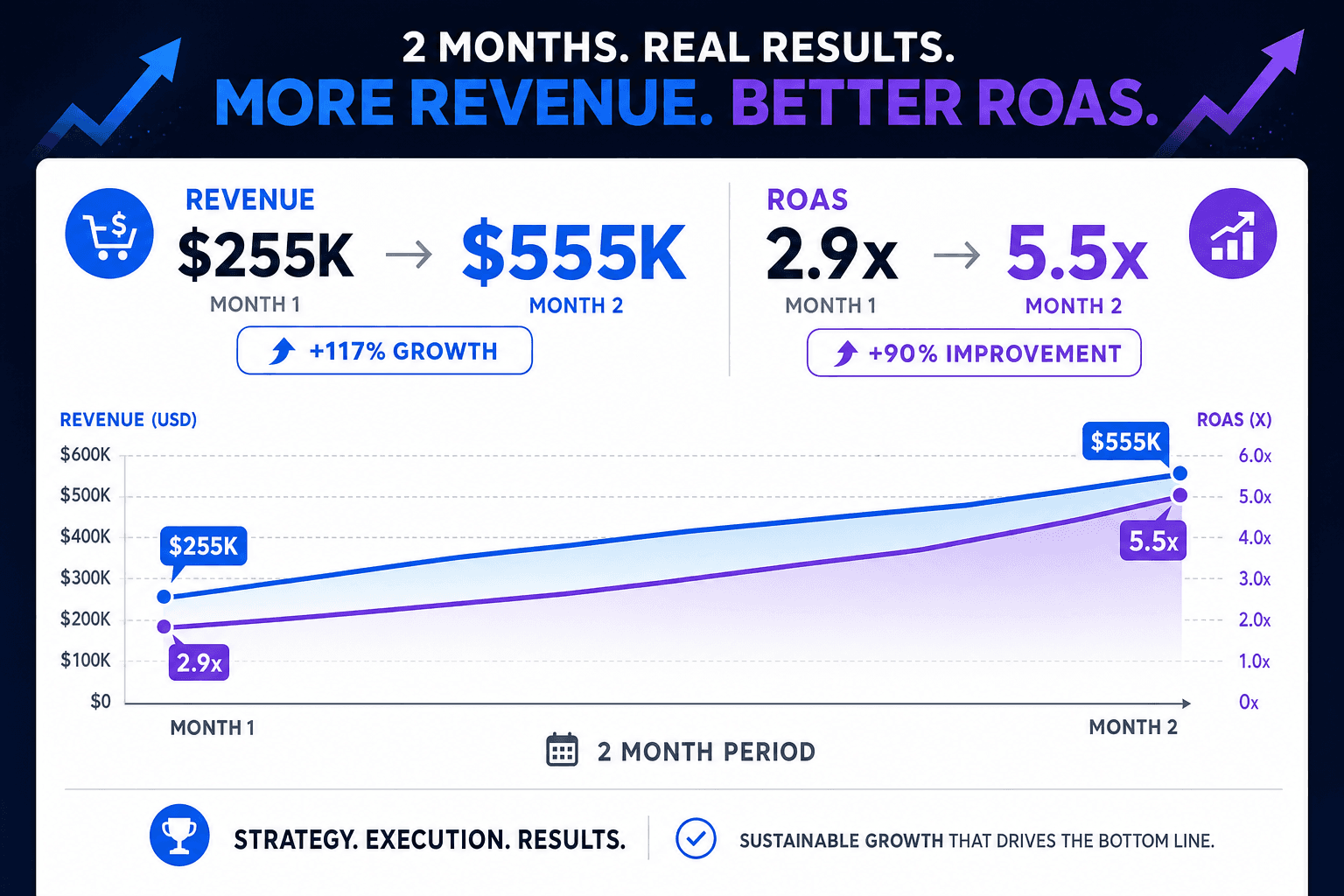
$255k → $555k in 2 months, ROAS 2.9x → 5.5x+
Nickel & Suede
Challenge
Nickel & Suede, an apparel and accessories brand, needed to scale revenue profitably on paid social.
What we did
We ran Meta and TikTok creative testing at volume. That testing discipline is what we would bring to your must-win SKUs before Q4.
Result
Revenue grew from $255k to $555k in two months. ROAS rose from 2.9x to 5.5x+, peaking at 7.95x, and site conversion lifted 34%.
- Revenue
- $255k → $555k (2 mo)
- ROAS
- 2.9x → 5.5x+ (peak 7.95x)
- Site conversion
- +34%
Own Peak Season: Build Your Toy Brand's Growth Plan
There's no obligation and no generic pitch deck. You'll leave with a specific read on your attribution, creative, and channel mix, plus where we see growth, even if we're not a fit.
Sagum · January 2017 · St. George, Utah · 8+ years