

8+ years growing brands on KPIs, now with AI
Rescue travel gear ROAS before your next peak
When ROAS slips and peak-season stock is already in the warehouse, we build the strategy that sells it through.
8+ years growing DTC brands · Google, Meta & TikTok partner · Performance-judged, not vanity-metric-reported


Get your free Growth Gap Analysis
Senior strategist review · response within one business day
Prefer to reach out directly?
The Challenge
Travel Gear Is a Different Marketing Problem Than Most DTC Categories
Your customer doesn't reorder a backpack every 90 days. They research for weeks, read every 1-star review on OutdoorGearLab, compare you to The North Face and Cotopaxi, then buy or abandon the cart because sizing felt like a gamble. Your paid media has to earn trust before the click converts, which most ecommerce playbooks aren't built for.
Two clocks run your business: the season and your inventory. Summer is your peak, BFCM is its own fiscal quarter, and January–February is a dead zone with cheap CPMs and no intent. If you've committed $200K to summer packs, you face a hard sell-through deadline while ROAS slips toward 2.5x and contribution margin disappears.
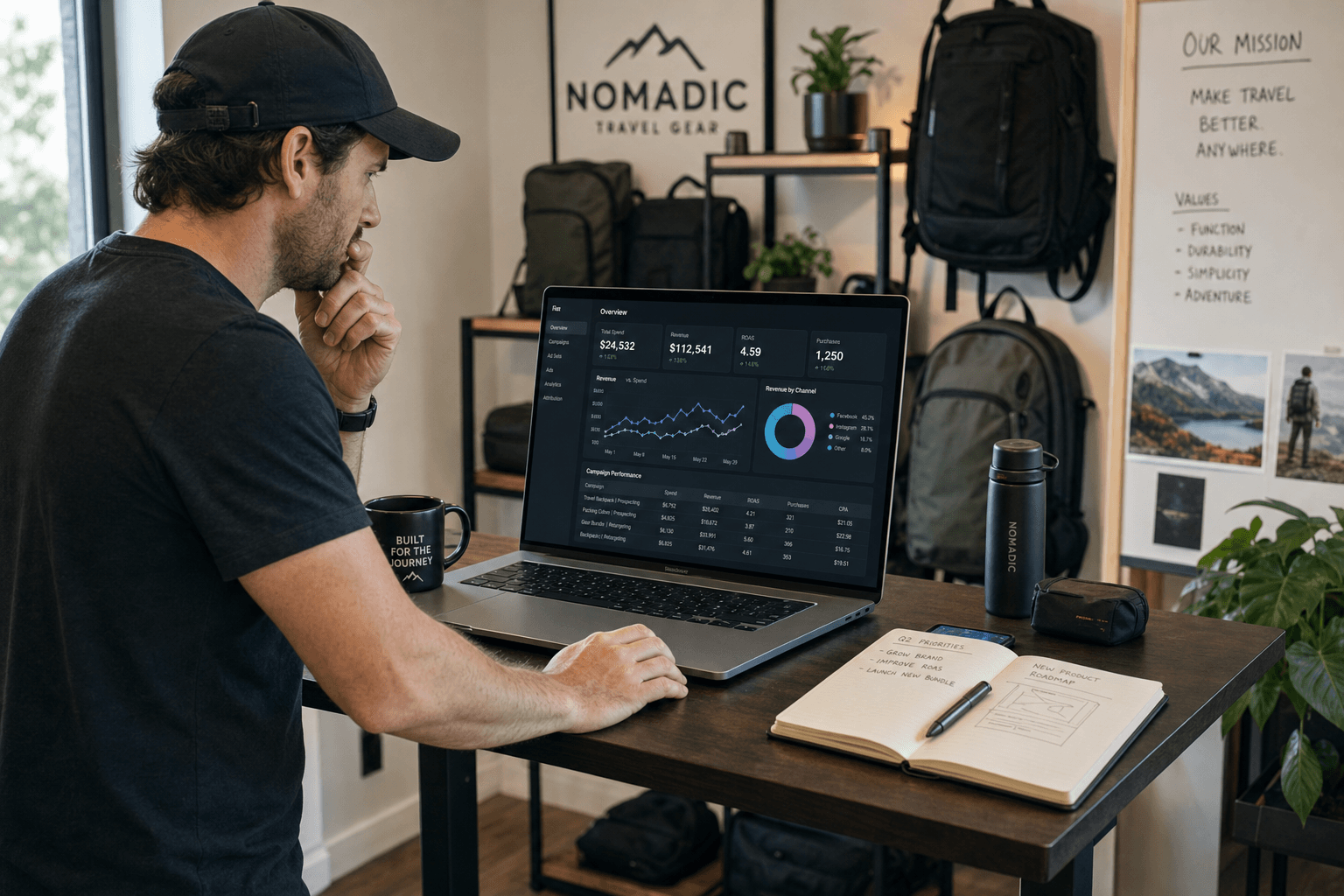
Creative fatigues faster than you can replace it: the UGC clip that drove a 4x ROAS in March is stale by May. You're managing a PMax campaign you don't fully trust and whitelisted creator content across three handles, while your blended ROAS (total revenue ÷ total ad spend) tells a different story than Meta's dashboard.
The Opportunity
Travel Gear Demand Is Real, and Most Brands Capture It Poorly
Travel gear averages around $126 per order, with premium SKUs (technical packs, outerwear, luggage) at $150–$300. That lets a well-run paid program support a $60–$80 new-customer CAC (nCAC) and a profitable 12-month LTV, especially with cross-sell catalog depth. Over half of sports and outdoor equipment dollars go online as the shift from specialty retail accelerates.
Google Shopping and PMax close high-intent buyers who find your product before Osprey's, Meta and TikTok build the consideration that sends them searching, and most brands underfund email and SMS relative to their return. Winners run all three without cannibalization, with the tightest loop between creative testing, attribution, and inventory pacing.
Most competitors run the same three six-month-old creatives, trust platform ROAS over blended ROAS, and leave email on an untouched launch drip. Brands building before the category matures will own it in three years.
What Most Get Wrong
What Most Travel Gear Brands and Their Agencies Get Wrong
Trusting platform ROAS instead of blended ROAS
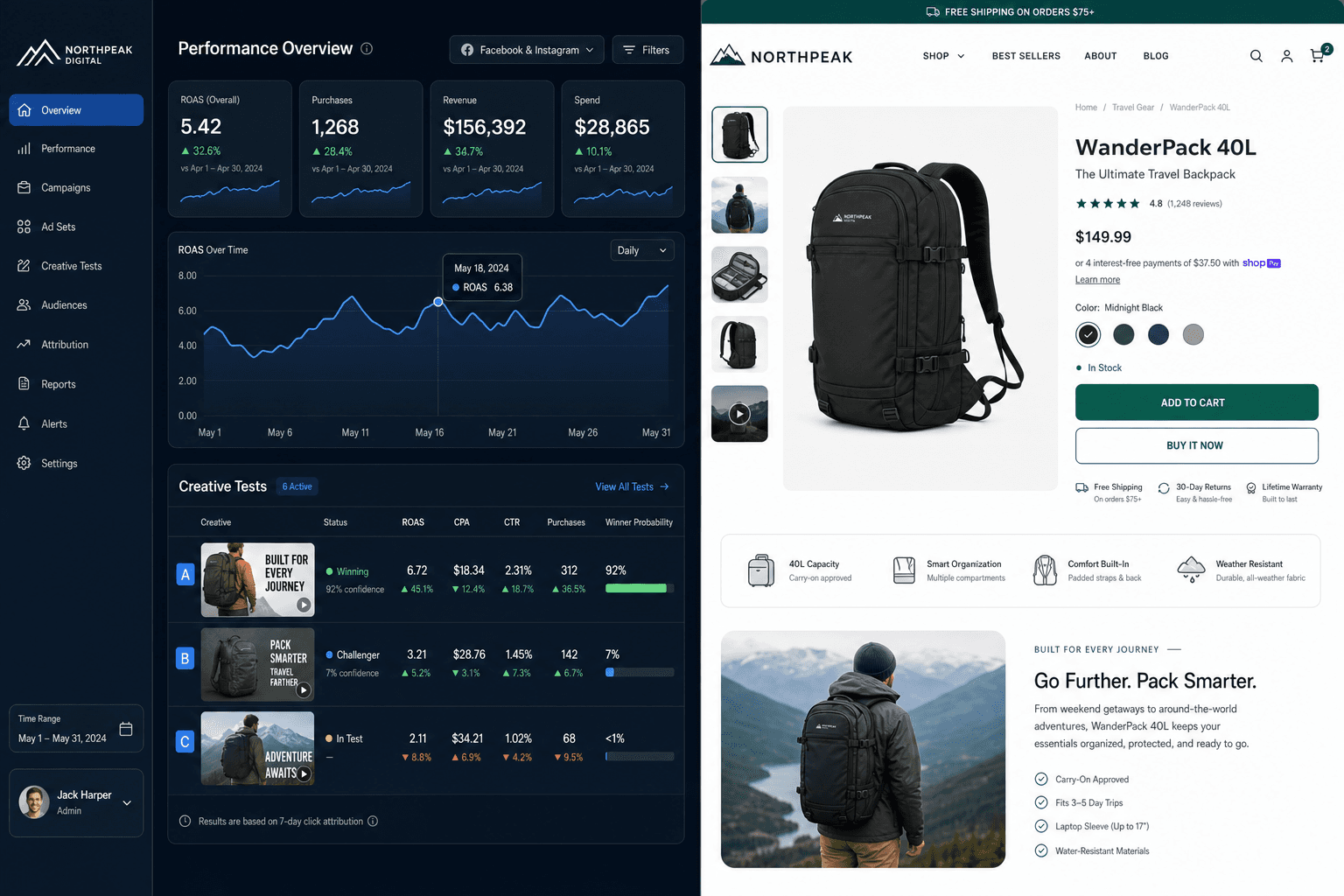
Meta says 4.2x, Google 5.1x, blended ROAS 2.3x: the gap is usually view-through attribution counting one sale twice. Founders scaling on platform numbers find margin compression in their bank account.
Running the same creative until it dies
Fatigue silently kills ROAS: a winning UGC clip lasts only weeks. Brands testing one or two new concepts per month chase yesterday's performance and see the drop after CPMs rise.
Flat ad spend all year
Matching February's spend to June's burns money in the January–February dead zone and leaves you underspent when conversion rates peak.
Spending 90% of the marketing budget on paid acquisition
Email alone returns about $36 per $1 spent (Litmus), yet most travel gear founders haven't touched their welcome sequence in a year. Every lost customer means another paid acquisition.
Agencies using beauty or apparel playbooks on considered purchases
A $189 backpack isn't a $29 skincare replenishment. Agencies chasing 90-second impulses with video hooks, flash sales, and aggressive retargeting misfire on buyers comparing reviews and specs for 1–3 weeks.
Why Now
Travel Gear Brands Win by Building Before Each Peak Season
Travel gear is in structural transition: a growing share of buyers weigh a brand's environmental practices, resale and rental are expanding and competing for the same wallet, and tariff-driven price worries have many consumers delaying discretionary purchases, gear included. The survivors will be brands with the tightest customer relationships and most efficient acquisition.
AI lets a two-person team test 5–8 creative concepts a week instead of 1–2 a month, catch attribution errors inflating platform numbers, and trigger email from real-time browsing as well as purchase history.
Your peak-season inventory is already bought. Brands that build paid, owned, and creative infrastructure before summer or BFCM demand arrives sell through profitably; the rest run 40%-off clearance after the peak. The build window before CPMs spike is shorter than most teams plan.
The Mechanism
Where AI Gives Travel Gear Brands a Real Edge
Real productivity, not AI theater. Here's where it actually moves a number for travel gear brands.
Creative
What AI does: AI finds which visuals, hooks, and copy angles drive performance in your UGC library, then writes structured briefs for new creator content from what converts.
The result: You go from 1–2 new concepts per month to 5–8 per week and stay ahead of fatigue.
Why it matters here: Your March UGC winner is stale by May, and platforms give fresh, high-engagement content lower CPMs, so travel gear brands that iterate faster pull ahead.
Analytics
What AI does: AI attribution modeling reconciles platform-reported ROAS against blended ROAS, flags view-through overlap between Meta and Google, and surfaces your true nCAC.
The result: You know within 48 hours whether a campaign drives real revenue or claims credit for sales that would have happened anyway.
Why it matters here: With a 50% gross margin on a $189 backpack, a 0.5x ROAS misread at scale separates a profitable quarter from a cash flow problem.
Digital Ads
What AI does: AI shifts budget in real time across Google Shopping, PMax, and Meta toward the campaigns and audiences that are converting, without waiting for a weekly review.
The result: Budget follows demand instead of a static monthly plan.
Why it matters here: The gap between a 3.2x and a 4.1x blended ROAS often comes down to budget timing across the spring ramp, June peak, and BFCM window.
What AI does: AI-built flows trigger on browse behavior, category viewed, and time since purchase, with post-purchase cross-sell timed to the 6–18 month gear repurchase window and tied to what the customer already owns.
The result: Email, DTC's most profitable channel, runs without manual intervention and captures LTV from customers you've already paid to acquire.
Why it matters here: Gear LTV plays out over 12–24 months, not 30 days. A pack buyer is a candidate for a stuff sack, rain cover, or travel jacket.
Conversion Optimization
What AI does: AI checks product pages against conversion benchmarks for high-AOV considered purchases, finds where sizing uncertainty and durability objections drive abandonment, and suggests copy, social proof, and UX fixes.
The result: At meaningful traffic, a 1–2 point conversion gain on a $150 AOV often beats an equal ad budget increase, lifting ROAS without more spend.
Why it matters here: Online cart abandonment averages about 70% (Baymard), and in gear, sizing anxiety and 'is this brand legit' hesitation are primary drivers.
Ready to see what this looks like for your travel gear brands business?
No obligation. A senior strategist will show you exactly where the wins are.
The Strategy
How to Run Paid, Owned, and Creative for a Travel Gear Brand
Judge every channel, budget, and creative decision by whether it moves blended ROAS at a contribution margin that sustains the business.
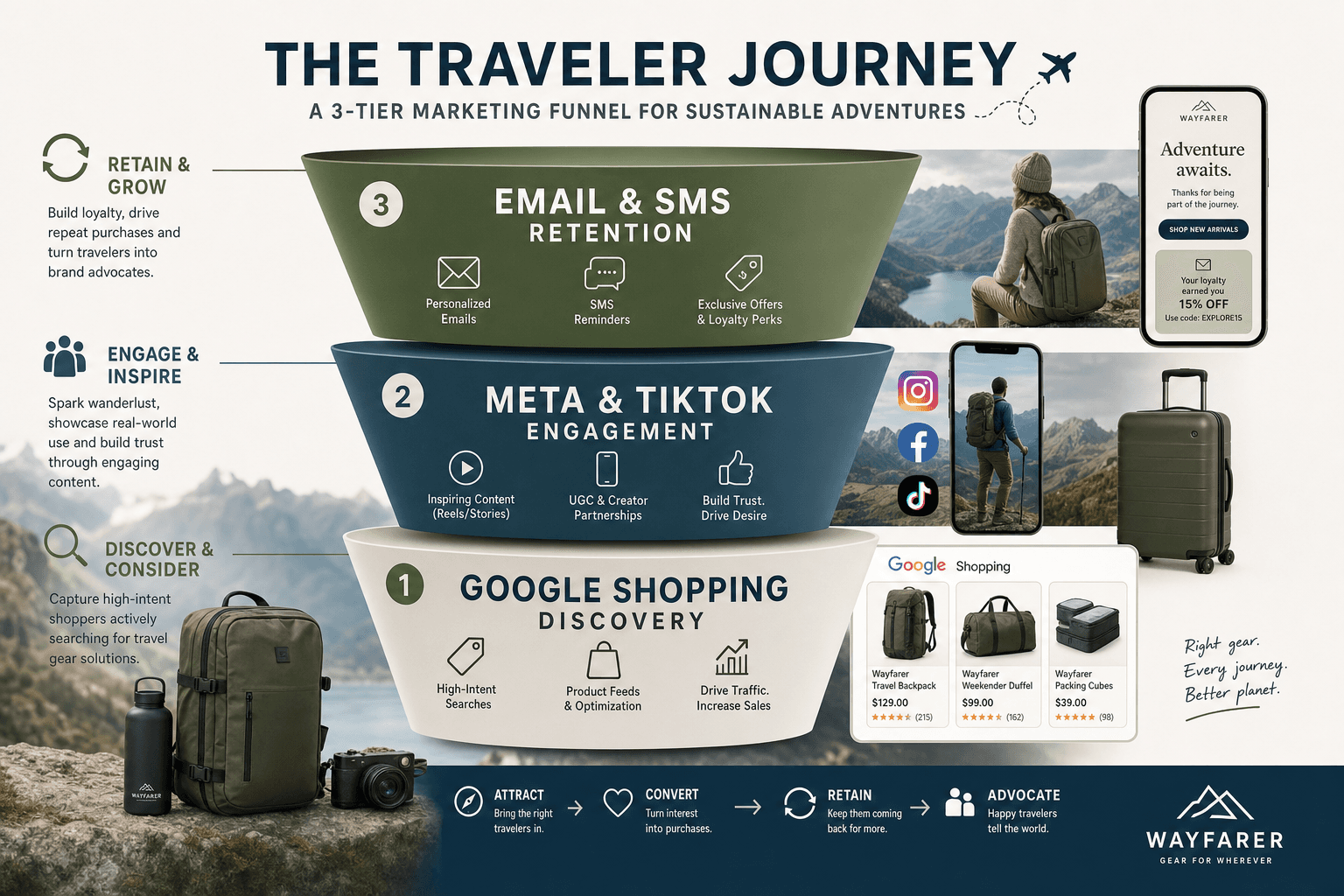
Run three layers. Google Shopping and PMax, structured around your highest-margin SKUs rather than your highest-volume ones, close buyers already searching for what you sell. Meta and TikTok work the mid and upper funnel, where UGC-style creative whitelisted through creator handles builds the consideration that drives those searches.
The third layer is email and SMS, your owned retention engine, sequenced to the gear repurchase and cross-sell window.
Pace budget to the seasonal calendar: test creative and build your list at low CPMs in January–February, ramp through March–May, then scale and manage sell-through in June–August. Plan BFCM as a separate campaign with its own creative, offer structure, and budget.
Fix attribution before you scale, so every budget call rests on blended ROAS and your real nCAC and payback period.
The one number that governs this
The governing KPI is blended ROAS, with nCAC as the secondary metric that sets how aggressively you can scale.
How We Help
What We'd Do for Your Travel Gear Brand
We'd fix attribution first, because that's where the money leaks, then run each layer of the strategy above, plus the creative and conversion work that feeds it.
Analytics & Attribution Audit
Reconcile platform ROAS with blended ROAS, find Meta and Google view-through overlap, and make nCAC and contribution margin your source of truth before budget decisions.
Paid Media: Google Shopping & PMax
Restructure Shopping and PMax around your highest-margin SKUs and ready-to-buy, high-intent queries, with budget paced to the seasonal calendar.
Paid Media: Meta & TikTok
Test 5–8 UGC-style concepts per week via whitelisted creator handles where appropriate, prospect from best-customer profiles, and time retargeting to the 1–3 week deliberation cycle.
Creative Strategy & Production Briefs
Analyze your creative library with AI and write structured creator briefs, so new content replaces each winner before fatigue shows up in ROAS.
Email & SMS Automation
Build browse- and category-triggered flows, post-purchase sequences timed to the gear repurchase window, and cross-sell to related catalog products.
Conversion Optimization
Review pages against high-AOV benchmarks, answer sizing and durability objections in copy and social proof, and lift conversion before we ask for more budget.
Who's Behind This
Who we are, and what makes us different
Sagum is a performance marketing agency founded in January 2017 in St. George, Utah. We've spent 8+ years growing real brands and being judged on KPIs, not vanity metrics.
We deliberately limit how many clients we take so each one gets senior attention. We treat your numbers like our own, we never run generic playbooks, and your strategy is built for your business, because shouldn't your brand's marketing be custom to your brand?
Sagum.ai is our AI arm: the same proven operators now build AI into the work wherever it creates real edge, not as theater, but as leverage applied with discipline.
- 8+ years growing brands on performance KPIs, not vanity metrics
- Limited client roster, with senior attention on every account
- An extension of your team; your success is tied to ours
- Custom strategy per brand, never a generic playbook
- AI built in where it moves a number; judgment over hype
“Sagum is a performance marketing agency that's spent 8+ years growing brands by treating their numbers like our own. We take on few clients, never run generic playbooks, and now build AI into the work wherever it creates real edge, not hype. Your strategy is built for your business, and our success is tied to yours.”

“Sagum roughly doubled our bottom line. They treat the work like it's their own business.”
Rachel Nilsson
CEO, RAGS
Proof
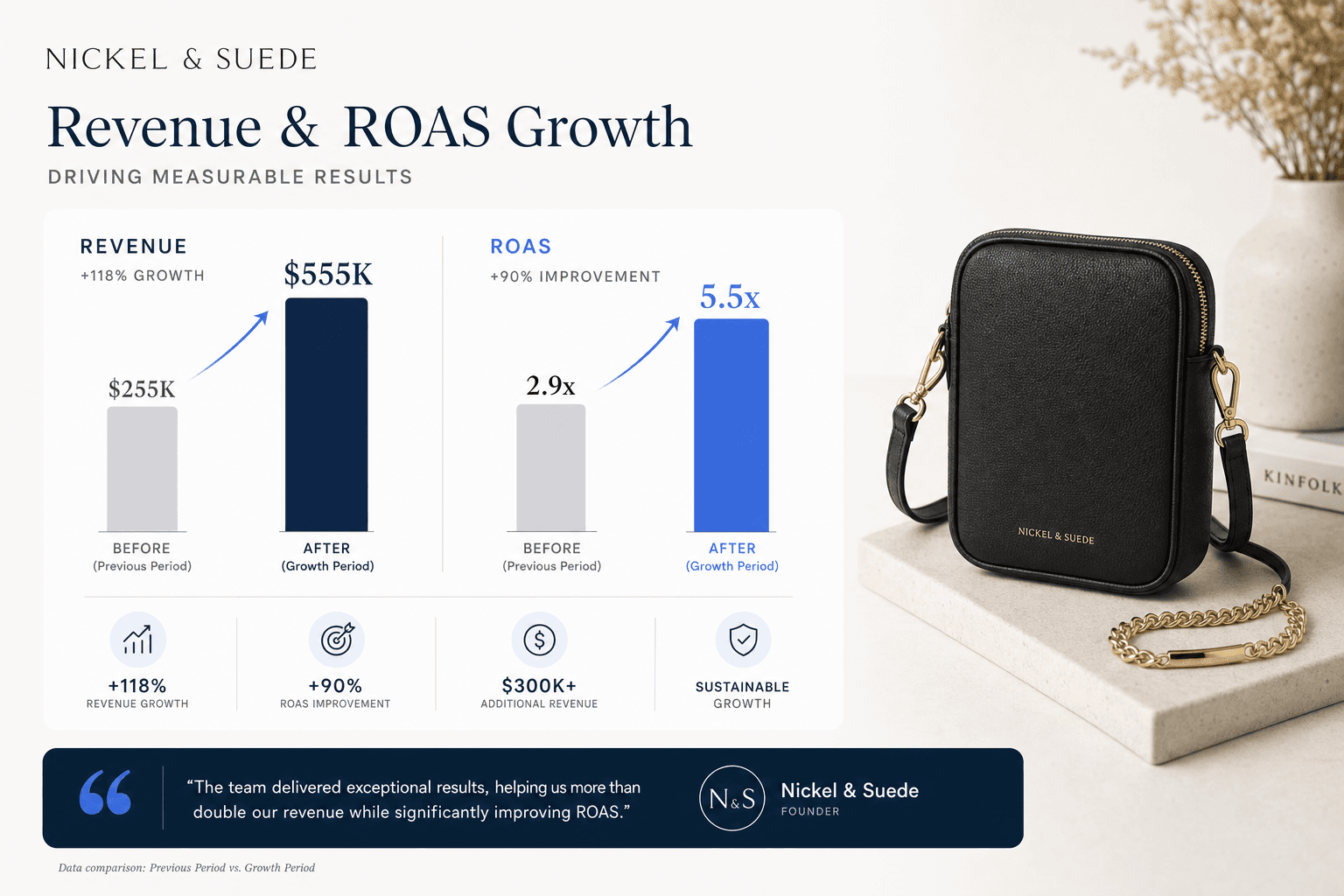
$255k → $555k in 2 months, ROAS 2.9x → 5.5x+
Nickel & Suede
Challenge
Nickel & Suede, an apparel and accessories brand, needed to scale revenue profitably on paid social, the same pressure travel gear brands face on high-AOV products.
What we did
We ran Meta and TikTok creative testing at volume.
Result
Revenue went from $255K to $555K in two months, ROAS rose from 2.9x to 5.5x+ (peaking at 7.95x), and site conversion rate improved 34%. That testing discipline transfers to high-AOV travel gear.
- Revenue
- $255k → $555k (2 mo)
- ROAS
- 2.9x → 5.5x+ (peak 7.95x)
- Site conversion
- +34%
Your Peak-Season Inventory Is Committed. Let's Sell It Through Profitably.
No obligation. You get one conversation built around your blended ROAS, nCAC, and the seasonal calendar you're working against. We take on few clients and will tell you if we're not the right fit.
Sagum · January 2017 · St. George, Utah · 8+ years