

8+ years growing brands on KPIs, now with AI
Grow Your Walmart Marketplace Sales
We build the TACoS flywheel that turns Walmart Connect spend into compounding organic rank and real GMV growth.
Google Ads · Meta · TikTok partner · 8+ years performance marketing · Walmart Connect specialists


Get your free Growth Gap Analysis
Senior strategist review · response within one business day
Prefer to reach out directly?
The Challenge
Walmart Marketplace Isn't Amazon With a Blue Logo
You already know bid strategy, keyword harvesting, and the patience organic rank needs. Little of that Amazon playbook ports cleanly to Walmart. Walmart Connect's second-price auction (you pay just above the second-highest bid) makes Amazon-style overbidding wasteful. Walmart Connect CPCs run 30–50% below Amazon's for comparable intent, yet most sellers under-invest early and starve the conversion signal that lifts organic rank.
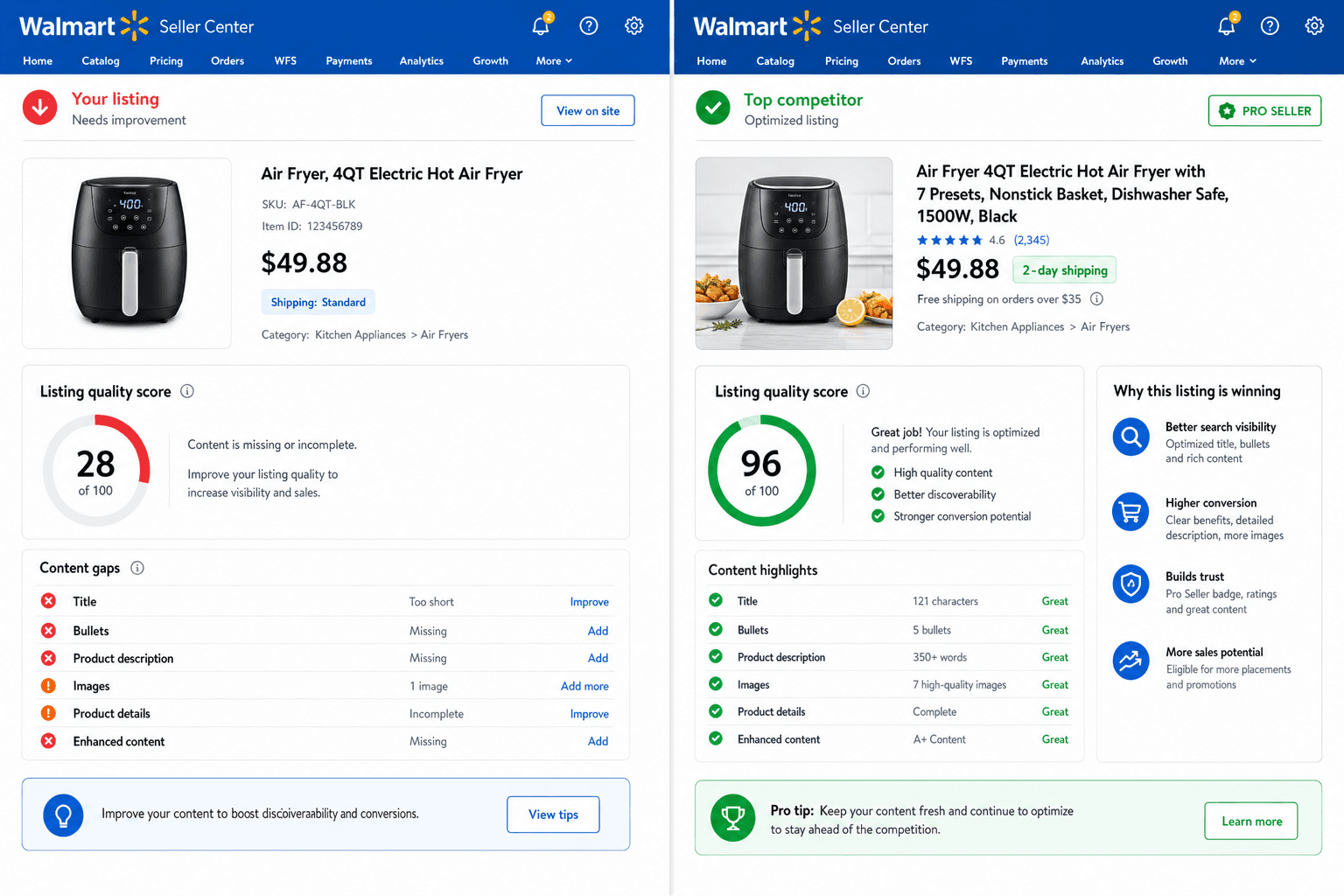
Content Quality Score (CQS) weights titles, descriptions, and images at 60% of the total. Amazon copy-paste misses Walmart-specific attributes and merchandising fields. Walmart favors brand-owner content, so resellers can't fix conversion-killing gaps on listings they don't control.
Price a SKU a dollar above its Amazon price and Walmart flags it non-competitive, demoting it in search. Without automated repricing, top SKUs lose the Buy Box and you notice only when GMV drops.
The Pro Seller badge, whose holders convert at 1.7x the average Marketplace seller's rate, refreshes on the 5th and 20th of each month. Miss the on-time delivery or cancellation threshold and it lapses mid-cycle with no alert.
The Opportunity
Walmart Ads Are Still Underpriced, but Not for Long
Walmart Marketplace crossed 200,000 active sellers in mid-2025 (44,000 joined in the first five months of 2025), yet its ad layer stays uncrowded and cheap: most sellers don't advertise, advertise without Walmart Fulfillment Services (WFS), or treat Walmart Connect as a side channel.
Walmart's ads-to-organic flywheel is earlier-stage than Amazon's. Build it correctly while Walmart CPCs trail Amazon's, and competitors pay more to challenge your positions.
Most sellers leave new-to-brand demand unclaimed: advertisers adding Sponsored Brands and Videos to Sponsored Products grew new-to-brand sales 135% year-over-year in 2024–25, and new-to-brand buyers placed 69% of Sponsored Brands orders.
WFS is the accelerant: 2-day shipping badges, a 50% higher Buy Box win rate, and 15–30% higher conversion than seller-fulfilled items. Sellers who pair WFS with properly funded Walmart Connect campaigns are the ones compounding. Everyone else pays for clicks that don't convert.
What Most Get Wrong
What Most Walmart Sellers and Their Agencies Get Wrong
Treating TACoS like ACoS and optimizing too tight, too early
Chasing sub-5% TACoS in the ramp phase starves the conversion signal Walmart needs to build organic rank, so the channel never scales.
Running ads on listings with a CQS below 80
Buying clicks on a 65-score listing means paying Walmart Connect to show your weakest content: clicks rise, conversion doesn't. Raising scores from 70 to 90 lifts conversion 13% on average.
No automated repricing across the catalog
Walmart continuously checks prices against Amazon, eBay, and your site, and one overpriced SKU loses rank and the Buy Box, with no notification, before a manual audit catches it.
Ignoring WFS for SKUs where the math works
WFS fees start at $3.45/unit. Skipping WFS where that fee is absorbable forfeits its 2-day badge, Buy Box lift, and conversion gains, and misses Pro Seller thresholds tied to shipping.
Managing ads and listing quality as separate workstreams
Walmart Connect performance and Content Quality Score depend on each other, so an agency that runs ads but ignores content, pricing, and fulfillment leaves three levers unmanaged.
Why Now
Walmart Connect Is Catching Up to Amazon, and Its CPCs Will Too
Walmart Connect is maturing fast: Sponsored Videos launched, Sponsored Brands are scaling, and Walmart's AI advertising assistant, Marty, debuted in beta for Sponsored Search with conversational bidding and keyword recommendations. As Walmart Connect adds the tools Amazon sellers know, its CPC gap with Amazon will narrow.
A brand with structured Sponsored Products campaigns, WFS-backed listings, a CQS above 90, and automated repricing competes in a different tier than most Marketplace sellers. That edge is cheapest to build while Walmart CPCs trail Amazon's.
In a second-price auction, tight match types and high-converting listings outperform a bigger broad-match budget. That is a skill advantage that compresses as sophisticated operators arrive. Build the TACoS flywheel now, investing through the ramp and optimizing down later, or pay Amazon-level CPCs once Walmart Connect catches up.
The Mechanism
Where AI Gives Walmart Sellers an Edge
Real productivity, not AI theater. Here's where it actually moves a number for walmart marketplace sellers.
Digital Ads (Walmart Connect)
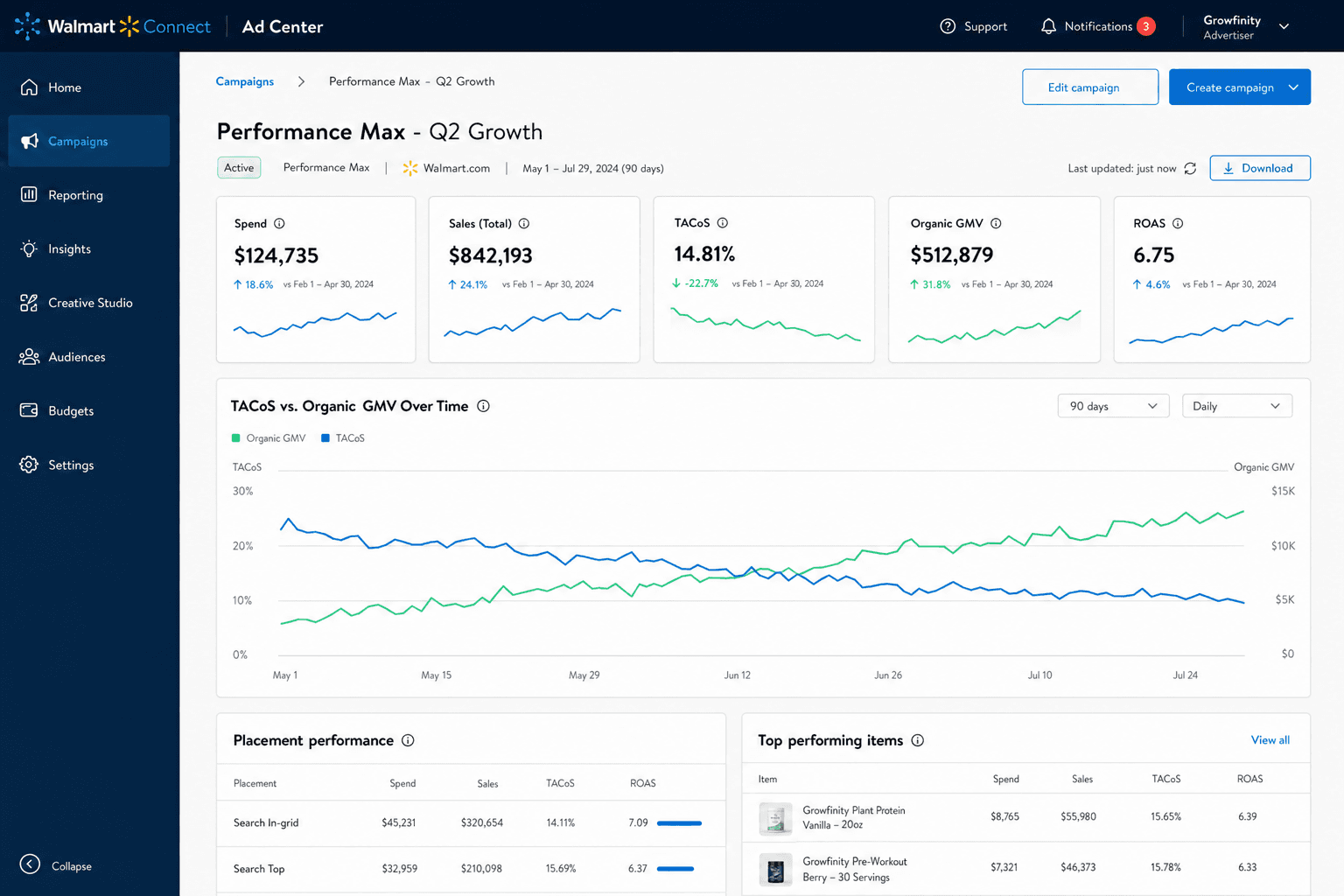
What AI does: AI extends Walmart's dynamic bidding (up to +100% when conversion is likely), shifting bids and budget across all three ad formats toward keywords and placements that drive GMV, not only ad-attributed clicks.
The result: TACoS trends down as organic rank compounds.
Why it matters here: In-grid position 1 gets 6x the add-to-cart rate of positions 2–10. Slipping to 3 is often a bid fix AI catches in hours, not weekly.
Analytics & Attribution
What AI does: AI reconciles Ad Center ROAS with Seller Center GMV across the 14-day attribution window, flags gaps between sponsored and organic revenue, and shows which SKUs' spend builds rank or buys unconverted clicks.
The result: You get Walmart channel ROAS and TACoS you can trust, feeding blended ROAS, plus a signal when the listing, not the bid, is at fault.
Why it matters here: Walmart's closed-loop first-party measurement is opaque, so operators who can't reconcile Ad Center with Seller Center set budgets by whichever number looks better.
Creative
What AI does: AI generates and tests multiple angles for Sponsored Brands and Sponsored Videos at once (hero images, headline constructions, benefit framings) to find the message that drives new-to-brand conversion.
The result: You find the winning creative sooner, instead of guessing with one creative per quarter.
Why it matters here: Walmart's Sponsored Brands format is newer and less saturated than Amazon's, so brands testing now set the category's visual and messaging anchors before it commoditizes.
Conversion Optimization (Listing Quality)
What AI does: AI audits CQS catalog-wide, finds the gaps holding scores below 90 (missing secondary images, thin descriptions, absent Walmart-specific attributes), and ranks fixes by revenue impact.
The result: Your listings convert the traffic your ads buy.
Why it matters here: On a SKU doing $50k/month in GMV, the 13% average lift from a 70-to-90 score adds $6,500/month from content work alone, before raising ad spend.
SEO (Walmart Organic Search)
What AI does: AI mines Walmart's Search Insights dashboard (keyword gaps, search funnel rank, sales rank by item) for the organic keywords your paid campaigns should seed with conversion signals.
The result: Paid campaigns build organic rank you keep after TACoS optimizes down.
Why it matters here: Walmart's ads-to-organic flywheel is earlier-stage than Amazon's, so rank you build now by coordinating paid and organic keywords is cheaper to defend than to attack.
Ready to see what this looks like for your walmart marketplace sellers business?
No obligation. A senior strategist will show you exactly where the wins are.
The Strategy
How to Run Walmart Marketplace Marketing
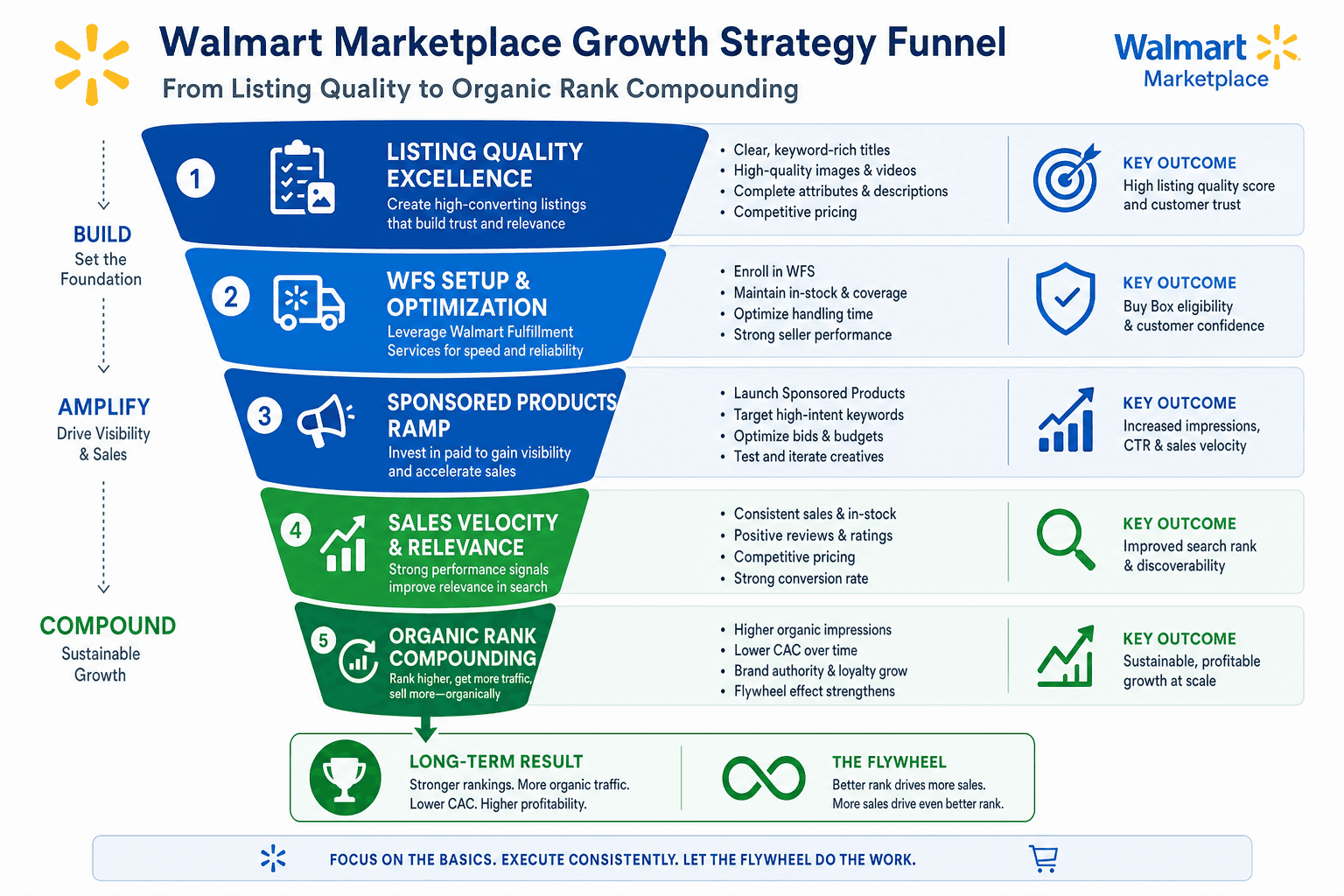
Run ads, listings, fulfillment, and pricing as one system. Phase one builds the foundation before Walmart Connect budget scales. Get CQS above 90 on top-revenue SKUs and use WFS wherever the $3.45/unit fee is absorbable, since Pro Seller metrics hold only with WFS's shipping badge and Buy Box lift.
Automate repricing with min/max floors that keep Walmart at parity with or slightly below Amazon, and review the Pro Seller dashboard after each refresh on the 5th and 20th of the month.
Phase two is the ramp. Build Sponsored Products campaigns for listings at CQS 80 or higher, on high-intent keyword clusters from Search Insights rather than imported Amazon lists. Bid to hold in-grid position 1 on top converters, and budget TACoS at 15–20% to buy conversion signals that build organic rank.
Phase three is the flywheel. As organic rank and unsponsored GMV grow, TACoS optimizes toward 10–12% without cutting spend. Sponsored Brands and Videos layer in for new-to-brand buyers, and continuous creative testing keeps you from defending one ad against a competitor testing five.
Campaign-level ACoS shows whether each keyword group pays for itself. TACoS (Walmart ad spend over total Walmart sales) and blended ROAS (total revenue over total ad spend, all channels) must improve alongside Seller Center GMV.
The one number that governs this
Blended ROAS across all your channels governs the business. Walmart TACoS (15–20% in ramp, 10–12% later) sets channel efficiency. Seller Center GMV confirms the flywheel.
How We Help
What We'd Do for Your Walmart Catalog
We build the foundation that makes ad spend work before scaling Walmart Connect budget, then run the flywheel.
Walmart Connect Campaign Management (Sponsored Products, Sponsored Brands, Sponsored Videos)
Builds the full ad stack with top-of-search bids on high converters, ramp-phase TACoS targets, and keyword harvesting from Search Insights.
Listing Quality & Content Quality Score Optimization
Audits CQS catalog-wide and fixes attribute gaps in order of revenue impact, so ad spend lands on listings that convert.
WFS Enrollment & Fulfillment Strategy
Runs per-SKU WFS math, enrolls SKUs where it pays off, and manages inventory and restocks in WFS Action Center, since fulfillment gates Pro Seller status.
Repricing & Buy Box Management
Sets automated repricing with min/max price floors and checks Buy Box win rate weekly, so a weak price competitiveness score doesn't demote top SKUs.
Analytics & Attribution (Blended ROAS and TACoS Reconciliation)
Reconciles Ad Center and Seller Center data into trustworthy Walmart TACoS and channel ROAS, rolled into blended ROAS, showing which SKUs' spend builds rank.
Creative Testing (Sponsored Brands and Video)
Tests multiple angles weekly across Sponsored Brands and Sponsored Videos to find the new-to-brand message before a competitor with one static creative stumbles on it.
Pro Seller Badge Monitoring & Eligibility Management
Tracks on-time delivery, cancellation rate, and price competitiveness score each refresh cycle, flagging risks before you lose the badge's 1.7x conversion advantage.
Who's Behind This
Who we are, and what makes us different
Sagum is a performance marketing agency founded in January 2017 in St. George, Utah. We've spent 8+ years growing real brands and being judged on KPIs, not vanity metrics.
We deliberately limit how many clients we take so each one gets senior attention. We treat your numbers like our own, we never run generic playbooks, and your strategy is built for your business, because shouldn't your brand's marketing be custom to your brand?
Sagum.ai is our AI arm: the same proven operators now build AI into the work wherever it creates real edge, not as theater, but as leverage applied with discipline.
- 8+ years growing brands on performance KPIs, not vanity metrics
- Limited client roster, with senior attention on every account
- An extension of your team; your success is tied to ours
- Custom strategy per brand, never a generic playbook
- AI built in where it moves a number; judgment over hype
“Sagum is a performance marketing agency that's spent 8+ years growing brands by treating their numbers like our own. We take on few clients, never run generic playbooks, and now build AI into the work wherever it creates real edge, not hype. Your strategy is built for your business, and our success is tied to yours.”
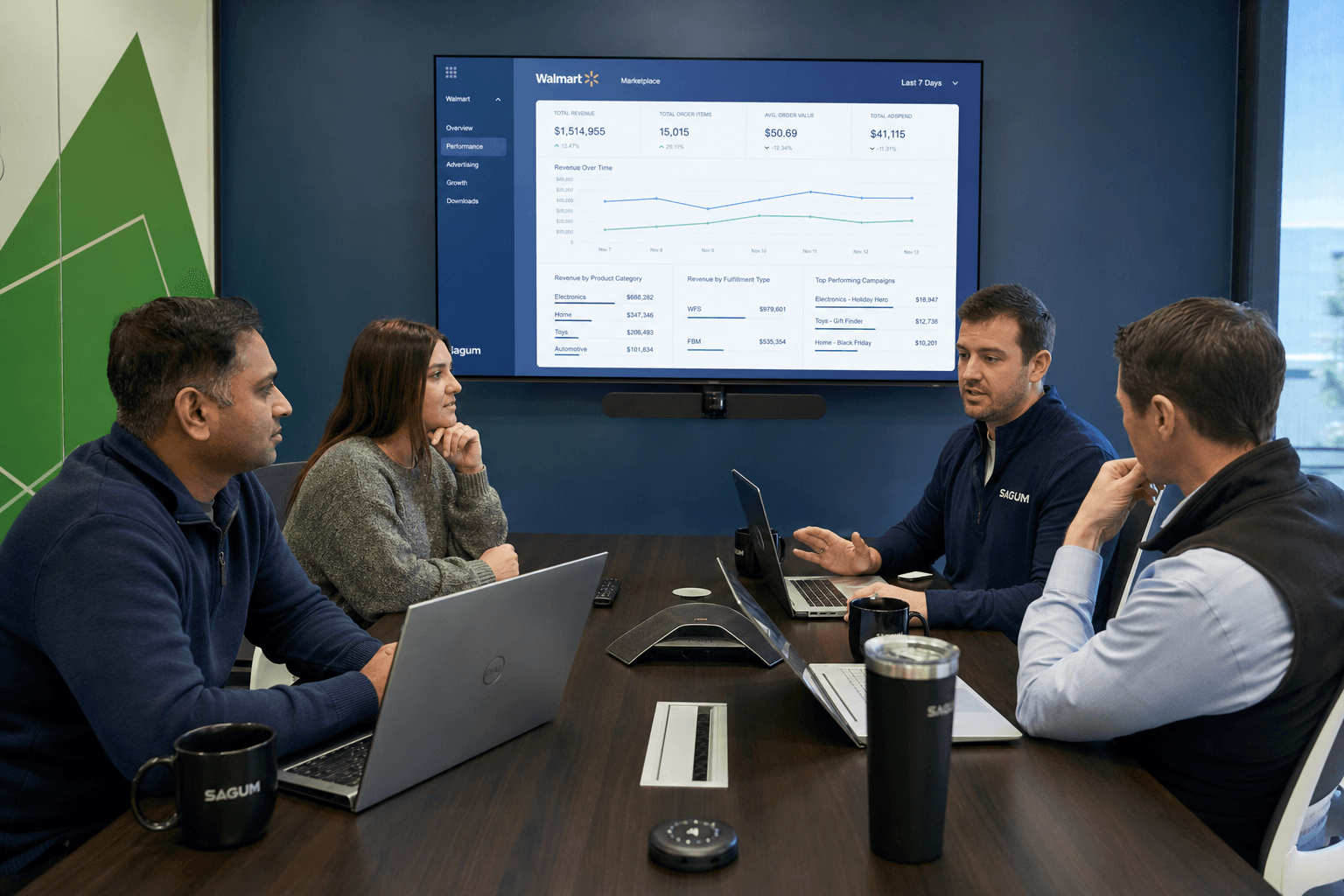
“After six years, Sagum is our most important partner: trusted, communicative, and caring about our business as if it's their own.”
Long-term partner
6-year client
Proof
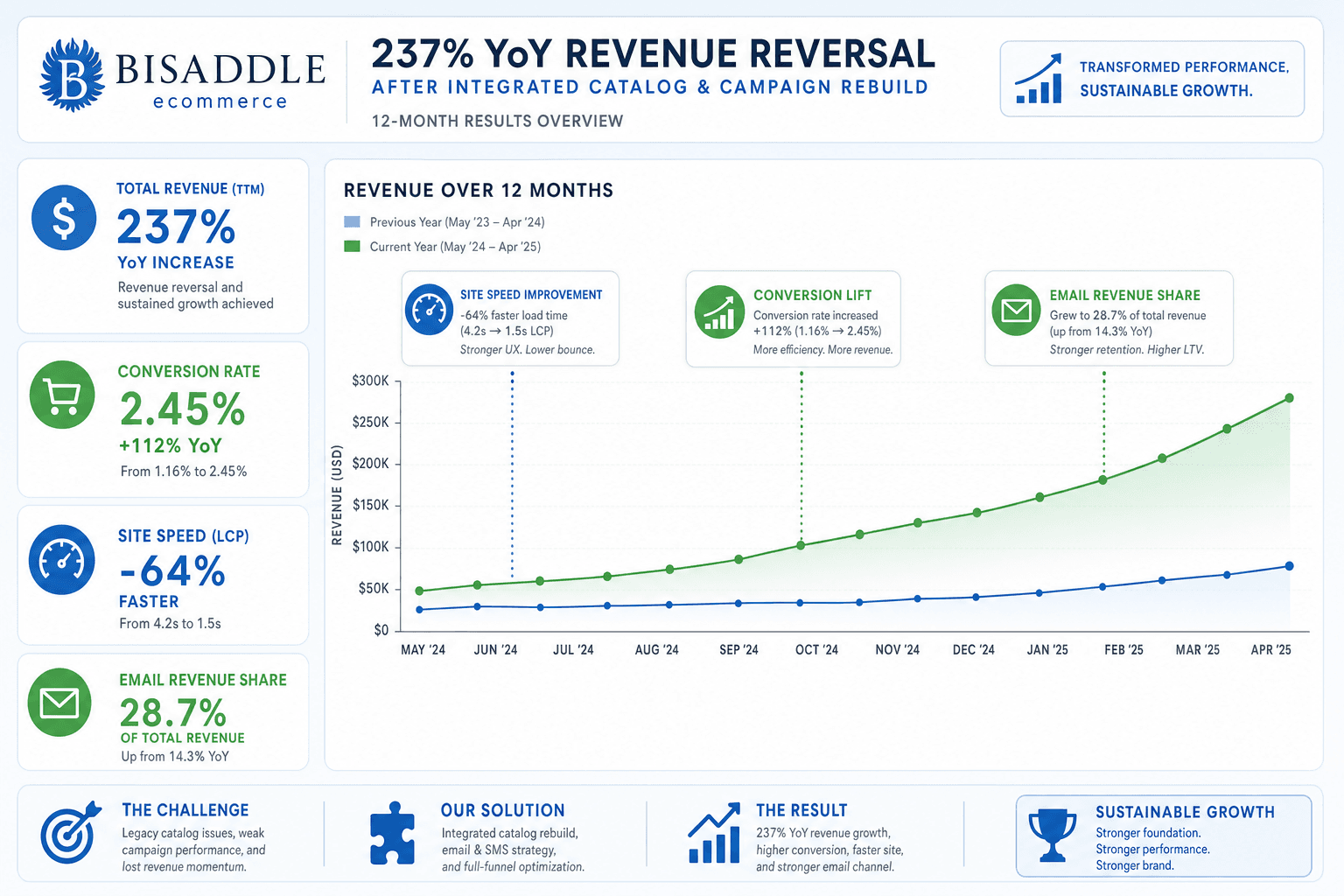
Reversed 3 years of decline to 237% YoY
Bisaddle
Challenge
Bisaddle faced three years of decline, the kind of slide Walmart sellers risk when weak listings waste the traffic their ads buy.
What we did
We redesigned the site, doubling its speed, and grew email.
Result
Bisaddle reversed its decline to reach 237% YoY. The redesign lifted conversion 122%, and email grew to 48% of revenue. On Walmart, we'd apply the same conversion-first discipline to your listings before scaling ads.
Let's Build Your Walmart TACoS Flywheel
No obligation. We'll audit your Walmart Connect campaigns, Content Quality Scores, and Buy Box health against your catalog, margins, and growth targets, and show you where the flywheel leaks.
Sagum · January 2017 · St. George, Utah · 8+ years