

8+ years growing brands on KPIs, now with AI
Womenswear marketing built on contribution margin
We engineer paid media, creative, and email around 60-day CAC payback and ads that don't die in a week.
8+ years growing ecommerce brands · Google Ads, Meta & TikTok partners · Performance-judged, never on vanity metrics


Get your free Growth Gap Analysis
Senior strategist review · response within one business day
Prefer to reach out directly?
The Challenge
Womenswear DTC Is a Different Problem Than Standard Ecommerce
You sell identity, fit, and timing to a buyer who found you on Instagram, has seventeen other tabs open, and returns the dress if it photographs differently than imagined. Fashion ecommerce returns average 30–40%, so ROAS that ignores them can hide a loss.
A womenswear ad working today is fatiguing by Thursday: frequency passes 3.0 and performance collapses. Without new angles, you burn budget on dead creative or pause mid-season; most brands have only a media buyer asking for content when things break.
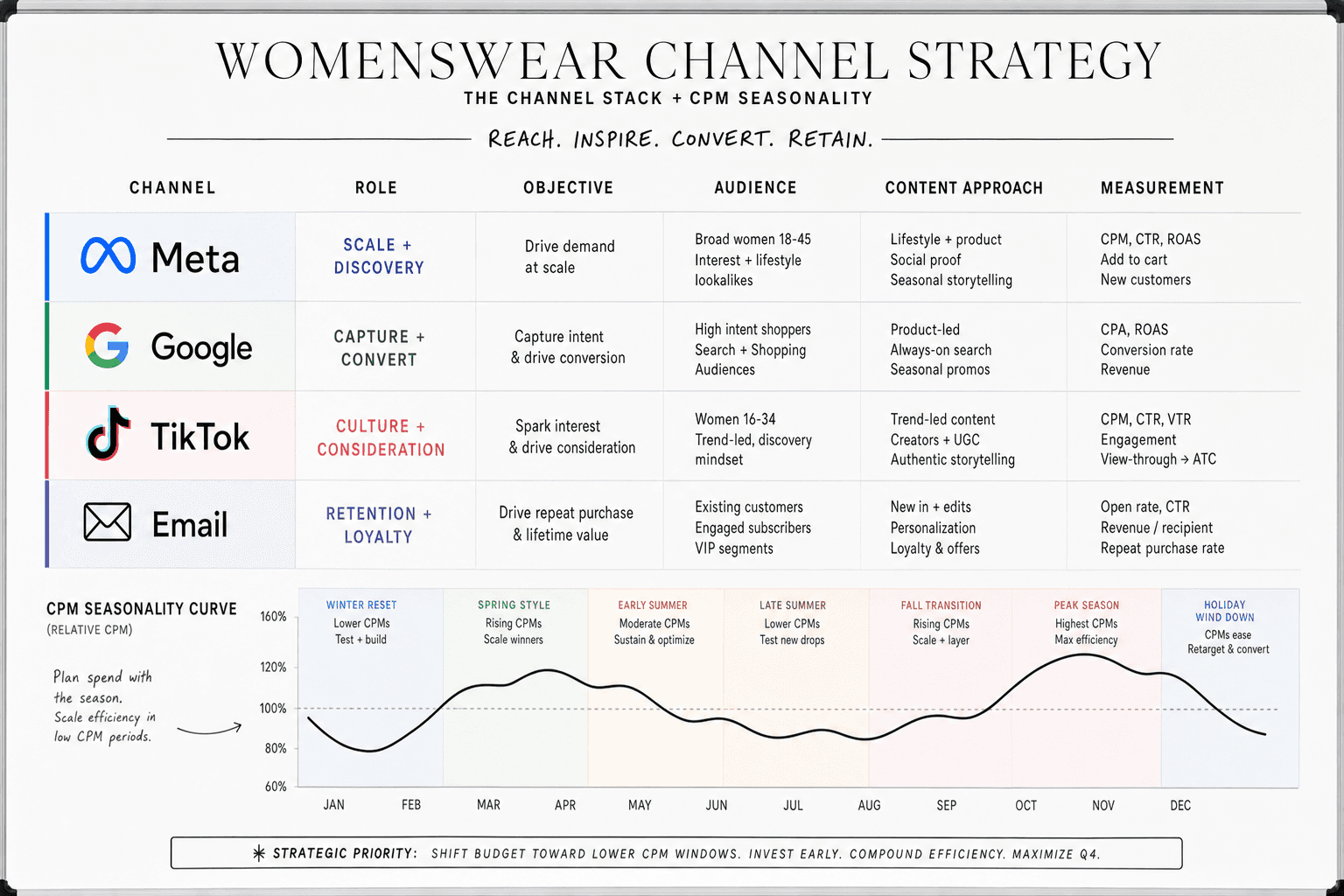
November and December CPMs run roughly 41% and 35% above the annual average, yet Q4 brings about 42% of annual ecommerce revenue; miss it or enter with untested creative and lose the year. Most brands write off January, when CPMs run 22% below average.
Most of your customers buy once; fashion DTC customers average 1.88 lifetime orders, so you need repeat purchase from email and post-purchase flows, profitable first orders, or, usually, both. An agency with no Klaviyo plan alongside paid media isn't thinking about your business.

The Opportunity
Womenswear Winners Compete on Discipline, Not Just Creative
Womenswear is cheap to reach, with apparel CPMs averaging around $10.93, among ecommerce's lowest. Margin is won or lost in conversion.
Brands testing more than 20 new creative angles per month report 65% higher ROAS than those testing fewer than 10. That gap comes from a buildable production and testing system.
January is underexploited: cheaper CPMs, thinner competition, and all spring for new customers to buy again. Brands putting 35–40% of annual acquisition budget into Q1 compound the advantage.
Google Shopping and Performance Max catch high-intent comparison shoppers Meta misses, at a 3.52x median ROAS for apparel, yet most womenswear brands skip or botch them. For under-35 audiences, TikTok is still an arbitrage while the window lasts: CPMs below Meta's, UGC-style creative that doesn't read as an ad, and a discovery algorithm that can take an unknown brand viral.
What Most Get Wrong
What Most Womenswear Brands (and Their Agencies) Get Wrong
Optimizing to platform ROAS instead of contribution margin
Meta reports a 4x ROAS; after returns, discounts, and shipping, contribution margin is negative. A media buyer who can't report margin net of returns is measuring the wrong thing.
No creative production system
Ads fatigue in 5–7 days at scale, so without weekly new angles you run dead creative the last two weeks of every month and reach Q4 with no proven assets.
Treating Q4 as the only season
Brands pouring everything into BFCM pay peak CPMs for customers they never work to retain, then go quiet and hand competitors January's cheap acquisition window, which compounds into spring.
Running email as an afterthought
You live on the second purchase, and email drives up to 30% of fashion ecommerce revenue; without Klaviyo flows, your most profitable channel sits nearly idle.
Hiring a generalist agency that doesn't know fashion
A generalist optimizes CPL, runs one creative for six weeks, and misses return-rate problems, seasonal budget misallocation, and size-and-fit targeting gaps while its ROAS report looks fine and margin erodes.
Why Now
Womenswear Brands That Prepare Before Q4 Pull Ahead
The ROAS gap between brands testing creative heavily and those testing lightly is widening, and AI-assisted production makes heavy testing achievable without a full in-house studio.
Attribution is still broken for most womenswear brands post-iOS 14. Brands that moved to blended ROAS tracking (total revenue over total ad spend), incrementality testing, and Triple Whale or Northbeam make budget decisions on accurate data; brands trusting Meta's dashboard misallocate spend without knowing it.
Q4 is won in the 6–8 weeks before it starts: brands that spend them testing hooks, formats, and offers scale into BFCM with proven assets, while late starters are still testing when CPMs peak. If you sell to buyers under 35, TikTok playbooks and audience data you build at today's CPMs will cost more to build in 18 months.
The Mechanism
Where AI Gives Womenswear Brands a Real Edge
Real productivity, not AI theater. Here's where it actually moves a number for womenswear brands.
Creative
What AI does: AI generates multiple hooks, copy variants, and visual concepts weekly, then uses performance data to flag which directions to scale before fatigue.
The result: You get the testing volume behind that 65% ROAS gap, so new angles rotate in before performance collapses.
Why it matters here: Creative fatigues in 5–7 days at scale, so a media buyer who requests assets after performance drops is always behind.
Analytics
What AI does: AI attribution tracks blended ROAS across channels, then backs out returns, discounts, and shipping from revenue to surface true contribution margin post-iOS 14.
The result: Budget follows profitability, and you catch misallocated spend before it compounds across a season.
Why it matters here: Return rates make platform ROAS structurally misleading in womenswear, so a brand at 4x ROAS can still lose money.
Digital Ads
What AI does: AI paces budgets and bids across Meta (including Advantage+ sales campaigns), Google Shopping/PMax, and TikTok, shifting spend in real time toward the lowest new-customer CAC (nCAC) and off fatiguing creative.
The result: Spend follows performance rather than a flat monthly allocation, so you capture January's cheap CPMs systematically and scale Q4 on tested creative.
Why it matters here: Womenswear CPMs swing hard by season, running roughly 41% above the annual average in November, so flat budgets overpay some months and underinvest in others.
What AI does: AI optimizes Klaviyo flows (welcome series, abandon cart, post-purchase, win-back) with send-time optimization, subject line testing, and LTV cohort analysis flagging new-customer segments on track for 60-day CAC payback.
The result: Email earns its full revenue share, and post-purchase flows are built to win the second order before LTV flattens.
Why it matters here: With fashion DTC customers averaging 1.88 orders, email is your highest-margin channel for repeat purchase; running it on autopilot is the most common, costliest mistake.
Conversion Optimization
What AI does: AI analyzes landing and product pages for friction between ad click and purchase, then tests size-guide placement, social proof positioning, and return-policy visibility to ease fit-and-returns anxiety behind fashion's 30–40% return rates.
The result: Existing traffic converts better, clearer expectations lower returns, and your product page earns trust from a buyer comparing you against three other tabs.
Why it matters here: In womenswear, conversion drop-off is often a fit-anxiety problem rather than a media problem: buyers unsure about sizing or returns don't convert.
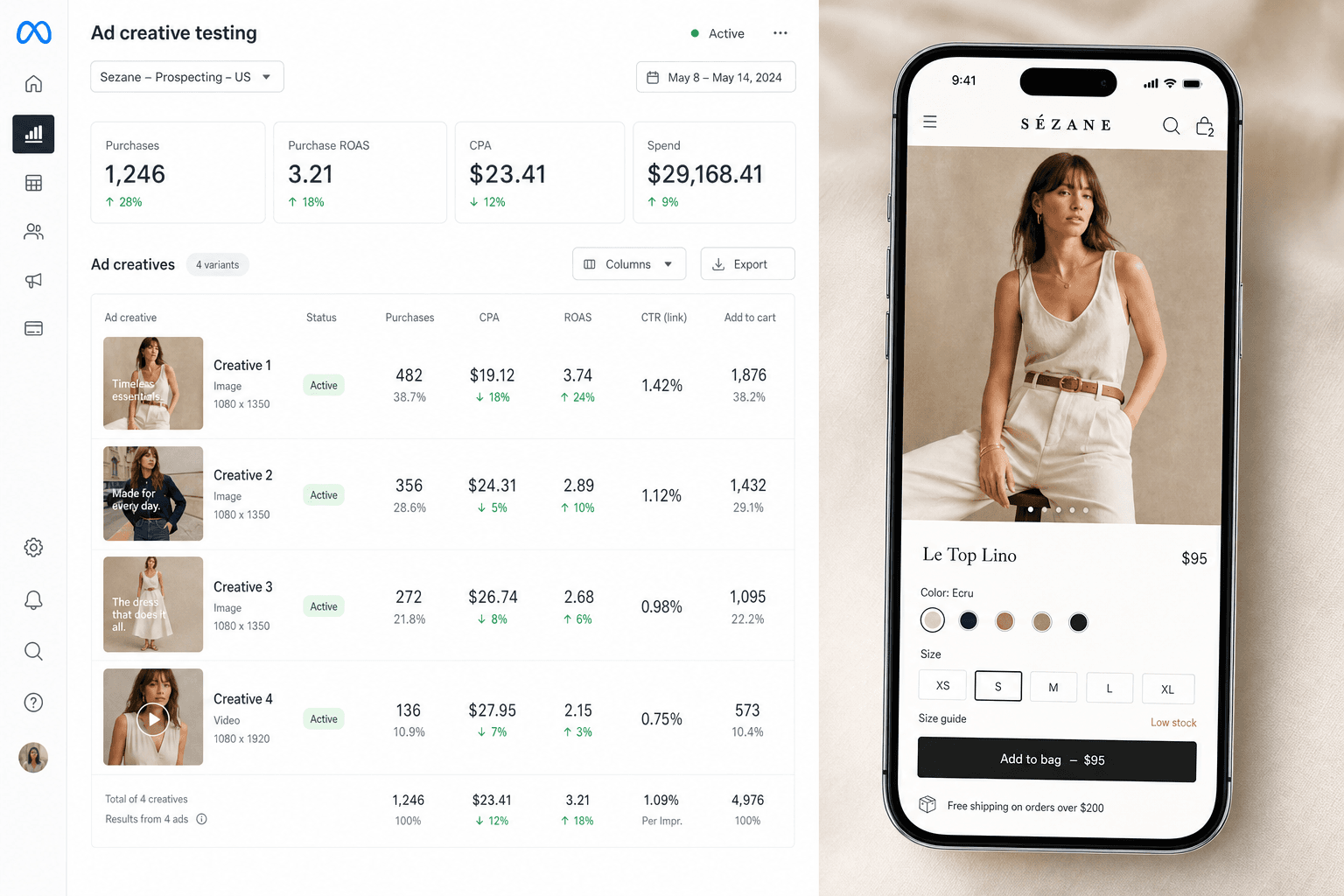
Ready to see what this looks like for your womenswear brands business?
No obligation. A senior strategist will show you exactly where the wins are.
The Strategy
The Womenswear Marketing Strategy We'd Run
Meta is the primary acquisition engine: Advantage+ sales campaigns (formerly Advantage+ Shopping) for prospecting, Dynamic Product Ads (DPA) for retargeting, and new angles rotated in before frequency kills performance. Google Shopping and Performance Max run alongside it for searchers who already know what they want.
TikTok earns a place for brands targeting buyers under 35, with a shorter, rawer playbook that hooks viewers in the first two seconds.
Email is not optional: Klaviyo flows are the retention layer that makes single-purchase economics survivable, and they aim for a second purchase before LTV flattens at Month 5.
Budget pacing follows the CPM calendar, with January acquisition a strategic priority. Creative testing for Q4 starts 6–8 weeks before the quarter opens, and August back-to-school and spring drops get their own creative prep.
Attribution runs on blended ROAS, and contribution margin after returns, discounts, shipping, and ad spend decides what scales.
The one number that governs this
The governing KPI is blended ROAS measured against contribution margin, with nCAC tracked by cohort against a 60-day payback target. Platform ROAS is directional only.
How We Help
What We'd Do for Your Womenswear Brand
For most brands we fix attribution, build the creative system, then sequence channels to your AOV, return rate, seasonality, and LTV. We take few clients, so you get senior attention.
Attribution & Analytics Setup
First, we set up blended ROAS tracking and contribution margin reporting net of returns and variable costs, and integrate Triple Whale or Northbeam.
Paid Social (Meta & TikTok)
We run Advantage+ sales campaigns for prospecting and DPA for retargeting, rotating creative weekly before frequency passes 3.0, and build TikTok playbooks for under-35 buyers.
Google Shopping & Performance Max
We run Google Shopping and PMax on branded, category, and competitor terms where economics work, and hold them to contribution margin like every other channel.
Creative Production & Testing System
We build the system behind 20+ creative tests per month: AI-assisted concepts, hooks, copy angles, and static, video, and UGC-style formats.
Email & Klaviyo Flows
We build or rebuild your Klaviyo flows with send-time optimization and subject line testing, aimed at the second purchase.
Conversion Optimization
We audit product and landing pages for size-guide placement, fit confidence signals, and return-policy visibility, testing to lift conversion and reduce return-driven platform ROAS inflation.
Seasonal Budget Strategy
We shift spend and channel mix as CPMs move, treat January as an acquisition window, and build Q4 creative 6–8 weeks early.
Who's Behind This
Who we are, and what makes us different
Sagum is a performance marketing agency founded in January 2017 in St. George, Utah. We've spent 8+ years growing real brands and being judged on KPIs, not vanity metrics.
We deliberately limit how many clients we take so each one gets senior attention. We treat your numbers like our own, we never run generic playbooks, and your strategy is built for your business, because shouldn't your brand's marketing be custom to your brand?
Sagum.ai is our AI arm: the same proven operators now build AI into the work wherever it creates real edge, not as theater, but as leverage applied with discipline.
- 8+ years growing brands on performance KPIs, not vanity metrics
- Limited client roster, with senior attention on every account
- An extension of your team; your success is tied to ours
- Custom strategy per brand, never a generic playbook
- AI built in where it moves a number; judgment over hype
“Sagum is a performance marketing agency that's spent 8+ years growing brands by treating their numbers like our own. We take on few clients, never run generic playbooks, and now build AI into the work wherever it creates real edge, not hype. Your strategy is built for your business, and our success is tied to yours.”
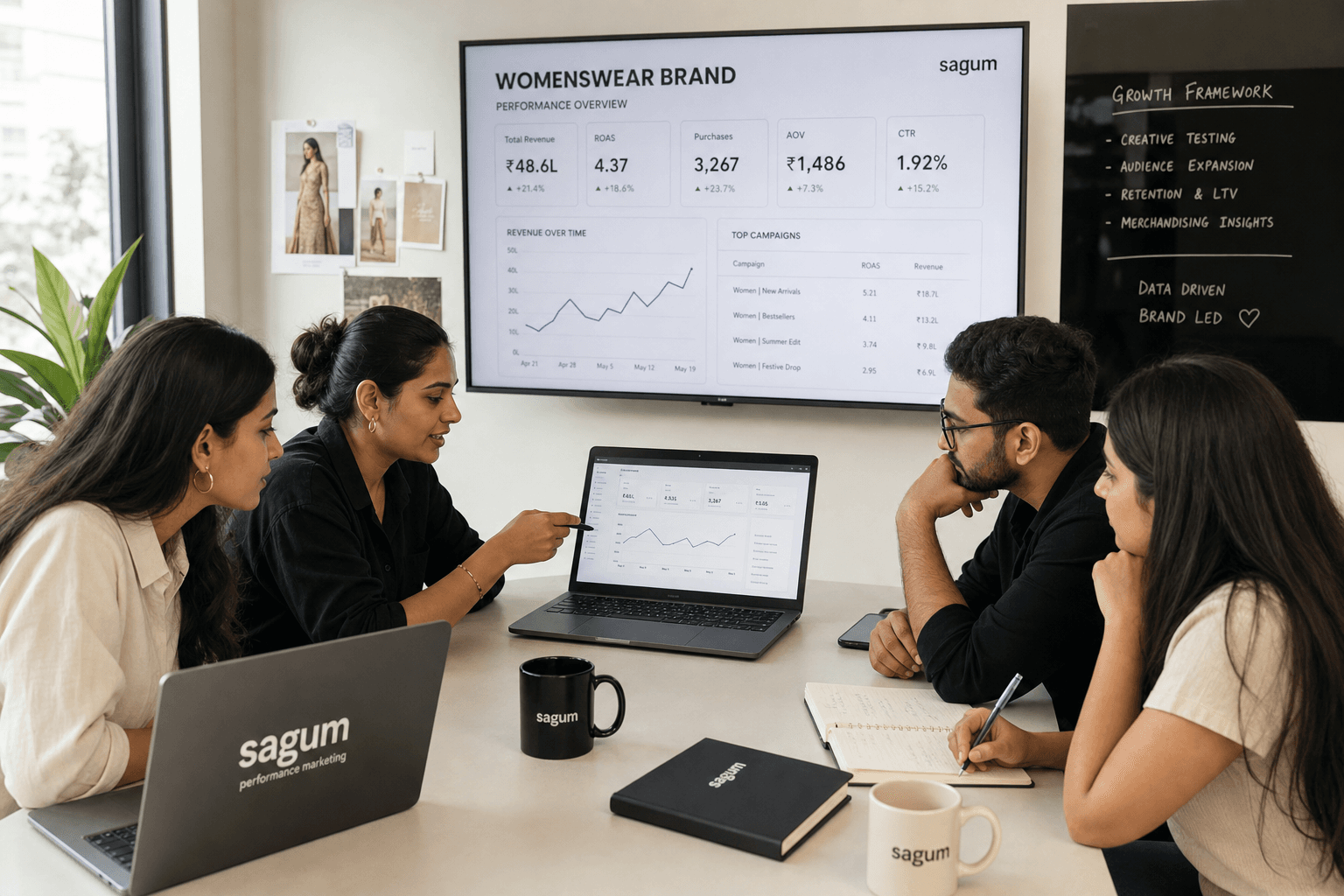
“Sagum roughly doubled our bottom line. They treat the work like it's their own business.”
Rachel Nilsson
CEO, RAGS
Proof
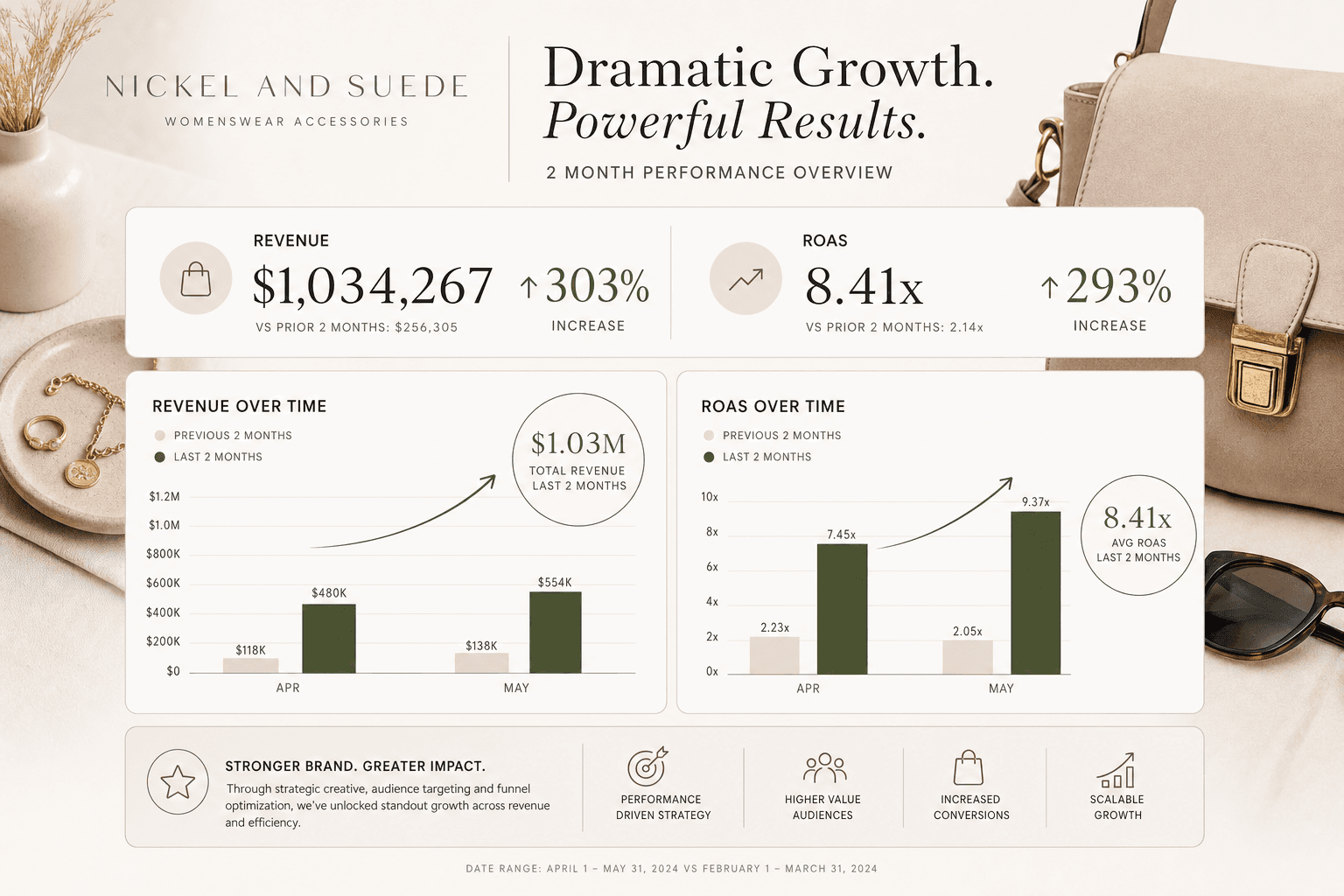
$255k → $555k in 2 months, ROAS 2.9x → 5.5x+
Nickel & Suede
Challenge
Nickel & Suede, an apparel and accessories brand, needed to scale revenue profitably on paid social, a familiar problem in womenswear, where visual creative fatigues fast.
What we did
We ran Meta and TikTok creative testing at volume.
Result
Revenue grew from $255K to $555K in two months, and ROAS rose from 2.9x to 5.5x+, peaking at 7.95x, with a 34% lift in site conversion rate. We'd bring that discipline to womenswear.
- Revenue
- $255k → $555k (2 mo)
- ROAS
- 2.9x → 5.5x+ (peak 7.95x)
- Site conversion
- +34%
If Your ROAS Looks Fine but Your Margin Doesn't, Let's Talk
No obligation. We'll review your channel mix, creative cadence, and attribution setup and tell you exactly where the gap is, based on your brand's economics, not a generic audit template.
Sagum · January 2017 · St. George, Utah · 8+ years