

8+ years growing brands on KPIs, now with AI
More Revenue From Your Woo Store
Performance marketing built around WooCommerce's real levers: feed hygiene, page speed, and contribution margin.
Google Ads · Meta · TikTok · 8+ years · AI-powered


Get your free Growth Gap Analysis
Senior strategist review · response within one business day
Prefer to reach out directly?
The Challenge
WooCommerce isn't Shopify, and most agencies don't know the difference
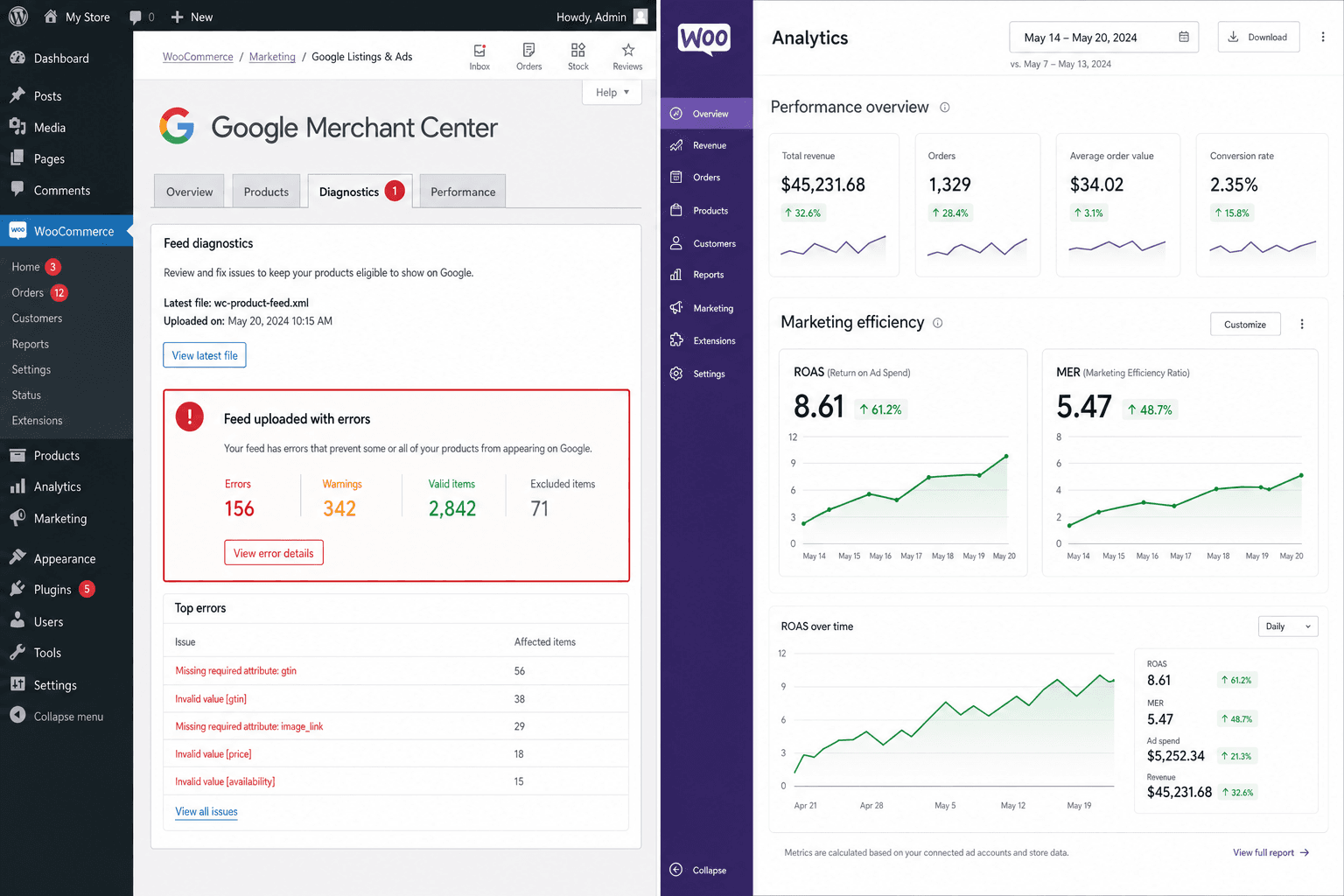
You chose WooCommerce to own your data, hosting, checkout, and plugin stack, complexity included. Your feed runs on Google for WooCommerce or a plugin (Simprosys, CTX Feed, AdTribes), and mismatched variant prices or missing GTINs can get 15–20% of your catalog rejected in Merchant Center, killing Performance Max (PMax) delivery. WordPress stays silent while ROAS drops.
Attribution isn't turnkey: GA4 and GTM need custom events on an AJAX-heavy cart firing fragment requests on every page load. Logged-in customers bypass full-page cache, so Core Web Vitals look fine in PageSpeed Insights while real users hit 4-second loads and abandon.
On WooCommerce Subscriptions, MRR leaks through Action Scheduler backlogs that let renewals fail silently, and through soft declines smarter dunning would recover. Revenue churn is the scoreboard, yet most operators watch logo churn (cancellations).
Every agency change to plugins, functions.php hooks, or footer scripts risks a production incident; you've been burned. You need a team that works staging-first, keeps child theme discipline, and knows the difference between add_action() and breaking your checkout.
The Opportunity
WooCommerce's complexity is your moat with the right team running it
WooCommerce winners turn the platform's extensibility into growth Shopify stores can't copy. Custom product meta fields and feed custom labels let you sort bestsellers, high-margin SKUs, and clearance into separate PMax asset groups for tiered bidding, without a spreadsheet. Shopify stores fight over the same PMax black box; you can build structure inside it.
Direct API sync updates products as they change, with no XML generation load, feed lag, availability mismatches, or a feed plugin hammering your database every four hours. A clean catalog earns higher impression share on converting queries.
Abandoned cart emails through AutomateWoo or Klaviyo at 1, 24, and 72 hours are zero-CPM revenue most stores skip or misconfigure. For subscriptions, smart dunning can recover a meaningful share of failed payments, and a pause option saves some would-be cancellations, both MRR recovery with no ad spend.
What Most Get Wrong
What WooCommerce stores and their agencies get wrong
Blaming bids or budget when a dirty feed throttles PMax
Missing GTINs, stale availability, and mismatched variant pricing get products disapproved, throttling PMax on your best SKUs. Agencies that don't live in Merchant Center miss the fix: feed hygiene.
Treating page speed as tech work, not a ROAS lever
A 1-second delay cuts conversions up to 7%. Cart fragment AJAX, non-lazy-loaded images, and scripts blocking the main thread for 300ms+ slow your pages; shared hosting taxes every paid click.
Measuring logo churn instead of revenue churn
Revenue churn (gross MRR lost per cohort) shows if you're shrinking. Without dunning, 20–40% of churn goes unaddressed: soft declines (insufficient funds, temporary issuer holds) that clear on retry.
Letting attribution rot while scaling ad spend
Core WooCommerce has no native first-party data layer, so without custom GTM events for add-to-cart, begin-checkout, and purchase, you optimize Google and Meta campaigns on incomplete conversion data.
Hiring a generic agency that brings Shopify tactics to WordPress
Ignoring staging and functions.php hook priority breaks checkout. Plugins are an attack surface: in April 2026, a backdoor hidden eight months earlier activated across 30+ plugins with about 400,000 installs.
Why Now
WooCommerce operators can pull ahead now
PMax now dominates Shopping, yet most WooCommerce competitors run it flat: one asset group, basic feed, set-and-forget budget. Operators running structured PMax on a clean, API-synced feed capture the impression share competitors leave.
AI lets a disciplined team do in days what took weeks, like testing five creative angles a week across Meta and Google; that speed compounds over a quarter. With organic search less predictable, WooCommerce's SEO edge is narrowing, and stores building a paid channel, retention stack, and clean attribution now will be stronger before the next algorithm cycle.
HPOS (High-Performance Order Storage), default for new installs, delivers up to 5x faster order creation and 40x faster lookup. Moving older stores and custom plugins to HPOS now buys faster checkout and cleaner analytics.
The Mechanism
Where AI gives WooCommerce stores an edge
Real productivity, not AI theater. Here's where it actually moves a number for woocommerce brands.
Google Shopping Feed & PMax
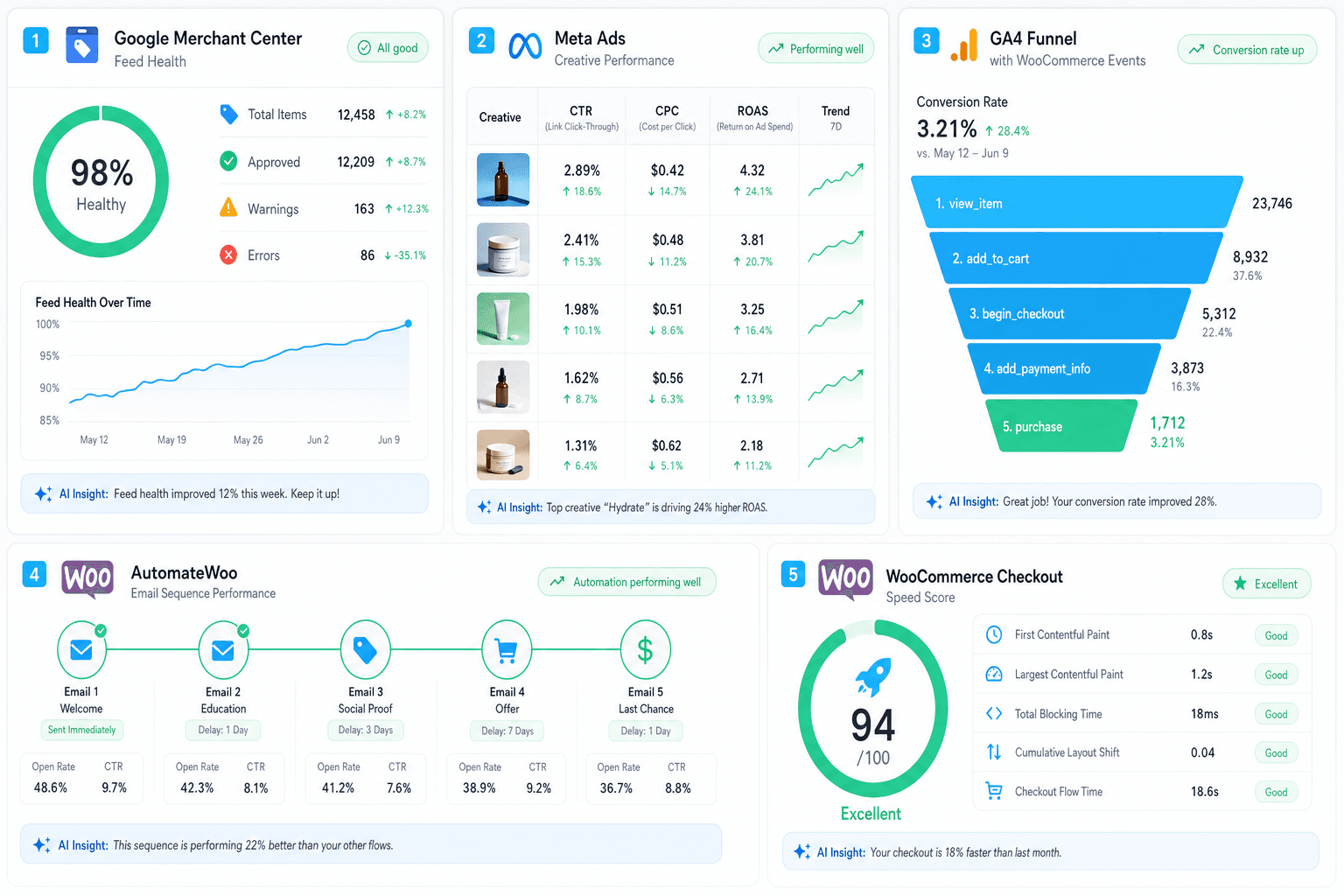
What AI does: AI monitors your catalog, flags Merchant Center disapprovals within hours, auto-assigns bestseller, high-margin, and clearance labels from live sales data, and recommends direct API sync over XML where hosting supports it.
The result: Fewer impressions go to disapproved SKUs, and tiered bidding focuses PMax spend on converting products, with no weekly manual feed audit.
Why it matters here: The free Google for WooCommerce extension handles basic sync and PMax, but a well-managed feed needs the monitoring and labeling AI adds on top.
Paid Ads (Google & Meta)
What AI does: AI tests several angles weekly (hooks, offers, framing) and moves budget before losers burn spend. For subscriptions, it tests pause messaging: 58% of consumers paused a subscription instead of canceling (Chargebee, 2025).
The result: You test 5x more creative variations per month than a manual workflow allows, and budget follows performance in near-real-time instead of waiting on monthly reports.
Why it matters here: WooCommerce stores often carry deeper catalogs and more SKU variation than Shopify-native brands, and AI testing scales across them without proportionally more agency hours.
Analytics & Attribution
What AI does: AI audits GA4 + GTM event firing, flags AJAX cart breaks in event sequences and logged-in sessions bypassing full-page cache, and builds cohort retention tables from WooCommerce Subscriptions data.
The result: You can trust attribution before scaling spend and see whether MRR is growing or new subscribers are masking dollar losses.
Why it matters here: Your AJAX cart and cache bypass create attribution gaps simpler platforms lack; AI can catch them systematically instead of waiting for a revenue anomaly.
Email & Lifecycle Automation
What AI does: AI checks your AutomateWoo or Klaviyo flows (abandoned cart with product images and cart links, pre-renewal reminders, win-backs) against order and subscriber data and sets dunning retries by payment failure distribution.
The result: You recover zero-CPM cart revenue and the MRR lost to involuntary churn without touching your ad budget.
Why it matters here: Core WooCommerce lacks cart recovery and dunning. Each recovered dollar lifts contribution margin: sales you paid to acquire, or MRR failing silently in Action Scheduler.
Conversion Rate Optimization
What AI does: AI audits cart fragment AJAX on non-cart pages, render-blocking scripts, checkout field count, whether CheckoutWC or WooCommerce Blocks bypasses Cloudflare cache on dynamic sessions, and above-the-fold image weight on mobile.
The result: Checkout conversion improves through specific technical fixes, each tested in staging before it touches production.
Why it matters here: On WooCommerce, CRO is inseparable from WordPress infrastructure, and 53% of mobile users abandon pages taking longer than 3 seconds.
Ready to see what this looks like for your woocommerce brands business?
No obligation. A senior strategist will show you exactly where the wins are.
The Strategy
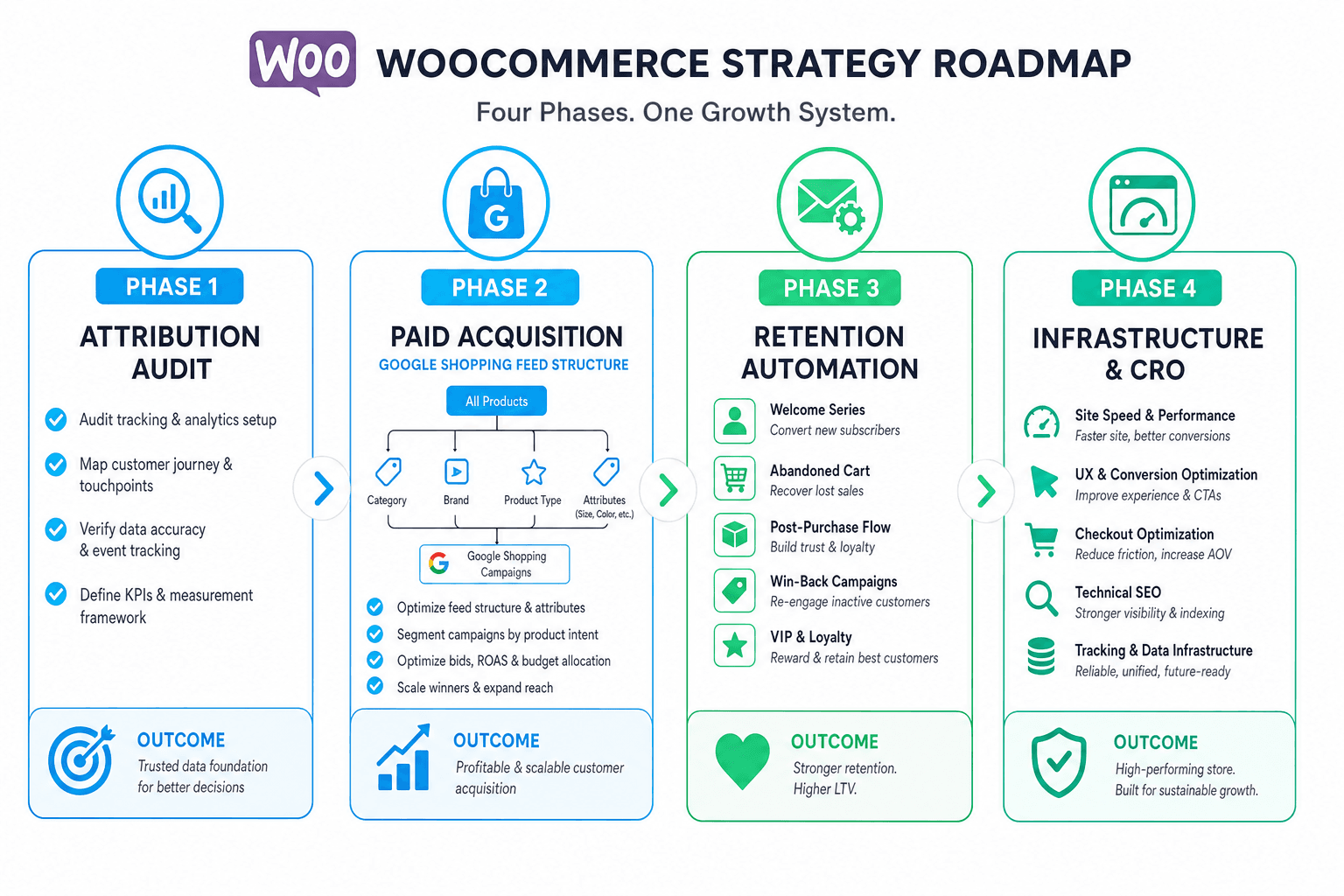
A four-phase WooCommerce marketing plan held to margin
Most WooCommerce strategies fail because they stop at the platform's surface. Ours goes one layer deeper and holds every phase to margin, since top-line growth that compresses margin isn't growth.
Phase 1 is trusting your numbers: before ad spend scales, we audit GA4 + GTM against your event firing, fix the attribution gaps your AJAX cart creates, and verify a clean Merchant Center feed.
In Phase 2, Google Shopping and PMax become your primary paid channel, but only on a structured feed with asset groups segmented by sales-tier custom labels; on Meta, we run prospecting and retargeting on AI-tested creative.
Each channel answers to reconciled channel ROAS and the account to blended ROAS (total revenue ÷ total ad spend), because platform ROAS flatters Google and misses Meta's halo.
Phase 3 closes the retention loop: the abandoned cart sequence, lifecycle flows (welcome series, pre-renewal reminders, win-backs at 30/60/120 days), and a dunning stack that retries soft declines at D+1, D+3, and D+7 and routes hard declines to a card-update prompt.
Phase 4 fixes infrastructure: hosting tier, WP Rocket rules that bypass cache on cart and checkout, images, and render-blocking scripts. Load speed is a ROAS problem you fix without touching bids, and every change goes through staging with a rollback plan.
The one number that governs this
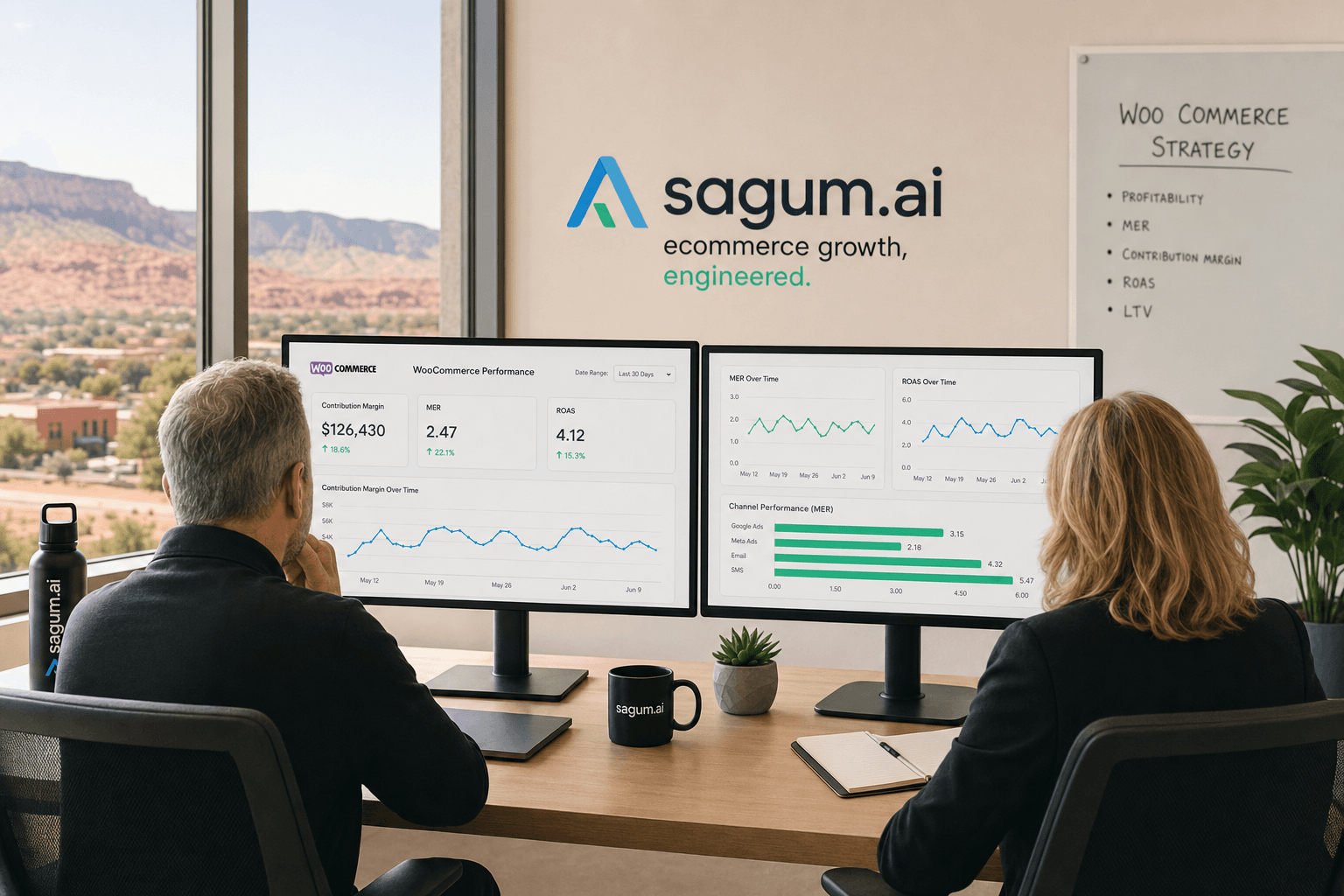
Blended contribution margin (revenue minus COGS, ad spend, and fulfillment) is the governing number. Channel ROAS judges each channel; blended ROAS judges the account.
How We Help
What we would do for your WooCommerce store
We take few clients, so you get senior attention, not a junior account manager running a template; every engagement starts with your WooCommerce stack, catalog, retention metrics, and margin targets.
Google Shopping Feed Audit & Optimization
Phases 1 and 2: We audit feeds for missing GTINs and variant pricing errors, add sales-based labels, and recommend direct API sync where hosting allows.
Performance Max & Google Ads Management
Phase 2: We run label-tiered PMax plus Search on brand and high-intent non-brand queries, held to channel ROAS targets.
Meta & TikTok Paid Social
Phase 2: We run creative-led Meta prospecting and retargeting, testing multiple AI-generated angles a week, plus TikTok where product and audience fit.
Attribution & Analytics Implementation
Phase 1: We fix GA4 + GTM with the custom events your AJAX cart needs and build cohort retention tables for subscriptions before spend scales.
Email & Lifecycle Automation (AutomateWoo / Klaviyo)
Phase 3: We build your cart recovery and lifecycle flows, plus dunning that recovers MRR lost to involuntary churn.
WooCommerce CRO & Page Speed
Phase 4: We audit checkout and hosting and treat a 1-second load gain as a ROAS gain.
SEO (WooCommerce-Native)
Phase 2 and ongoing: We build catalog SEO around permalinks and Yoast/Rank Math schema, control crawl budget on faceted navigation, and reduce reliance on organic.
Who's Behind This
Who we are, and what makes us different
Sagum is a performance marketing agency founded in January 2017 in St. George, Utah. We've spent 8+ years growing real brands and being judged on KPIs, not vanity metrics.
We deliberately limit how many clients we take so each one gets senior attention. We treat your numbers like our own, we never run generic playbooks, and your strategy is built for your business, because shouldn't your brand's marketing be custom to your brand?
Sagum.ai is our AI arm: the same proven operators now build AI into the work wherever it creates real edge, not as theater, but as leverage applied with discipline.
- 8+ years growing brands on performance KPIs, not vanity metrics
- Limited client roster, with senior attention on every account
- An extension of your team; your success is tied to ours
- Custom strategy per brand, never a generic playbook
- AI built in where it moves a number; judgment over hype
“Sagum is a performance marketing agency that's spent 8+ years growing brands by treating their numbers like our own. We take on few clients, never run generic playbooks, and now build AI into the work wherever it creates real edge, not hype. Your strategy is built for your business, and our success is tied to yours.”
“After six years, Sagum is our most important partner: trusted, communicative, and caring about our business as if it's their own.”
Long-term partner
6-year client
Proof
187% YoY sales growth with a seamless WooCommerce-to-Shopify migration
Phoenix Systems
Challenge
Phoenix Systems needed to migrate and redesign its site from WooCommerce to Shopify without losing performance, while growing its D2C channels across Shopify and Amazon.
What we did
We migrated and redesigned the site from WooCommerce to Shopify, then grew the D2C channels across Shopify and Amazon.
Result
Sales grew 187% year-over-year, the migration lost no SEO, and conversion doubled on increased traffic. Whether you stay on WooCommerce or plan a move, we bring that same discipline to your store.
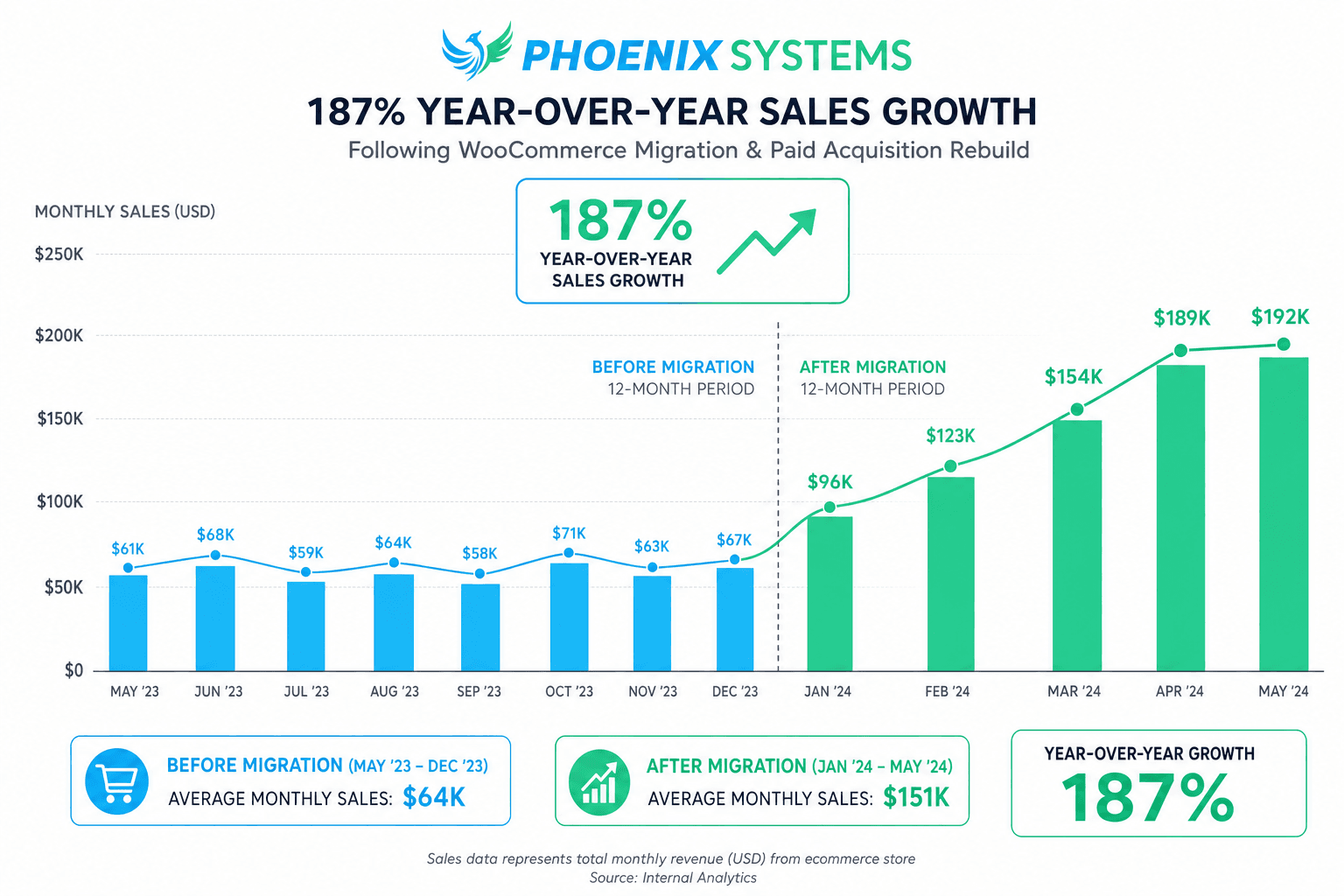
- Sales growth
- +187% YoY (2024)
- Conversion rate
- Doubled
- SEO on migration
- No loss
Let's find where your WooCommerce store leaves money on the table
No obligation. We'll come in knowing your stack (feed hygiene, attribution gaps, retention leaks) and tell you what we'd fix first and why, with a strategy built for your store.
Sagum · January 2017 · St. George, Utah · 8+ years