

8+ years growing brands on KPIs, now with AI
More Revenue From Customers You Already Have
We help Yotpo brands convert loyalty members, reviews, and VIP tiers into repeat purchase revenue that shows up in blended ROAS.
8+ years growing DTC brands · Google, Meta & TikTok Partner · AI-augmented performance marketing


Get your free Growth Gap Analysis
Senior strategist review · response within one business day
Prefer to reach out directly?
The Challenge
You Built the Loyalty Program. The Revenue Still Isn't Compounding.
You chose Yotpo to get reviews, loyalty, and referrals under one roof, not three disconnected tools, then launched the points engine, VIP tiers, and Klaviyo integration. Yet redemption often sits below 15%, points liability grows on the balance sheet, and it's hard to tell from month-end blended ROAS how much is loyalty-driven repeat revenue versus paid acquisition.
Yotpo's five dashboards (rewards, VIP tiers, referrals, points, generated revenue) each tell part of the story; combining them is a full-time job.
SMSBump shut down in December 2025; any tier-upgrade welcome sequences, '50 points away' nudges, and referral conversion flows built there need rebuilding in Klaviyo or Attentive without breaking their logic.
New SKUs show no Google Shopping stars until they have the three reviews Google requires for Yotpo to syndicate them, so you scale spend on listings that look anonymous next to competitors who've collected reviews for years. Turning Yotpo into a retention engine that measurably cuts your dependence on paid acquisition takes execution: knowing which levers to pull, in what order.

The Opportunity
Loyalty Members Are Worth More. Most Brands Never Fully Capture It.
In well-run loyalty programs, members often carry materially higher LTV than non-members, and VIP tiers carry higher AOV. Most brands fall short on three levers: redemption rate, review velocity, and flow architecture.
Yotpo's guidance puts healthy active redemption, your most honest health metric, at roughly 15–25%. Below 15%, members earn points they never spend, the loyalty loop doesn't close, and liability grows without repeat purchases.
Review velocity controls paid efficiency. Yotpo, a Google-approved reviews aggregator, can syndicate stars to Google Shopping, Facebook, and TikTok Shop, but Shopping ads show them only after three reviews, so seed new-product reviews through the loyalty earn loop (points for reviews) first.
Flow architecture is the third lever. Brands that rebuilt SMSBump flows correctly in Klaviyo, segmented by tier and point balance, outpace competitors with broken or missing flows.
What Most Get Wrong
What Yotpo Brands and Their Agencies Get Wrong
Treating redemption rate as a vanity metric
Most brands call the program healthy as membership grows. Below 15% redemption, points go unspent and liability distorts margin reporting. Check Percent Redeemers per tier (VIP Tiers Performance dashboard).
Scaling paid spend on new SKUs before three reviews
Google requires three reviews before stars show, and the feed takes two to four weeks to process after connection. Until then, anonymous listings lose clicks and conversions to starred competitors.
Porting SMSBump flows to Klaviyo without redesigning segmentation
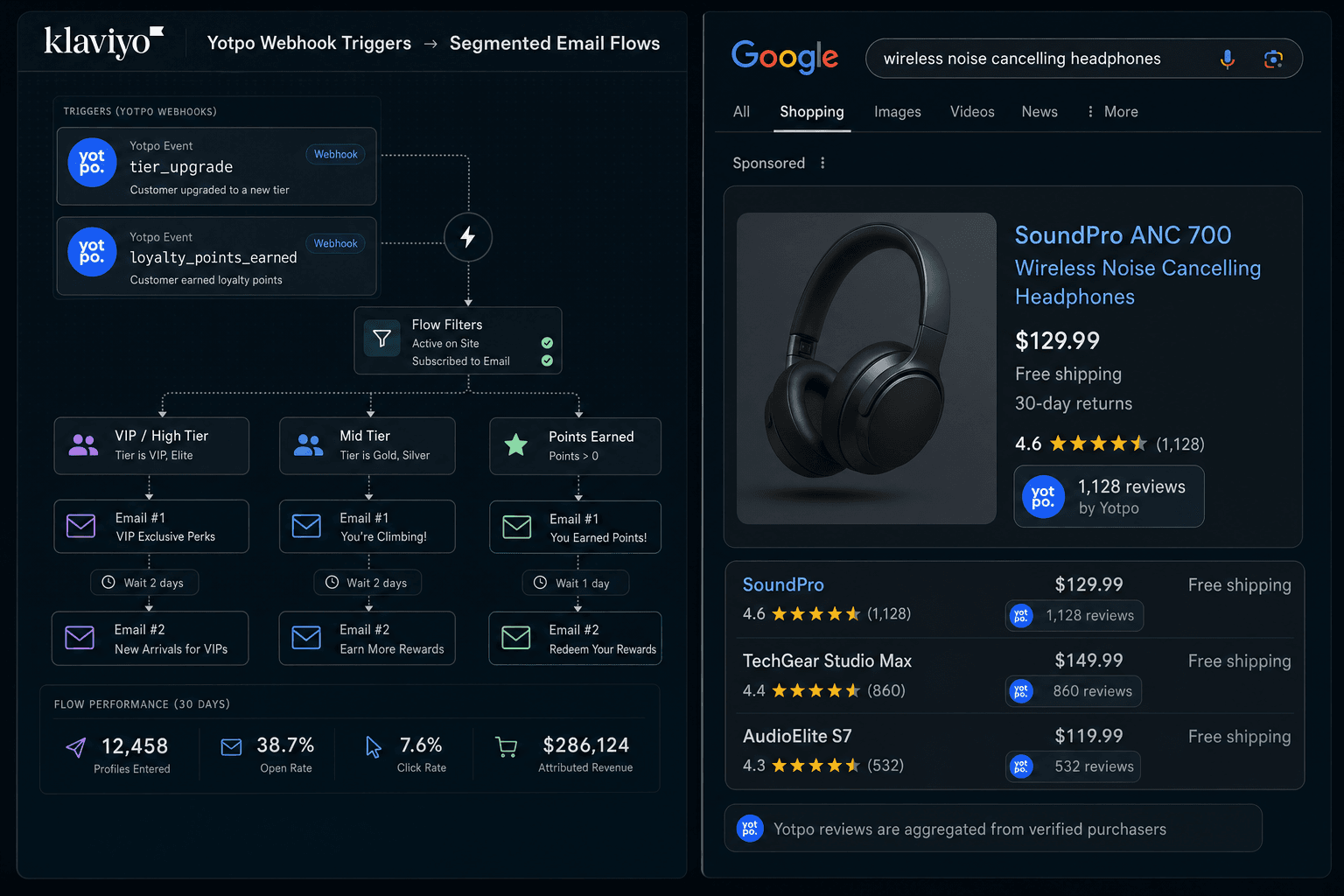
A one-to-one lift-and-shift loses Yotpo's cross-product segmentation, so flows fire on wrong conditions or miss segments. Rebuild them on Yotpo webhook events used as Klaviyo triggers.
Letting points liability grow without an expiration or earn-rate audit
With no expiry or too-generous earn rates, unredeemed balances inflate apparent engagement and pressure margin. Quarterly earn-rate, redemption, and liability audits are standard above $10M GMV; most brands skip them.
Judging loyalty revenue by last-click attribution
Without multi-touch attribution (Triple Whale, Northbeam, or similar), loyalty-driven repeat purchases get credited to the last touch, usually email or direct, so brands underinvest in retention and overspend on acquisition.
Why Now
Why Yotpo Brands That Rebuild Retention First Pull Ahead
Two shifts favor Yotpo brands that move first. The first is the fallout from SMSBump's shutdown: brands that ported SMSBump flows one-to-one are likely running broken loyalty flows, and every peak season makes that costlier.
The second is AI, which winning operators use to test more creative angles, find attribution gaps faster, and spot which loyalty cohorts are worth acquiring and which churn after the first redemption. Over a single quarter, a brand running five creative tests per week against loyalty-member lookalikes will outlearn a competitor running one test per month.
Clean flows, healthy redemption, review syndication to Google Shopping and TikTok Shop, and AI testing compound into a retention moat that gets harder to close the longer it runs, so the brand that builds it first sets the bar.
The Mechanism
Where AI Creates Real Edge for Yotpo Brands
Real productivity, not AI theater. Here's where it actually moves a number for yotpo loyalty brands.
Analytics & Attribution
What AI does: Layers Yotpo cohort data (member vs. non-member, tier, redemption history) onto blended ROAS, so you see the program's revenue value without inferring it from last-click data.
The result: The LTV gap between members and non-members shows in acquisition economics and reshapes your prospecting and retention budgets.
Why it matters here: Last-click credits loyalty-driven repeat purchases to email or direct, so Yotpo programs that work get defunded as cost centers.
Creative
What AI does: Turns Yotpo Reviews UGC (customer language, star ratings, photo reviews) into ad creative, testing five to eight angles per week against loyalty-member lookalikes on Meta and TikTok Shop.
The result: You learn faster which review-sourced angles win customers who look like your best loyalty members.
Why it matters here: Meta and TikTok Shop already carry your syndicated UGC; as paid creative, not static social proof, it wins customers more likely to enroll and redeem.
Email & Automation
What AI does: Drafts copy and optimizes send times for Klaviyo flows rebuilt on Yotpo webhook triggers (loyalty_points_earned, tier_upgrade, review_create): VIP early access, points-expiry nudges, and referral flows, each segmented by tier.
The result: Flows fire on the right triggers, reach the right tier segments, and measurably raise redemption, your program's primary health indicator.
Why it matters here: If you ran SMSBump flows, you had to rebuild them, and a rebuild with tier-based segmentation gives you an engine competitors can't copy quickly.
Digital Ads
What AI does: Builds campaigns on loyalty cohorts: prospecting to lookalikes of your highest-LTV members, retargeting for members 50 points from their next reward, and Google Shopping timed to review velocity milestones.
The result: Your acquisition spend goes to buyers who resemble loyalty members instead of one-time purchasers, and Shopping budget stops funding unstarred listings.
Why it matters here: Brands that seed new-SKU reviews through the earn loop before spending convert better and pay a lower effective CPC than brands running anonymous listings.
Conversion Optimization
What AI does: Tunes in-cart redemption with Shopify checkout extensibility: points balances shown at checkout, lower-friction widget placement, and VIP free-shipping thresholds (set by Shopify customer tags like yotpo-tiers-silver) visible before purchase.
The result: Redemption climbs toward the 15–25% range Yotpo's guidance calls healthy, closing the loop, slowing liability growth, and raising repeat purchase frequency.
Why it matters here: Correctly configured Yotpo programs fail most often on redemption, and the fix almost always sits in checkout. Unseen balances don't get redeemed.
Ready to see what this looks like for your yotpo loyalty brands business?
No obligation. A senior strategist will show you exactly where the wins are.
The Strategy
How Retention Marketing Should Run for a Yotpo Brand
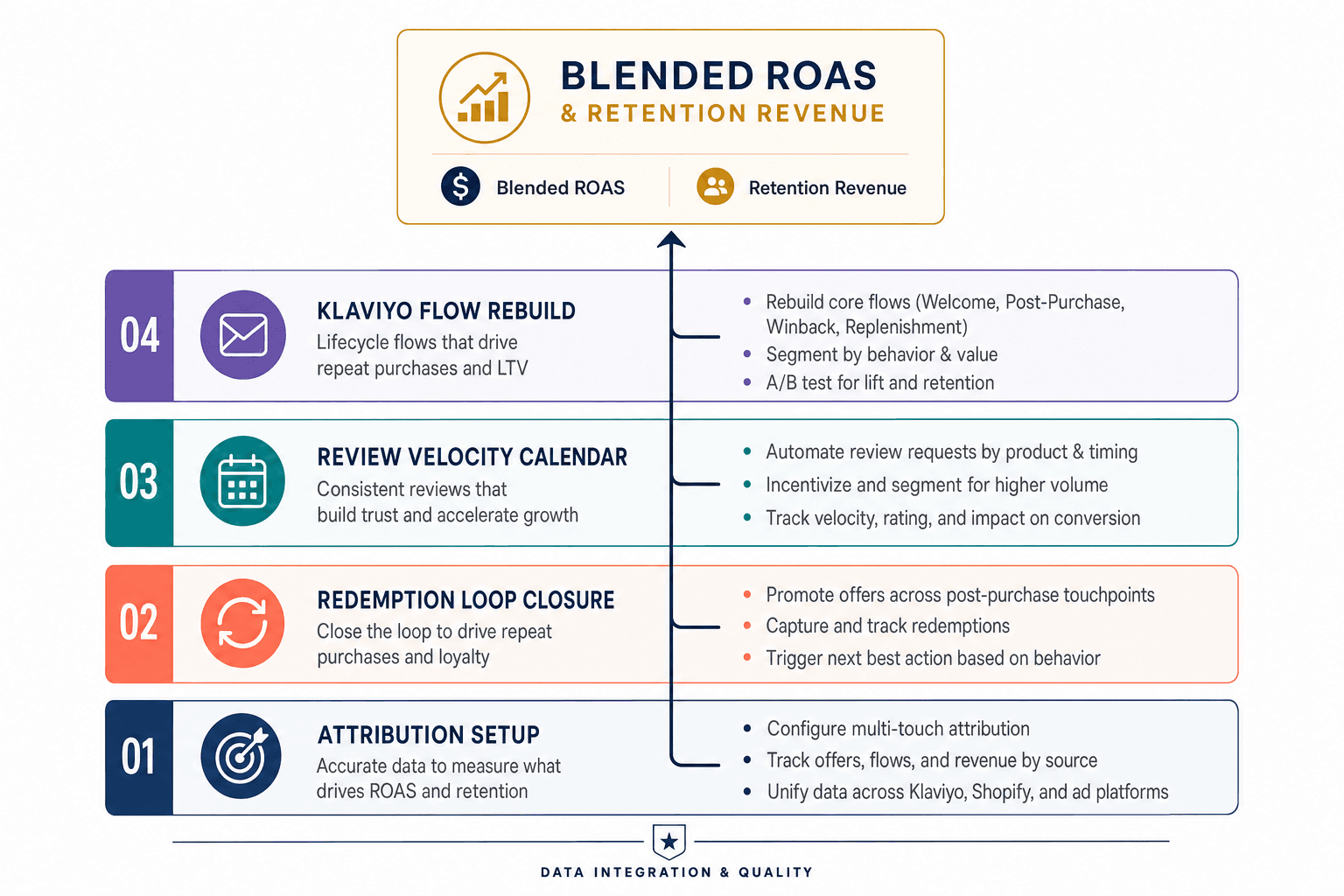
Run four layers in sequence. First, fix measurement: use Triple Whale or a comparable attribution layer to separate loyalty-driven repeat revenue from paid acquisition, and track member share of revenue, repeat purchase and redemption rates per tier, and points liability.
Second, if redemption sits below 15%, the low end of Yotpo's healthy range, that's your highest-payoff fix. Close the loop at three checkpoints: the in-cart widget, Klaviyo flows that remind members of their balance, and VIP free shipping shown before purchase. That's plumbing work, not a program redesign.
Third, keep new SKUs off Google Shopping until they cross the three-review threshold. The loyalty earn loop gets you there fastest, so time paid launches to review milestones instead of product launch dates.
Fourth, rebuild SMSBump flows in Klaviyo as flows triggered by Yotpo webhooks, not static email copies, each with its own trigger event and segment. If your loyalty flows ran on SMSBump, finishing this rebuild is the highest-impact operational move you have.
As retention improves, blended ROAS rises because more revenue comes from customers you don't have to re-acquire.
The one number that governs this
Track blended ROAS anchored to % of revenue from returning customers and repeat purchase rate, and measure loyalty ROI against acquisition cost.
How We Help
What We'd Do for Your Yotpo Brand
We'd fix measurement first, then close the execution gaps in your loyalty program, then build paid media around your retention economics.
Attribution & Analytics Setup
Layer Triple Whale or a comparable multi-touch attribution tool over your Yotpo and Klaviyo data before we touch a campaign.
Loyalty Program Audit & Optimization
Audit redemption per tier, liability, earn rates, and widget placement against Yotpo's healthy-redemption guidance, then use checkout and Klaviyo fixes to lift Percent Redeemers.
Klaviyo Flow Architecture (Post-SMSBump)
Rebuild loyalty flows in Klaviyo on Yotpo webhook triggers, with near-reward nudges segmented by tier and point balance.
Review Velocity Strategy
Use the earn loop to collect new-SKU reviews so Shopping stars go live before campaigns, and feed syndicated reviews into Meta and TikTok Shop creative.
Paid Media (Google, Meta, TikTok)
Prospect to lookalikes of your highest-LTV members, retarget members near their next reward, and sequence Shopping to review milestones, judged on blended ROAS.
Creative Production & Testing
Turn Yotpo Reviews UGC into creative tested weekly against loyalty-member lookalikes to find messages that win buyers who enroll and redeem.
AI Systems & Reporting
Build automated reporting that puts the five Yotpo dashboards beside blended ROAS, so program health and paid efficiency sit in one view.
Who's Behind This
Who we are, and what makes us different
Sagum is a performance marketing agency founded in January 2017 in St. George, Utah. We've spent 8+ years growing real brands and being judged on KPIs, not vanity metrics.
We deliberately limit how many clients we take so each one gets senior attention. We treat your numbers like our own, we never run generic playbooks, and your strategy is built for your business, because shouldn't your brand's marketing be custom to your brand?
Sagum.ai is our AI arm: the same proven operators now build AI into the work wherever it creates real edge, not as theater, but as leverage applied with discipline.
- 8+ years growing brands on performance KPIs, not vanity metrics
- Limited client roster, with senior attention on every account
- An extension of your team; your success is tied to ours
- Custom strategy per brand, never a generic playbook
- AI built in where it moves a number; judgment over hype
“Sagum is a performance marketing agency that's spent 8+ years growing brands by treating their numbers like our own. We take on few clients, never run generic playbooks, and now build AI into the work wherever it creates real edge, not hype. Your strategy is built for your business, and our success is tied to yours.”

“After six years, Sagum is our most important partner: trusted, communicative, and caring about our business as if it's their own.”
Long-term partner
6-year client
Proof
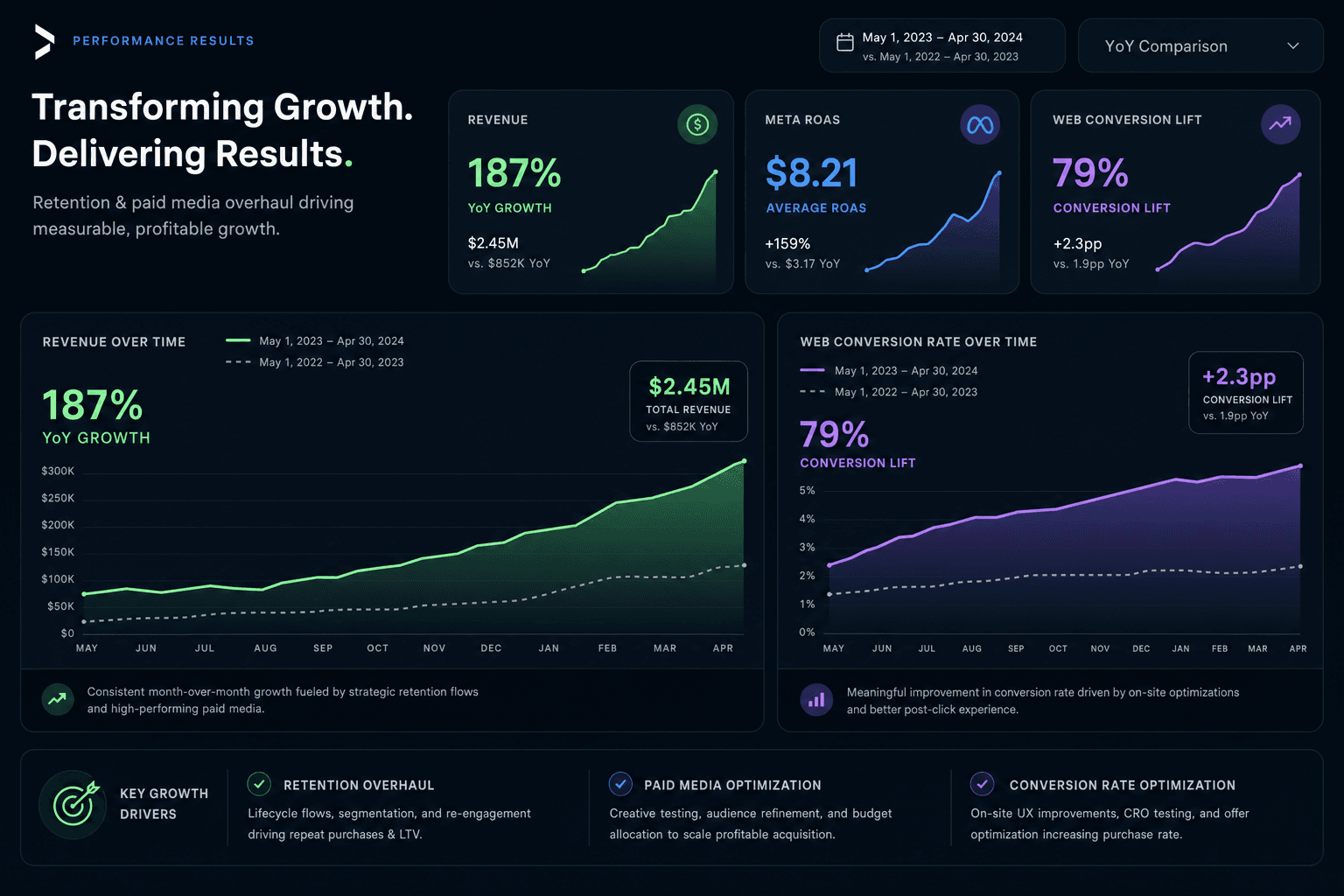
187% YoY, $8+ ROAS on Meta, +79% web conversion
Clean Monday Meals
Challenge
A food DTC brand needed to grow across several channels.
What we did
We scaled the brand's Meta paid media and took over its email and Amazon channels.
Result
The brand grew 187% year-over-year, hit $8+ ROAS on Meta, and lifted web conversion 79%. We'd bring the same paid media and email execution to your retention-driven brand.
See What Your Loyalty Program Is Worth and What It's Costing You
No obligation. We'll audit your redemption rate, attribution setup, Klaviyo flow architecture, and review syndication, and show you the specific gaps between where your program is and where it should perform.
Sagum · January 2017 · St. George, Utah · 8+ years